
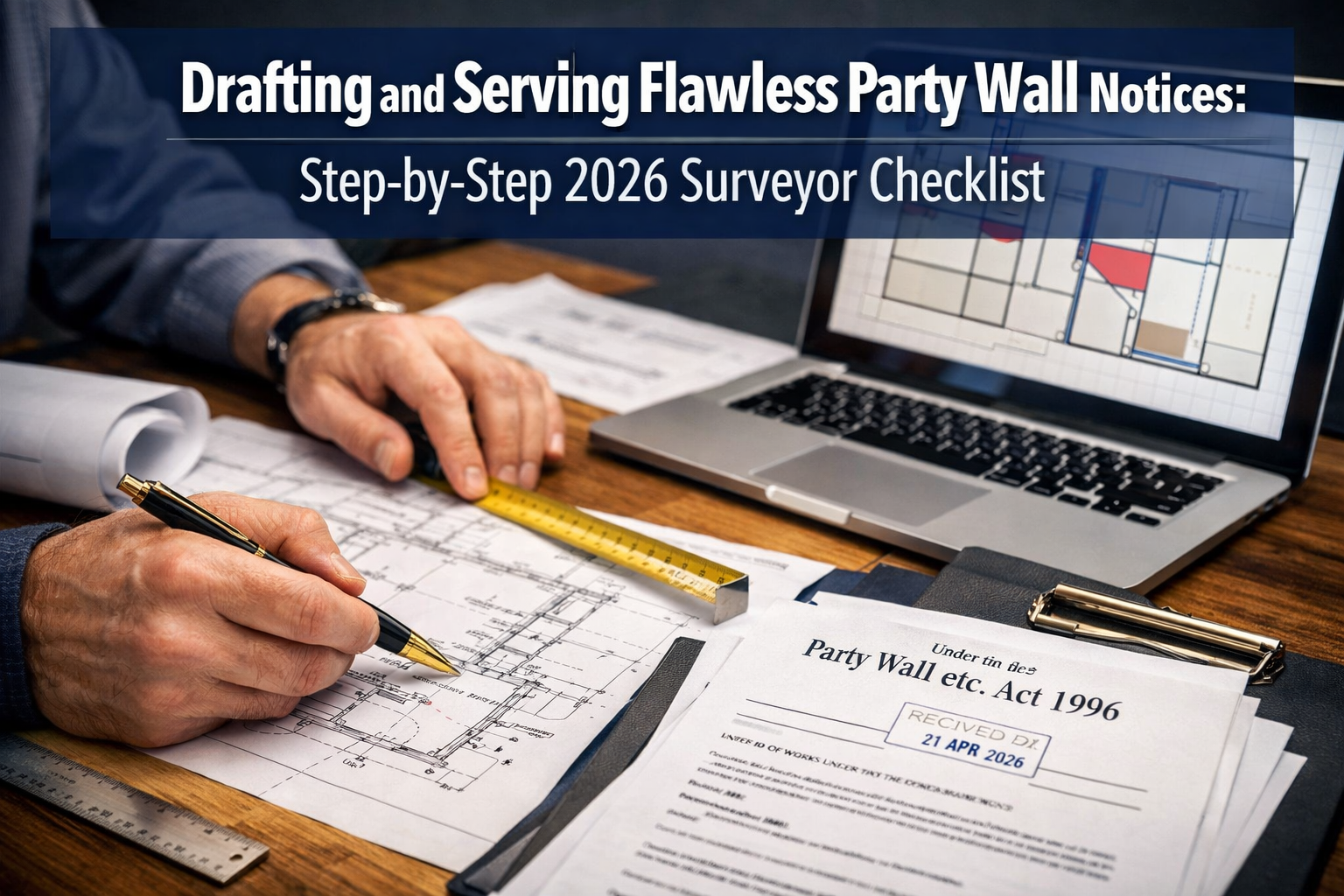
More than 60% of party wall disputes in 2026 stem from improperly drafted or incorrectly served notices—a costly mistake that delays construction projects, damages neighbour relationships, and exposes building owners to legal challenges. As the UK construction boom continues and housing density increases across London and major cities, the demand for accurate party wall procedures has never been higher [6]. Understanding how to create and deliver compliant notices under the Party Wall etc. Act 1996 is essential for surveyors, building owners, and construction professionals navigating today’s complex property landscape.
This comprehensive guide to Drafting and Serving Flawless Party Wall Notices: Step-by-Step 2026 Surveyor Checklist provides surveyors and property professionals with the precise framework needed to prepare legally compliant notices, avoid common pitfalls, and ensure smooth project progression in high-volume construction environments.
Key Takeaways
- Proper notice drafting requires eight mandatory elements including full owner details, work descriptions, start dates, and Act references to ensure legal compliance
- Service timing is critical: Section 1 and 3 notices need minimum one month notice, while Section 6 notices require two months before work commences [5]
- Common mistakes like incomplete information, missed adjoining owners, and insufficient notice periods account for most party wall disputes in 2026
- Multiple service methods including hand delivery, recorded post, and email with proof of receipt provide legal protection for building owners
- RICS guidance updates for 2026 emphasize comprehensive documentation and transparent communication throughout the notice process
Understanding Party Wall Notices Under the Party Wall etc. Act 1996
The Party Wall etc. Act 1996 establishes the legal framework for construction work affecting shared walls, boundaries, and excavations near neighbouring properties. Party wall notices serve as formal communication documents that inform adjoining owners about proposed works and trigger their rights under the legislation [4].
The Three Types of Party Wall Notices
Understanding which notice type applies to specific works is fundamental to the Drafting and Serving Flawless Party Wall Notices: Step-by-Step 2026 Surveyor Checklist:
Section 1 Notice (Line of Junction Notice) 📋
- Used when building a new wall on or astride the boundary line
- Applies to garden walls, new party walls, or structures at property boundaries
- Requires one month minimum notice before work begins [2]
Section 3 Notice (Party Structure Notice) 🏗️
- Required for work directly to an existing party wall or party structure
- Covers repairs, alterations, rebuilding, or underpinning of shared structures
- Needs one month minimum notice period [3]
Section 6 Notice (Notice of Adjacent Excavation) ⛏️
- Necessary when excavating within three or six metres of a neighbouring building
- Depth requirements trigger specific distance thresholds
- Requires two months minimum notice before excavation starts [5]
For detailed information about responding to notices, review our guide on party wall act notices and how to respond.
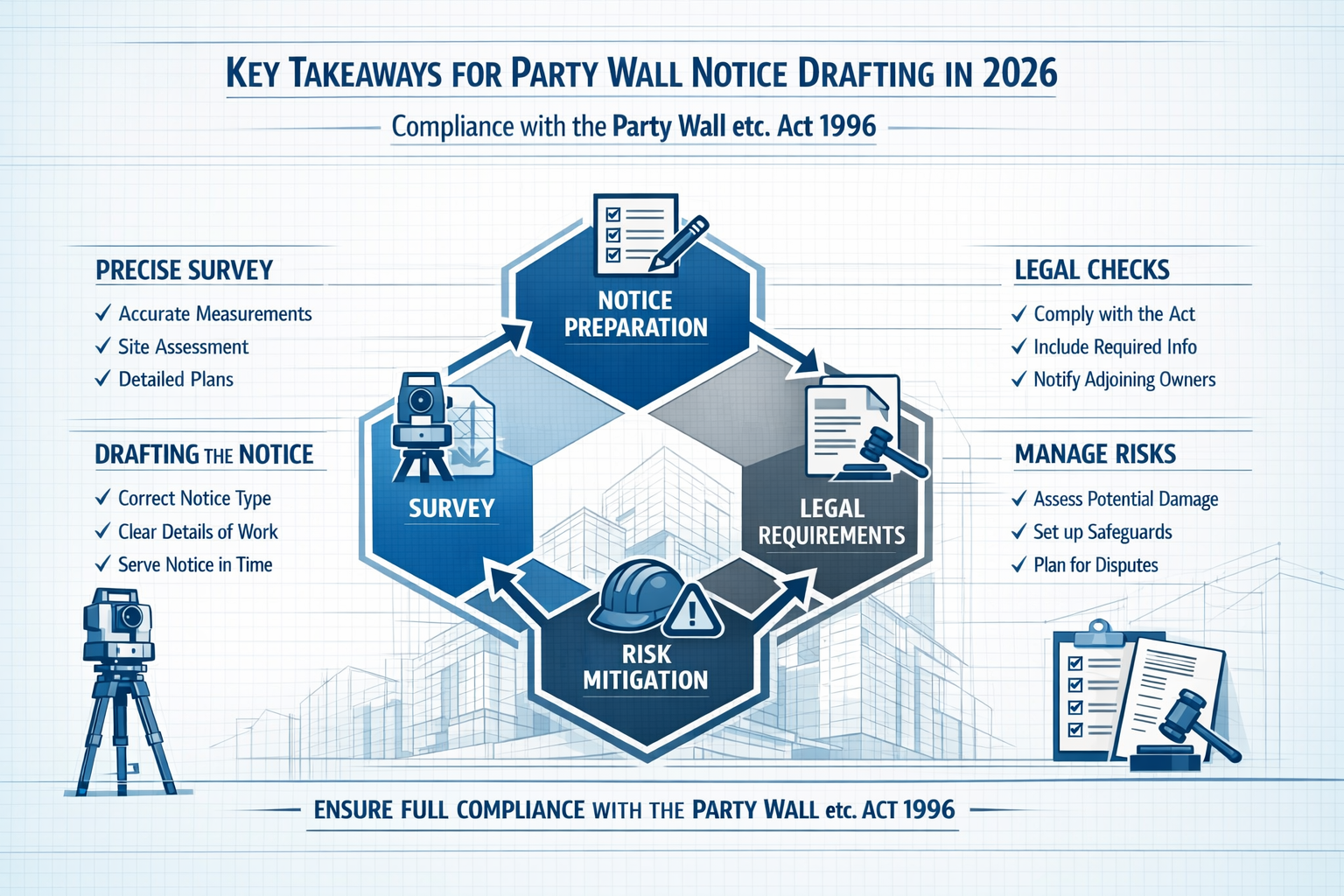
Drafting and Serving Flawless Party Wall Notices: Essential Components Checklist
Creating legally compliant notices requires meticulous attention to mandatory information fields. Missing or incorrect details invalidate notices and restart the entire timeline, causing project delays.
Eight Mandatory Elements for Valid Notices
Every party wall notice must contain these critical components [2][3]:
| Element | Requirements | Common Errors |
|---|---|---|
| Building Owner Details | Full legal name(s) and complete address | Using nicknames, omitting co-owners |
| Adjoining Owner Details | Full legal name(s) and complete address of ALL owners | Missing leaseholders, incomplete company names |
| Property Address | Exact address where works will occur | Vague descriptions, missing unit numbers |
| Work Description | Detailed, specific description of proposed works | Generic statements, insufficient detail |
| Planned Start Date | Specific date meeting minimum notice periods | Dates too soon, vague “spring 2026” references |
| Notice Type | Clear statement of Section 1, 3, or 6 | Omitting section reference entirely |
| Act Reference | Statement that notice is served under Party Wall etc. Act 1996 | Missing legal reference |
| Signature & Date | Building owner’s signature and service date | Unsigned notices, backdated documents |
Crafting Comprehensive Work Descriptions
The work description represents the most critical—and frequently inadequate—element of party wall notices. Vague descriptions like “renovation work” or “building extension” fail to meet legal standards and leave adjoining owners unable to properly assess the impact [3].
Effective work descriptions should include:
✅ Specific structural changes: “Removal of existing chimney breast from party wall at first floor level”
✅ Dimensions and measurements: “Installation of steel beam 3.5m long, 203mm deep within party wall”
✅ Construction methods: “Underpinning party wall foundation to depth of 2.1m using mass concrete”
✅ Temporary works: “Installation of temporary support props during beam insertion”
✅ Access requirements: “Scaffold access required on adjoining owner’s property”
Professional surveyors working across South London, East London, and North London emphasize that detailed descriptions prevent disputes and facilitate smoother award negotiations.
Identifying All Adjoining Owners
One of the most common failures in the Drafting and Serving Flawless Party Wall Notices: Step-by-Step 2026 Surveyor Checklist involves missing adjoining owners. Building owners must serve notices to every legal owner with an interest in the adjoining property [2].
This includes:
- 🏠 Freeholders (property owners)
- 📝 Leaseholders with sufficient lease term (typically 12+ months remaining)
- 🏢 Corporate entities (companies owning investment properties)
- ⚖️ Trustees (for properties held in trust)
- 👥 Multiple co-owners (all names must appear)
Land Registry searches provide definitive ownership information. In complex cases involving Central London commercial properties, multiple leaseholders and freeholders may require separate notices.
Step-by-Step Process for Serving Party Wall Notices in 2026
Proper service of notices is equally important as accurate drafting. The Drafting and Serving Flawless Party Wall Notices: Step-by-Step 2026 Surveyor Checklist requires documented proof of service to establish legal compliance.
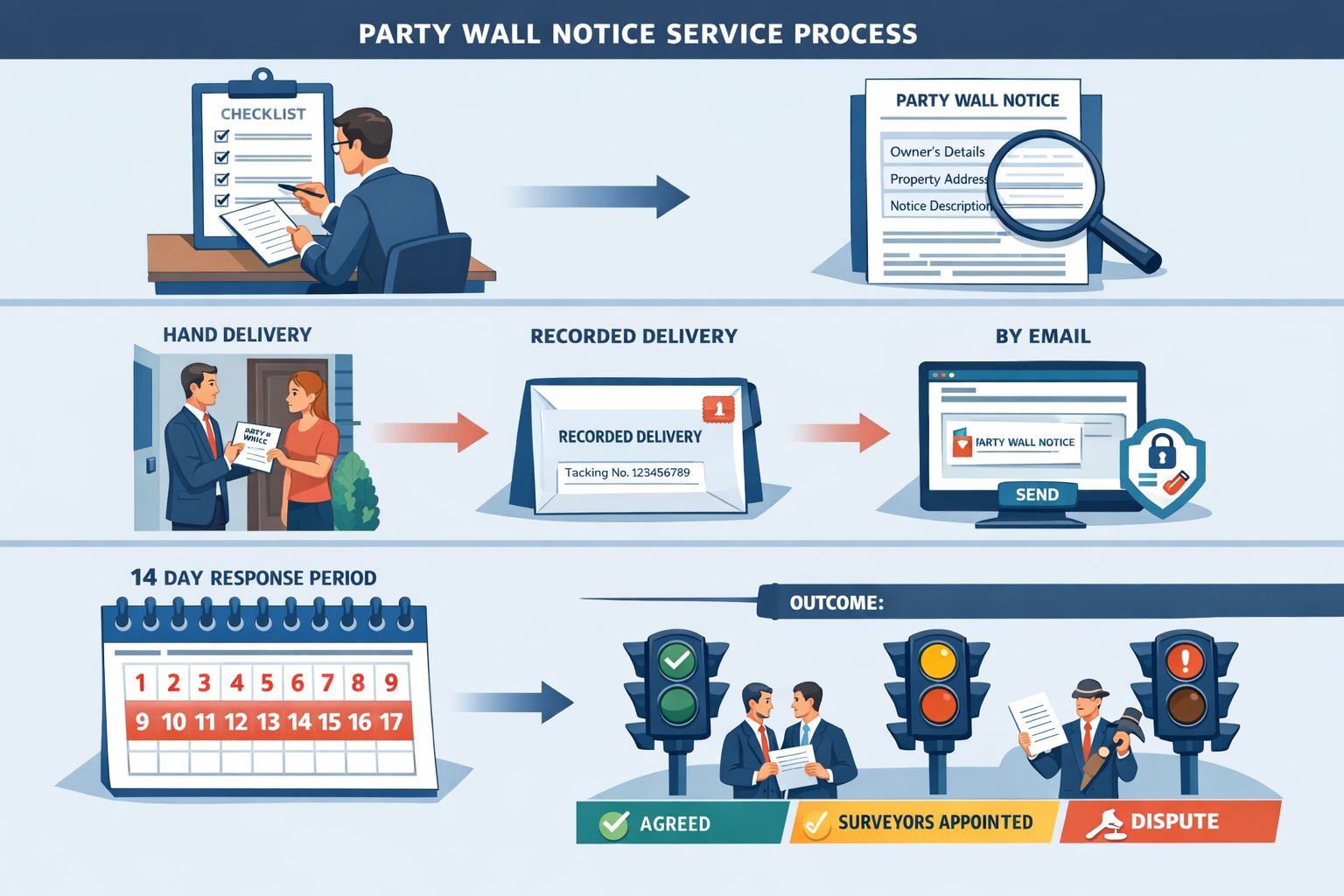
Timeline Requirements and Strategic Planning
Critical timing considerations for 2026 projects [5]:
Section 1 & 3 Notices:
- Minimum one month notice before work commencement
- Adjoining owners have 14 days to respond
- Strategic recommendation: Serve 6-8 weeks before planned start to accommodate potential disputes
Section 6 Notices:
- Minimum two months notice before excavation begins
- Adjoining owners have 14 days to respond
- Strategic recommendation: Serve 10-12 weeks ahead for complex excavation projects
Pro Tip: 💡 Start the party wall process during planning permission stages. Many West London projects experience delays when notices are served too late in the construction timeline.
Acceptable Service Methods
The Party Wall etc. Act 1996 recognizes several valid service methods [2]:
1. Hand Delivery 🤝
- Personal delivery to the adjoining owner
- Most direct method with immediate confirmation
- Document the date, time, and recipient’s acknowledgment
2. Recorded Delivery Post 📮
- Royal Mail Signed For or Special Delivery
- Provides tracking and signature proof
- Keep postal receipts and tracking records
3. Standard Post ✉️
- Legally acceptable but offers no delivery proof
- Higher risk if disputes arise about service
- Not recommended for high-value projects
4. Email Delivery 📧
- Increasingly accepted with prior agreement
- Request read receipts and confirmation replies
- Follow up with hard copy via recorded post
5. Leaving at the Property 🚪
- Valid if hand delivery to person not possible
- Must be left in a conspicuous location
- Document with photographs and witness statements
Documentation and Record-Keeping
Essential records for the 2026 surveyor checklist:
📁 Maintain comprehensive files including:
- Copies of all served notices with signatures
- Proof of service documentation (postal receipts, email confirmations)
- Land Registry ownership documents
- Photographs of delivery/posting
- Response letters from adjoining owners
- Appointment of surveyors correspondence
- Complete timeline log of all communications
Professional party wall surveyors recommend digital and physical backup systems to protect against document loss during lengthy construction projects.
Common Pitfalls and How to Avoid Them
Despite clear legal requirements, surveyors and building owners repeatedly make preventable mistakes that invalidate notices and delay projects.
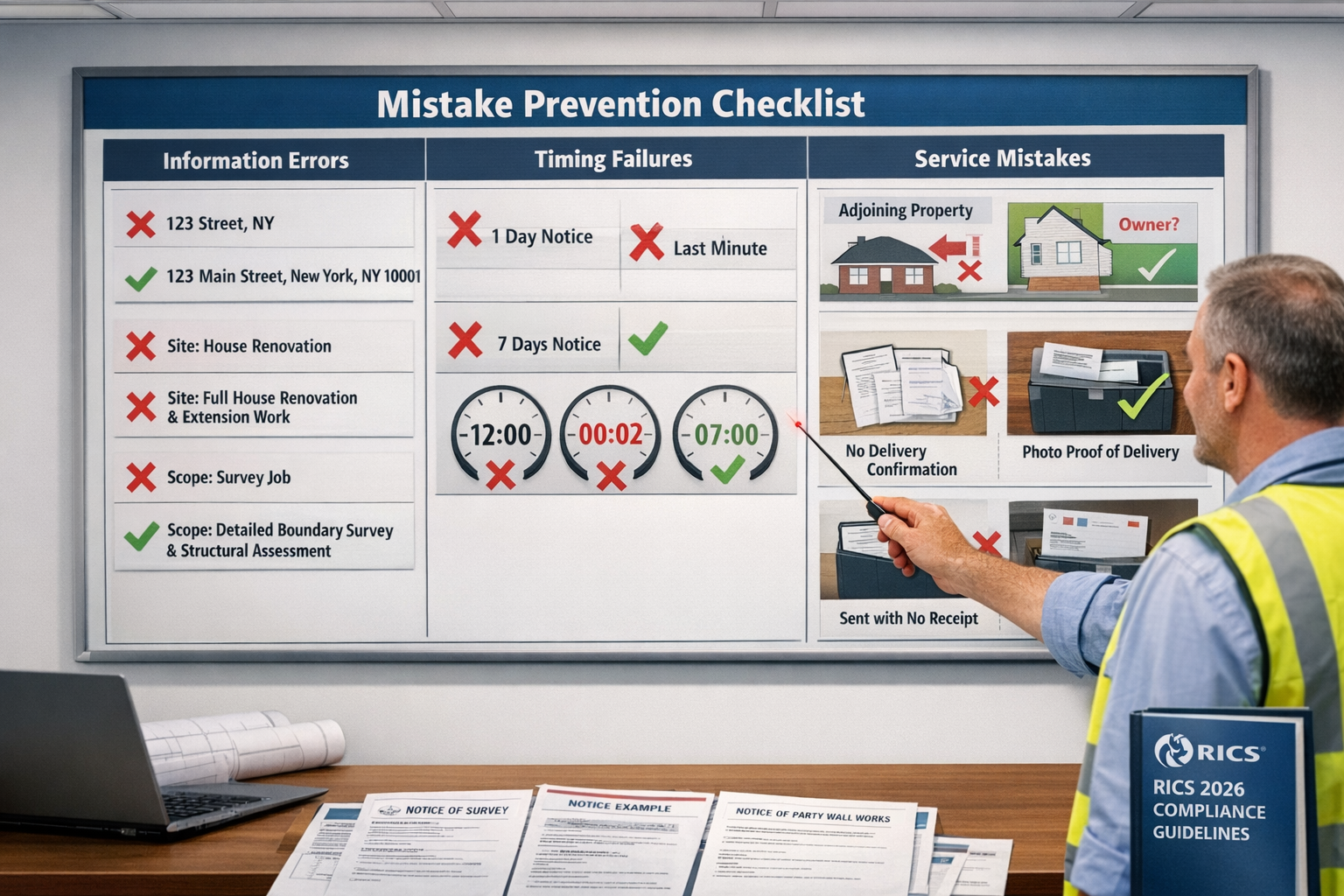
Top Seven Notice Drafting Errors
1. Insufficient Work Descriptions ❌
- Problem: Generic statements like “loft conversion” or “extension work”
- Solution: Include specific structural interventions, dimensions, and construction methods
- Impact: Adjoining owners cannot properly assess impact; disputes increase
2. Incorrect or Incomplete Owner Details ❌
- Problem: Missing co-owners, using informal names, outdated addresses
- Solution: Conduct thorough Land Registry searches; verify current occupants
- Impact: Notice is legally invalid; entire process must restart
3. Inadequate Notice Periods ❌
- Problem: Serving notices too close to planned work commencement
- Solution: Calculate backwards from start date; add buffer time for responses
- Impact: Work delays, potential injunctions, increased costs [5]
4. Missing Act References ❌
- Problem: Failing to state notice is served under Party Wall etc. Act 1996
- Solution: Use standard template language referencing the Act explicitly
- Impact: Adjoining owners may not recognize legal significance
5. Vague Start Dates ❌
- Problem: Using “early 2026” or “spring” instead of specific dates
- Solution: Provide exact date or “on or after [specific date]”
- Impact: Adjoining owners cannot determine response deadlines
6. Unsigned or Undated Notices ❌
- Problem: Forgetting building owner signature or service date
- Solution: Implement final checklist review before service
- Impact: Notice lacks legal validity; may be challenged
7. Failure to Serve All Required Notices ❌
- Problem: Serving Section 3 notice but missing required Section 6 notice for excavation
- Solution: Comprehensive work analysis to identify all applicable notice types
- Impact: Work may proceed without proper authorization; liability exposure
Understanding the types of party wall works helps identify which notices apply to specific projects.
Service Method Mistakes
Inadequate proof of service remains a persistent problem. Building owners who cannot demonstrate proper notice service face significant challenges if disputes arise or adjoining owners claim non-receipt [2].
Best practices include:
🔒 Always use trackable delivery methods for initial service
📸 Photograph the notice before and during service
📝 Create witness statements for hand deliveries
💾 Maintain digital copies with metadata showing creation dates
📋 Log all service attempts in chronological project files
For complex projects, consider engaging experienced professionals. Learn more about building owner’s surveyor services for comprehensive support.
RICS Guidance and 2026 Compliance Updates
The Royal Institution of Chartered Surveyors (RICS) provides professional standards that complement statutory requirements under the Party Wall etc. Act 1996. As construction activity intensifies in 2026, RICS guidance emphasizes transparent communication and comprehensive documentation [6].
Key RICS Principles for Party Wall Notices
Transparency and Clarity 🔍
- Notices should enable adjoining owners to fully understand proposed works
- Technical jargon should be explained in accessible language
- Visual aids (drawings, photographs) should supplement written descriptions
Proportionality ⚖️
- Notice detail should match work complexity and potential impact
- Minor works require clear but concise descriptions
- Major structural interventions demand comprehensive technical specifications
Professional Competence 🎓
- Surveyors drafting notices should possess appropriate qualifications
- Complex projects benefit from specialist party wall expertise
- Continuing professional development ensures current knowledge
Ethical Practice ✨
- Honest representation of work scope and timing
- No deliberate omissions or misleading information
- Respect for adjoining owners’ rights and concerns
2026 High-Volume Project Considerations
The current construction boom creates unique challenges for party wall procedures [6]:
Increased Dispute Volume 📈
- Higher construction activity generates more party wall cases
- Adjoining owner fatigue in areas with multiple simultaneous projects
- Greater scrutiny of notice quality and surveyor competence
Expedited Timelines ⏱️
- Developer pressure to accelerate notice periods
- Temptation to cut corners on documentation
- Importance of maintaining statutory minimum periods
Technology Integration 💻
- Digital notice service gaining acceptance
- Electronic award documentation
- Online dispute resolution platforms
Cost Management 💰
- Adjoining owners increasingly cost-conscious about party wall costs
- Pressure for efficient, streamlined processes
- Importance of clear fee agreements
Professional surveyors can provide valuable guidance on how to keep party wall costs down while maintaining compliance.
Advanced Notice Scenarios and Special Circumstances
Certain project types present additional complexity requiring enhanced notice procedures.
Multiple Adjoining Owners
Terraced properties and semi-detached houses often involve multiple adjoining owners requiring separate notices [2]:
- Properties with party walls on both sides need notices to both neighbours
- Corner properties may have three or four adjoining owners
- Each owner receives individual notice with identical information
- Response periods run independently for each owner
Absent or Unresponsive Owners
When adjoining owners cannot be located or fail to respond within 14 days:
- Conduct reasonable searches: Land Registry, electoral roll, neighbours
- Attempt multiple service methods: Post, hand delivery, email
- Document all attempts comprehensively
- Appoint surveyor on behalf of non-responsive owner after 14 days [4]
- Proceed with award process using appointed surveyor
The adjoining owner’s surveyor plays a crucial role in protecting absent owners’ interests.
Commercial and Mixed-Use Properties
Corporate ownership adds complexity:
- Serve notices to registered company at registered address
- Include company registration number
- Address to appropriate director or company secretary
- Consider separate notices for commercial tenants with repairing leases
Leasehold Complications
Both freeholders and qualifying leaseholders require notices:
- Check lease terms for repairing obligations
- Leaseholders with less than 12 months typically excluded
- Service notices to management companies where applicable
- Consider building-wide works affecting multiple units
Creating Compliant Party Wall Awards
After notice service and surveyor appointment, the process culminates in a party wall award—a legally binding document setting out work permissions, conditions, and protections.
Award Components
Comprehensive awards include:
📋 Work authorization: Detailed permission for specified works
📸 Schedule of condition: Pre-work property condition record (learn about schedule of condition)
⏰ Working hours: Permitted times and days for construction
🔧 Access rights: Entry permissions for building owner and contractors
💵 Cost provisions: Fee payment responsibilities and reimbursement procedures
🛡️ Protective measures: Requirements for minimizing damage and disturbance
⚖️ Dispute resolution: Process for addressing problems during works
Award Timeline
Typical progression following notice service:
- Day 0: Notice served
- Day 14: Response deadline expires
- Day 15-21: Surveyors appointed (if consent not given)
- Day 22-42: Surveyors inspect, negotiate terms
- Day 43-56: Award drafted and agreed
- Day 57+: Work may commence per award terms
Delays occur when surveyors cannot agree, requiring third surveyor appointment for dispute resolution.
Practical Checklist: Drafting and Serving Flawless Party Wall Notices
Use this comprehensive checklist to ensure compliance with the Drafting and Serving Flawless Party Wall Notices: Step-by-Step 2026 Surveyor Checklist:
Pre-Notice Stage ✅
- Conduct Land Registry search for all adjoining properties
- Identify all legal owners (freeholders, leaseholders, companies)
- Determine which notice types apply (Section 1, 3, and/or 6)
- Prepare detailed work descriptions with dimensions
- Create or obtain technical drawings showing proposed works
- Calculate earliest possible work start date with adequate notice period
- Review lease terms for leasehold properties
Notice Drafting Stage ✅
- Include building owner’s full legal name and address
- Include all adjoining owners’ full legal names and addresses
- State exact property address where works will occur
- Provide comprehensive, specific work description
- Specify planned start date meeting minimum notice requirements
- State notice type (Section 1, 3, or 6)
- Reference Party Wall etc. Act 1996 explicitly
- Obtain building owner’s signature and date
- Attach supporting drawings or photographs
- Review against mandatory elements checklist
Service Stage ✅
- Select appropriate service method (recorded delivery recommended)
- Prepare individual notices for each adjoining owner
- Photograph notices before service
- Serve notices via chosen method with proof
- Retain all service documentation (receipts, tracking numbers)
- Create service log with dates and methods
- Follow up to confirm receipt
- Diarize 14-day response deadline
- Prepare for potential surveyor appointments
Post-Service Stage ✅
- Monitor for responses within 14-day period
- If consent given, obtain written confirmation
- If dissent or no response, initiate surveyor appointment
- Provide surveyors with comprehensive project information
- Cooperate with schedule of condition inspections
- Review draft award carefully before agreement
- Ensure all parties receive final signed award
- Do not commence work before award is in place
- Maintain award and notice files throughout project
For those considering whether professional help is needed, review guidance on having a party wall agreement without a surveyor.
Conclusion
Mastering the Drafting and Serving Flawless Party Wall Notices: Step-by-Step 2026 Surveyor Checklist is essential for construction professionals navigating today’s high-volume property development environment. Properly drafted notices containing all eight mandatory elements—owner details, property address, work description, start date, notice type, Act reference, and signatures—form the foundation of compliant party wall procedures.
Strategic timing that exceeds minimum statutory periods, comprehensive identification of all adjoining owners through Land Registry searches, and meticulous documentation of service methods protect building owners from disputes and project delays. As RICS guidance emphasizes, transparency, proportionality, and professional competence remain paramount in 2026’s competitive construction landscape.
Next Steps
For Building Owners:
- Start the party wall process early—ideally during planning stages
- Conduct thorough ownership research before drafting notices
- Consider engaging qualified party wall surveyors for complex projects
- Maintain comprehensive records of all communications and documents
For Surveyors:
5. Implement quality control checklists for every notice drafted
6. Stay current with RICS guidance and legislative developments
7. Build robust documentation systems for high-volume practices
8. Develop clear client communication protocols
For Adjoining Owners:
9. Review received notices carefully against the mandatory elements checklist
10. Seek professional advice if work descriptions are unclear
11. Respond within 14 days to protect your rights
12. Consider appointing your own surveyor for significant works
Whether you’re carrying out works or your neighbour is carrying out works, understanding proper notice procedures ensures smoother construction projects, better neighbour relations, and full legal compliance.
For professional assistance with party wall matters, contact experienced surveyors who can guide you through every stage of the process.
References
[1] Watch – youtube.com
[2] How To Serve A Party Wall Notice – partywalldiy.com
[3] Party Structure Notice How To Draft Serve And Respond To It – surveymerchant.com
[4] Party Wall Agreement – hoa.org.uk
[5] When Should Party Wall Notices Be Served – peterbarry.co.uk
[6] Party Wall Surveys Amid 2026 Construction Boom Handling Disputes In High Demand Uk Housing Markets – https://nottinghillsurveyors.com/blog/party-wall-surveys-amid-2026-construction-boom-handling-disputes-in-high-demand-uk-housing-markets
Speak to a RICS chartered party wall surveyor
Free initial consultation. Notices, awards and schedules of condition across London and nationwide.