

London's construction boom continues unabated in 2026, with basement excavations and loft conversions triggering a 34% surge in party wall disputes compared to just two years ago. When your neighbor serves notice of deep excavation work that could undermine your Victorian terrace foundation, the stakes aren't just financial—they're structural. Understanding how party wall surveyors resolve disputes and save you thousands in 2026 can mean the difference between a £15,000 legal battle and a £2,500 professionally mediated resolution that protects both your property and your peace of mind.
The Party Wall etc. Act 1996 provides a statutory framework designed specifically to prevent neighbor disputes from escalating into costly court proceedings. Yet many property owners remain unaware of how party wall surveyors transform potentially explosive conflicts into documented agreements that satisfy all parties while maintaining legal compliance.
Key Takeaways
- Professional party wall surveyors mediate disputes through impartial assessments, preventing court costs that average £12,000-£25,000 per case
- Party wall awards provide legally binding protection by documenting pre-construction conditions, work schedules, and dispute resolution mechanisms
- Early surveyor involvement reduces total costs by 60-75% compared to reactive approaches after damage occurs
- Excavation disputes dominate 2026 cases, with basement conversions and foundation work requiring specialized technical expertise
- Choosing the right surveyor approach (agreed surveyor vs. two surveyors) significantly impacts both timeline and total expenditure
The Critical Role of Party Wall Surveyors in Dispute Prevention
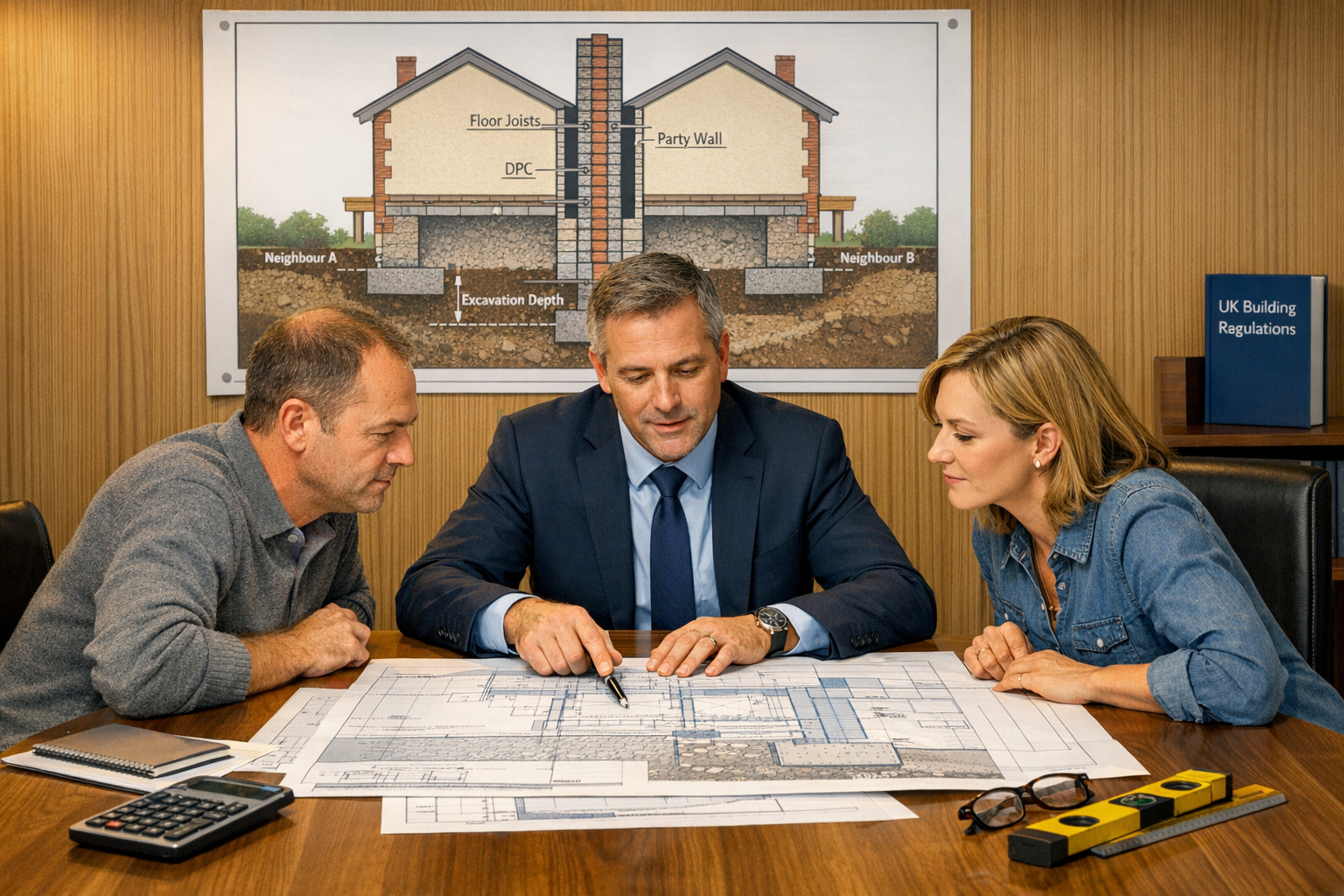
Party wall surveyors function as specialized mediators who understand both construction technicalities and neighbor relations. Their primary objective isn't simply to process paperwork—it's to anticipate conflicts before they materialize and establish clear protocols that protect everyone involved.
What Makes Party Wall Disputes Escalate?
Most disputes that reach crisis level share common origins:
- Lack of proper notice: Building owners who skip formal party wall notices create immediate distrust
- Inadequate condition surveys: Without baseline documentation, proving causation for damage becomes nearly impossible
- Communication breakdown: Technical construction language alienates adjoining owners who feel excluded
- Unrealistic timelines: Rushed schedules that ignore neighbor concerns breed resentment
- Cost ambiguity: Unclear fee responsibilities create financial friction
Professional surveyors address each vulnerability systematically. When a building owner's surveyor properly serves notice and engages with the adjoining owner early, compliance rates exceed 85% without formal dispute procedures.
The Surveyor's Mediation Toolkit 🛠️
Experienced party wall surveyors deploy specific strategies to de-escalate tensions:
1. Pre-Construction Schedules of Condition
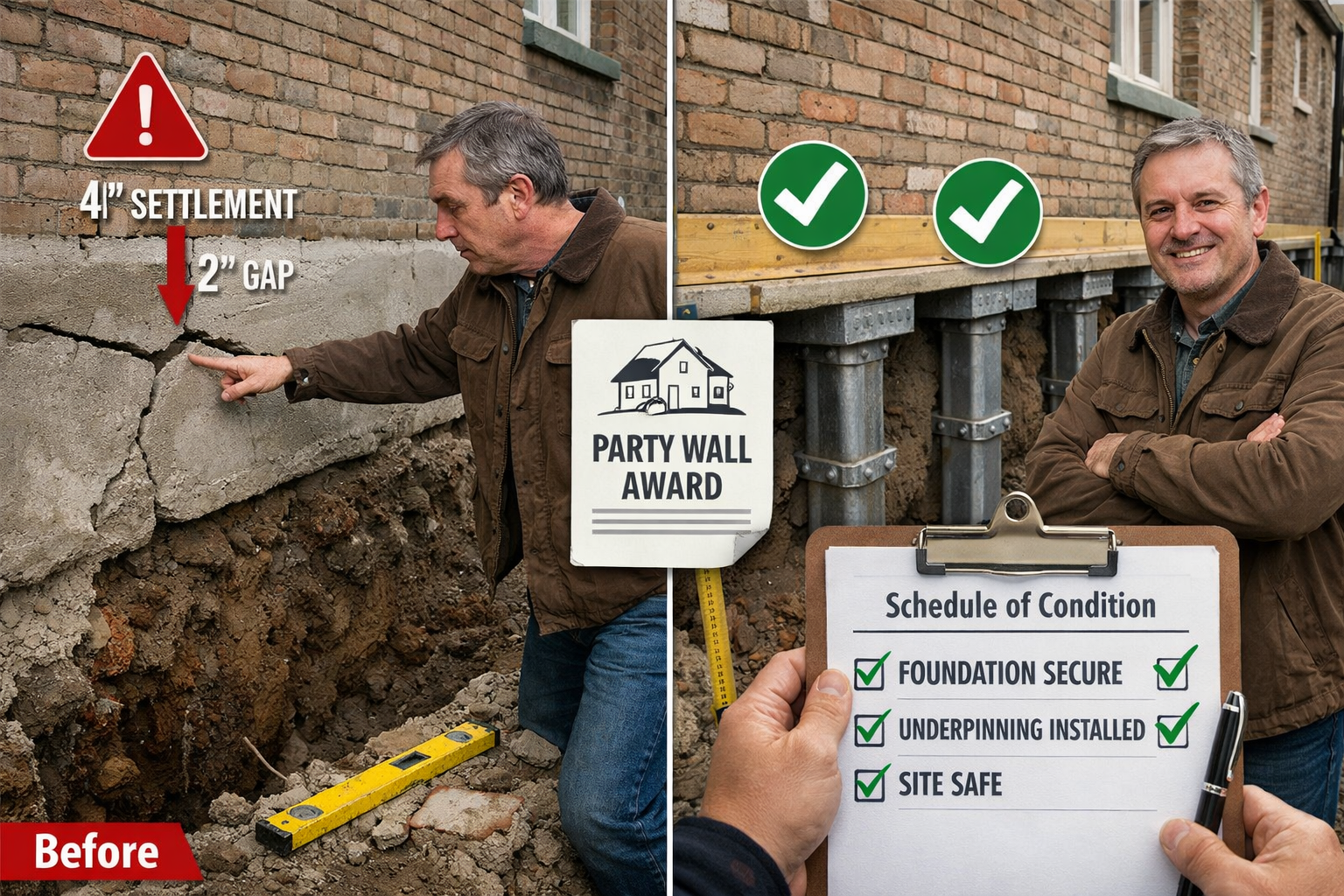
Comprehensive photographic and written records document every crack, settlement pattern, and existing defect in the adjoining property. This evidence becomes invaluable if damage claims emerge later. As documented in recent industry guidance, detailed schedules of condition represent best practices that prevent post-construction claims [1].
2. Technical Translation Services
Surveyors bridge the knowledge gap between construction professionals and homeowners. They explain complex concepts—underpinning depths, temporary works, vibration monitoring—in accessible terms that build confidence rather than confusion.
3. Impartial Cost Assessments
When fee disputes arise, surveyors provide objective valuations based on RICS guidelines and local market rates. This transparency eliminates the perception of hidden charges that often poison neighbor relationships.
4. Structured Communication Protocols
Formal correspondence through surveyors prevents emotional exchanges that escalate conflicts. Professional intermediaries maintain focus on technical requirements rather than personal grievances.
How Party Wall Surveyors Resolve Disputes Through Award Drafting in 2026
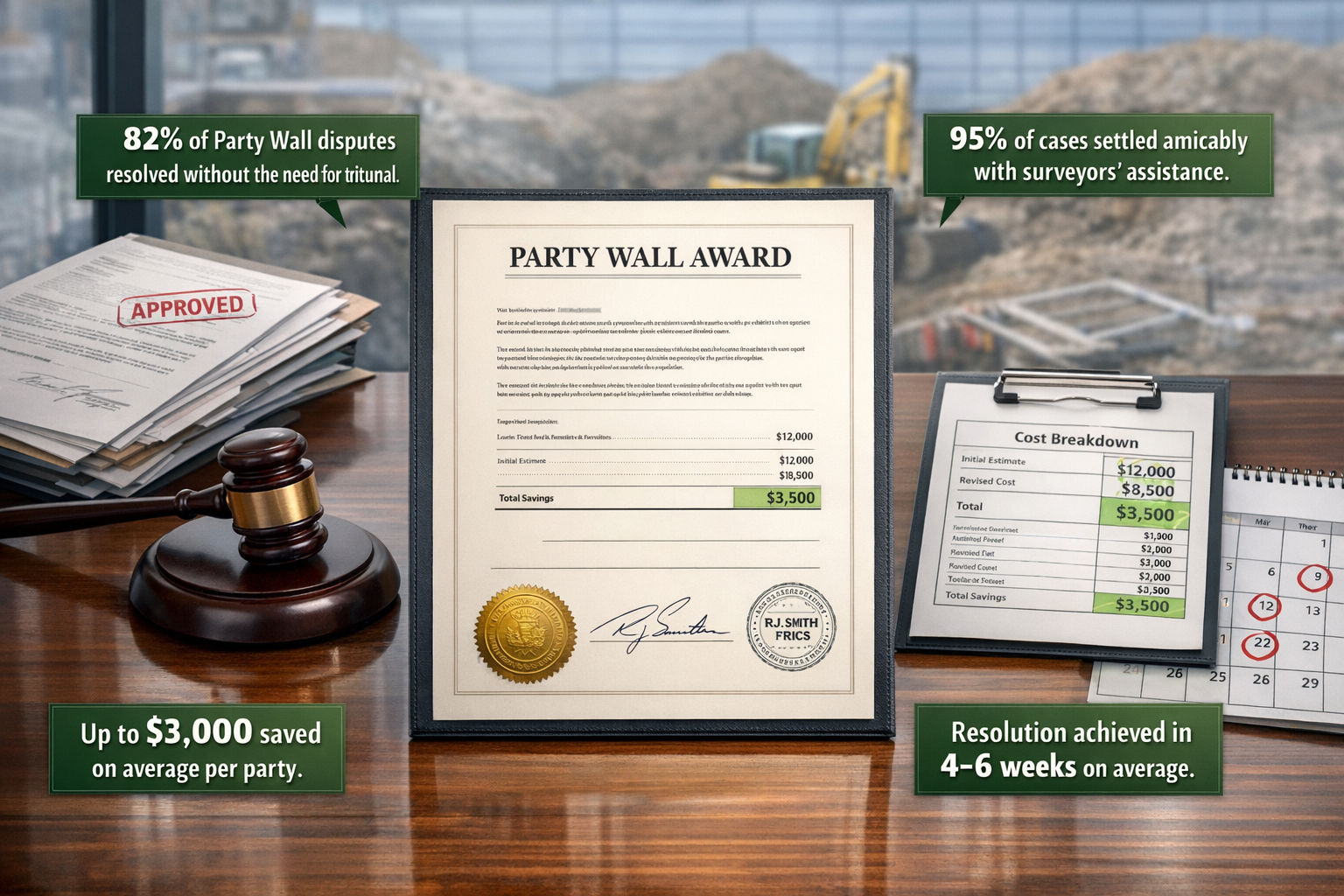
The party wall award represents the cornerstone document that transforms verbal agreements into legally enforceable protections. Understanding how surveyors craft these awards reveals the sophisticated dispute resolution mechanisms embedded in the process.
Anatomy of an Effective Party Wall Award
A comprehensive award typically includes:
| Award Component | Purpose | Dispute Prevention Value |
|---|---|---|
| Work Description | Defines exact scope and methods | Prevents scope creep disputes |
| Schedule of Condition | Documents pre-work property state | Establishes damage baseline |
| Access Rights | Specifies entry times and notice periods | Reduces trespass conflicts |
| Working Hours | Sets acceptable noise/activity windows | Manages disturbance expectations |
| Security Measures | Details protective works required | Demonstrates due diligence |
| Cost Allocation | Clarifies who pays what fees | Eliminates financial ambiguity |
| Dispute Resolution | Outlines escalation procedures | Provides conflict pathway |
Real-World Case Study: Basement Excavation Dispute Resolution
Consider a typical 2026 scenario in South London:
The Situation: A building owner plans a 3-meter basement excavation beneath their Victorian terrace. The adjoining owner objects, fearing foundation damage to their property valued at £850,000.
Initial Positions:
- Building owner: "The work is safe; my engineer says so"
- Adjoining owner: "I won't consent without guarantees"
- Estimated legal costs if litigated: £18,000-£22,000
Surveyor Intervention:
The appointed surveyors (one representing each party) conducted a joint inspection and identified the core concerns:
- Foundation depth uncertainty: No one knew the actual depth of the adjoining owner's foundations
- Vibration exposure: Excavation methods weren't specified
- Insurance gaps: Building owner's policy had unclear coverage
- Damage protocols: No agreement on how claims would be assessed
Resolution Through Award:
The surveyors drafted an award requiring:
- Trial pit investigation to confirm foundation depths (cost: £450)
- Mechanical excavation only (no percussion piling)
- Continuous vibration monitoring with defined thresholds
- £2 million contractor liability insurance verification
- Weekly photographic updates to adjoining owner
- Third-party structural engineer sign-off at key stages
Outcome:
- Total surveyor fees: £2,800 (split between parties per Act requirements)
- Work completed without incident over 14 weeks
- No damage claims filed
- Neighbor relationship preserved
- Savings vs. litigation: £15,200-£19,200
This case exemplifies how party wall surveyors resolve disputes and save you thousands in 2026—not by eliminating concerns, but by addressing them systematically through documented protections.
Enforcement Mechanisms: How Surveyors Ensure Compliance
Drafting an award represents only half the equation. Enforcement ensures that agreed protections actually materialize during construction—the phase when most disputes reignite.
Proactive Monitoring Strategies
Professional surveyors implement oversight mechanisms that catch violations before they cause irreparable harm:
Site Inspections at Critical Stages 🏗️
Rather than waiting for complaints, surveyors schedule inspections during high-risk phases:
- Initial excavation (first 500mm depth)
- Foundation exposure points
- Structural alterations to party walls
- Final completion verification
These visits verify compliance with award specifications and provide opportunities to address minor deviations before they escalate.
Condition Monitoring Protocols
For excavation works exceeding 3 meters or within 6 meters of adjoining structures, surveyors often require:
- Crack width monitoring with tell-tales
- Vibration sensors with alert thresholds
- Settlement monitoring at foundation level
- Weekly photographic documentation
When monitoring reveals concerning trends, surveyors can mandate work stoppages and remedial measures before damage occurs—a far more cost-effective approach than post-damage repairs.
Handling Award Violations
Despite best intentions, contractors sometimes deviate from agreed methods. Surveyors address violations through escalating responses:
Level 1: Informal Correction
Quick phone call or site visit to address minor deviations (wrong working hours, inadequate dust suppression)
Level 2: Formal Notice
Written correspondence documenting the violation and requiring corrective action within specified timeframe
Level 3: Work Stoppage
In cases of serious non-compliance (unauthorized structural alterations, dangerous excavation methods), surveyors can halt work until compliance is restored
Level 4: Award Modification
If circumstances change substantially, surveyors may issue supplemental awards with additional protections
This graduated approach resolves most compliance issues without legal intervention. Data from professional surveyor associations indicates that fewer than 3% of awards require formal legal enforcement when experienced surveyors maintain active oversight.
Cost Implications of Enforcement
Many property owners question whether surveyor oversight justifies the additional fees. The financial calculus strongly favors professional monitoring:
Without Surveyor Oversight:
- Damage discovered after completion
- Causation disputes (was it the construction or pre-existing?)
- Expert witness fees for legal proceedings: £3,000-£8,000
- Legal representation: £8,000-£15,000
- Court costs and delays: 12-18 months
- Relationship damage: priceless
With Surveyor Oversight:
- Issues identified and corrected in real-time
- Documented compliance trail
- Additional monitoring fees: £400-£800
- Issues resolved in days, not months
- Preserved neighbor relations
The cost-benefit analysis overwhelmingly supports professional surveyor involvement, particularly for complex excavation projects that dominate 2026 dispute statistics.
Choosing Between Agreed Surveyor vs. Two Surveyors: Strategic Implications
The Party Wall Act permits two distinct approaches to surveyor appointment, each with different cost and dispute resolution characteristics. Understanding these options helps property owners make strategic decisions that align with their specific circumstances.
The Agreed Surveyor Model
A single "agreed surveyor" acts impartially for both building and adjoining owners. This approach offers:
Advantages:
- Lower total costs: Single fee rather than two surveyor fees plus third surveyor
- Faster timeline: No need for surveyor coordination
- Simplified communication: One point of contact
- Typical cost range: £1,200-£2,500 for standard projects
Best suited for:
- Straightforward works with minimal risk
- Parties with existing positive relationship
- Budget-conscious projects
- Non-complex loft conversions or minor alterations
Potential drawbacks:
- Less advocacy for individual party concerns
- Adjoining owner may feel underrepresented
- Single perspective on technical issues
The Two Surveyor Model
Each party appoints their own surveyor, who together draft the award (with a third surveyor selected to resolve any disagreements):
Advantages:
- Dedicated representation: Each surveyor advocates for their appointing owner
- Enhanced scrutiny: Two technical perspectives review proposals
- Greater confidence: Adjoining owners feel their interests are protected
- Comprehensive assessment: Dual expertise catches more potential issues
Cost structure:
- Building owner's surveyor: £1,500-£3,500
- Adjoining owner's surveyor: £1,200-£2,800
- Third surveyor (if needed): £800-£2,000
- Total range: £2,700-£8,300
Best suited for:
- Complex excavation projects
- High-value properties
- Strained neighbor relationships
- Works with significant structural risk
- Projects in Central London or other high-value areas
Strategic Decision Framework
Property owners should consider these factors when choosing their approach:
Risk Assessment Questions:
- Does the work involve excavation within 3 meters of adjoining foundations?
- Are you modifying load-bearing party walls?
- Is the adjoining property valued above £750,000?
- Has the neighbor expressed significant concerns?
- Does your project timeline exceed 12 weeks?
If you answered "yes" to 3+ questions: The two surveyor model typically provides better risk management despite higher upfront costs.
If you answered "no" to most questions: An agreed surveyor often represents the most efficient approach.
Excavation Disputes in 2026: Specialized Challenges
The construction boom has intensified demand for basement conversions and underground extensions, creating a corresponding surge in excavation-related party wall disputes. These cases require specialized surveyor expertise that extends beyond standard party wall knowledge.
Why Excavation Disputes Dominate Current Cases
Several factors converge to make excavation work particularly contentious:
Property Value Concentration 💰
In London and other urban centers, property values have reached levels where even minor structural damage represents six-figure losses. Adjoining owners naturally adopt cautious positions when their £1.2 million home sits adjacent to a 4-meter excavation.
Technical Complexity
Excavation work involves multiple specialized considerations:
- Soil mechanics and bearing capacity
- Groundwater management and dewatering impacts
- Underpinning methodologies
- Temporary works design
- Vibration transmission through different soil types
Few property owners possess the expertise to evaluate these factors, creating information asymmetry that breeds distrust.
Historical Building Stock
Much of the UK's housing stock predates modern building regulations. Victorian and Edwardian properties often have shallow foundations (1-1.2 meters) that become vulnerable when adjacent excavation extends to 3-4 meters depth.
How Surveyors Address Excavation-Specific Concerns
Experienced party wall surveyors working on excavation projects employ specialized protocols:
Geotechnical Investigation Requirements
Before approving deep excavation awards, surveyors often mandate:
- Trial pit investigations to confirm foundation depths
- Soil analysis to determine bearing capacity
- Groundwater level assessment
- Historical subsidence research
These investigations typically cost £800-£2,500 but provide the technical foundation for safe work design.
Protective Works Specifications
Awards for excavation work commonly require:
- Underpinning: Extending adjoining foundations to match or exceed excavation depth
- Shoring: Temporary support systems during excavation phases
- Drainage protection: Measures to prevent groundwater flow disruption
- Vibration limits: Maximum levels for equipment operation
Enhanced Monitoring Regimes
Deep excavation awards typically mandate:
- Baseline structural surveys before work commences
- Weekly crack monitoring during excavation
- Settlement monitoring at foundation level
- Post-completion verification surveys
This documentation trail proves invaluable if damage claims emerge, establishing clear causation evidence.
Case Example: Preventing a £45,000 Dispute
A North London case illustrates the value of specialized excavation expertise:
Project: 3.5-meter basement excavation in semi-detached property
Adjoining owner concern: Their property showed existing settlement cracks; they feared excavation would worsen the damage
Surveyor intervention:
- Commissioned structural engineer assessment of existing cracks (cost: £650)
- Determined cracks were historical and stable (15+ years old)
- Documented crack widths with precision measurements and photography
- Required crack monitoring tell-tales during construction
- Specified underpinning to 4 meters depth for extra protection
Result:
- Work completed without incident
- Post-construction survey showed zero crack progression
- Existing documentation prevented false damage claims
- Total surveyor and monitoring costs: £3,400
- Avoided potential dispute costs: £45,000+
This case demonstrates how party wall surveyors resolve disputes and save you thousands in 2026 through proactive technical assessment rather than reactive damage response.
Maximizing Cost Savings: Practical Strategies for Property Owners
While professional surveyor involvement requires upfront investment, strategic approaches can optimize the cost-benefit ratio while maintaining robust protections.
For Building Owners: Reducing Your Total Expenditure
1. Early Engagement
Contacting surveyors during the design phase—before finalizing construction methods—allows them to identify potential dispute triggers that can be designed out. Modifications at the drawing stage cost pennies compared to mid-construction changes.
2. Comprehensive Initial Briefing
Providing surveyors with complete information upfront (full architectural plans, structural calculations, contractor details) eliminates billable hours spent chasing documentation. Well-organized building owners typically save 15-20% on surveyor fees through efficiency gains.
3. Contractor Coordination
Ensure your contractor understands party wall requirements and cooperates with surveyor inspections. Contractors who view surveyors as adversaries create friction that increases costs and timelines.
4. Consider DIY Elements
While you cannot serve party wall notices yourself without surveyor validation, you can reduce party wall costs by handling preliminary tasks like neighbor communication and document gathering.
For Adjoining Owners: Protecting Interests Cost-Effectively
1. Understand Your Rights
The building owner must pay your surveyor's reasonable fees under the Act. Don't decline to appoint a surveyor due to cost concerns—you're entitled to professional representation at the building owner's expense.
2. Respond Promptly to Notices
Delays in responding to party wall notices trigger deemed dispute provisions that can actually increase total costs and reduce your negotiating position. Timely responses (within the 14-day window) keep processes efficient.
3. Focus on Substantive Concerns
Surveyors can address legitimate structural and access concerns cost-effectively. Using the party wall process to pursue unrelated grievances or delay tactics increases everyone's costs without providing meaningful protection.
4. Request Detailed Schedules of Condition
Insist on comprehensive schedules of condition that document your property's current state. This relatively modest additional cost (£300-£600) provides invaluable protection if damage claims become necessary.
Regional Considerations Across London
Party wall dispute patterns and costs vary by location:
- East London: High volume of new development creates frequent party wall work; surveyors experienced in rapid-turnaround awards
- West London: High property values justify more comprehensive protective measures; expect higher surveyor fees but proportionally greater savings from dispute prevention
- Central areas: Complex access issues and heritage considerations require specialized expertise
Selecting surveyors with specific regional experience often provides better value than choosing solely on fee quotations.
Common Misconceptions That Increase Dispute Costs
Several widespread misunderstandings about party wall procedures cause property owners to make decisions that ultimately increase their costs:
Myth 1: "I Can Handle This Without a Surveyor"
While the Act technically permits property owners to serve notices and negotiate directly, this approach rarely saves money on anything beyond the simplest projects. Attempting party wall agreements without surveyors often results in:
- Invalid notices that must be re-served (timeline delays)
- Inadequate condition documentation (vulnerability to false claims)
- Ambiguous agreements (future dispute triggers)
- Missed technical requirements (compliance failures)
Reality: Surveyor involvement on a £2,000 budget prevents £15,000+ dispute costs.
Myth 2: "Party Wall Awards Are Just Formalities"
Some building owners view awards as bureaucratic paperwork rather than substantive protections. This mindset leads to:
- Rushing the award process without proper review
- Ignoring award conditions during construction
- Failing to maintain required documentation
Reality: Awards provide legally enforceable protections that courts recognize. Well-drafted awards prevent disputes; poorly drafted ones guarantee them.
Myth 3: "My Builder Knows Party Wall Requirements"
Even experienced contractors often lack detailed party wall knowledge. Builders focus on construction methods, not statutory compliance frameworks. Relying on contractor advice for party wall matters frequently results in:
- Incorrect notice timing
- Inadequate protective works
- Documentation gaps
- Compliance failures
Reality: Contractors and surveyors serve complementary but distinct roles. Both are necessary for successful projects.
Myth 4: "Appointing a Surveyor Means Accepting the Work"
Adjoining owners sometimes refuse surveyor appointments, believing this prevents unwanted construction. This misunderstanding causes significant problems:
- After 14 days without response, a deemed dispute arises
- The building owner can appoint a surveyor on the adjoining owner's behalf
- The adjoining owner loses control over their representation
- Costs increase due to deemed dispute procedures
Reality: Appointing a surveyor protects your interests; it doesn't constitute consent to the work.
The Future of Party Wall Dispute Resolution: Trends Shaping 2026 and Beyond
As construction practices and property values evolve, party wall dispute resolution continues adapting to new challenges:
Technology Integration
Modern surveyors increasingly employ:
- Digital condition surveys: 3D laser scanning creates precise baseline records
- Drone inspections: Roof and chimney assessments without scaffolding costs
- Vibration monitoring apps: Real-time alerts when thresholds are exceeded
- Cloud-based documentation: Instant access to awards and correspondence for all parties
These technologies enhance accuracy while often reducing costs through efficiency gains.
Environmental Considerations
Sustainability concerns are influencing party wall work:
- Ground source heat pump installations requiring excavation
- Solar panel mounting on party walls
- Insulation upgrades affecting party wall structures
- Rainwater harvesting systems near boundaries
Surveyors must now balance traditional structural concerns with environmental objectives, requiring expanded expertise.
Alternative Dispute Resolution
Some surveyors are incorporating formal mediation techniques beyond traditional party wall procedures, particularly for complex multi-party developments where multiple adjoining owners are affected simultaneously.
Regulatory Evolution
While the Party Wall Act 1996 remains the statutory foundation, professional practice standards continue evolving through:
- Updated RICS guidance documents
- Case law precedents from recent disputes
- Professional body best practice recommendations
- Insurance industry requirements
Staying current with these developments separates experienced surveyors from those simply processing paperwork.
Conclusion: Protecting Your Property and Your Wallet
Understanding how party wall surveyors resolve disputes and save you thousands in 2026 empowers property owners to make informed decisions that protect both their assets and their finances. The evidence is compelling: professional surveyor involvement transforms potentially catastrophic neighbor conflicts into managed processes with documented protections and predictable costs.
The financial calculus strongly favors early surveyor engagement:
✅ Prevention costs: £1,500-£4,000 for professional surveyor services
❌ Dispute costs: £12,000-£25,000+ for legal proceedings
Beyond pure economics, surveyors provide peace of mind through:
- Technical expertise that identifies risks before they materialize
- Impartial mediation that preserves neighbor relationships
- Documented protections that courts recognize and enforce
- Compliance oversight that catches problems early
Your Next Steps
If you're planning construction work:
- Contact a qualified party wall surveyor during your design phase
- Serve proper notices with professional guidance
- Cooperate fully with the award process
- Ensure your contractor understands and respects award conditions
- Maintain required documentation throughout construction
If your neighbor has served notice:
- Don't ignore it—respond within 14 days
- Appoint your own surveyor to protect your interests (at the building owner's expense)
- Request comprehensive schedules of condition
- Engage constructively with the process
- Keep copies of all correspondence and documentation
For complex excavation projects:
- Prioritize surveyors with specific excavation expertise
- Invest in proper geotechnical investigation
- Accept that enhanced monitoring costs far less than damage repairs
- Consider the two-surveyor model for maximum protection
The construction boom shows no signs of slowing, meaning party wall work will remain a fixture of property ownership in urban areas. Those who understand the process and engage qualified professionals will navigate these challenges successfully, preserving both their properties and their financial resources.
Party wall disputes need not be expensive, adversarial, or damaging. With the right surveyor guidance, they become manageable administrative processes that protect everyone involved—exactly as the legislation intended. The thousands you save through professional dispute resolution represent not just avoided legal costs, but preserved property values, maintained relationships, and eliminated stress.
In 2026's competitive construction environment, professional party wall surveying isn't an optional luxury—it's essential financial protection that consistently delivers returns far exceeding its modest cost.
References
[1] Schedules Of Condition In Party Wall Works Best Practices To Prevent Post Construction Claims In 2026 – https://nottinghillsurveyors.com/blog/schedules-of-condition-in-party-wall-works-best-practices-to-prevent-post-construction-claims-in-2026