Construction activity across England and Wales has surged by 23% since 2024, with loft conversions and basement extensions driving unprecedented demand for party wall agreements. As homeowners rush to maximize property value in 2026’s competitive market, understanding the Party Wall etc. Act 1996 has become essential for avoiding costly disputes and project delays.
This comprehensive guide addresses the Most Common Party Wall Questions Answered: From Notices to Awards in 2026’s Busy Renovation Season, providing clear answers to help building owners navigate the legal requirements, costs, and surveyor processes that protect both their interests and their neighbors’ rights.
Key Takeaways
- Party wall notices are legally required for works affecting shared walls, boundaries, or excavations within 3-6 meters of neighboring properties
- Neighbors have 14 days to respond to notices, either giving written consent or triggering the surveyor appointment process
- Building owners typically pay all party wall surveyor costs, regardless of whether one or two surveyors are appointed
- Party Wall Awards provide legal protection by documenting pre-work conditions and establishing procedures for handling damage
- Minor works like replastering or drilling for shelves generally don’t require formal party wall notices

Understanding Party Wall Basics: What Triggers the Legal Requirement?
What Exactly Is a Party Wall?
A party wall is a wall or floor partition separating buildings or parts of buildings belonging to different people, such as the dividing wall between semi-detached houses or flats in shared residential properties[2]. The Party Wall etc. Act 1996 applies exclusively to England and Wales—it does not extend to Scotland or Northern Ireland[5].
Understanding what constitutes a party structure is crucial before planning any renovation work.
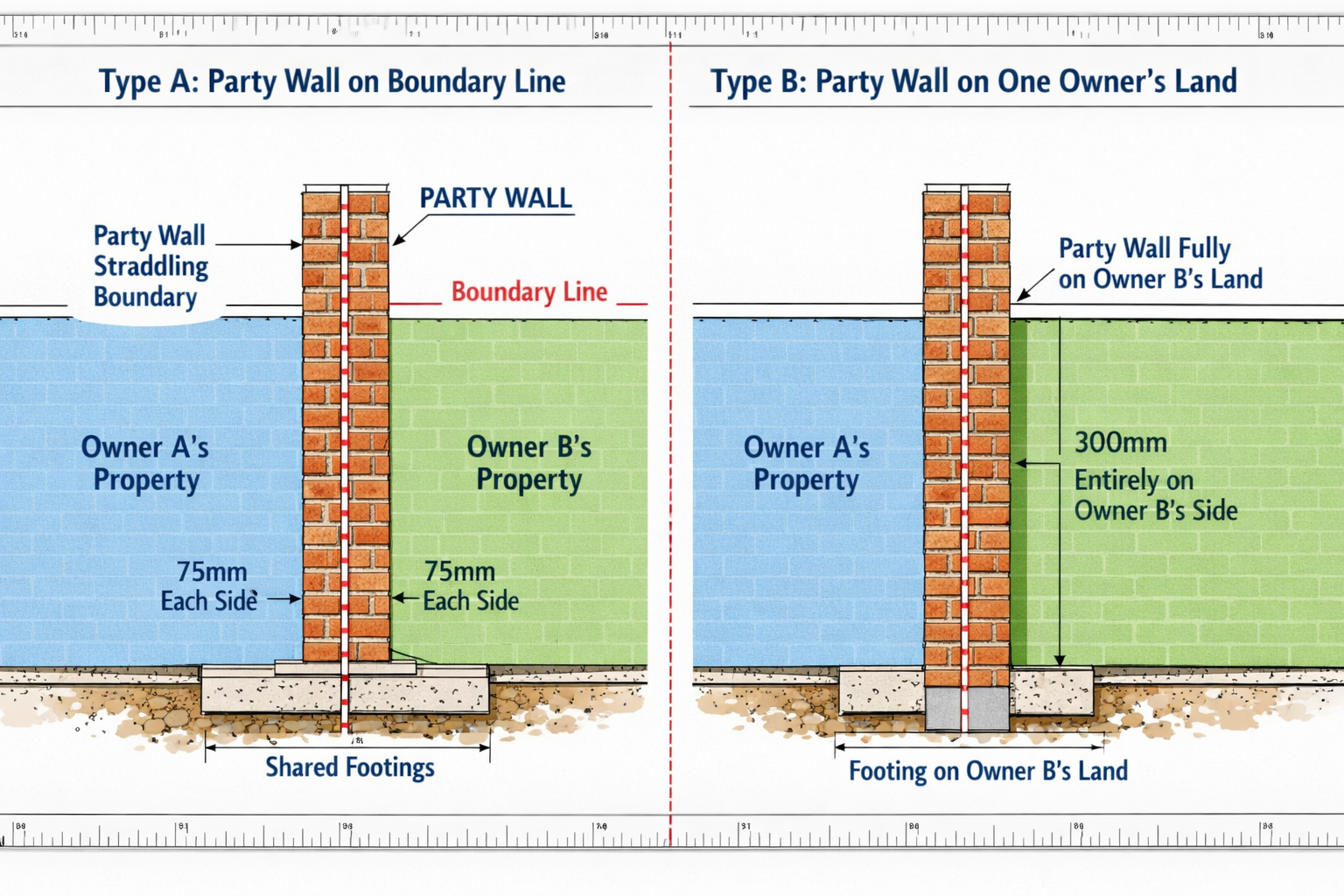
Two Main Types of Party Walls 🏘️
Type A Walls stand astride the boundary line with varying configurations:
- The wall sits directly on the property boundary
- Both owners have equal rights to the structure
- Most common in terraced and semi-detached properties
Type B Walls stand wholly on one owner’s land but serve both properties:
- The entire wall is on one person’s property
- Only the dividing portion is considered “party”
- The wall separates buildings owned by different people[4]
When Must You Serve a Party Wall Notice?
You must serve a party wall notice when planning construction work that could affect a shared wall or boundary[1]. The Act covers three main categories:
1. New Building Work on Boundaries
- Constructing a new wall directly on the boundary line
- Building within 3 meters of a neighbor’s structure if excavating below their foundation level
- Excavating within 6 meters if digging below a 45-degree angle from their foundation base
2. Work to Existing Party Walls
- Building or demolishing a party wall
- Making a party wall taller, shorter, or deeper
- Removing chimney breasts from party walls
- Cutting into a party wall to insert beams or damp proof courses
- Knocking down and rebuilding a party wall[4]
3. Common Renovation Triggers in 2026 🔨
- Loft conversions requiring steel beam insertion
- Basement extensions involving underpinning
- Kitchen extensions with new foundations
- Damp proof course installation
- Structural alterations affecting load-bearing walls[5]
For detailed guidance on types of party wall works, consult specialized resources before beginning your project.
What Work Doesn’t Require Notice?
Some adjustments are considered too minor to require formal notice[2]:
✅ Removing old plaster and replastering
✅ Repairing and replacing electrical wiring and sockets
✅ Drilling into walls to fix plugs and screws for shelves
✅ Painting or decorating party walls
✅ Installing surface-mounted fixtures
However, if you’re unsure whether your planned work requires notice, it’s always safer to consult with a qualified surveyor. Learn more about having a party wall agreement without a surveyor for straightforward cases.
The Notice and Response Process: Timeline and Procedures
How to Serve a Proper Party Wall Notice 📋
Serving notice is the building owner’s legal responsibility. The notice must be:
- In writing with specific details about the planned work
- Served at least two months before starting for most party wall works
- Served at least one month before for excavation work near boundaries
- Delivered to all affected neighbors who share the wall or boundary
The notice should clearly describe the nature of the work, when it will start, and how long it will take. For comprehensive guidance, review our party wall act notices guide.
The Critical 14-Day Response Window ⏰
Once a party wall notice is served, the neighbor has 14 days to respond[5]. Two possible outcomes exist:
Option 1: Written Consent (Assent)
- The neighbor agrees to the work in writing
- No surveyors need to be appointed
- No Party Wall Award is required
- Work can proceed after the notice period expires
- This is the simplest and most cost-effective outcome[5]
Option 2: Dissent or No Response
- The neighbor objects or doesn’t respond within 14 days
- The dispute resolution process begins
- Surveyors must be appointed
- A Party Wall Award must be prepared before work starts
Important: Silence equals dissent. If your neighbor doesn’t respond within 14 days, the law treats this as disagreement, and you must proceed with appointing surveyors[1].
Appointing Party Wall Surveyors
When consent isn’t given, both parties have surveyor options:
Single Agreed Surveyor (Most Common)
- Both parties agree to appoint one impartial surveyor
- More cost-effective than two surveyors
- Faster resolution process
- The surveyor acts fairly for both sides
Two Surveyors Plus Third Surveyor
- Each party appoints their own surveyor
- The two surveyors select a third “agreed surveyor”
- More expensive but provides additional representation
- Used when relationships are strained or work is complex
Understanding costs of the party wall process helps building owners budget appropriately for their projects.
Party Wall Awards: What They Cover and Why They Matter
What Is a Party Wall Award?
A Party Wall Award is a legal document prepared by the appointed surveyor(s) that sets out:
- Detailed description of the proposed works
- Conditions and restrictions on how work must be carried out
- Access arrangements for surveyors and contractors
- Working hours and noise restrictions
- Procedures for handling damage if it occurs
- Schedule of Condition documenting pre-work state[1]
The Award provides legal protection for both the building owner and the adjoining owner. Learn more about party wall awards and their legal significance.
Key Components of Awards in 2026
Modern Party Wall Awards typically include:
1. Schedule of Condition 📸
This crucial document records the property’s condition before work begins:
- Dated photographs of all relevant areas
- Written descriptions of existing cracks, damage, or defects
- Measurements and technical assessments
- Copies provided to both parties[5]
For best practices, review guidance on schedules of condition to prevent post-construction disputes.
2. Working Procedures
- Specific methods for carrying out the work
- Safety measures and protective equipment
- Dust and noise control requirements
- Waste removal procedures
3. Damage Resolution Protocol
- How damage will be assessed
- Who pays for repairs (typically the building owner)
- Timeline for completing remedial work
- Dispute resolution procedures
4. Access Rights
- When and how surveyors can inspect
- Reasonable notice requirements
- Emergency access provisions
What Awards Don’t Cover ❌
Party Wall Awards have specific limitations:
- They only cover the specific work mentioned in the notice
- They don’t restrict future changes by either party
- They don’t address planning permission issues
- They don’t resolve boundary disputes (separate legal matter)
- They don’t cover general building regulations compliance[1]
Understanding these limitations helps set realistic expectations for what the party wall process can achieve.
How Long Does the Award Process Take?
In 2026’s busy renovation season, typical timelines are:
| Scenario | Timeline |
|---|---|
| Immediate consent | 0 days (work proceeds after notice period) |
| Agreed surveyor, simple work | 2-4 weeks |
| Two surveyors, standard work | 4-8 weeks |
| Complex projects with disputes | 8-12+ weeks |
Planning ahead and serving notices early prevents project delays. For location-specific advice, consult specialists in party wall services across London.

Most Common Party Wall Questions Answered: From Notices to Awards in 2026’s Busy Renovation Season
Who Pays for Party Wall Surveyors?
The building owner typically pays all party wall surveyor costs, regardless of whether one or two surveyors are appointed[1]. This includes:
- Fees for the building owner’s surveyor
- Fees for the adjoining owner’s surveyor (if appointed)
- Costs of the third surveyor (if required)
- Administrative and documentation expenses
However, if the adjoining owner requests unreasonable or unnecessary work, they may be required to pay those additional costs. Final costs depend on the complexity of the work and the surveyor’s fees[1].
For strategies to minimize expenses, read our guide on how to keep party wall costs down.
Can I Start Work Without a Party Wall Agreement?
No. Starting work without serving proper notice or obtaining an Award (when required) can lead to:
- Legal injunctions stopping your work immediately
- Court orders requiring you to undo completed work
- Financial penalties and legal costs
- Damaged neighbor relations that complicate future projects
- Insurance complications if damage occurs[1]
Failure to serve notice is a serious legal issue with neighbors that can derail entire renovation projects.
What If My Neighbor Refuses to Engage?
If your neighbor won’t respond or refuses to cooperate:
- Wait 14 days after serving notice
- Appoint a surveyor on their behalf (you have this legal right)
- Proceed with the Award process as normal
- Pay all surveyor fees as the building owner
The Act provides mechanisms to prevent neighbors from blocking legitimate work through non-cooperation[5].
Do I Need Party Wall Consent for Garden Walls?
It depends on the wall type and work planned:
Party Fence Walls (on the boundary):
- Building a new wall on the boundary requires notice
- Raising or altering an existing boundary wall requires notice
- Repairs to your side generally don’t require notice
Boundary Walls (entirely on your property):
- Work on walls entirely within your property doesn’t require party wall notice
- However, check boundary wall rules to understand the distinction
For height restrictions, consult guidance on how high you can build walls between neighbors.
What Happens If Damage Occurs During Work?
The Party Wall Award establishes procedures:
- Stop work immediately if damage occurs
- Notify the surveyor(s) who will inspect
- Document the damage with photographs and descriptions
- Compare to the Schedule of Condition to determine if it’s new
- Arrange repairs at the building owner’s expense
- Complete repairs promptly to agreed standards
Having a comprehensive Schedule of Condition before work begins is essential protection for both parties[5].
Can My Neighbor Stop My Renovation?
No, not if you follow the proper procedures. The Party Wall Act doesn’t give neighbors veto power over legitimate building work. However, they can:
- Ensure proper procedures are followed
- Require protective measures during work
- Have their property’s condition documented
- Receive compensation for actual damage
- Require reasonable working hours and methods
The Act balances property owners’ rights to improve their homes with neighbors’ rights to protection from damage.
How Specific Must the Notice Be?
Notices should include:
✓ Detailed description of all proposed works
✓ Drawings or plans showing the work
✓ Start date for the project
✓ Expected duration of the works
✓ Your contact information
Vague or incomplete notices can be rejected, delaying your project. For templates, see our party wall agreement template guide.
What About Flats and Apartments?
Party wall procedures apply to flats, but with complications:
- Multiple adjoining owners may need separate notices
- Freeholders and leaseholders both have interests
- Managing agents may need to be involved
- Lease terms may impose additional requirements
Apartment renovations often require more complex party wall arrangements due to multiple affected parties.
Best Practices for 2026’s Renovation Season 🏗️
With construction activity at record levels, follow these expert tips:
1. Start Early
- Serve notices at least 3 months before your planned start date
- Allow extra time for surveyor appointments and Awards
- Don’t book contractors until the Award is finalized
2. Communicate Proactively
- Talk to neighbors before serving formal notice
- Explain your plans and timeline clearly
- Address concerns before they become objections
3. Document Everything
- Take comprehensive photographs before work begins
- Keep copies of all correspondence
- Maintain records of surveyor communications
- Store the Award safely for future reference
4. Choose Experienced Professionals
- Select surveyors with strong local knowledge
- Verify their party wall specialization
- Check references and professional memberships
- Consider location-specific expertise in areas like North London, South London, East London, or West London
5. Budget Appropriately
- Include party wall costs in your project budget
- Plan for potential delays in the timeline
- Consider contingency funds for unexpected issues
Conclusion
Navigating the Most Common Party Wall Questions Answered: From Notices to Awards in 2026’s Busy Renovation Season requires understanding legal obligations, timelines, and best practices that protect both building owners and their neighbors. The Party Wall etc. Act 1996 provides a clear framework for managing construction work affecting shared structures, but success depends on early planning, proper notice procedures, and professional surveyor involvement when needed.
Your Action Plan
If you’re planning building work:
- Determine whether your project requires party wall notice
- Serve proper written notice at least 2 months before starting
- Communicate openly with neighbors about your plans
- Appoint qualified surveyors if consent isn’t given
- Document existing conditions thoroughly before work begins
If you’ve received a party wall notice:
- Respond within 14 days to protect your rights
- Consider giving consent for straightforward, minor works
- Appoint a surveyor if you have concerns about the work
- Ensure a Schedule of Condition documents your property’s current state
- Keep copies of all documentation for future reference
For comprehensive support throughout the party wall process, explore our general FAQs or contact specialized professionals who can guide you through your specific situation.
The 2026 renovation boom presents opportunities to enhance property value, but only when projects proceed with proper legal compliance and neighbor consideration. By understanding and following party wall procedures, building owners can complete their projects smoothly while maintaining positive relationships with adjoining owners.
References
[1] Most Popular Party Wall Questions – grahamkinnear.com
[2] 8 Important Party Wall Questions – londonbuildingsurveyors.com
[4] Party Wall Common Questions – hsa-surveyors.com
[5] Party Wall Agreement – hoa.org.uk
Speak to a RICS chartered party wall surveyor
Free initial consultation. Notices, awards and schedules of condition across London and nationwide.