More than 60% of loft conversion disputes stem from inadequate Party Wall Act compliance, leading to costly delays, strained neighbour relations, and potential legal action. Understanding the Party Wall Act Basics for Loft Conversions: Notices, Agreements and Surveyor Essentials before breaking ground can save homeowners thousands of pounds and months of frustration.
The Party Wall etc. Act 1996 governs all loft conversion work affecting shared structures in England and Wales, establishing formal procedures that protect both building owners and adjoining property owners. Whether planning a dormer extension, hip-to-gable conversion, or mansard loft transformation, navigating party wall notices correctly ensures legal compliance and smooth project execution.
This comprehensive guide breaks down the Party Wall Act Basics for Loft Conversions: Notices, Agreements and Surveyor Essentials into actionable steps, covering when notices are required, how to serve them properly, and what role surveyors play in protecting all parties involved.
Key Takeaways
- Mandatory two-month notice period must be served before structural loft conversion work begins on semi-detached or terraced properties
- Party Structure Notices are required when cutting into shared walls for steel beams, removing chimney breasts, or raising party wall height
- Written consent or formal party wall awards must be obtained from all affected adjoining owners before commencing work
- Independent surveyors draft awards that specify working methods, access arrangements, and protective measures for neighbouring properties
- Detached properties typically don’t require party wall agreements unless excavation occurs within three metres of adjoining structures
Understanding When Loft Conversions Trigger Party Wall Act Requirements
The Party Wall etc. Act 1996 applies specifically to semi-detached and terraced properties where structural work affects shared walls or boundaries. Detached houses with no shared structures generally fall outside the Act’s scope, unless excavation work occurs near neighbouring property foundations.[1]
Common Loft Conversion Works Requiring Party Wall Notices
Several typical loft conversion activities automatically trigger Party Wall Act obligations:
🔨 Cutting into party walls to insert steel beams represents the most frequent trigger. Loft conversions commonly require structural steel beams inserted into party walls to support new floor joists and roof structures. This invasive work directly affects the shared wall’s integrity and requires formal notification.[5]
🧱 Removing chimney breasts from party walls necessitates party wall agreements because the work alters the structural composition of the shared wall. Even when removing only the portion within your property, the chimney breast typically extends through the party wall.[1]
📏 Raising party wall height falls under section 2(2)(a) of the Party Wall Act, allowing building owners to increase wall height to accommodate additional headroom in loft conversions. This right requires proper notice and agreement procedures.[3]
💧 Inserting damp proof courses into party structures constitutes notifiable work under section 2(2)(f) of the Act. Loft conversions often require damp-proofing measures where new construction meets existing party walls.[3]
When Party Wall Agreements Are NOT Required
Understanding exemptions saves unnecessary costs and delays:
- Detached properties with no shared walls or structures
- Roof-only work that doesn’t involve cutting into, raising, or modifying party walls
- Beam placement over purpose-built columns instead of insertion into party walls
- Internal alterations that don’t affect party structures[1][2]
Property owners planning loft conversions should consult experienced professionals to determine whether their specific project triggers Party Wall Act requirements. The types of party wall works vary significantly based on property configuration and conversion design.
Step-by-Step Guide to Party Wall Act Notices for Loft Conversions
Serving proper notices represents the critical first step in Party Wall Act compliance. The process follows strict timelines and documentation requirements that building owners must understand before commencing work.
Identifying Which Notice Type Applies
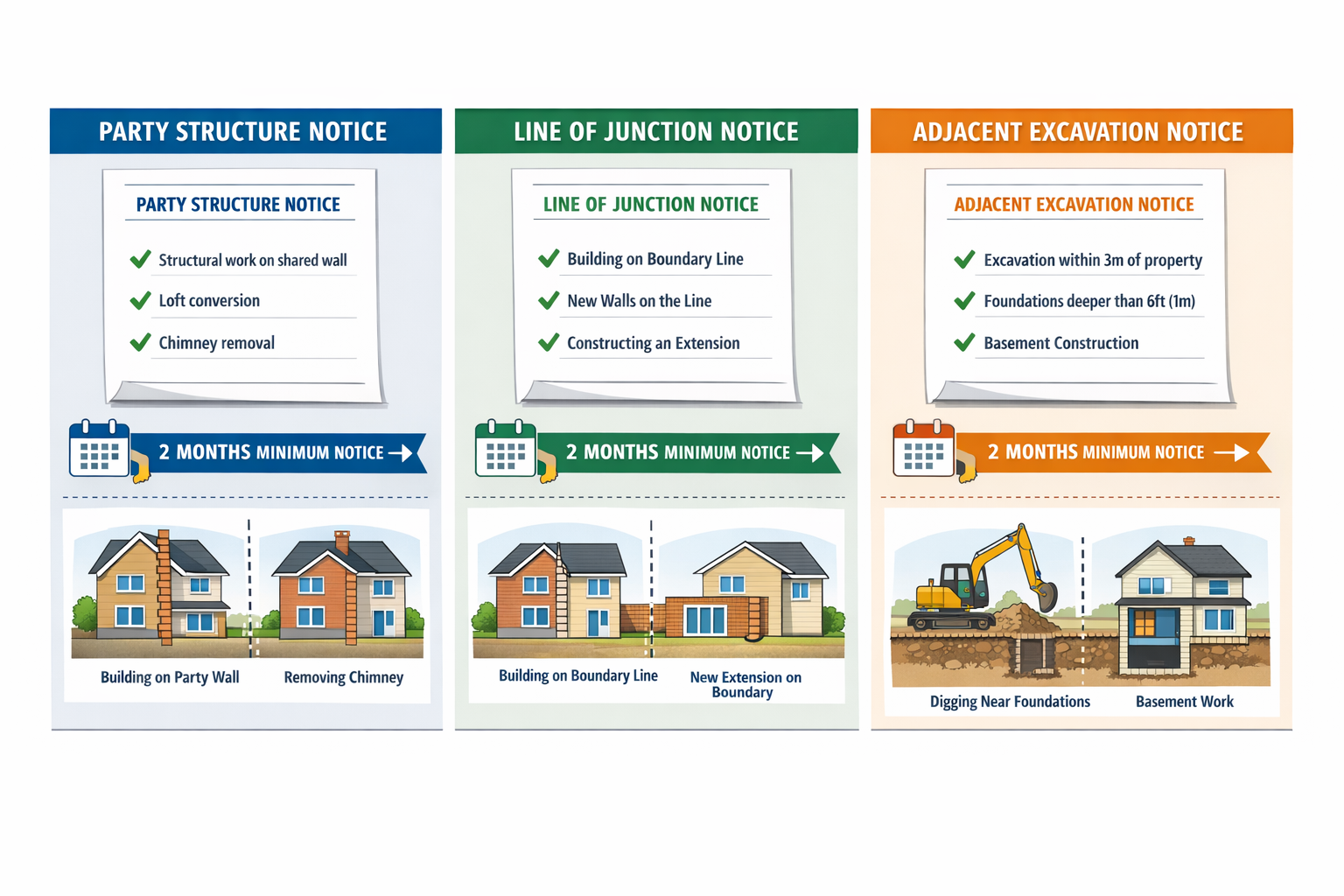
The Party Wall Act 1996 establishes three distinct notice categories, each addressing specific work types:
| Notice Type | When Required | Minimum Notice Period |
|---|---|---|
| Party Structure Notice | Work directly affecting party walls (cutting, raising, removing) | 2 months |
| Line of Junction Notice | Building new walls on boundary lines | 1 month |
| Adjacent Excavation Notice | Excavation within 3-6 metres of neighbouring structures | 1 month |
For most loft conversions in semi-detached or terraced properties, a Party Structure Notice is required when structural modifications affect the shared wall.[1]
Preparing and Serving Party Structure Notices
The notice preparation process requires careful attention to detail and comprehensive documentation:
Step 1: Document Proposed Works
Create detailed specifications including:
- Exact location of steel beam insertions
- Dimensions and depths of cuts into party walls
- Proposed wall height increases
- Timeline for commencement and completion
- Architectural drawings showing party wall modifications
Step 2: Serve Written Notice
The building owner must serve formal written notice to all adjoining owners at least two months before work begins. This timeline is non-negotiable and starting work prematurely constitutes a legal breach.[5]
The notice must include:
- Building owner’s name and address
- Description of proposed works
- Date work will commence
- Statement of adjoining owner’s rights under the Act
Step 3: Await Response
Adjoining owners have 14 days to respond in one of three ways:
- Consent in writing (simplest outcome, allows work to proceed)
- Dissent or request modifications (triggers surveyor appointment process)
- No response (legally constitutes dissent after 14 days)
Understanding what party wall act notices are and how to respond helps building owners anticipate potential outcomes and prepare accordingly.

The Party Wall Agreement Process: From Consent to Award
When adjoining owners consent immediately, the process concludes quickly with written permission documented. However, when consent isn’t forthcoming or modifications are requested, the formal surveyor appointment and award drafting process begins.
Appointing Party Wall Surveyors
The Act provides three surveyor appointment options:
Option 1: Agreed Surveyor
Both parties jointly appoint a single surveyor who acts impartially. This option typically costs less but requires mutual trust and agreement. Some homeowners successfully navigate having a party wall agreement without a surveyor when relationships are cooperative.[2]
Option 2: Two Surveyors (Most Common)
Each party appoints their own surveyor:
- The building owner appoints a building owner’s surveyor
- The adjoining owner appoints an adjoining owner’s surveyor
- The two surveyors work together to draft the award
Option 3: Third Surveyor
The two appointed surveyors may select a third surveyor to resolve disputes if they cannot reach agreement on specific award terms.
Understanding Party Wall Awards
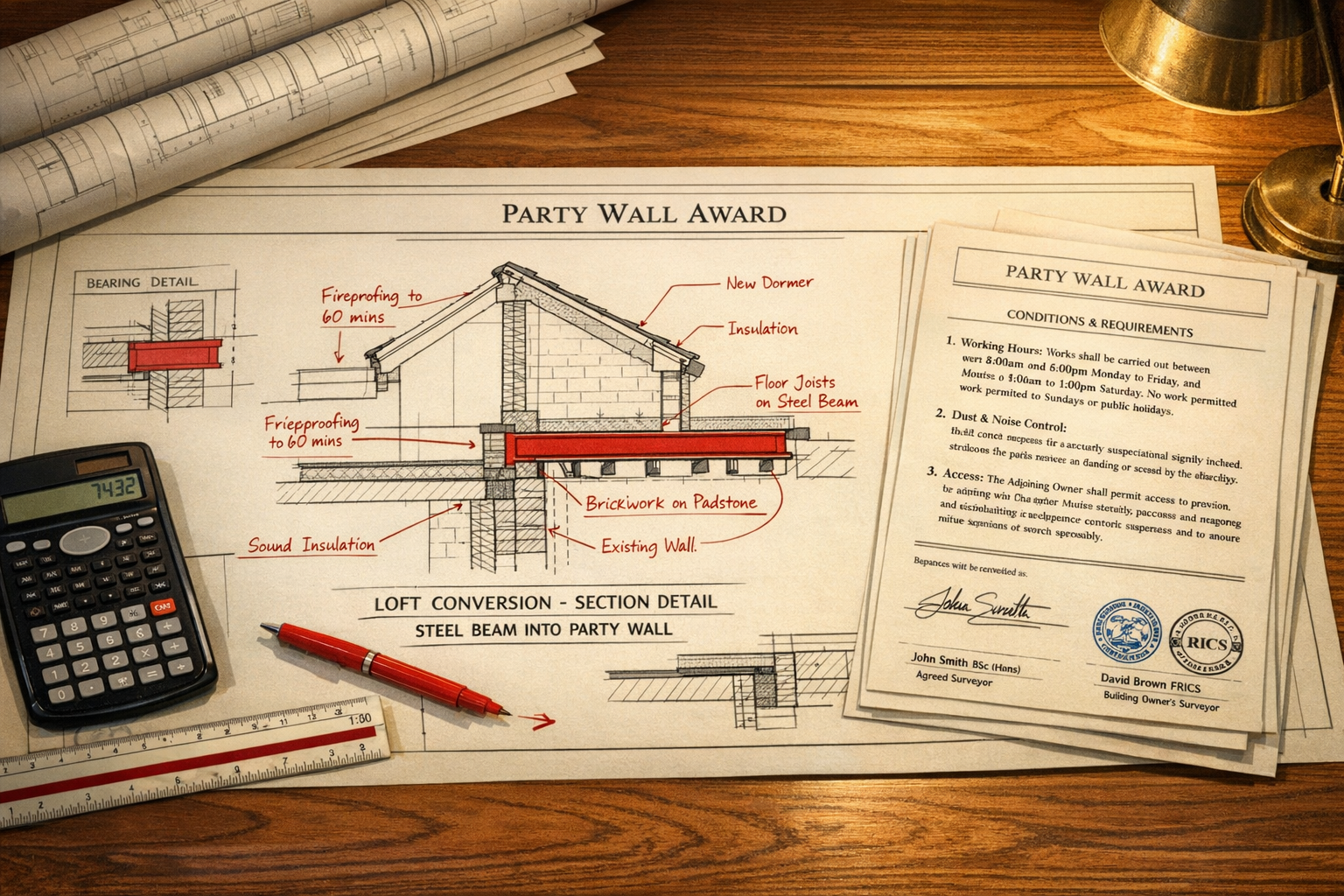
A party wall award is a legally binding document that specifies:
✅ Detailed work descriptions – Precise specifications of permitted activities
✅ Working hours and methods – Restrictions on noise, access, and construction techniques
✅ Schedule of condition – Photographic and written record of adjoining property’s current state
✅ Access arrangements – Rights to enter neighbouring property if necessary
✅ Protective measures – Required safeguards to prevent damage
✅ Cost allocation – Who pays for what aspects of the process
The party wall awards process typically takes 4-8 weeks from surveyor appointment to final award issuance, though complex cases may extend longer.
Schedule of Condition: Protecting All Parties
Before work commences, surveyors prepare a comprehensive schedule of condition documenting the adjoining property’s current state through:
- 📸 Detailed photographs of all rooms, particularly those adjacent to party walls
- 📝 Written descriptions of existing cracks, settlement, or defects
- 📐 Measurements and technical assessments of structural elements
- 🎥 Video documentation for comprehensive records
This baseline documentation proves invaluable if disputes arise regarding damage allegedly caused by conversion work. Without proper condition records, determining responsibility for cracks or structural issues becomes nearly impossible.
Essential Surveyor Roles and Responsibilities in Loft Conversion Projects
Professional surveyors serve as impartial technical experts who balance building owners’ rights to improve their properties against adjoining owners’ rights to protection from damage and disruption.
Key Surveyor Duties Throughout the Process
Initial Assessment Phase
Surveyors review architectural plans, assess structural implications, and determine appropriate protective measures. They identify potential risks to adjoining properties and recommend mitigation strategies.
Award Drafting Phase
Surveyors collaborate to create comprehensive awards addressing:
- Specific working methodologies
- Structural support requirements during construction
- Monitoring protocols for detecting movement or damage
- Dispute resolution procedures if problems arise
Construction Monitoring Phase
Surveyors may conduct site visits to verify compliance with award terms, though this isn’t always required. They remain available to address concerns or disputes during active construction.
Post-Completion Phase
Final inspections compare the adjoining property’s condition against the pre-work schedule of condition, determining whether any damage occurred and establishing responsibility for repairs.
Selecting Qualified Party Wall Surveyors
Choosing experienced professionals significantly impacts project outcomes. Consider these factors:
🎓 Qualifications and Memberships
Look for surveyors belonging to professional bodies like:
- Faculty of Party Wall Surveyors (FPWS)
- Royal Institution of Chartered Surveyors (RICS)
- Pyramus and Thisbe Club
📍 Local Knowledge
Surveyors familiar with local property construction methods and common issues provide more accurate assessments. For London projects, consider specialists in specific areas like party wall surveyor north London or party wall surveyor south London depending on project location.
💰 Transparent Fee Structures
Reputable surveyors provide clear fee schedules upfront. Understanding costs of party wall the process helps budget appropriately and avoid surprises.
⭐ Track Record
Request references from previous loft conversion clients and verify the surveyor’s experience with similar projects.
Managing Costs and Timelines for Party Wall Compliance
Financial planning for Party Wall Act compliance requires understanding both direct costs and potential timeline implications that affect overall project budgets.
Typical Cost Breakdown
Notice Preparation and Service: £200-£500
Basic costs for preparing and serving formal notices, including registered post delivery and documentation.
Surveyor Fees: £700-£1,500 per surveyor
Professional fees vary based on project complexity, property value, and regional rates. Building owners typically pay for both their own surveyor and the adjoining owner’s surveyor fees.[4]
Award Preparation: £500-£1,000
Costs for drafting comprehensive party wall awards, including technical specifications and legal documentation.
Schedule of Condition: £300-£800
Photographic and written documentation of adjoining property’s pre-work condition.
Total Typical Range: £2,000-£5,000
Individual costs apply for each notice served, so properties with multiple adjoining owners face proportionally higher expenses.[4] Homeowners can explore strategies for how to keep party wall costs down without compromising compliance quality.
Timeline Planning for Loft Conversion Projects
Proper Party Wall Act compliance adds minimum timeframes to project schedules:
Week 1-2: Notice Preparation
Gather architectural plans, prepare detailed work descriptions, and draft formal notices.
Week 3-4: Notice Service and Response Period
Serve notices and await 14-day response period from adjoining owners.
Week 5-12: Surveyor Appointment and Award Drafting
If consent isn’t immediate, surveyors are appointed and work together to draft awards (typically 4-8 weeks).
Week 13+: Work Commencement
Only after receiving written consent or formal party wall awards can structural work begin.
Starting the Party Wall Act process at least three months before planned construction provides adequate buffer for unexpected delays or complications.[5]
Common Pitfalls and How to Avoid Them
Understanding frequent mistakes helps building owners navigate the process smoothly and maintain positive neighbour relations.
Critical Mistakes to Avoid
❌ Starting Work Before Obtaining Proper Consent
Beginning structural work without written agreement or formal awards constitutes a legal breach, potentially resulting in injunctions forcing work stoppage and legal costs.
❌ Inadequate Notice Descriptions
Vague or incomplete work descriptions in notices create ambiguity and potential disputes. Provide comprehensive technical specifications with supporting drawings.
❌ Ignoring the Two-Month Minimum Period
The statutory two-month notice period for party structure work is mandatory and cannot be waived, even with neighbour agreement.[5]
❌ Failing to Document Pre-Work Conditions
Without thorough schedule of condition documentation, proving that damage existed before work began becomes impossible, leaving building owners liable for pre-existing issues.
❌ Choosing Unqualified Surveyors
Inexperienced surveyors may draft inadequate awards that fail to protect either party’s interests, leading to disputes and additional costs.
Best Practices for Smooth Party Wall Processes
✅ Communicate Early with Neighbours
Informal discussions before serving formal notices help build goodwill and may identify concerns that can be addressed proactively.
✅ Provide Comprehensive Documentation
Include detailed architectural drawings, structural engineer calculations, and clear work descriptions with notices.
✅ Budget Appropriately
Account for full Party Wall Act costs in project budgets, including potential surveyor fees for multiple adjoining owners.
✅ Select Experienced Professionals
Engage qualified party wall surveyors, structural engineers, and contractors familiar with Act requirements.
✅ Maintain Detailed Records
Document all communications, notices served, responses received, and surveyor correspondence throughout the process.
Regional Considerations for London Loft Conversions
London’s dense housing stock and diverse property types create unique Party Wall Act challenges that require specialized local knowledge.
London-Specific Factors
Victorian and Edwardian Terraces
Older properties often feature complex party wall arrangements with shared chimney stacks, interconnected roof structures, and historical modifications that complicate modern conversions.
Multiple Adjoining Properties
Mid-terrace properties require notices to adjoining owners on both sides, doubling surveyor costs and coordination complexity. Corner properties may have additional considerations for boundary walls.
Conservation Areas and Listed Buildings
Additional planning restrictions in conservation areas may affect loft conversion designs and party wall work specifications.
Regional Cost Variations
Party wall surveyor fees vary across London boroughs. Properties in central London or west London may face higher professional fees compared to outer boroughs.
Navigating Complex London Property Arrangements
London properties frequently present challenging scenarios:
Converted Flats in Period Houses
Determining which flat owners qualify as “adjoining owners” requiring notice can be complex when properties have been subdivided.
Shared Freeholds
Properties with shared freehold arrangements may have additional contractual obligations beyond statutory Party Wall Act requirements.
Commercial-Residential Mixed Use
Ground floor commercial premises with residential flats above require careful consideration of access rights and working hour restrictions.
Engaging surveyors with specific experience in London property types ensures appropriate handling of these regional complexities. The locations directory helps identify qualified professionals across different London areas.
Conclusion
Navigating Party Wall Act Basics for Loft Conversions: Notices, Agreements and Surveyor Essentials requires careful planning, proper documentation, and professional expertise. The statutory requirements exist to protect both building owners’ rights to improve their properties and adjoining owners’ rights to protection from damage and disruption.
Key action steps for successful Party Wall Act compliance:
-
Determine early whether your loft conversion triggers Party Wall Act requirements – Semi-detached and terraced properties with structural work affecting party walls almost certainly require formal notices
-
Serve proper notices with comprehensive work descriptions at least two months before planned construction – Adequate lead time prevents costly project delays
-
Engage qualified party wall surveyors with relevant experience and professional credentials to draft protective awards
-
Budget appropriately for full Party Wall Act costs including surveyor fees for all adjoining owners and schedule of condition documentation
-
Maintain detailed records and open communication with neighbours throughout the process to minimize disputes
-
Ensure thorough schedule of condition documentation before work commences to establish baseline property conditions
The Party Wall Act 1996 provides a balanced framework that enables property improvements while protecting all parties’ interests. Understanding these Party Wall Act Basics for Loft Conversions: Notices, Agreements and Surveyor Essentials transforms what seems like bureaucratic complexity into a manageable process that facilitates successful loft conversions.
For property owners planning loft conversions in 2026, early engagement with the Party Wall Act process represents an investment in project success, neighbour relations, and legal protection. The statutory procedures, while adding time and cost to projects, ultimately provide structure and certainty that benefit everyone involved.
Whether undertaking a modest dormer addition or extensive mansard conversion, proper Party Wall Act compliance ensures your loft transformation proceeds smoothly from initial notice through final completion.
References
[1] Party Wall Agreement Loft Conversion – houseup.co.uk
[2] Party Wall Agreement For Loft Extension Conversion – create-room.co.uk
[3] Loft Conversions And The Party Wall Act – peterbarry.co.uk
[4] Party Wall And Building Regulations For Your Loft Conversion – bespokelofts.co.uk
[5] Party Wall Surveyor Loft Conversion – biggerlivinglofts.com
Speak to a RICS chartered party wall surveyor
Free initial consultation. Notices, awards and schedules of condition across London and nationwide.