More than 60% of party wall disputes in 2026 stem from confusion about excavation rules and surveyor fees—two areas where homeowners consistently underestimate legal obligations and financial exposure. Whether planning a basement conversion, loft extension, or foundation work near a shared boundary, understanding the Party Wall Act has never been more critical as construction activity surges across UK housing markets.
This comprehensive guide addresses the Party Wall Act FAQs for 2026: Excavations, Alterations, and Surveyor Costs Answered, providing property owners with updated RICS guidance and current market realities. From the 3-metre and 6-metre excavation rules to who pays surveyor fees and what happens when neighbours disagree, this article compiles the most pressing questions affecting homeowners undertaking building work in 2026.
Key Takeaways
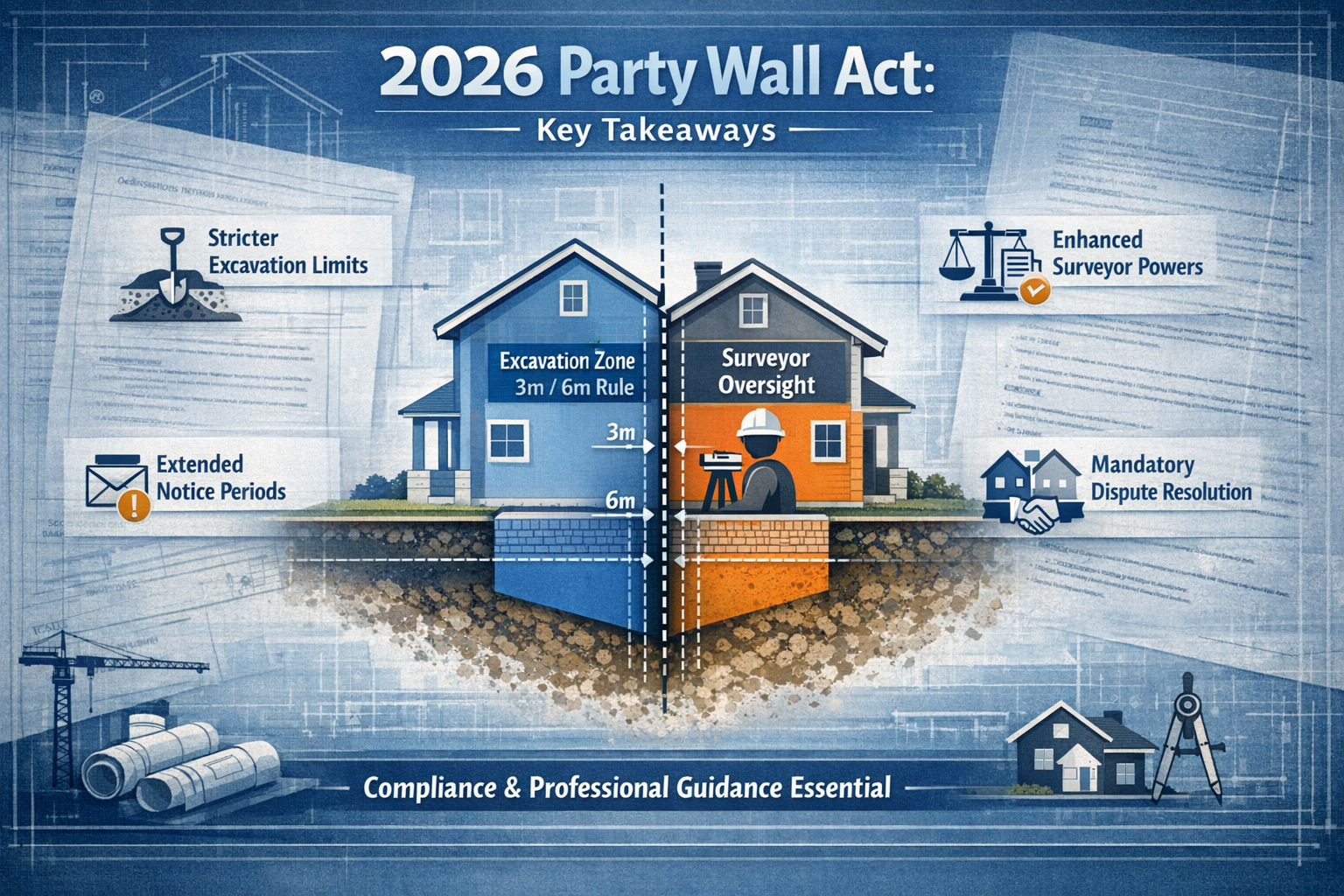
- Excavation depth triggers notices: Work exceeding 3 metres deep or within 6 metres of a neighbour’s structure requires formal Party Wall Notice under Sections 2 and 6 of the Act
- Building owners pay all costs: The property owner initiating construction bears full responsibility for both their own and the neighbour’s surveyor fees, typically ranging from £900 to £5,400 depending on project complexity
- Single surveyor arrangements save money: Appointing one impartial surveyor acting for both parties costs £900–£2,700, while dual surveyor appointments effectively double expenses
- Non-compliance carries severe penalties: Starting work without required notices can result in immediate injunctions, full liability for any damage, and loss of legal protections
- Fixed fees protect against overcharges: Reputable surveyors offer transparent pricing with no hidden charges, though hourly rates vary from £90 to £450 across the market
Understanding Party Wall Act Excavation Rules in 2026
The Party Wall etc. Act 1996 establishes specific thresholds that trigger mandatory notification requirements when excavating near neighbouring properties. These rules protect adjoining owners from structural damage while providing building owners with a clear legal framework for proceeding with construction work.
The Critical 3-Metre Excavation Rule
Under Section 2 of the Party Wall Act, any excavation exceeding 3 metres in depth requires the building owner to serve a Party Wall Notice to all adjoining owners whose land, buildings, or structures may be affected[5]. This applies regardless of how close the excavation occurs to the boundary line.
The notice must include detailed section drawings showing excavation depth and position relative to the adjoining owner’s structures[5]. This allows neighbours to assess potential risks to their property’s structural integrity and foundation stability.
When the 3-metre rule applies:
- Basement conversions extending below 3 metres
- Deep foundation work for multi-storey extensions
- Underground utility installations requiring significant depth
- Swimming pool excavations exceeding standard depths
Property owners frequently underestimate this requirement, assuming proximity to the boundary matters more than absolute depth. However, the Act specifically addresses deep excavations regardless of lateral distance, recognizing that subsurface work can affect neighbouring foundations through soil movement and water table changes.
The 6-Metre Adjacent Excavation Rule
Section 6 of the Act introduces a second critical threshold: if you’re digging foundations within 6 metres of a neighbour’s structure, you likely need to serve a Section 6 Notice for Adjacent Excavation and Construction[3]. This rule applies when your proposed foundation will be lower than your neighbour’s existing foundation base.
The 6-metre rule requires minimum one month’s notice before work begins[3], giving adjoining owners adequate time to review plans, appoint surveyors if necessary, and arrange pre-construction condition surveys.
Key requirements for Section 6 notices:
✅ Clear statement of proposed foundation depth
✅ Intended location of the new wall or structure
✅ Plans and sections detailing the excavation so neighbours can assess risk[3]
✅ Contact information for the building owner and their surveyor
✅ Explanation of the neighbour’s right to appoint their own surveyor
The interaction between the 3-metre and 6-metre rules often confuses homeowners. A basement extension 4 metres deep and 5 metres from the boundary would trigger both Section 2 (depth exceeds 3 metres) and Section 6 (within 6 metres of neighbour’s structure) requirements, necessitating comprehensive notice procedures.
For detailed guidance on serving these notices correctly, consult our complete guide to Party Wall notices.
Consequences of Failing to Serve Required Notices
Starting foundation work without serving required notices exposes building owners to severe legal and financial consequences. Neighbours can seek an injunction to stop work immediately, causing massive delays and increased costs[3]. Construction halts, contractors remain idle (often still billing), and project timelines collapse.
More significantly, without an agreed Party Wall Award, building owners become fully and solely liable for any damage[3]. The Act’s legal protections—which normally limit liability to damage directly caused by the notified work—disappear entirely. Property owners face potentially lengthy litigation without the structured dispute resolution procedures the Act provides.
Real-world impact of non-compliance:
- Immediate work stoppages costing thousands in contractor standby fees
- Personal liability for all structural damage, regardless of causation
- Loss of insurance coverage for party wall-related claims
- Neighbour legal costs added to building owner’s expenses
- Potential criminal penalties for deliberate non-compliance
Understanding the types of party wall works requiring notices helps property owners identify when formal procedures apply to their specific project.
Party Wall Act FAQs for 2026: Surveyor Costs and Payment Responsibilities
Surveyor costs represent one of the most frequently asked questions about party wall procedures. The 2026 market shows significant variation in pricing structures, making it essential for building owners to understand typical ranges and payment obligations.
Single Surveyor vs. Dual Surveyor Arrangements
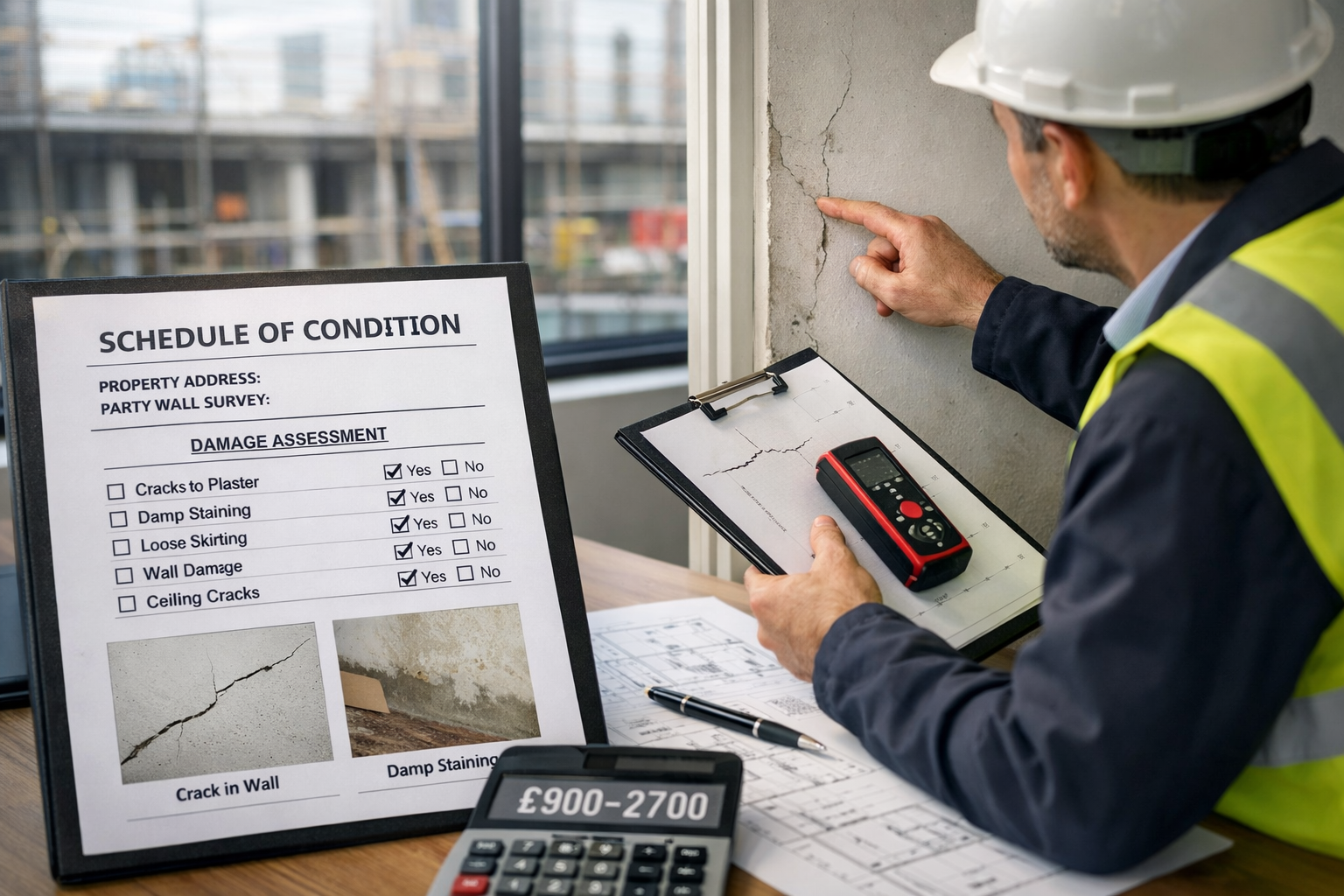
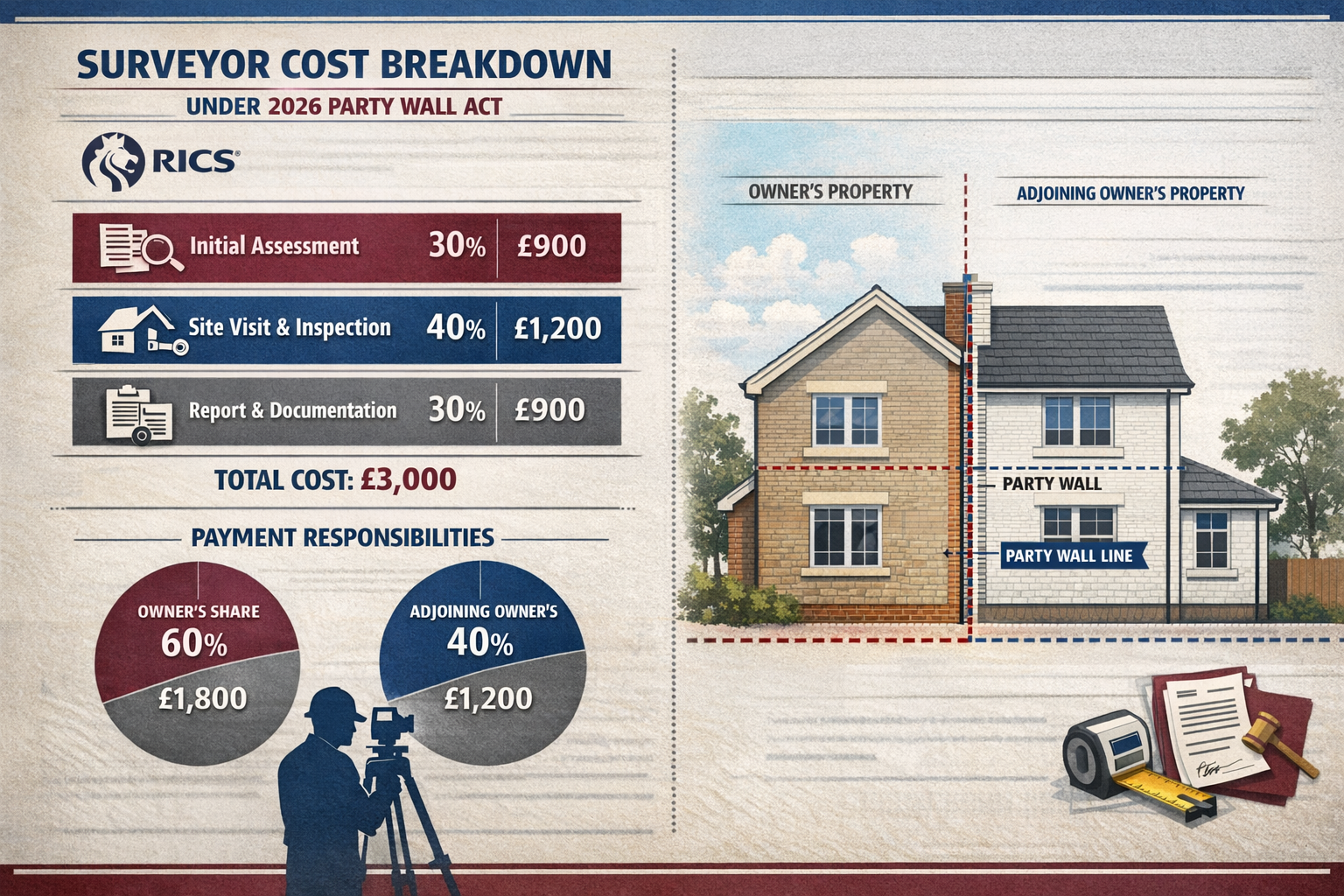
A party wall agreement with one impartial surveyor acting for both parties typically costs £900 to £2,700, with costs varying by project type[1][6]. As of April 2026, this remains the standard market rate across most UK regions[1].
Single surveyor cost breakdown by project type:
| Project Type | Typical Cost Range |
|---|---|
| Loft conversion | £900–£1,200 |
| Single-storey extension | £1,200–£1,500 |
| Basement conversion | £1,800–£2,700 |
When both neighbours appoint their own surveyors, total costs increase significantly to £1,800 to £5,400[1][6], effectively doubling expenses due to each party maintaining separate representation. While dual surveyor arrangements provide independent advocacy for each party, the financial impact can be substantial for straightforward projects.
For homeowners seeking cost-effective approaches, our guide on how to keep party wall costs down offers practical strategies for managing expenses without compromising legal compliance.
London-Specific Pricing and Regional Variations
In London, party wall agreement costs range from £750 to £1,800 per surveyor per affected neighbour[7]. Building owners must pay for both their own surveyor and the neighbour’s surveyor, with the complete process typically taking 2 to 4 months[7].
Regional pricing variations reflect local market conditions, surveyor availability, and property values. Central London commands premium rates due to higher operational costs and complex property configurations common in densely built urban areas.
Regional surveyor cost comparison (2026):
- 🏙️ Central London: £1,200–£1,800 per surveyor (Central London specialists)
- 🌆 North London: £900–£1,500 per surveyor (North London services)
- 🏘️ South London: £850–£1,400 per surveyor (South London experts)
- 🌇 East/West London: £800–£1,350 per surveyor (East London | West London)
Hourly Rates and Fee Structures
Party wall surveyors charge between £90 and £450 per hour as of 2026[1], though surveyors should only apply their full hourly rate to actual party wall work rather than the entire construction job[2]. This distinction matters significantly when reviewing invoices and fee proposals.
Schedule of Condition Reports represent an additional cost component, typically ranging from £450 to £2,000 depending on property size and complexity[2]. These specialist reports document pre-construction property conditions, requiring 1 to 3 hours of surveyor time for thorough assessment and photography.
All building owner and agreed party wall surveyor fees should be fixed with no hidden charges[2]. Reputable surveyors provide transparent pricing structures upfront, allowing property owners to budget accurately for the complete process.
Professional Tip: “Always obtain two or three estimates before proceeding with surveyor appointments. Fee variations often reflect experience levels and service comprehensiveness rather than pure market positioning.”[2]
For detailed cost breakdowns and budgeting guidance, visit our comprehensive costs guide.
Who Pays Party Wall Surveyor Fees?
The building owner planning the work pays all party wall surveyor costs associated with drawing up the Party Wall Agreement[1]. This includes fees for both the building owner’s surveyor and the adjoining owner’s surveyor—a frequently misunderstood aspect that catches property owners off-guard.
Payment responsibility breakdown:
✅ Building owner’s surveyor fees → Building owner pays
✅ Adjoining owner’s surveyor fees → Building owner pays
✅ Third surveyor fees (if required) → Building owner pays
✅ Schedule of Condition reports → Building owner pays
✅ Party Wall Award preparation → Building owner pays
However, in limited instances where a shared wall is in disrepair, costs may be split between parties if the cause of defect and wall use is shared[1]. These situations require careful assessment and typically involve repair works benefiting both properties equally.
Understanding who acts as the adjoining owner’s surveyor and their fee entitlements helps building owners anticipate total project costs accurately.
Common Party Wall Alterations and Notice Requirements
Beyond excavations, numerous alteration types trigger Party Wall Act requirements. Understanding which works require formal notices prevents compliance issues and maintains positive neighbour relations throughout construction projects.
Works Requiring Party Structure Notices
Section 1 of the Party Wall Act covers works directly affecting existing party walls, party structures, and party fence walls. These require Party Structure Notices served at least two months before work commences.
Common alterations requiring Party Structure Notices:
- Cutting into a party wall to install steel beams or joists
- Removing chimney breasts from party walls
- Increasing party wall height for loft conversions
- Underpinning party walls or foundations
- Inserting damp-proof courses through party structures
- Demolishing and rebuilding party walls
Property owners often assume minor alterations don’t require formal notices, but the Act applies broadly to any work affecting the structural integrity or load-bearing capacity of shared structures. Learn more about what constitutes a party structure and when notices become mandatory.
Building New Walls on Boundary Lines
Constructing a new wall directly on the boundary line between properties requires advance notice to adjoining owners, even when the wall stands entirely on the building owner’s land. The Act recognizes that boundary construction affects both properties’ future development rights and structural considerations.
New wall notice requirements:
- One month’s advance notice for new walls on boundary lines
- Specification of wall height, thickness, and materials
- Foundation depth and construction methodology
- Proposed position relative to the exact boundary line
Understanding boundary wall rules and the difference between party fence walls and boundary walls clarifies when Party Wall Act procedures apply versus when standard boundary dispute mechanisms govern.
Loft Conversions and Extension Projects
Loft conversions frequently trigger party wall requirements when work involves:
- Raising party wall height to accommodate increased head room
- Cutting into party walls for steel beam installation
- Underpinning party walls to support additional loads
- Installing new floor joists bearing onto party walls
Single and multi-storey extensions require notices when foundations fall within the 6-metre rule or when new structures physically connect to existing party walls. Even detached extensions may require notices if excavation depths exceed 3 metres.
For property owners uncertain whether their specific project requires formal procedures, our general FAQs address common scenarios and provide practical guidance.
Dispute Resolution and Third Surveyor Appointments
Despite the Act’s structured procedures, disagreements between surveyors occasionally arise. Understanding dispute resolution mechanisms helps building owners navigate these situations efficiently.
When Third Surveyors Become Necessary
If two separate party wall surveyors cannot reach agreement on specific aspects of the Party Wall Award, a third independent party wall surveyor is appointed to resolve the dispute and finalize the agreement[1]. This significantly increases total costs beyond the dual surveyor estimate[1].
Third surveyors act as arbitrators, reviewing both surveyors’ positions and making binding determinations on contested issues. Their fees add another layer of expense, typically ranging from £1,500 to £3,500 depending on dispute complexity and time required for resolution.
Common issues requiring third surveyor intervention:
- Disagreement over Schedule of Condition accuracy
- Disputes about necessary protective measures during construction
- Conflicts regarding working hours or access arrangements
- Contested damage assessments during or after construction
- Fee disputes between the two appointed surveyors
Agreed Surveyor Appointments
Many straightforward projects benefit from agreed surveyor arrangements, where both parties consent to a single impartial professional acting for both interests. This approach reduces costs, streamlines communication, and accelerates the overall process.
Agreed surveyors must maintain strict impartiality, providing balanced advice to both building and adjoining owners. They prepare a single Party Wall Award addressing all necessary protections and procedures, with both parties receiving identical documentation.
For guidance on whether agreed surveyor arrangements suit specific circumstances, explore our resources on having a party wall agreement without a surveyor and when professional appointments become essential.
Understanding Party Wall Awards
The Party Wall Award represents the formal legal document concluding the party wall process. It specifies:
- Detailed description of proposed works
- Protective measures required during construction
- Access arrangements for surveyors and contractors
- Schedule of Condition baseline documentation
- Working hours and noise limitation agreements
- Dispute resolution procedures if damage occurs
- Fee payment schedules and responsibilities
Awards become legally binding on both parties once issued, providing enforceable protections and obligations throughout the construction period. Understanding party wall awards and contract templates helps property owners recognize what constitutes adequate documentation.
Responding to Party Wall Notices as an Adjoining Owner
Receiving a Party Wall Notice from a neighbour initiating construction work requires prompt, informed response. Adjoining owners possess specific rights and face important decisions affecting their property protection.
Your Rights as an Adjoining Owner
When served with a valid Party Wall Notice, adjoining owners can:
✅ Consent to the proposed works, allowing them to proceed as described
✅ Dissent to the works, triggering the surveyor appointment process
✅ Request additional information about proposed construction methods
✅ Appoint their own surveyor at the building owner’s expense
✅ Require a Schedule of Condition documenting pre-construction property state
Adjoining owners should never feel pressured to consent immediately. Taking time to review plans, consult professionals, and understand implications protects long-term property interests.
The 14-Day Response Window
Most Party Wall Notices require responses within 14 days of service. Failing to respond within this timeframe constitutes deemed dissent, automatically triggering the surveyor appointment process.
While deemed dissent protects adjoining owners by ensuring professional oversight, explicit responses provide greater control over the process and surveyor selection.
Recommended response steps:
- Acknowledge receipt of the notice promptly
- Review all documentation thoroughly, noting any unclear aspects
- Consider appointing a surveyor for professional guidance
- Respond in writing before the 14-day deadline
- Keep copies of all correspondence for future reference
Our guide on how to respond to party wall notices provides detailed templates and practical advice for adjoining owners navigating this process.
Appointing Your Own Surveyor
Adjoining owners possess the absolute right to appoint their own surveyor, with all fees paid by the building owner initiating the works. This provides independent professional advocacy throughout the construction process.
Benefits of appointing your own surveyor:
- Independent assessment of proposed work risks
- Professional negotiation of protective measures
- Expert Schedule of Condition documentation
- Ongoing monitoring during construction
- Immediate response capability if damage occurs
When selecting a surveyor, adjoining owners should prioritize experience, local knowledge, and responsiveness. The surveyor becomes your advocate throughout the project, making their expertise and communication style critical factors.
For adjoining owners seeking comprehensive guidance, our adjoining owners resource center provides detailed information about rights, responsibilities, and best practices.
2026 Market Realities and RICS Guidance Updates
The party wall surveying landscape continues evolving in 2026, with updated professional standards and market dynamics affecting property owners undertaking construction work.
Current RICS Professional Standards
The Royal Institution of Chartered Surveyors (RICS) maintains professional standards governing party wall surveyor conduct, fee structures, and documentation requirements. These standards protect property owners from excessive charges and ensure consistent service quality across the profession.
Key RICS guidance for 2026:
- Surveyors must provide transparent fee proposals before appointment
- Conflicts of interest must be disclosed immediately
- Professional indemnity insurance remains mandatory for all practitioners
- Continuing professional development ensures current knowledge
- Complaints procedures provide recourse for service issues
Property owners should verify surveyor RICS membership and request evidence of professional indemnity insurance before proceeding with appointments.
Construction Boom Impact on Surveyor Availability
The 2026 UK construction boom, particularly in high-demand housing markets, has increased party wall surveyor workloads significantly[8]. This affects appointment availability and potentially extends timeline expectations for property owners planning work.
Market realities affecting 2026 projects:
- Extended lead times for surveyor appointments in busy markets
- Premium pricing in areas with acute surveyor shortages
- Increased importance of early planning and notice service
- Greater emphasis on agreed surveyor arrangements to reduce delays
Property owners should initiate party wall procedures 3 to 4 months before planned construction commencement to accommodate current market conditions and potential delays.
Fixed Fee Arrangements and Cost Transparency
Reputable surveyors increasingly offer fixed fee arrangements for standard project types, providing cost certainty and protecting against unexpected billing. These arrangements should specify:
- Total fee for complete service provision
- What services the fee includes and excludes
- Payment schedule and milestone triggers
- Additional cost triggers (if any)
- Fee adjustment mechanisms for scope changes
Typical fixed fee structures (2026):
- Party Wall Notice review and service: £65–£150 + VAT
- Complete party wall agreement (single surveyor): £950–£2,700 + VAT
- Schedule of Condition report: £450–£2,000 + VAT
- Dispute resolution and Award preparation: £1,200–£3,500 + VAT
These figures represent 2026 market rates, approximately 30% higher than 2020 levels due to inflation and increased professional indemnity insurance costs[2].
For current pricing information specific to your project type and location, visit our detailed costs breakdown.
Practical Tips for Smooth Party Wall Procedures
Successfully navigating party wall requirements involves more than legal compliance—it requires proactive communication, careful planning, and realistic expectation setting.
Early Neighbour Communication
Informal discussions with neighbours before serving formal notices often prevent disputes and facilitate agreed surveyor arrangements. Explaining project benefits, addressing concerns proactively, and demonstrating consideration for neighbour impacts builds goodwill throughout the construction period.
Effective neighbour communication strategies:
- Share preliminary plans informally before formal notice service
- Explain project timeline and expected disruption honestly
- Offer to fund Schedule of Condition reports proactively
- Provide direct contact information for questions or concerns
- Keep neighbours informed of progress and any timeline changes
While formal notice service remains legally required regardless of informal discussions, positive neighbour relations significantly reduce dispute likelihood and associated costs.
Realistic Timeline Planning
Party wall procedures add 2 to 4 months to project timelines[7], requiring adjustment to construction schedules and contractor coordination. Building owners should:
- Serve notices minimum 2 months before planned work commencement
- Allow additional time for surveyor appointments and negotiations
- Build flexibility into contractor booking schedules
- Communicate timeline expectations clearly to all parties
- Prepare contingency plans for potential delays
Rushing party wall procedures rarely succeeds and often creates unnecessary conflicts. Adequate time allocation demonstrates professionalism and respects neighbours’ legitimate interests.
Documentation and Record Keeping
Maintaining comprehensive records throughout party wall procedures protects all parties and facilitates dispute resolution if issues arise:
📋 Essential documentation to retain:
- All notices served and received (with proof of service)
- Surveyor appointment confirmations and fee agreements
- Complete Schedule of Condition reports with photographs
- Party Wall Award and all amendments
- Construction progress photographs
- All correspondence between parties and surveyors
- Payment records for surveyor fees and related costs
Digital copies stored securely ensure documentation availability years after construction completion, particularly valuable if latent defects emerge or property sales require disclosure of historical party wall procedures.
Conclusion
The Party Wall Act FAQs for 2026: Excavations, Alterations, and Surveyor Costs Answered demonstrates that successful navigation of party wall requirements depends on understanding excavation rules, realistic cost expectations, and proactive compliance strategies. The 3-metre and 6-metre excavation thresholds trigger mandatory notice requirements that building owners ignore at significant legal and financial peril.
Surveyor costs ranging from £900 for single surveyor arrangements to £5,400 for complex dual surveyor scenarios represent necessary investments in legal protection and neighbour relations. Building owners bear full financial responsibility for all surveyor fees, making cost-effective arrangements through agreed surveyors and fixed fee structures particularly valuable.
The 2026 construction boom increases the importance of early planning, with 3 to 4-month lead times now standard for complete party wall procedures. Property owners who serve notices promptly, communicate transparently with neighbours, and engage qualified surveyors early position their projects for smooth progression without costly delays or disputes.
Actionable Next Steps
✅ Assess your project against the 3-metre and 6-metre excavation rules immediately
✅ Obtain 2-3 surveyor quotes with fixed fee proposals before proceeding
✅ Serve required notices minimum 2 months before planned construction
✅ Consider agreed surveyor arrangements for straightforward projects
✅ Document everything from initial neighbour discussions through construction completion
For property owners currently planning construction work, beginning party wall procedures today prevents tomorrow’s complications. Whether undertaking basement conversions, loft extensions, or boundary construction, the Act’s requirements apply consistently across project types and property values.
Professional guidance from experienced party wall surveyors provides invaluable protection against the legal and financial consequences of non-compliance. The relatively modest investment in proper procedures delivers substantial returns through dispute prevention, liability limitation, and maintained neighbour relations throughout construction and beyond.
References
[1] Party Wall Surveyor Cost – hoa.org.uk
[2] Party Wall Surveyor Costs – designingbuildings.co.uk
[3] Excavation And The Party Wall Act Navigating The 3 And 6 Metre Rules For Foundations – partywallslimited.com
[4] Party Wall Agreements What You Need To Know – fmb.org.uk
[5] Party Wall Act 3 Metre Rule – iconsurveyors.co.uk
[6] Costs – westvilleassociates.com
[7] Party Wall Agreement London 2026 – mayfairstudio.co.uk
[8] Party Wall Surveys Amid 2026 Construction Boom Handling Disputes In High Demand Uk Housing Markets – https://nottinghillsurveyors.com/blog/party-wall-surveys-amid-2026-construction-boom-handling-disputes-in-high-demand-uk-housing-markets
Speak to a RICS chartered party wall surveyor
Free initial consultation. Notices, awards and schedules of condition across London and nationwide.