
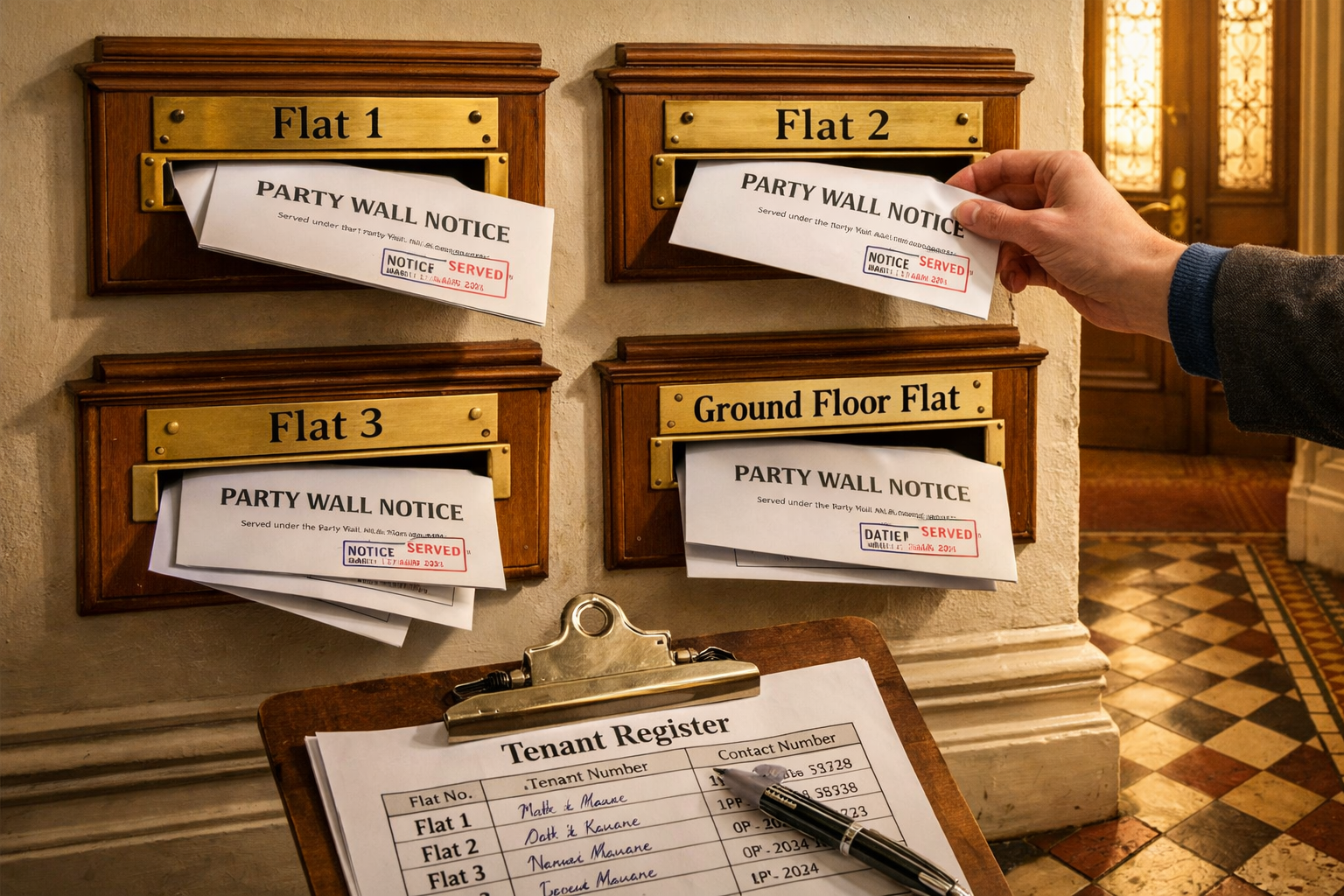
Over 60% of party wall disputes in converted flats and multi-occupancy buildings stem from incomplete notice service to all affected parties—a costly oversight that can invalidate entire awards and delay construction projects for months. When a Victorian terrace house has been split into four separate flats, each with different ownership structures, the seemingly straightforward process of serving a party wall notice transforms into a legal maze requiring precision, strategy, and comprehensive understanding of both freehold and leasehold complexities.
Party Wall Awards in Multi-Owner Properties: Navigating Freehold and Leasehold Complexities represents one of the most challenging aspects of construction law in 2026, particularly as urban areas continue densifying and property ownership structures become increasingly fragmented. The stakes are high: miss a single adjoining owner in your notice service, and the entire award may be deemed invalid, exposing building owners to significant legal and financial consequences.
Key Takeaways
- Multiple notice service is mandatory: Every adjoining owner—whether freeholder, leaseholder, or shared freeholder—must receive proper written notice at least 2 months before work begins[1]
- Ownership structures matter: Freehold, leasehold, and shared freehold arrangements each require different approaches to notice service and consent collection
- Award clauses need collective protection: Party Wall Awards must include specific provisions addressing multi-party consents and dispute resolution mechanisms
- Surveyor selection impacts outcomes: Choosing experienced surveyors familiar with multi-owner scenarios ensures legally robust awards and smoother processes
- 2026 legislative changes: New tenant rights provisions have repositioned leaseholder interests as central to party wall procedures in institutional buy-to-let arrangements[2]
Understanding Party Wall Awards in Multi-Owner Contexts
A Party Wall Award is a legally binding document prepared by appointed party wall surveyors that sets out the rights and responsibilities of all parties involved in construction work affecting shared structures. In single-owner scenarios—such as two detached houses sharing a boundary—the process remains relatively straightforward. However, multi-owner properties introduce layers of complexity that demand specialized knowledge and meticulous attention to detail.
What Constitutes a Multi-Owner Property?
Multi-owner properties typically include:
- Converted flats in period buildings (Victorian terraces, Georgian townhouses)
- Purpose-built apartment blocks with multiple leaseholders
- Mixed-use buildings combining commercial and residential units
- Properties with shared freehold arrangements
- Buildings with multiple long leaseholders and separate freeholders
- Tenement buildings common in urban areas
Each ownership type presents unique challenges when serving notices and securing consents for party wall awards.
The Legal Framework in 2026
The Party Wall etc. Act 1996 remains the primary legislation governing party wall matters in England and Wales[3]. However, 2026 has seen significant developments, particularly regarding tenant rights. Recent legislative changes have repositioned tenant rights as central to all party wall notices and procedures for institutional buy-to-let arrangements[2], meaning that leaseholders now have enhanced protections and must be treated as primary stakeholders rather than secondary parties in the notice process.
Key statutory requirements include:
- ✅ Written notice served at least 2 months before work begins (1 month for certain work types)[1][3]
- ✅ Adjoining owners have 14 days to respond to notices[1][3]
- ✅ Failure to respond triggers the dispute resolution process automatically
- ✅ All affected parties must receive individual notice—collective notices to “all residents” are insufficient
Identifying All Adjoining Owners: The Critical First Step
The foundation of any valid party wall process in multi-owner properties lies in correctly identifying every single adjoining owner who must receive notice. This seemingly simple task becomes remarkably complex in converted buildings and mixed-ownership scenarios.
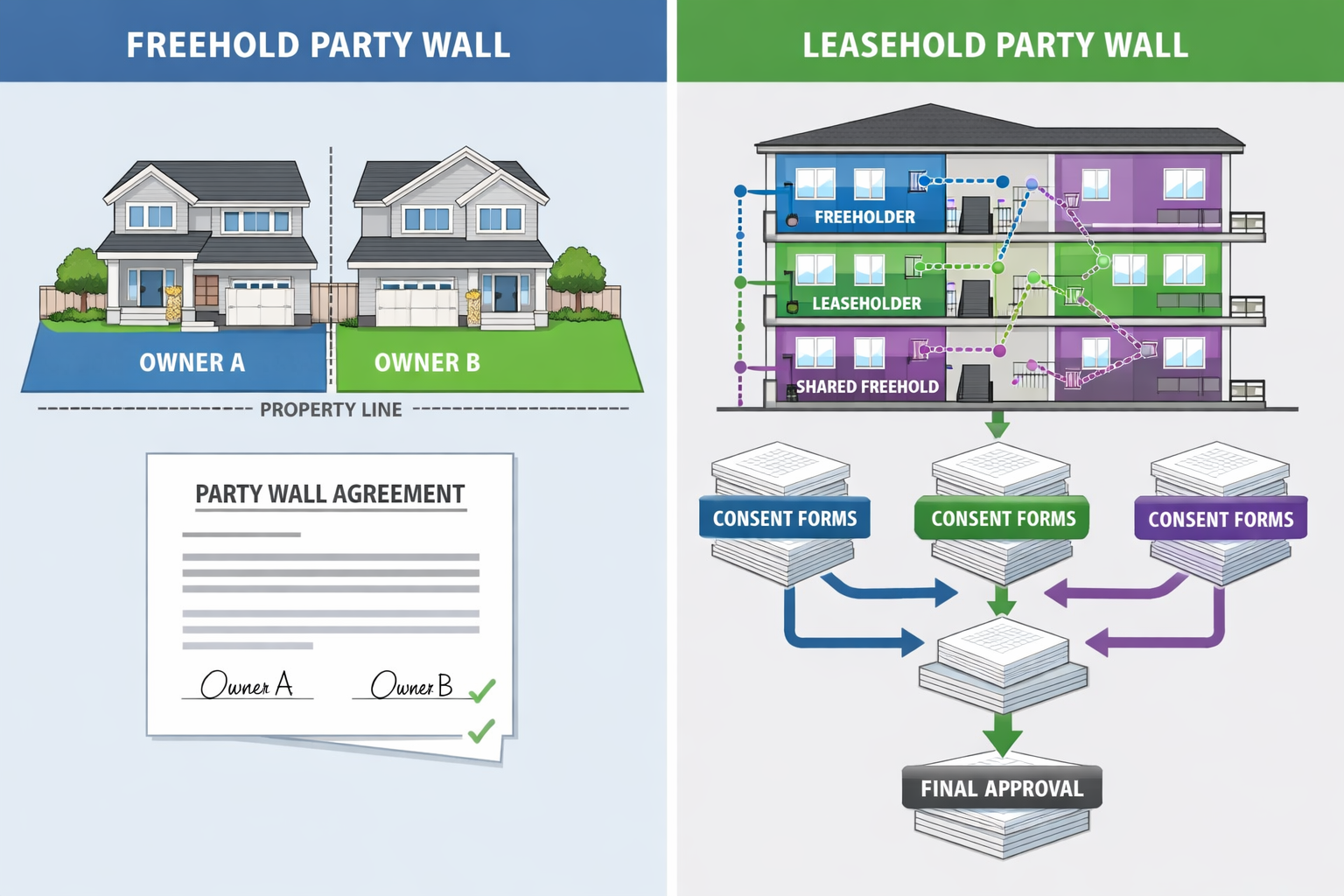
Freehold vs. Leasehold: Who Receives Notice?
Understanding the distinction between freeholders and leaseholders determines your notice service strategy:
| Ownership Type | Notice Requirements | Consent Authority | Common Scenarios |
|---|---|---|---|
| Freeholder | Must always receive notice | Full authority to consent or dissent | Single-family homes, landlords of converted properties |
| Long Leaseholder (80+ years) | Must receive notice as “owner” under the Act | Authority to consent for their demise | Flat owners in converted buildings |
| Short Leaseholder | Generally not served (freeholder receives notice) | Limited authority | Tenants with leases under 7 years |
| Shared Freeholder | Each freeholder must receive individual notice | Collective consent required | Properties owned jointly by multiple parties |
Important distinction: Under the Party Wall Act, “owner” includes not just freeholders but also leaseholders with unexpired terms of more than one year[3]. This means in a converted Victorian house with four flats, you may need to serve notice to:
- The freeholder (if they retain ownership)
- Each of the four long leaseholders
- Any intermediate leaseholders (rare but possible)
Conducting Thorough Title Searches
Professional party wall surveyors in multi-owner scenarios must conduct comprehensive Land Registry searches to identify:
- Registered proprietors of each title
- Lease terms and conditions affecting party wall rights
- Restrictive covenants that may impact works
- Shared freehold arrangements and management companies
- Intermediate interests (head leases, sub-leases)
Missing even one adjoining owner can invalidate the entire process. For complex properties in areas like Central London or North London, professional title investigation becomes essential.
Serving Notices to Multiple Adjoining Owners
Once all adjoining owners are identified, the building owner must serve proper written notice to each party individually. The notice service process in multi-owner properties requires careful coordination and documentation.
Notice Service Methods and Evidence
Valid service methods include:
- 📬 Recorded delivery post (provides proof of service)
- 🤝 Hand delivery with signed acknowledgment
- 📧 Email (if recipient agrees to electronic service)
- 📋 Leaving notice at the property (least reliable method)
For multi-owner properties, recorded delivery to each individual owner provides the strongest evidence of proper service. Maintain a detailed log including:
- Date and time of service
- Method used
- Recipient details
- Tracking numbers or delivery confirmations
- Copies of all notices served
Staggered Responses and Timeline Management
When serving notices to multiple adjoining owners, responses rarely arrive simultaneously. Each owner has 14 days from receipt to respond[1], creating potentially staggered timelines:
Example scenario: Building owner serves notice to four flat owners on March 1st:
- Flat 1 owner responds with consent on March 10th
- Flat 2 owner doesn’t respond (deemed dissent after 14 days)
- Flat 3 owner dissents on March 8th
- Flat 4 owner requests clarifications, responds March 14th
This creates multiple parallel processes that must be managed simultaneously. Professional surveyors track each response timeline separately while coordinating the overall award process.
Party Wall Awards in Multi-Owner Properties: Drafting Collective Consent Clauses
Creating a legally robust Party Wall Award for multi-owner properties requires specialized clauses that address collective interests while protecting individual rights.
Essential Award Components for Multi-Owner Scenarios
A comprehensive Party Wall Award for multi-owner properties must include:
1. Identification of All Parties
The award must clearly identify:
- Building owner(s) and their legal status
- Each adjoining owner by name and property description
- Surveyor appointments for each party
- Any agreed surveyor acting for multiple parties
2. Scope of Works Provisions
Detailed descriptions of types of party wall works must specify:
- Which party walls or structures are affected
- How works impact each individual property
- Access requirements through multiple properties
- Timing and sequencing to minimize disruption
3. Collective Consent Mechanisms
Critical clauses for multi-owner awards include:
“Where works affect common elements serving multiple adjoining owners, the building owner shall not proceed until all affected owners have either consented or the dispute resolution process has concluded for each party.”
This prevents scenarios where work begins after receiving consent from some owners but not others, which could expose the building owner to claims from non-consenting parties.
4. Damage and Compensation Provisions
Multi-owner awards require nuanced approaches to damage assessment:
- Individual schedules of condition for each affected property
- Separate compensation mechanisms for each owner
- Collective damage provisions for shared elements (common staircases, shared roofs)
- Clear liability allocation when damage affects multiple properties
5. Access Rights and Restrictions
When building works require access through multiple properties:
✓ Specify which properties require access
✓ Define access routes and timing windows
✓ Establish protocols for key holding and security
✓ Address insurance requirements for access
✓ Include provisions for alternative access if one owner refuses
Handling Dissenting Owners in Multi-Party Scenarios
When one or more adjoining owners dissent (or fail to respond within 14 days[1]), the dispute resolution process begins. In multi-owner properties, this can create complex situations:
Scenario A: Single Dissenting Owner
- Dissenting owner appoints their own surveyor
- Consenting owners may share an agreed surveyor
- Two surveyors (or three if they appoint a third surveyor) prepare the award
- Award binds all parties, including dissenters
Scenario B: Multiple Dissenting Owners
- Each dissenting owner may appoint separate surveyors
- Multiple surveyors must coordinate to produce a single coherent award
- Increased complexity and potential for disagreements among surveyors
- Higher costs distributed according to the award terms
Cost Allocation in Multi-Owner Awards
The building owner typically pays for the party wall process, including surveyor fees[3]. However, multi-owner scenarios introduce questions about cost distribution:
Standard approach: Building owner pays all reasonable surveyor fees, including:
- Building owner’s surveyor fees (£150-£200 per hour)[3]
- Adjoining owners’ surveyor fees
- Third surveyor fees (if appointed)
- Total award costs typically around £1,000 for straightforward cases[3]
Complex multi-owner scenarios can significantly increase costs:
- Multiple adjoining owners with separate surveyors
- Extended negotiation periods
- Detailed condition surveys for multiple properties
- Ongoing monitoring during extended construction periods
For guidance on managing expenses, review strategies for keeping party wall costs down.
Shared Freehold Arrangements: Special Considerations
Shared freehold properties—where multiple parties jointly own the freehold—present unique challenges for party wall procedures. These arrangements are increasingly common in converted buildings where flat owners have collectively purchased the freehold.
Notice Service to Shared Freeholders
When the adjoining property has shared freehold ownership:
❌ Incorrect approach: Serving notice to “The Freeholders” or the management company
✅ Correct approach: Serving individual notice to each named freeholder
Example: A converted house has four flats with shared freehold owned by all four flat owners. The building owner next door must serve four separate notices—one to each freeholder—even though they collectively own the same property.
Collective Decision-Making Processes
Shared freeholders typically have agreements governing collective decisions. Party wall matters may require:
- Unanimous consent from all freeholders
- Majority consent (e.g., 75% agreement)
- Delegated authority to a management company or designated representative
Critical surveyor strategy: Review the shared freeholders’ agreement or articles of association to understand decision-making requirements. The Party Wall Award should acknowledge these internal governance structures while ensuring statutory compliance.
Conflict Resolution Among Shared Freeholders
Disagreements among shared freeholders about party wall matters create challenging situations:
Scenario: Four shared freeholders receive notice; three consent, one dissents.
Resolution approach:
- The dissenting freeholder appoints their own surveyor
- The three consenting freeholders may appoint a shared surveyor or consent without appointment
- Surveyors prepare an award that binds all parties
- The dissenting freeholder’s concerns are addressed through award conditions
This process respects individual freeholder rights while allowing the majority to proceed, preventing a single freeholder from blocking reasonable works.

Surveyor Strategies for Flats and Tenements
Professional party wall surveyors specializing in multi-owner properties employ specific strategies to ensure legally airtight awards and smooth processes.
Pre-Notice Consultation and Stakeholder Mapping
Best practice approach:
- Conduct comprehensive title research before serving notices
- Create stakeholder maps identifying all owners and their relationships
- Hold pre-notice consultations with building owners to explain the multi-party process
- Develop service strategies tailored to the specific ownership structure
- Anticipate potential objections and prepare mitigation strategies
Experienced surveyors in areas like East London and South London, where converted properties are common, develop specialized knowledge of local ownership patterns and common issues.
Coordinating Multiple Schedules of Condition
In multi-owner properties, separate schedules of condition must be prepared for each affected property:
Efficient coordination strategies:
- 📅 Schedule consecutive inspection appointments
- 📸 Use standardized photographic documentation methods
- 📊 Employ consistent condition assessment criteria
- 💾 Maintain centralized digital records accessible to all surveyors
- 🔄 Coordinate with multiple adjoining owners’ surveyors
Time-saving tip: When multiple properties have similar layouts (common in converted buildings), template condition reports can be adapted for each unit while ensuring property-specific details are accurately captured.
Managing Communications with Multiple Parties
Clear communication protocols prevent misunderstandings and delays:
Effective communication framework:
| Communication Type | Method | Frequency | Recipients |
|---|---|---|---|
| Formal notices | Recorded delivery | As required by Act | Individual owners |
| Progress updates | Email summaries | Weekly during active works | All parties |
| Inspection arrangements | Direct contact | As needed | Individual owners |
| Award drafts | Secure document sharing | Draft and final versions | All surveyors |
| Dispute notifications | Formal written notice | As issues arise | Affected parties |
Drafting Awards for Legal Robustness
Surveyors must ensure awards withstand potential legal challenges:
Key robustness strategies:
✅ Precise party identification: Full legal names, addresses, and property descriptions
✅ Clear work descriptions: Detailed specifications leaving no ambiguity about scope
✅ Comprehensive condition records: Thorough documentation of pre-work conditions
✅ Explicit consent acknowledgments: Clear statements of each party’s agreement or dissent
✅ Defined dispute resolution processes: Procedures for handling post-award disagreements
✅ Realistic timelines: Achievable schedules considering multi-party coordination
Addressing Leasehold-Specific Concerns
Leaseholders have particular concerns that surveyors must address:
Common leaseholder concerns:
- 🏠 Structural integrity: Ensuring works don’t compromise building stability
- 💰 Property value: Protecting against devaluation from construction impacts
- 🔊 Noise and disruption: Minimizing disturbance during works
- 🚪 Access and security: Protecting privacy and security during access periods
- 📋 Lease compliance: Ensuring works don’t breach lease covenants
Surveyor response strategies:
- Include detailed condition monitoring provisions
- Specify working hours and noise limitations
- Establish clear access protocols with advance notice requirements
- Review lease terms for relevant restrictions
- Include compensation mechanisms for excessive disruption
The 2026 legislative changes have reinforced these protections, particularly in institutional buy-to-let arrangements where tenant rights are now central to party wall procedures[2].
Practical Case Studies: Multi-Owner Award Scenarios
Case Study 1: Victorian Terrace Conversion (Four Flats)
Situation: Building owner wants to extend at rear, affecting party wall with neighboring converted terrace containing four long leasehold flats.
Ownership structure:
- Freeholder: Institutional landlord
- Four leaseholders with 125-year leases
Notice service approach:
- Notices served to all four leaseholders (as “owners” under the Act)
- Notice also served to freeholder (as reversionary interest holder)
- Total of five notices served
Outcome:
- Three leaseholders consented
- One leaseholder dissented, appointed surveyor
- Freeholder consented without surveyor appointment
- Award prepared by building owner’s surveyor and dissenting leaseholder’s surveyor
- Award included individual schedules of condition for all four flats
- Works proceeded with comprehensive monitoring provisions
Case Study 2: Shared Freehold with Mixed Responses
Situation: Building owner serving notice on adjoining property with three shared freeholders.
Challenges:
- One freeholder abroad, difficult to contact
- One freeholder immediately consented
- One freeholder raised concerns about structural impact
Resolution strategy:
- Individual notices served to all three freeholders via recorded delivery
- Absent freeholder’s notice sent to property and last known email
- Concerned freeholder appointed surveyor after consultation
- Consenting freeholder chose not to appoint separate surveyor
- Award addressed structural concerns through enhanced monitoring
- Works proceeded with all parties’ interests protected
Case Study 3: Purpose-Built Block with Management Company
Situation: Works affecting purpose-built apartment block with 12 flats and professional management.
Complexity factors:
- Mix of owner-occupiers and buy-to-let investors
- Management company handles building maintenance
- Some owners difficult to locate
Surveyor approach:
- Coordinated with management company to identify all leaseholders
- Served notices to all 12 leaseholders individually
- Offered shared surveyor appointment for consenting owners
- Eight owners consented and appointed shared surveyor
- Four owners dissented or didn’t respond, appointed separate surveyors
- Three surveyors coordinated to produce comprehensive award
- Management company assisted with access coordination
Common Pitfalls and How to Avoid Them
❌ Pitfall 1: Incomplete Notice Service
Problem: Failing to identify and serve notice to all adjoining owners
Consequence: Invalid award, potential injunctions, project delays
Solution: Conduct thorough title searches and serve individual notices to every identified owner
❌ Pitfall 2: Treating Management Companies as Owners
Problem: Serving notice only to the management company instead of individual owners
Consequence: Non-compliance with statutory requirements, invalid notices
Solution: Serve notices to individual leaseholders/freeholders; management companies may facilitate but cannot substitute for proper service
❌ Pitfall 3: Inadequate Award Clauses for Collective Scenarios
Problem: Using standard two-party award templates for multi-owner situations
Consequence: Ambiguity about rights and obligations, increased dispute risk
Solution: Use specialized multi-party award templates with collective consent and coordination clauses
❌ Pitfall 4: Poor Timeline Coordination
Problem: Failing to account for staggered response deadlines from multiple owners
Consequence: Confusion about when works can commence, potential premature work start
Solution: Track each owner’s response deadline separately; commence only after all processes conclude
❌ Pitfall 5: Insufficient Communication
Problem: Inadequate updates to multiple parties during the process
Consequence: Misunderstandings, increased tensions, potential disputes
Solution: Establish regular communication protocols and provide consistent updates to all parties
The Role of Professional Surveyors in Multi-Owner Scenarios
Given the complexities outlined, professional party wall surveyors become essential for multi-owner properties. Their expertise ensures:
🔍 Comprehensive due diligence: Identifying all affected parties through proper title investigation
📋 Proper documentation: Preparing legally compliant notices and awards
⚖️ Impartial assessment: Providing objective evaluations when appointed as agreed surveyors
🤝 Dispute resolution: Facilitating agreement among multiple parties with different interests
💼 Risk management: Protecting building owners from legal challenges and project delays
When selecting surveyors for multi-owner scenarios, consider:
- Experience with complex ownership structures: Track record with conversions, shared freeholds, and tenements
- Local knowledge: Familiarity with area-specific ownership patterns (particularly important in areas like West London)
- Communication skills: Ability to coordinate multiple parties effectively
- Attention to detail: Thoroughness in identifying all affected parties
- Professional qualifications: Membership in relevant professional bodies (RICS, FPWS)
For building owners undertaking works, understanding the building owner’s role and the building owner’s surveyor’s responsibilities is crucial. Similarly, adjoining owners should understand their rights and the role of adjoining owners’ surveyors.
Conclusion: Achieving Airtight Legal Protection in Multi-Owner Party Wall Awards
Party Wall Awards in Multi-Owner Properties: Navigating Freehold and Leasehold Complexities demands meticulous attention to detail, comprehensive understanding of ownership structures, and strategic coordination among multiple stakeholders. The risks of incomplete notice service or inadequate award provisions are too significant to approach casually—particularly in 2026’s evolving legislative landscape where tenant and leaseholder rights have gained enhanced protections.
Key Success Factors
✅ Identify every adjoining owner through thorough title searches and due diligence
✅ Serve individual notices to each owner using trackable methods with proper documentation
✅ Employ specialized award clauses addressing collective consents and multi-party coordination
✅ Engage experienced surveyors with proven expertise in complex ownership scenarios
✅ Maintain clear communication throughout the process with all affected parties
✅ Prepare comprehensive schedules of condition for each affected property
✅ Build realistic timelines accounting for multiple response deadlines and coordination requirements
Actionable Next Steps
If you’re planning works affecting multi-owner properties:
- Conduct preliminary title research to understand the ownership structure before committing to project timelines
- Consult with experienced party wall surveyors early in the planning process
- Budget appropriately for potentially higher surveyor fees in multi-party scenarios
- Build extra time into project schedules to accommodate complex notice and award processes
- Review available resources such as sample party wall agreement templates and guides on the Party Wall Act
- Understand the full scope of party wall costs and processes
The complexity of multi-owner party wall scenarios should not deter necessary building works, but it demands respect for proper procedures and professional expertise. With careful planning, thorough notice service, and comprehensive award provisions, building owners can achieve legally robust protection while maintaining positive relationships with all adjoining owners—whether they hold freehold, leasehold, or shared ownership interests.
For property owners facing these complexities, professional guidance isn’t just advisable—it’s essential for protecting your interests and ensuring your project proceeds smoothly from notice service through completion.
References
[1] Understanding Party Wall Act What Homeowners Need Know Before Renovating – partywallslimited.com
[2] Party Wall Surveys For Renters Rights Act Compliance Managing Notices When Landlord Initiated Works Face New Section 8 Ground Requirements – https://nottinghillsurveyors.com/blog/party-wall-surveys-for-renters-rights-act-compliance-managing-notices-when-landlord-initiated-works-face-new-section-8-ground-requirements
[3] Party Wall Agreement – hoa.org.uk
Speak to a RICS chartered party wall surveyor
Free initial consultation. Notices, awards and schedules of condition across London and nationwide.