
More than 60% of construction projects involving shared walls face delays or legal challenges due to improperly served party wall notices. When cutting into party walls to insert beams, install damp-proof courses, or make structural alterations, understanding Party Wall Notices for Cutting into Shared Walls: Legal Requirements and Surveyor Checks becomes essential for avoiding costly project stoppages and neighbour disputes.
The Party Wall etc. Act 1996 governs all work affecting shared structures in England and Wales, establishing strict notice requirements, response timelines, and surveyor oversight protocols. Missing a single mandatory element in your notice can render it invalid, triggering immediate work stoppages even when construction is already underway.
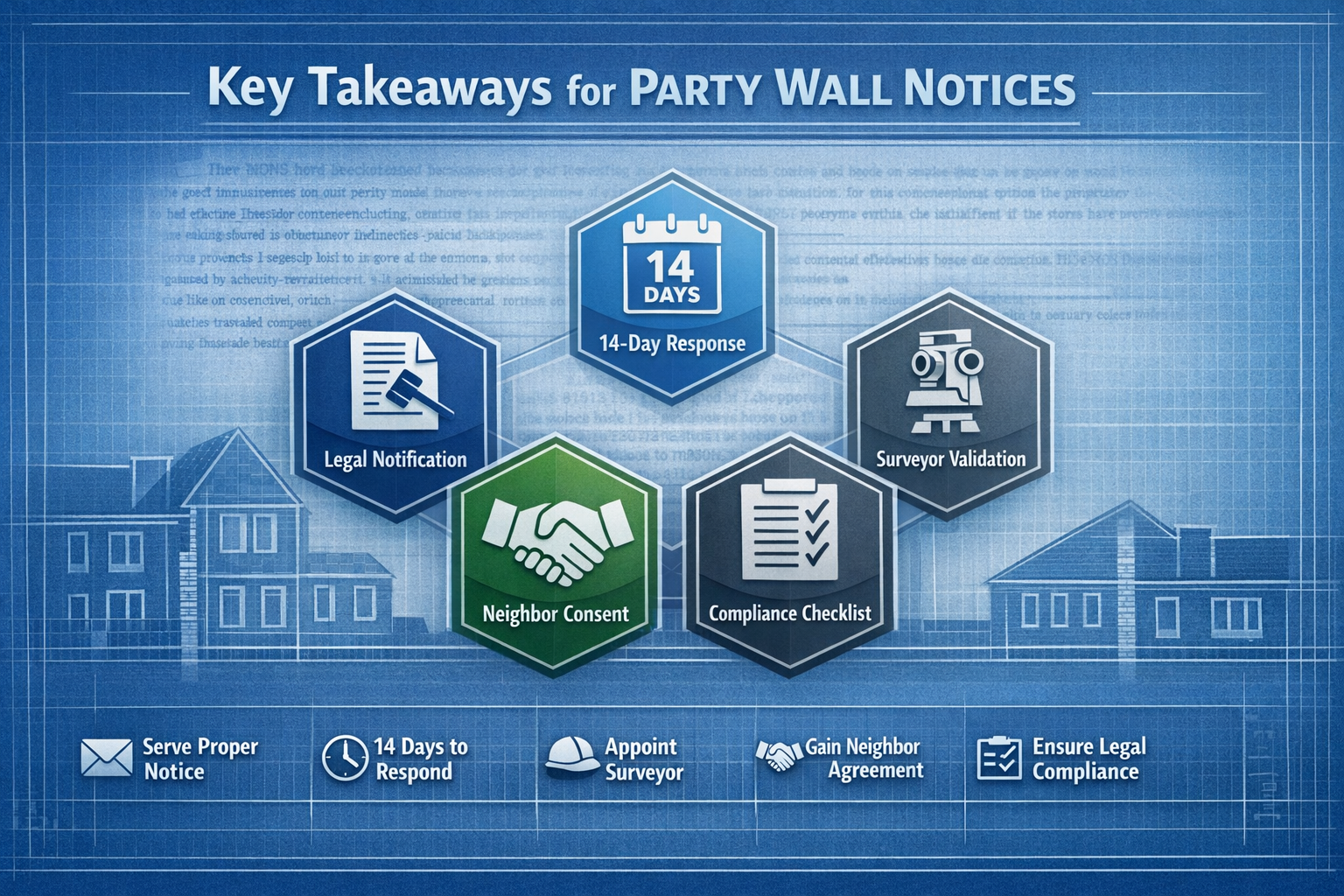
Key Takeaways
- Section 2 of the Party Wall Act 1996 specifically covers cutting into shared walls for beam insertion, damp-proof courses, and structural alterations, requiring two months’ advance written notice[1]
- Mandatory notice components include detailed work descriptions, proposed start dates, and technical drawings showing exactly how cuts will affect the party wall structure
- Neighbours have 14 days to respond with written consent or dissent, after which surveyors must prepare a legally binding Party Wall Award[3]
- Invalid notices halt projects immediately through court injunctions, making surveyor guidance critical for compliance
- Schedule of Condition documentation protects all parties by recording pre-work property conditions, preventing future damage disputes
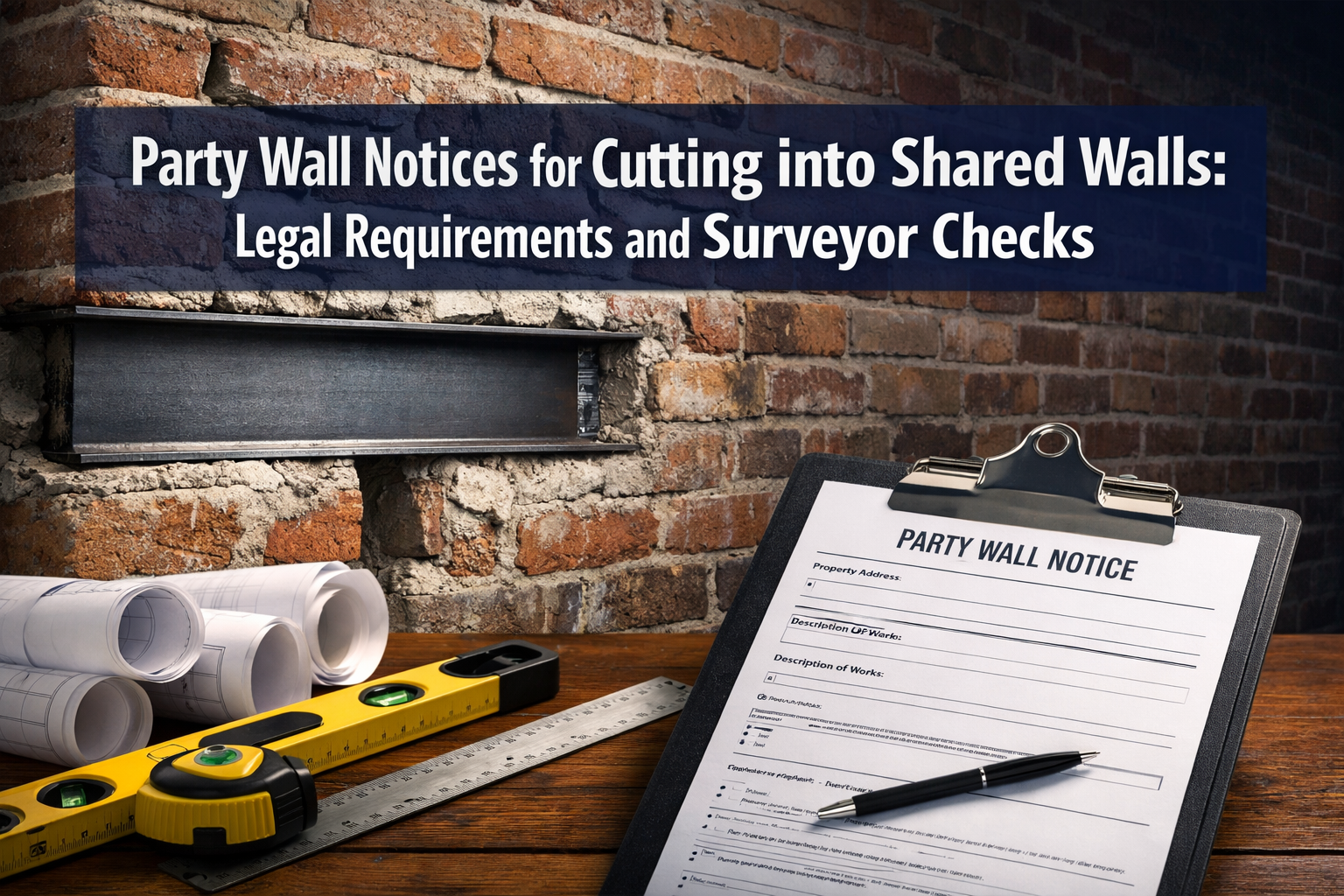
Understanding Section 2 Notice Requirements for Cutting Work
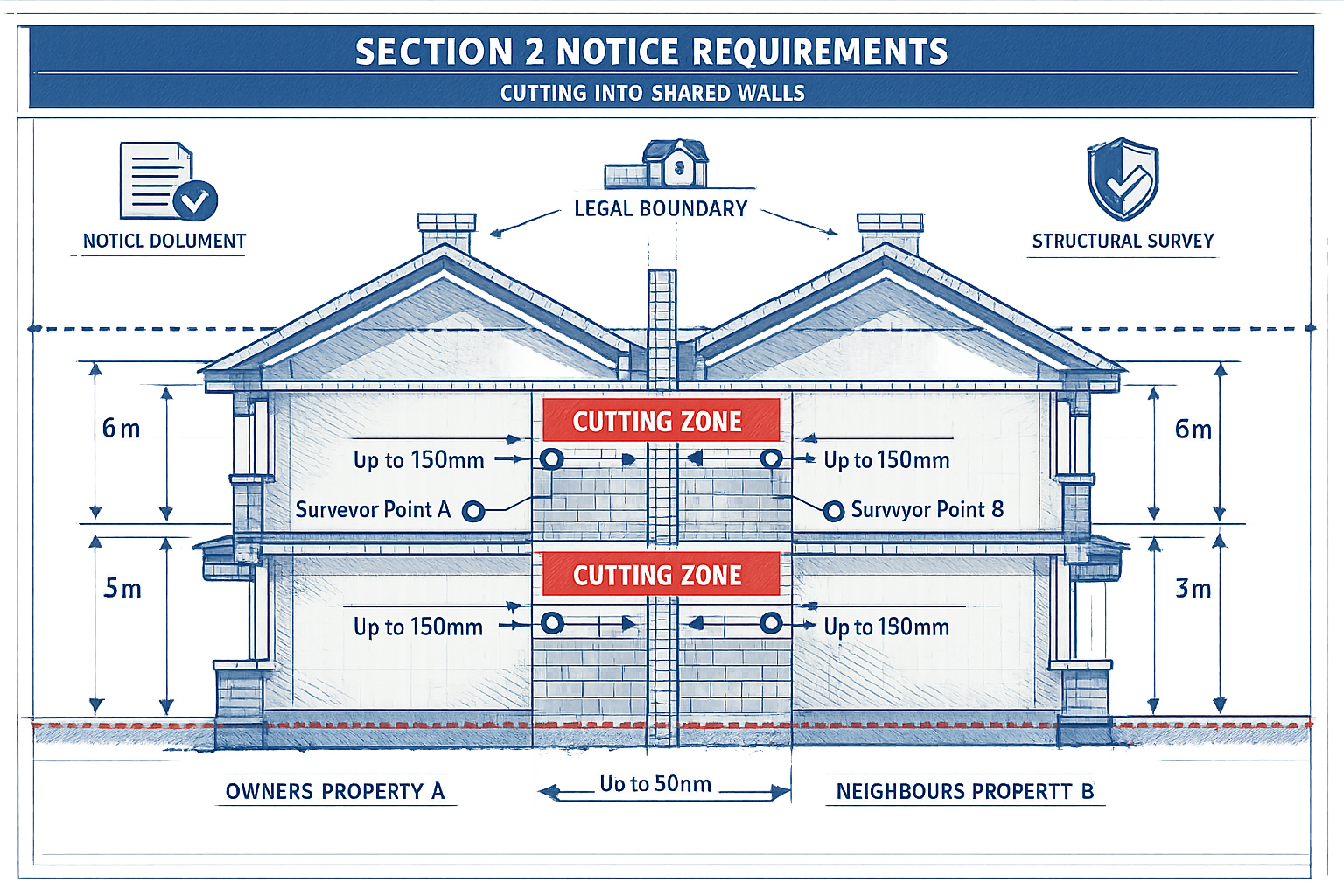
Section 2 of the Party Wall etc. Act 1996 explicitly addresses repairs and alterations to existing party walls. This section applies whenever homeowners plan to cut into shared walls for structural purposes, including:
- Inserting steel beams or joists to support extensions or loft conversions
- Cutting away masonry to create new openings or access points
- Installing damp-proof courses that require cutting into the wall fabric
- Inserting padstones or lintels for structural support
- Making good and repairing existing party walls with cutting work
What Makes Section 2 Work Different
Unlike Section 1 (new building on the boundary line) or Section 6 (excavation near neighbouring foundations), Section 2 work involves direct interference with existing shared structures. This distinction matters because cutting into a party wall affects both properties’ structural integrity simultaneously[1].
The Act recognizes that cutting work carries inherent risks:
⚠️ Structural instability during and after cutting
🧱 Damage to adjoining property from vibration or load redistribution
💧 Moisture penetration through new openings or cuts
📉 Property value concerns for neighbours
Mandatory Two-Month Notice Period
For most cutting and alteration work under Section 2, building owners must serve notice at least two months before the intended start date[3]. This extended timeline allows:
- Neighbours to review technical plans thoroughly
- Professional surveyors to assess structural implications
- Scheduling of pre-work condition surveys
- Resolution of concerns before construction begins
Exception: Excavation work under Section 6 requires only one month’s notice, though cutting into walls always demands the full two-month period[3].
Mandatory Components of Valid Party Wall Notices for Cutting into Shared Walls
Invalid notices represent the most common reason projects face legal challenges and work stoppages. Understanding Party Wall Notices for Cutting into Shared Walls: Legal Requirements and Surveyor Checks requires knowing exactly what information must appear in your notice documentation.
Essential Written Notice Elements
Every party wall notice for cutting work must include specific information to achieve legal validity:
| Required Component | Details Needed | Why It Matters |
|---|---|---|
| Work Description | Precise explanation of cutting operations, beam sizes, insertion methods | Neighbours must understand scope and impact[2] |
| Proposed Start Date | Specific calendar date (not “approximately” or “soon”) | Triggers 14-day response timeline |
| Technical Drawings | Scaled plans showing cut locations, depths, beam specifications | Enables proper structural assessment |
| Building Owner Details | Full name, address, contact information | Establishes legal service of notice |
| Property Address | Complete address of both properties | Confirms which party wall is affected |
| Surveyor Information | Your appointed surveyor’s details (if already selected) | Facilitates dispute resolution process |
Technical Drawing Requirements
Generic sketches won’t suffice. Your drawings must show:
✅ Exact cut dimensions (width, depth, height)
✅ Distance from property boundaries and existing openings
✅ Beam specifications including material, size, and load-bearing capacity
✅ Support methods during and after cutting
✅ Temporary propping arrangements if required
✅ Make-good details for finishing work
Professional architectural drawings prepared by qualified designers significantly reduce notice rejection rates. Many party wall surveyors in Central London recommend having drawings reviewed before serving notice to avoid invalidation.
Common Notice Errors That Halt Projects
According to industry data, these mistakes most frequently invalidate notices:
🚫 Vague work descriptions (“general alterations” or “improvements”)
🚫 Missing or inadequate drawings showing insufficient detail
🚫 Incorrect start dates that don’t allow full notice periods
🚫 Failure to identify all affected neighbours in semi-detached or terraced properties
🚫 Omitting specific beam dimensions or structural specifications
🚫 Not updating notices when work scope changes
“A party wall notice isn’t a formality—it’s a legal document that must contain precise technical information. Generic descriptions or missing drawings render notices invalid, giving neighbours grounds to seek immediate injunctions stopping all work.”[2]
Serving Notice to Multiple Neighbours
Terraced properties require particular attention. Cutting work affecting one party wall may impact multiple adjoining owners. Building owners must serve separate notices to each affected neighbour, even when cutting into a single wall[1].
For example, inserting a beam into the party wall of a mid-terrace house requires serving notice to:
- The immediate neighbour sharing that specific wall
- Any other neighbour whose property structure connects to the affected wall
- Neighbours below (if the property is a flat or maisonette)
Failing to serve all required notices creates legal vulnerabilities that neighbours can exploit to halt construction.
The 14-Day Response Timeline and Neighbour Rights
Once you’ve properly served your party wall notice, neighbours enter a critical 14-day response window. Understanding Party Wall Notices for Cutting into Shared Walls: Legal Requirements and Surveyor Checks means recognizing that this fortnight determines your entire project pathway.
Three Possible Neighbour Responses
1. Written Consent (Assent)
The neighbour provides written agreement to your proposed cutting work. This consent:
- Must be in writing (verbal agreements hold no legal weight)
- Should reference the specific notice served
- Allows work to proceed without a Party Wall Award
- Doesn’t waive the neighbour’s right to claim for damage later
Even with consent, prudent building owners arrange Schedule of Condition surveys to document pre-work property conditions.
2. Written Dissent (Objection)
The neighbour formally objects to the work or specific aspects of it. Dissent triggers the surveyor appointment process and requires a Party Wall Award before work can begin[3].
Dissent doesn’t mean the work can’t proceed—it simply means formal procedures must be followed to protect both parties’ interests.
3. No Response (Deemed Dissent)
If 14 days pass without any written response, the law treats this silence as automatic dissent. Building owners must then follow the same surveyor appointment process as if the neighbour had formally objected[3].
Many neighbours fail to respond simply because they don’t understand the notice or its implications. Proactive communication often prevents deemed dissent situations.
The Surveyor Appointment Process
When dissent occurs (actual or deemed), the Party Wall Act mandates surveyor involvement:
Option A: Agreed Surveyor
Both parties appoint a single surveyor to act impartially for both sides. This approach typically costs less and resolves matters faster.
Option B: Two Surveyors
Each party appoints their own surveyor. These two surveyors then select a third surveyor to act as arbitrator if they disagree. This provides maximum protection but increases costs.
The building owner’s surveyor and adjoining owner’s surveyor collaborate to prepare the Party Wall Award—a legally binding document that:
- Authorizes the specific cutting work described
- Sets conditions for how work must be performed
- Establishes working hours and access arrangements
- Determines who pays surveyor fees (usually the building owner)
- Provides dispute resolution mechanisms
What Happens If You Start Work Without Agreement
Starting cutting work before receiving written consent or a Party Wall Award violates the Act and exposes building owners to serious consequences:
⚖️ Court injunctions that immediately halt all construction[2]
💰 Financial penalties and legal costs
📋 Trespass claims from neighbours
🔨 Forced removal of completed work
💸 Liability for all damage to adjoining properties
“Ignoring party wall procedures doesn’t just risk delays—it can result in court orders forcing you to undo completed work at your own expense, even if the cutting was structurally sound.”[2]
Surveyor Checks That Validate Notices and Prevent Project Delays
Professional surveyor guidance represents the most effective strategy for ensuring Party Wall Notices for Cutting into Shared Walls: Legal Requirements and Surveyor Checks proceed smoothly. Experienced surveyors catch errors before they become legal problems.
Pre-Notice Surveyor Review
Before serving notice, qualified surveyors should review:
Technical Adequacy
- Are drawings sufficiently detailed and scaled?
- Do beam specifications match structural requirements?
- Are temporary works clearly shown?
- Do plans comply with Building Regulations?
Legal Compliance
- Does the notice contain all mandatory information?
- Are all affected neighbours identified?
- Is the notice period calculated correctly?
- Are property descriptions accurate?
Practical Considerations
- Can the proposed work be executed as described?
- Are access arrangements realistic?
- Have alternative methods been considered?
- Are timelines achievable?
Surveyors working across North London, South London, and East London report that pre-notice reviews reduce rejection rates by over 80%.
Schedule of Condition Surveys
These detailed property inspections form the foundation of damage protection for all parties. Before any cutting begins, surveyors should:
📸 Photograph all relevant areas in both properties
📏 Measure and record existing cracks or defects
📝 Document current decoration standards
🎥 Video record vulnerable areas when appropriate
✍️ Create written descriptions of all conditions observed
The Schedule of Condition serves as forensic evidence if damage disputes arise later. Without this documentation, determining whether cracks resulted from cutting work or existed previously becomes nearly impossible[3].
Ongoing Monitoring During Cutting Work
Responsible surveyors don’t disappear after serving notices. During cutting operations, they should:
- Conduct site visits at critical work stages
- Monitor structural movement using crack monitors or surveying equipment
- Verify compliance with Party Wall Award conditions
- Address neighbour concerns promptly
- Document work progression photographically
This oversight protects building owners from unfounded damage claims while ensuring neighbours’ properties remain safe.
Post-Work Inspections and Make-Good
After cutting work completes, surveyors compare the adjoining property’s condition against the original Schedule of Condition. Any damage attributable to the work must be repaired to the neighbour’s satisfaction.
Make-good work typically includes:
🔧 Repairing plasterwork disturbed by vibration
🎨 Redecorating affected rooms to match original standards
🧱 Fixing masonry damage on the neighbour’s side
💧 Addressing any moisture issues caused by cutting
Cost Considerations and Who Pays
Understanding the financial implications of Party Wall Notices for Cutting into Shared Walls: Legal Requirements and Surveyor Checks helps building owners budget accurately.
Typical Cost Breakdown
| Expense Category | Estimated Cost Range | Who Pays |
|---|---|---|
| Party Wall Notice Preparation | £150-£400 | Building owner |
| Building Owner’s Surveyor Fees | £700-£1,500 | Building owner |
| Adjoining Owner’s Surveyor Fees | £700-£1,500 | Building owner (usually) |
| Schedule of Condition Survey | £300-£800 per property | Building owner |
| Party Wall Award Preparation | Included in surveyor fees | Building owner |
| Make-Good and Repairs | Variable (£500-£5,000+) | Building owner |
The building owner typically bears all party wall procedure costs, including the neighbour’s surveyor fees[3]. This arrangement ensures neighbours aren’t financially penalized for protecting their property rights.
For detailed cost breakdowns, see our guide on party wall costs and the process.
Strategies to Keep Costs Down
While party wall procedures involve unavoidable expenses, several approaches minimize costs:
✅ Communicate early with neighbours to encourage consent
✅ Propose an agreed surveyor rather than two separate surveyors
✅ Provide comprehensive drawings upfront to avoid repeated surveys
✅ Schedule work efficiently to minimize surveyor site visits
✅ Work carefully to prevent damage requiring expensive make-good
Additional cost-saving strategies appear in our article on how to keep party wall costs down.
Special Considerations for Different Types of Cutting Work
Not all cutting work affects party walls identically. Understanding Party Wall Notices for Cutting into Shared Walls: Legal Requirements and Surveyor Checks requires recognizing how different operations create distinct challenges.
Beam Insertion and Steel Installation
Cutting to insert structural beams represents one of the most common party wall operations. Key considerations:
- Load transfer to the party wall during and after installation
- Temporary propping requirements that may affect both properties
- Vibration management during cutting and drilling
- Fire resistance of new beam installations
- Acoustic impact of structural alterations
Surveyors must verify that beam specifications match structural calculations and that insertion methods won’t compromise the party wall’s integrity.
Damp-Proof Course Installation
Installing or renewing damp-proof courses often requires cutting horizontal slots through party walls. Specific concerns include:
- Maintaining structural stability during horizontal cutting
- Coordinating work if both properties need damp-proofing
- Preventing moisture migration between properties
- Ensuring continuous damp protection across the party wall
- Temporary weatherproofing during installation
These projects typically require phased cutting to maintain wall stability throughout the process.
Creating New Openings
Cutting new doorways or service penetrations through party walls demands careful planning:
- Fire safety compliance for new openings
- Sound insulation requirements under Building Regulations
- Structural support around new openings
- Agreement on opening size and position
- Future alteration rights for both parties
Party Wall Awards for new openings often include conditions about maintaining fire doors and acoustic seals.
Common Disputes and How Surveyors Resolve Them
Even with proper notices, disputes occasionally arise during cutting work. Professional surveyors employ proven resolution strategies:
Timing and Access Disputes
Issue: Neighbours object to proposed working hours or access arrangements.
Resolution: Party Wall Awards can specify:
- Restricted working hours (e.g., 8am-6pm weekdays only)
- Advance notice requirements for site access
- Limitations on noise-generating activities
- Weekend and holiday work restrictions
Damage Claims
Issue: Neighbours claim cutting work damaged their property.
Resolution: Surveyors compare current conditions against the Schedule of Condition to determine:
- Whether damage existed pre-work
- Whether damage could reasonably result from cutting operations
- Appropriate repair scope and standards
- Fair compensation if repairs prove impractical
Scope Creep Concerns
Issue: Neighbours worry that approved cutting work will expand beyond the original notice.
Resolution: Party Wall Awards explicitly limit work to specified operations. Any material changes require:
- Serving a fresh notice
- Obtaining new agreement or Award
- Additional surveyor oversight
For guidance on responding to notices, see our resource on Party Wall Act notices and how to respond.
Regional Variations and Local Considerations
While the Party Wall Act 1996 applies uniformly across England and Wales, practical implementation varies by location.
London-Specific Challenges
High-density terraced housing in London creates unique complications:
- Multiple adjoining owners requiring separate notices
- Complex ownership structures with freeholders and leaseholders
- Conservation area restrictions affecting cutting methods
- Listed building considerations requiring heritage-sensitive approaches
Surveyors practicing in West London frequently handle properties with multiple layers of party wall legislation and planning constraints.
Areas Without Party Wall Act Coverage
The Act doesn’t apply in:
🏴 Scotland (different legal framework applies)
🇮🇪 Northern Ireland (separate property law)
🏝️ Channel Islands and Isle of Man (local regulations vary)
Property owners in these areas must follow alternative legal procedures for cutting work affecting shared walls[3].
Practical Timeline for Cutting Work Projects
Understanding realistic timelines helps building owners plan effectively:
Weeks 1-2: Planning Phase
- Engage architect and structural engineer
- Develop cutting work plans and specifications
- Consult party wall surveyor for pre-notice review
Week 3: Notice Preparation and Service
- Finalize technical drawings
- Prepare formal party wall notice
- Serve notice on all affected neighbours
Weeks 4-5: Neighbour Response Period
- Wait for 14-day response window
- Address neighbour questions or concerns
- Appoint surveyors if dissent occurs
Weeks 6-10: Award Preparation (if required)
- Surveyors conduct Schedule of Condition surveys
- Negotiate Award terms and conditions
- Finalize and serve Party Wall Award
Week 11+: Construction Phase
- Begin cutting work per Award conditions
- Maintain surveyor oversight
- Complete make-good and repairs
Total Timeline: 11-14 weeks from initial planning to work commencement when Awards are required; 5-6 weeks when neighbours consent immediately.
The Role of Party Wall Awards in Cutting Work
Party Wall Awards represent legally binding documents that authorize cutting work while protecting all parties’ interests. Understanding Party Wall Notices for Cutting into Shared Walls: Legal Requirements and Surveyor Checks requires recognizing that Awards serve as construction contracts between neighbours.
What Awards Must Include
Every Party Wall Award for cutting work should specify:
📋 Authorized work description (referencing original notice)
📅 Permitted working hours and days
🔑 Access rights and requirements
🛡️ Protective measures during construction
💰 Cost allocation for surveyor fees
⚖️ Dispute resolution procedures
📸 Schedule of Condition (attached as appendix)
🔧 Make-good obligations and standards
Awards typically run 10-20 pages for straightforward cutting work, longer for complex projects.
Award Enforcement and Modifications
Once served, Party Wall Awards bind both parties legally. Building owners must:
- Follow all conditions exactly as specified
- Provide required advance notices for site access
- Allow surveyor inspections when requested
- Complete make-good work to specified standards
Neighbours can seek court enforcement if building owners violate Award terms. Conversely, building owners can pursue legal remedies if neighbours unreasonably obstruct authorized work.
When Awards Require Modification
If circumstances change during construction, Awards may need amendment:
- Unexpected structural conditions requiring different cutting methods
- Extended timelines beyond original estimates
- Additional work not covered in the original notice
- Changed access arrangements due to site constraints
Modifications require surveyor agreement and, in some cases, fresh notices.
Future-Proofing Your Cutting Work Compliance
As construction practices evolve and legal interpretations develop, staying compliant with Party Wall Notices for Cutting into Shared Walls: Legal Requirements and Surveyor Checks requires ongoing attention.
Documentation Best Practices
Maintain comprehensive records of:
📁 All notices served with proof of delivery
📧 Neighbour communications (emails, letters, meeting notes)
📷 Photographic evidence throughout the project
📝 Surveyor reports and correspondence
🧾 Contractor invoices for cutting work
✅ Completion certificates and sign-offs
These records prove invaluable if disputes arise months or years after work completion.
Emerging Trends in 2026
Recent developments affecting party wall procedures include:
🏗️ Increased scrutiny of structural calculations for beam insertions
🌍 Sustainability considerations in cutting work methods
📱 Digital notice service gaining acceptance
🤝 Mediation services for dispute resolution
📊 Enhanced monitoring technology for tracking structural movement
Professional surveyors stay current with these developments to provide cutting-edge guidance[5].
Conclusion
Party Wall Notices for Cutting into Shared Walls: Legal Requirements and Surveyor Checks represent far more than administrative formalities—they form the legal foundation for safe, compliant structural alterations affecting shared properties. Cutting into party walls without proper notices exposes building owners to court injunctions, financial penalties, and forced work removal, while neighbours risk property damage without adequate protection.
The two-month notice requirement under Section 2 of the Party Wall Act 1996 provides essential time for proper technical review, neighbour consultation, and surveyor oversight. Valid notices must include precise work descriptions, technical drawings showing exact cut locations and dimensions, and specific start dates. Missing any mandatory element renders notices invalid, creating legal vulnerabilities that halt projects immediately.
Professional surveyor involvement transforms potentially contentious cutting work into structured, protected processes. Pre-notice reviews catch errors before they become problems, Schedule of Condition surveys establish baseline documentation, and Party Wall Awards create legally binding frameworks that authorize work while safeguarding all parties’ interests.
Next Steps for Building Owners
If you’re planning cutting work affecting party walls:
- Consult a qualified party wall surveyor at least three months before your intended start date
- Commission detailed technical drawings showing all cutting operations precisely
- Identify all affected neighbours who require notice service
- Prepare comprehensive notices containing all mandatory elements
- Serve notices properly with proof of delivery
- Arrange Schedule of Condition surveys before work begins
- Follow Party Wall Award conditions exactly during construction
- Complete make-good work promptly to maintain good neighbour relations
For expert guidance on your specific cutting work project, contact experienced party wall surveyors who understand local requirements and can navigate complex procedures efficiently. Proper planning and professional support transform party wall procedures from obstacles into manageable steps that protect everyone’s interests while keeping your project on track.
References
[1] Understanding Party Wall Act What Homeowners Need Know Before Renovating – partywallslimited.com
[2] What Happens If You Ignore The Party Wall Act – fpws.uk
[3] Party Wall Agreement – hoa.org.uk
[4] Party Wall Agreements And Townhome Declarations Key Issues To Watch Out For When Drafting – ngazette.com
[5] Party Wall Notice Requirements For Prs Database Compliance Works Surveyor Tactics Post Renters Rights Act Registration In 2026 – https://nottinghillsurveyors.com/blog/party-wall-notice-requirements-for-prs-database-compliance-works-surveyor-tactics-post-renters-rights-act-registration-in-2026
Speak to a RICS chartered party wall surveyor
Free initial consultation. Notices, awards and schedules of condition across London and nationwide.