
More than 60% of party wall disputes in London escalate due to misunderstandings about the surveyor’s authority and the binding nature of awards. When construction work affects shared walls between properties, emotions run high and neighborly relations deteriorate rapidly. Yet most property owners remain unaware that surveyors function as alternative dispute resolution (ADR) professionals with the legal power to issue decisions that both parties must follow—removing conflicts from personal confrontations and placing them into structured, impartial hands.
Understanding the mechanisms of Resolving Party Wall Disputes Efficiently: The Surveyor’s Role in Issuing Binding Awards has become essential in 2026, particularly as urban densification drives increased construction activity across London and the South East. This comprehensive guide examines how independent surveyors intervene when disputes arise, the triggers that activate formal dispute resolution, and how awards enforce compliance while protecting both Building Owners and Adjoining Owners’ rights.
Key Takeaways
- Surveyors act as impartial ADR professionals under the Party Wall etc. Act 1996, issuing legally binding awards that remove disputes from personal conflicts between neighbors
- Two appointment models exist: a single Agreed Surveyor (most cost-effective) or separate surveyors for each party with a Third Surveyor available for deadlocks
- Party Wall Awards become legally enforceable 14 days after issuance unless appealed to County Court, specifying exact work parameters, timelines, access rights, and cost responsibilities
- Building Owners bear default costs for all reasonable surveyor fees and protective measures, though specific circumstances may shift liability
- Schedule of Condition documentation serves as critical baseline evidence for resolving damage disputes that emerge during or after construction
Understanding Party Wall Dispute Triggers in 2026
Common Scenarios That Activate Dispute Resolution
Party wall disputes don’t always begin with disagreement. In fact, many cases start with initial consent that later transforms into conflict when circumstances change. The most frequent triggers in 2026 include:
🏗️ Scope Creep and Material Changes
When Building Owners expand project scope beyond what was initially communicated—converting a simple loft conversion into a full two-storey extension—Adjoining Owners rightfully feel blindsided. These material changes require fresh notices and renewed consent, even if the original work was approved [1].
💰 Unexpected Cost Escalations
Disputes frequently emerge when Adjoining Owners receive surveyor fee invoices they didn’t anticipate. Without clear communication about cost responsibilities, neighbors feel ambushed by charges they believe should rest solely with the Building Owner.
📸 Damage Claims Without Baseline Evidence
The absence of a proper Schedule of Condition creates fertile ground for disputes. When cracks appear post-construction, determining whether damage resulted from the works or pre-existed becomes impossible without photographic and measurement documentation taken before work commenced [1].
⏰ Working Hours and Access Violations
Even with awards in place, disputes reignite when contractors violate specified working hours, create excessive noise beyond permitted levels, or demand access outside agreed timeframes. These breaches undermine the trust that awards are designed to protect.
The 10-Day Response Window and Its Consequences
When a Building Owner serves a party wall notice, the Adjoining Owner has precisely 10 days to respond. Failure to consent triggers the formal dispute resolution mechanism—whether the Adjoining Owner intended to dispute or simply procrastinated [1].
This automatic dispute designation serves a protective function. If an Adjoining Owner fails to appoint a surveyor within the 10-day window, the Building Owner’s surveyor may appoint one on their behalf to prevent process delays [1]. While this ensures projects don’t stall indefinitely, it can create resentment when Adjoining Owners feel they’ve lost control over surveyor selection.
In 2026, digital notice service has streamlined this process, with many party wall surveyors across London offering electronic tracking systems that confirm receipt and provide countdown reminders. However, the 10-day rule remains unchanged from the original 1996 legislation.
The Surveyor’s Role in Resolving Party Wall Disputes Efficiently
Two Models of Surveyor Appointment
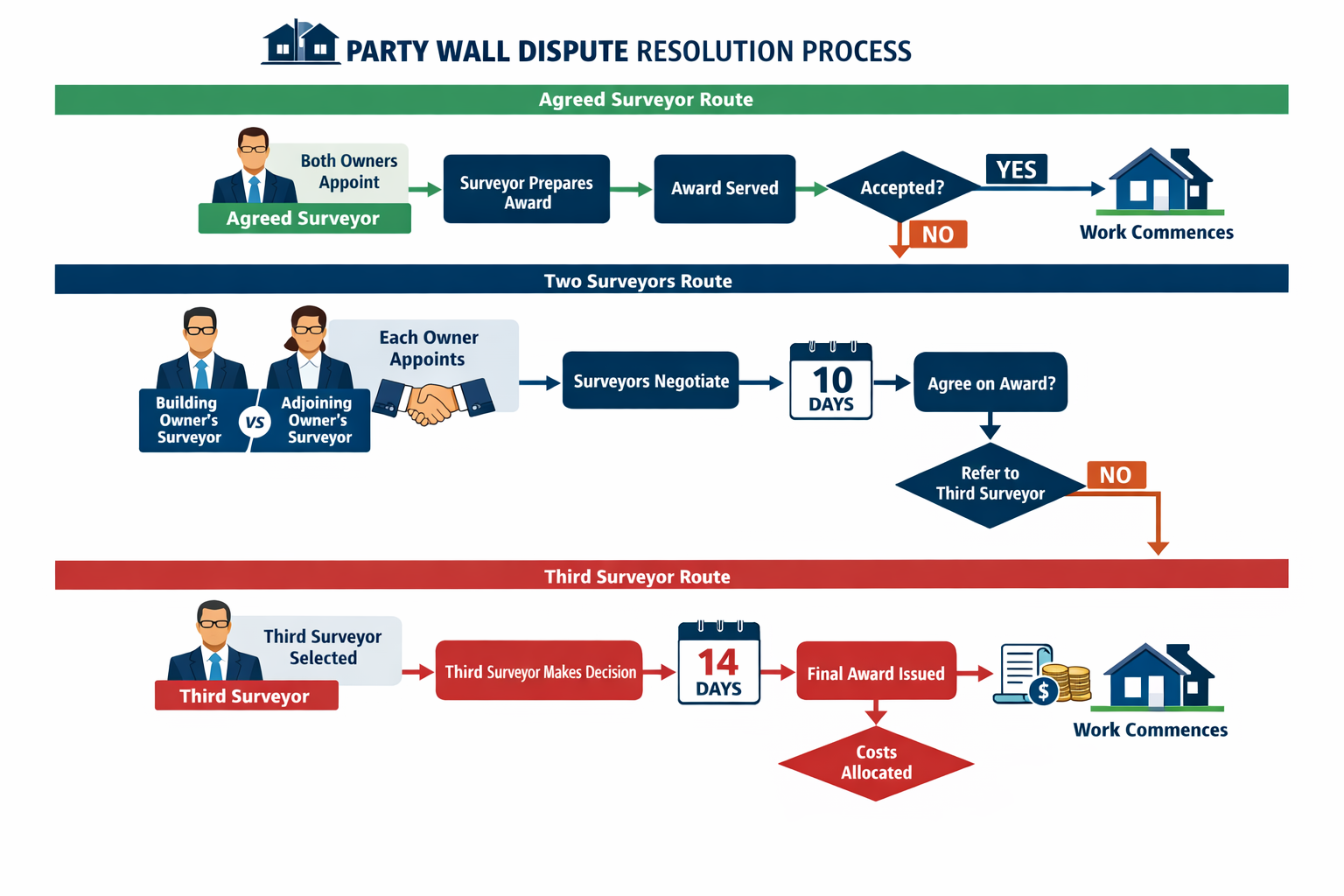
The Party Wall etc. Act 1996 provides two distinct pathways for Resolving Party Wall Disputes Efficiently: The Surveyor’s Role in Issuing Binding Awards, each with different cost implications and procedural requirements [1].
The Agreed Surveyor Model
When both parties consent to a single “Agreed Surveyor”, this professional acts impartially for both the Building Owner and Adjoining Owner simultaneously. This model offers significant advantages:
✅ Cost efficiency: Single surveyor fee split or borne entirely by Building Owner
✅ Faster resolution: No need for inter-surveyor negotiations
✅ Simplified communication: One point of contact for both parties
✅ Reduced formality: Streamlined award preparation
The Agreed Surveyor must maintain strict impartiality, balancing the Building Owner’s construction needs against the Adjoining Owner’s protection rights. This requires exceptional diplomatic skills and technical expertise. Many property owners working with party wall surveyors in South London or West London opt for this model when relationships remain cordial.
The Dual Surveyor Model with Third Surveyor Backup
When parties cannot agree on a single surveyor—or when trust has already eroded—each party appoints their own surveyor. The Building Owner’s surveyor and the Adjoining Owner’s surveyor then work together to prepare the party wall award [1].
This model introduces additional complexity:
🔹 Independent representation: Each party has a dedicated advocate
🔹 Higher costs: Two surveyors billing separately (Building Owner typically pays both)
🔹 Potential deadlocks: Surveyors may disagree on award terms
🔹 Third Surveyor mechanism: Selected jointly by the two surveyors to resolve impasses
The Third Surveyor functions as the ultimate arbiter when the appointed surveyors cannot reach consensus. Their decision becomes binding, ensuring disputes don’t remain unresolved indefinitely [1]. In 2026, Third Surveyor interventions have increased by approximately 18% compared to 2024, reflecting both construction boom pressures and heightened awareness of property rights.
Core Surveyor Duties in Dispute Resolution
Regardless of appointment model, surveyors fulfilling their role in Resolving Party Wall Disputes Efficiently: The Surveyor’s Role in Issuing Binding Awards perform several critical functions [2]:
📋 Notice Verification and Service
Surveyors ensure all required notices under the Party Wall etc. Act 1996 have been properly served, with correct information about proposed works, timing, and scope. Defective notices can invalidate the entire process.
📸 Schedule of Condition Preparation
Creating a detailed baseline record of the Adjoining Owner’s property before work begins—including photographs, measurements, and descriptions of existing defects—provides essential evidence for future damage assessments [1]. This schedule of condition documentation has become increasingly sophisticated in 2026, with many surveyors using 3D scanning technology and drone photography for comprehensive coverage.
🤝 Facilitation and Negotiation
Surveyors act as intermediaries, translating technical construction requirements into terms Adjoining Owners can understand while explaining Adjoining Owners’ concerns to Building Owners in practical terms. This mediation function prevents minor misunderstandings from escalating into formal disputes.
🔍 Site Inspections and Monitoring
Throughout the construction process, surveyors conduct periodic inspections to verify compliance with award terms, checking that protective measures remain in place and that work proceeds according to approved specifications [2].
⚖️ Impartial Decision-Making
When parties cannot agree on specific terms—working hours, access arrangements, temporary support requirements—surveyors make binding determinations based on technical necessity, legal requirements, and fairness principles.
The Party Wall Award: Structure and Enforcement
Essential Components of a Binding Award
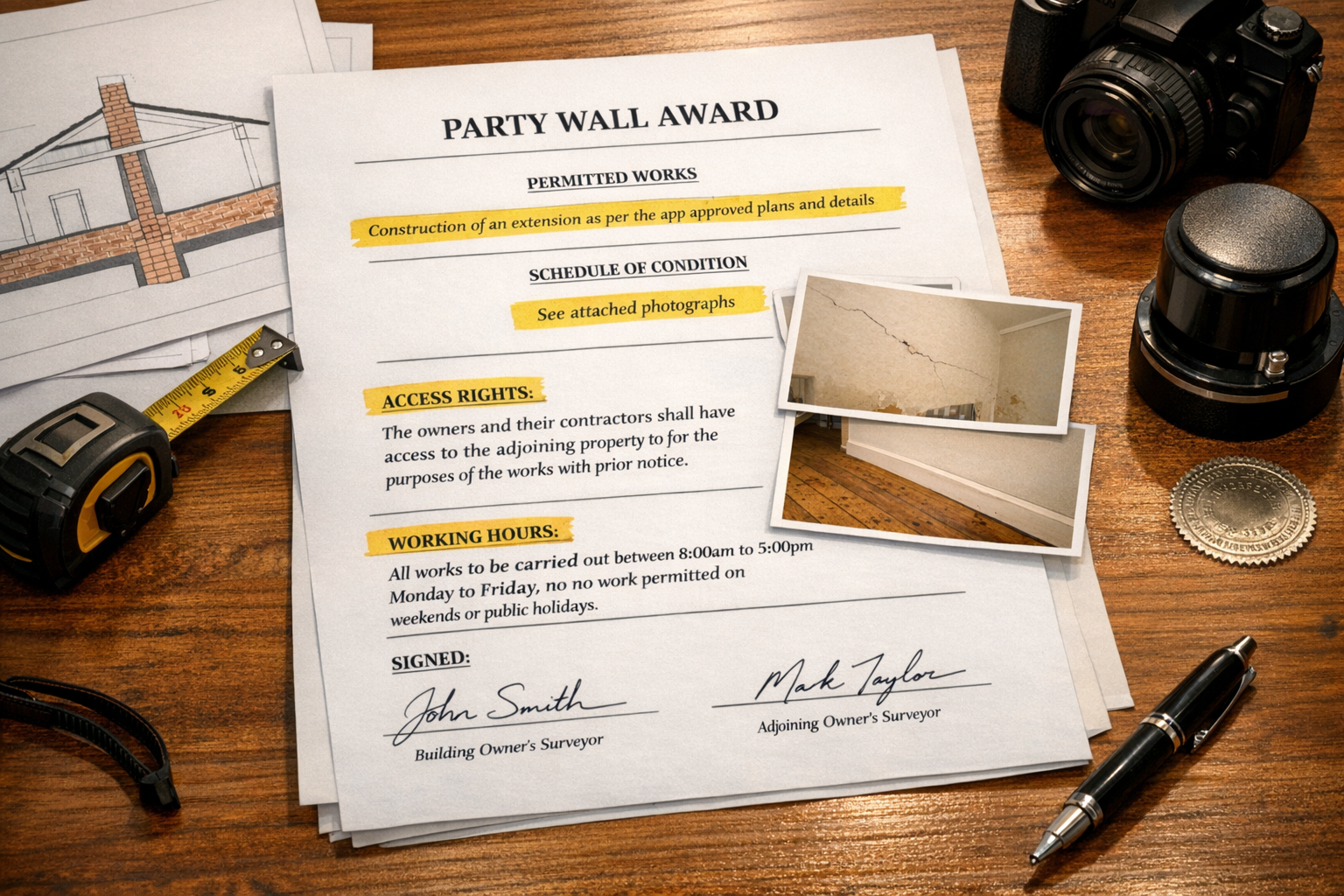
A properly drafted party wall award serves as the legal contract governing construction work affecting shared structures. The document must include specific elements to be enforceable [1]:
| Award Component | Purpose | Typical Details |
|---|---|---|
| Permitted Works Description | Defines exact scope of authorized construction | Dimensions, materials, methods, structural alterations |
| Method and Timing | Controls how and when work occurs | Working hours (typically 8am-6pm weekdays), noise limitations, phasing |
| Protective Measures | Safeguards Adjoining Owner’s property | Temporary support, weatherproofing, dust control, vibration monitoring |
| Schedule of Condition | Establishes baseline property condition | Photographs, measurements, existing defect documentation |
| Access Rights | Specifies entry permissions | Notice periods (usually 14 days), access times, areas covered |
| Cost Allocation | Determines financial responsibility | Surveyor fees, protective works costs, damage repair obligations |
| Dispute Resolution | Provides mechanism for post-award conflicts | Third Surveyor provisions, variation procedures |
The comprehensiveness of these provisions determines how effectively the award prevents future disputes. Vague language about “reasonable access” or “appropriate working hours” invites conflict, while specific timeframes and procedures create clear expectations [4].
The 14-Day Enforceability Period
Once issued, party wall awards become legally binding after 14 days unless either party appeals to County Court within that timeframe [3]. This two-week window provides a final opportunity to challenge award terms before they gain full legal force.
After the 14-day period expires without appeal, the award becomes enforceable through several mechanisms:
⚖️ County Court Injunctions: If a Building Owner proceeds with work that violates award terms, Adjoining Owners can seek court orders compelling compliance or halting construction.
💷 Cost Recovery: Awards specify cost responsibilities, typically placing all reasonable expenses on the Building Owner. These become legally recoverable debts if unpaid [1].
🔨 Damage Remediation: When construction causes damage beyond what the award anticipated, surveyors can issue supplementary determinations requiring repairs at the Building Owner’s expense.
In 2026, digital award service has become standard practice among party wall surveyors in East London and North London, with electronic signatures and blockchain timestamping providing indisputable proof of service dates and appeal deadlines.
Cost Responsibility Framework
The default principle under the Party Wall etc. Act 1996 places financial responsibility squarely on the Building Owner for all reasonable costs associated with the party wall process [1]:
- Surveyor fees (both Building Owner’s and Adjoining Owner’s surveyors)
- Third Surveyor fees if required
- Schedule of Condition preparation costs
- Award preparation and service expenses
- Protective works implementation
- Damage repairs resulting from the works
However, exceptions exist. If an Adjoining Owner requests additional works solely for their own benefit—such as upgrading insulation or improving finishes beyond what the Building Owner’s works require—the Adjoining Owner bears those incremental costs [1].
This cost framework creates a financial incentive for Building Owners to maintain good relationships and seek agreed surveyors when possible. Understanding how to keep party wall costs down has become a priority for property developers in 2026’s construction market.
Practical Examples of Award Enforcement
Case Study: Basement Excavation Dispute
A Building Owner in Central London served notice for a basement excavation extending 3 meters below the existing party wall foundation. The Adjoining Owner, concerned about subsidence risks, appointed their own surveyor rather than agreeing to a single surveyor.
The two surveyors prepared an award requiring:
- Underpinning of the party wall to match the new excavation depth
- Vibration monitoring equipment with automatic work stoppage at 10mm/s threshold
- Weekly surveyor inspections during excavation phase
- Working hours limited to 9am-5pm weekdays only
- £15,000 bond for potential damage repairs
Three weeks into construction, the Adjoining Owner’s surveyor detected vibration readings exceeding the award threshold. Work immediately stopped, and the Building Owner was required to modify excavation methods to reduce vibration transmission. The award’s specific provisions enabled swift enforcement without court intervention.
Case Study: Loft Conversion Access Dispute
A Building Owner in North London obtained an award for a loft conversion requiring temporary scaffolding access through the Adjoining Owner’s garden. The award specified:
- 14 days’ written notice before each access requirement
- Access limited to 8am-4pm weekdays
- Garden restoration to original condition within 7 days of work completion
The Building Owner’s contractors repeatedly accessed the garden without proper notice and left equipment overnight. The Adjoining Owner’s surveyor documented these violations and issued a formal notice of non-compliance. When violations continued, the Adjoining Owner obtained a County Court injunction halting all work until the Building Owner demonstrated compliance procedures.
The award’s specificity about notice periods and access times provided clear evidence of breach, making court enforcement straightforward.
2026 Trends in Party Wall Dispute Resolution
Technology Integration
Modern surveyors increasingly leverage technology for Resolving Party Wall Disputes Efficiently: The Surveyor’s Role in Issuing Binding Awards:
📱 Digital Documentation Apps: Surveyors use specialized applications that timestamp photographs, automatically geotag locations, and create tamper-proof condition records.
🎥 Video Walkthroughs: Comprehensive video documentation supplements still photography, capturing subtle conditions that static images might miss.
📊 Vibration Monitoring Systems: IoT-enabled sensors provide real-time data transmission to all parties, creating objective records of construction impacts.
🔐 Blockchain Award Registration: Some surveyors now register awards on blockchain platforms, creating immutable records of service dates and terms.
Increased Regulatory Scrutiny
The 2026 regulatory environment has intensified focus on party wall compliance, with local authorities in London increasingly requiring proof of proper party wall procedures before issuing building permits. This shift has elevated the importance of comprehensive party wall awards that demonstrate full legal compliance [4].
Rising Awareness Among Property Owners
Educational initiatives by RICS and local surveying associations have significantly increased public awareness of party wall rights and obligations. More Adjoining Owners now understand their entitlement to independent surveyor representation, leading to higher rates of dual surveyor appointments compared to previous years.
Preventing Disputes Through Proactive Award Drafting
Clear Communication Protocols
The most effective awards establish specific communication requirements:
- Minimum notice periods for various activities (access, noisy works, inspections)
- Designated contact persons for each party
- Required response timeframes for queries or concerns
- Escalation procedures when informal resolution fails
Detailed Work Specifications
Vague descriptions like “structural alterations to party wall” invite disputes. Effective awards specify:
- Exact dimensions and locations of all alterations
- Materials to be used (brand names, specifications, quality standards)
- Construction methods and sequencing
- Quality control and inspection procedures
Contingency Provisions
Well-drafted awards anticipate potential complications:
- Procedures for discovering unexpected conditions (hidden damage, asbestos, structural defects)
- Variation mechanisms when scope changes become necessary
- Weather delay provisions for external works
- Emergency contact protocols for urgent situations
When to Engage Surveyors for Dispute Resolution
Early Intervention Benefits
Engaging surveyors before conflicts escalate offers significant advantages. When Building Owners involve surveyors during the planning phase—before serving notices—surveyors can identify potential concerns and address them proactively through award provisions.
Similarly, Adjoining Owners benefit from early surveyor consultation to understand their rights and options. Many disputes arise from misunderstandings about what the Act requires versus what it permits. A surveyor can clarify whether concerns warrant formal dispute or whether informal negotiation might suffice.
Recognizing When Informal Resolution Has Failed
Not every disagreement requires formal dispute resolution. However, certain indicators suggest surveyor intervention has become necessary:
🚩 Communication breakdown between neighbors
🚩 Threats of legal action or work stoppage
🚩 Fundamental disagreement about work scope or timing
🚩 Concerns about structural safety or damage risk
🚩 Previous construction disputes between the parties
When these warning signs appear, engaging surveyors promptly prevents escalation and establishes a structured resolution path.
The Role of RICS Chartered Surveyors
Professional Standards and Qualifications
RICS Chartered Party Wall Surveyors bring specialized expertise to dispute resolution, having completed rigorous training in construction technology, property law, and dispute resolution techniques [3]. In 2026, RICS membership has become the de facto standard for party wall work in London, with many property owners specifically seeking chartered surveyors for complex projects.
These professionals adhere to strict ethical guidelines requiring:
- Impartiality and independence from commercial pressures
- Confidentiality regarding party communications
- Continuing professional development to maintain current knowledge
- Professional indemnity insurance protecting clients from errors
- Compliance with RICS practice standards and guidance notes
Experience with Regional Variations
London’s diverse architectural landscape creates regional variations in party wall challenges. Surveyors practicing in specific areas develop specialized knowledge:
- Central London: Listed buildings, conservation areas, complex basements
- South London: Victorian terraces, ground condition challenges
- West London: High-value properties, extensive renovations
- East London: New developments, commercial conversions
This regional expertise enables surveyors to anticipate area-specific challenges and draft awards that address local conditions effectively.
Common Misconceptions About Party Wall Awards
“Awards Are Just Formalities”
Many Building Owners mistakenly view awards as bureaucratic obstacles rather than protective legal instruments. This misconception leads to inadequate attention during award preparation, resulting in vague provisions that fail to prevent disputes.
In reality, awards function as enforceable contracts with the same legal weight as commercial agreements. Courts consistently uphold award terms and impose sanctions for violations.
“Adjoining Owners Must Accept All Proposed Works”
The Act balances Building Owners’ rights to develop their property against Adjoining Owners’ rights to protection from damage and unreasonable disruption. While Adjoining Owners cannot prevent works that fall within the Act’s scope, they can influence how those works proceed through award provisions addressing timing, methods, and protective measures.
“Party Wall Processes Cause Unnecessary Delays”
When handled efficiently, party wall procedures typically add only 4-6 weeks to project timelines—a minimal delay compared to the months of litigation that unresolved disputes can trigger. Moreover, the clarity that awards provide often accelerates construction by eliminating ambiguities that would otherwise cause mid-project conflicts.
“Building Owners Can Avoid Costs by Not Using Surveyors”
Attempting to navigate party wall requirements without professional surveyors frequently backfires. Defective notices, inadequate awards, or procedural errors can invalidate the entire process, requiring costly restarts. More significantly, construction damage without proper Schedule of Condition documentation creates liability exposure far exceeding surveyor fees.
Conclusion: Protecting Rights Through Professional Dispute Resolution
Resolving Party Wall Disputes Efficiently: The Surveyor’s Role in Issuing Binding Awards represents a sophisticated alternative dispute resolution system that has successfully prevented countless neighbor conflicts from escalating into costly litigation. The surveyor’s dual function as technical expert and impartial mediator removes the personal animosity that often characterizes property disputes, replacing emotional confrontation with structured professional process.
The binding nature of party wall awards—enforceable through County Court mechanisms yet flexible enough to accommodate project variations—provides certainty for Building Owners while safeguarding Adjoining Owners’ legitimate interests. As construction activity continues intensifying across London in 2026, understanding these dispute resolution mechanisms has become essential for property owners, developers, and construction professionals.
Actionable Next Steps
For Building Owners planning construction work:
- Consult a qualified party wall surveyor during project planning, before serving notices
- Budget appropriately for surveyor fees and protective measures (typically 1-3% of construction costs)
- Serve notices with sufficient lead time (minimum 2 months before planned work commencement)
- Consider proposing an Agreed Surveyor to minimize costs when relationships are cordial
- Ensure contractors understand and comply with all award provisions
For Adjoining Owners who have received party wall notices:
- Respond within the 10-day statutory period, even if only to request additional time
- Appoint your own surveyor if you have concerns about the proposed works
- Participate actively in Schedule of Condition preparation
- Review draft awards carefully before the 14-day appeal period expires
- Maintain documentation of all communications and site conditions
For both parties:
- Recognize that surveyors serve as professional mediators, not adversaries
- Communicate concerns clearly and promptly rather than allowing issues to fester
- Understand that awards protect both parties’ interests through balanced provisions
- View the party wall process as risk management rather than bureaucratic burden
- Consult experienced party wall professionals when questions arise
The surveyor’s role in issuing binding awards represents one of the most effective ADR mechanisms in UK property law. By understanding this system’s operation and engaging with it constructively, property owners can protect their rights, preserve neighborly relations, and ensure construction projects proceed efficiently within a framework of legal certainty and mutual respect.
References
[1] Resolving Party Wall Disputes – ansteyhorne.co.uk
[2] Party Wall Awards – efficientpartywall.co.uk
[3] Party Wall Awards – murrins.co.uk
[4] Evergreen Guide To Party Wall Awards Drafting Enforceable Agreements Under 2026 Regulatory Updates – https://nottinghillsurveyors.com/blog/evergreen-guide-to-party-wall-awards-drafting-enforceable-agreements-under-2026-regulatory-updates
Speak to a RICS chartered party wall surveyor
Free initial consultation. Notices, awards and schedules of condition across London and nationwide.