
Nearly 70% of post-construction party wall disputes stem from inadequate pre-work documentation, leaving property owners trapped in costly litigation over whether damage existed before building work began. Without a robust schedule of condition, determining liability becomes a matter of conflicting memories rather than objective evidence—a scenario that benefits no one except lawyers.
Understanding Schedule of Condition Essentials in Party Wall Awards: Best Practices for 2026 Damage Protection has become critical for anyone undertaking construction work near shared boundaries. This comprehensive documentation process protects both building owners and their neighbors by establishing an irrefutable baseline of property condition before any hammer swings or excavator digs.
While the Party Wall Act 1996 doesn’t formally mandate schedules of condition, qualified surveyors now consider them essential in virtually every case [1]. The practice has evolved significantly, with 2026 protocols emphasizing digital documentation, standardized measurement techniques, and streamlined dispute resolution processes.
Key Takeaways
✅ Schedules of condition are non-mandatory but essential for protecting all parties from post-construction damage disputes and establishing clear liability
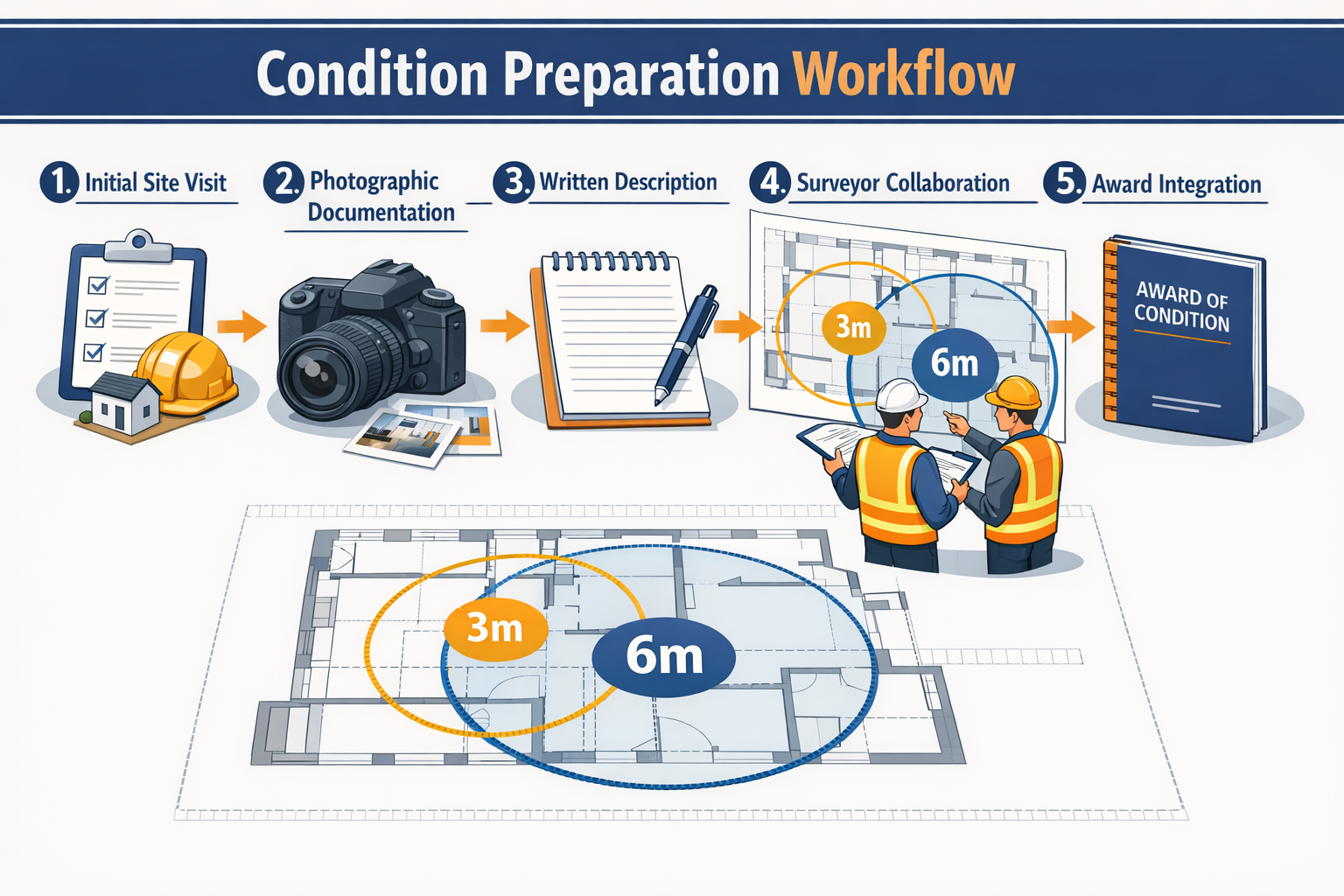
✅ Distance radius matters: Minor works require 3-meter documentation radius; high-risk projects like basements need 6-meter coverage [1]
✅ Written descriptions trump photographs: Detailed written records with supporting photos provide the most defensible documentation format [1]
✅ Timing is critical: Serve party wall notices at least two months before works commence to allow proper schedule preparation [4]
✅ Professional surveyors prevent disputes: Qualified experts produce standardized, legally defensible schedules that stand up to post-work scrutiny
What Is a Schedule of Condition in Party Wall Awards?
A schedule of condition serves as a detailed snapshot of an adjoining owner’s property immediately before construction work begins. This comprehensive record documents every crack, defect, settlement issue, and imperfection within the relevant radius of proposed works [2].
The primary function is straightforward yet crucial: enabling surveyors to determine the building owner’s liability for any damage caused by construction activities [2]. Without this baseline documentation, distinguishing pre-existing damage from work-related harm becomes nearly impossible.
Why Schedules of Condition Matter in 2026
The construction landscape has grown increasingly complex, with basement excavations, loft conversions, and structural alterations becoming standard in urban areas. Each project carries inherent risks to neighboring properties, making pre-work documentation more valuable than ever.
According to industry experts, attempting to establish damage causation without an independent schedule of condition creates significant risk for both parties [3]. Building owners face potentially unlimited liability claims, while adjoining owners struggle to prove legitimate damage occurred during works.
Key benefits include:
- 🛡️ Clear liability determination when damage disputes arise
- 📋 Objective evidence replacing subjective memories
- ⚖️ Reduced litigation costs through documented baselines
- 🤝 Improved neighbor relations via transparent processes
- 💰 Financial protection for all stakeholders
The schedule becomes an integral part of the party wall award once agreed by both surveyors, providing legally binding documentation of pre-work conditions [1].
Legal Framework and Professional Standards
While not explicitly required under the Party Wall etc. Act 1996, schedules of condition have become routine practice among qualified surveyors [2]. The professional standard recognizes that proper documentation protects everyone’s interests and dramatically reduces post-construction disputes.
Modern best practice recommends commissioning qualified party wall surveyors to prepare schedules, with proper notices served well in advance of commencement [4]. This timeline allows thorough inspection, documentation, and agreement between parties before any disruptive work begins.
Understanding types of party wall works helps determine when schedules are particularly critical—with high-risk activities like underpinning and excavation demanding especially rigorous documentation.
Step-by-Step Guide to Creating Robust Schedules of Condition
Creating a defensible schedule of condition requires systematic methodology, attention to detail, and adherence to established protocols. The process involves multiple stages, each contributing to the final document’s reliability and legal standing.
Stage 1: Determining Documentation Radius
The first critical decision involves establishing how much of the adjoining property requires documentation. This radius varies based on work type and associated risk levels [1]:
| Work Type | Documentation Radius | Examples |
|---|---|---|
| Minor Works | 3.00 meters | Simple extensions, loft conversions, internal alterations |
| High-Risk Projects | 6.00 meters | Basement excavation, underpinning, deep foundations, structural modifications |
Experienced surveyors assess project specifics to determine appropriate coverage. The radius extends from the closest point of proposed works, not from the party wall itself. This distinction matters significantly for excavations or extensions projecting into gardens.
Stage 2: Coordinating Surveyor Access
The building owner’s appointed surveyor typically records the schedule while shadowed by the adjoining owner’s surveyor [1]. This collaborative approach ensures both parties have input and can raise concerns during the inspection process.
Access requirements include:
- 📅 Scheduling visits with reasonable notice to occupants
- 🔑 Securing entry permissions for all relevant areas
- 👥 Coordinating both surveyors for simultaneous attendance
- 🏠 Building owner property access only when necessary (e.g., when flank walls are only visible from building owner’s side) [1]
Professional surveyors understand that access can be challenging, particularly in occupied residential properties. Flexibility and clear communication help facilitate smooth inspections while minimizing disruption.
Stage 3: Photographic Documentation Protocol
Photography forms the visual backbone of any schedule, but 2026 best practices have evolved significantly from earlier approaches. Modern protocols emphasize quality over quantity, with strategic image capture supporting written descriptions rather than replacing them.
Current photographic standards include:
- 📸 High-resolution digital images with embedded metadata (date, time, location)
- 🎯 Context and detail shots for each documented defect
- 📏 Scale references where appropriate (coins, measuring tapes, reference cards)
- 💾 Digital file retention in surveyor archives rather than printed copies [1]
- 🔍 Focused documentation of defects, cracks, damage, and settlement issues
The shift away from routinely including printed photographs or disks reflects practical efficiency. Photos are now retained in surveyors’ files and retrieved only if disputes arise post-construction [1]. This approach reduces documentation bulk while maintaining evidence availability when needed.
Stage 4: Written Description Methodology
Written records form the primary documentation in any schedule of condition, with photographs serving as supporting evidence [1]. This hierarchy exists because photos lack context and prove time-consuming to review when locating specific defects after work completion.
Effective written descriptions include:
- 📍 Precise location (room, wall, ceiling, floor)
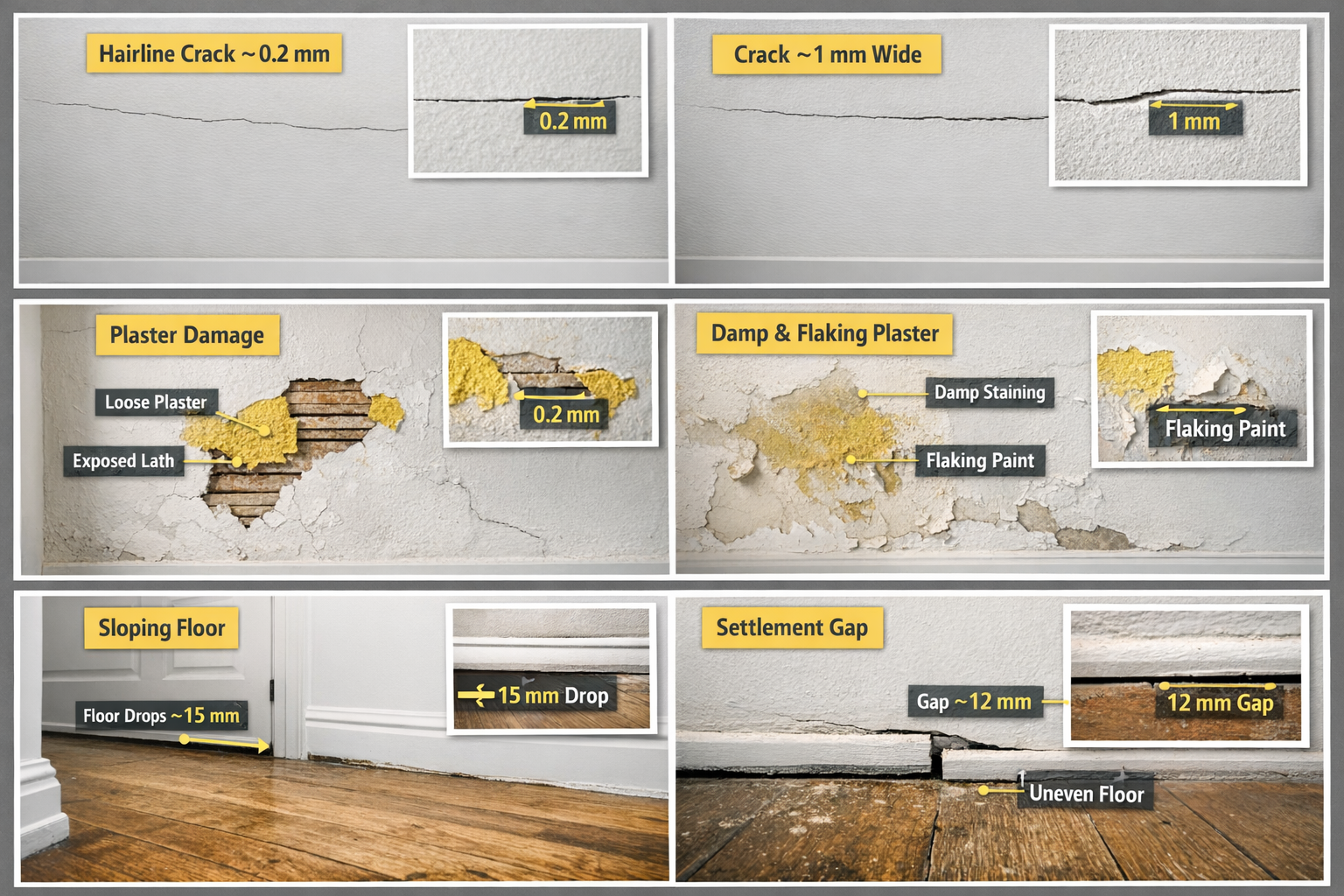
- 📐 Estimated measurements of crack lengths and widths
- 🔍 Defect characteristics (hairline, structural, surface, settlement-related)
- 🎨 Surrounding context (near window, above door, ceiling junction)
- ⚠️ Severity assessment (cosmetic, moderate, significant)
Importantly, crack dimensions are estimated rather than precisely measured [1]. Exact measurement would prove excessively time-consuming across entire properties. Experienced surveyors develop the skill to estimate distances with reasonable accuracy—sufficient for establishing baselines and identifying post-work changes.
Stage 5: Draft Review and Agreement
After completing the inspection and compiling documentation, the building owner’s surveyor prepares a draft schedule and sends it to the adjoining owner’s surveyor for review [1]. This collaborative verification ensures accuracy and provides opportunity to address any concerns before finalization.
The review process typically involves:
- ✉️ Draft circulation to the adjoining owner’s surveyor
- 🔍 Verification of descriptions against inspection notes
- 💬 Discussion of any discrepancies or additional items
- ✅ Agreement on final document content
- 📑 Integration into the party wall award
Once both surveyors agree, the schedule becomes part of the formal party wall award documentation, establishing the official baseline for post-work damage assessment.
Professional Service Considerations
While property owners can theoretically prepare their own schedules, professional surveyors bring invaluable expertise, standardized methodologies, and legal defensibility. Qualified services typically start around £290.00 for domestic and commercial properties [5], representing modest investment compared to potential dispute costs.
Engaging professionals early—ideally when serving party wall notices—allows adequate time for thorough documentation before work commences. Understanding party wall costs helps budget appropriately for comprehensive protection.
Common Pitfalls Leading to Post-Project Claims
Even with schedules of condition in place, certain mistakes and oversights create vulnerabilities that lead to disputes. Understanding these pitfalls helps building owners, adjoining owners, and their surveyors avoid preventable conflicts.
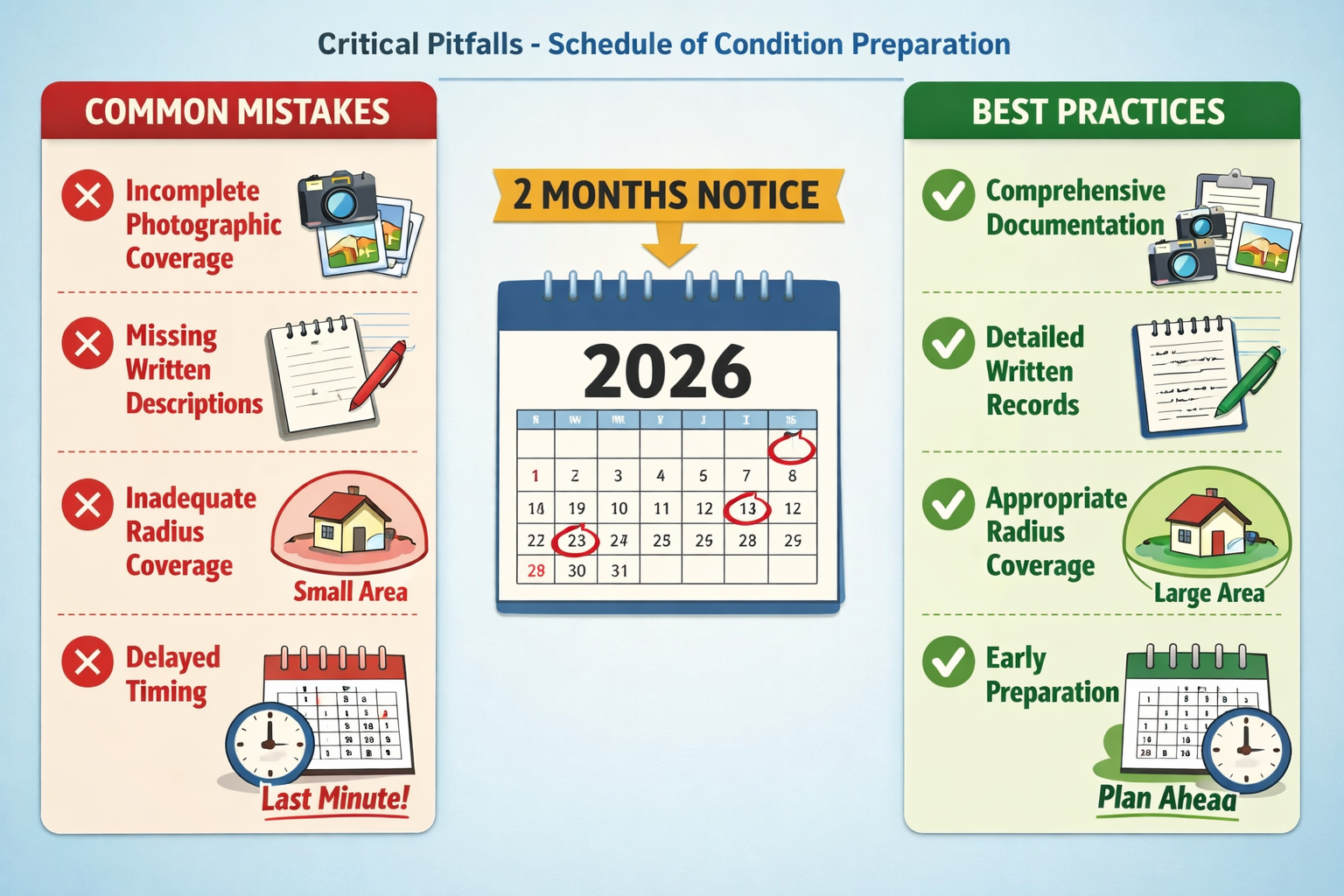
Pitfall 1: Inadequate Coverage Radius
The Problem: Limiting documentation to immediately adjacent rooms or using insufficient radius coverage leaves gaps in the baseline record. Damage occurring beyond the documented area becomes impossible to attribute definitively.
The Solution: Apply appropriate radius guidelines based on work type [1]. For high-risk projects like basement excavations, the 6-meter radius may seem excessive but proves essential when vibration, settlement, or excavation effects extend further than anticipated.
Properties in areas like North London or West London often feature Victorian or Edwardian construction particularly susceptible to movement, warranting comprehensive documentation.
Pitfall 2: Photo-Only Documentation
The Problem: Relying exclusively on photographs without detailed written descriptions creates significant challenges when reviewing evidence months or years later. Photos lack context, making it difficult to locate specific defects or understand their characteristics [1].
The Solution: Prioritize written descriptions as primary documentation, using photographs as supporting evidence. Each defect should have a clear written record including location, dimensions, characteristics, and context before any photo reference.
Pitfall 3: Delayed Preparation Timing
The Problem: Rushing schedule preparation immediately before work commencement leaves insufficient time for thorough documentation, surveyor coordination, and dispute resolution if disagreements arise about property condition.
The Solution: Serve party wall notices at least two months before works commence (one month for excavation-only projects) [4]. This timeline allows proper schedule preparation, review, agreement, and award finalization before any construction activity begins.
Early engagement also facilitates keeping party wall costs down by avoiding rushed processes and last-minute complications.
Pitfall 4: Imprecise Defect Descriptions
The Problem: Vague descriptions like “crack in ceiling” or “damage to wall” provide insufficient detail to distinguish pre-existing conditions from new damage. Without specific location, dimension, and characteristic information, disputes become inevitable.
The Solution: Document every defect with precision:
- ❌ Avoid: “Crack in living room ceiling”
- ✅ Better: “Hairline crack approximately 450mm long, 0.5mm wide, running north-south across living room ceiling, 300mm from east wall, terminating at central light fitting”
This level of detail enables definitive identification and comparison during post-work inspections.
Pitfall 5: Unilateral Documentation
The Problem: Building owners or their contractors creating schedules without independent surveyor involvement or adjoining owner participation produces biased documentation lacking credibility in disputes.
The Solution: Engage qualified, independent surveyors from the outset. The collaborative approach—with the building owner’s surveyor recording while shadowed by the adjoining owner’s surveyor [1]—ensures balanced documentation acceptable to all parties.
This professional approach proves particularly valuable for complex projects in areas like Central London or South London, where property values and construction complexity increase dispute stakes.
Pitfall 6: Incomplete Room Coverage
The Problem: Documenting only obviously vulnerable areas (rooms directly adjacent to works) while skipping seemingly unaffected spaces creates gaps when unexpected damage occurs in “safe” zones.
The Solution: Apply the appropriate radius systematically, documenting all rooms, corridors, and spaces within the defined distance regardless of perceived risk. Vibration, settlement, and structural movement can affect areas far from the immediate work zone.
Pitfall 7: Missing Baseline for Subsequent Claims
The Problem: Failing to preserve schedules of condition or integrate them properly into party wall awards means the documentation may be unavailable or lack legal standing when disputes arise months or years after completion.
The Solution: Ensure schedules become formal components of the party wall award, with copies retained by both surveyors and provided to both property owners. Digital archiving ensures long-term accessibility even if physical documents are lost.
Schedule of Condition Essentials: 2026 Best Practice Checklist
Implementing comprehensive best practices ensures schedules of condition fulfill their protective function effectively. This checklist consolidates current professional standards for 2026:
Pre-Inspection Preparation
- ☑️ Serve appropriate party wall notices with adequate advance timing
- ☑️ Engage qualified surveyors for both building and adjoining owners
- ☑️ Determine documentation radius based on work type and risk assessment
- ☑️ Schedule coordinated access with both surveyors present
- ☑️ Prepare documentation templates and equipment (camera, measuring tools, notebooks)
During Inspection
- ☑️ Document systematically room-by-room within defined radius
- ☑️ Capture context and detail photographs for each defect
- ☑️ Write detailed descriptions with precise locations and estimated dimensions
- ☑️ Note pre-existing damage severity to establish baselines
- ☑️ Allow adjoining owner’s surveyor to raise concerns and verify observations
- ☑️ Access building owner property only when necessary for complete documentation
Post-Inspection Process
- ☑️ Compile comprehensive written schedule with supporting photographs
- ☑️ Circulate draft to adjoining owner’s surveyor for review
- ☑️ Address discrepancies through professional discussion
- ☑️ Finalize agreed schedule with both surveyors’ approval
- ☑️ Integrate into party wall award as formal documentation
- ☑️ Provide copies to all relevant parties
- ☑️ Archive digitally for long-term accessibility
Documentation Standards
- ☑️ Prioritize written descriptions over photographic evidence
- ☑️ Estimate measurements with reasonable accuracy rather than precise measurement
- ☑️ Include sufficient detail for definitive defect identification
- ☑️ Maintain professional objectivity throughout documentation
- ☑️ Follow current digital retention practices rather than printed photo distribution
Risk-Specific Considerations
For high-risk works (basements, underpinning, deep excavations):
- ☑️ Extend documentation radius to 6 meters [1]
- ☑️ Include structural elements particularly vulnerable to movement
- ☑️ Document ground levels and settlement indicators
- ☑️ Consider monitoring arrangements for ongoing assessment during works
For minor works (extensions, loft conversions):
- ☑️ Apply 3-meter radius as baseline [1]
- ☑️ Focus on areas with direct structural connection to works
- ☑️ Document ceiling and wall junctions particularly susceptible to movement
- ☑️ Include adjacent rooms even if seemingly unaffected
Integrating Schedules into Party Wall Awards
The schedule of condition’s legal effectiveness depends on proper integration into the formal party wall award. This process transforms documentation from informal records into binding baseline evidence.
Award Integration Process
Once both surveyors agree on the schedule content, it becomes an appendix or attachment to the main party wall award document [1][3]. This integration typically occurs through:
- Formal referencing in the award body text
- Physical attachment as an appendix
- Cross-referencing in damage liability clauses
- Signature/agreement by both appointed surveyors
The integrated schedule then carries the same legal weight as other award provisions, establishing the official baseline for any subsequent damage assessments.
Damage Assessment Protocol
When construction work completes, surveyors conduct a post-work inspection comparing current property condition against the schedule baseline. This comparison determines whether:
- ✅ No new damage occurred (property condition unchanged)
- ⚠️ New damage is present (defects not documented in original schedule)
- 🔍 Existing damage worsened (documented defects increased in severity)
The schedule provides objective evidence for these determinations, replacing subjective memories with documented facts. Building owners bear responsibility only for damage attributable to their works—not pre-existing conditions captured in the schedule.
Dispute Resolution Support
When disagreements arise about damage causation, the schedule of condition serves as primary evidence in resolution processes. Whether through surveyor negotiation, third surveyor appointment, or formal dispute resolution, the documented baseline proves invaluable.
Professional schedules prepared by qualified surveyors carry significantly more weight than informal documentation, making the initial investment in proper preparation worthwhile for all parties.
Conclusion: Protecting Your Property Investment Through Proper Documentation
Schedule of Condition Essentials in Party Wall Awards: Best Practices for 2026 Damage Protection represents far more than bureaucratic paperwork—it provides essential insurance against costly disputes, damaged relationships, and prolonged litigation. The modest investment in professional schedule preparation delivers exponential returns through dispute prevention and clear liability determination.
The key principles bear repeating:
🎯 Engage qualified surveyors early rather than attempting DIY documentation
📏 Apply appropriate radius coverage based on work type and risk assessment
📝 Prioritize written descriptions supported by strategic photography
⏰ Allow adequate preparation time through early notice service
🤝 Ensure collaborative documentation with both surveyors participating
📋 Integrate schedules formally into party wall awards for legal standing
Actionable Next Steps
For building owners planning construction work:
- Review your project scope and determine whether party wall procedures apply
- Engage a qualified surveyor at least two months before planned commencement [4]
- Serve appropriate notices to adjoining owners with adequate timing
- Budget for professional schedule preparation as essential project cost
- Ensure schedules integrate into final party wall awards before work begins
For adjoining owners receiving party wall notices:
- Appoint your own qualified surveyor rather than consenting without professional advice
- Ensure your surveyor participates in schedule of condition preparation
- Review draft schedules carefully and raise concerns before finalization
- Retain copies of completed schedules for future reference
- Understand your rights regarding property access and documentation
For both parties:
- Recognize that comprehensive schedules protect everyone’s interests equally
- View professional surveyor fees as dispute prevention investment, not unnecessary expense
- Maintain open communication throughout the process to prevent misunderstandings
- Archive documentation carefully for potential future reference
- Consider schedules essential for any significant construction work, regardless of legal requirements
The construction landscape continues evolving, but the fundamental need for objective baseline documentation remains constant. By implementing these Schedule of Condition Essentials in Party Wall Awards: Best Practices for 2026 Damage Protection, property owners on both sides of party walls can proceed with confidence, knowing their interests are protected through professional, comprehensive documentation.
Don’t wait until damage disputes arise to recognize the value of proper schedules of condition. Invest in professional documentation from the outset, and enjoy the peace of mind that comes from knowing exactly where liability begins and ends.
References
[1] Schedules Of Condition For Party Wall Awards – taylor-mitchell.co.uk
[2] Party Walls Specimen Schedule Of Condition – isurv.com
[3] Party Wall Agreement – hoa.org.uk
[4] Schedules Of Condition In Party Wall Works Best Practices To Prevent Post Construction Claims In 2026 – https://nottinghillsurveyors.com/blog/schedules-of-condition-in-party-wall-works-best-practices-to-prevent-post-construction-claims-in-2026
[5] Schedule Of Condition – bristolpartywall.co.uk
Speak to a RICS chartered party wall surveyor
Free initial consultation. Notices, awards and schedules of condition across London and nationwide.