

Over 40% of construction disputes in residential projects involve work that expands beyond what was originally agreed — and party wall works are no exception. Scope creep in party wall works: contract protections for surveyors in 2026 is not a niche concern. It is one of the most pressing professional liability issues facing party wall surveyors today, as London's densely packed housing stock continues to generate a high volume of notifiable works, from basement excavations to loft conversions and rear extensions.
The Party Wall etc. Act 1996 provides a statutory framework that governs these works, but the Act was never designed to manage every contractual nuance that arises when a project evolves mid-process. When the scope of works drifts beyond what was originally notified and agreed, surveyors can find themselves exposed to appeals, cost challenges, and professional complaints. Understanding how to draft awards and engagement terms that limit that exposure is essential practice in 2026.
Key Takeaways
- Scope creep occurs when party wall works expand beyond the original notice, exposing surveyors to legal and professional risk.
- The Party Wall etc. Act 1996 strictly limits surveyor jurisdiction to notifiable works; awards that stray beyond this are ultra vires.
- Clear, written engagement terms and precisely drafted party wall awards are the primary contractual defences against scope creep.
- Surveyors should use schedule of condition reports, defined fee structures, and explicit scope clauses to protect themselves and their clients.
- Proactive communication between all parties throughout the project reduces the likelihood of disputes escalating.

What Is Scope Creep in Party Wall Works and Why It Matters in 2026
Scope creep, in the context of party wall surveying, refers to the gradual or sudden expansion of works beyond what was described in the original party wall notice and subsequently addressed in the party wall award. It can happen in several ways:
- A building owner extends an excavation deeper than notified.
- Additional structural elements are altered without a supplementary notice.
- Works to a party fence wall are added to a project that originally only covered a party structure.
- The surveyor is asked to adjudicate matters that fall outside the statutory remit entirely, such as planning disputes or general neighbourly grievances.
The Party Wall etc. Act 1996 is a dispute-resolution code with a strictly defined scope [4]. Surveyors' jurisdiction is confined to disputes "in respect of any matter connected with any work to which this Act relates." This means any award terms that venture beyond notifiable works — works on party structures, new party walls on the line of junction, or notifiable excavations — risk being declared ultra vires and therefore void [5]. An ultra vires award can be appealed to the County Court, leaving the surveyor exposed to costs and reputational damage.
In 2026, this risk is heightened by several factors:
| Risk Factor | Why It Matters in 2026 |
|---|---|
| Rising construction costs | Owners push for more work within existing awards to avoid new fees |
| Complex urban projects | Basement and subterranean works frequently evolve mid-project |
| Increased adjoining owner awareness | More owners challenge awards that appear to exceed statutory limits |
| RICS guidance on fee transparency | Surveyors face scrutiny over how scope changes affect billing |
Understanding the types of party wall works that fall within the Act is the first line of defence. If a surveyor cannot clearly identify whether a new element of work is notifiable, they cannot protect themselves or their clients from the consequences of scope drift.
"The Act is a dispute-resolution code, not a general vehicle for neighbour law, contract law or planning disputes. Surveyors who stray beyond that are exposed to appeals and costs challenges." [10]
How Scope Creep Enters Party Wall Projects
Scope creep rarely announces itself. It tends to enter party wall projects through informal channels — a verbal instruction on site, a revised architect's drawing sent without a formal supplementary notice, or a building owner who assumes that a previously agreed award covers new elements of work.
Common entry points include:
- Verbal instructions on site: A contractor asks the surveyor to inspect additional works not covered by the award. Without a written record, the surveyor's involvement can be misinterpreted as tacit approval.
- Revised drawings: Architects update plans after the award is made. If no supplementary notice is served and no amended award is issued, the original award may not cover the revised works [4].
- Adjoining owner requests: An adjoining owner asks the surveyor to address matters — such as pre-existing damp or boundary disputes — that fall outside the Act's remit entirely.
- Contractor assumptions: Site teams assume the party wall award is a general licence to proceed with all structural works, not just those specifically described.
For surveyors acting as the building owner's surveyor or the adjoining owner's surveyor, recognising these entry points early is critical. Once scope creep has occurred and works have progressed, unwinding the situation is far more difficult and costly than preventing it.
Contract Protections for Surveyors: Drafting the Award
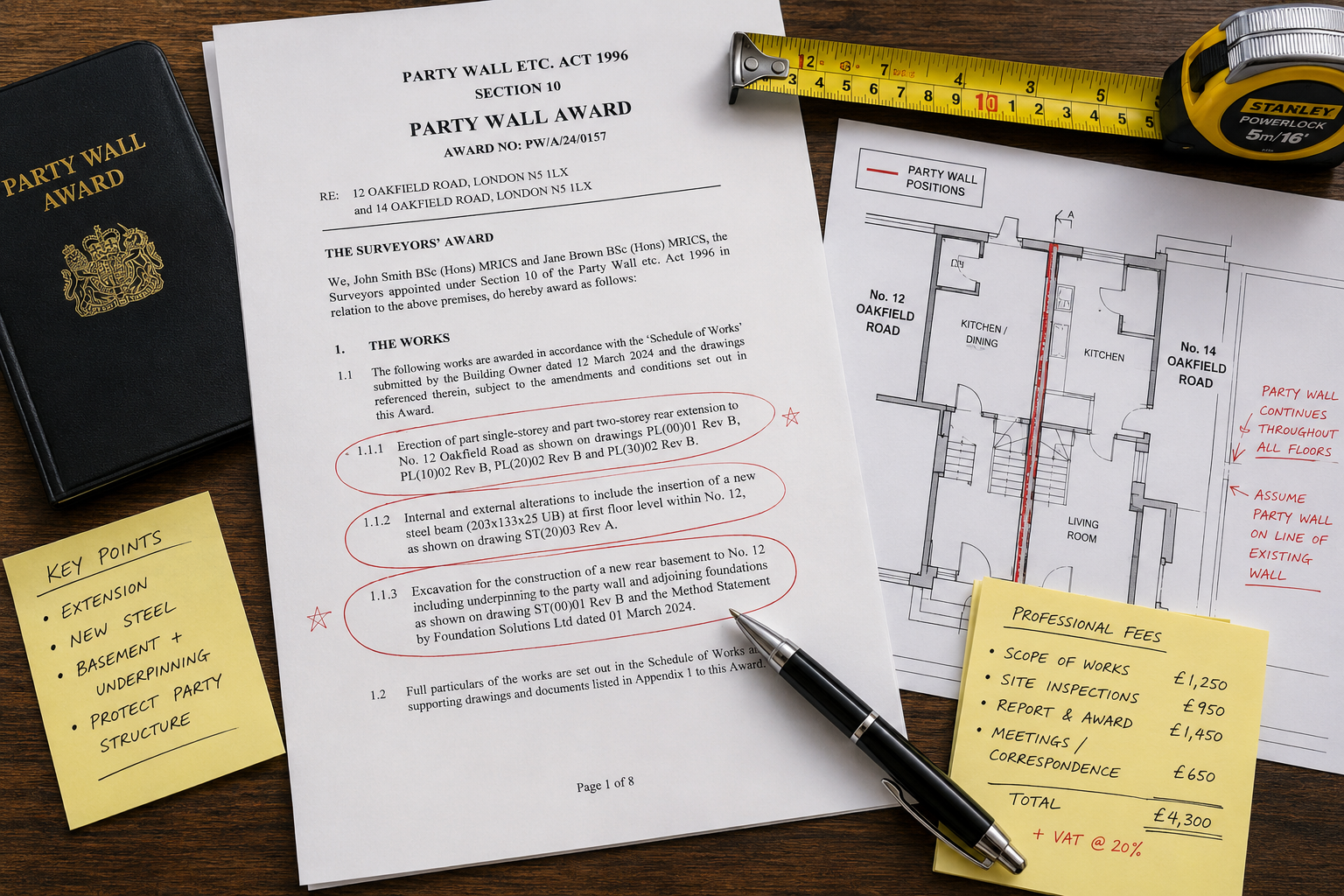
The party wall award is the surveyor's primary legal instrument. Drafting it with precision is the most effective form of contract protection available. The RICS "Party wall legislation and procedure" 7th edition guidance emphasises that surveyors should define scope and fees clearly in writing from the outset [3].
Define the Works with Precision
Every award should contain an unambiguous description of the notifiable works it covers. Vague language such as "works in connection with the proposed development" invites interpretation disputes. Instead, the award should reference:
- Specific structural elements (e.g., "underpinning to the shared party wall between [address A] and [address B] as shown on drawing reference X dated Y").
- The depth and extent of any excavations.
- The specific sections of the Act under which the works are authorised (Section 2, Section 6, etc.).
This level of specificity means that if additional works arise, there is a clear baseline against which the new works can be measured. If they fall outside the award's description, a supplementary notice and amended award are required before the surveyor can legitimately act [4].
Include a Scope Limitation Clause
A well-drafted award should contain an explicit clause stating that the award covers only the works described therein and that any variation, addition, or modification to the works must be the subject of a further notice and award before the surveyor's authority extends to those works. This clause:
- Puts all parties on notice that the award is not a blank cheque.
- Creates a clear trigger for a supplementary process.
- Protects the surveyor from claims that they implicitly approved additional works by continuing to act.
Address Fees and Variations Explicitly
One of the most common sources of dispute between surveyors and building owners is fees for work that was not anticipated at the outset. The costs of party wall works and the process should be addressed transparently in the engagement letter and, where appropriate, referenced in the award itself.
Surveyors should consider including:
- A base fee for the defined scope of works.
- A clearly stated hourly or per-item rate for any additional work arising from scope changes.
- A requirement that the building owner confirms in writing before any additional work is undertaken by the surveyor.
This approach aligns with RICS guidance on fee transparency and reduces the risk of fee disputes that can escalate into formal complaints [3][9].
Scope Creep in Party Wall Works: Contract Protections for Surveyors in 2026 — Engagement Letters and Terms of Appointment
The party wall award addresses the statutory relationship between the parties. But the surveyor's engagement letter governs the contractual relationship between the surveyor and the party who appointed them. These are two distinct instruments, and both need to address scope creep.
What the Engagement Letter Should Cover
A robust engagement letter should set out:
1. The defined scope of the surveyor's appointment
This should mirror the works described in the notice and should explicitly state that the appointment does not extend to works outside the Act's remit or to works not covered by a valid notice.
2. The process for handling scope changes
The letter should describe what happens if the works change: who is responsible for serving a supplementary notice, what fees will apply, and whether the surveyor has discretion to decline to act on additional works if no supplementary notice is served.
3. Limitations on the surveyor's liability
While party wall surveyors have statutory immunity for acts done in pursuance of the Act [4], this immunity does not extend to acts outside the Act's scope. The engagement letter should make clear that the surveyor's liability is limited to acts within the statutory framework.
4. Communication protocols
All instructions should be in writing. The engagement letter should state that verbal instructions from contractors, architects, or owners will not be acted upon without written confirmation.
For those unfamiliar with how party wall agreements work without professional involvement, it is worth noting that having a party wall agreement without a surveyor carries its own risks — but even agreed appointments benefit from formal written terms.
The Schedule of Condition as a Scope Anchor
A schedule of condition is a photographic and written record of the adjoining property's condition before works begin. It serves a dual purpose in the context of scope creep:
- It establishes a baseline that is tied to the original notified works, making it harder for parties to claim that damage from additional, unauthorised works falls within the award's remediation provisions.
- It creates a clear evidential record that the surveyor's involvement was limited to a defined moment in time and a defined set of works.
Surveyors should ensure that the schedule of condition is explicitly referenced in the award and that its scope matches the works described therein. A schedule that covers the entire adjoining property without reference to specific works can inadvertently imply a broader surveyor responsibility than is warranted.
Recognising and Responding to Ultra Vires Requests
Scope creep in party wall works: contract protections for surveyors in 2026 must also address what happens when a party asks a surveyor to act beyond the Act's limits. Practitioner commentary is clear that the Act is not a vehicle for resolving general neighbour disputes, planning matters, or pre-existing defects unconnected to the notified works [10][5].
Situations that fall outside the Act's remit include:
- Disputes about pre-existing boundary positions (as distinct from the line of junction for a new wall).
- Complaints about noise, dust, or inconvenience that do not relate to structural damage.
- Requests to adjudicate on planning permission or building regulations compliance.
- Disputes about works that were completed before any notice was served.
When faced with such requests, surveyors should respond in writing, clearly stating that the matter falls outside their statutory jurisdiction and that they are unable to address it within the party wall process. This written response is itself a form of contract protection — it creates a contemporaneous record that the surveyor did not exceed their authority.
For adjoining owners who believe their surveyor is not acting within the correct boundaries, guidance on the role of the adjoining owner's surveyor and their rights under the Act can help clarify expectations before a formal dispute arises.
Practical Award Drafting Tips to Limit Liability
The following practical steps represent best practice for award drafting in 2026, drawing on RICS guidance and established case law principles [3][8]:
1. Reference drawings and specifications precisely
Every award should attach or reference specific drawings by number and revision. If drawings are updated, a supplementary award should be issued.
2. Use a defined works schedule
Attach a schedule of works as an appendix to the award. This schedule should list each discrete element of work, the section of the Act under which it is authorised, and any specific conditions or restrictions.
3. State what the award does NOT cover
A brief exclusion clause — stating that the award does not authorise works beyond those described, does not address planning matters, and does not constitute approval of any works not notified under the Act — is a simple but effective protection.
4. Set a time limit on the award
Awards should specify a period within which works must commence and a period within which they must be completed. If works extend beyond that period, a fresh notice may be required, which gives the surveyor an opportunity to reassess the scope.
5. Include a supplementary notice trigger
State explicitly that if the building owner wishes to carry out works not described in the award, a further notice must be served and a further award made before those works commence.
Surveyors looking for a starting point can review a party wall contract template and guide on party wall awards to understand the standard structure before customising for specific projects.
Keeping Costs Down While Maintaining Contractual Rigour
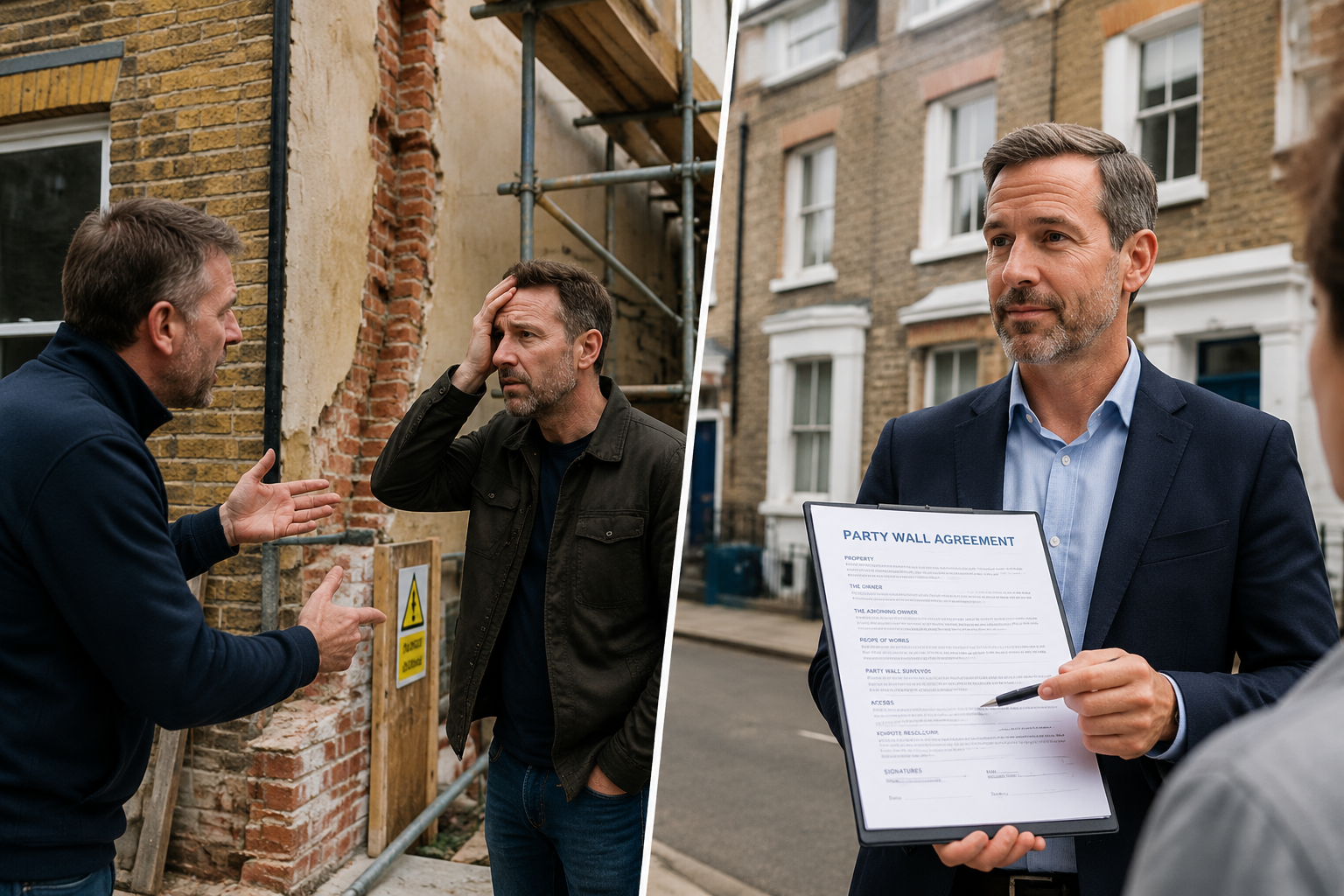
There is a common misconception that robust contract protections add unnecessary cost and complexity to straightforward party wall projects. In practice, the opposite is true. A poorly defined award that allows scope creep to go unchecked typically results in higher costs for all parties — through disputes, appeals, and remediation work.
Surveyors can help building owners keep party wall costs down by:
- Drafting comprehensive awards that reduce the likelihood of supplementary processes.
- Identifying the full scope of notifiable works at the outset, so that all elements can be addressed in a single award where possible.
- Communicating clearly with all parties about what the award covers and what it does not.
- Responding promptly to scope change requests with written guidance, rather than allowing ambiguity to accumulate.
This approach serves the interests of building owners, adjoining owners, and surveyors alike. It is also consistent with the consumer-focused principles in the RICS party walls consumer guide, which emphasises clarity and proportionality in the party wall process [9].
Conclusion
Scope creep in party wall works: contract protections for surveyors in 2026 demands a proactive, document-driven approach. The Party Wall etc. Act 1996 provides a clear but limited jurisdiction, and surveyors who operate within that boundary — and who document that boundary carefully — are well protected. Those who allow scope to drift, whether through informal instructions, vague award language, or pressure from building owners, face real exposure to appeals, costs challenges, and professional complaints.
Actionable next steps for surveyors in 2026:
- Review all engagement letter templates to ensure they include explicit scope limitation clauses and written instruction requirements.
- Audit recent awards to confirm that works descriptions are tied to specific drawings and Act sections.
- Introduce a standard supplementary notice trigger clause in all new awards.
- Use schedule of condition reports as a scope anchor, not merely as an evidential record.
- Respond to all ultra vires requests in writing, creating a contemporaneous record of the boundary between statutory and non-statutory matters.
For building owners and adjoining owners navigating this process, working with an experienced local surveyor — whether in East London, West London, North London, South London, or Central London — remains the most reliable way to ensure that the party wall process is managed within its proper legal and contractual boundaries from the outset.
References
[1] Party Wall Agreement – https://hoa.org.uk/advice/guides-for-homeowners/i-am-improving/party-wall-agreement/
[2] salford-repository.worktribe – https://salford-repository.worktribe.com/OutputFile/1502566
[3] Jan 22 Party Wall Legislation And Procedure 7th Edition – https://www.rics.org/content/dam/ricsglobal/documents/standards/jan_22_party_wall_legislation_and_procedure_7th_edition.pdf
[4] The Party Wall Etc Act 1996 Explanatory Booklet – https://www.gov.uk/government/publications/preventing-and-resolving-disputes-in-relation-to-party-walls/the-party-wall-etc-act-1996-explanatory-booklet
[5] Partywallguidancenote Feb23 Web – https://www.property-care.org/write/MediaUploads/Technical%20Documents/PartyWallGuidanceNote_Feb23_WEB.pdf
[6] If You Cant Agree – https://www.gov.uk/party-walls-building-works/if-you-cant-agree
[7] Party Walls – https://www.rbkc.gov.uk/environment/advice-builders/party-walls
[8] A Reasonable Party Wall Guide – https://howorth.uk/2026/03/04/a-reasonable-party-wall-guide/
[9] Party Walls Consumer Guide 2022 – https://www.rics.org/content/dam/ricsglobal/documents/consumer-guides/party-walls-consumer-guide-2022.pdf
[10] How Far Can Party Wall Surveyors Go To Protect Adjoining Owners – https://www.houricanassociates.com/party-wall-news/how-far-can-party-wall-surveyors-go-to-protect-adjoining-owners/