
Nearly 40% of party wall disputes in England and Wales arise from procedural errors during the notice stage—mistakes that could have been avoided with proper understanding of the legal framework. As construction activity continues to surge in 2026, navigating the Step-by-Step Party Wall Process: From Notice Service to Award Finalization in 2026 Projects has become essential for building owners, adjoining owners, and construction professionals alike.
The Party Wall Act 1996 governs how property owners must handle construction work that affects shared walls, boundaries, or nearby structures. Understanding this process from initial notice through final award isn’t just about legal compliance—it’s about maintaining good neighbor relations and avoiding costly delays or litigation. This comprehensive guide breaks down each stage of the party wall procedure, covering Type A and Type B walls, dissent responses, schedules of condition, and common pitfalls that can derail even well-planned projects.
Key Takeaways
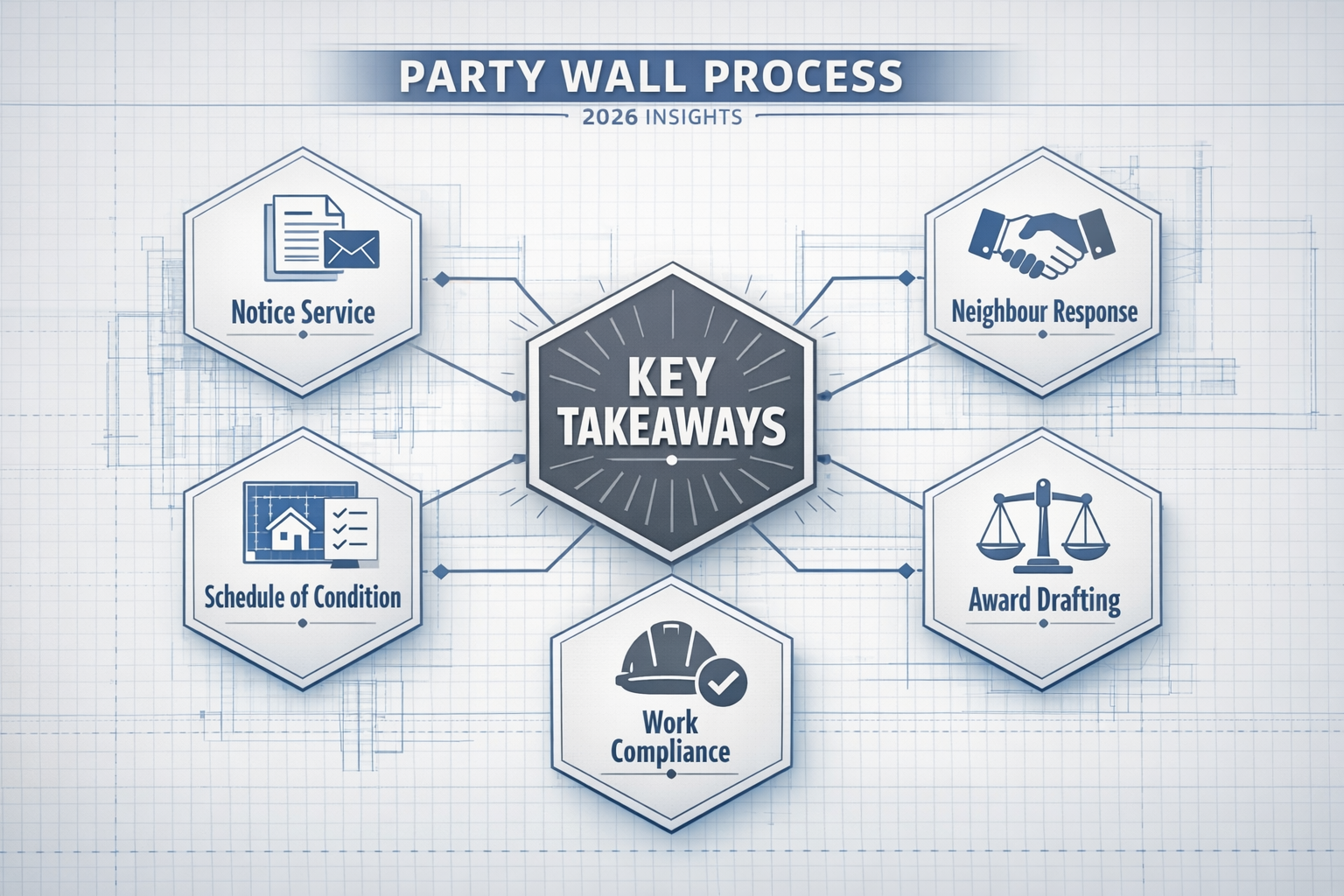
- Three notice types exist under the Party Wall Act 1996: Section 1 (new walls on boundaries), Section 3 (work to existing party walls), and Section 6 (excavation near neighbors’ structures)
- The 2-month notice period is mandatory for most party wall works, with neighbors having 14 days to respond with consent, dissent, or counter notice
- Written consent eliminates the need for surveyors and awards, potentially saving thousands in professional fees
- Schedule of condition documentation protects both parties by establishing pre-work property conditions with dated photographs and written records
- No construction work can legally commence without either written consent or a finalized Party Wall Award in place
Understanding the Party Wall Act 1996 Framework
The Party Wall Act 1996 applies exclusively to England and Wales—not Scotland or Northern Ireland—and establishes the legal framework for how property owners must handle construction affecting shared structures or boundaries.[1] This legislation balances the rights of building owners to improve their properties with the protection of adjoining owners from potential damage.
Jurisdiction and Applicability
The Act covers residential, commercial, and mixed-use properties where work affects:
- Shared walls between semi-detached or terraced properties
- Boundary lines where new walls will be constructed
- Structures within excavation zones (3-6 meters from neighbors’ foundations)
- Party structures including floors between flats and shared chimneys
It’s important to note that the Party Wall Act process operates independently from planning permission requirements. Building owners can serve party wall notices before obtaining planning approval, allowing up to 12 months before work must commence.[1]
The Three Primary Notice Categories
The Step-by-Step Party Wall Process: From Notice Service to Award Finalization in 2026 Projects centers on three distinct notice types, each addressing different construction scenarios:
| Notice Type | Section | Typical Works | Notice Period |
|---|---|---|---|
| Line of Junction Notice | Section 1 | New walls on/astride boundary lines | 2 months ⏰ |
| Party Structure Notice | Section 3 | Work to existing party walls, raising walls, inserting beams | 2 months ⏰ |
| Adjacent Excavation Notice | Section 6 | Excavation within 3-6m of neighbor’s structure | 1 month ⏰ |
Section 1 works involve building new walls either directly on the boundary line (Type A wall) or astride the boundary line (Type B wall). Type A walls sit entirely on the building owner’s land but along the boundary, while Type B walls straddle the boundary with foundations on both properties.[2]
Section 3 works encompass modifications to existing party structures, including:
- Cutting into party walls for beam insertion
- Raising party walls for loft conversions
- Demolishing and rebuilding party walls
- Removing chimney breasts from party walls
- Inserting damp proof courses
Section 6 works trigger notice requirements when excavating within specific distances: within 3 meters if digging deeper than the neighbor’s foundations, or within 6 meters if excavating within a 45-degree angle from the bottom of their foundations.[4]
Works That Don’t Require Party Wall Notices
Not every project affecting walls needs formal procedures. Minor works such as plastering, electrical installations, drilling for kitchen units, or cosmetic repairs fall outside the Act’s scope.[1][5] However, when in doubt, consulting with party wall professionals can prevent costly mistakes.
Stage 1: Preparing and Serving Party Wall Notices
The foundation of the Step-by-Step Party Wall Process: From Notice Service to Award Finalization in 2026 Projects begins with properly prepared and served notices. This critical stage sets the tone for the entire procedure and determines whether the process proceeds smoothly or encounters complications.
Essential Information Required in Party Wall Notices
Every valid party wall notice must contain mandatory information to comply with the Act’s requirements:[2]
✅ Full names and addresses of both the building owner and all adjoining owners
✅ Property address where works will occur
✅ Detailed description of proposed works with drawings or plans
✅ Planned start date (minimum one month away for Section 6, two months for Sections 1 and 3)
✅ Applicable section number (Section 1, 3, or 6)
✅ Statement confirming notice is given under the Party Wall Act 1996
✅ Signature and date from the building owner
Pro Tip: Including detailed architectural drawings and specifications with your notice demonstrates professionalism and helps adjoining owners understand the scope of work, often leading to faster consent.
Methods of Service
Party wall notices can be served through several methods:
- Hand delivery to the adjoining owner personally
- Registered or recorded delivery mail (recommended for proof)
- Leaving at the property in a conspicuous location
- Standard post (though proof of service is harder to establish)
For different types of party wall works, maintaining evidence of service is crucial. Keep copies of all notices, postal receipts, and any acknowledgment from neighbors.
Timeline Considerations
Building owners can serve notice up to one year before work begins, providing flexibility for project planning.[1] However, once served, the clock starts ticking on the adjoining owner’s response period.
The standard timeline follows this pattern:
Day 0: Notice served
Day 14: Adjoining owner’s consent/dissent deadline
Day 30: Counter notice deadline (if requesting additional works)
Day 60: Earliest work commencement date (for Section 1 & 3 notices)
Common Notice Service Mistakes to Avoid
🚫 Serving notice too late – Many building owners wait until just before construction, creating unnecessary pressure
🚫 Incomplete descriptions – Vague work descriptions lead to disputes and delays
🚫 Missing adjoining owners – Failing to identify all affected neighbors (including those sharing boundaries at angles)
🚫 Incorrect section references – Misidentifying the applicable section undermines the notice’s validity
🚫 No proof of service – Without evidence, you cannot prove compliance if disputes arise
Understanding how to properly serve party wall notices is fundamental to avoiding these pitfalls and ensuring your project stays on schedule.
Stage 2: Neighbor Responses and Dispute Resolution
After serving notice, the Step-by-Step Party Wall Process: From Notice Service to Award Finalization in 2026 Projects enters a critical phase where adjoining owners must respond. Their decision determines whether the process remains simple or requires formal surveyor involvement.
The Three Possible Responses
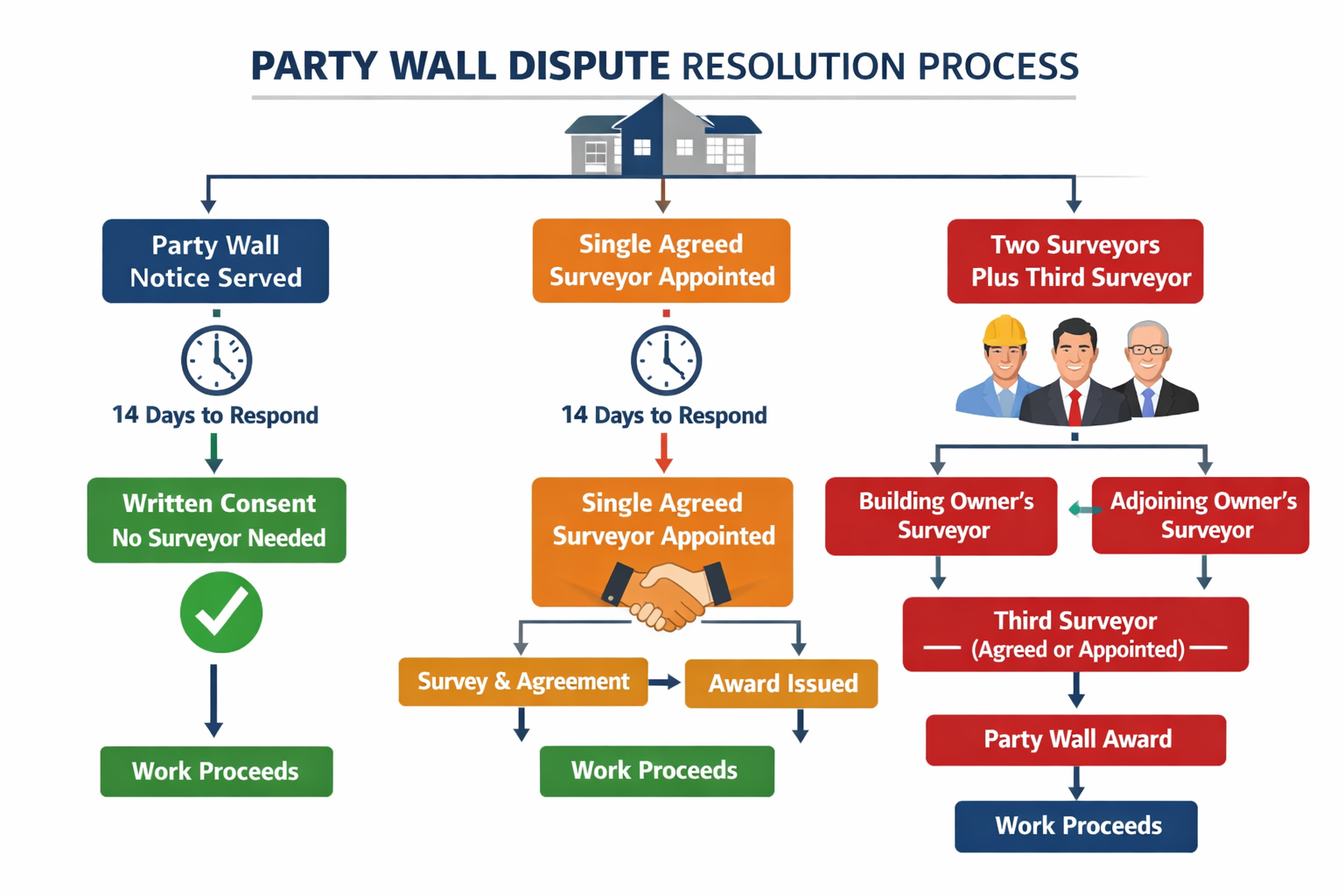
Adjoining owners have 14 days to respond to party wall notices, with three potential outcomes:[5]
1. Written Consent ✅ (Best Case Scenario)
When neighbors provide written consent, the process becomes remarkably straightforward. No party wall surveyor or formal Party Wall Award is necessary, potentially saving both parties thousands of pounds in professional fees.[1][5]
The building owner can proceed with works after the notice period expires, though documenting pre-work conditions remains advisable. Even with consent, maintaining a schedule of condition protects against future disagreement about damage.
2. Dissent or No Response 🔴 (Triggers Formal Process)
If the adjoining owner refuses consent or fails to respond within 14 days, a deemed dispute arises automatically under the Act. This isn’t necessarily adversarial—it simply means the formal surveyor appointment process must begin.[5]
At this stage, both parties must appoint surveyors to prepare a Party Wall Award. Three appointment structures exist:
Option A: Agreed Surveyor 🤝
Both parties jointly appoint a single surveyor who acts impartially. This is the most cost-effective approach when relationships remain amicable. The agreed surveyor prepares one award and charges fees that both parties typically share (though the building owner usually pays initially).
Option B: Two Surveyors 👥
Each party appoints their own surveyor. The building owner’s surveyor represents their interests, while the adjoining owner’s surveyor protects their rights. These two surveyors work together to prepare the award, and if they cannot agree, they appoint a third surveyor to resolve differences.
Option C: Two Surveyors Plus Third Surveyor 👥➕👤
When the appointed surveyors cannot reach agreement on specific matters, they select a third surveyor (also called the “agreed surveyor” in this context) to make binding decisions on disputed points.
Understanding Counter Notices
Adjoining owners can issue a counter notice within one month of receiving the original notice, requesting additional works that would benefit them.[5] For example:
- If the building owner plans to raise a party wall, the adjoining owner might request weathering on their side
- When inserting a damp proof course, neighbors might ask for it to extend into their property
- During rebuilding work, adjoining owners could request improved insulation or soundproofing
Important: Adjoining owners who request additional works through counter notices may be required to pay for those extras, particularly if they benefit exclusively from the improvements.[5]
The Role of Party Wall Surveyors
Once a dispute arises (whether through dissent or silence), appointing qualified party wall surveyors becomes mandatory. These professionals:
📋 Assess the proposed works and their potential impact
📋 Prepare schedules of condition documenting pre-work property states
📋 Draft the Party Wall Award with specific terms and conditions
📋 Resolve technical disputes between parties
📋 Oversee work execution to ensure compliance with the award
📋 Address post-construction claims if damage occurs
The building owner typically bears the cost of both surveyors’ fees, though keeping party wall costs down is possible through efficient communication and proper documentation.
Timeframes for Surveyor Appointments
Once dissent occurs or the 14-day period expires without response:
- Each party has 10 days to appoint their surveyor
- If the adjoining owner fails to appoint within 10 days, the building owner’s surveyor can make the appointment on their behalf
- The appointed surveyors then have 10 days to select a third surveyor (if using the two-surveyor approach)
Understanding what happens when your neighbor is carrying out works helps adjoining owners navigate their rights and responsibilities during this stage.
Stage 3: Schedule of Condition Preparation
Before any construction begins, creating a comprehensive schedule of condition is essential to the Step-by-Step Party Wall Process: From Notice Service to Award Finalization in 2026 Projects. This document serves as the baseline evidence for assessing any damage claims after work completion.
What Is a Schedule of Condition?
A schedule of condition is a detailed record documenting the pre-construction state of the adjoining owner’s property, particularly areas that might be affected by the proposed works. It typically includes:
📸 Dated photographs of all relevant areas (walls, ceilings, floors, external facades)
📝 Written descriptions of existing defects, cracks, or damage
📐 Measurements of existing cracks with crack width gauges
🗺️ Floor plans marking locations of documented conditions
📅 Timestamps proving when the inspection occurred
Best Practices for 2026 Projects
Modern schedule of condition preparation has evolved significantly, incorporating digital tools and standardized methodologies. According to current best practices:[6]
Use High-Resolution Digital Photography 📱
Capture images with smartphones or cameras that embed EXIF data (date, time, location). Take wide-angle shots for context and close-ups for detail. Photograph:
- All rooms adjoining the party wall
- External elevations
- Existing cracks (with measuring tape for scale)
- Decorative finishes and fixtures
- Structural elements like beams and lintels
Document Everything in Writing ✍️
Supplement photographs with detailed written descriptions. Note the location, size, and nature of every defect. Use objective language: “Vertical crack in plaster, 150mm long, 2mm wide, located 500mm from ceiling in bedroom” rather than subjective terms like “minor crack.”
Obtain Agreement from Both Parties 🤝
Both the building owner and adjoining owner (or their representatives) should sign and date the schedule of condition, acknowledging its accuracy. This mutual agreement prevents later disputes about whether damage was pre-existing.
Store Securely with Multiple Copies 💾
Maintain digital and physical copies. Cloud storage with timestamps provides additional verification. Share copies with all relevant parties: building owner, adjoining owner, and appointed surveyors.
Who Prepares the Schedule of Condition?
In formal party wall procedures, the appointed surveyor(s) typically prepare the schedule of condition as part of their duties. However, even when neighbors provide written consent and no surveyor is involved, building owners should still create their own schedule of condition.[1][6]
For projects proceeding without a surveyor, consider hiring a professional photographer or surveyor specifically for condition documentation—a small investment that provides substantial protection.
Common Schedule of Condition Pitfalls
⚠️ Insufficient photographic coverage – Missing areas that later show damage
⚠️ Poor image quality – Blurry or poorly lit photos that don’t show detail
⚠️ Lack of scale references – Photos without measuring tapes or rulers
⚠️ Delayed preparation – Creating schedules after work has already begun
⚠️ No adjoining owner access – Failing to gain entry to document their property
⚠️ Inadequate written descriptions – Relying solely on photos without contextual notes
Legal Weight of Schedules of Condition
When post-construction disputes arise, schedules of condition carry significant legal weight. Courts and surveyors rely heavily on these documents to determine:
- Whether damage existed before works commenced
- The extent of any deterioration caused by construction
- Appropriate compensation for legitimate damage claims
- Whether building owners fulfilled their duty of care
Without a proper schedule of condition, building owners face an uphill battle proving that damage was pre-existing, potentially leading to unjustified compensation payments.[6]
Stage 4: Drafting and Finalizing the Party Wall Award
When written consent isn’t obtained, the Step-by-Step Party Wall Process: From Notice Service to Award Finalization in 2026 Projects culminates in the preparation and finalization of a Party Wall Award—a legally binding document that governs how works will proceed.
What Is a Party Wall Award?
A Party Wall Award is a formal legal document prepared by the appointed surveyor(s) that sets out:
📄 Detailed description of the works to be undertaken
📄 Rights granted to the building owner
📄 Conditions and restrictions on how work must be executed
📄 Access arrangements for surveyors and workers
📄 Working hours and noise limitations
📄 Schedule of condition (attached as appendix)
📄 Security for expenses (if required)
📄 Cost allocation for surveyor fees and expenses
The award is legally binding on both parties and remains attached to the properties, affecting future owners if works are incomplete.[7]
Key Components of a Comprehensive Award
Work Description and Specifications
The award must clearly describe the approved works, often referencing architectural drawings and structural calculations. Ambiguity here leads to disputes during construction, so precision is essential.
Rights and Obligations
The award specifies:
- Building owner’s rights to enter adjoining property for works
- Notice requirements before accessing neighbor’s property
- Adjoining owner’s rights to inspect works in progress
- Obligations to minimize disruption and damage
Protective Conditions
Modern awards typically include conditions such as:
🛡️ Structural protection measures (shoring, propping, temporary supports)
🛡️ Dust and debris control requirements
🛡️ Vibration monitoring for sensitive structures
🛡️ Working hours restrictions (typically 8am-6pm weekdays)
🛡️ Noise level limitations complying with local authority requirements
🛡️ Insurance requirements and indemnity provisions
Security for Expenses
In cases where significant risk exists, surveyors may require the building owner to provide security for expenses—a sum deposited or guaranteed to cover potential damage repairs. This protects adjoining owners from bearing costs if the building owner becomes insolvent or disputes damage claims.
The Award Finalization Process
Once drafted, the award follows this finalization sequence:
Step 1: Draft Circulation 📧
The surveyor(s) prepare a draft award and circulate it to both parties for review.
Step 2: Comment Period 💬
Both parties can raise questions or concerns about the draft terms. Surveyors address reasonable concerns while maintaining impartiality.
Step 3: Final Award Issuance ✅
The surveyor(s) issue the final award, serving copies on both building owner and adjoining owner.
Step 4: Appeal Period ⏱️
Either party has 14 days to appeal the award to the county court if they believe it contains errors or the surveyor exceeded their authority. Appeals are rare and typically unsuccessful unless procedural irregularities occurred.
Step 5: Award Becomes Binding ⚖️
After the 14-day appeal period expires, the award becomes fully binding and works can commence in accordance with its terms.
Understanding Award Costs
The building owner typically bears all costs associated with the party wall process, including:
- Their own surveyor’s fees
- The adjoining owner’s surveyor’s fees (if separate surveyors appointed)
- The third surveyor’s fees (if appointed)
- Schedule of condition preparation costs
- Award drafting and finalization expenses
Total costs vary significantly based on project complexity, but typically range from £700-£2,000 for straightforward cases with an agreed surveyor, up to £3,000-£5,000+ for complex projects requiring multiple surveyors.[5] Understanding the costs of the party wall process helps with budgeting.
Using Party Wall Agreement Templates
For simpler projects where neighbors consent but parties want formal documentation, party wall agreement templates can provide structure. However, these should never replace professional advice for complex works or disputed situations.
Stage 5: Work Commencement and Compliance Monitoring
With the Party Wall Award finalized or written consent obtained, the Step-by-Step Party Wall Process: From Notice Service to Award Finalization in 2026 Projects enters its execution phase. Compliance with award terms and ongoing communication remain critical.
Pre-Commencement Requirements
Before the first hammer swings, building owners must ensure:
✔️ Award is finalized and the 14-day appeal period has expired
✔️ Schedule of condition is completed and agreed
✔️ Contractors are briefed on award conditions and restrictions
✔️ Access arrangements are confirmed with adjoining owners
✔️ Insurance is in place as specified in the award
✔️ Required notices have been given to adjoining owners about start dates
Ongoing Compliance During Construction
Throughout the construction period, building owners must:
🔨 Adhere to working hours specified in the award
🔨 Implement protective measures (hoarding, dust sheets, vibration monitoring)
🔨 Provide access for surveyors to inspect works
🔨 Maintain communication with adjoining owners about progress
🔨 Document the process with photographs and records
🔨 Address concerns promptly if neighbors report issues
Role of Surveyors During Construction
Appointed surveyors don’t disappear after issuing the award. Their ongoing duties include:
- Periodic site inspections to verify compliance with award terms
- Resolving technical issues that arise during construction
- Mediating disputes between parties about work execution
- Approving variations if changes to the approved works become necessary
- Documenting progress for future reference
Common Construction Phase Issues
Even with a solid award in place, problems can emerge:
Unexpected Structural Conditions 🏗️
Discovering unforeseen structural issues may require award modifications. Surveyors can issue supplementary awards or written agreements to address these situations.
Damage Claims 💥
If the adjoining owner reports damage during works, surveyors investigate whether it relates to the party wall works. The schedule of condition becomes crucial evidence. Legitimate damage must be repaired or compensated according to award terms.
Access Disputes 🚪
Disagreements about access timing or extent should be referred to the surveyor(s) for resolution. The award typically grants reasonable access rights, but “reasonable” requires interpretation.
Work Variations 📐
If the building owner needs to modify the approved works, they must obtain surveyor approval and potentially serve additional notices if the changes fall outside the original scope.
Completion and Final Inspection
Upon work completion:
- Building owner notifies the adjoining owner and surveyor(s)
- Final inspection occurs, comparing completed works to the schedule of condition
- Any damage is identified and remediation arranged
- Final account of surveyor fees is prepared and settled
- Completion certificate may be issued confirming compliance with the award
Common Pitfalls and How to Avoid Them
Throughout the Step-by-Step Party Wall Process: From Notice Service to Award Finalization in 2026 Projects, several recurring mistakes can derail even well-intentioned projects.
Pitfall #1: Starting Work Without Proper Consent or Award
The Problem: Some building owners begin construction before obtaining written consent or a finalized award, assuming neighbors won’t object.
The Consequence: Adjoining owners can obtain injunctions forcing work stoppage, leading to costly delays and legal fees.
The Solution: Never commence work until either written consent is received or the Party Wall Award is finalized and the appeal period has expired.[1]
Pitfall #2: Inadequate Notice Descriptions
The Problem: Vague or incomplete work descriptions in notices create ambiguity about what’s approved.
The Consequence: Disputes arise when actual works differ from what neighbors understood, potentially requiring new notices and delays.
The Solution: Include detailed architectural drawings, specifications, and clear written descriptions with every notice. When in doubt, provide more information rather than less.
Pitfall #3: Ignoring Boundary Wall Considerations
The Problem: Building owners confuse party walls with boundary walls, applying incorrect procedures.
The Consequence: Invalid notices and potential legal challenges.
The Solution: Understand the difference between party fence walls and boundary walls before serving notices. Party walls are shared structures; boundary walls sit entirely on one property.
Pitfall #4: Failing to Identify All Affected Neighbors
The Problem: Building owners serve notice only on the most obvious adjoining owner, missing others affected by excavation or structural work.
The Consequence: Unnotified neighbors can halt works and claim damages.
The Solution: Carefully identify all properties within the relevant distances for Section 6 works. Consider properties at angles, not just those directly adjacent.
Pitfall #5: Poor Communication
The Problem: Building owners treat the party wall process as purely bureaucratic, failing to communicate openly with neighbors.
The Consequence: Neighbors become defensive, withhold consent, and the process becomes adversarial.
The Solution: Discuss plans with neighbors before serving formal notices. Address concerns proactively. Good relationships often lead to written consent, avoiding surveyor fees entirely.
Pitfall #6: Choosing Unqualified Surveyors
The Problem: Appointing surveyors without proper party wall expertise or RICS accreditation.
The Consequence: Poorly drafted awards, missed issues, and potential professional negligence.
The Solution: Verify surveyors’ qualifications, experience with party wall matters, and professional indemnity insurance. Qualified party wall surveyors should have specific training in the Party Wall Act 1996.
Pitfall #7: Neglecting Post-Construction Documentation
The Problem: Failing to conduct final inspections and document the completed state.
The Consequence: Delayed damage claims emerge months or years later without clear evidence of when issues arose.
The Solution: Complete post-construction schedules of condition and obtain sign-off from surveyors and adjoining owners confirming satisfactory completion.
Regional Considerations Across London and Beyond
The Step-by-Step Party Wall Process: From Notice Service to Award Finalization in 2026 Projects applies consistently across England and Wales, but practical considerations vary by location.
London-Specific Factors
London’s dense housing stock and active construction market create unique party wall challenges:
Higher Property Values 💷
Greater financial stakes make disputes more contentious and increase the importance of proper documentation.
Victorian and Georgian Terraces 🏘️
Older construction methods and shared structural elements require specialist knowledge. Party wall surveyors in Central London often encounter complex historical structures.
Multiple Adjoining Owners 👥
Terraced properties may require serving notice on neighbors on both sides, plus properties behind if excavating.
Conservation Areas 🏛️
Additional planning restrictions in areas like North London, South London, East London, and West London don’t change party wall requirements but add complexity to projects.
Urban vs. Rural Differences
Urban Areas: Higher density means more party wall situations, greater neighbor sensitivity, and more experienced local surveyors.
Rural Areas: Fewer party wall cases, potentially less experienced surveyors, but often more cooperative neighbor relationships.
Future Trends: Party Wall Process Evolution in 2026 and Beyond
As we progress through 2026, several trends are shaping the Step-by-Step Party Wall Process: From Notice Service to Award Finalization in 2026 Projects:
Digital Documentation and Technology
📱 Digital notice service through secure platforms
📱 3D scanning for schedules of condition
📱 Drone photography for external elevation documentation
📱 Vibration monitoring apps providing real-time data
📱 Digital award signatures and blockchain verification
Increased Professionalization
The Royal Institution of Chartered Surveyors (RICS) continues developing party wall guidance, raising professional standards and accountability. More surveyors are obtaining specialist party wall qualifications beyond general surveying credentials.
Environmental Considerations
Modern awards increasingly address:
- Thermal efficiency improvements during party wall works
- Acoustic performance requirements for sound insulation
- Sustainable materials specifications
- Energy efficiency upgrades coordinated with structural works
Alternative Dispute Resolution
Mediation and alternative dispute resolution methods are becoming more common before formal surveyor appointments, potentially reducing costs and maintaining neighbor relationships.
Conclusion
The Step-by-Step Party Wall Process: From Notice Service to Award Finalization in 2026 Projects requires careful attention to legal requirements, timelines, and professional standards. Success depends on proper notice preparation, clear communication with neighbors, comprehensive condition documentation, and compliance with award terms throughout construction.
Whether you’re a building owner planning renovations, an adjoining owner receiving notice, or a construction professional managing projects, understanding each stage of this process protects your interests and maintains positive neighbor relationships. The Party Wall Act 1996 provides a balanced framework that, when followed correctly, allows necessary construction while safeguarding all parties’ rights.
Your Next Steps
If you’re planning construction work:
- Identify whether your project requires party wall notices by reviewing types of party wall works
- Prepare detailed notices with architectural drawings at least 2-3 months before your intended start date
- Communicate openly with neighbors before formal notice service
- Engage qualified party wall surveyors if disputes arise
- Create comprehensive schedules of condition before work begins
If you’ve received a party wall notice:
- Review the party wall act notices guide to understand your rights
- Respond within 14 days—either consenting or appointing a surveyor
- Don’t ignore notices, as this creates deemed dissent and may limit your options
- Consider the benefits of appointing your own surveyor to protect your interests
- Ensure your property is properly documented before works commence
For both parties:
- Maintain detailed records throughout the process
- Keep communication professional and documented
- Address concerns promptly before they escalate
- Consider the long-term relationship with your neighbor
- Seek professional advice when uncertain about any aspect of the process
The party wall process may seem complex, but with proper preparation, professional guidance, and good faith communication, it protects everyone’s interests while enabling necessary construction work. By following this step-by-step approach, your 2026 project can proceed smoothly from initial notice through final award and successful completion.
For personalized guidance on your specific situation, consider consulting with experienced party wall professionals who can navigate the complexities of your unique circumstances and ensure full compliance with the Party Wall Act 1996.
References
[1] Party Wall Agreement – hoa.org.uk
[2] How To Serve A Party Wall Notice – partywalldiy.com
[3] Steps To Success 10 Steps To Getting Party Wall Approval – christopher-david.co.uk
[4] Watch – youtube.com
[5] Party Wall Agreements What You Need To Know – fmb.org.uk
[6] Schedules Of Condition In Party Wall Works Best Practices To Prevent Post Construction Claims In 2026 – https://nottinghillsurveyors.com/blog/schedules-of-condition-in-party-wall-works-best-practices-to-prevent-post-construction-claims-in-2026
[7] The Party Wall Process Your Complete Guide – akt-surveyors.com
Speak to a RICS chartered party wall surveyor
Free initial consultation. Notices, awards and schedules of condition across London and nationwide.