

A single regulation change on 31 October 2026 will strip London councillors of the power to block most extensions, lofts and basements, even when dozens of neighbours object. That is not a slow bureaucratic shift; it is a rewrite of who decides what happens to your house, and it lands in just a few weeks.
For anyone planning a rear extension, loft conversion or basement dig in London this autumn, the householder extension planning officer decision 31 October 2026 London party wall story matters on two fronts. Planning will become faster and more predictable, but it will also become less of a venue for neighbour disputes. That means the Party Wall etc. Act 1996, not the planning committee, becomes the real place where neighbours’ rights are protected.
Key Takeaways
- From 31 October 2026, the National Scheme of Delegation (SI 2026/854) hands almost all householder extension decisions to planning officers, with no committee route regardless of objection numbers.
- Objections can still shape conditions, but they can no longer trigger a committee hearing or vote on a standard extension or loft conversion.
- Planning permission has never authorised interference with a neighbour’s structure, the Party Wall Act 1996 remains unchanged and is now the primary safeguard for neighbours.
- With mortgage rates at 5.93% and Bank Rate decided on 5 November 2026, build cost and finance planning matter as much as design.
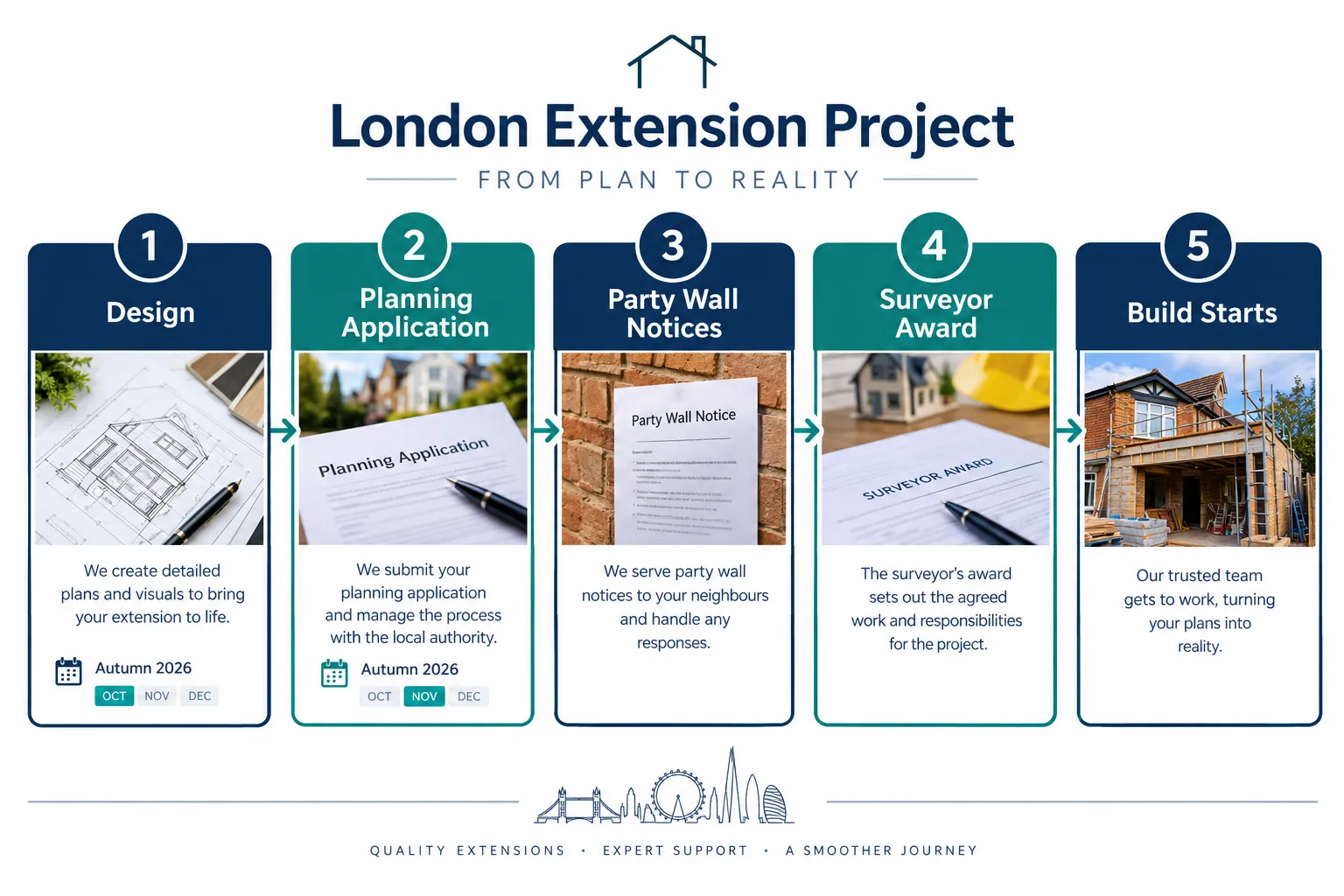
- The safe sequence is design, then planning, then party wall notices, then award, then build, rushing this order risks delay or dispute.
What Changes for a Householder Extension Planning Officer Decision 31 October 2026 London Party Wall Applications
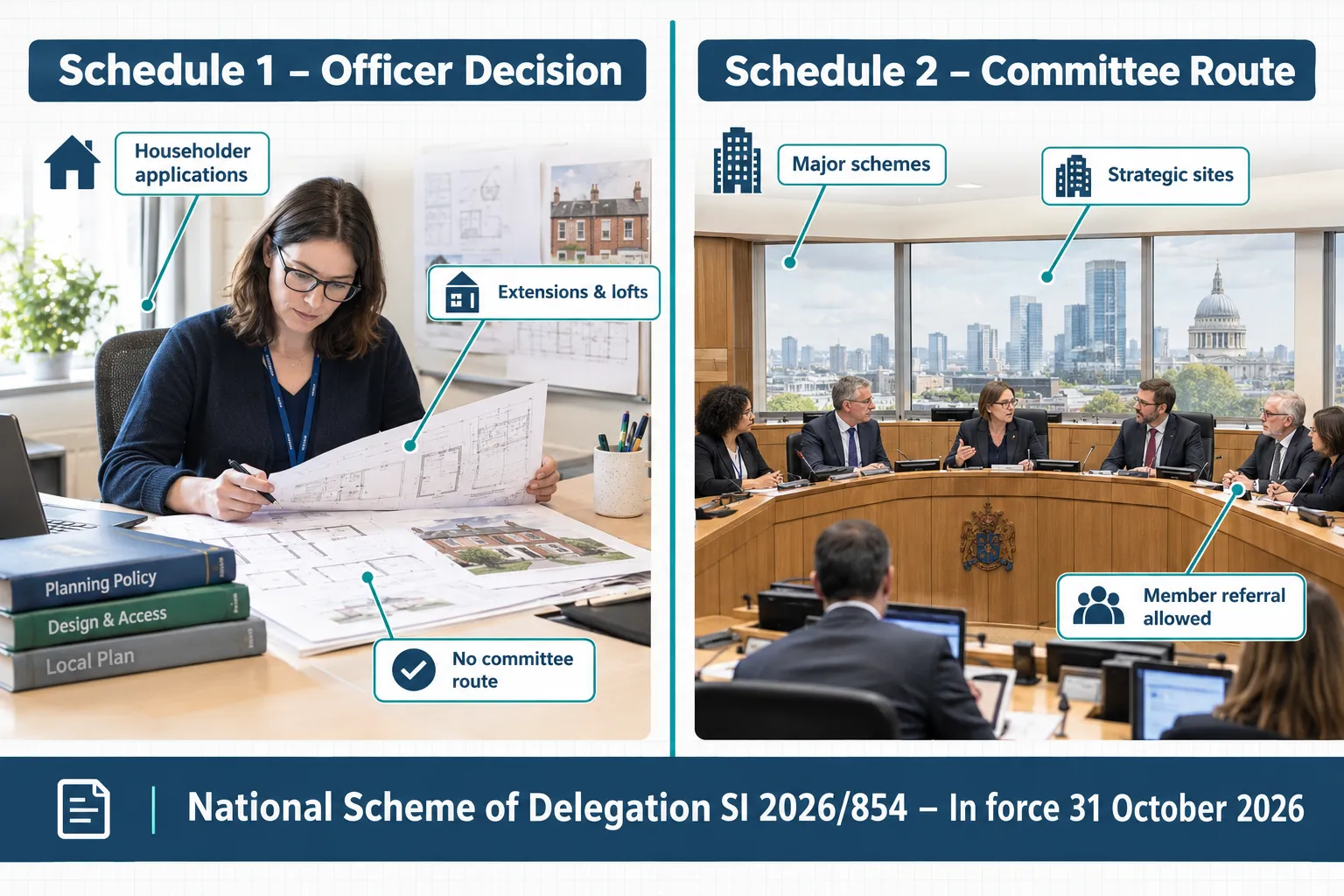
The Town and Country Planning (Discharge of Local Planning Authority Functions) (England) Regulations 2026, known as the National Scheme of Delegation, comes into force on 31 October 2026. It sorts planning applications into two schedules. Schedule 1 covers householder applications, extensions, loft conversions and similar domestic works, and these must be decided by a planning officer. They cannot be sent to committee, no matter how many letters of objection a scheme attracts.
Schedule 2 covers larger or more contentious applications, which can only reach committee if a nominated officer and a nominated committee member both agree the case passes a gateway test. Committees themselves are capped at 13 members. The old practice of automatic referral once objection numbers hit a local threshold is abolished, as is routine councillor call-in. Statutory guidance is explicit: a committee decision taken on an application that should have been delegated risks judicial review. Local councils can no longer write their own override procedures.
For London homeowners, the practical effect is a more consistent, policy-led process. Decisions will be made against the local plan and national guidance rather than the mood of a committee room. For neighbours who previously relied on turning up to object at a meeting, that avenue effectively closes for standard extension schemes.
Why This Makes the Party Wall Act the Real Protection for Neighbours
This is the point many homeowners and neighbours miss. Planning permission has never given anyone the right to damage, build on, or excavate near a neighbour’s wall or foundations. It regulates land use, design and amenity, not who can touch a shared structure. That job belongs entirely to the Party Wall etc. Act 1996, and the Act is unchanged by the new planning regulations.
Under the Act, notice is required before:
- Section 2, work to an existing shared or party wall, requiring two months’ notice.
- Section 1, building a new wall on the boundary line, requiring one month’s notice.
- Section 6, excavation within 3 metres of a neighbouring structure (or 6 metres on a 45-degree line) where the new work goes deeper than the neighbour’s foundations, requiring one month’s notice.
A neighbour who receives a notice has 14 days to consent or dissent. Silence counts as dissent. Dissent triggers the appointment of party wall surveyors and a formal party wall award, which includes a schedule of condition recording the state of the neighbouring property before work starts. Full detail on this process is set out in our guide to the Party Wall Etc Act 1996.
With planning objections carrying less weight at the committee stage, the party wall notice has become the moment neighbours should pay closest attention, not the planning portal comments box.
The Correct Sequence: Design, Planning, Party Wall Notices, Award, Build
Getting the order right avoids wasted money and avoidable arguments. The recommended sequence for an autumn or winter 2026 project is:
- Design, finalise drawings, structural calculations and specification before anything is submitted.
- Planning application, submit for householder consent, now decided by an officer under the delegated scheme.
- Party wall notices, serve section 1, 2 or 6 notices as soon as the design is fixed, ideally once planning is granted or close to decision.
- Party wall award, if a neighbour dissents (or stays silent), surveyors are appointed and an award is agreed, with a schedule of condition.
- Build, work starts only once planning permission and any required award are in place.
Realistic timelines matter here. A householder planning decision typically takes around eight weeks from validation, though the new delegated process should reduce delay caused by committee scheduling. Section 2 notices need two months, section 1 and 6 notices need one month, and if a dispute arises, a surveyor-led award can add several more weeks. Builders booked for a January 2027 start should be serving party wall notices well before Christmas 2026, not after. Homeowners wanting to serve notices themselves before appointing a surveyor can review Having A Party Wall Agreement Without A Surveyor for what is and is not advisable.
Common London Scenarios Under the New Rules
Rear extension on a terrace. The classic London single-storey rear extension usually involves work to the party wall shared with next door. A section 2 notice is almost always required. Under the new delegation rules, the planning officer will assess the application on policy grounds such as light, outlook and design, objections about noise or disruption during construction carry little planning weight but remain central to the party wall process.
Loft conversion with steel beams into the party wall. Loft conversions often need padstones or steel beams bearing into the shared wall. This is party wall work even where no excavation is involved, so a section 2 notice applies. Homeowners should check our Types Of Party Wall Works guide to confirm which notices their specific build triggers.
Basement excavation. Basement projects are the highest-risk category. Excavation near a neighbour’s foundations almost always triggers a section 6 notice, and deep digs close to shared walls routinely lead to a full award with a detailed schedule of condition, given the risk of settlement or cracking next door.
Homeowners in different parts of the capital can find locally based support through Party Wall Surveyor West London, Party Wall Surveyor North London, Party Wall Surveyor Central London, Party Wall Surveyor East London and Party Wall Surveyor South London.
Costs, Finance and Who Pays for Party Wall Work
Finance conditions are tightening at the same time as these planning reforms. The average two-year fixed mortgage sits at 5.93%, its highest level since July 2024, and sub-5% deals have almost disappeared. Bank Rate is 3.75%, with the next decision due 5 November 2026 and markets pricing in a rise to 4%. Nationwide’s 1 October 2026 figures show UK house prices up 0.8% annually, London up a more modest 0.4%, while terraced houses, the classic extension candidate, led growth at 1.8%.
Against that backdrop, controlling party wall costs matters. The building owner carrying out the work generally pays the surveyor’s fees, including any surveyor appointed on the neighbour’s behalf, plus the cost of the schedule of condition. Our guide on How To Keep Party Wall Costs Down explains practical ways to manage this, and Costs Of Party Wall The Process sets out what a typical award process involves.
What Neighbours Should Do When a Notice Arrives
Receiving a party wall notice is not something to ignore, and it is not the same as a planning consultation letter. Neighbours should:
- Read the notice carefully and note the type (section 1, 2 or 6) and the deadline for responding.
- Respond within 14 days, consenting, dissenting, or requesting more information.
- Consider appointing a surveyor if there are concerns about structural risk, even where consenting feels like the easier option.
- Keep records and photographs of the shared wall and nearby structure before work begins.
Further detail on responding properly is covered in Party Wall Act Notices What They Are And How To Respond and What Is A Party Structure Notice How Do I Serve It In London. Those wanting to see what a formal agreement looks like can review the Free Download Sample Party Wall Agreement Template Word or the broader Party Wall Contract Template Guide On Party Wall Awards.
FAQ
Does the new delegation scheme change how long planning permission takes? Not directly, but removing committee referral for householder applications should reduce delays caused by waiting for a committee date, since officers decide Schedule 1 applications themselves.
Can neighbours still object to a planning application after 31 October 2026? Yes, objections can still be submitted and may influence conditions, but they cannot force a householder extension to committee.
Does planning permission remove the need for party wall notices? No. Planning and party wall matters are entirely separate. Permission to build does not authorise work on a neighbour’s wall or foundations.
What happens if a neighbour does not respond to a notice? Silence after 14 days is treated as dissent, which leads to surveyor appointment and a formal award.
Who pays for the party wall surveyor? Normally the building owner carrying out the works pays all reasonable surveyor fees, including those of a surveyor appointed for the neighbour.
Is a basement extension more likely to need an award? Yes, because excavation close to a neighbour’s foundations almost always triggers a section 6 notice and a detailed schedule of condition.
Conclusion
The 31 October 2026 reforms make London’s planning system faster and more rule-based, but they shift the real decision-making power away from public objection and towards policy and procedure. That makes the Party Wall Act 1996 more important than ever for protecting neighbours and for giving homeowners certainty before building work starts. Anyone planning an extension, loft conversion or basement this autumn should finalise designs now, submit for planning promptly, and serve party wall notices in good time, ideally with guidance from a qualified surveyor at Party Wall Etc Act 1996 and Party Wall Awards, so that planning approval and a party wall award arrive together, not in conflict.