
Looking for expert solutions?
Request a Quote

Tag: building control

  • Budget 2026 Promises No Major Building Regulation Changes This Parliament, But the Building Safety Levy and Future Homes Standard Still Land: What London Builders and Neighbours Need to Know (November 2026)

    Budget 2026 Promises No Major Building Regulation Changes This Parliament, But the Building Safety Levy and Future Homes Standard Still Land: What London Builders and Neighbours Need to Know (November 2026)

    The government has told the housebuilding industry something rare: stop bracing for change. The Autumn Budget, published Wednesday 28 October 2026, promised no major changes to building regulations in England for the rest of this Parliament. Yet in the same month, a new levy took effect and a major technical standard quietly locked in its 2027 start date. For London homeowners and developers planning works in 2027, this is a confusing moment, and it is exactly why Budget 2026 building regulations stability Building Safety Levy questions are now landing in surveyors’ inboxes daily.

    This article, written in November 2026, sets out what has actually changed, what has not, and how it interacts with the Party Wall etc. Act 1996 for anyone planning extensions, loft conversions, basements or infill schemes.

    Key Takeaways

    • The Budget’s “no major changes” pledge is a policy statement, not law, building-safety reforms and Grenfell Tower Inquiry work continue regardless.
    • The Building Safety Levy started on 1 October 2026 for qualifying major residential schemes, triggered by building control applications, not planning permission.
    • The Future Homes Standard (SI 2026/335) mostly takes effect 24 March 2027, with higher-risk-building provisions following on 24 September 2027.
    • Transitional protection exists for schemes with full-plans applications made before 24 March 2027 and work starting before 24 March 2028.
    • Party wall notices still run on their own statutory clocks (two months for a Party Structure Notice under section 3, one month for a Line of Junction Notice under section 1 or an excavation notice under section 6, with a 14-day response window in every case) and should be served early to avoid clashing with these regulatory deadlines.

    What the Budget 2026 Building Regulations Stability Building Safety Levy Pledge Actually Means

    The Budget wording is carefully limited. Ministers pledged stability on building regulations to give housebuilders certainty on costs and technical requirements. It is a statement of intent, not a statutory instrument, and it does not define “major change.” Two carve-outs matter:
    What the Budget 2026 Building Regulations Stability Building Safety Levy Pledge Actually Means
    • Building-safety improvements, including Grenfell Tower Inquiry recommendations, continue unaffected.
    • Ministers may still introduce “more proportionate” rules if they support development.

    So “stability” does not mean “frozen.” Existing law already in the pipeline, including the levy and the Future Homes Standard, proceeds exactly as scheduled.

    The Building Safety Levy: Already Live Since 1 October 2026

    The Building Safety Levy came into force on 1 October 2026. It applies to major residential developments of 10 or more dwellings, or 30 or more purpose-built student bed spaces, where the building control application is submitted on or after that date.

    Key mechanics, according to Walker Morris (October 2026):

    Feature Detail
    Trigger Building control application date, not planning permission
    Liability Falls on the named client
    Calculation Chargeable gross internal area, RICS Code of Measuring Practice (6th edition)
    Rates Vary by local authority
    Discount 50% for previously-developed land
    Payment point Due at completion notice or first occupation
    Enforcement Non-payment can block completion certificates

    For most individual householder extensions and loft conversions, the levy’s scale thresholds mean it will not apply. But for larger infill schemes, flat conversions, or small blocks reaching ten units, it is now a real cost line that affects viability and cashflow planning.

    Future Homes Standard: Dates Already Fixed

    The Future Homes Standard regulations, SI 2026/335, were made on 23 March 2026. They are unaffected by the Budget’s stability pledge because they are already law. Key dates:

    • Most provisions, including the Part L changes and an on-site renewable electricity requirement for new dwellings, take effect 24 March 2027.
    • Certain higher-risk-building provisions follow on 24 September 2027.
    • Transitional protection applies where notices or full-plans applications were submitted before 24 March 2027 and work commences before 24 March 2028.

    Developers with schemes close to these thresholds should check whether submitting a full-plans application before March 2027 preserves the current, less onerous technical route.

    OBR’s Warning on Housing Supply

    The Office for Budget Responsibility, in its 28 October 2026 forecast, cut its UK net housing additions projection by 190,000 over the forecast period, citing higher interest rates, affordability pressures and regulatory costs. This is a reminder that policy stability alone does not remove the financial headwinds facing London schemes.
    OBR's Warning on Housing Supply

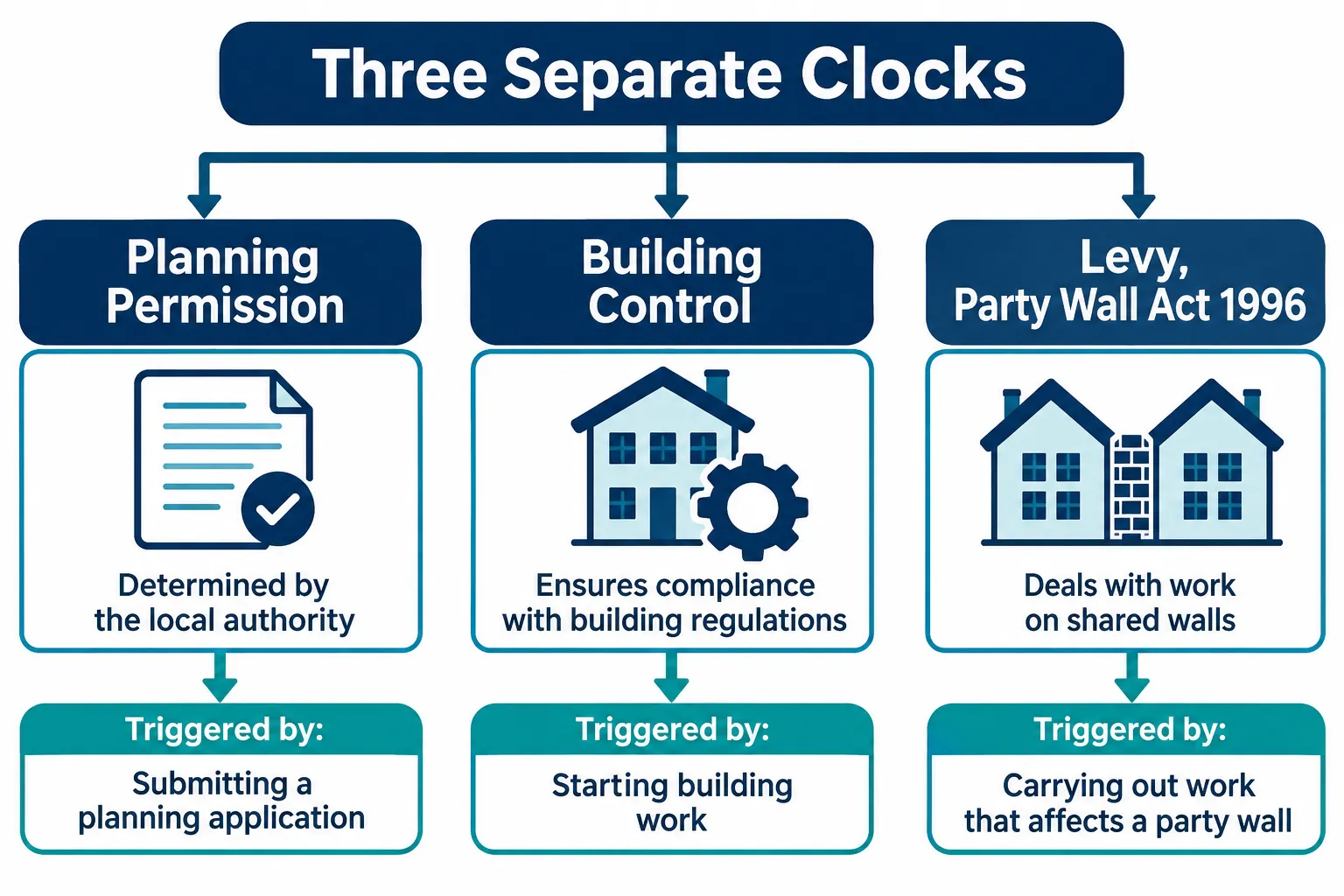
    Planning, Building Regs and the Party Wall Act: Three Separate Clocks

    Homeowners often assume these three consents move together. They do not.

    • Planning permission governs land use, design and external impact.
    • Building regulations/building control governs structural safety, fire, energy and now triggers the Building Safety Levy where applicable.
    • The Party Wall etc. Act 1996 governs work affecting shared walls, boundaries and excavations near a neighbour’s foundations, entirely separate from planning or building control approval.

    A project can have planning permission and a building control application in progress while the party wall notice has not even been served yet, and that is often where delays start.

    Why Serving Party Wall Notice Early Matters Before March 2027

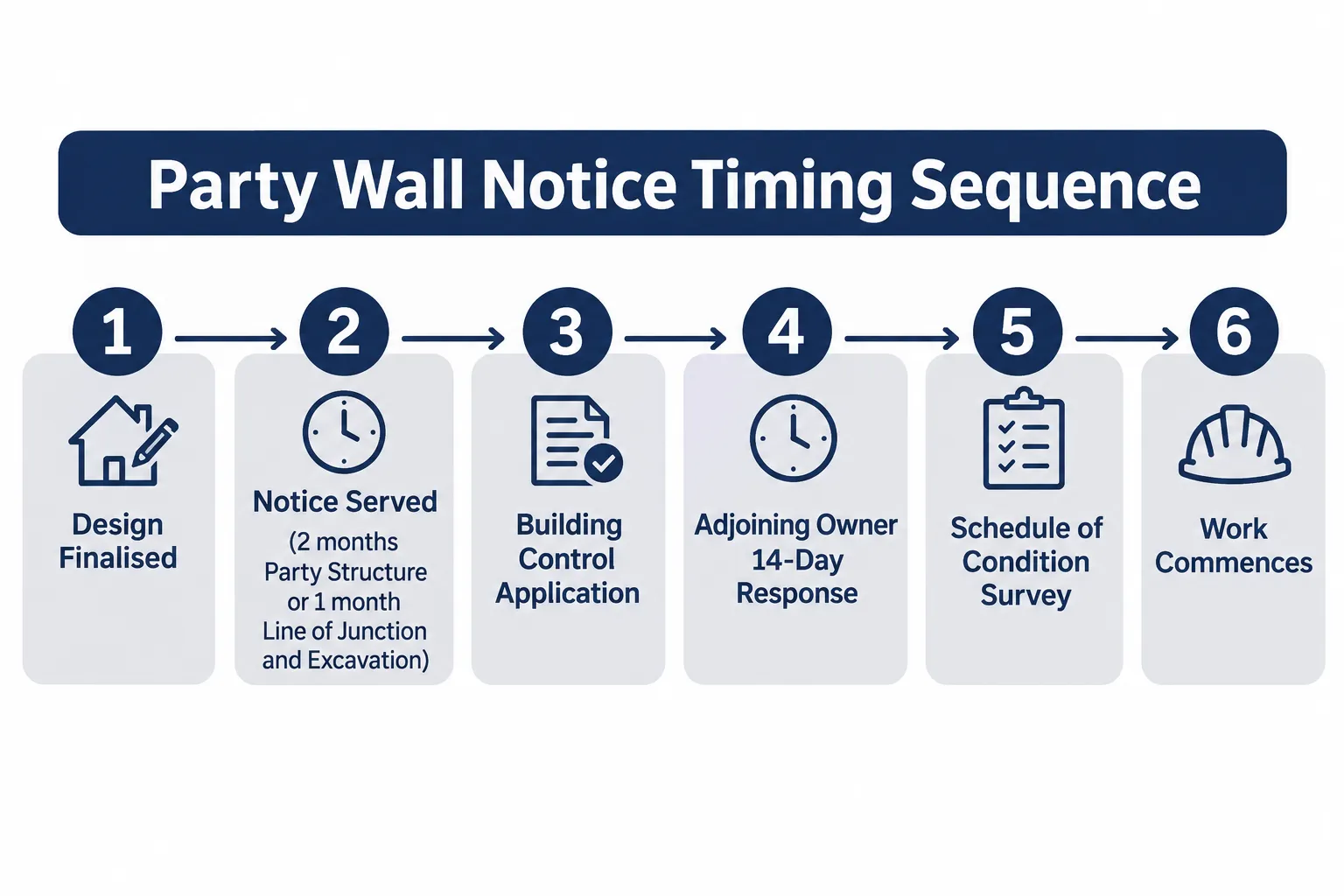
    Party wall notices carry statutory response periods set by the Party Wall etc. Act 1996: a Party Structure Notice under section 3, covering works to an existing party wall or structure, requires at least two months’ notice. A Line of Junction Notice under section 1, for a new wall built at or astride the boundary, and a notice for adjacent excavation under section 6, each require at least one month’s notice. In every case, the adjoining owner has 14 days to respond, after which a dispute is deemed to have arisen if no consent is given.

    For anyone targeting a 2027 start date ahead of the Future Homes Standard’s 24 March deadline, this timing matters:

    1. Design and specification finalised.
    2. Party wall notice served, starting the one- or two-month statutory clock immediately depending on notice type.
    3. Building control application submitted, check levy and Part L implications.
    4. Adjoining owner responds within 14 days, consents, or a surveyor is appointed.
    5. Schedule of Condition survey carried out to protect both parties.
    6. Work commences once notices have run their course and approvals are in place.

    Leaving the party wall notice until after building control is agreed risks losing weeks that cannot be recovered once a transitional deadline has passed. A Schedule of Condition, prepared before work starts, remains the best protection against later disputes over cracks or damage, regardless of which regulatory regime applies.

    FAQ

    Does the Budget mean building regulations are frozen for London extensions? No. It is a policy pledge to avoid major new changes, not a block on existing scheduled law like the Future Homes Standard or Building Safety Levy.

    Will my loft conversion be hit by the Building Safety Levy? Most single-dwelling projects fall below the 10-dwelling or 30-bed-space thresholds, so the levy typically will not apply, but larger conversions and infill blocks should check carefully.

    When does the Future Homes Standard actually start? Most provisions apply from 24 March 2027, with higher-risk-building elements following on 24 September 2027, subject to transitional protections.

    Does a party wall notice depend on building control approval? No. The Party Wall etc. Act 1996 runs independently of planning and building control timelines, with its own two-month or one-month notice periods depending on the works involved.

    Should I get a Schedule of Condition before neighbouring works start? Yes, it is strongly advisable for both the building owner and adjoining owner, to record the pre-works condition of shared structures.

    Conclusion

    The headline from Budget 2026 is reassurance, but the real-world deadlines have not moved. The Building Safety Levy is already live, and the Future Homes Standard’s March 2027 start date is fixed in law. For London homeowners and developers, the practical priority is sequencing: finalise designs, serve party wall notices promptly under the correct statutory period, and check building control timing against these dates. Anyone unsure how these rules interact with their specific project should take professional advice from a RICS-regulated surveyor before works begin.

  • Building Safety Levy London Rates 1 October 2026: What Developers and Party Wall Teams Need to Know

    One week ago, London’s development industry crossed a line it had been bracing for since the policy was first announced. On 1 October 2026, the Building Safety Levy went live, and every qualifying residential scheme submitted for building control from that date now carries a new cost line that did not exist a fortnight earlier. The Building Safety Levy London rates 1 October 2026 developers party wall question is no longer theoretical. It is sitting in live cost appraisals, cash-flow models and site meetings across the capital right now.

    This matters well beyond head office finance teams. Project managers sequencing demolition and construction, neighbours expecting Party Wall etc. Act 1996 notices, and contractors pricing mid-size schemes all need to understand how the levy interacts with existing processes. This article sets out the rates, who pays, the exemptions, and what the levy changes for development and party wall works in practice.

    Key Takeaways

    • The levy applies to building control applications and initial notices submitted on or after 1 October 2026 for major residential development of at least 10 new dwellings, or at least 30 purpose-built student bedspaces.
    • The 10-dwelling threshold is tested against the whole planning permission, so splitting a scheme into several smaller building control submissions does not avoid liability.
    • London borough rates vary widely per square metre of chargeable floorspace, with a reduced rate for sites that are at least 75 percent previously developed land.
    • The named client on the building control application is legally responsible for paying the levy, and a completion certificate cannot be issued until it is settled.
    • Party wall procedures under the 1996 Act continue unchanged alongside building control; most single-house extensions and loft conversions sit below the levy threshold entirely.

    The Building Safety Levy London Rates 1 October 2026 Developers Party Wall Regime Explained

    The levy is a national charge designed to raise around £3.4 billion over roughly ten years, funding the remediation of unsafe buildings. It sits alongside, not instead of, existing building control fees and Party Wall Act obligations.

    Liability is triggered by the building control application or initial notice, not by planning permission or start of works. Any qualifying application lodged on or after 1 October 2026 falls inside the regime. Crucially, an application submitted and then rejected before that date, then resubmitted afterwards, becomes liable at that point. There is no grandfathering for resubmissions.

    Who Pays and Which Schemes Qualify

    A scheme qualifies as a “major residential development” if it delivers at least 10 new dwellings, or at least 30 purpose-built student accommodation bedspaces. This threshold is assessed against the entire planning permission covering the site.

    That detail matters for phased schemes. A developer cannot carve a 24-home permission into three building control applications of eight homes each to sit under the threshold. Regulators look at the permission as a whole.

    The client named on the building control application or initial notice holds statutory responsibility for payment. Local authorities collect the charge. For schemes using the Building Safety Regulator’s gateway process on higher-risk buildings, the same principle applies: no settled levy, no completion certificate.

    Borough Rates for the Building Safety Levy London Rates 1 October 2026 Developers Party Wall Charge

    Rates are set per square metre of new chargeable floorspace and vary significantly by borough. A reduced rate applies only where at least 75 percent of the land within the permission’s red line boundary is previously developed land.

    Borough Standard rate (per m²) Previously developed land rate (per m²)
    Kensington and Chelsea £100.35 £50.17
    Westminster £98.01 £49.01
    Hammersmith and Fulham £91.87 £45.94
    Camden £87.12 £43.56
    City of London £87.04 £43.52

    The previously developed land rate is a 50 percent reduction on the standard rate, available only where the 75 percent threshold is met across the whole site.

    Chargeable floorspace means new residential gross internal area, including qualifying communal areas. Affordable housing and other exempt accommodation within a scheme are excluded from the calculation, even where the wider development is otherwise liable.

    Worked Example: A Westminster Scheme

    Numbers make this concrete. Take a 40-home scheme in Westminster with 3,000 square metres of chargeable floorspace.

    • At the standard rate: 3,000 m² multiplied by £98.01 gives a levy bill of approximately £294,000.
    • At the previously developed land rate: 3,000 m² multiplied by £49.01 gives approximately £147,000, provided at least 75 percent of the site meets the previously developed land test.

    That is a meaningful six-figure cost, not a rounding error in a viability appraisal, but it is a far cry from the “millions” some early commentary implied. For schemes of this size, the levy is a line item to budget accurately, not an existential threat to deliverability on its own.

    Exemptions from the Levy

    Several categories sit outside the charge entirely:

    • Developments below the 10-dwelling or 30-bedspace threshold.
    • Social and supported housing.
    • Specified accommodation including hospitals, care homes, hospices, hotels, hostels, children’s homes, refuges, prisons, almshouses and temporary homeless accommodation.
    • Non-profit registered providers and their wholly owned subsidiaries.

    Joint ventures are not automatically exempt, even where a registered provider is one partner. Structuring matters here, and legal advice on the delivery vehicle should happen before the building control application is drafted, not after.

    What This Means for Development Viability and Programme

    For mid-size London schemes, the levy adds a new fixed cost that must be modelled early, ideally at the land acquisition and planning stage rather than discovered at building control submission. Three practical pressures stand out:

    Viability. The charge is payable regardless of sales performance or build cost inflation. Appraisals for schemes around the 10-home threshold should treat the levy as a near-certain cost, not a contingency.

    Cash flow. After commencement information is submitted, the local authority can take up to eight weeks to issue a levy liability notice or a notice of no charge. That lag needs to sit inside the programme, because the levy must be settled before a completion certificate is issued. For higher-risk buildings, the Building Safety Regulator will not issue a completion certificate while any balance is outstanding.

    Submission strategy. Developers weighing whether to submit before or after a borough boundary change, or whether to phase a scheme, need to remember the whole-permission test. Attempting to engineer smaller submissions purely to dodge the charge is unlikely to succeed and could delay the project further.

    Party Wall Works Still Run Alongside Building Control

    A common misconception is that the levy changes neighbour relations or party wall procedure. It does not. The Party Wall etc. Act 1996 process, serving notices, agreeing schedules of condition, appointing surveyors and issuing awards, runs entirely separately from building control and the levy.

    For most domestic projects, this distinction is simple: a typical single-house extension or loft conversion falls well below the 10-dwelling threshold and is not charged the levy at all, even though party wall notices may still be required if the works are near a shared boundary. It is only once a scheme reaches the scale of a genuine multi-unit residential development, converting a building into ten or more flats, for example, that both regimes can apply in parallel: party wall awards governing the physical works next to a boundary, and the levy governing the building control charge for the development as a whole.

    Frequently Asked Questions

    Does the levy apply to a single house extension or loft conversion? No. These projects almost always fall well under the 10-dwelling or 30-bedspace threshold and are not liable, though party wall notices may still be needed separately.

    Can a developer avoid the levy by splitting a scheme into smaller building control applications? No. The threshold is tested against the whole planning permission, so phased or split submissions covering the same permission remain liable.

    What happens if a building control application was submitted before 1 October 2026? It stays outside the regime. However, if that application was rejected before 1 October and resubmitted afterwards, it becomes liable.

    Who is legally responsible for paying the levy? The client named on the building control application or initial notice, not the contractor or the eventual homeowner.

    How long does it take to get a levy liability notice? Local authorities can take up to eight weeks after commencement information is provided to issue a levy liability notice or a notice of no charge.

    Does paying the levy affect party wall surveyor appointments? No. Party wall matters under the 1996 Act are handled independently of building control and the levy, though both processes typically run concurrently on larger schemes.

    Conclusion

    The Building Safety Levy London rates 1 October 2026 developers party wall framework is now an operating reality, not a future compliance date. Borough rates range from roughly £87 to over £100 per square metre, previously developed land can halve that cost, and the whole-permission threshold test closes off obvious avoidance routes. For schemes of 10 homes or more, the practical next steps are clear: model the levy into viability appraisals now, build the eight-week notice window into the completion programme, confirm whether any exemption applies before finalising the delivery structure, and keep party wall notices and awards moving on their own separate track. Developers who treat this as a routine budgeting and scheduling task, rather than a crisis, will clear building control with far less friction.