
The government has told the housebuilding industry something rare: stop bracing for change. The Autumn Budget, published Wednesday 28 October 2026, promised no major changes to building regulations in England for the rest of this Parliament. Yet in the same month, a new levy took effect and a major technical standard quietly locked in its 2027 start date. For London homeowners and developers planning works in 2027, this is a confusing moment, and it is exactly why Budget 2026 building regulations stability Building Safety Levy questions are now landing in surveyors’ inboxes daily.
This article, written in November 2026, sets out what has actually changed, what has not, and how it interacts with the Party Wall etc. Act 1996 for anyone planning extensions, loft conversions, basements or infill schemes.
Key Takeaways
- The Budget’s “no major changes” pledge is a policy statement, not law, building-safety reforms and Grenfell Tower Inquiry work continue regardless.
- The Building Safety Levy started on 1 October 2026 for qualifying major residential schemes, triggered by building control applications, not planning permission.
- The Future Homes Standard (SI 2026/335) mostly takes effect 24 March 2027, with higher-risk-building provisions following on 24 September 2027.
- Transitional protection exists for schemes with full-plans applications made before 24 March 2027 and work starting before 24 March 2028.
- Party wall notices still run on their own statutory clocks (two months for a Party Structure Notice under section 3, one month for a Line of Junction Notice under section 1 or an excavation notice under section 6, with a 14-day response window in every case) and should be served early to avoid clashing with these regulatory deadlines.
What the Budget 2026 Building Regulations Stability Building Safety Levy Pledge Actually Means
The Budget wording is carefully limited. Ministers pledged stability on building regulations to give housebuilders certainty on costs and technical requirements. It is a statement of intent, not a statutory instrument, and it does not define “major change.” Two carve-outs matter:
- Building-safety improvements, including Grenfell Tower Inquiry recommendations, continue unaffected.
- Ministers may still introduce “more proportionate” rules if they support development.
So “stability” does not mean “frozen.” Existing law already in the pipeline, including the levy and the Future Homes Standard, proceeds exactly as scheduled.
The Building Safety Levy: Already Live Since 1 October 2026
The Building Safety Levy came into force on 1 October 2026. It applies to major residential developments of 10 or more dwellings, or 30 or more purpose-built student bed spaces, where the building control application is submitted on or after that date.
Key mechanics, according to Walker Morris (October 2026):
| Feature | Detail |
|---|---|
| Trigger | Building control application date, not planning permission |
| Liability | Falls on the named client |
| Calculation | Chargeable gross internal area, RICS Code of Measuring Practice (6th edition) |
| Rates | Vary by local authority |
| Discount | 50% for previously-developed land |
| Payment point | Due at completion notice or first occupation |
| Enforcement | Non-payment can block completion certificates |
For most individual householder extensions and loft conversions, the levy’s scale thresholds mean it will not apply. But for larger infill schemes, flat conversions, or small blocks reaching ten units, it is now a real cost line that affects viability and cashflow planning.
Future Homes Standard: Dates Already Fixed
The Future Homes Standard regulations, SI 2026/335, were made on 23 March 2026. They are unaffected by the Budget’s stability pledge because they are already law. Key dates:
- Most provisions, including the Part L changes and an on-site renewable electricity requirement for new dwellings, take effect 24 March 2027.
- Certain higher-risk-building provisions follow on 24 September 2027.
- Transitional protection applies where notices or full-plans applications were submitted before 24 March 2027 and work commences before 24 March 2028.
Developers with schemes close to these thresholds should check whether submitting a full-plans application before March 2027 preserves the current, less onerous technical route.
OBR’s Warning on Housing Supply
The Office for Budget Responsibility, in its 28 October 2026 forecast, cut its UK net housing additions projection by 190,000 over the forecast period, citing higher interest rates, affordability pressures and regulatory costs. This is a reminder that policy stability alone does not remove the financial headwinds facing London schemes.
Planning, Building Regs and the Party Wall Act: Three Separate Clocks
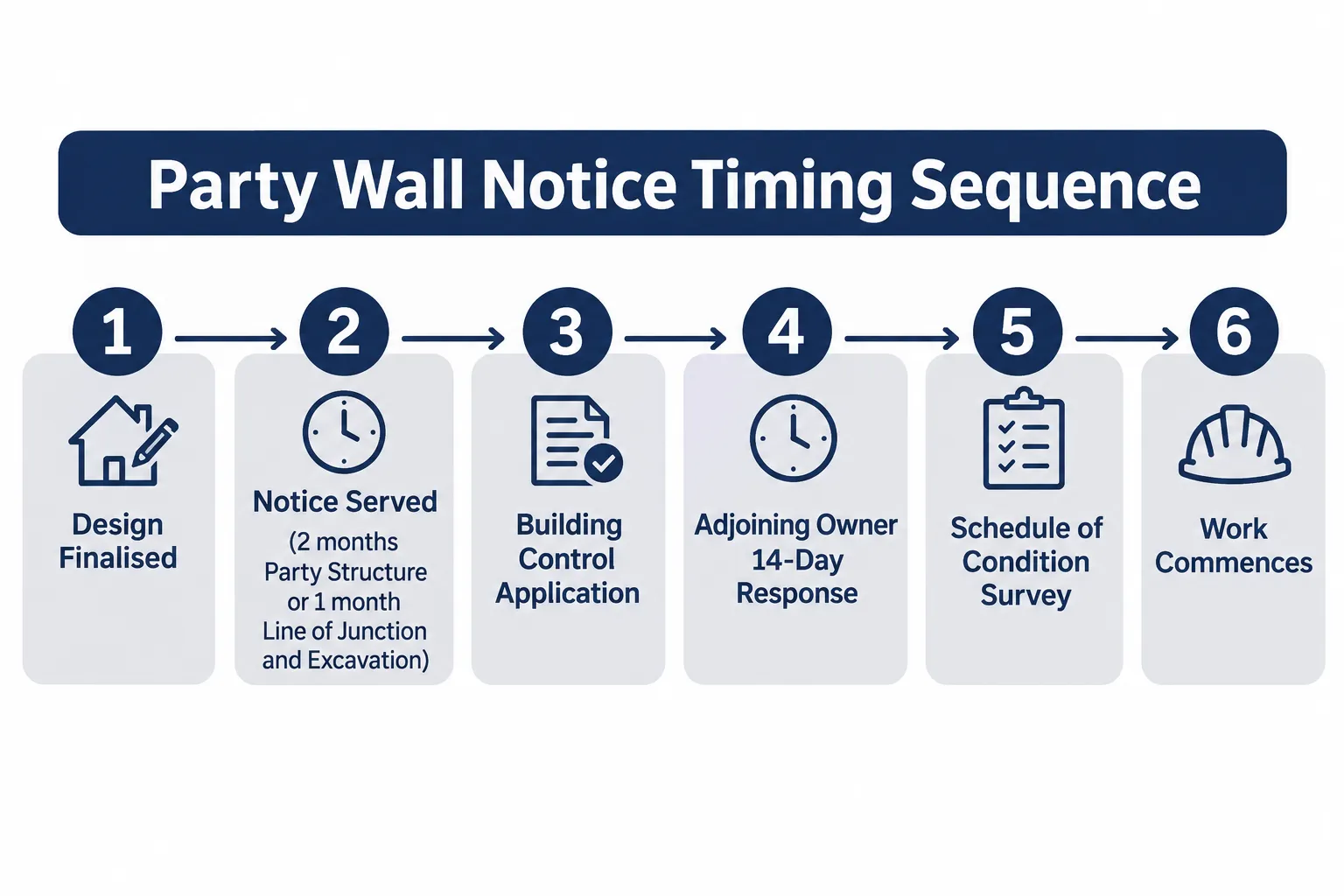
Homeowners often assume these three consents move together. They do not.
- Planning permission governs land use, design and external impact.
- Building regulations/building control governs structural safety, fire, energy and now triggers the Building Safety Levy where applicable.
- The Party Wall etc. Act 1996 governs work affecting shared walls, boundaries and excavations near a neighbour’s foundations, entirely separate from planning or building control approval.
A project can have planning permission and a building control application in progress while the party wall notice has not even been served yet, and that is often where delays start.
Why Serving Party Wall Notice Early Matters Before March 2027
Party wall notices carry statutory response periods set by the Party Wall etc. Act 1996: a Party Structure Notice under section 3, covering works to an existing party wall or structure, requires at least two months’ notice. A Line of Junction Notice under section 1, for a new wall built at or astride the boundary, and a notice for adjacent excavation under section 6, each require at least one month’s notice. In every case, the adjoining owner has 14 days to respond, after which a dispute is deemed to have arisen if no consent is given.
For anyone targeting a 2027 start date ahead of the Future Homes Standard’s 24 March deadline, this timing matters:
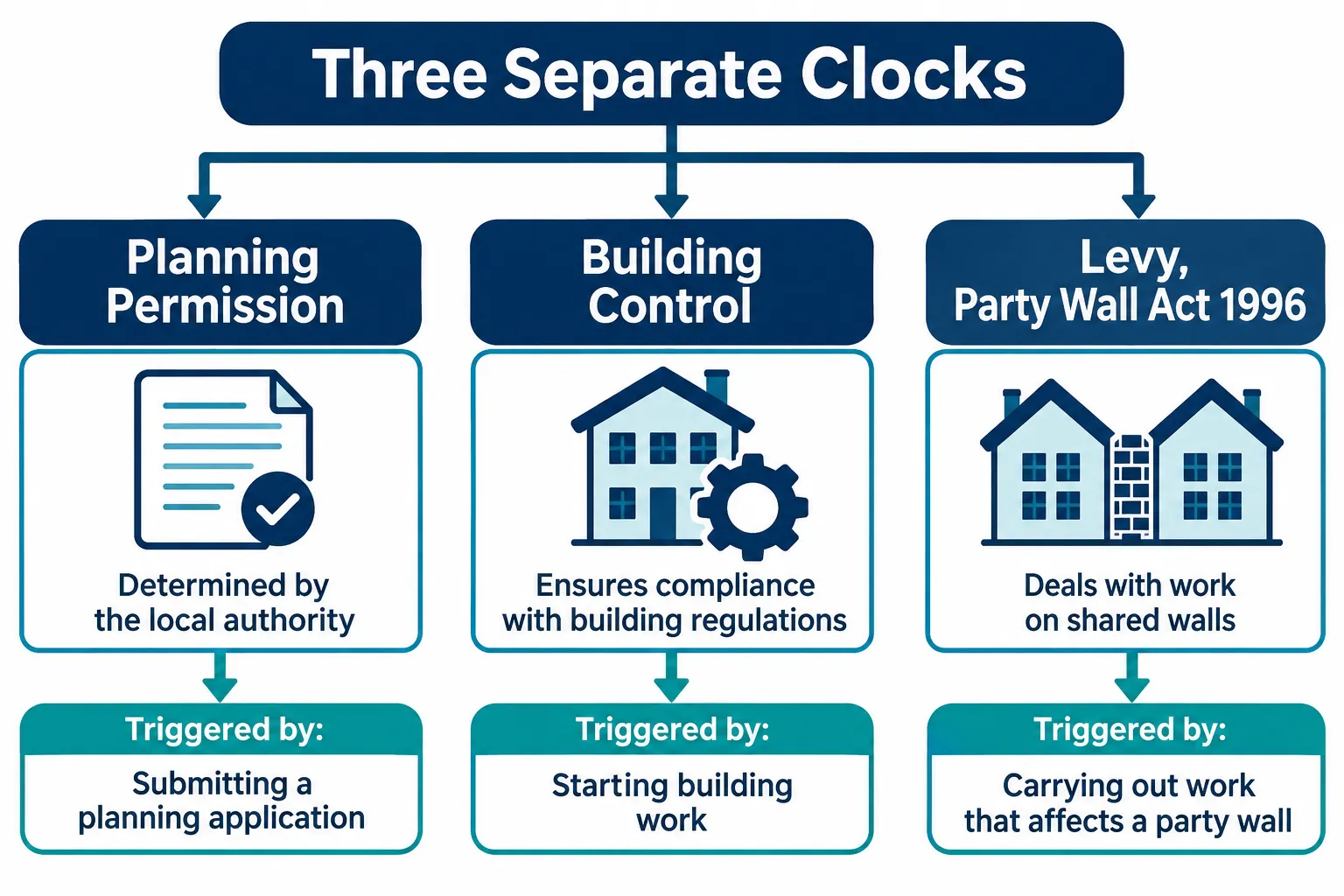
- Design and specification finalised.
- Party wall notice served, starting the one- or two-month statutory clock immediately depending on notice type.
- Building control application submitted, check levy and Part L implications.
- Adjoining owner responds within 14 days, consents, or a surveyor is appointed.
- Schedule of Condition survey carried out to protect both parties.
- Work commences once notices have run their course and approvals are in place.
Leaving the party wall notice until after building control is agreed risks losing weeks that cannot be recovered once a transitional deadline has passed. A Schedule of Condition, prepared before work starts, remains the best protection against later disputes over cracks or damage, regardless of which regulatory regime applies.
FAQ
Does the Budget mean building regulations are frozen for London extensions? No. It is a policy pledge to avoid major new changes, not a block on existing scheduled law like the Future Homes Standard or Building Safety Levy.
Will my loft conversion be hit by the Building Safety Levy? Most single-dwelling projects fall below the 10-dwelling or 30-bed-space thresholds, so the levy typically will not apply, but larger conversions and infill blocks should check carefully.
When does the Future Homes Standard actually start? Most provisions apply from 24 March 2027, with higher-risk-building elements following on 24 September 2027, subject to transitional protections.
Does a party wall notice depend on building control approval? No. The Party Wall etc. Act 1996 runs independently of planning and building control timelines, with its own two-month or one-month notice periods depending on the works involved.
Should I get a Schedule of Condition before neighbouring works start? Yes, it is strongly advisable for both the building owner and adjoining owner, to record the pre-works condition of shared structures.
Conclusion
The headline from Budget 2026 is reassurance, but the real-world deadlines have not moved. The Building Safety Levy is already live, and the Future Homes Standard’s March 2027 start date is fixed in law. For London homeowners and developers, the practical priority is sequencing: finalise designs, serve party wall notices promptly under the correct statutory period, and check building control timing against these dates. Anyone unsure how these rules interact with their specific project should take professional advice from a RICS-regulated surveyor before works begin.