Looking for expert solutions?
Request a Quote

Tag: county court appeal

  • Party Wall Dispute Resolution: When to Escalate Beyond Agreement and Award

    Party Wall Dispute Resolution: When to Escalate Beyond Agreement and Award

    Fewer than one in five party wall disputes ever reach a County Court, yet the consequences of escalating at the wrong moment, or failing to escalate when it is genuinely necessary, can cost property owners tens of thousands of pounds and months of delay. Understanding the precise escalation pathways in party wall dispute resolution: when to escalate beyond agreement and award is therefore one of the most practically valuable pieces of knowledge any building owner or adjoining owner can hold.

    The Party Wall etc. Act 1996 remains the governing statutory framework, with no outstanding amendments as of 2026 [6]. It creates a structured, tiered system designed to resolve most disputes through surveyors and legally binding awards, reserving courts as a genuine last resort. This article maps every stage of that system, explains the triggers that justify moving from one tier to the next, and sets out what property owners, surveyors, and legal advisers should consider before escalating.

    Key Takeaways

    • Most party wall disputes are resolved through surveyor appointments and a formal award under section 10 of the Act, court action is the exception, not the rule.
    • A failure by an adjoining owner to respond to a notice within 14 days triggers automatic deemed dissent, starting the formal dispute resolution process [3].
    • A party wall award is legally binding and allows works to proceed even without the neighbour’s consent, provided its terms are followed [7].
    • Either party has a 14-day window after service of the award to appeal to the County Court, but grounds are narrow and cost risks are significant [7].
    • The RICS draft 8th edition guidance, consulted in 2026, emphasises proportionality and early dispute avoidance over routine escalation [1][9].

    How the Party Wall Act Creates a Tiered Dispute Resolution Framework
    How the Party Wall Act Creates a Tiered Dispute Resolution Framework

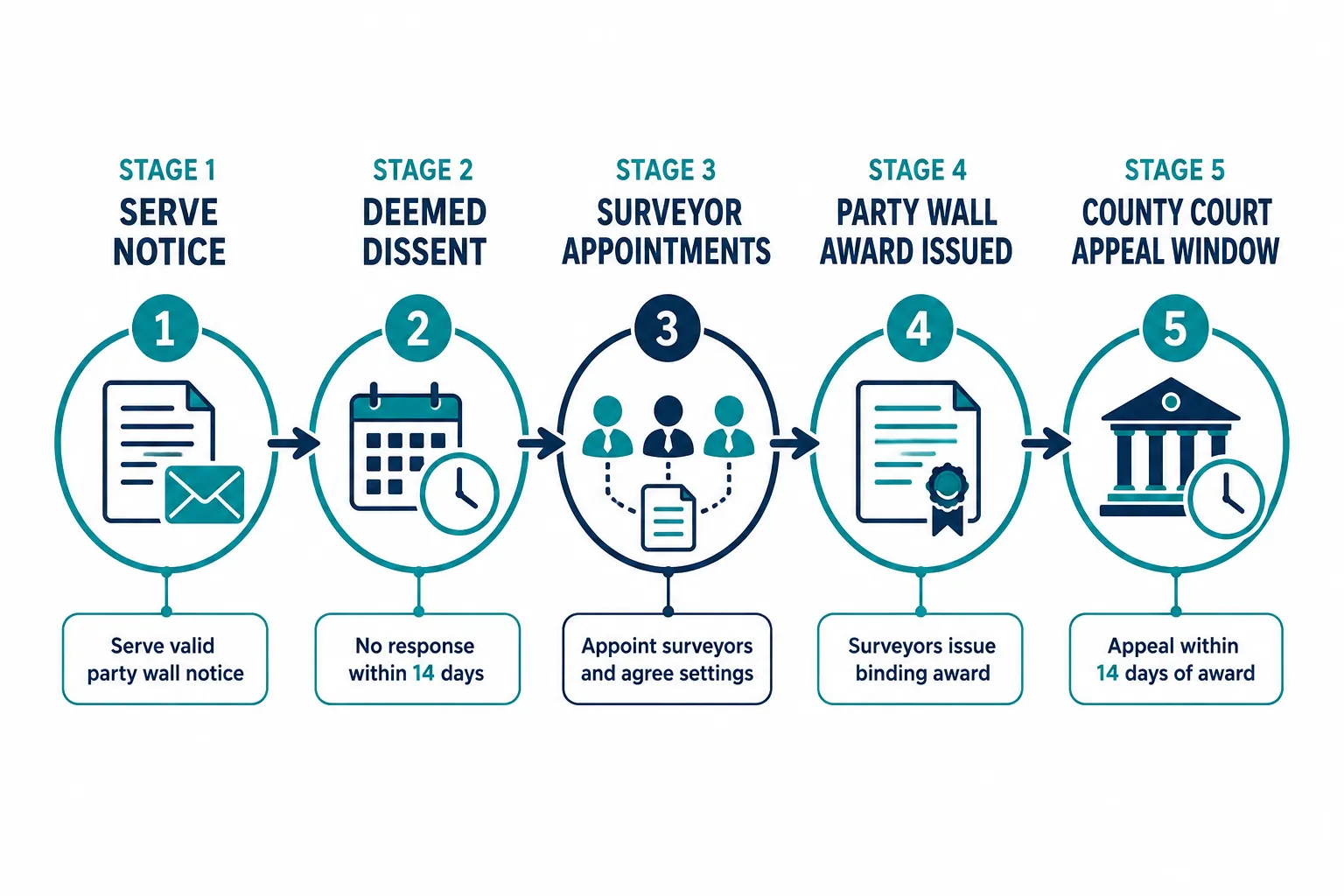
    The Act does not treat every disagreement between neighbours as a formal dispute. Instead, it establishes a clear sequence: notice, response, appointment of surveyors, and award. Understanding where a matter sits within this sequence is the first step in deciding whether escalation is warranted.

    Serving Notice: The Starting Point

    Every party wall matter begins with a valid notice. Depending on the nature of the works, this may be a party structure notice, a line of junction notice, or a notice under section 6 relating to excavation near an adjoining owner’s foundations. The Party Wall Act Notices: What They Are and How to Respond guide provides a detailed breakdown of each notice type and the correct response procedures.

    Once a notice is served, the adjoining owner has 14 days to respond. They can consent, refuse, or serve a counter-notice requesting additional or protective works [3]. Critically, silence is not consent. If no response is received within 14 days, the adjoining owner is deemed to have dissented under section 6 of the Act, and a dispute is legally deemed to have arisen [10]. This automatic trigger is one of the most commonly misunderstood aspects of the process, and it is the point at which the formal dispute resolution machinery begins.

    From Deemed Dissent to Surveyor Appointments

    Once a dispute is deemed to have arisen, both parties must appoint surveyors. Each party appoints their own surveyor, or they may agree to use a single Agreed Surveyor. The surveyors’ role is to reach a Party Wall Award, a legally binding document that sets out the rights and obligations of both parties in relation to the notifiable works.

    The award covers practical matters such as:

    • The scope and method of the proposed works
    • Hours of working and access arrangements
    • Protective measures for the adjoining property
    • A schedule of condition to record the pre-works state of the neighbouring property
    • Who bears the costs of the award

    For a deeper understanding of what these documents contain and how they are structured, the Party Wall Contract Template Guide on Party Wall Awards is a useful reference.

    Escalation Within the Surveyor Framework: The Role of the Third Surveyor
    Escalation Within the Surveyor Framework: The Role of the Third Surveyor

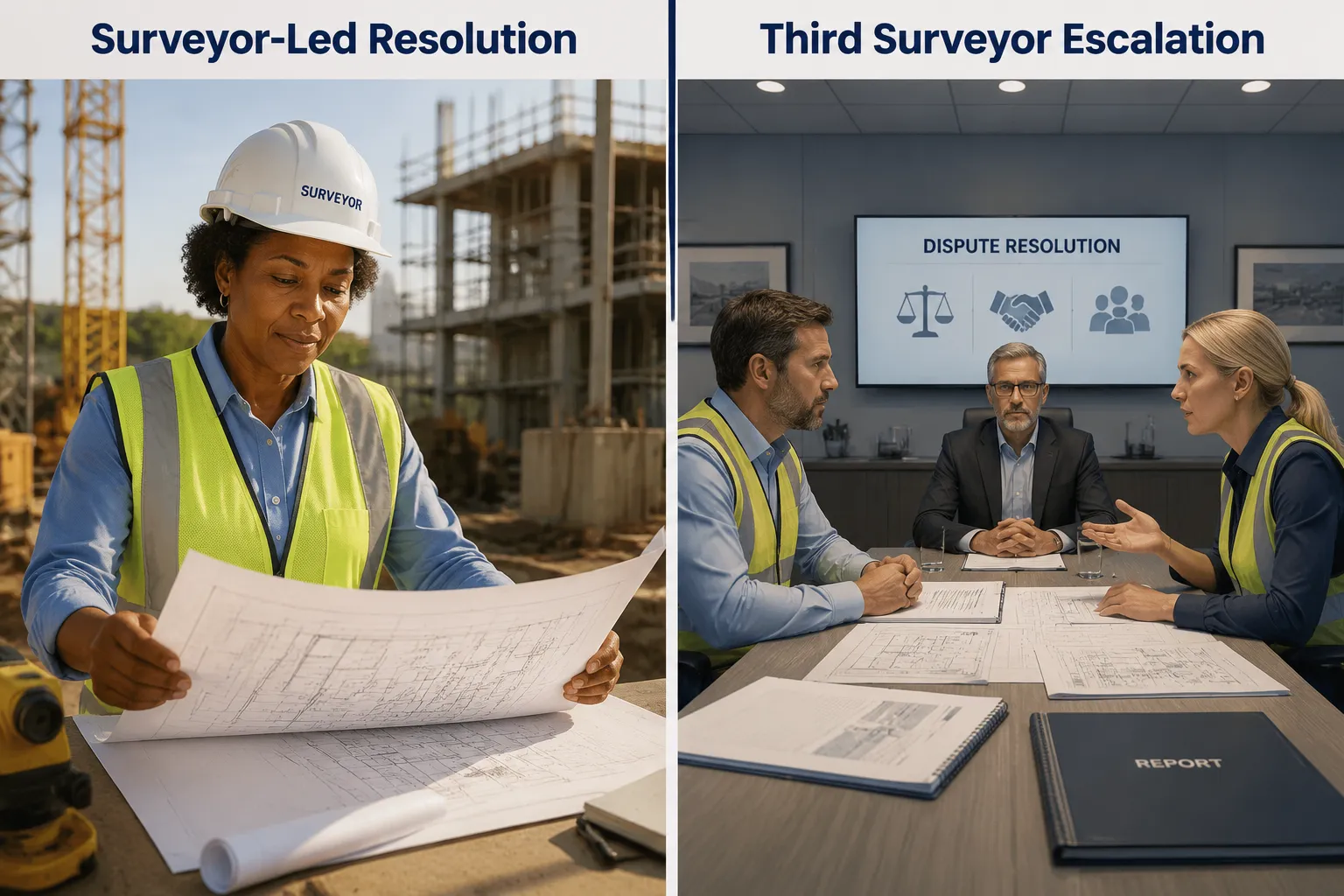
    Not all disputes between appointed surveyors can be resolved by negotiation alone. When the two party-appointed surveyors cannot agree on the terms of an award, the matter is referred to a Third Surveyor, a neutral professional selected in advance by both parties at the time of their appointments.

    When the Third Surveyor Is Engaged

    The Third Surveyor does not automatically become involved in every case. Their role is triggered when:

    • The two appointed surveyors cannot reach agreement on a specific point within the award
    • One surveyor believes the other is acting unreasonably or outside their proper function
    • A party wishes to challenge a specific provision being proposed by the surveyors

    The Third Surveyor then makes a determination on the disputed point, and their decision is incorporated into the award. This mechanism is designed to keep technical disagreements within the surveyor framework, avoiding unnecessary court proceedings [7][12].

    The RICS draft 8th edition guidance, currently under consultation in 2026, explicitly identifies early dispute avoidance as a priority theme, encouraging surveyors to resolve disagreements through careful drafting and negotiation before involving the Third Surveyor [9]. Proportionality is a core principle: conditions and protective measures in awards should be no more onerous than necessary, reducing the likelihood that either party will seek further escalation [1][9].

    Proportionality and the Award

    A well-drafted award is the most effective tool for preventing escalation beyond the surveyor framework. Surveyors are expected to ensure that the award is balanced, practical, and proportionate to the nature of the works. Overly restrictive conditions, for example, prohibiting works during hours that are commercially reasonable, increase the risk that the building owner will challenge the award. Equally, inadequate protective measures may lead the adjoining owner to seek redress.

    For guidance on managing the costs associated with this process, the resource on how to keep party wall costs down outlines practical strategies for both parties.

    Party Wall Dispute Resolution: When to Escalate Beyond Agreement and Award to the County Court
    Party Wall Dispute Resolution: When to Escalate Beyond Agreement and Award to the County Court

    The award is a legally binding document. Once served, it allows the building owner’s works to proceed even without the adjoining owner’s agreement, provided the terms of the award are strictly complied with [7]. In the vast majority of cases, this is where the formal dispute resolution process ends.

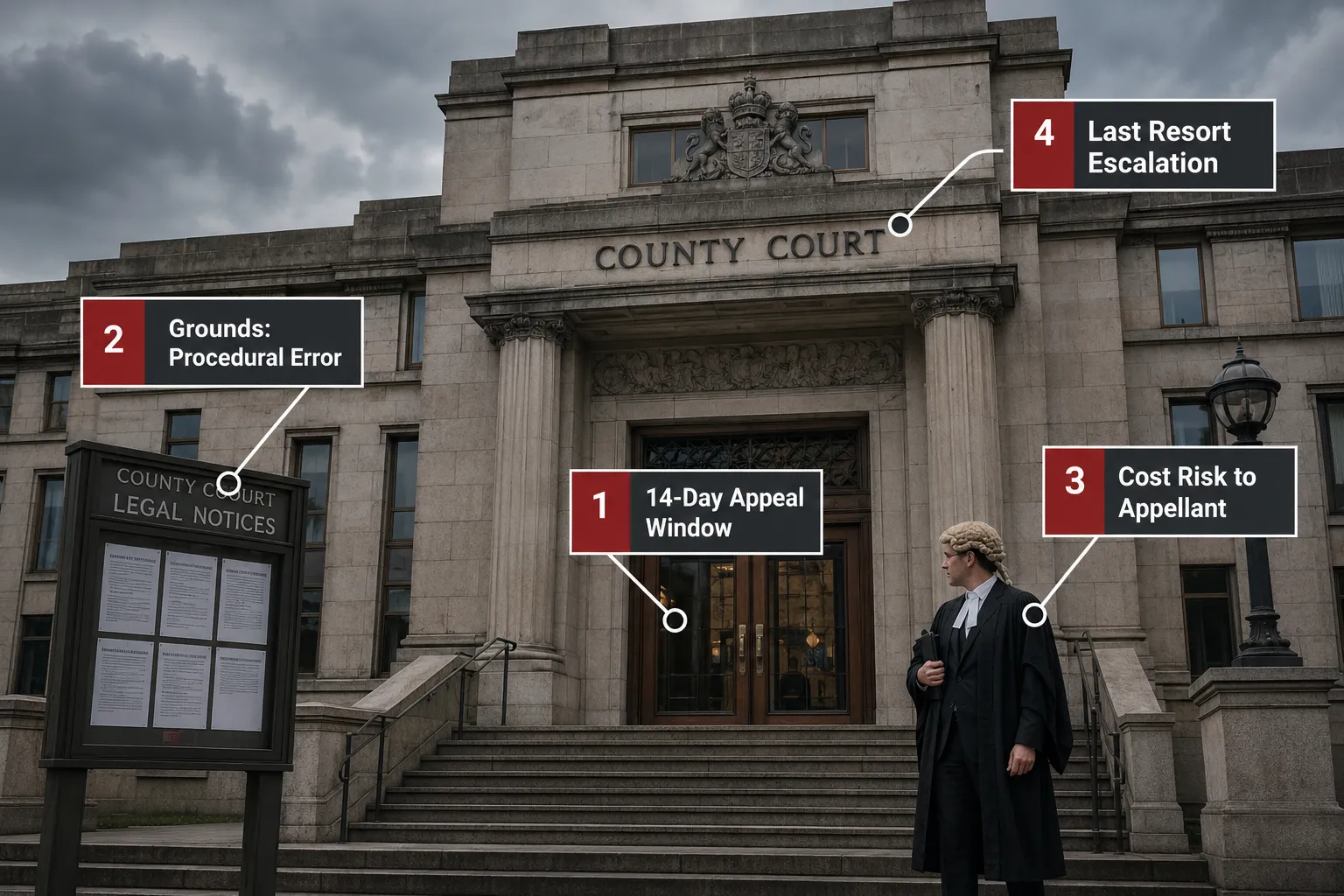
    However, the Act provides a statutory right of appeal. Either party may appeal the award to the County Court within 14 days of service of the award [7]. This window is strict. Missing it will almost certainly mean the award stands as final.

    Grounds for Appeal: What Justifies Escalation

    The grounds for appealing a party wall award to the County Court are deliberately narrow. They are not a mechanism for general dissatisfaction. Recognised grounds include:

    Ground Description
    Procedural error The award was made without proper jurisdiction, e.g., notice was invalid or not properly served
    Unreasonable provisions Specific conditions in the award are unreasonable in the circumstances
    Failure of due process A party was not given a proper opportunity to make representations
    Conflict of interest A surveyor had an undisclosed interest that undermined impartiality

    The RICS consultation on the 8th edition specifically highlights surveyor conduct, impartiality, and conflicts of interest as areas requiring updated guidance [9]. Electronic service of notices and documents is also recognised within official guidance [4], and challenges to the validity of electronic service can, in rare cases, provide grounds for escalation.

    Cost risk is a serious consideration. Unsuccessful appellants may be ordered to pay the other party’s legal costs [7]. This means that escalating to the County Court on weak or speculative grounds can result in a significantly worse financial outcome than accepting the award and negotiating any outstanding concerns through the surveyor framework.

    When Court Action Is Genuinely Warranted

    Beyond the 14-day appeal window, court proceedings may still be appropriate in specific circumstances:

    • Breach of the award by the building owner, if works proceed outside the terms of the award, the adjoining owner may seek an injunction or damages through the courts
    • Trespass or nuisance, where works cause damage that goes beyond what the award contemplated, common law remedies remain available
    • Failure to serve notice at all, where a building owner has carried out notifiable works without serving any notice, the adjoining owner may seek damages and, in some cases, an order to undo the works

    It is worth noting that the Party Wall etc. Act 1996 framework is designed to prevent exactly these situations by requiring advance notice and agreement. Where the process has been followed correctly, the need for court action is rare.

    Mediation as an Alternative Escalation Route

    Mediation is not explicitly provided for within the Party Wall etc. Act 1996, but it is increasingly recognised as a valuable tool in party wall dispute resolution: when to escalate beyond agreement and award becomes necessary, mediation can offer a faster and less costly alternative to court proceedings.

    Mediation is particularly useful where:

    • The dispute is primarily about the relationship between neighbours rather than a technical point of law
    • Both parties want to preserve an ongoing relationship (for example, in a terraced or semi-detached property)
    • The costs of court proceedings are disproportionate to the value of the matter in dispute

    A mediator does not make a binding decision but facilitates negotiation between the parties. Any agreement reached in mediation can then be formalised through the surveyor framework or, if necessary, recorded in a separate legally binding agreement.

    Practical Escalation Checklist: A Step-by-Step Summary

    Before escalating any party wall matter beyond the award stage, property owners and their advisers should work through the following steps:

    1. Confirm the award has been properly served, check the date of service and calculate the 14-day appeal window
    2. Identify the specific ground for escalation, procedural error, unreasonable provision, or breach of the award
    3. Assess proportionality, is the cost and time of escalation proportionate to the issue at stake?
    4. Exhaust surveyor-level remedies first, has the Third Surveyor been engaged where appropriate?
    5. Consider mediation, particularly where the dispute is relational rather than purely technical
    6. Take legal advice, before filing a County Court appeal, obtain specialist advice on the strength of the grounds and the likely cost exposure
    7. Act within the 14-day window, if appealing the award, do not delay

    For those in London seeking specialist support at any stage of this process, local expertise is available through Party Wall Surveyor North London and Party Wall Surveyor South London.

    The 2026 Regulatory Landscape: What Is Changing

    The RICS launched a formal eight-week consultation on the draft 8th edition of Party Wall Legislation and Procedure in April 2026, with the consultation closing on 5 June 2026 [1][9]. This is the most significant update to practice guidance in several years, and its four core themes directly affect how escalation decisions should be made:

    1. Validity and service of notices, updated guidance on what constitutes a valid notice and the implications of defective service
    2. Surveyor appointments and conduct, strengthened expectations around impartiality and conflicts of interest
    3. Proportionality in awards, a clear steer that awards should be no more onerous than necessary
    4. Early dispute avoidance, a shift in emphasis away from routine recourse to the Third Surveyor and towards negotiated resolution [9]

    Once the final 8th edition is published, it is expected to take effect approximately three months later, with sector analysis suggesting it will start influencing practice in late 2026 [9]. While the statutory framework remains unchanged [6], this guidance will shape how surveyors, legal advisers, and dispute resolution practitioners approach escalation decisions going forward.

    The government’s own guidance on preventing and resolving party wall disputes has also been updated in 2026, reinforcing that the award process, not the courts, is the primary resolution mechanism, and that escalation beyond it should be reserved for situations where statutory rights or due process have arguably been breached [2].

    “Most issues, such as access, timing, and safeguards, should be dealt with through negotiation and the award process, reserving escalation beyond the award for situations where statutory rights or due process are arguably breached.”, Government guidance, 2026 [2]

    Conclusion

    Party wall dispute resolution: when to escalate beyond agreement and award is not a question with a single answer. The Act creates a carefully designed sequence, notice, deemed dissent, surveyor appointments, award, Third Surveyor, and finally County Court appeal, and each stage has its own triggers, timelines, and cost implications.

    The most important practical principle is this: exhaust the surveyor framework before considering court action. The Third Surveyor exists precisely to resolve disagreements that the appointed surveyors cannot settle between themselves. The County Court appeal is reserved for cases where the award itself is procedurally defective or contains genuinely unreasonable provisions, not for general dissatisfaction with the outcome.

    Actionable next steps for property owners in 2026:

    • If you have received a party wall notice, read the Party Wall Act Notices: What They Are and How to Respond guide before deciding whether to consent or dissent.
    • If works are already underway and you believe the terms of an award are being breached, seek specialist surveyor advice immediately, do not wait for damage to accumulate.
    • If you are considering a County Court appeal, take legal advice on the strength of your grounds before the 14-day window closes.
    • Keep records of all notices, correspondence, and the schedule of condition throughout the process, these documents are essential if escalation becomes necessary.

    The evolving RICS guidance and the government’s updated materials in 2026 both point in the same direction: earlier dialogue, more proportionate awards, and a strong preference for resolution within the surveyor framework. Following that approach is not just good practice, it is the most cost-effective and time-efficient route for all parties involved.

    References

    [1] RICS Launches Consultation on Updated Party Wall Practice Guidance – rics.org

    [2] Preventing and Resolving Disputes in Relation to Party Walls – gov.uk

    [3] Reaching Agreement with Neighbours – gov.uk

    [4] Building Regulations Circulars – gov.uk

    [6] Party Wall etc. Act 1996 – legislation.gov.uk

    [7] 2026 Party Wall Act Updates: Key Changes Impacting Awards and Agreements in Stabilizing Property Markets – 2026 party wall act updates key changes impacting awards and agreements in stabilizing property markets

    [9] RICS 8th Edition Party Wall Guidance – hudsonpartywallsurveyors.co.uk

    [10] Party Wall etc. Act 1996, Section 6 – legislation.gov.uk

  • Party Wall Award Disputes: How to Challenge, Vary or Appeal a Surveyor’s Decision in England & Wales

    Party Wall Award Disputes: How to Challenge, Vary or Appeal a Surveyor’s Decision in England & Wales

    }

    Fewer than 1% of party wall awards ever reach a County Court, yet when they do, the costs can dwarf the original building works by a significant margin [5]. For homeowners caught in a difficult dispute, understanding exactly when and how a party wall award can be challenged is the difference between a proportionate legal response and an expensive mistake.

    This guide walks through the full process of party wall award disputes: how to challenge, vary or appeal a surveyor’s decision in England & Wales, covering the statutory framework, recognised legal grounds, court procedures, costs, and practical strategies to protect your position without unnecessary escalation.

    Key Takeaways

    • A party wall award can only be appealed to the County Court within a strict 14-day window from the date it is served [2]
    • Valid grounds for appeal are narrow: they include jurisdictional error, legal mistake, and procedural unfairness, not simply disagreement with the outcome [3]
    • An award that is fundamentally flawed may be challenged as a nullity at any time, but courts apply this route sparingly [8]
    • Appeals do not automatically stop building works; a separate application for a stay of proceedings is required [8]
    • Costs in party wall appeal cases can be substantial, and courts have wide discretion over who pays [5]

    What Is a Party Wall Award and Why Disputes Arise

    A party wall award is the formal written document produced by one or more appointed surveyors under the Party Wall Etc Act 1996. It sets out the rights and obligations of both the building owner and the adjoining owner in relation to proposed works affecting a shared wall, boundary, or nearby excavation. You can read a detailed overview of how awards are structured on the Party Wall Awards page.

    Awards typically cover the scope and method of works, working hours, protective measures, access arrangements, and compensation provisions. When either party believes the award is wrong, whether due to legal error, overreach by the surveyor, or procedural failure, the Act provides a specific mechanism to challenge it.

    Disputes tend to arise in several common situations:

    • The surveyor is alleged to have acted outside the powers granted by the Act
    • One party believes the award imposes unreasonable conditions or fails to reflect the true extent of damage
    • There are questions about whether a valid dispute actually existed before the award was made
    • The process leading to the award is alleged to have been unfair or irregular

    Understanding types of party wall works that typically trigger these situations helps homeowners identify whether their concerns have legal merit before committing to a challenge.

    What Is a Party Wall Award and Why Disputes Arise

    The 14-Day Appeal Window: A Deadline That Cannot Be Ignored

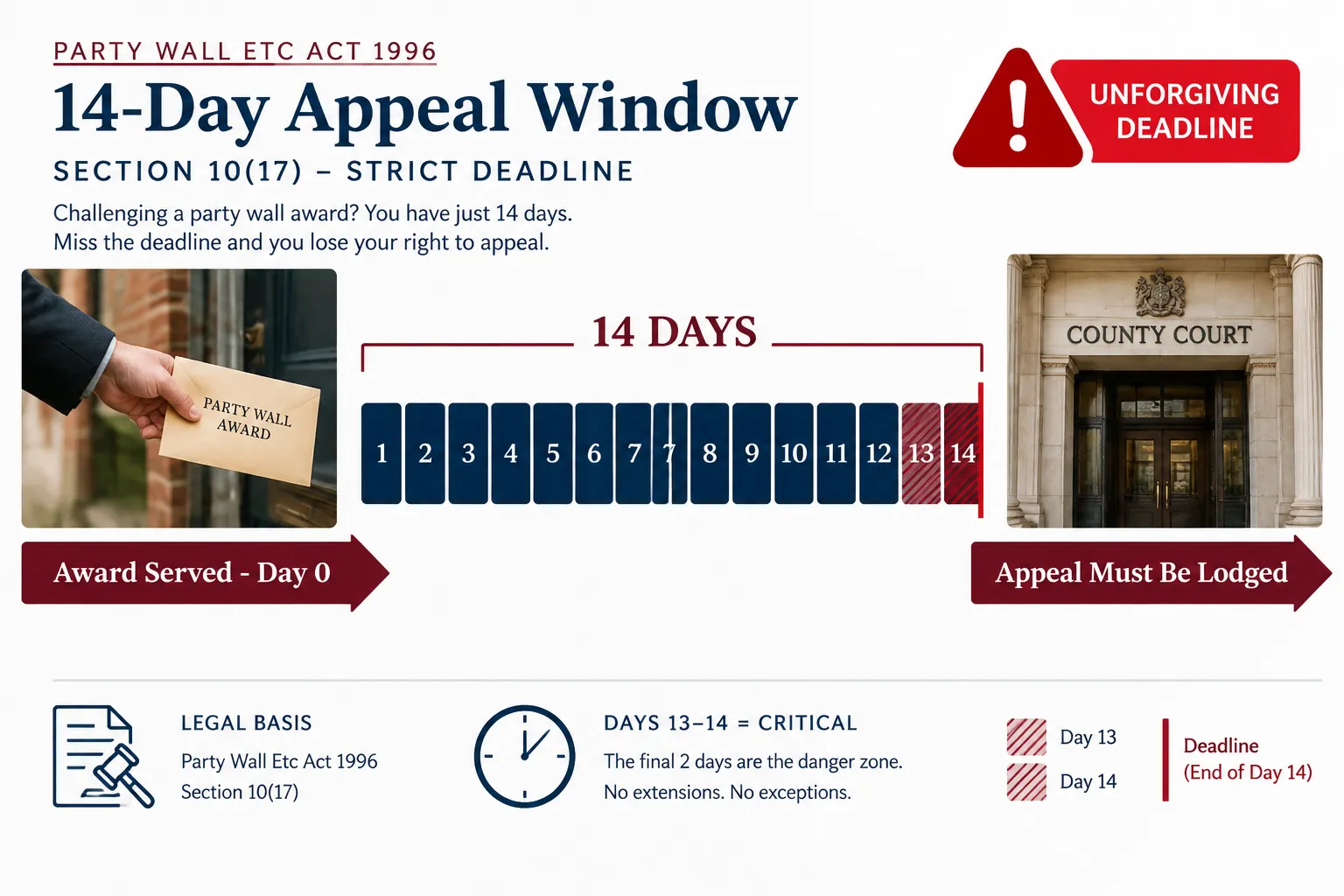
    Section 10(17) of the Party Wall Etc Act 1996 gives either party the right to appeal an award to the County Court. The appeal must be lodged within 14 days of the date the award is served [2]. This is one of the most unforgiving deadlines in property law.

    “The 14-day limit is not a guideline, it is a statutory cut-off. Missing it almost certainly ends any prospect of a conventional appeal.” [3]

    Key points about the appeal window:

    • The clock starts from the date of service, not the date the party reads or acknowledges the award
    • Service is typically by hand delivery or first-class post, and the date is recorded on the award itself
    • There is no general discretion for the court to extend this period under ordinary circumstances [8]
    • If the deadline is missed, the only remaining route is a nullity challenge, a much harder legal threshold to meet

    What if the deadline has passed?

    Where the 14-day window has closed, a party may still apply to the court under CPR Part 8 to argue that the award is a nullity, meaning it was so fundamentally defective that it never had legal effect in the first place [8]. Courts treat this as a high bar. Mere legal error or disagreement with the surveyor’s judgment will not suffice. The award must be shown to be void from the outset, for example because the surveyor had no jurisdiction to act at all.

    Recognised Grounds for Challenging a Party Wall Award

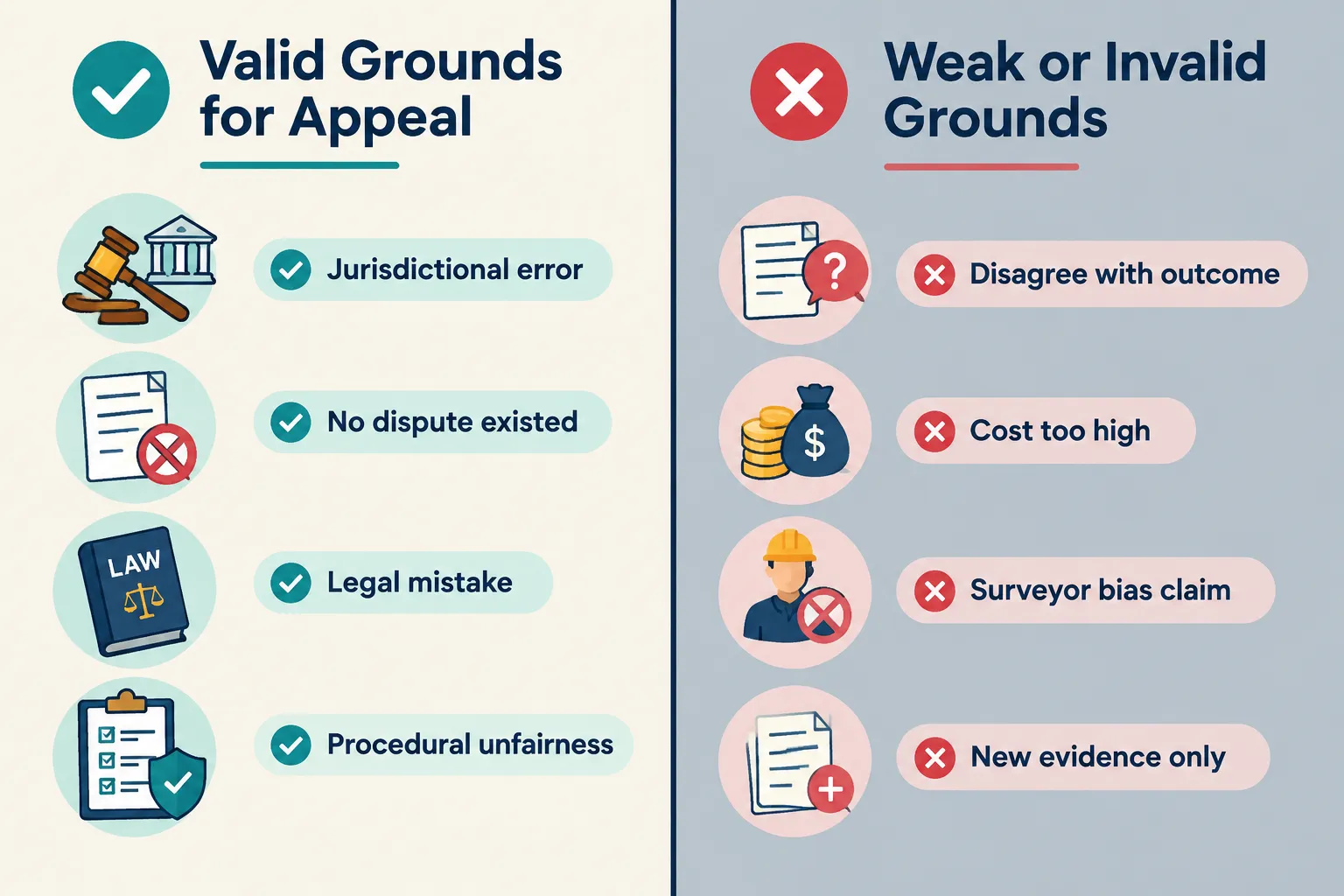
    Not every grievance amounts to a valid legal ground for appeal. Courts in England and Wales apply a structured analysis when reviewing party wall award disputes. The following are the recognised grounds under which a challenge may succeed [3][8]:

    Jurisdictional Error

    A surveyor’s authority under the Act is strictly defined. If a surveyor has made an award that goes beyond the scope of the dispute, for example, by ruling on matters that were never notified under a valid party wall notice, the award may be challenged on jurisdictional grounds. This is one of the stronger grounds available.

    Absence of a Valid Dispute

    The Act only empowers surveyors to act once a dispute has arisen or is deemed to have arisen. If no valid notice was served, or if the adjoining owner consented to the works in writing, there may be no jurisdiction for an award at all [4]. An award made in the absence of a genuine dispute may be void.

    Legal Error

    Where a surveyor has misapplied the law, for example, by misinterpreting the Act’s provisions on compensation or access, this may constitute a ground of appeal. The error must be one of law, not simply a judgment call the losing party disagrees with [3].

    Procedural Unfairness

    If the process leading to the award was fundamentally unfair, for instance, if one party was denied a reasonable opportunity to make representations, this may support a challenge. Courts look carefully at whether the procedural defect actually affected the outcome [9].

    What Does NOT Constitute a Valid Ground

    It is equally important to understand what courts will not accept as grounds for appeal:

    • Mere dissatisfaction with the surveyor’s decision
    • A belief that the surveyor favoured the other party without evidence of procedural unfairness
    • New evidence that could have been presented during the surveying process
    • Disagreement with the level of compensation awarded, absent a legal error
    What Does NOT Constitute a Valid Ground

    How to Appeal: The County Court Process Under CPR Part 52

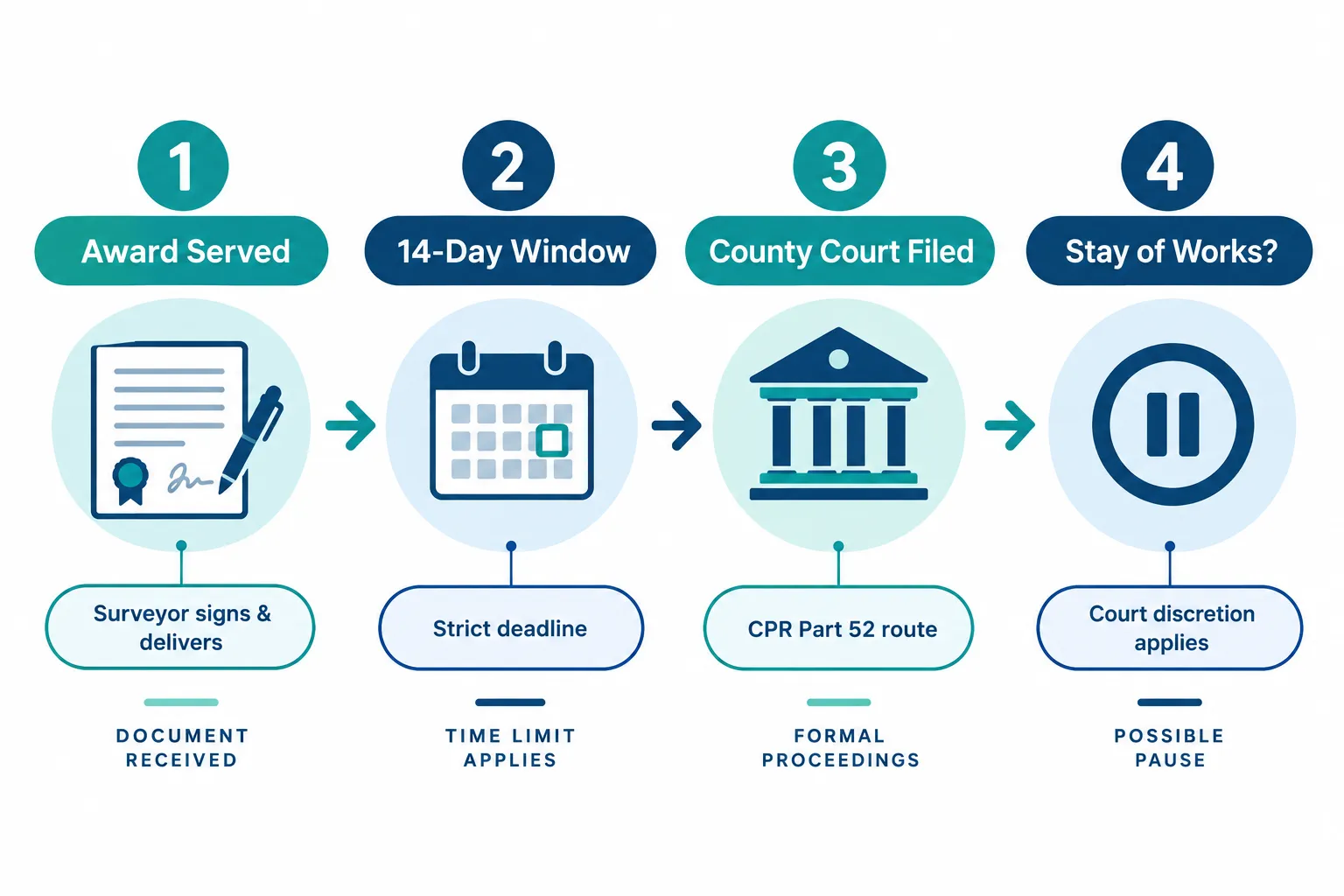
    Party wall award appeals are heard in the County Court and proceed under CPR Part 52, the standard civil appeals procedure [8]. This is an important distinction: despite some confusion in practice, these are not brought as Part 8 claims (which are reserved for nullity challenges).

    Step-by-Step Overview of the Appeal Process

    1. Obtain legal advice immediately Given the 14-day deadline, the first step is to consult a solicitor with party wall or property litigation experience as soon as the award is served.

    2. File an Appellant’s Notice (Form N161) The appeal is initiated by filing Form N161 at the appropriate County Court. The notice must set out the grounds of appeal clearly and concisely.

    3. Serve the Respondent The appellant must serve the notice on the other party (the respondent) promptly after filing.

    4. Apply for a Stay of Works if Needed An appeal does not automatically halt building works. If the building owner intends to proceed while the appeal is pending, the adjoining owner must make a separate application for a stay [8]. Courts have discretion to grant or refuse a stay, and will weigh the balance of convenience and potential harm to both parties.

    5. Attend the Hearing The County Court will list the appeal for a hearing. Both parties may be represented by solicitors or barristers. Expert witnesses, typically experienced party wall surveyors, often play a significant role in explaining technical matters to the court [9].

    6. Await Judgment The court may uphold the award, vary it, or set it aside. It also has power to make a fresh award or remit the matter back to the surveyors.

    The Role of Expert Witnesses

    In complex party wall award disputes, the court will often benefit from expert evidence on surveying practice and the technical aspects of the works. Expert witnesses in these cases are expected to comply with CPR Part 35 and RICS best practice guidance [9]. Their duty is to the court, not to the party instructing them, a distinction that matters greatly in contested proceedings.

    Varying an Award: The Less Adversarial Route

    Before committing to a court appeal, it is worth considering whether the award can be varied by agreement or through the surveyor process itself. Section 10(12) of the Act allows the appointed surveyor or surveyors to make a further award varying or supplementing an earlier one, provided a dispute still subsists [7].

    The case of Evans v Paterson (November 2021) confirmed important principles about surveyors’ jurisdiction to make further and compensation awards, reinforcing that the surveying process retains flexibility even after an initial award is made [7]. This means that in some cases, a further award, rather than a court appeal, may be the more proportionate and cost-effective way to address a genuine grievance.

    Parties should also be aware that the costs of the party wall process can escalate significantly once litigation begins. Exploring variation through the surveyor route first is almost always worth considering.

    Costs, Financial Risk, and Practical Considerations in 2026

    The financial stakes in party wall award appeals are high. In 2026, practitioners report that the total costs of a contested County Court appeal, including solicitors’ fees, expert witness fees, and court fees, routinely range from several thousand pounds to well over £20,000 for complex cases [5].

    Key cost considerations include:

    • Court fees: Filing an appeal incurs court fees based on the value of the claim
    • Solicitor and barrister fees: Hourly rates vary significantly; specialist property litigators command a premium
    • Expert witness costs: Party wall surveyors acting as expert witnesses typically charge between £150 and £350 per hour [9]
    • Adverse costs risk: If the appeal fails, the court may order the appellant to pay the respondent’s costs as well as their own
    Practical tip:

    Before filing an appeal, obtain a realistic costs estimate from your solicitor and weigh it against the financial benefit of a successful outcome. In many cases, the cost of appealing exceeds the value of what can be gained [5].

    The government’s official explanatory booklet on the Party Wall Etc Act 1996 advises that parties should always try to resolve disputes amicably before resorting to formal legal proceedings [2]. This remains sound advice in 2026, particularly given the current pressures on County Court listing times.

    For those looking to manage costs proactively from the outset, the guidance on how to keep party wall costs down offers practical strategies applicable at every stage of the process.

    Costs, Financial Risk, and Practical Considerations in 2026

    Enforcement of Awards and the Status of Works During an Appeal

    A party wall award is legally binding and enforceable once served, even if an appeal is pending [1]. The building owner is entitled to proceed with the notified works unless the court grants a stay.

    Enforcement options available to the adjoining owner include:

    • Applying to the County Court for an injunction to halt works that breach the award
    • Seeking damages for breach of the award’s conditions
    • In cases of ongoing damage, applying for an emergency injunction on short notice

    Conversely, if the building owner fails to comply with protective measures set out in the award, such as making good damage or paying compensation, the adjoining owner can enforce those obligations through the court.

    It is worth noting that where works have already been completed before an appeal is resolved, the court’s ability to provide meaningful relief may be limited. This makes early action essential.

    When to Seek Professional Help: Choosing the Right Surveyor

    The quality of the original surveying appointment significantly affects the likelihood of disputes arising. A well-qualified, impartial surveyor will produce an award that is legally sound, proportionate, and difficult to challenge successfully.

    If a dispute has already arisen and an appeal is being considered, the adjoining owner should consider appointing their own adjoining owner’s surveyor if they have not already done so. Similarly, building owners should ensure their building owner’s surveyor has the experience to defend the award if challenged.

    For those in London, specialist surveyors are available across all areas, including Central London, South London, and North London.

    Expert Outlook: Predictions for Party Wall Award Disputes in 2026 and Beyond

    Based on current practitioner analysis, several trends are expected to shape party wall award disputes in the coming years [9]:

    • Increased scrutiny of surveyors’ jurisdiction as urban development intensifies and more complex multi-party projects arise
    • Greater use of expert witnesses in County Court appeals, following clarification of their role under RICS best practice guidance
    • Growing awareness among homeowners of the 14-day appeal deadline, reducing the number of out-of-time nullity applications
    • Continued judicial reluctance to disturb awards on grounds that amount to mere disagreement with the surveyor’s professional judgment

    These are forward-looking expectations based on current industry trends, not guaranteed outcomes.

    Conclusion

    Party wall award disputes require prompt, informed action. The 14-day appeal window under the Party Wall Etc Act 1996 is unforgiving, and the grounds on which courts will intervene are deliberately narrow. Jurisdictional error, absence of a valid dispute, legal mistake, and procedural unfairness are the recognised routes, but none of them is a substitute for a well-run surveying process from the start.

    Actionable next steps for homeowners facing a disputed award:

    1. Note the exact date the award was served and calculate the 14-day deadline immediately
    2. Consult a solicitor with party wall or property litigation experience within the first 48 hours
    3. Assess whether the concern is a genuine legal ground or a disagreement with the outcome
    4. Consider whether a further award through the surveyor process is a more proportionate remedy
    5. Obtain a realistic costs estimate before committing to County Court proceedings
    6. If works are ongoing and potentially harmful, apply for a stay without delay

    Getting the right surveyor appointed at the outset, and ensuring the process is properly followed from the first notice, remains the single most effective way to avoid costly disputes altogether.

    References

    [1] If You Can’t Agree – gov.uk

    [2] The Party Wall Etc Act 1996 Explanatory Booklet – gov.uk

    [3] When To Appeal A Party Wall Award And When Not To – boundariesbook.co.uk

    [4] How To Apply For A Party Wall Award 3 – uklegalguides.com

    [5] Party Wall Award Appeal Costs 2026 – calchub.uk

    [6] UK Party Wall Agreement Guide 2026 – calchub.uk

    [7] Evans V Paterson 17 November 2021 – boundariesbook.co.uk

    [8] Appeal Party Wall Award – ansteyhorne.co.uk

    [9] Expert Witness Roles In Party Wall Award Challenges 2026 Case Law And RICS Best Practices – princesurveyors.co.uk

    [10] Party Wall FAQs – christopheranthony.org.uk