

A single missing photograph has determined the outcome of more than one party wall dispute in the English courts. When a neighbour claims that building works cracked their plaster or undermined their foundations, the difference between winning and losing often comes down to whether a surveyor compiled a meticulous, court-ready record before the first drill bit turned. Expert Witness Party Wall Surveyors in 2026: Preparing Schedules and Photographic Evidence for Court is no longer a niche specialism, it is a defined professional discipline governed by a new global standard, tightening accreditation requirements, and a body of case law that rewards rigour and punishes guesswork.
This article explains exactly how party wall surveyors compile and present evidence, from pre-works schedules of condition through to photographic bundles and expert reports, when disputes escalate to court or tribunal settings.
Key Takeaways
- RICS issued the 5th edition of its expert witness professional standard in July 2026, effective 30 November 2026, setting mandatory rules for how surveyors prepare and present evidence including schedules of condition and photographs [1]
- Schedules of condition and photographic records are the primary factual evidence in party wall disputes; their quality directly affects liability findings under the Party Wall etc. Act 1996
- CPR Part 35 governs expert evidence in civil proceedings, and party wall surveyors acting as expert witnesses must comply with both CPR and the RICS standard simultaneously [5]
- Courts increasingly expect expert surveyors to be formally accredited; RICS maintains a published register of accredited expert witnesses running at least through 2027 [4][6]
- Transparent use of technology, including digital photography, metadata, and any AI-assisted tools, is now a professional expectation, not an option [8]
The Legal Framework Governing Expert Witness Party Wall Surveyors in 2026
Party wall disputes sit at the intersection of property law, construction practice, and civil procedure. When a dispute cannot be resolved through the Party Wall Awards process and escalates to county court or the High Court, the surveyor’s role shifts from quasi-arbitrator to expert witness. That shift carries significant legal consequences.
Civil Procedure Rules Part 35 is the foundational instrument. It requires that an expert witness’s overriding duty is to the court, not to the party that instructed them. Any surveyor preparing schedules of condition or photographic evidence for litigation must understand that their report will be scrutinised against this standard before it is admitted as evidence.
Layered on top of CPR Part 35 is the RICS professional standard. In July 2026, RICS issued the 5th edition of Surveyors Acting as Expert Witnesses, which replaces the 4th edition and becomes fully effective on 30 November 2026 [1]. The new edition splits its content into two distinct parts:
| Section | Status | Covers |
|---|---|---|
| Professional Standard | Mandatory | Independence, conflicts of interest, fee arrangements, report structure |
| Supplementary Information | Non-mandatory guidance | Inspection methods, evidence presentation, joint expert meetings |
This two-tier structure is intentional. It separates the rules a surveyor must follow from the guidance that represents best practice [3]. For party wall expert witnesses, both tiers are relevant: the mandatory rules govern conduct, while the supplementary guidance shapes how schedules and photographic bundles should be assembled and explained to a tribunal.
The 2026 Built Environment Journal analysis of expert witness duties reinforces that independence and robust, well-reasoned evidence are non-negotiable [5]. A surveyor who prepares a schedule of condition that omits pre-existing damage, or who selects only photographs that favour the instructing party, risks not only losing the case but facing professional sanction.
Case law adds further weight. The Court of Appeal’s decision in Taylor v Jones [2024] EWCA Civ 170 clarified when a building owner is liable for remedial works under the Party Wall etc. Act 1996. Legal commentary on that case consistently stresses that carefully prepared pre-works schedules of condition and photographic records are the primary mechanism for establishing whether damage was caused by the notifiable works [15]. Earlier cases including Welter v McKeeve (2018) and Walsh v PSB Management (2022) similarly emphasise that party wall surveyors’ records constrain how liability is assessed [11].
For practitioners working in London, understanding the Party Wall etc. Act 1996 in its full statutory context is the starting point for any expert witness engagement.
Compiling a Schedule of Condition: Standards and Methodology
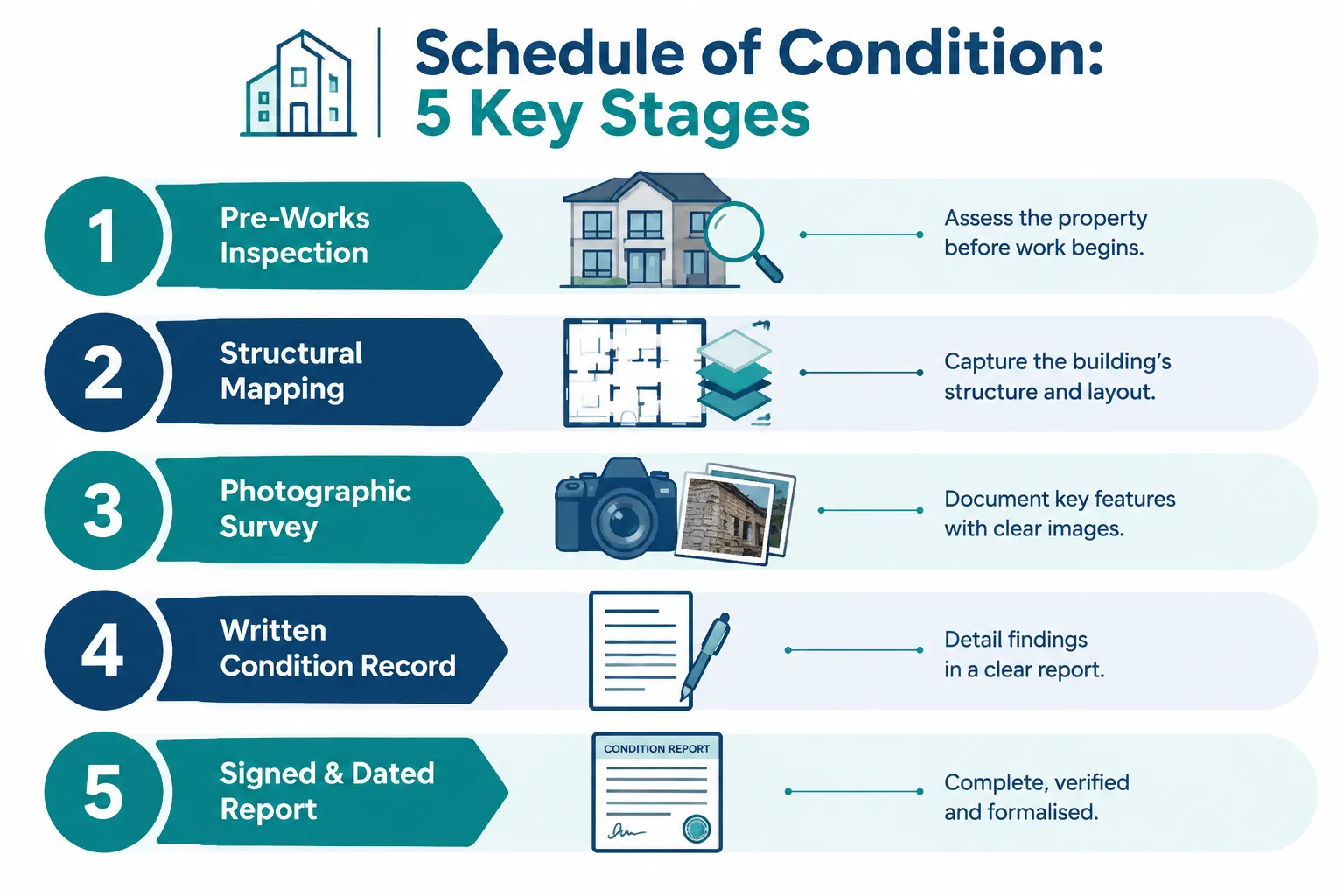
A Schedule of Condition is the cornerstone document in any party wall expert witness case. It establishes the baseline state of an adjoining owner’s property before notifiable works begin. Without it, attributing post-works damage to the building owner’s activities becomes speculative, and courts have little tolerance for speculation.
What a Schedule of Condition Must Record
A thorough schedule covers the following elements:
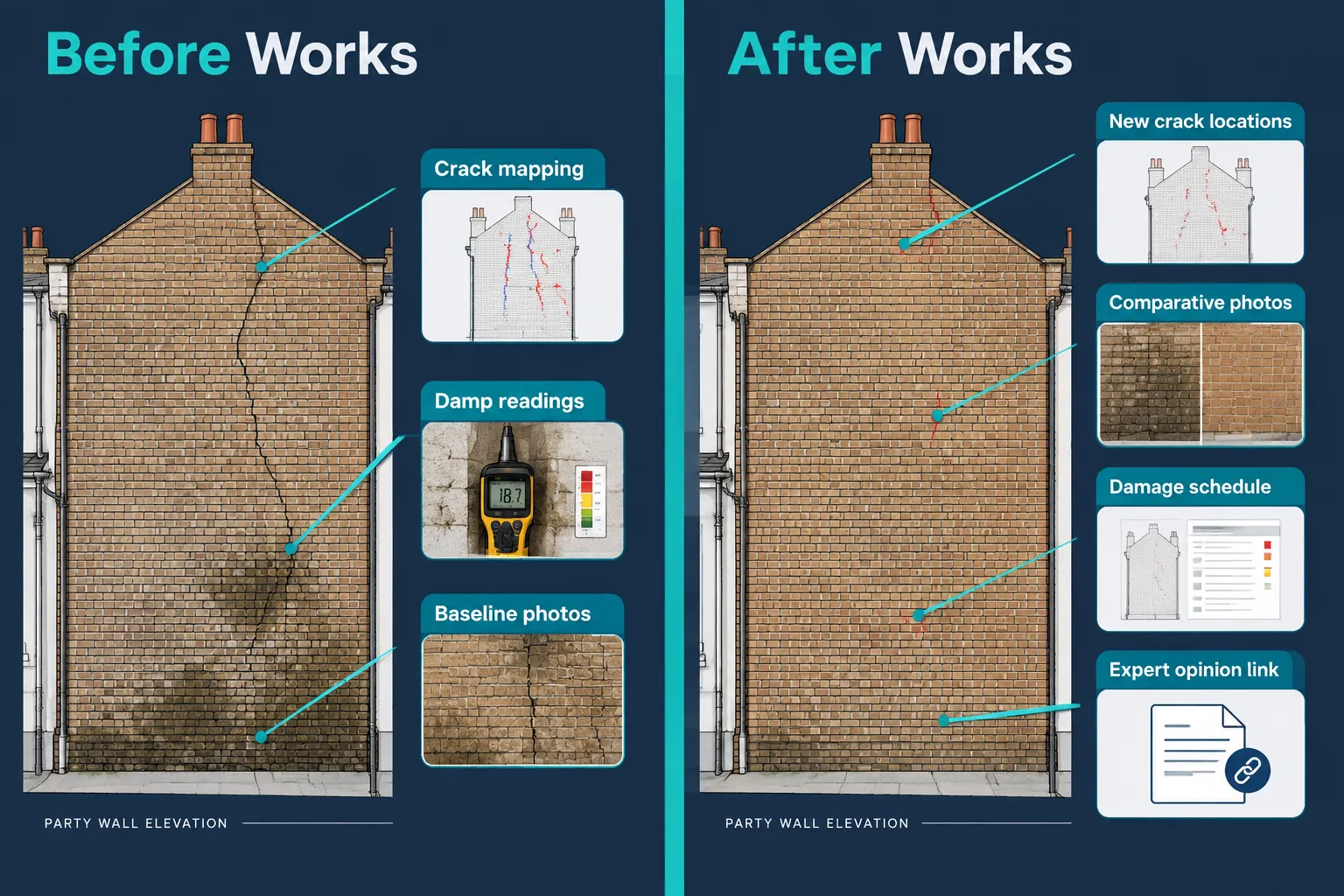
- Structural condition, existing cracks (mapped by location, width, and length), settlement patterns, and any signs of previous movement
- Damp and moisture readings, baseline moisture levels in walls, floors, and ceilings adjacent to the party wall or excavation zone
- Finishes and fittings, the condition of plasterwork, tiling, joinery, and decorative finishes in rooms directly affected by the proposed works
- External fabric, the condition of brickwork, pointing, copings, and any boundary structures
- Services, the location and visible condition of drainage, pipework, and electrical installations near the works
Each item must be described precisely. Vague entries such as “minor cracking noted” are inadequate for court purposes. A court-ready schedule uses a recognised crack classification system (such as the BRE classification), records exact dimensions, and cross-references every entry to a numbered photograph.
The Inspection Process
The inspection itself must be systematic. A surveyor acting as an expert witness under the 5th edition RICS standard is expected to be able to justify every aspect of their methodology [1][7]. That means:
- Conducting the inspection personally, not delegating to an unqualified assistant
- Using calibrated instruments where measurements are taken
- Recording the date, time, weather conditions, and names of those present
- Noting any areas that could not be inspected and explaining why
The Adjoining Owners Surveyor and the Building Owners Surveyor may each compile their own schedules, or they may agree a joint schedule. Where a joint schedule is produced, the 5th edition standard requires a clear audit trail: any agreement reached between opposing experts must be documented and disclosed to the instructing parties [1][3]. This prevents a situation where a joint schedule is later disputed by one side as misrepresenting what was agreed.
Timing Is Everything
The schedule must be completed before works commence. Courts have repeatedly found that a schedule produced after works have started carries significantly less evidential weight, because it cannot reliably distinguish pre-existing damage from works-related damage. Surveyors should serve the completed schedule on all parties and retain a copy with a verifiable creation date, a digitally signed PDF with metadata intact is now standard practice.
Understanding the full range of Types of Party Wall Works that trigger the Act is essential for determining the correct scope of a pre-works inspection.
Photographic Evidence: Best Practice for Expert Witness Party Wall Surveyors in 2026
Photographs are the most persuasive form of evidence in party wall disputes. A judge or tribunal member who has never stood inside a Victorian terrace can understand a crack in a wall instantly when shown a clear, well-lit, correctly scaled photograph. The challenge is ensuring that photographic evidence meets the standards that courts and the RICS professional standard now expect.
Core Requirements for Court-Admissible Photographs
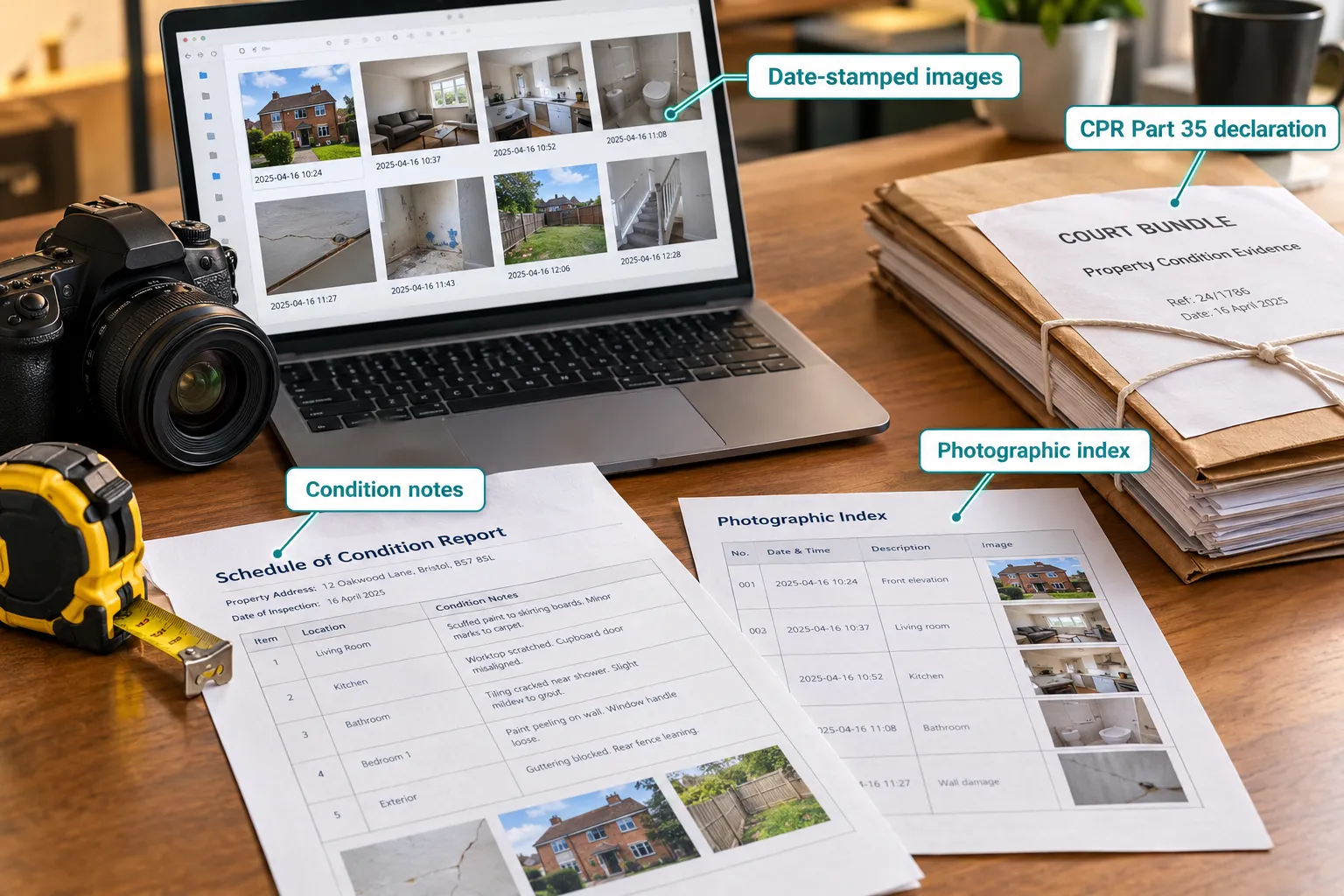
Every photograph submitted as evidence should have:
- A date and time stamp embedded in the file metadata (EXIF data)
- A unique reference number that cross-references the schedule of condition
- A scale reference in the frame (a crack gauge, ruler, or coin) where dimensions are relevant
- A location shot showing the wider context, followed by a close-up of the specific defect
- Consistent lighting, flash or supplementary lighting should be used consistently to avoid misrepresenting the severity of staining or cracking
Photographs should be stored in a secure, unedited format. Any enhancement, adjusting brightness, contrast, or cropping, must be documented and disclosed. The RICS Modus analysis of AI and expert witness work warns explicitly that image enhancement and AI-assisted analysis must be used transparently; a surveyor who cannot explain how an image was processed risks having that evidence challenged or excluded [8].
Organising a Photographic Bundle
A photographic bundle for court is not simply a folder of images. It is a structured evidential document. Best practice in 2026 includes:
- A photographic index listing each image by reference number, location, date, and brief description
- Printed or PDF versions with annotations (arrows, labels) added as a separate overlay, never burned into the original image file
- A narrative section in the expert report that explains what each photograph shows and why it supports the surveyor’s opinion
- Cross-referencing between the photographic index and the schedule of condition entries
“Carefully prepared pre-works schedules of condition and photographic evidence are critical to demonstrating whether damage was caused by the notifiable works.”, Legal commentary on Taylor v Jones [2024] EWCA Civ 170 [15]
Technology, AI, and Evidential Integrity
Industry commentary on the 2026 RICS standard predicts that courts will increasingly scrutinise expert methodologies, data handling, and the use of technology [7]. While no formal minimum resolution or mandatory metadata fields have been published, emerging best practice points to:
- Systematic photo logging with a consistent naming convention
- Secure cloud storage with access logs
- Explicit disclosure in the expert report of the camera equipment, settings, and any post-processing applied
- Caution with AI-assisted condition recording tools, surveyors must understand and be able to justify any AI output they rely on [8]
Surveyors working across London, whether engaged as a Party Wall Surveyor in Central London, South London, or North London, encounter a wide range of property types and construction periods, each presenting different photographic challenges. Victorian brickwork, for example, often shows historic cracking patterns that must be distinguished clearly from fresh movement.
Accreditation, Independence, and the Expert Report
RICS Accreditation in 2026
The expectation that party wall surveyors acting as expert witnesses hold formal accreditation has grown steadily. The RICS Register of Accredited Expert Witnesses, updated in September 2025, requires completion of four training modules, an ethics test, and an interview [6]. The May 2025 list of registered expert witnesses is scheduled to remain in force until 31 December 2027 [4]. Together, these timelines confirm that 2026 is a year in which courts and instructing solicitors increasingly expect surveyors preparing schedules and photographic evidence for party wall disputes to be either accredited or formally registered.
The RICS Find a Surveyor service confirms that chartered surveyor expert witnesses are selected for their ability to provide objective, independent opinion on technical matters, with inspection-based evidence, measurements, schedules, and photographs, at the core of that work [12].
Maintaining Independence
The 5th edition standard places particular emphasis on independence. Key rules include:
- A surveyor must not accept an instruction where there is a conflict of interest that cannot be managed
- Fee arrangements must not be contingent on the outcome of proceedings
- Expert witnesses may only meet opposing experts with prior client consent, and any meeting that touches on settlement prospects must be reported to the instructing parties [1][3]
These rules have direct implications for party wall work. A Building Owners Surveyor who is also acting as an expert witness must be especially careful that their dual role does not compromise the independence their expert report requires.
Structuring the Expert Report
A court-compliant expert report in a party wall dispute typically contains:
- Instructions and scope, what the surveyor was asked to do and by whom
- Qualifications and experience, the surveyor’s relevant expertise
- Methodology, how the inspection was conducted and how evidence was gathered
- Factual findings, the schedule of condition, photographic evidence, and measurement data
- Opinion, the surveyor’s reasoned conclusions on causation, liability, and remedial works
- CPR Part 35 declaration, the mandatory statement that the expert’s duty is to the court
The opinion section must be clearly separated from the factual findings. Courts have criticised reports that blend fact and opinion without distinction, as this makes it difficult to assess the reliability of each element independently.
Practical Steps for Surveyors Preparing Evidence in 2026
The convergence of the new RICS 5th edition standard, tightening accreditation requirements, and a growing body of case law means that party wall surveyors cannot afford to treat expert witness preparation as an afterthought. The following practical steps reflect current best practice:
Before the instruction:
- Confirm there is no conflict of interest
- Agree the scope and fee arrangement in writing, ensuring fees are not outcome-contingent
- Check accreditation status and update training if required [4][6]
During the inspection:
- Use a structured inspection checklist aligned to the schedule of condition format
- Photograph systematically: context shot, medium shot, close-up, scale reference
- Record all metadata and store images securely immediately after the inspection
When preparing the report:
- Cross-reference every schedule entry to a numbered photograph
- Separate factual findings from expert opinion clearly
- Disclose all tools and processes used, including any digital enhancement
- Include the CPR Part 35 declaration
If meeting opposing experts:
- Obtain prior client consent
- Keep a written record of what was discussed and agreed
- Disclose any agreement on schedule entries or photographic interpretations to all parties [1][3]
Surveyors who are new to expert witness work, or who want to understand how disputes arise before they reach court, should review the guidance on Party Wall Act Notices and the process for having a Party Wall Agreement without a surveyor to understand the full dispute pathway.
Conclusion
Expert Witness Party Wall Surveyors in 2026: Preparing Schedules and Photographic Evidence for Court represents a discipline that demands both technical precision and procedural rigour. The RICS 5th edition professional standard, effective 30 November 2026, sets a clear mandatory framework [1]. Case law, most recently Taylor v Jones, confirms that courts will scrutinise the quality of pre-works schedules and photographic records when determining liability under the Party Wall etc. Act 1996 [15]. And the move toward formal accreditation means that surveyors who have not reviewed their inspection and evidence-gathering procedures are already behind the curve [4][6].
Actionable next steps for party wall surveyors:
- Review current inspection and photography protocols against the 5th edition RICS standard before 30 November 2026
- Register or update accreditation with RICS to meet the expectations of courts and instructing solicitors
- Implement a systematic photographic logging process with secure, metadata-intact storage
- Ensure all expert reports clearly separate factual findings from opinion and include the CPR Part 35 declaration
- Where joint schedules of condition are agreed with opposing experts, document the process fully and disclose it to all parties
The courts reward preparation. A surveyor who arrives at trial with a methodical, cross-referenced, date-stamped evidential record is in an entirely different position from one who relies on memory and a handful of undated photographs. In 2026, the standard for that preparation has never been higher, or more clearly defined.
References
[1] Surveyors Acting As Expert Witnesses – rics.org
[2] List Of Rics Registered Expert Witnesses January 2025 V2 – rics.org
[3] Rics Launches Global Consultation On Updated Expert Witness Standard – rics.org
[4] List Of Rics Registered Expert Witnesses May 2025 – rics.org
[5] Expert Witness Duties Responsibilities – ww3.rics.org
[6] Rics Register Of Accredited Expert Witnesses September 2025 – rics.org
[7] Rics 2026 Expert Witness Guidance Key Changes For Surveyors – rimkus.com
[8] Ai Expert Witness – ww3.rics.org
[9] Rics Consultation On Professional Standard For Surveyors Acting As Expert Witnesses 5th Edition 2025 – ewi.org.uk
[10] Rics A New Edition Of Our Surveyors Acting As Activity – linkedin.com