

A recovering housing market does not just move properties, it moves walls. As transaction volumes climb and homeowner confidence returns in 2026, a quieter but equally significant trend is unfolding: the volume of party wall notices being served across the UK, and particularly in London, is rising in step with renewed extension and improvement activity. Understanding why 2026 market recovery is driving more party wall notices, and what surveyor insights from rising extension activity reveal about the months ahead, is essential for any homeowner, developer or adjoining owner navigating this shifting landscape.
Key Takeaways
- The 2026 housing market recovery is creating a pipeline of home extension and improvement projects that directly increases the number of party wall notices served.
- Extension activity is still below pre-2022 norms but is stabilising, meaning a catch-up wave of projects is likely in the second half of 2026 and into 2027.
- Urban renewal, retrofit programmes and densification are adding complexity to party wall procedures beyond simple rear extensions.
- Adjoining owners are becoming more aware of their rights, making disputes and formal party wall awards more common.
- Homeowners who plan ahead, serving correct notices, understanding timelines and engaging qualified surveyors early, can avoid costly delays.
The 2026 Housing Market Recovery: What the Data Shows
The UK housing market entered 2026 with cautious momentum. The RICS UK Residential Market Survey for January 2026 reported early signs of recovery, with surveyors noting improving buyer sentiment despite persistent affordability pressures [11][12]. By late February, Zoopla data confirmed a strong rebound in activity: six percent more homes were listed for sale compared with a year earlier, driven by the lowest mortgage rates in four years and improved access for first-time buyers [15].
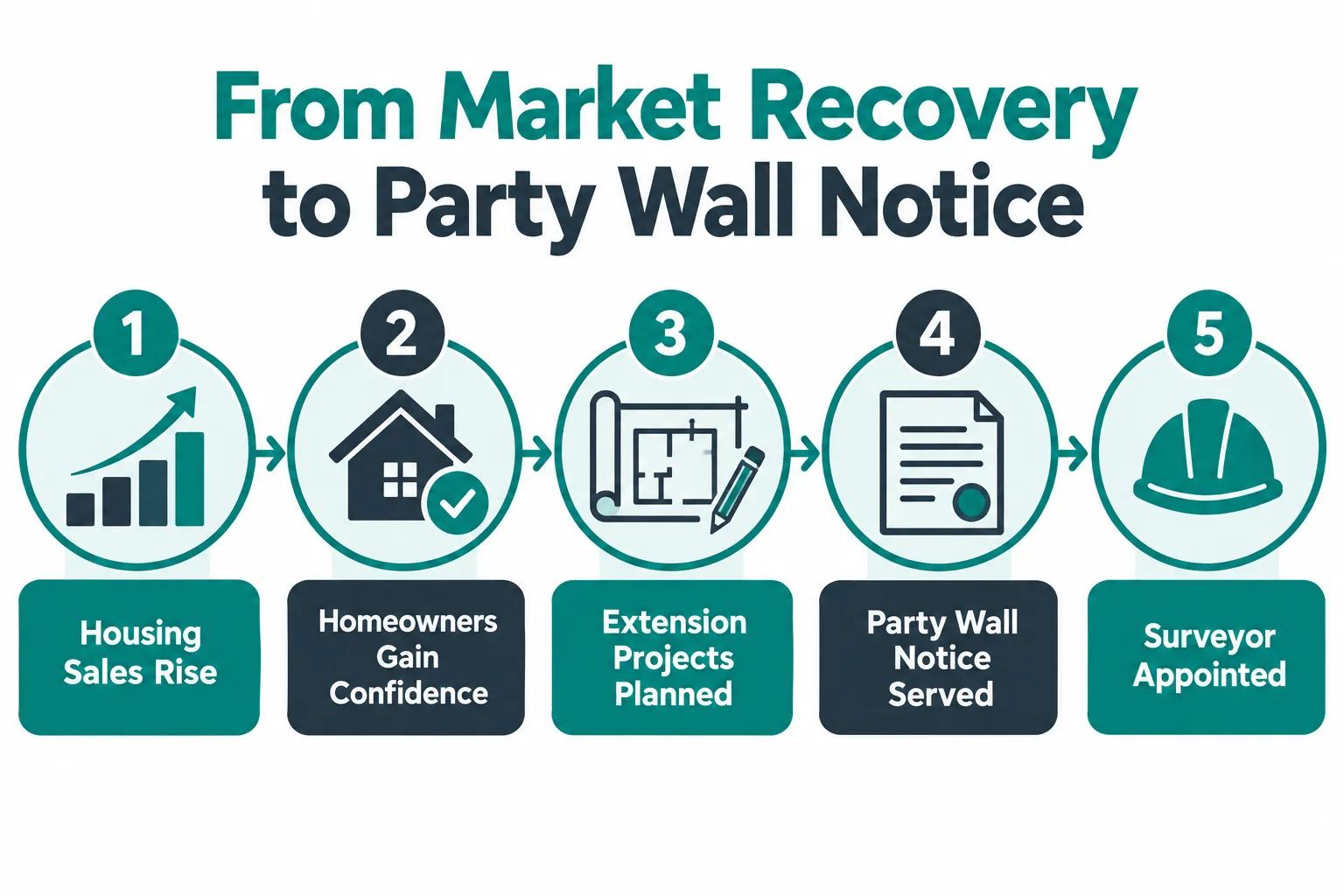
RSM UK’s Q2 2026 Housing Tracker anticipated housing starts rising in Q3 and completions increasing in late Q3 and Q4 2026, with the Bank of England holding rates around 3.75% and mortgage reforms boosting borrowing capacity [7]. The Construction Products Association, cited by PwC’s H1 2026 outlook, projected public and private housing output rising around four percent in volume from a very low base, with private housing repair, maintenance and improvement (RMI), the category that includes extensions and retrofits, rising approximately two percent [9].
This combination of more transactions, improving credit conditions and rising construction output forms the foundation of why 2026 market recovery is driving more party wall notices: each new extension or excavation project near a shared boundary is a potential trigger for formal statutory procedures under the Party Wall etc. Act 1996.
Key market signals at a glance:
| Indicator | Direction in 2026 | Source |
|---|---|---|
| Homes listed for sale | +6% year-on-year | Zoopla [15] |
| Housing starts (Q3 forecast) | Rising | RSM UK [7] |
| Private housing RMI output | +2% forecast | CPA / PwC [9] |
| Householder planning applications | Stabilising after -11% YoY dip | Planning Portal [2] |
Extension Activity: Subdued but Building a Pipeline
Despite the positive headline signals, extension activity in 2026 has not yet fully recovered. Planning Portal’s January 2026 Market Insight showed householder planning applications, which include the majority of home extensions, were down eleven percent year-on-year compared with January 2025, even though they rose four percent month-on-month from December [2]. Applications for larger home extensions specifically were also down eleven percent year-on-year in January, confirming that activity remains subdued [2].
The July 2026 Market Insight report painted a similar picture: householder submissions were eight percent lower than July 2025 and four percent below June 2026, with applications for larger home extensions down ten percent compared with June and six percent versus July 2025 [3]. The recovery in extension activity is clearly lagging behind the recovery in sales transactions.
Surveyor insight: “The pipeline is building, not yet flowing. Homeowners who bought in 2023 and 2024 are now reaching the financial confidence to start the extension they always planned.”
Savills analysis reinforces this view. In 2025, there was roughly one home extension or improvement for every seven sales, compared with a previous norm of one in five [1]. That gap represents a significant backlog of deferred projects. As confidence and budgets recover through 2026 and 2027, that catch-up wave is expected to translate directly into more planning applications, more construction starts, and more party wall notices being served on adjoining owners.
How Rising Extension Activity Translates Into More Party Wall Notices
The legal mechanism connecting extension activity to party wall procedures is straightforward. The Party Wall etc. Act 1996 requires building owners to serve formal notice on adjoining owners before undertaking specific categories of work. These include:
- Party Structure Notices: For works to an existing shared wall, such as inserting a steel beam, raising the wall height or cutting into it for a new extension. A minimum of two months’ notice is required. [8]
- Line of Junction Notices: For building a new wall at or astride the boundary line. One month’s notice is required. [8]
- Notices of Adjacent Excavation: For excavating within three or six metres of a neighbour’s structure (depending on depth). One month’s notice is required. [8]
For a detailed breakdown of what a party structure notice involves and how to serve one correctly, see this guide on what is a party structure notice and how to serve it in London.
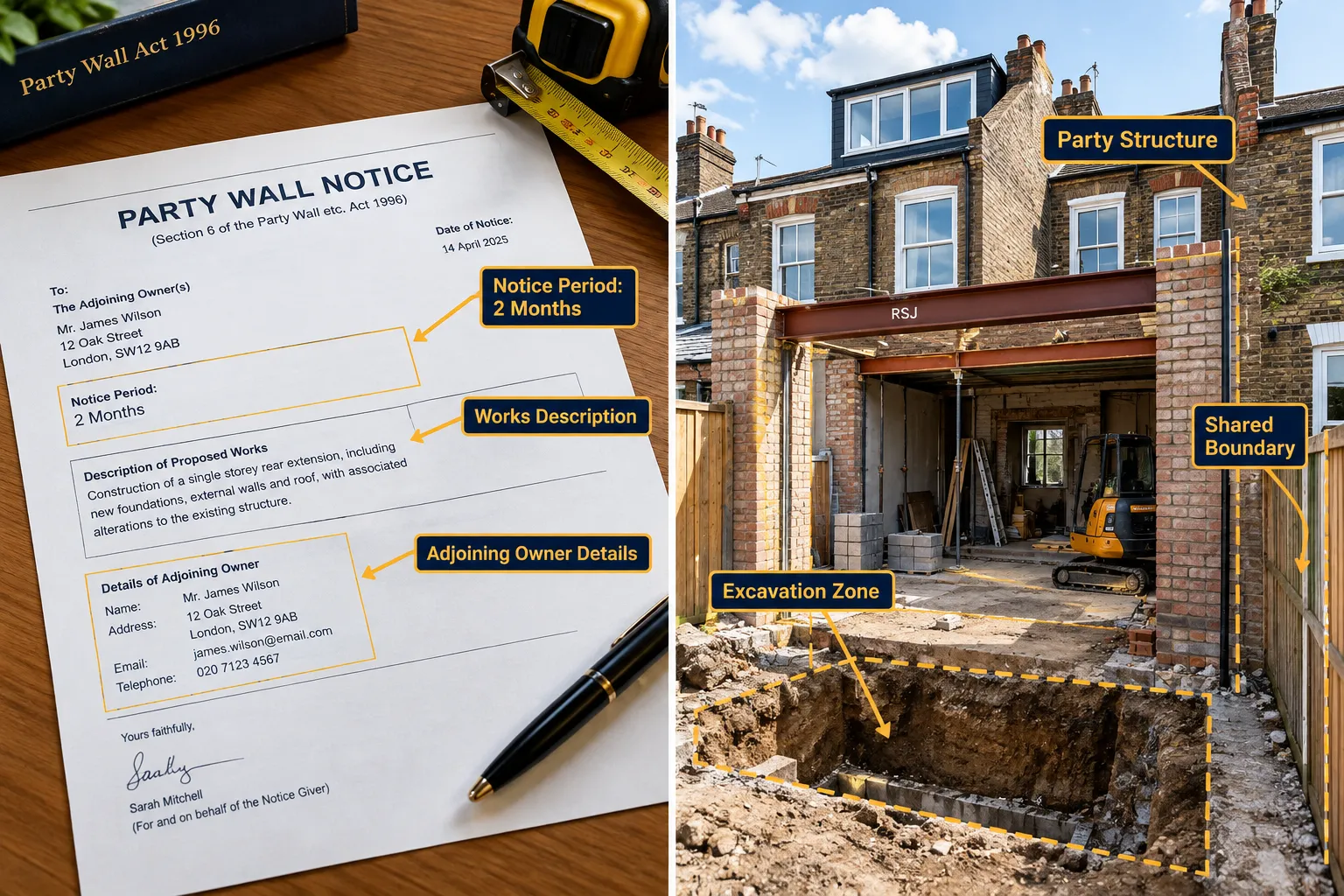
Every rear extension that touches or comes close to a shared wall, every loft conversion that raises a party wall, and every basement or deep-foundation project near a neighbour’s structure generates at least one, and often several, of these notices. As the volume of such projects rises, so does the volume of statutory notices.
A May 2026 analysis by Prince Surveyors on party wall surveys and urban renewal identified a sharp rise in party wall disputes, rights-of-light claims and nuisance actions driven specifically by government housing targets, mixed-use densification, retrofit and EPC upgrade programmes, and cladding remediation works [5]. The same analysis highlighted that infill development and retrofit projects are increasing the volume of all three types of party wall notices, not just the standard rear-extension party structure notice [5].
Understanding the types of party wall works that trigger these obligations is an essential first step for any homeowner planning a project in 2026.
Surveyor Insights: Why Disputes and Awards Are Becoming More Complex
The increase in notices is only part of the story. Surveyors working across London are also reporting that the disputes arising from those notices are becoming more involved, requiring more detailed party wall awards and greater professional input than in previous cycles.
Several factors are driving this complexity:
1. More “deemed dissent” outcomes
Simple Survey’s Party Wall Predictions for 2026 forecast a rise in notices ending in deemed dissent, where an adjoining owner fails to respond within 14 days and is automatically treated as having dissented [6]. Rising construction costs, more ambitious project scopes (multi-storey extensions, basements, full retrofits) and greater general awareness of compensation rights are all making neighbours more cautious about giving consent [6].
2. Overlapping regulatory regimes
Cladding remediation under the Building Safety Act, EPC-driven retrofit programmes and permitted development changes are all generating works that overlap with party wall obligations. Each overlap adds a layer of legal and technical complexity to the award-drafting process [5].
3. Rights-of-light and nuisance actions
Urban densification is bringing rights-of-light litigation into closer contact with party wall procedures. A rear extension that is perfectly compliant under the Party Wall Act may still attract a rights-of-light injunction from a neighbour, and surveyors are increasingly being asked to navigate both regimes simultaneously [5].
4. Adjoining owners are better informed
Awareness of the right to appoint an adjoining owner’s surveyor, whose fees are typically paid by the building owner, has grown significantly. This means more adjoining owners are exercising that right, increasing the formal surveyor involvement on each project.
A London-focused commentary on 2026 Party Wall Act updates confirmed that statutory notice periods remain unchanged at two months for party wall works and one month for excavation [4]. That predictability is helpful for project planning, but it also means that any surge in extension activity translates directly and proportionately into more notices, more potential disputes, and more awards under the existing regime [4].
London: The Epicentre of Rising Party Wall Activity
London’s housing density makes it the natural focal point for rising party wall notice volumes. The city’s stock of Victorian and Edwardian terraced and semi-detached houses means that almost every extension project involves a shared wall, a boundary close to a neighbour’s foundations, or both.
Activity is spread across all parts of the capital. In central areas, basement and lower-ground-floor extensions remain popular despite their complexity. In west and south London, rear and side-return extensions dominate. In north and east London, loft conversions and upward extensions are increasingly common as homeowners seek to add space without losing garden area.
Homeowners and developers in these areas can find specialist support through location-specific surveying services:
- Party Wall Surveyor Central London
- Party Wall Surveyor West London
- Party Wall Surveyor South London
- Party Wall Surveyor North London
- Party Wall Surveyor East London
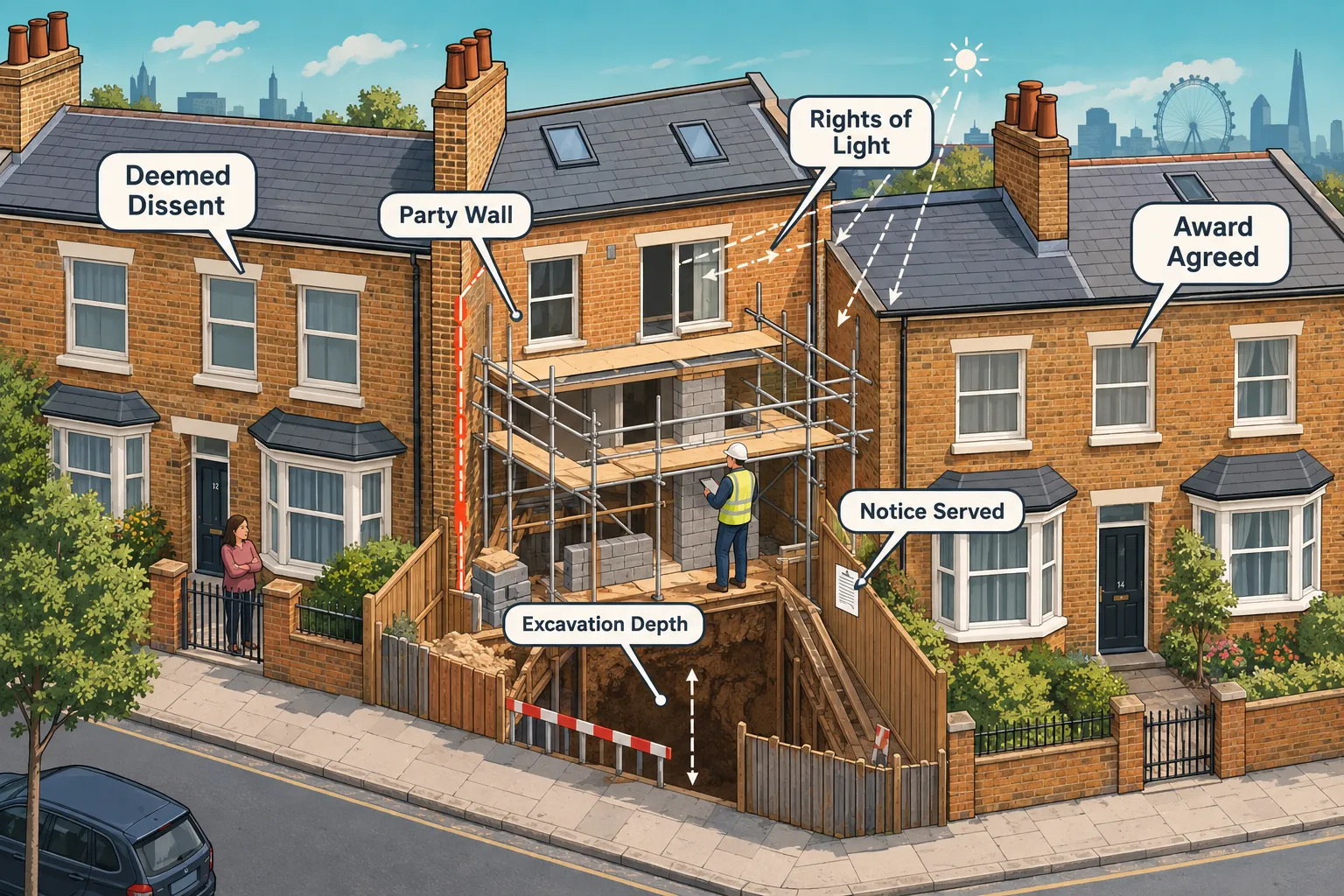
The urban renewal dynamic identified by Prince Surveyors is particularly acute in London, where government housing targets, permitted development rights for upward extensions, and the ongoing retrofit agenda are converging to produce a sustained high volume of notifiable works [5].
Practical Guidance for Homeowners in the 2026 Market
Understanding why 2026 market recovery is driving more party wall notices and surveyor insights from rising extension activity is useful context, but homeowners need practical steps. The following guidance applies whether a homeowner is the building owner planning works or the adjoining owner receiving a notice.
For building owners planning an extension:
- Identify whether the proposed works fall within the scope of the Party Wall etc. Act 1996 before submitting a planning application. Many projects require notice even where planning permission is not needed.
- Serve notices at the correct time. Party structure notices require two months’ lead time; excavation notices require one month [8]. Serving late causes project delays.
- Engage a building owner’s surveyor early to draft notices correctly and manage the process efficiently.
- Understand the costs of the party wall process upfront, including the likelihood of paying the adjoining owner’s surveyor’s fees if they dissent.
- Review practical strategies to keep party wall costs down without cutting corners on compliance.
For adjoining owners receiving a notice:
- Do not ignore a party wall notice. Failure to respond within 14 days triggers deemed dissent and the appointment of a surveyor anyway, but without any input from the adjoining owner at the outset [6].
- Understand what the notice means and what rights it confers. A clear explanation is available in this guide on party wall act notices, what they are and how to respond.
- Consider appointing an adjoining owner’s surveyor to protect interests. Their fees are generally borne by the building owner.
- Request a schedule of condition before works begin. This documents the existing state of the property and is the primary evidence base for any future compensation claim.
Notice response timeline:
| Action | Deadline |
|---|---|
| Respond to party wall notice | Within 14 days of service |
| Consent in writing | Avoids formal award; works can proceed after notice period |
| Dissent and appoint surveyor | Triggers award process |
| Deemed dissent (no response) | Automatic after 14 days; surveyor appointed |
What to Expect in the Second Half of 2026 and Beyond
The data points consistently toward a strengthening pipeline of extension activity in the second half of 2026. RSM UK’s Housing Tracker anticipates rising housing starts in Q3 and increasing completions in Q4 [7]. The Savills-identified backlog of deferred improvement projects among recent buyers is likely to begin unwinding as mortgage conditions stabilise [1]. PwC’s construction outlook projects private housing RMI continuing to grow modestly through the remainder of the year [9].
For the party wall sector, this trajectory means:
- More notices served, particularly for rear extensions, loft conversions and basement projects in dense urban areas.
- More deemed dissents, as adjoining owners exercise greater caution in the face of complex or high-value works [6].
- More formal awards required, as the proportion of projects requiring surveyor involvement increases.
- Greater demand for qualified surveyors, both as building owner’s surveyors and adjoining owner’s surveyors, across all London boroughs.
Surveyors and homeowners alike should treat the current period as a preparation window, a time to understand obligations, build professional relationships, and ensure that when the catch-up wave of extension projects arrives in earnest, the legal and procedural groundwork is already in place.
Conclusion
The connection between 2026’s housing market recovery and the rising volume of party wall notices is neither coincidental nor temporary. It is a direct, structural consequence of more homeowners gaining the confidence and financial capacity to undertake the extension and improvement projects they deferred during years of market uncertainty. Surveyor insights from rising extension activity confirm that the pipeline is building, that disputes are becoming more complex, and that both building owners and adjoining owners face greater procedural demands than in previous cycles.
Actionable next steps for homeowners in 2026:
- If planning any works near a shared wall or boundary, check obligations under the Party Wall etc. Act 1996 before finalising project timelines.
- Serve notices at the correct time, two months for party structure works, one month for excavation, to avoid costly project delays.
- Engage a qualified party wall surveyor early, whether as a building owner or as an adjoining owner receiving a notice.
- If costs are a concern, explore legitimate strategies to manage the process efficiently without compromising legal compliance.
- Stay informed about how urban renewal, retrofit requirements and densification are adding new layers of complexity to what might appear to be straightforward extension projects.
The 2026 market recovery is good news for homeowners and the construction sector. Navigating its party wall implications well is what separates a smooth project from an expensive dispute.
References
[1] Fewer Homeowners Renovate Despite Rise In Sales Savills Finds – mortgagesolutions.co.uk
[2] January 2026 Market Insight – blog.planningportal.co.uk
[3] June 2026 Market Insight Report 2 – blog.planningportal.co.uk
[4] 2026 Party Wall Act Updates Key Changes Impacting Awards And Agreements In Stabilizing Property Markets – 2026 party wall act updates key changes impacting awards and agreements in stabilizing property markets
[5] Party Wall Surveys In 2026 Urban Renewal Managing High Demand Disputes And Neighbour Relations – princesurveyors.co.uk
[6] Simple Surveys Party Wall Predictions For 2026 – simplesurvey.co.uk
[7] Uk Housing Tracker Outlook – rsmuk.com
[8] When How Tell Them – gov.uk
[9] Construction And Housebuilding Outlook H1 2026 – pwc.co.uk
[10] Party Wall Agreement – hoa.org.uk