
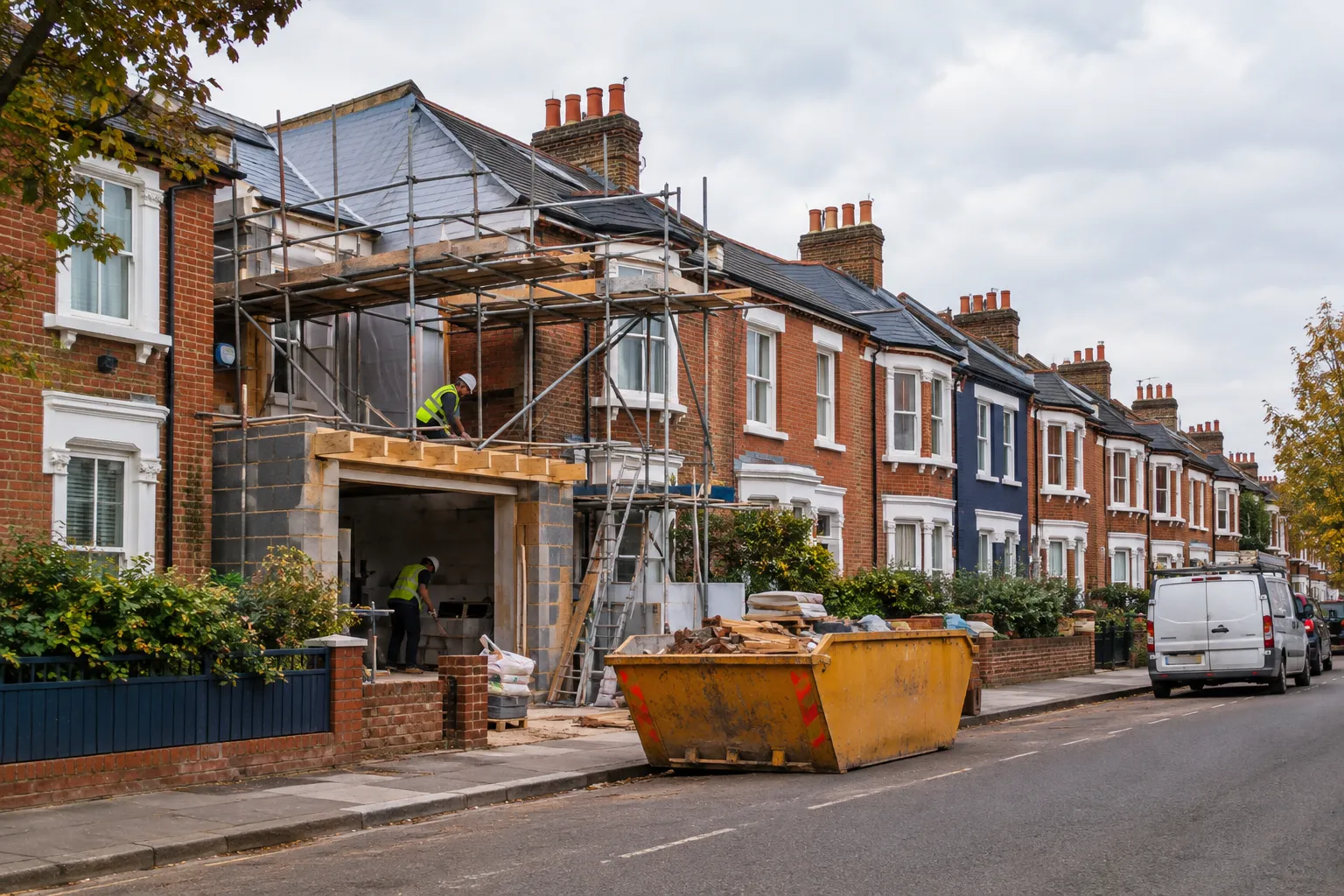
Fifty thousand pounds. That is the figure shadow housing secretary Katie Lam put on the table at the Conservative Party conference on 5 October 2026 as the potential saving per new home if a future Conservative government tore up building regulations. It is a striking number, and it sits at the centre of a package that would reshape how London builds, extends and alters property. The Conservatives pledge to scrap stamp duty and Future Homes Standard has landed just three weeks before Chancellor-level decisions at the 28 October 2026 Budget, and it raises a practical question many London homeowners have not yet asked: what happens to shared walls, boundaries and party structures if a building boom actually arrives.
This article sets out exactly what was proposed, how the property industry has reacted, and why the Party Wall etc. Act 1996 would still matter just as much, arguably more, under a deregulated building regime.
Key Takeaways
- At the October 2026 Conservative conference, Katie Lam proposed scrapping stamp duty, axing the Future Homes Standard, merging Section 106 and the Community Infrastructure Levy into one charge, and removing other housebuilding rules.
- The party claims these changes could cut new-build costs by up to £50,000 per home, though this is an opposition proposal, not government policy.
- Prime Minister Andy Burnham has confirmed stamp duty will not change at the 28 October 2026 Budget, so no immediate change is coming.
- Propertymark’s Timothy Douglas welcomed the supply focus but warned savings must reach buyers and that cutting costs must not mean cutting quality.
- Regardless of planning or regulatory shake-ups, the Party Wall etc. Act 1996 still governs extensions, basements and infill works on shared walls, and a looser building regime makes independent surveying more important, not less.
What the Conservatives Pledge to Scrap Stamp Duty and Future Homes Standard Actually Proposes
The announcement, made at party conference on 5 October 2026, was wide-ranging. Lam set out four main commitments:

- Scrap stamp duty entirely, removing a tax Reallymoving estimates costs the average English mover £9,500, and London movers a much steeper £21,250.
- Scrap the Future Homes Standard, the set of energy efficiency and low-carbon heating rules due to shape new-build construction.
- Merge Section 106 agreements and the Community Infrastructure Levy into a single unified developer charge, replacing two separate negotiated systems with one.
- Remove other housebuilding regulations, which the party argues adds unnecessary cost to every new home built.
Lam also commented on the Renters’ Rights Act, saying “I don’t care where it comes from. It’s got to go.” The party later clarified this referred to regulatory burdens on landlords generally, not a formal pledge to repeal the Act itself.
It is worth being precise about what this is and is not. These are opposition proposals from a party not currently in government. They would require winning an election and passing new legislation before any of it became law. For now, nothing changes. Prime Minister Andy Burnham has already stated that stamp duty will not be altered at the 28 October 2026 Budget, closing off any suggestion of an imminent shift under the current government.
Why a Building Boom Would Change the Party Wall Landscape in London
London’s housing stock is dense, old, and physically interconnected in a way few other UK cities match. Terraced houses share structural walls. Basements sit metres from a neighbour’s foundations. Side-return extensions run hard against boundary lines. If the Conservatives pledge to scrap stamp duty and Future Homes Standard were ever implemented, the stated aim is simple: make it cheaper and easier to build. Lower transaction costs could encourage more people to move rather than stay put and extend, but a simplified, cheaper planning and regulatory system could also unleash more extensions, loft conversions, basement digs and infill development, particularly in a city where land is scarce and every square metre matters.
“Scrapping stamp duty would remove a significant barrier to moving,” said Timothy Douglas of Propertymark, “but the £50,000 saving will need to be tested against whether it actually reaches consumers.”
That caution matters for party wall purposes too. A genuine building boom, more extensions, more basements, more infill schemes squeezed between existing homes, means more projects that fall within the scope of the Party Wall etc. Act 1996. More projects means more notices served on neighbours, more negotiated awards, and more schedules of condition recording the state of adjoining properties before work begins.
The Party Wall Act Still Applies However Planning Rules Change
Here is the key point for London property owners to understand: the Party Wall etc. Act 1996 is separate legislation from planning permission and building regulations. Scrapping the Future Homes Standard, merging developer levies, or removing other building rules would not touch the Party Wall Act. If a project involves work on, or near, a shared wall, excavating within three to six metres of a neighbouring structure for a basement, or building up to or astride a boundary line, the Act’s notice and dispute-resolution procedures still apply in full.
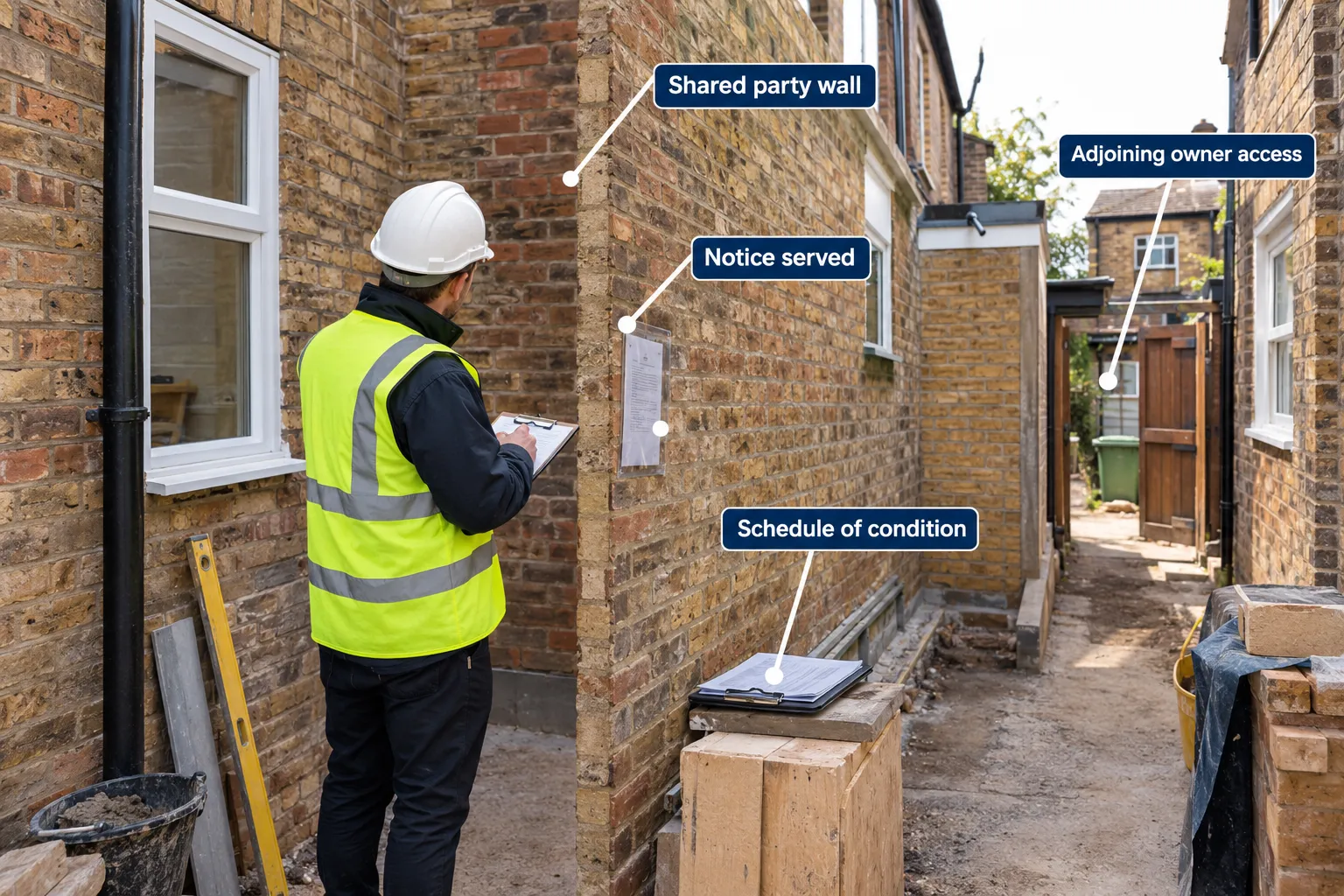
This distinction matters because deregulation at the planning and building-control level does not mean deregulation of neighbour rights. If anything, a faster, cheaper approvals process without the Future Homes Standard’s structural and energy checks could increase the importance of other safeguards, including:
| Safeguard | Why it matters more under deregulation |
|---|---|
| Schedule of condition | Fewer upfront building checks mean disputes over pre-existing damage become harder to resolve without a clear baseline record |
| Party wall notice | Still legally required before notifiable works, regardless of planning simplification |
| Appointed surveyor oversight | Provides independent technical scrutiny that looser building rules may no longer guarantee |
| Party wall award | Sets out how works will proceed and protects both building owner and adjoining owner |
Industry Reaction: Supply Focus Welcomed, Quality Warnings Raised
Timothy Douglas of Propertymark gave a measured response to the announcement. He welcomed the focus on housing supply and a simpler planning system, and agreed that removing stamp duty would strip away a genuine obstacle for people wanting to move home. But he raised two clear cautions. First, the headline £50,000 saving needs testing, savings on paper for developers do not automatically translate into lower prices for buyers. Second, and most relevant to party wall work, he warned that policy makers must not cut costs at the expense of quality and standards.
That second warning is the one London homeowners and developers should sit with. Removing red tape can speed up delivery, but it can also strip away checks that currently protect neighbours from poor workmanship, inadequate foundations, or undocumented damage. A schedule of condition and a properly appointed party wall surveyor become the practical backstop when other regulatory layers are thinned out.
What Homeowners and Developers Should Do Now
Because these proposals are not government policy, there is no need for panic action. But London property owners planning extensions, loft conversions or basement works should keep three things in mind:
- Nothing changes immediately. Stamp duty rules and current building regulations remain in force; the Budget on 28 October 2026 is not expected to alter stamp duty.
- Party wall obligations do not depend on which party is in government. Anyone planning notifiable works on a shared wall or near a boundary still needs to serve proper notice.
- A schedule of condition is cheap insurance. Whatever happens to planning rules nationally, documenting the state of a neighbouring property before work starts protects everyone involved if a dispute arises later.
FAQ
Is scrapping stamp duty and the Future Homes Standard already government policy? No. These are proposals from the Conservative Party, currently in opposition, announced at their October 2026 conference. They would require a change of government and new legislation to take effect.
Will stamp duty change at the October 2026 Budget? No. Prime Minister Andy Burnham has confirmed stamp duty will not change at the 28 October 2026 Budget.
Does the Party Wall Act still apply if building regulations are relaxed? Yes. The Party Wall etc. Act 1996 is separate from planning and building control. Any changes to the Future Homes Standard or other building rules would not remove the legal requirement to serve notice on affected neighbours for notifiable works.
Why would scrapping the Future Homes Standard affect party wall matters? It would not change the Act itself, but if it leads to more building activity with fewer structural and energy checks, independent oversight through party wall surveys and schedules of condition becomes a more important safeguard for both building owners and neighbours.
What is the average stamp duty saving being discussed? Reallymoving estimates average stamp duty paid by movers in England at £9,500 in 2026, rising to £21,250 for London movers, figures cited in discussion of the proposed scrapping.
Conclusion
The Conservatives pledge to scrap stamp duty and Future Homes Standard is a significant opposition proposal, not a change in law. For now, London homeowners should plan around the rules that exist today, not the ones being debated at conference podiums. What is certain is this: whatever happens to stamp duty, Section 106, or energy standards, the Party Wall etc. Act 1996 will keep governing shared walls, boundaries and excavation near neighbouring structures. Anyone planning an extension, basement or infill project in London should serve proper notice, commission a thorough schedule of condition, and engage a qualified party wall surveyor early, steps that protect both building owners and neighbours no matter which party sets housing policy next.
party wall surveyor, Party Wall etc. Act 1996, stamp duty reform, Future Homes Standard, Conservative housing policy, London extensions, schedule of condition, basement excavation London, Section 106, Community Infrastructure Levy, planning deregulation, housing supply policy