A 57% year-on-year collapse is not a dip. It is the kind of number that normally accompanies a recession, not a mid-cycle wobble. Yet that is exactly what Glenigan’s October 2026 Construction Index recorded for London in the three months to the end of September, and it arrived alongside a 43% quarterly fall, making the capital the second-weakest region in the country. The story behind London construction starts fall party wall October 2026 figures is not simply “building has stopped.” It is that big schemes have stalled while small, domestic works, lofts, extensions, basements, are quietly becoming the dominant source of construction activity in the city. That shift has direct consequences for anyone planning work under the Party Wall etc. Act 1996 this winter.
Key Takeaways
- London construction starts fell 57% year-on-year and 43% quarter-on-quarter in Glenigan’s data to end-September 2026, the second-worst performance of any UK region.
- UK-wide residential starts dropped 33% annually, but private housing starts stabilised quarter-on-quarter, rising 4%, even as they remained 32% below last year.
- Civil engineering starts jumped 101% quarterly and 43% annually, cushioning the overall headline, but this growth is concentrated in infrastructure, not housing.
- As large developments stall, more London building activity is concentrated in smaller domestic projects, exactly the works covered by the Party Wall Act.
- Fewer new large sites mean surveyors and contractors have more capacity, but mortgage costs and sluggish house sales are reshaping how and when owners commission party wall work.
Reading the Glenigan Numbers Properly
Glenigan’s Index, published on 6 October 2026, measures the value of construction projects starting on site, not planning applications or intentions. The London construction starts fall party wall October 2026 data point sits inside a wider national picture that is more mixed than the headline suggests.
| Sector | Quarterly change | Annual change |
|---|---|---|
| London (all starts) | -43% | -57% |
| East of England | -73% | -57% |
| UK residential | -8% | -33% |
| UK private housing | +4% | -32% |
| UK social housing | -33% | -35% |
| UK non-residential | -15% | -16% |
| UK civils | +101% | +43% |
Glenigan economist Allan Wilen summed it up plainly: “A welcome surge in civil engineering projects partially offset a decline in residential and non-residential project starts.” He also noted that private housing starts have “stabilised against the previous three months”, a small but notable signal that the worst of the housing slowdown may be levelling off, even if the annual comparison still looks grim.
Glenigan has kept its forecast for a construction recovery in 2027, with market attention now turning to the Autumn Budget on 28 October 2026 as a potential catalyst, or further drag, on confidence.
Why London Construction Starts Fall Party Wall October 2026 Trends Matter for Neighbours
When large residential and commercial schemes are shelved, developers stop needing cranes, piling rigs, and multi-month excavation programmes next to neighbouring properties. But homeowners do not stop wanting more space. Instead, London’s building activity appears to be rebalancing toward smaller, owner-led projects.
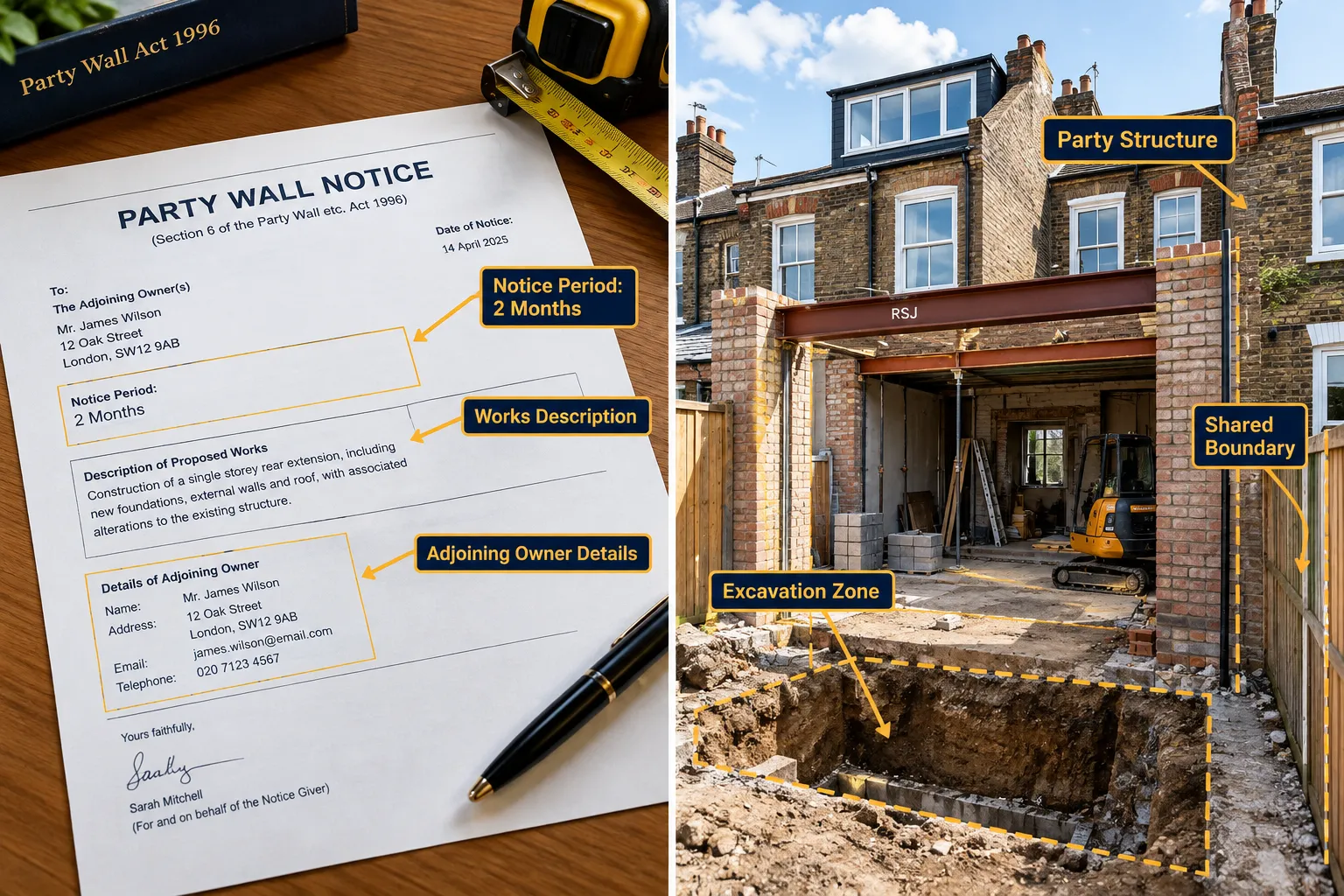
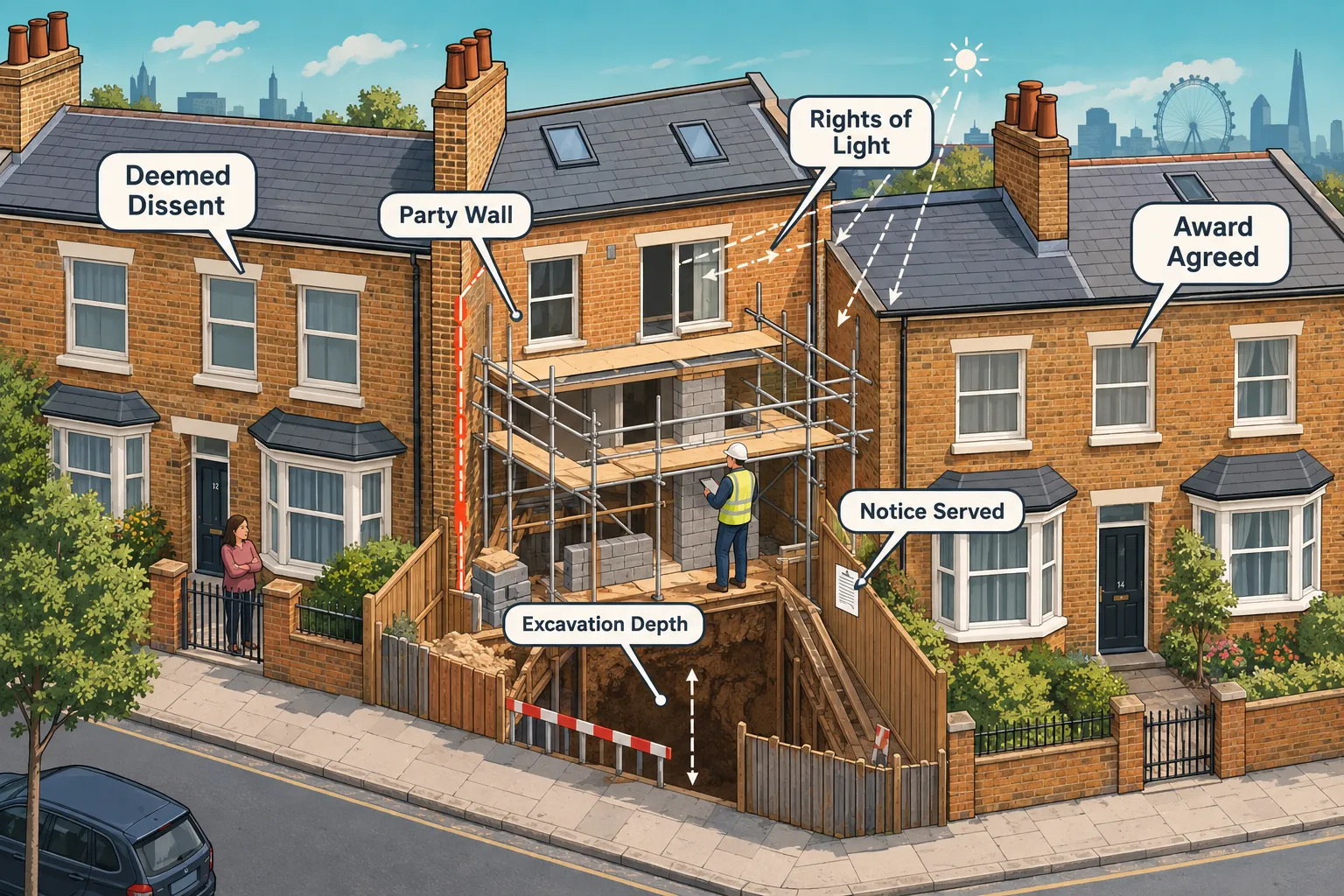
This matters because the Party Wall etc. Act 1996 does not care about project size in pounds, it cares about proximity and type of work. A single-storey rear extension triggers the same legal notice requirements as a major basement dig next door. Relevant triggers include:
- Section 1, building a new wall on or near a boundary line.
- Section 2, work directly to a shared party wall or structure, such as cutting in beams, raising a wall, or underpinning.
- Section 6, excavating within 3 metres of a neighbour’s building where new foundations go deeper than theirs, or within 6 metres where a line drawn at 45 degrees would cut their foundations.
Notice periods are fixed by statute: one month for Section 1 and Section 6 notices, two months for Section 2 works. These timeframes do not shrink just because the wider market has slowed.
“A quieter site next door does not mean a quieter legal process. The notice periods, schedules of condition, and award process under the 1996 Act apply regardless of how the broader construction market is performing.”
Market Context Behind the Slowdown
The construction figures do not sit in isolation. Several housing market indicators from early October 2026 paint a consistent picture of a cautious capital:
- Zoopla (1 October 2026) reported London property prices down 1% annually, with only 30% of homes listed between April and June selling within three months.
- Lloyds’ House Price Index (September 2026) put the average Greater London home at £531,548, down 2.2% year-on-year.
- Moneyfacts recorded the average five-year fixed mortgage rate at 6.00% as of 5 October 2026.
- Conveybuddy’s Q3 data showed remortgage instructions up 19% and survey instructions up 13%, suggesting owners are choosing to stay put and improve rather than move.
That last point is central to understanding the shift. With mortgage rates elevated and sale timelines stretching, many London homeowners are opting to extend, convert, or dig down rather than sell and buy. Every one of those choices can bring the Party Wall Act into play.
What the Slowdown Means for Surveyors, Lead Times and Costs
For anyone planning domestic building work this winter, the construction slowdown has practical upsides and a few new risks worth understanding.
Surveyor and contractor availability
With fewer large commercial and residential sites competing for resources, party wall surveyors and specialist contractors in London generally have more capacity than during the boom years of 2021-2023. This can mean:
- Faster appointment of a surveyor once notice has been served.
- More competitive quotes for the surveying work itself.
- Contractors with gaps in their schedule, sometimes willing to negotiate on price for the work itself.
Lead times still bound by law
Faster appointments do not shorten statutory notice periods. Owners still need to budget one to two months minimum before work can legally start under the Act, and dissenting neighbours can still require a formal award, which adds further time.
Schedules of condition remain essential
A quieter market is an ideal time to insist on a thorough schedule of condition before work begins. With surveyors less stretched, there is less excuse for a rushed inspection, and a detailed record protects both owner and neighbour if a dispute over cracks or settlement arises later.
Cost allocation under pressure
Glenigan’s data showing private housing “stabilising” rather than growing suggests owners are still cost-conscious. Surveyors’ fees, which are typically paid by the building owner under the Act, remain a fixed cost regardless of market conditions, and should be factored into any extension, loft, or basement budget from the outset.
Practical Steps for Owners Planning Winter Works
- Check whether your project needs notice. Any extension, loft conversion, or excavation near a boundary likely falls under Sections 1, 2 or 6.
- Serve notice early, even with more surveyor capacity available, the one- and two-month clocks still apply.
- Commission a schedule of condition on neighbouring properties before works start, not after a complaint.
- Get multiple contractor quotes while the market is quieter, this is a buyer’s moment for smaller works.
- Budget for the full process, including surveyor fees, not just construction costs, especially with mortgage and remortgage costs already squeezing household budgets.
Conclusion
The headline from Glenigan’s October 2026 Index is dramatic, but the practical story for London homeowners is more nuanced. Large developments have stalled sharply, while civil engineering has surged and private housing starts have stabilised. For individual owners, the London construction starts fall party wall October 2026 trend translates into a quieter market with more available surveyors and contractors, but the same legal notice periods, excavation rules, and schedule-of-condition obligations under the 1996 Act still apply in full. Anyone planning a loft conversion, extension, or basement this winter should serve notice promptly, secure a detailed schedule of condition, and use the current market conditions to negotiate fairly priced, well-documented work.
FAQ
Does a national construction slowdown affect my Party Wall Act notice period? No. Notice periods of one month (Sections 1 and 6) and two months (Section 2) are fixed by statute and unaffected by market conditions.
Will it be easier to find a party wall surveyor now? Generally yes. With fewer large sites competing for talent, many London surveyors report more capacity and faster turnaround for appointments and awards.
Why did civil engineering starts rise while housing fell? Glenigan’s data shows civils up 101% quarterly, largely from infrastructure projects unrelated to residential building, which offset, but did not reverse, the housing decline.
Should I still get a schedule of condition if my neighbour’s house looks fine? Yes. A schedule of condition protects both parties by recording the existing state of a property before work begins, regardless of how stable it appears.
Is now a good time to start a loft conversion or extension in London? Market conditions suggest more competitive contractor pricing and surveyor availability, though owners should still budget carefully given mortgage rates near 6%.
Does the Autumn Budget affect party wall rules? No. The Budget may influence construction investment and confidence, but it does not change the legal requirements of the Party Wall etc. Act 1996.
.cg-pw-wrap{max-width:700px;margin:0 auto;font-family:Arial,Helvetica,sans-serif;border:1px solid #d8dde3;border-radius:8px;padding:16px;background:#fafbfc} .cg-pw-wrap h3{margin:0 0 10px;color:#1a2b40;font-size:18px} .cg-chart{display:flex;align-items:flex-end;gap:10px;height:180px;border-bottom:2px solid #333;padding:0 4px} .cg-bar{flex:1;background:#2a6fdb;border-radius:4px 4px 0 0;position:relative;display:flex;align-items:flex-end;justify-content:center;transition:height.3s} .cg-bar.neg{background:#d64545} .cg-bar span{position:absolute;top:-20px;font-size:11px;color:#333;font-weight:bold} .cg-labels{display:flex;gap:10px;margin-top:6px} .cg-labels div{flex:1;text-align:center;font-size:10px;color:#555} .cg-source{font-size:11px;color:#777;margin-top:10px} .cg-toggle{margin-bottom:10px} .cg-toggle button{font-size:12px;padding:5px 10px;margin-right:6px;border:1px solid #2a6fdb;background:#fff;color:#2a6fdb;border-radius:4px;cursor:pointer} .cg-toggle button.active{background:#2a6fdb;color:#fff}Glenigan Index: Construction Starts, Q3 2026
Source: Glenigan Construction Index, published 6 October 2026. Chart for illustrative comparison of sector change.