

Average London house prices fell for the eleventh month running in July 2026, according to the Office for National Statistics, and the typical property now sits £19,000 below where it stood a year earlier. That single fact, more than any marketing slogan, explains why skips, scaffolding and party wall notices are becoming a familiar sight on streets across the capital. When selling looks unattractive and borrowing is expensive, staying put and building up or out starts to make financial sense, and for most of those projects, the law requires a formal notice to the neighbours next door.
This article looks at the trend of London homeowners extending instead of moving party wall notices 2026, why the sales market is pushing people towards building work, and what that means practically for anyone planning a rear extension, loft conversion or basement dig this autumn and winter.
Key Takeaways
- ONS data (16 September 2026) shows London’s average house price at £569,000 in July 2026, down 3.3% year-on-year and £19,000 below the July 2025 peak, a market backdrop that makes extending look more attractive than moving.
- RICS’s September 2026 survey recorded a -32% house price net balance and an 18% fall in agreed sales, with London performing notably worse than the UK average.
- Rising mortgage rates, average viewings per listing down 57% in two years, and a ruled-out stamp duty reform are all keeping homeowners in place rather than moving.
- Most rear extensions, loft conversions and basement projects legally require Party Wall etc. Act 1996 notices, serving them late is one of the most common and costly planning mistakes.
- Notice periods (one or two months) plus a 14-day response window mean notices should go out well before a builder is due on site.
Why London Homeowners Are Extending Instead of Moving Party Wall Notices 2026
The case for staying put is built from several overlapping pressures. ONS figures released on 16 September 2026 put the average London house price at £569,000 in July 2026, a 3.3% annual fall and the eleventh consecutive month of year-on-year decline, against a UK average of £273,000 that actually rose 1.4%. London is, unusually, moving in the opposite direction to the rest of the country. The next ONS house price release lands on 21 October 2026, and will be watched closely for signs of whether that run of falls continues.
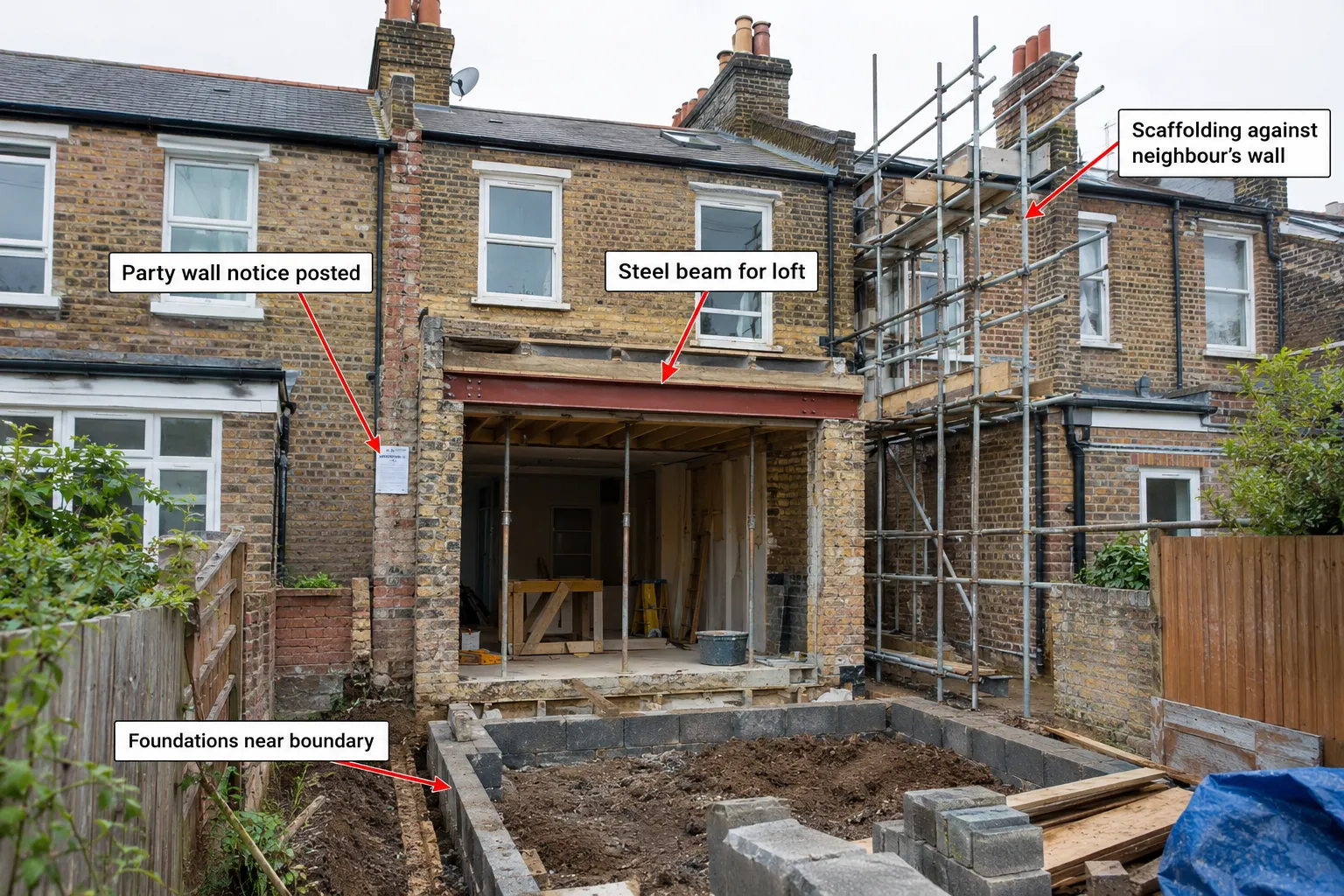
RICS’s September 2026 survey, published 8 October, paints a similarly subdued picture: new buyer enquiries down 22%, agreed sales down 18%, and a house price net balance of -32% in current prices. RICS economist Tarrant Parsons noted that “a renewed rise in interest rate expectations has created a fresh headwind” for the market. London, the survey noted, has performed notably worse than the national average.
Demand-side data backs this up. Analysis of Rightmove figures by Tembo (15 October 2026) found the average number of viewings per listing has fallen to just 1.7 in August 2026, down 57% from nearly four viewings two years earlier. Eighty-six per cent of estate agents reported homes selling below asking price. Mortgage rates are not helping either: the average two-year fix stood at 5.97% and the five-year at 5.99%, with nearly two million fixed-rate deals due to expire across 2026. Yorkshire Building Society data reported by Moneyfacts (14 October 2026) showed home-mover mortgage applications down 10.2% year-on-year between late June and late September 2026.
Stamp duty is compounding the problem. HomeOwners Alliance research found that over 800,000 homeowners have shelved moving plans because of the tax, and the Prime Minister has ruled out reform ahead of the 28 October 2026 Budget, saying plainly: “That won’t be happening.” With moving costs fixed and sale prices soft, many households are turning their budgets inward instead.
That shift mirrors wider renovation trends. Legal & General’s “Great Home Renovation” study of 2,000 UK homeowners who had renovated in the past year (reported November 2025) found almost half preferred improving their home to moving, with three in ten citing financial reasons for staying put and 77% funding work from savings. The UK home improvement sector was valued at £29.7 billion in 2024, up 5.1% on the year before. Separately, Propertymark warned on 13 October 2026 that the draft London Plan must turn housing ambition into actual homes, a reminder that denser development across the capital means more building work happening next to existing neighbours, not less.
Which Projects Trigger the Party Wall etc. Act 1996
Not every home improvement needs a party wall notice, but most of the popular ones in London terraces and semis do. The Party Wall etc. Act 1996 applies whenever work affects a shared structure, a boundary, or ground near a neighbour’s foundations. Common trigger projects include:
- Rear extensions where new foundations are dug within 3 metres of a neighbour’s foundations, or deeper than them.
- Loft conversions that cut into the party wall to support steel beams or install padstones.
- Basement and lightwell digs, which almost always involve excavation close to, or below, next door’s footings.
- Chimney breast removal, where the stack is shared between two properties.
- New boundary walls built astride or up to the line of junction with a neighbour.
Under the Act, excavation within 3 metres of a neighbour’s building, and deeper than their foundations, is notifiable, as is excavation within 6 metres if it falls within a 45-degree line drawn down from their foundations. Flats above and below a property can also count as adjoining owners, something that is easy to overlook in converted Victorian buildings.
Timeline Planning for London Homeowners Extending Instead of Moving Party Wall Notices 2026
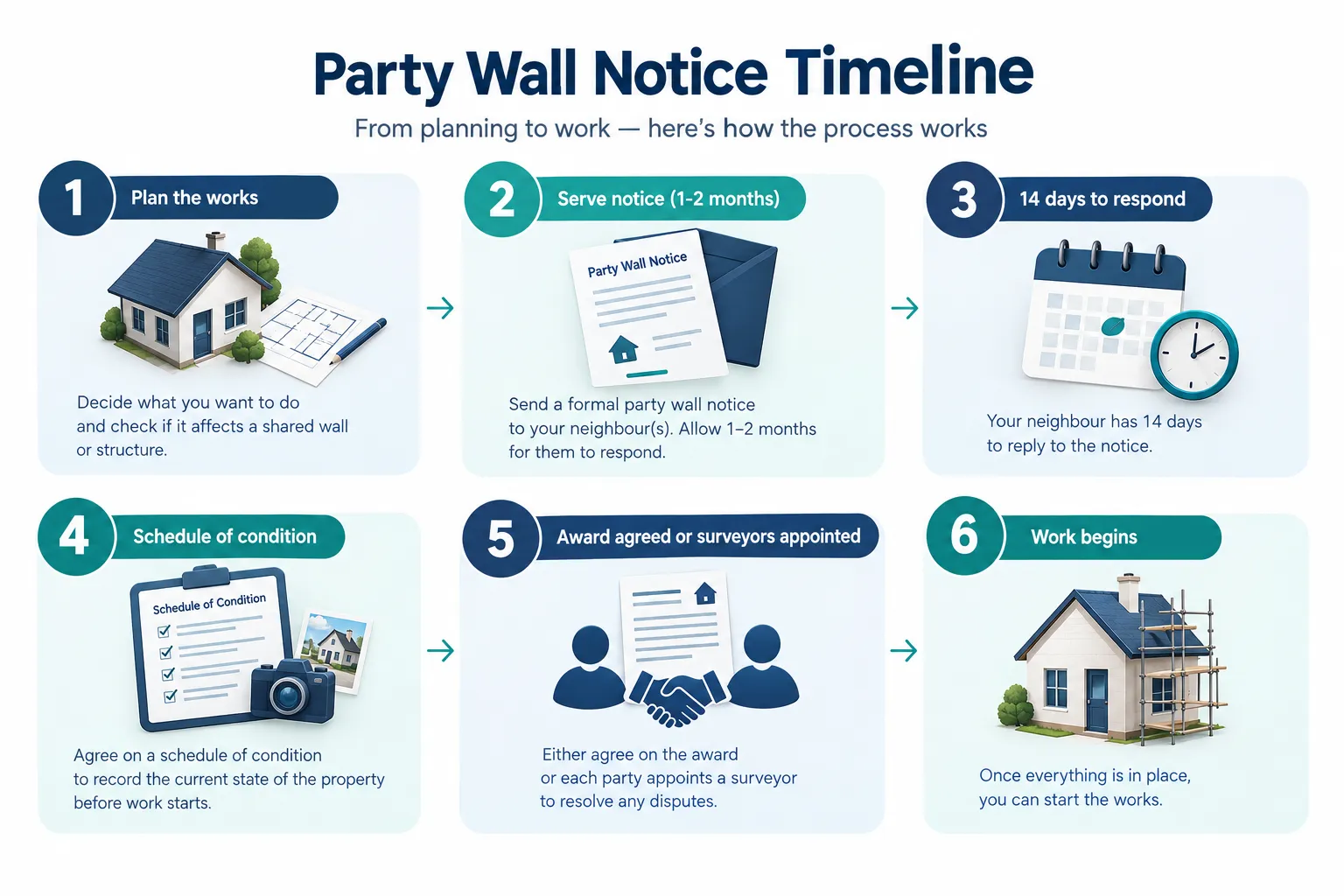
Serving notice late is one of the easiest ways to derail a building schedule. Section 2 notices, covering works to an existing party wall or structure, require two months’ notice. Section 1 notices, for new walls at the boundary, and Section 6 notices, for adjacent excavation, each require one month. Once served, a neighbour has 14 days to respond, consent, dissent, or silence (which, after the notice period, is treated as a dispute requiring a surveyor).
Given those timeframes, notices should ideally be served as soon as drawings are finalised, not once a contractor’s start date is confirmed. Builders booked for a January start, for example, should expect notices to go out well before November to allow for response time, any dissent, and the drafting of an award. For a full breakdown of what a valid notice must contain, see this guide to party wall notices and the explanation of how to serve a party structure notice in London.
What Happens If a Neighbour Dissents
A neighbour is entitled to dissent, and this is not unusual, particularly where excavation or structural steel is involved. Once that happens, the parties either agree to appoint a single “agreed surveyor” to act for both, or each appoints their own surveyor, who then select a third surveyor to resolve any disagreement between them. The surveyors produce a party wall award, which sets out the work permitted, any protective measures, and working hours. The building owner, the person carrying out the works, is almost always responsible for the reasonable surveyor fees on both sides, even where two surveyors are appointed. More detail on how awards work is covered in this party wall award and contract template guide, and the costs involved in the party wall process are worth budgeting for early.
Schedule of Condition: Protection for Both Sides
A schedule of condition is standard practice before notifiable works begin, especially in terraced housing where vibration and settlement can travel between properties. It is a detailed photographic and written record of the adjoining property’s condition, cracks, cornices, floors, taken before work starts. If a dispute arises later about new cracking or damage, the schedule gives both the building owner and the adjoining owner independent evidence of the starting condition. It protects homeowners from unfair blame and protects neighbours from being left to prove damage without a baseline record.
Common Mistakes to Avoid
Several avoidable errors come up repeatedly in London party wall disputes:
- Starting work before notices expire. Even with planning permission granted, works affecting a party wall cannot lawfully begin until the notice period has passed or an award is in place.
- Assuming planning permission covers everything. Planning consent and building regulations are entirely separate from party wall consent; having one does not remove the need for the other.
- Missing adjoining owners. In converted houses or blocks, this can mean notifying flats above and below, not just next door, and every leaseholder with an interest, not only the freeholder.
- Skipping the schedule of condition. Without one, both sides are left arguing from memory if cracks appear later.
- Treating the 14-day window loosely. Silence after the deadline is a dispute, not consent, and should trigger surveyor appointment promptly rather than being ignored.
Homeowners in flats and converted properties should also check whether boundary or fence works fall under party wall or separate boundary wall rules, as the two are often confused. Those extending in different parts of the capital can find locally focused guidance, for example from party wall surveyors in East London or party wall surveyors in North London, reflecting the mix of Victorian terraces, conversions and new-build infill common in each area.
What to Watch Next
Three dates matter for anyone weighing up whether to move or extend. The ONS releases fresh house price data on 21 October 2026, which will show whether London’s run of annual price falls has reached a twelfth month. The Budget follows on 28 October 2026, where stamp duty reform has already been ruled out, but other housing or tax measures could still shift the moving-versus-improving calculation. The Bank of England’s November decision on interest rates will also influence mortgage pricing at a point when nearly two million fixed-rate deals are due to expire this year.
Frequently Asked Questions
Do I need a party wall notice for a loft conversion? Usually yes, if the work involves cutting into the party wall to insert steel beams or padstones for structural support. A straightforward loft conversion that does not touch the shared wall may not require one, but most do.
How long before building work should I serve a party wall notice? Serve notices as soon as plans are finalised. Section 2 notices need two months, while Section 1 and Section 6 notices need one month, plus a 14-day response period and time to resolve any dissent.
What if my neighbour ignores the notice? If there is no response within 14 days, this is treated as a dispute. Surveyors are then appointed to produce an award before work can lawfully proceed.
Who pays for the party wall surveyor? The building owner carrying out the works typically pays reasonable surveyor fees, including where the adjoining owner appoints their own surveyor.
Does planning permission remove the need for a party wall notice? No. Planning permission and party wall consent are separate legal processes, and both may be required for the same project.
Conclusion
A stalled London sales market, expensive mortgages, and a stamp duty system left untouched in the upcoming Budget are combining to make extending look more sensible than moving for many homeowners this autumn. But a cheaper alternative to moving is not a shortcut around the law: rear extensions, loft conversions, basement digs and chimney breast removals typically still require formal party wall notices, correct timing, and often a schedule of condition. Homeowners planning work should check early whether their project is notifiable, identify every adjoining owner, and build notice periods into their build programme rather than their contractor’s start date. Getting this right protects relationships with neighbours as much as it protects the build itself.
party wall act 1996, party wall notices London, London house extensions, loft conversion rules, basement extension London, party wall surveyor, schedule of condition, London property market 2026, stamp duty reform, ONS house prices, RICS survey, home improvement trends