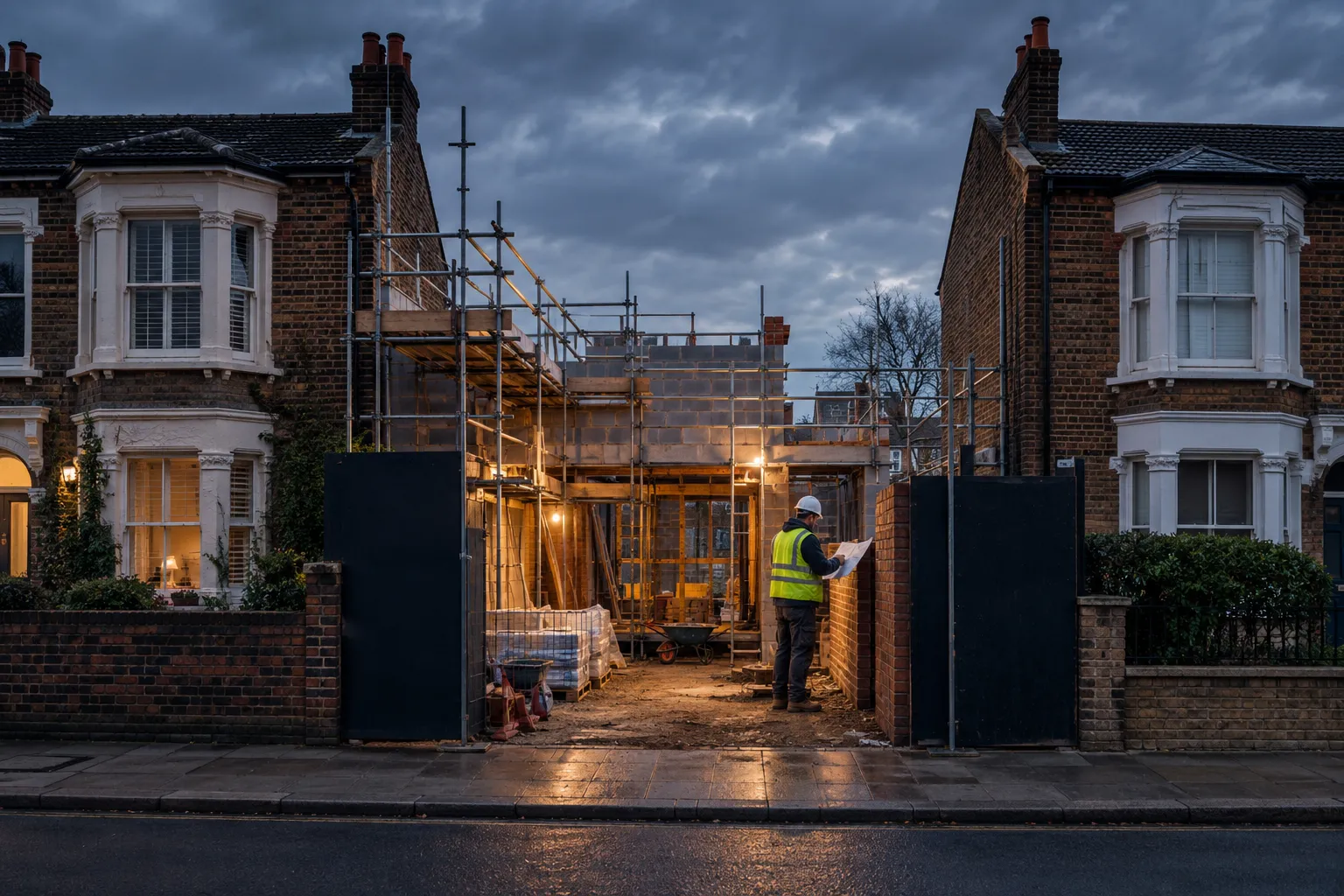
A new line item just appeared on the cost sheet of every London scheme with ten or more flats, and nobody is talking about how it collides with the one law that already governs almost every boundary wall in the capital. From 1 October 2026, the Building Safety Levy sits on top of CIL, Section 106 and, for most infill sites, a Party Wall etc. Act 1996 process that was already tightening timelines. For developers and homeowners alike, the Building Safety Levy 1 October 2026 London developers party wall question is no longer theoretical. It is live, it is being charged per square metre, and it is already shaping how schemes are designed on the ground.
This analysis, published 4 October 2026 by Party Wall Surveyor London, sets out exactly what the levy does, who is exempt, the confirmed borough rates, and why party wall sequencing now needs to move even earlier in the programme.
Key Takeaways
- The Building Safety Levy took effect on 1 October 2026 for building-control applications submitted on or after that date, charged per square metre of new residential floorspace.
- Developments of fewer than 10 dwellings (or fewer than 30 student bedspaces) are exempt, a threshold that is already influencing unit counts on tight sites.
- Confirmed London rates range from £48.00/m² in Bexley to £100.35/m² in Kensington & Chelsea, with a 50% discount on previously developed land.
- Most homeowner extensions, loft conversions and basements escape the levy but still require Party Wall Act notices and, often, a formal award.
- Because the levy is triggered by the building-control application date and party wall notice periods run one to two months, sequencing the two processes correctly protects both budget and programme.
What the Building Safety Levy Means for London Developers From 1 October 2026
The levy applies to initial notices or full plans applications for new residential floorspace submitted from 1 October 2026 onward. Rates are set per local authority, reflecting local house prices, and are charged per square metre of qualifying floorspace. The local authority acts as the collecting authority, but liability sits with the “client” named on the building-control application. Payment falls due by the first completion notice or first occupation, whichever happens first, and a completion certificate will be withheld if the levy is unpaid.

The policy intent is straightforward. MHCLG’s August 2026 remediation data recorded 4,724 buildings of 11 metres or more identified with unsafe cladding, with 46% of remediation work not yet started. The levy is forecast to raise roughly £3.5 billion over ten years to help fund that remediation programme. Propertymark lobbied specifically for the per-square-metre model and for the small-site exemption, arguing that a flat charge would have hit smaller housebuilders disproportionately hard.
For London specifically, the rates are high relative to most of England, reflecting local house prices. That makes the interaction with existing contributions, CIL and Section 106, a genuine cash-flow issue for small and medium developers running tight infill schemes.
Confirmed Building Safety Levy Rates for London Boroughs
The following published rates apply to standard sites and to previously developed land, where at least 75% of the planning red-line site meets the definition of previously developed land (in which case the rate is 50% of the standard figure).
| Borough | Standard rate (£/m²) | Previously developed land rate (£/m²) |
|---|---|---|
| Kensington & Chelsea | 100.35 | 50.17 |
| Westminster | 98.01 | 49.01 |
| Hammersmith & Fulham | 91.87 | 45.94 |
| Camden | 87.12 | 43.56 |
| Tower Hamlets | 61.20 | 30.60 |
| Greenwich | 54.33 | 27.16 |
| Bexley | 48.00 | 24.00 |
These figures only cover the boroughs officially published and referenced here; developers working outside these areas should check their own local authority’s confirmed rate rather than assume a figure.
Exemptions, and Why Most Homeowner Projects Are Unaffected
The levy carves out a long list of exempt categories: developments of fewer than 10 dwellings (or fewer than 30 purpose-built student bedspaces), social housing, supported housing, care homes, hospitals, hotels, hostels and hospices, school accommodation, prisons, temporary homeless accommodation, and armed-forces or Crown accommodation.
In practice, this means the vast majority of London homeowner projects, a rear extension, a loft conversion, a basement dig, a two-flat conversion, fall outside the levy entirely. But exemption from the Building Safety Levy does not mean exemption from the Party Wall etc. Act 1996. Any excavation within 3 or 6 metres of a neighbour’s foundations, any work directly on a shared wall, or any new wall built astride or against the boundary still triggers a statutory notice requirement, regardless of levy status. Homeowners should review Party Wall Notices and the underlying Party Wall etc. Act 1996 framework before assuming a small project needs no formal process.
Building Safety Levy 1 October 2026 London Developers Party Wall: The 9-Unit vs 10-Unit Question
For small and medium developers, the 10-dwelling exemption threshold is already shaping scheme design decisions. A scheme of nine flats pays no Building Safety Levy. A scheme of ten flats on an identical footprint pays full levy on every square metre of qualifying floorspace, at whatever rate the borough sets.
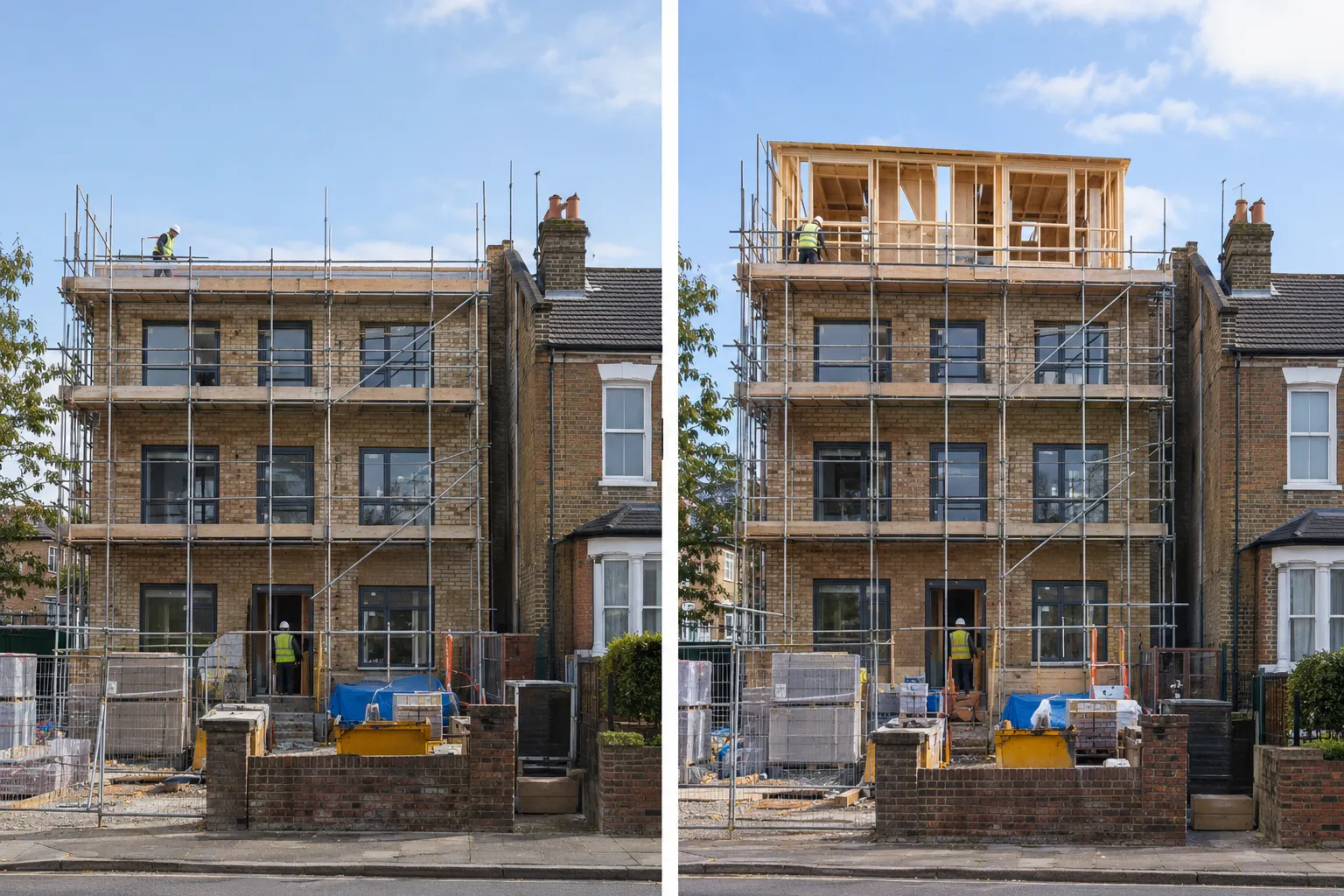
It is easy to see why some architects and developers will now test whether dropping a unit, or redesigning floorspace to shrink below the threshold, makes commercial sense versus building the tenth flat and absorbing the levy. This is a design and viability decision for developers and their advisers to work through on a scheme-by-scheme basis, this article does not offer tax or legal advice on how to structure a project around the exemption.
What is clear is that any scheme at or near the ten-unit line, on a tight urban infill plot, is also highly likely to share boundaries with neighbouring buildings on more than one side. That raises the stakes on party wall planning from day one.
The Brownfield Discount and What Counts as Previously Developed Land
The 50% discount for previously developed land only applies where at least 75% of the planning red-line site meets the statutory definition. For many London infill sites, former garages, yards, or demolished light-industrial units, this discount can materially change the levy bill. But the 75% threshold is strict: a site with significant garden land, undeveloped amenity space, or agricultural land mixed into the red line may fail the test even if the building footprint itself sits on brownfield ground. Developers should confirm this classification with their building-control body before relying on the discounted rate in a viability appraisal.
Sequencing: Building Control Applications and Party Wall Notices
The levy is triggered by the date a building-control application, an initial notice or full plans, is submitted. Party Wall Act notices, by contrast, require one month’s notice for new walls on the line of junction or adjacent excavation works, and two months’ notice for works to an existing party structure. Getting the order wrong creates two different risks.
Submit building control too early, before party wall notices have been served and responded to, and a developer may find adjoining owners dissenting, appointing surveyors, or even seeking an injunction after the levy clock and construction programme have already started. Submit party wall notices too late, and a scheme can find a signed-off building control application sitting idle while notice periods run, pushing back the start of works and the point at which the levy becomes payable relative to projected cash flow. Reviewing what a party structure notice involves and how to serve it in London early in pre-construction planning helps avoid both scenarios.
What a Party Wall Award Should Cover on a Multi-Unit Scheme
On a scheme of ten or more flats facing full levy liability alongside CIL and Section 106, programme risk from party wall disputes is no longer a minor nuisance, it is a direct cost. A well-drafted party wall award on a multi-unit site should address:
- Security for expenses: protection for adjoining owners if the developer’s financial position changes mid-build.
- Access rights: clearly defined rights of entry to adjoining land for scaffolding, underpinning or finishing works.
- Working hours and noise controls: agreed parameters that reduce the risk of complaint-driven work stoppages.
- Schedule of condition: a detailed photographic record of the adjoining property before works start, protecting both sides from later disputes over damage.
- Programme and sequencing clauses: timing provisions that dovetail with the building-control and occupation dates that now also drive levy liability.
Developers working across several boroughs should also budget surveyor fees against total scheme contingency; the costs of the party wall process vary by complexity but are far lower than the cost of a stalled site. Reviewing a party wall contract template and award guide before appointing surveyors helps developers and their teams, including building owners, understand what a robust award typically contains.
FAQ
Does the Building Safety Levy replace CIL or Section 106? No. It is an additional charge collected by the local authority alongside existing CIL and Section 106 obligations.
Are homeowner loft conversions and extensions liable for the levy? Almost always no, because they fall under the 10-dwelling threshold. They may still require party wall notices under the 1996 Act.
What happens if the levy is not paid? The collecting local authority will withhold the completion certificate until payment is made.
Does the brownfield discount apply automatically? No. At least 75% of the planning red-line site must meet the statutory definition of previously developed land for the 50% rate to apply.
Can party wall notices be served before a building-control application is submitted? Yes, and on multi-unit schemes near the levy exemption threshold this is often advisable, since notice periods of one to two months can otherwise delay the start of works relevant to levy timing.
Does serving a party wall notice affect levy liability? No. The two processes are entirely separate; the notice relates to neighbour consent for works, not to the levy charge itself.
Conclusion
The Building Safety Levy 1 October 2026 London developers party wall landscape now has two parallel compliance tracks running on every qualifying scheme: a financial obligation tied to building-control submission, and a statutory neighbour-notification process tied to the works themselves. Developers building at or near the ten-unit threshold need both tracks mapped against the same programme, with party wall notices served early enough to avoid dissent, appointed surveyors, or delayed awards eating into a budget that already carries levy, CIL and Section 106 costs.
For developers, architects and homeowners across London boroughs, from Kensington & Chelsea to Bexley, getting the sequencing right from the outset is far cheaper than fixing it mid-build. Party Wall Surveyor London advises developers, architects and homeowners across North, South, East, West and Central London on notice strategy, award drafting and programme sequencing for schemes affected by the new levy. Contact Party Wall Surveyor London today to discuss how your project’s building-control timeline and party wall obligations should be sequenced.