Looking for expert solutions?
Request a Quote

Tag: loft conversion party wall

  • Party Wall Notice Extension London Falling Prices November 2026: What the Rate Rise and Soft Market Mean for Your Build

    Last updated: November 9, 2026

    London house prices fell 1% over the year to October 2026, according to Zoopla, while the Bank of England pushed the base rate to 4% on 5 November 2026. That combination is pushing more homeowners to look at extending rather than moving. If you’re one of them, understanding how a party wall notice extension London falling prices November 2026 situation actually works, from timing to cost, is now essential planning rather than paperwork to deal with later.

    Quick Answer

    With London prices down and mortgage rates sticky near 6%, extending is looking more attractive than moving for many homeowners this November. But party wall notices still take one to two months minimum under the Party Wall etc. Act 1996, and a dispute can add weeks more. Serve notices early, budget £700 to £1,500 per surveyor appointment for a typical job, and never start work before the notice period expires.

    Key Takeaways

    • Bank Rate rose from 3.75% to 4% on 5 November 2026, the first rise since August 2023 (Bank of England).
    • Zoopla’s October 2026 index shows London prices down 1% (£5,400) annually, with homes taking 56 days to sell, the slowest of any UK region.
    • Lloyds’ October 2026 index recorded a 1.2% annual UK price fall, the steepest drop since October 2023.
    • Savills (9 November 2026) forecasts London suburbs falling 3.5% and outer prime London 2.5% in 2027, with no recovery expected before 2028.
    • Section 2 notices (work to a party wall) need two months’ notice; Section 1 (new walls at the boundary) and Section 6 (excavation near a party wall) need one month.
    • A neighbour has 14 days to respond before a dispute is automatically deemed to exist.
    • Starting work before the notice period ends, or serving an invalid notice, are the two most common and costly mistakes.
    • The building owner usually pays reasonable surveyor fees, even when the neighbour appoints their own surveyor.

    What is a party wall notice and when do I need one

    A party wall notice is a formal written notification, required under the Party Wall etc. Act 1996, telling your neighbour about building work that will affect a shared wall, boundary, or nearby excavation. You need one if you’re building on or near a party wall, building a new wall at the boundary line, or digging foundations within 3 or 6 metres of a neighbouring building depending on depth.

    The Act applies across England and Wales and covers three main scenarios:

    • Section 1: building a new wall at the line of junction between two properties.
    • Section 2: work directly to an existing party wall or structure, such as cutting in steel beams or raising a wall.
    • Section 3: covers related works, including underpinning.
    • Section 6: excavation within 3 metres (if deeper than the neighbour’s foundations) or 6 metres (depending on angle) of an adjoining building.

    If your project touches any of these, you must serve notice before starting work. Skipping it isn’t a minor technicality, it can lead to an injunction halting your build.

    How much does a party wall notice cost in London

    Party wall notice costs in London typically run from £700 to £1,500 per surveyor appointment for straightforward rear extensions or loft conversions, rising to £2,000 to £4,000 or more where a dispute arises and two separate surveyors are instructed. The building owner usually covers these costs, including the neighbour’s surveyor fees, as long as they’re reasonable.

    Costs depend on:

    • Number of adjoining owners: a mid-terrace property with neighbours on both sides needs two separate notices and potentially two sets of surveyor fees.
    • Route chosen: an agreed surveyor acting for both parties is cheaper than two separate surveyors each charging separately.
    • Complexity: basement digs and structural steel into party walls usually need a more detailed schedule of condition and award, pushing costs up.
    • Disputes: if a neighbour refuses to engage or disagrees with the proposed works, costs rise because two surveyors must negotiate a party wall award.

    A useful rule of thumb: budget party wall costs as a fixed line item in your build budget from day one, not as a contingency.

    Is it cheaper to extend or move when house prices are falling

    For many London homeowners right now, extending works out cheaper than moving once stamp duty, estate agency fees, and higher mortgage rates on a new purchase are added up. Zoopla’s October 2026 data shows London prices down 1% annually and homes taking 56 days to sell, the slowest of any region, which weakens the case for selling into a soft market.

    Consider the maths:

    Factor Moving Extending
    Stamp duty on next purchase Often tens of thousands of pounds None
    Agency and legal fees Typically 1-3% of sale price plus legal costs None
    Mortgage rate impact New mortgage at current rates (fixed rates near 6%, AJ Bell) May only need a smaller additional borrowing or none at all
    Market timing risk Selling into falling prices, average 56 days to sell in London (Zoopla) No exposure to sale price
    Disruption Full house move Builders on site, but you stay put

    This isn’t a universal answer. If your current home genuinely can’t accommodate the space you need, moving may still make sense. But where the gap is “one more bedroom” or “a bigger kitchen,” extending is a reasonable response worth costing properly before assuming a move is better.

    Do falling prices make home extensions more affordable right now

    Falling prices don’t directly reduce building costs, but they do change the calculation around whether to extend. Labour and materials costs are largely independent of house price movements, so an extension that cost £80,000 last year will cost roughly the same now. What’s changed is the opportunity cost of staying versus moving.

    That said, there are indirect benefits:

    • Some contractors report slightly more availability as fewer people are moving and commissioning major renovations on purchase, though this varies by area and trade.
    • With Savills forecasting further falls in London suburbs (3.5%) and outer prime London (2.5%) for 2027, and no recovery expected until 2028, staying and improving avoids locking in a sale at a weaker price point.

    Choose to extend now if your main driver is avoiding a sale into a falling market. Choose to wait or reconsider if your extension budget depends on releasing equity you don’t currently have.

    What happens if my neighbour objects to my extension plans

    If a neighbour objects to your party wall notice, or simply doesn’t respond within 14 days, a dispute is automatically deemed to have arisen under the Act. This doesn’t block your project, but it does mean you now need a formal surveyor process to resolve it.

    Two routes exist:

    1. Agreed surveyor: both parties appoint the same surveyor, who acts impartially. This is usually faster and cheaper.
    2. Two surveyors: each party appoints their own, and the surveyors agree a third surveyor as a fallback if they can’t settle disputes between themselves.

    The surveyor(s) produce a party wall award covering the work, a schedule of condition of the neighbour’s property, and how costs are split. The building owner typically pays the reasonable fees of both surveyors.

    Common edge case: a neighbour who is unresponsive, not necessarily hostile, still triggers a deemed dispute. Don’t assume silence means consent.

    How long does the party wall notice process usually take

    The process typically takes between one and three months from serving notice to being clear to start work, depending on the type of work and whether a dispute arises. Section 2 notices need two months’ notice; Section 1 and Section 6 notices need one month. Add time if a dispute requires surveyor appointment and award negotiation.

    A realistic timeline for a typical London rear extension:

    • Week 0: notice served on neighbour.
    • Week 2: 14-day response deadline passes.
    • Week 2-8: if no dispute, two-month notice period runs its course for Section 2 works.
    • Week 8+: if dispute arises, add 4-8 weeks for surveyor appointment and award.

    Given contractor availability is tight across London this autumn, serving notices in parallel with getting planning permission or building regulations approval, rather than afterwards, protects your start date.

    Can I get a mortgage for an extension with a 4% base rate

    Yes, mortgages and further advances for extensions remain available at 4% base rate, though average two- and five-year fixed rates sit close to 6% according to AJ Bell. Lenders assess affordability on the new, higher rate environment, so monthly repayment costs on any additional borrowing will be noticeably higher than during the low-rate years before 2022.

    Practical points:

    • A further advance from your existing lender is often simpler and cheaper than remortgaging the whole property.
    • Some homeowners fund extensions through savings or a mix of savings and smaller borrowing to limit exposure to current fixed rates.
    • Budget for the party wall notice and surveyor costs within your total finance request, lenders will want to see the full project cost, including professional fees.

    What’s the difference between a party wall notice and agreement

    A party wall notice is the initial written notification you serve on a neighbour describing proposed work; a party wall award (sometimes loosely called an “agreement”) is the formal document a surveyor or surveyors produce once the notice process concludes, setting out how the work will proceed and how costs are handled.

    • Notice: starts the process, specifies the work and timing, triggers the response clock.
    • Award: the binding resolution, produced if consent isn’t given informally or if a dispute arises, covering access rights, working hours, protective measures, and the schedule of condition.

    If a neighbour simply agrees to the notice in writing within the 14-day window, no formal award is needed. An award only becomes necessary where a dispute is deemed to exist.

    Do I need a party wall notice for all types of extensions

    No, not every extension needs a party wall notice. You only need one where the work falls under Sections 1, 2, 3, or 6 of the Act, typically involving a shared wall, a new boundary wall, or nearby excavation.

    Common London extension types and their notice triggers:

    • Rear extensions: usually trigger Section 6 (excavation) if foundations are within 3 or 6 metres of the neighbour’s building.
    • Side-return extensions: often involve Section 2 if they tie into an existing party wall, plus Section 6 for foundations.
    • Loft conversions with steel beams: almost always trigger Section 2, since steels are frequently supported on or within the party wall.
    • Basement digs: trigger Section 6 at minimum, often alongside Section 2 if underpinning affects the party structure.
    • Detached garden outbuildings: may need no notice at all if they’re far enough from any boundary or party structure.

    Are there any exemptions to needing a party wall notice

    Yes, work that doesn’t touch a party wall, boundary, or fall within the excavation distances set out in Section 6 doesn’t require notice. Minor internal works, like redecorating or replacing non-structural fixtures on your own side of a party wall, also don’t trigger the Act.

    Examples of exempt work:

    • Internal plastering or decorating that doesn’t cut into the party wall structure.
    • Loft insulation that doesn’t involve structural alterations to the party wall.
    • Garden structures set back well beyond the 3 or 6 metre excavation thresholds.

    Edge case: even “minor” structural work, like drilling for shelving brackets deep into a party wall, technically falls under the Act if it affects the structure, though in practice neighbours rarely object to such small-scale work.

    What are common mistakes people make with party walls

    The two most damaging mistakes are starting work before the notice period expires and serving a notice that’s invalid, incomplete, or sent to the wrong party. Both can lead to injunctions, forced remedial work, or expensive disputes that delay the whole project.

    Other frequent errors:

    • Assuming silence equals consent: no response within 14 days means a dispute is deemed, not that you can proceed.
    • Serving notice too late: given two-month periods for Section 2 work, serving notice after booking contractors risks a costly delay.
    • Missing a leaseholder or freeholder: notices need to go to all relevant owners, not just the person living next door.
    • Underestimating schedule of condition importance: skipping this step leaves you exposed if the neighbour later claims damage that predates your work.

    What happens if you don’t get a party wall notice before starting work

    Starting work without serving the required notice can result in a neighbour obtaining a court injunction to stop the build, and you may be liable for any damage caused even if your contractor wasn’t negligent. Retrospective notices don’t fix the legal exposure for work already carried out.

    In practice:

    • Courts have granted injunctions halting ongoing works where no notice was served.
    • Insurance and warranty providers may refuse to cover disputes arising from unnoticed work.
    • Resolving the situation after the fact often costs more in surveyor and legal fees than doing it properly from the start.

    Should I extend my home now or wait for prices to drop more

    Extend now if your current home meets your location needs but lacks space, and you can fund the build without relying on a future house sale. Wait, or reconsider the scope, if your plans depend on releasing equity that’s shrinking in the current market, given Savills’ forecast of further falls in 2027 before any recovery expected in 2028.

    Decision rule: if moving would mean selling into a market where London homes take 56 days to sell on average (Zoopla, October 2026) and buying back in at similarly weak prices, extending removes that round trip entirely. If you need to release significant equity to fund the build, the maths may not work until the market stabilises.

    How do party wall notices affect my extension timeline and budget

    Party wall notices add a fixed minimum of one to two months to your project timeline, and should be budgeted as a defined cost line rather than an afterthought. Treat notice-serving as a task that runs parallel to planning and contractor procurement, not something that follows it.

    Practical checklist:

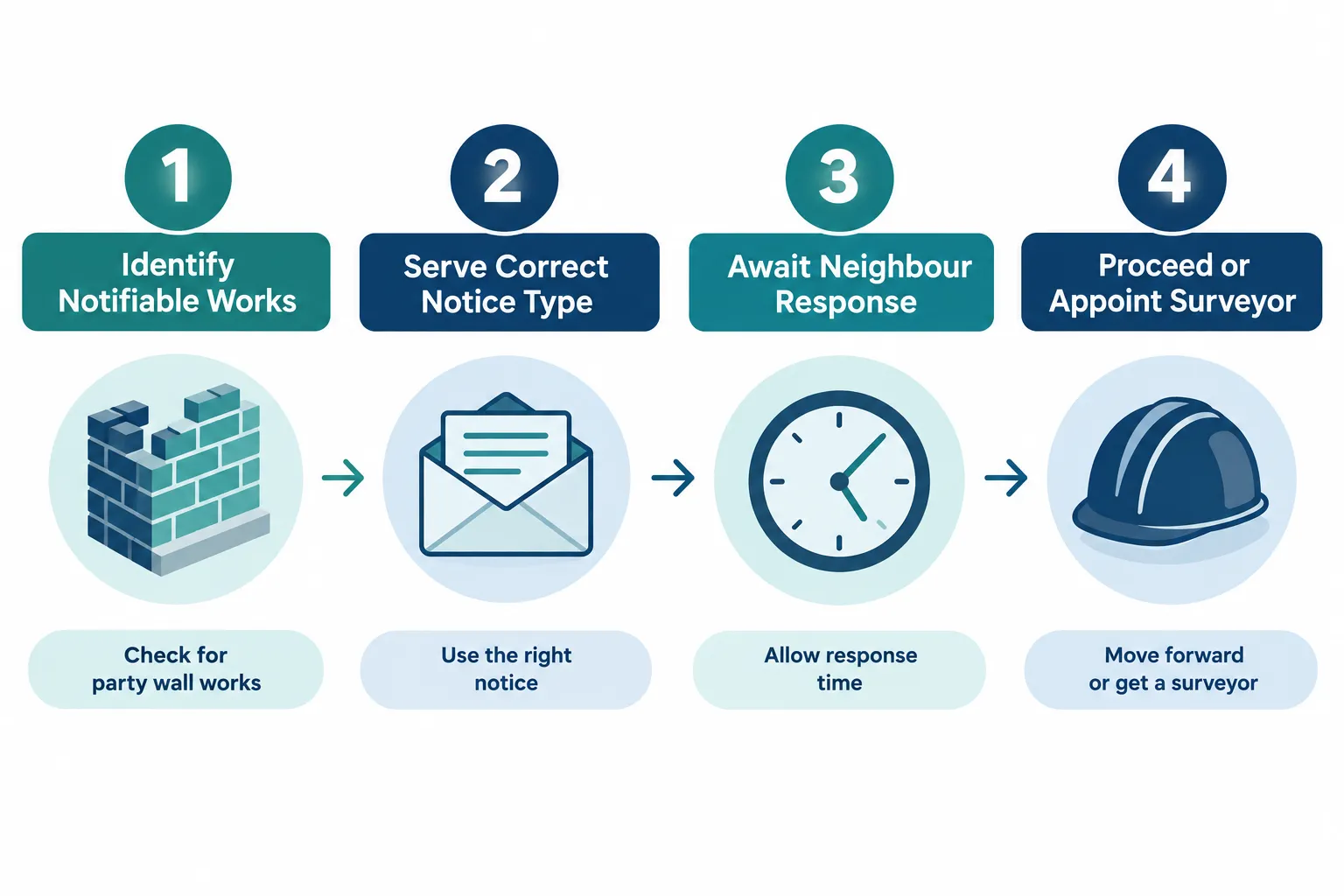
    1. Identify which sections of the Act apply to your specific works (rear extension, side-return, loft steels, basement dig).
    2. Serve notices as soon as drawings are finalised, even before planning permission is granted if timing is tight.
    3. Budget £700-£1,500 per surveyor appointment, more if a dispute is likely.
    4. Build the full one-to-three month notice window into your contractor start date.
    5. Commission a schedule of condition before work begins to protect against later disputes.

    What This Means in Practice for Commissioning a Survey or Valuation

    For anyone commissioning a party wall survey or valuation this November, the practical takeaway is to move early and budget realistically given current market conditions. With Bank Rate at 4% and mortgage rates near 6% (AJ Bell), financing costs are higher, and with contractor demand shifting as fewer people move, timing your notice-serving correctly protects both your build schedule and your budget.

    • Get a schedule of condition survey booked as soon as notices are served, not after the response deadline.
    • Ask your surveyor to confirm which Act sections apply before finalising drawings, this avoids redesigning after notice is served.
    • Factor surveyor fees into your overall extension budget alongside building costs, not as a separate afterthought.

    Practical Checklist

    • Confirm which Party Wall Act sections apply to your project.
    • Serve notices at least two months before your intended start date for Section 2 works.
    • Keep written records of all notices and responses.
    • Commission a schedule of condition before any work starts.
    • Budget £700-£4,000+ for surveyor fees depending on dispute risk.
    • Don’t start work until the notice period has fully expired and any dispute is resolved.

    FAQ

    Do I need a party wall notice for a loft conversion? Usually yes, if steel beams rest on or within a party wall, this falls under Section 2 and requires two months’ notice.

    How much notice do I need to give for excavation work? One month’s notice is required under Section 6 for excavation within 3 or 6 metres of a neighbouring building, depending on depth and angle.

    Can my neighbour refuse to let me extend? A neighbour can’t stop lawful work outright, but they can dispute the details, triggering the formal surveyor and award process under the Act.

    Who pays for the party wall surveyor? The building owner usually pays reasonable fees for both their own and the neighbour’s surveyor, as set out in the Act.

    What happens if I start work without serving notice? You risk a court injunction stopping the build and potential liability for damage, even without negligence.

    Is extending definitely cheaper than moving in November 2026? Not always, but with London prices down 1% annually (Zoopla) and mortgage rates near 6% (AJ Bell), extending avoids stamp duty, agency fees, and selling into a slow market.

    Conclusion

    Extending rather than moving is a reasonable option for many London homeowners this November, given a 1% annual price fall in London (Zoopla), a base rate rise to 4% (Bank of England), and mortgage rates sitting near 6% (AJ Bell). But the financial logic only holds if the party wall process is handled properly from the start. Serve notices early, confirm which sections of the Party Wall etc. Act 1996 apply to your specific works, and budget surveyor fees as a fixed project cost. Speak to a specialist party wall surveyor before finalising your drawings, so your notice timeline runs alongside your planning and contractor bookings rather than behind them.

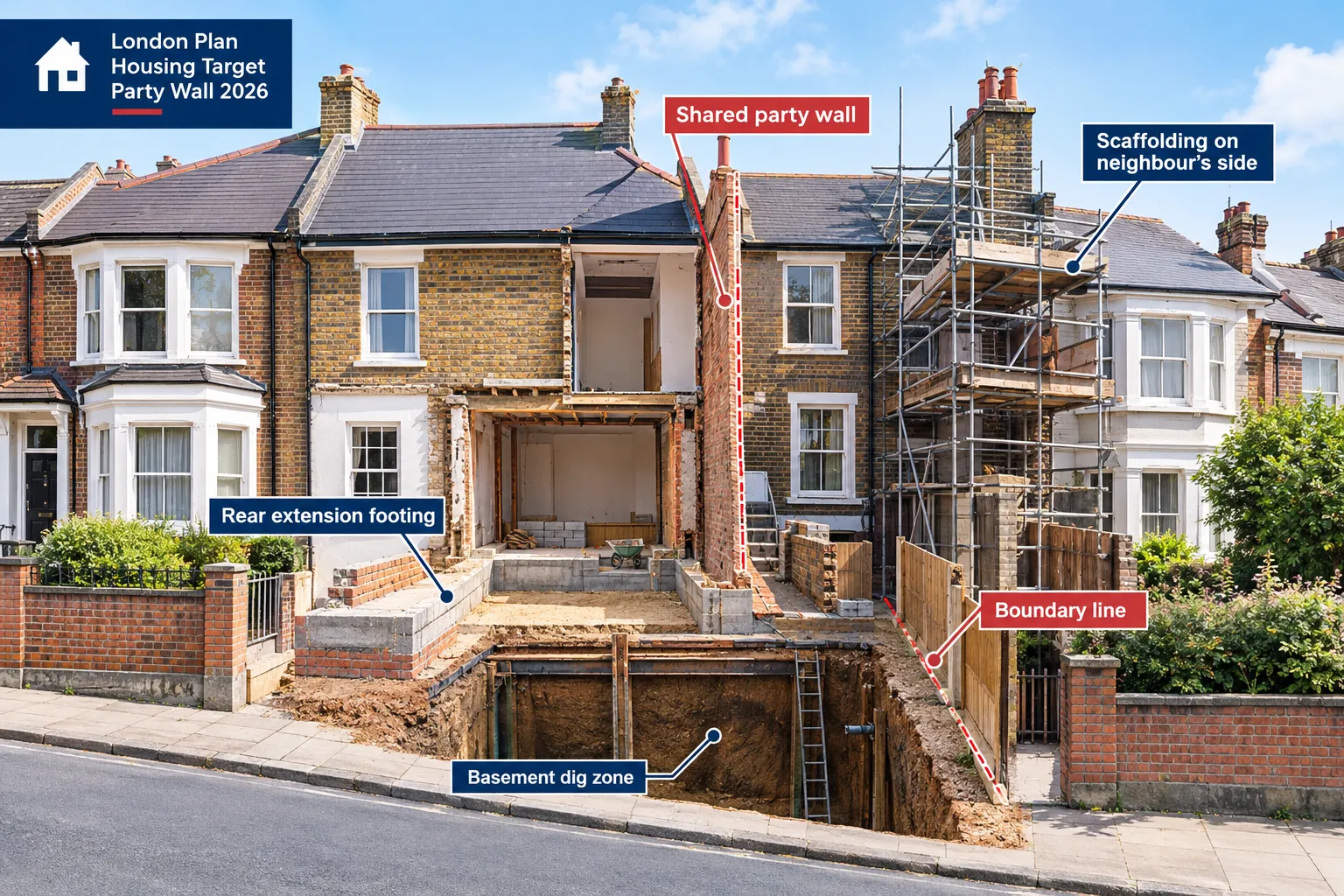
  • London Plan Housing Target Party Wall 2026: Why Denser Building Means More Notices

    London Plan Housing Target Party Wall 2026: Why Denser Building Means More Notices

    Six hundred thousand homes short. That is the gap between what London’s draft spatial strategy promises and what the government says the capital actually needs. On 15 October 2026, the consultation on the new London Plan closed with a proposed target of 558,000 homes over the decade to 2037, a figure 38% lower than the number floated in last year’s consultation, and barely two-thirds of the 850,000 homes London has been assessed as needing in the same period.

    For anyone who owns, extends, or lives next to a property in London, this is not an abstract planning statistic. Whatever number the Greater London Authority finally adopts, the practical reality is the same: London has almost no greenfield land left, so new homes will overwhelmingly come from building up, down, and into existing structures. That means the London Plan housing target party wall 2026 conversation is really a conversation about scaffolding, shared walls, and the legal notices that must accompany them.

    Key Takeaways

    • The draft London Plan sets a target of 558,000 homes to 2037, against an assessed need of 850,000, a shortfall campaigners call “materially below identified need.”
    • RE:UK and Propertymark both want firmer, more deliverable targets; the debate centres on ambition versus practicality.
    • Because London has little spare land, most new housing will come from densification: extensions, basement digs, upward additions, and office conversions.
    • Nearly all of these projects trigger the Party Wall etc. Act 1996, meaning a surge in notices under sections 1, 2 and 6.
    • Rising borrowing costs (five-year fixed mortgage rates near 6% in October 2026) make getting party wall procedure right the first time even more important for project budgets.

    The London Plan Housing Target Party Wall 2026 Debate, Explained

    The numbers at the centre of this row are stark. The draft plan put forward 558,000 homes across ten years. That is well below the 850,000 figure the government’s own assessment says London requires to meet demand from population growth, overcrowding, and affordability pressure. It is also a steep retreat from the ambition shown in the prior year’s consultation draft.

    The London Plan Housing Target Party Wall 2026 Debate, Explained

    Sam Bensted, assistant director at RE:UK, summed up the criticism directly: “However, when it comes to housing, the plan does not go far enough.” Bensted argued the GLA “must be more ambitious” in setting out how homes will actually get delivered locally, warning that a watered-down London target risks becoming “an unhelpful precedent” for other regional spatial strategies across England.

    Propertymark took a more measured position on 13 October 2026, backing the draft plan’s housing targets in principle but pushing for a more practical, realistic delivery route rather than a higher number on paper. The tension between those two positions, ambition versus deliverability, is likely to shape how the final adopted plan treats brownfield release, density standards, and estate renewal policy over the coming months.

    Why Density, Not Greenfield Land, Will Deliver London’s Homes

    Regardless of whether the final figure lands closer to 558,000 or edges toward the higher need assessment, London cannot sprawl its way to more housing. The capital’s growth boundary and green belt protections mean almost every additional home has to be squeezed out of land already built on. In practice, that takes several recognisable forms:

    • Loft and roof extensions adding storeys to existing terraces and semis.
    • Basement excavations digging down to add living space beneath existing footprints.
    • Rear and side infill extensions that push closer to boundary lines with neighbouring properties.
    • Office-to-residential conversions, such as the reported plan to turn the 90,962 sq ft Griffin House office in Hammersmith into studio apartments following a £46.1 million, 18-month loan from Atelier arranged through Sheen Lane.
    • Mixed residential-logistics schemes, like the revised Fulham riverside scheme that recently gained approval for 37 additional homes, taking its total to 313.
    • Estate regeneration, where existing blocks are redeveloped at higher density on the same footprint.

    Every one of these routes to new homes shares a common legal trigger: work close to, on, or above a boundary with a neighbouring property almost always falls under the Party Wall etc. Act 1996.

    How the Party Wall Act Responds to London’s Density Push

    The Party Wall etc. Act 1996 was not written with a housing crisis in mind, but it has become the quiet mechanism that governs nearly every densification project in London. Three sections matter most:

    Section 1 covers new walls built at or astride a boundary line, relevant to infill extensions and estate regeneration schemes that push buildings closer together.

    Section 2 applies to work on an existing shared wall itself, cutting in beams, raising its height for a loft extension, underpinning it, or demolishing and rebuilding it as part of an office-to-residential conversion.

    Section 6 covers excavation within 3 metres of a neighbouring structure where the dig goes below its foundations, or within 6 metres where a line drawn at 45 degrees from the base of the neighbour’s foundation would be cut, the section that catches almost every basement conversion.

    "When it comes to housing, the plan does not go far enough", Sam Bensted, RE:UK, on the draft London Plan's 558,000-home target.

    What Building Owners Must Serve Under the London Plan Housing Target Party Wall 2026 Rules

    Anyone carrying out notifiable work is the “building owner” under the Act, regardless of how modest the project is. The core obligations are straightforward but easy to get wrong:

    What Building Owners Must Serve Under the London Plan Housing Target Party Wall 2026 Rules
    1. Serve the correct notice type, a Party Structure Notice for Section 2 works, a Line of Junction Notice for Section 1, or an Excavation Notice for Section 6.
    2. Give proper notice periods, two months for most party structure and line of junction works, one month for excavation notices.
    3. Describe the works accurately, including drawings where the scope is substantial, such as basement digs or upward extensions.
    4. Respond to a schedule of condition request, which records the pre-existing state of the adjoining property to prevent later disputes over cracks or damage.
    5. Provide security for expenses if requested, particularly for larger basement or structural schemes where risk to the neighbouring property is higher.

    What Adjoining Owners Can Expect

    Neighbours on the receiving end of a notice have real rights, not just a courtesy heads-up. They can consent to the works, dissent and require a party wall award, or appoint their own surveyor if they are uneasy relying on an “agreed surveyor” shared with the building owner. They are also entitled to a schedule of condition survey before work starts, giving them documented protection if damage occurs during the build.

    With borrowing costs rising, five-year fixed mortgage rates reached around 6% in early October 2026, according to Moneyfacts, both sides have a stronger financial incentive to avoid delay. A dispute that drags out the party wall award process can stall a build programme for weeks, adding real cost to projects already squeezed by tighter lending conditions.

    Timescales That Matter for Dense London Schemes

    Notice type Minimum notice period Typical trigger
    Party Structure Notice (Section 2) 2 months Loft conversions, wall alterations
    Line of Junction Notice (Section 1) 1 month New boundary walls, infill extensions
    Excavation Notice (Section 6) 1 month Basement digs, deep foundations

    These periods run from service of a valid notice, not from when work is scheduled to start, a detail that regularly catches out building owners working to tight contractor availability.

    Frequently Asked Questions

    Does the London Plan housing target directly change party wall law? No. The Party Wall etc. Act 1996 is separate national legislation. The London Plan sets planning policy and density targets; it does not alter notice periods, surveyor appointment rules, or the Act’s scope.

    Will more homes under any adopted target mean more party wall disputes? Likely yes. Higher density means more shared walls, more basement digs, and more upward extensions near boundaries, all of which increase the volume of notifiable work across London.

    Is planning permission the same as party wall consent? No. Planning permission addresses land use and design; party wall consent addresses physical impact on a neighbouring structure. Both are usually required separately for extensions, conversions, and basement work.

    What happens if a building owner skips serving notice? The adjoining owner can seek an injunction to halt work, and the building owner may be liable for resulting damage without the usual protections an award provides.

    Does office-to-residential conversion trigger the Act? Often yes, particularly where structural alterations touch shared walls or floors adjoining another building, as is likely with large-scale conversions like the Griffin House scheme in Hammersmith.

    Conclusion

    Whatever final figure the GLA settles on after this consultation, the direction of travel is unmistakable: London’s housing future depends on building into, over, and under existing structures rather than outward onto new land. That reality puts the Party Wall etc. Act 1996 at the centre of the capital’s housing delivery story, not at its margins.

    Building owners planning an extension, basement, or conversion should start the party wall process early, well before contractors are booked, to avoid the notice periods delaying a tight build schedule. Adjoining owners should request a schedule of condition as a matter of course and understand their right to an independent surveyor. In a market defined by the London Plan housing target party wall 2026 debate and tightening finance costs, getting the legal groundwork right from day one protects budgets, timelines, and neighbourly relations alike.

  • Extensions and Loft Conversions: Party Wall Notice, Agreement and Award Requirements Explained

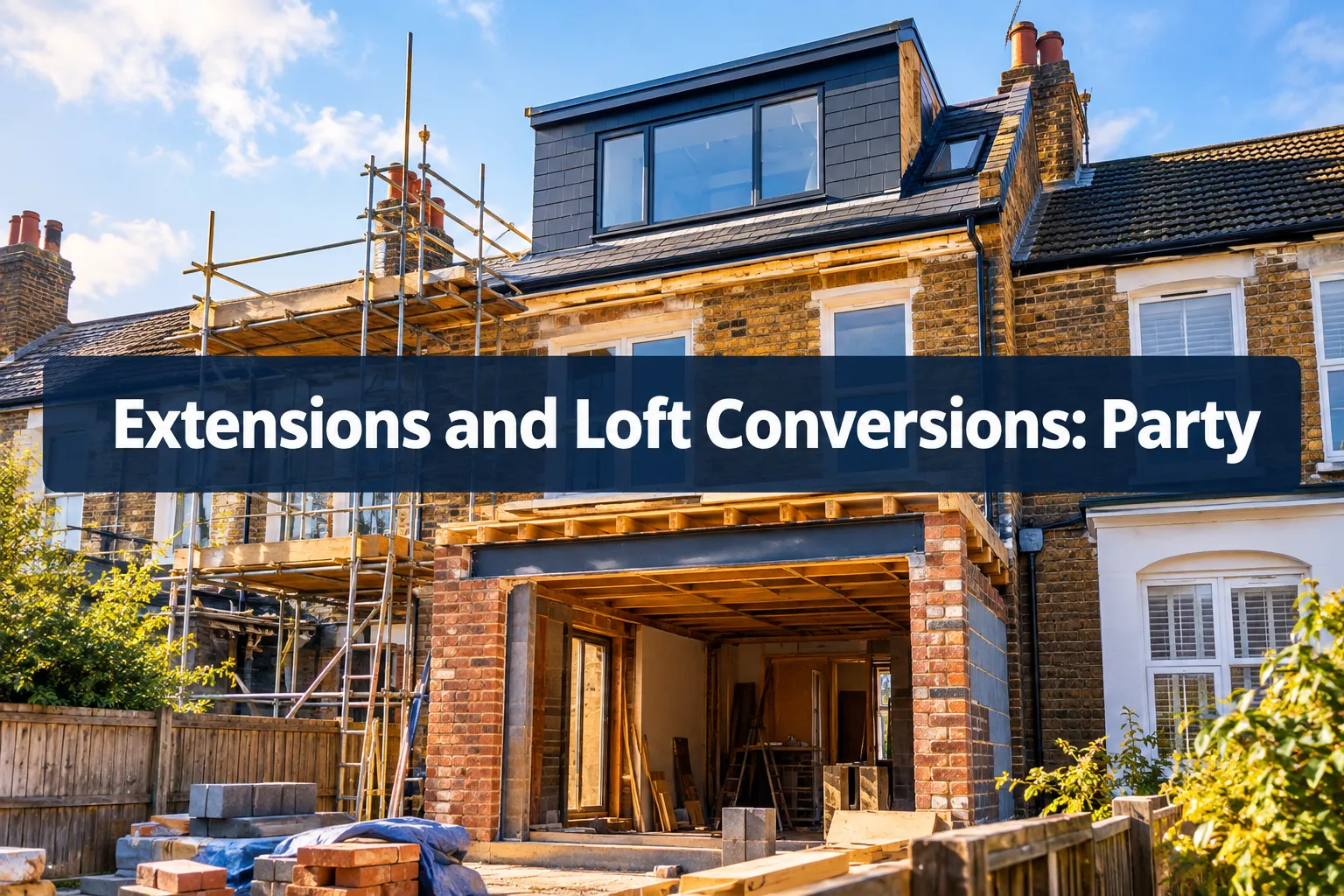
    Extensions and Loft Conversions: Party Wall Notice, Agreement and Award Requirements Explained

    Nearly 40% of homeowners who carry out extensions or loft conversions in England and Wales fail to serve the correct party wall notices before work begins, a costly oversight that can halt construction, trigger legal disputes, and expose building owners to compensation claims. Understanding the full scope of Extensions and Loft Conversions: Party Wall Notice, Agreement and Award Requirements Explained is not optional; it is a legal duty under the Party Wall etc. Act 1996 [7].

    Whether a homeowner is adding a rear extension to a London terrace or converting a loft in a semi-detached property, the Act imposes clear obligations on the “building owner” (the person carrying out the works). Permitted development rights allow certain works without planning permission, but they do not remove party wall duties, a distinction that continues to catch homeowners off guard [5][6].

    Key Takeaways

    • The Party Wall etc. Act 1996 applies to extensions and loft conversions that affect shared walls, boundaries, or foundations within defined distances.
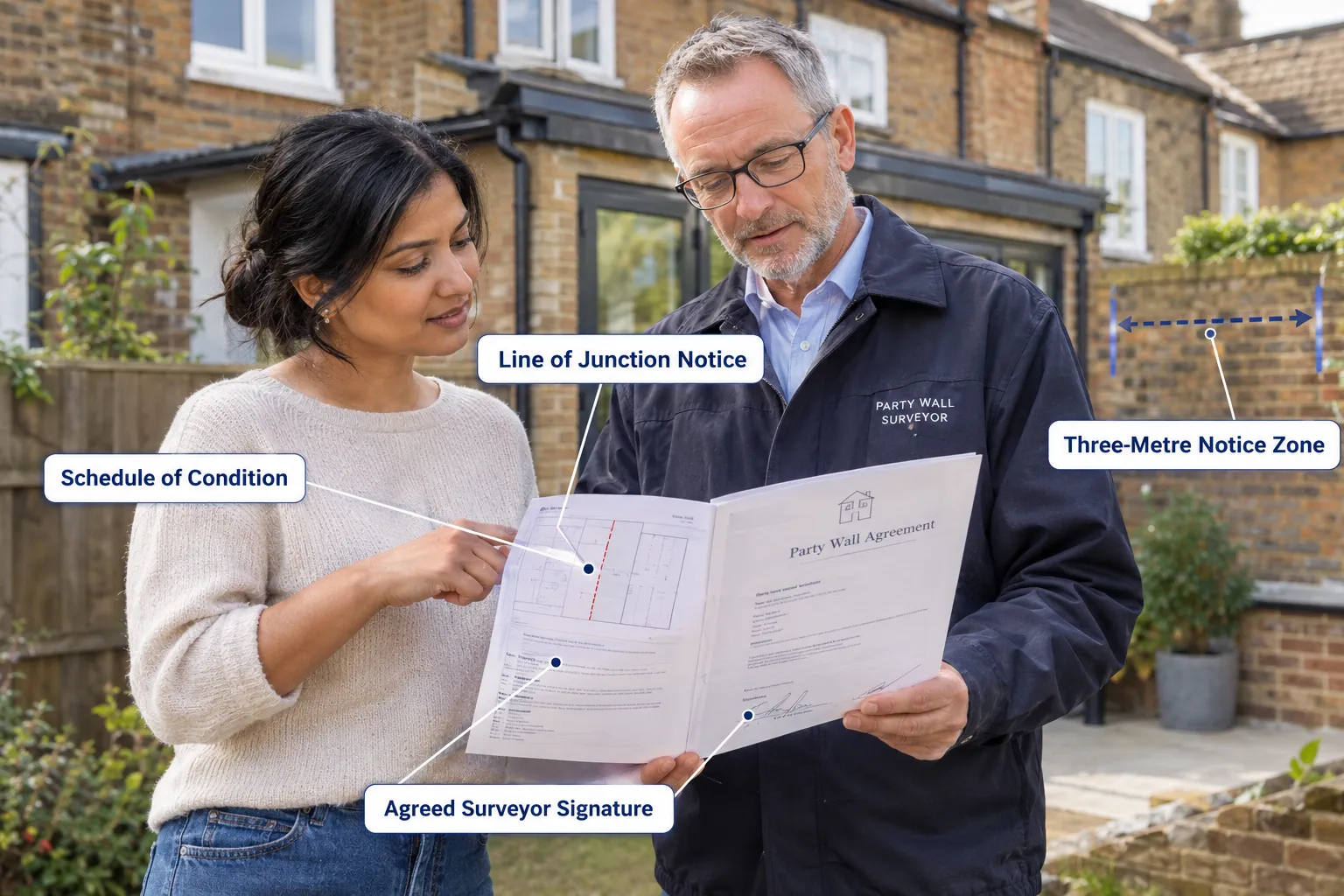
    • Three distinct notice types exist: a Party Structure Notice, a Line of Junction Notice, and a Three/Six Metre Notice, each triggered by different types of work.
    • Neighbours have 14 days to respond to a notice; failure to respond triggers a deemed dispute, requiring surveyor appointment.
    • A Party Wall Award is a legally binding document that governs how works proceed; it is not the same as a party wall agreement.
    • Permitted development rights do not override party wall obligations, both sets of rules apply independently.

    What the Party Wall etc. Act 1996 Actually Covers

    The Party Wall etc. Act 1996 is the sole statutory framework governing works to shared walls, boundary structures, and foundations in England and Wales. It applies to three categories of work, each governed by a different notice type:

    1. Works to an existing party wall or party structure (Section 2), cutting into, raising, underpinning, or inserting beams into a shared wall.
    2. New building at or on the boundary line (Section 1), erecting a new wall astride or adjacent to the boundary.
    3. Excavation near a neighbouring building (Section 6), digging foundations within 3 metres of a neighbour’s structure to a depth below their foundations, or within 6 metres under a 45-degree line.

    For extensions and loft conversions, all three categories can be triggered simultaneously. A rear extension, for example, may involve new foundations close to the boundary (Section 6), a new wall on the boundary (Section 1), and structural work to the existing shared wall (Section 2) [1].

    “Permitted development rights and party wall obligations are entirely separate legal regimes. Having one does not substitute for the other.” [5]

    What the Party Wall etc. Act 1996 Actually Covers

    When Loft Conversions Trigger Party Wall Obligations

    Loft conversions are among the most commonly misunderstood works in relation to party wall law. Many homeowners assume that because the works are “internal,” no notice is required. This is incorrect.

    The following loft conversion activities are almost always notifiable under the Act [10]:

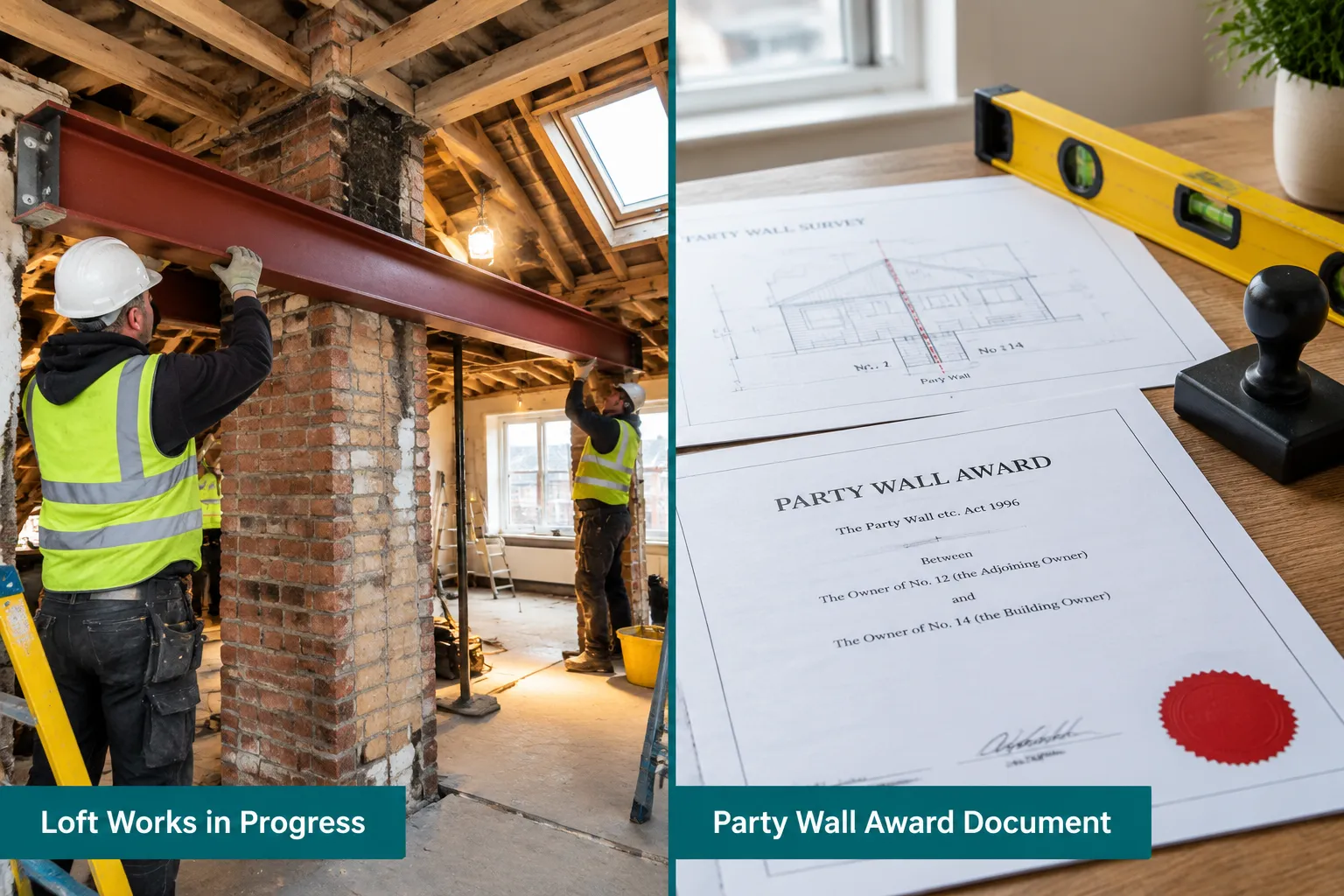
    • Installing steel RSJ beams that bear on or are built into a party wall
    • Raising the height of a party wall to accommodate a new roof structure
    • Cutting into the party wall to form a new structural connection
    • Inserting padstones or bearing plates into the shared wall
    • Underpinning the party wall as part of structural alterations

    In a typical London Victorian terrace, the party wall runs along the full depth of the property. Any loft conversion involving a steel beam spanning across the party wall, which is standard practice, will require a Party Structure Notice to be served on the adjoining owner before work begins [2].

    Extensions and Loft Conversions: Party Wall Notice Types and Timeframes

    Understanding which notice applies to which works is central to Extensions and Loft Conversions: Party Wall Notice, Agreement and Award Requirements Explained. Serving the wrong notice type, or no notice at all, does not make the works lawful; it simply means the building owner is proceeding without statutory protection.

    Notice Type Relevant Section Typical Trigger Minimum Notice Period
    Party Structure Notice Section 2 Steel beams in party wall, raising, cutting 2 months
    Line of Junction Notice Section 1 New wall on or at the boundary 1 month
    Three/Six Metre Notice Section 6 Excavation near neighbour’s foundations 1 month

    How to Serve a Valid Party Wall Notice

    The government’s official guidance on preventing and resolving party wall disputes sets out the minimum content requirements for a valid notice [7]. A notice must include:

    • The name and address of the building owner
    • The address of the property where works will take place
    • A description of the proposed works
    • The proposed start date
    • A statement that it is served under the relevant section of the Party Wall etc. Act 1996

    Notices must be served on every adjoining owner, which includes all registered proprietors of the neighbouring property. In a block of flats, this can mean serving multiple notices on different leaseholders and the freeholder. For a comprehensive overview of how party wall notices work and what they must contain, practitioners and homeowners should review the full statutory requirements carefully.

    What Happens After a Notice Is Served

    Once a valid notice is served, the adjoining owner has 14 days to respond in writing. Three outcomes are possible:

    1. Consent in writing, works may proceed after the notice period expires; no award is needed.
    2. Counter-notice (under Section 2 only), the adjoining owner requests additional works or modifications.
    3. Dissent or no response, a dispute is deemed to have arisen, triggering the surveyor appointment process.

    If no response is received within 14 days, the Act deems a dispute to exist automatically. At that point, both parties must appoint surveyors, either an agreed single surveyor or one each, to produce a Party Wall Award [6].

    For a detailed breakdown of how to respond to a notice as an adjoining owner, the guide on Party Wall Act notices, what they are and how to respond provides practical step-by-step guidance.

    What Happens After a Notice Is Served

    Party Wall Agreements and Awards: The Critical Distinction

    One of the most persistent sources of confusion in Extensions and Loft Conversions: Party Wall Notice, Agreement and Award Requirements Explained is the difference between a party wall agreement and a party wall award. These are not interchangeable terms.

    A party wall agreement is an informal, consensual arrangement between neighbours. It is not produced by surveyors and carries no statutory force beyond what the parties agree. It is only valid where both owners consent to the works without dispute.

    A party wall award is a formal, legally binding document produced by appointed surveyor(s) under the Act. It sets out:

    • The works permitted and how they must be carried out
    • The hours during which works may take place
    • Access rights for the building owner
    • A schedule of condition of the adjoining property (before works begin)
    • Provisions for making good any damage caused
    • Who bears the costs of the award

    The award is enforceable in the county court. Either party may appeal it within 14 days of service, but the works may proceed while an appeal is pending unless the court orders otherwise [7].

    For a thorough explanation of what a party wall award contains and how it is structured, the party wall awards resource provides authoritative detail. Homeowners who want to understand the template format before engaging surveyors may also find the party wall contract template guide on party wall awards a useful starting point.

    Can Homeowners Proceed Without a Surveyor?

    In some circumstances, where both parties consent and the works are straightforward, it is possible to document the agreement without appointing a surveyor. However, this approach carries significant risk, particularly for loft conversions involving structural works to a shared wall. Without a schedule of condition, there is no baseline record of the neighbouring property’s pre-works state, which makes resolving any damage claims extremely difficult [10].

    For homeowners exploring this route, the guide on having a party wall agreement without a surveyor outlines both the process and the risks involved.

    Practical Scenarios: London Terraces and Semi-Detached Properties

    The following scenarios illustrate how party wall obligations play out in the most common residential contexts in London.

    Scenario 1: Rear Extension on a Victorian Terrace

    A homeowner in North London plans a single-storey rear extension with new strip foundations extending 1.2 metres below ground level. The neighbouring property’s foundations are at 0.9 metres. Because the new foundations will be deeper than the neighbour’s within 3 metres, a Three Metre Notice under Section 6 is required. If the new side wall is to be built astride the boundary, a Line of Junction Notice under Section 1 is also needed. Both notices must be served at least one month before work starts [1].

    A party wall surveyor in North London can advise on the specific notice requirements based on the structural drawings.

    Scenario 2: Loft Conversion on a Semi-Detached Property

    A homeowner in South London is converting a loft with a hip-to-gable extension. The works involve:

    • Raising the party wall gable by 600mm
    • Installing two steel RSJ beams bearing on the party wall
    • Cutting pockets into the party wall for padstones

    All three elements require a Party Structure Notice under Section 2, served at least two months before work begins. If the neighbour dissents or fails to respond within 14 days, surveyors must be appointed and an award produced before any structural work to the party wall can commence [2][10].

    A party wall surveyor in South London familiar with the typical construction of Victorian and Edwardian semis can prepare the notice and, if needed, act as agreed surveyor for both parties.

    Scenario 3: Basement Extension Beneath an Extension

    Basement extensions beneath rear additions are increasingly common in London. These almost always trigger Section 6 notices due to the depth of excavation required. In some cases, right to light concerns also arise, particularly where a new extension or raised loft reduces natural light to a neighbouring habitable room [2].

    “Right to light disputes are increasingly being identified during party wall surveys on loft extensions, adding a layer of complexity that surveyors must address proactively.” [2]

    Scenario 3: Basement Extension Beneath an Extension

    Costs, Timeframes, and Common Pitfalls

    Typical Costs

    Party wall surveyor costs vary depending on the complexity of the works and whether one or two surveyors are appointed. As a general guide:

    • Agreed surveyor (both parties): Lower overall cost; typically suitable for straightforward works
    • Two surveyors (one each): Higher cost; the building owner typically bears both fees unless the adjoining owner’s surveyor acts unreasonably
    • Third surveyor: Appointed only if the two party surveyors cannot agree; rarely needed

    For a detailed breakdown of what drives party wall costs and how to manage them, the guide on how to keep party wall costs down offers practical strategies.

    Common Pitfalls to Avoid

    • Serving notice too late: The two-month notice period for Section 2 works is a minimum. Serving notice after works have started is a breach of the Act.
    • Incomplete notice content: A notice that omits the proposed start date or a description of works is invalid and must be re-served, resetting the clock.
    • Failing to identify all adjoining owners: In leasehold properties, both the leaseholder and the freeholder may be “adjoining owners” under the Act.
    • Assuming consent means no award is needed: Consent removes the need for an award, but only if given in writing within the 14-day response period.
    • Ignoring counter-notices: A counter-notice must be responded to within one month; failure to do so can create further delays.

    Forthcoming Changes to Professional Standards

    RICS is currently finalising the 8th edition of its Party Wall Legislation and Procedure guidance, following a formal consultation process [4]. Expert commentary in 2026 suggests the updated guidance will tighten standards on the content and service of notices, and clarify the obligations of surveyors when producing awards for complex structural works such as loft conversions [2][4]. Building owners and their surveyors should monitor these updates, as revised professional standards will influence best practice expectations across the industry.

    Conclusion

    Extensions and loft conversions are among the most significant investments a homeowner can make, and the party wall process is a legal safeguard that protects both the building owner and their neighbours. The core requirements of Extensions and Loft Conversions: Party Wall Notice, Agreement and Award Requirements Explained are clear: identify the correct notice type, serve it within the required timeframe, and respond appropriately to the neighbour’s reply.

    Actionable next steps for homeowners planning works in 2026:

    1. Obtain structural drawings early, party wall obligations cannot be assessed without knowing the depth of foundations and the structural connection to the party wall.
    2. Identify all adjoining owners before serving any notice, including freeholders and leaseholders in leasehold properties.
    3. Serve the correct notice type at least one month (Sections 1 and 6) or two months (Section 2) before the proposed start date.
    4. Do not assume consent, if no written response is received within 14 days, a dispute is deemed to exist and surveyors must be appointed.
    5. Engage a qualified party wall surveyor for any loft conversion involving steel beams, wall raising, or cutting into the party wall, the schedule of condition alone is worth the cost.
    6. Keep costs proportionate by exploring the agreed surveyor route where both parties are cooperative and the works are well-defined.

    The party wall process exists to enable works to proceed, not to prevent them. Approached correctly and early, it protects everyone involved.

    References

    [1] London Party Wall Extensions 2026 Rules Disputes And Neighbour Rights Explained – princesurveyors.co.uk

    [2] Party Wall Surveys For Right To Light Disputes In 2026 Loft Extensions Rics Protocols Post Planning Reforms – princesurveyors.co.uk

    [4] Rics Launches Consultation On Updated Party Wall Practice Guidance – rics.org

    [5] Permitted Development Guide – hoa.org.uk

    [6] Party Wall Agreement – hoa.org.uk

    [7] Preventing And Resolving Disputes In Relation To Party Walls – gov.uk

    [10] Party Wall Agreement Loft Conversion – houseup.co.uk