Looking for expert solutions?
Request a Quote

Tag: loft conversion

  • Energy Independence Bill Brings £30,000 MEES Penalties and an EPC C Deadline of October 2030: Landlord Energy Upgrades and Party Wall Notices in London, November 2026

    {“content”:[]}

    The Energy Independence Bill was introduced to Parliament on 4 November 2026, carrying a proposed maximum civil penalty of £30,000 for landlords who breach Minimum Energy Efficiency Standards (MEES) and confirming that privately rented homes in England and Wales must reach EPC C by 1 October 2030 unless exempt [1][2]. For owners of London terraces and converted flats, the question of landlord energy upgrades and party wall notices in November 2026 is now practical: several common retrofit measures touch a shared wall or boundary, and under the Party Wall etc. Act 1996 that can mean serving notice up to two months before work starts.

    Key Takeaways

    • The Energy Independence Bill, introduced on 4 November 2026, strengthens MEES enforcement and proposes a £30,000 maximum civil penalty for domestic breaches [1][2].
    • Rented homes must reach EPC C by 1 October 2030; the 2028 date for new tenancies has been dropped and the spending cap is now £10,000 per property [1][2].
    • Loft conversions bearing on a party wall, cutting through a party wall for flues or pipes, and excavation within 3m or 6m of a neighbour’s building are the retrofit works most likely to need a notice [3].
    • Section 2 notices need at least two months; section 1 and section 6 notices need at least one month, and a notice is valid for a year [3].
    • A schedule of condition is not required by the Act but is recommended, because without one it can be hard to prove whether damage was caused by the works [3].

    What the Energy Independence Bill changes for London landlords

    The Bill gives local authorities enhanced powers to enforce MEES in domestic and non-domestic private rentals, improves their access to compliance information, and provides a framework to move energy-efficiency schemes to a new Warm Homes Agency [1][4]. Enforcement authorities will have to report the action they take [2].

    The headline figures, according to Propertymark’s 5 November briefing and the GOV.UK factsheet, are [1][2]:

    • A proposed maximum civil penalty of £30,000 for breaches of the domestic regulations.
    • A single compliance date of 1 October 2030 for EPC C, with the earlier 2028 deadline for new tenancies removed.
    • A maximum required investment of £10,000 per property, cut from the £15,000 originally proposed and confirmed on 21 January 2026.
    • An estimated saving of around £210 a year on energy bills for upgraded homes.

    Knight Frank’s research note of 5 November adds that the standard will rest on a new fabric performance metric aligned to current EPC C [5]. The Bill is at the start of its passage, so details may change.

    Propertymark supports the efficiency goal but warns that some landlords may withdraw properties, and wants funding, exemptions, flexibility and tax relief [1]. A Let Compliance analysis reported by The Negotiator on 9 November calculates that a basic-rate landlord keeps £39.75 of every £100 of rent after mortgage interest, tax and compulsory fees [6]; it comes from a compliance-services company, so it is an industry estimate.

    “Many smaller landlords will decide the risk is no longer worth it.”, Erdem Volkan, founder of Let Compliance, quoted by The Negotiator [6]

    Why landlord energy upgrades and party wall notices overlap in November 2026

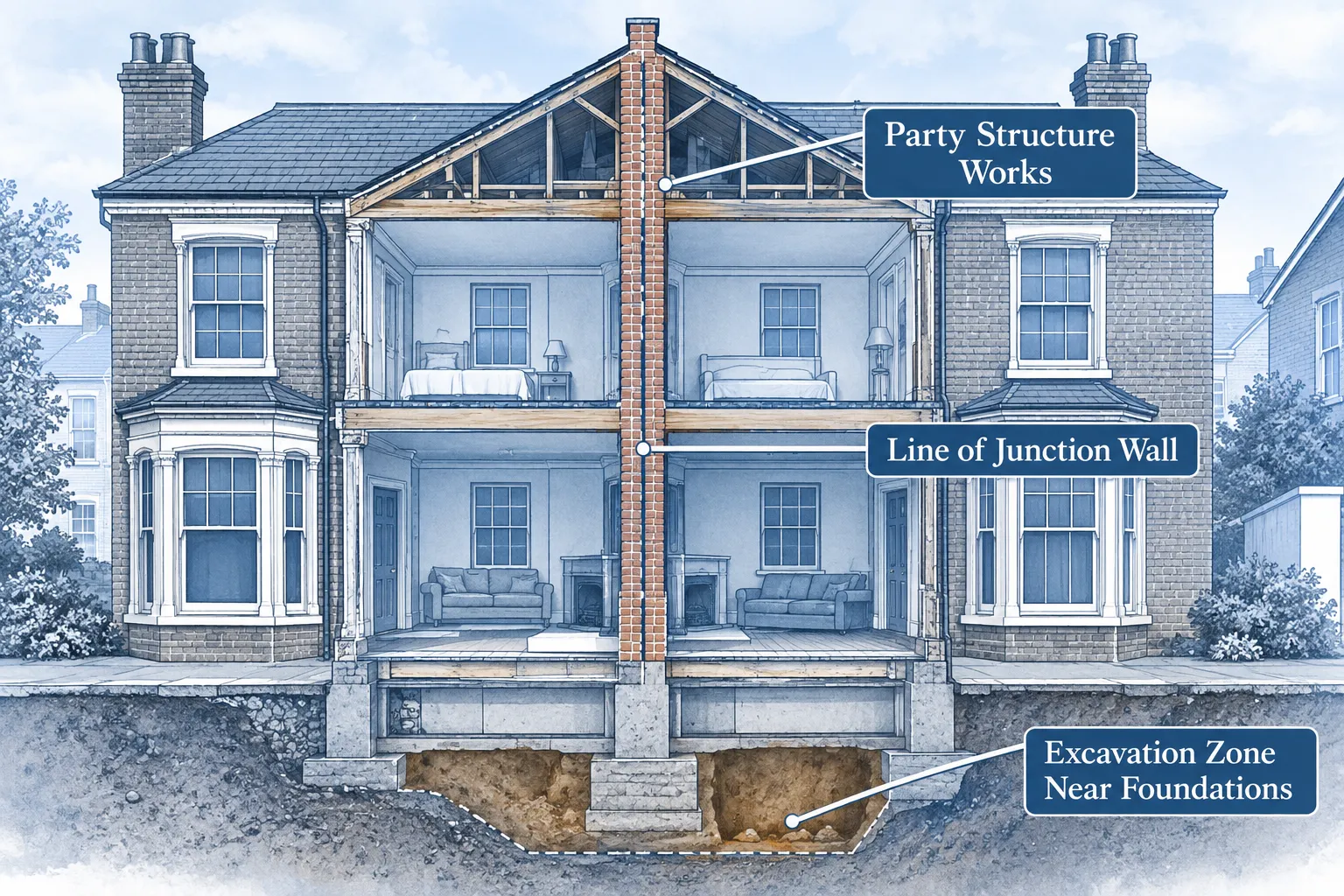
    London’s rental stock is dominated by Victorian and Edwardian terraces, mansion blocks and houses split into flats. In all of these, the wall between two homes is usually a party wall, and in converted houses the floor between flats is a party structure. The Act sits alongside planning and Building Regulations [3].

    Three parts of the Act matter for retrofit work:

    • Section 1: building a new wall on or at the line of junction between two properties.
    • Section 2: works to an existing party wall or party structure, including cutting into it, raising it, underpinning it or inserting a damp proof course.
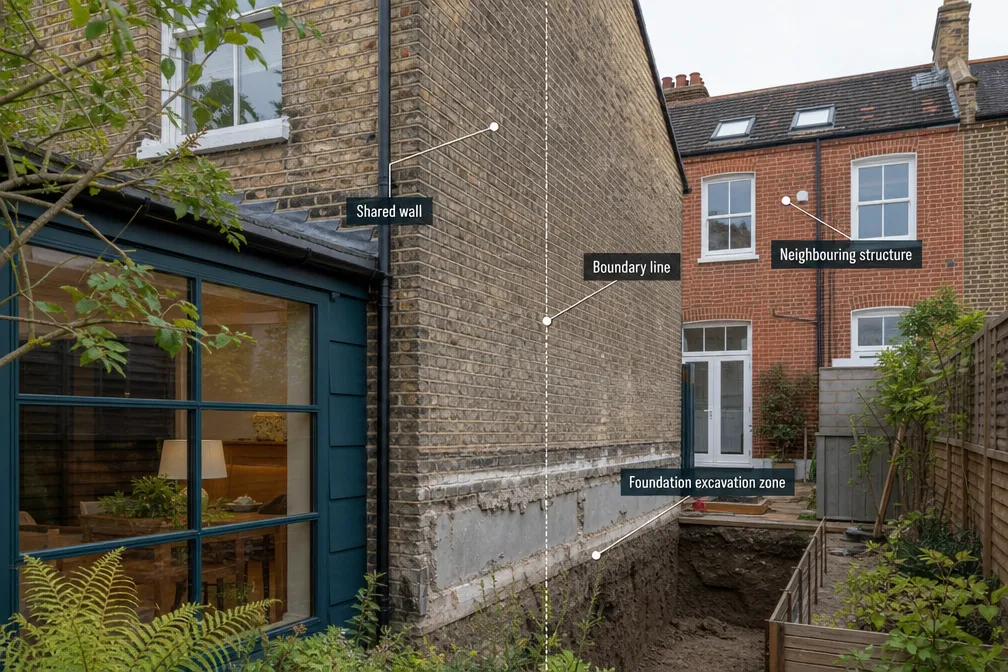
    • Section 6: excavation within 3m of a neighbouring building and deeper than its foundations, or within 6m where it cuts a 45-degree line drawn down from those foundations.

    The GOV.UK explanatory booklet describes the key test as whether the planned work “might have any possible consequences” for the wall’s structural strength or cause damage to the neighbour’s side [3]. The booklet is a general guide, not an authoritative interpretation of the law; the same applies here.

    Which landlord energy upgrades trigger a party wall notice?

    The table sets out common EPC-improving works in London homes and where they usually sit under the Act. Every project differs, so the surveyor should check before notices are drafted.

    Retrofit measure Relevant section Minimum notice
    Loft insulation laid over joists Usually none None
    Loft conversion with beams bearing on, or raising, the party wall Section 2 Two months
    Internal wall insulation fixed to the party wall Possibly section 2, depending on fixings Two months if notifiable
    External wall insulation on an elevation Usually none unless it oversails the boundary Depends
    Core drilling a party wall for a flue, pipe or cable Section 2 Two months
    Air-source heat pump on a shallow pad Usually none; section 6 if within 3m and deeper than neighbour’s foundations One month if notifiable
    Ground-source boreholes or trenches Section 6 where the 3m or 6m rules apply One month
    Solar panels on a shared roof Usually a lease question; check fixings into a party structure Depends

    Loft conversions and loft insulation

    Laying insulation across the loft floor is not work to the party wall and needs no notice. A loft conversion is different. The booklet lists “cutting into a party wall to take the bearing of a beam (e.g. for a loft conversion)” and “raising the height of a party wall” as section 2 works [3]. In a London terrace that usually means two months’ notice to the owners on each side, including freeholders and long leaseholders where the house next door is divided into flats.

    Internal wall insulation on the landlord’s own side

    Internal wall insulation is often the only fabric option for a flat or a terrace in a conservation area. Because the boards sit on the landlord’s side, many owners assume the Act does not apply, which is not always right. The booklet says minor works such as “drilling into a party wall to fix plugs and screws for ordinary wall units or shelving”, cutting in recessed sockets, and removing and replastering generally fall outside the Act [3]. A board system bonded to the plaster may well sit in that category.

    The position changes if the specification calls for deep chasing of services, cutting away masonry, heavy mechanical anchors for a framed system, or alterations around a chimney breast. Those are closer to the “cutting into” works the Act describes. The sensible course is to give the surveyor the installer’s specification before work is priced, and to treat anything that could affect the wall’s strength or the neighbour’s finishes as potentially notifiable.

    External wall insulation at the boundary

    External wall insulation on a front or rear elevation does not usually involve the party wall itself. Difficulties arise at the ends of a terrace or where a flank wall sits on, or close to, the boundary. If the insulation would oversail the neighbour’s land or be fixed into a wall separating two owners’ buildings, the Act or a neighbour’s licence may come into play. A new wall or plinth built on the line of junction falls under section 1, with one month’s notice [3].

    Heat pumps, flues and services

    An air-source heat pump on a concrete pad in a rear garden is rarely a party wall matter because the excavation is shallow. The exception is where the pad or pipe trench is within 3m of a neighbouring building and deeper than its foundations, which can happen beside a lightly founded Victorian outrigger. Ground-source systems are more likely to engage section 6. Running refrigerant pipework, a flue or a condensate drain through a party wall is cutting into the wall and sits under section 2 [3].

    The Government’s U-turn on a blanket gas-boiler ban under the Future Homes Standard, reported by The Negotiator on 10 November, applies to new homes from March 2027, not to retrofit [7]; for existing rented stock the route to EPC C remains fabric first.

    Notice periods, deemed disputes and the party wall award

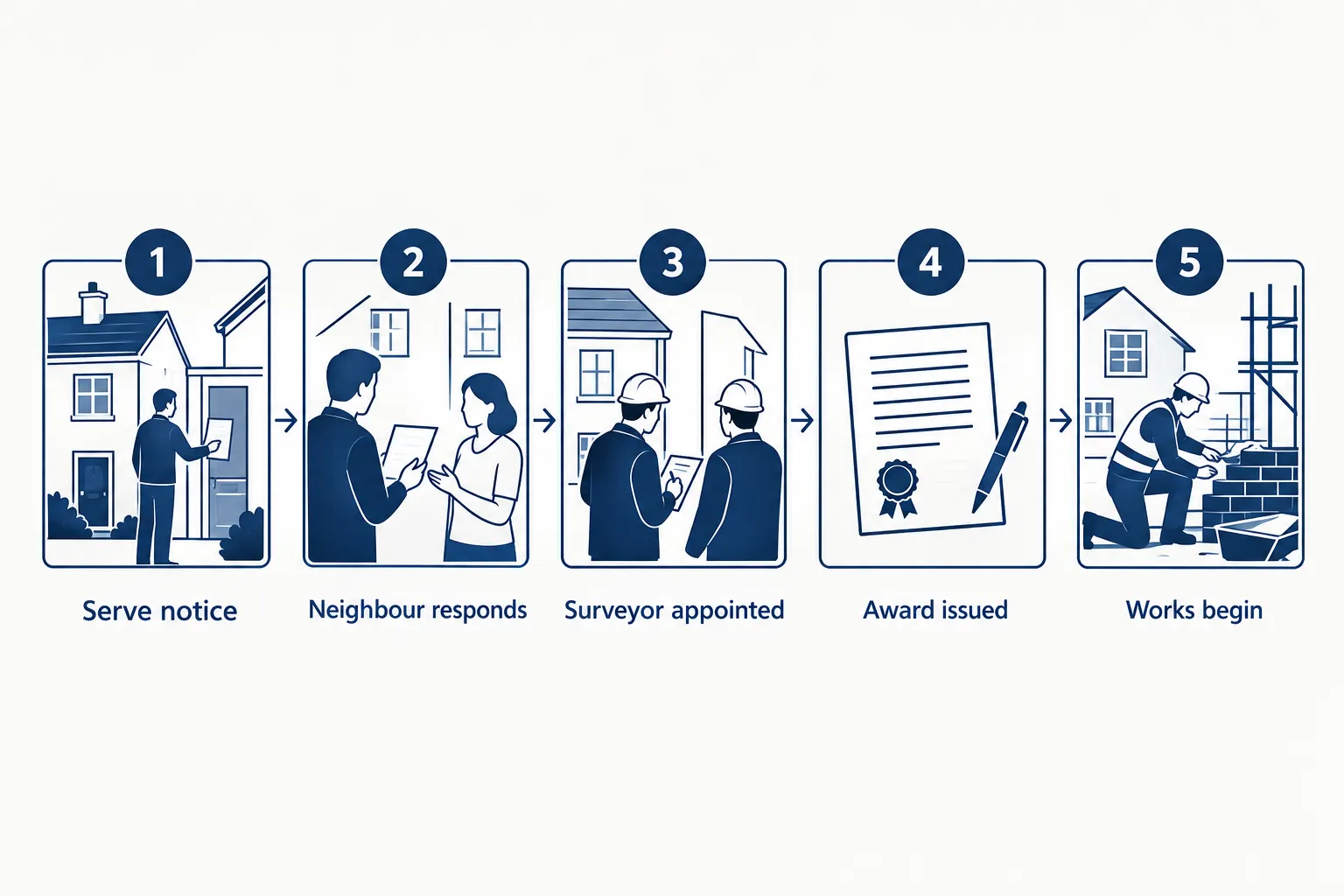
    Timing is the issue most likely to derail a retrofit programme. According to the booklet, a section 2 notice must be served at least two months before the planned start date, and section 1 and section 6 notices at least one month before; a notice is only valid for a year [3]. If an adjoining owner does not reply to a section 2 or section 6 notice within 14 days, a dispute is deemed to have arisen [3].

    Once a dispute exists, the owners either agree on one agreed surveyor or each appoint their own, and the surveyors produce a party wall award setting out what work may be done, when and how, any protective measures, and access for inspection. It is final and binding unless modified or rescinded by a county court on appeal, and each owner has 14 days to appeal [3].

    Schedules of condition and the neighbour relationship

    A schedule of condition records the state of the adjoining property before work starts, usually with photographs and a written description. The booklet notes that it is “not a requirement of the Act” but recommends it, because without one it may be hard to prove whether damage was caused by the works [3]. In London terraces, where cracking in old lime plaster is common, it protects both sides: the building owner is not blamed for pre-existing defects, and the adjoining owner has a clear baseline. For flats, the lease and freeholder consent are separate matters.

    FAQ

    Does laying loft insulation in a rented house need a party wall notice?

    Not normally. Laying insulation across the loft floor is not work to the party wall. A notice becomes relevant if the project also cuts into the party wall for beam bearings or raises it, which the booklet lists as section 2 works needing two months’ notice [3].

    Is internal wall insulation on my side of the party wall notifiable?

    It depends on the fixing method. The booklet treats drilling for plugs and screws, cutting in sockets and replastering as minor works outside the Act [3]. Deep chasing, cutting away masonry or heavy anchoring into the wall may be notifiable, so ask the surveyor to review the installer’s specification first.

    What is the penalty if a rented home misses the EPC C deadline?

    The Energy Independence Bill proposes a maximum civil penalty of £30,000 for breaches of the domestic MEES regulations, with EPC C required from 1 October 2030 unless a valid exemption is registered [1][2]. The Bill is still before Parliament, so figures could change.

    Conclusion

    With EPC C required from 1 October 2030, a £10,000 per-property cap and a proposed £30,000 maximum penalty [1][2], London landlords planning works in November 2026 have roughly four years to insulate, convert and re-heat properties that sit wall-to-wall with their neighbours.

    Practical next steps:

    1. List every rented property below EPC C and the measures the assessor recommends.
    2. Flag any measure that cuts into, fixes heavily to, raises or passes through a party wall or structure, or involves excavation within 3m or 6m of a neighbour’s building.
    3. Serve notices at the design stage, allowing two months for section 2 works and one month for sections 1 and 6.
    4. Commission a schedule of condition before work starts, especially in older terraces.
    5. Watch the Bill’s passage, since the detail may still move.

    Landlords unsure whether a planned retrofit engages the Act can contact Party Wall Surveyor London to speak to an independent RICS-regulated surveyor about notices, awards and schedules of condition across the capital.

    References

    1. Propertymark, “Energy reforms bring tougher penalties for landlords and new support for property upgrades”, Propertymark, 5 November 2026. propertymark.co.uk.
    2. Department for Energy Security and Net Zero, “Energy Independence Bill factsheets: Domestic private rental sector minimum energy efficiency standards enforcement”, GOV.UK, 4 November 2026. gov.uk.
    3. Ministry of Housing, Communities and Local Government, “The Party Wall etc. Act 1996: explanatory booklet”, GOV.UK. gov.uk.
    4. Department for Energy Security and Net Zero, “Energy reforms to cut bills and put power back in people’s hands”, GOV.UK, 4 November 2026. gov.uk.
    5. Flora Harley, “What does the Energy Independence Bill hold?”, Knight Frank Research, 5 November 2026. knightfrank.co.uk.
    6. Myra Butterworth, “Still worth it? Landlords keep only £39.75 of every £100 rent”, The Negotiator, 9 November 2026. thenegotiator.co.uk.
    7. David Callaghan, “Government U-turns on gas boiler ban”, The Negotiator, 10 November 2026. thenegotiator.co.uk.
  • PlanAssist AI Set to Halve Planning Decision Times for Extensions and Loft Conversions: What London Homeowners and Neighbours Need to Know (November 2026)

    {“content”:[]}

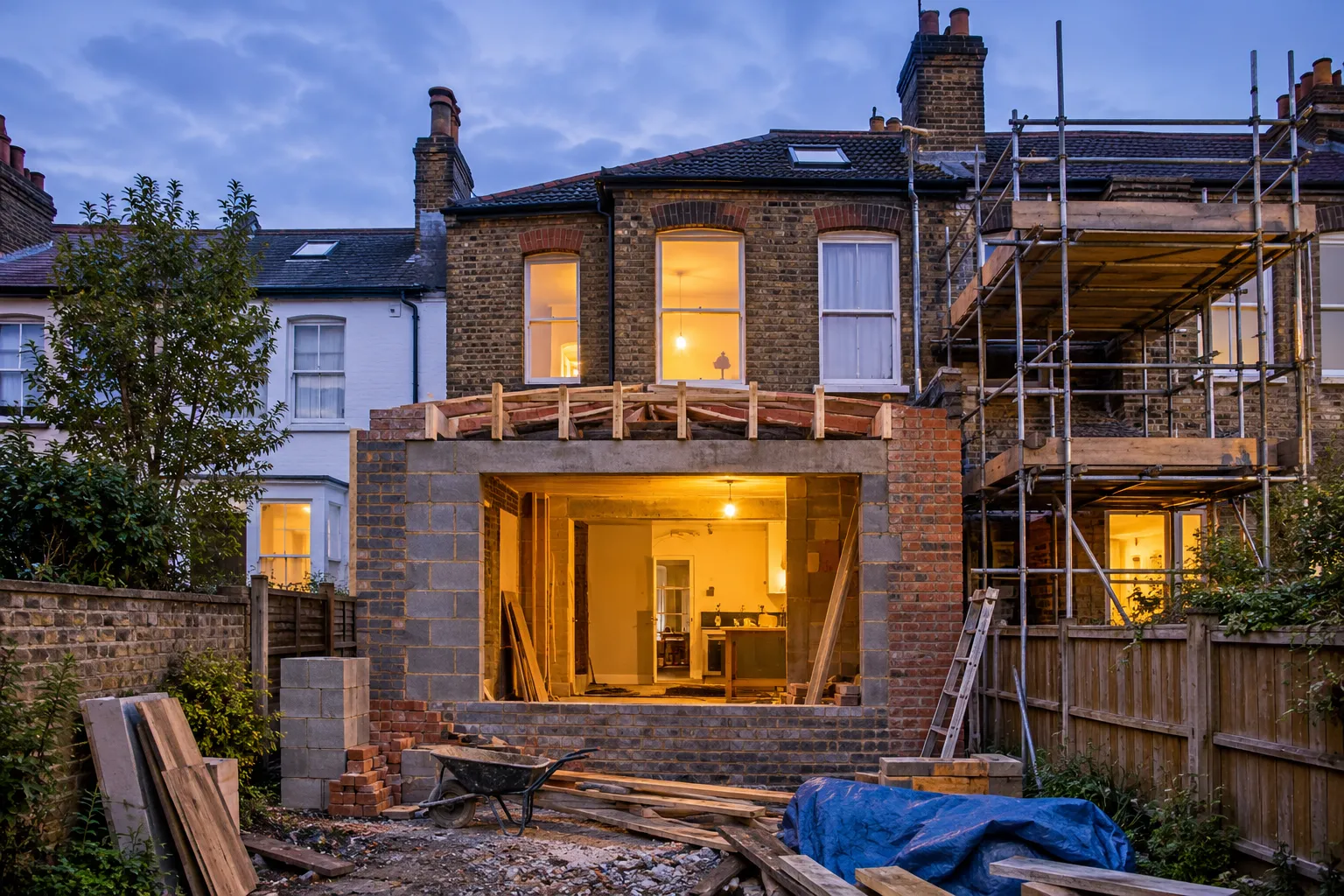
    Eight weeks down to four. That is the change in processing time for routine householder planning applications reported in early testing of the PlanAssist AI planning tool, according to Propertymark’s 5 November 2026 briefing on the government rollout [1]. For London homeowners planning an extension, loft conversion or basement, a faster planning decision sounds like pure good news. For their neighbours, it means the Party Wall etc. Act 1996 timetable arrives sooner than many expect.

    Key Takeaways

    • PlanAssist helps planning officers produce initial assessments of routine applications such as extensions, loft conversions and conservatories; officers still make the final decision [1].
    • Early testing cut time spent on key planning tasks by 58% and halved processing time for routine applications from eight weeks to four [1].
    • The tool was tested with Camden, Barnet and Dorset councils, is expanding to 12 more, and is intended to reach every council in England by the end of 2027 [1].
    • Planning permission and party wall consent are separate. A faster planning decision does not shorten the statutory notice periods under the Party Wall Act.
    • Serving party wall notices early, and agreeing a schedule of condition, protects both the building owner and the adjoining owner.

    What the PlanAssist AI Planning Tool Does

    PlanAssist is a government AI tool designed to help planning officers process routine applications faster. It targets householder projects such as extensions, loft conversions and conservatories, as well as small business property improvements [1].

    The tool combines three inputs to produce an initial assessment [1]:

    1. The planning application itself.
    2. Local planning policies.
    3. Site constraints, such as conservation area status.

    Propertymark quotes the government position that “qualified planning officers will remain responsible for reviewing assessments and making final decisions” [1]. The AI drafts; a human decides.

    PlanAssist AI Planning Tool Rollout: Dates and Councils

    Milestone Detail
    Pilot councils Camden, Barnet and Dorset
    Current expansion 12 further councils
    Linked planning rules New rules in force from 31 October 2026
    National target Every council in England by the end of 2027
    Reported time saving 58% on key planning tasks
    Routine application time Eight weeks to four in testing

    Alongside the rollout, the government has renewed the National Scheme of Delegation and recruited 420 additional planners, in support of its target of 1.5 million homes this Parliament [1]. Two of the three pilot councils, Camden and Barnet, are London boroughs, so parts of the capital are already seeing the effect.

    Propertymark welcomed faster processing for smaller applications but questioned whether similar gains can be achieved on larger developments, and pointed to staffing shortages and financial pressures at local planning authorities [1]. It also notes that the Future Homes and Buildings Standards for new homes take effect from March 2027 [1].

    Why Faster Planning Means Earlier Party Wall Notices

    The PlanAssist AI planning tool changes when a homeowner can start building. It does not change the Party Wall etc. Act 1996. The two processes run in parallel, and the Act’s notice periods are fixed by statute:

    • Works to a party wall or party structure (for example cutting in beams for a loft conversion or raising a shared wall): notice must be served at least two months before the work starts.
    • Excavation within 3 metres or 6 metres of a neighbour’s foundations, depending on depth (typical for rear extensions and basements): notice must be served at least one month before.
    • New walls on the line of junction: notice must be served at least one month before.

    Under the old eight-week planning timeline, a homeowner who served notices on the day of submission would usually have the two-month period run alongside the planning decision. With a four-week decision, the planning permission can arrive before the party wall notice period has ended. Builders are then booked, and the neighbour’s reply becomes the critical path.

    A faster planning decision is only useful if the party wall process keeps pace with it. Serve notices at the design stage, not after the approval letter arrives.

    What Adjoining Owners Should Do When a Notice Arrives

    Neighbours receiving a party wall notice have three options:

    1. Consent in writing within 14 days. Even with consent, a schedule of condition is strongly advisable.
    2. Dissent and appoint a surveyor. The parties may agree a single “agreed surveyor” or each appoint their own.
    3. Do nothing. After 14 days the notice is deemed dissented, and a dispute arises that surveyors must resolve.

    The adjoining owner’s reasonable surveyor costs are normally paid by the building owner. A schedule of condition records cracks, finishes and defects before work starts, so any later damage can be fairly assessed.

    What This Means for London Homeowners

    For a building owner, the practical sequence in late 2026 is:

    • Identify which neighbours are affected as soon as drawings exist.
    • Serve the correct notices early so the two-month or one-month period runs during, not after, the planning process.
    • Appoint a party wall surveyor to prepare the notices, agree the award and record the schedule of condition.
    • Keep neighbours informed, which reduces the chance of dissent.

    A party wall surveyor can serve valid notices, act as agreed surveyor for both sides, prepare the award and schedule of condition, and advise where excavation depth brings the 6-metre rule into play.

    FAQ

    Does PlanAssist approve my extension automatically?

    No. It produces an initial assessment. Propertymark reports that qualified planning officers remain responsible for the final decision [1].

    If planning is granted in four weeks, can I start work straight away?

    Not if the work is notifiable under the Party Wall Act. The statutory notice periods of one or two months still apply, and work cannot lawfully start until consent is given or an award is made.

    Do I need a party wall surveyor for a loft conversion?

    If the loft conversion involves cutting into or raising a party wall, notice is required. A surveyor is needed if the neighbour dissents or fails to respond within 14 days.

    Which London councils use PlanAssist now?

    Camden and Barnet were pilot councils, with Dorset, and the tool is expanding to 12 further councils ahead of national rollout by the end of 2027 [1].

    Conclusion

    The PlanAssist AI planning tool is likely to shorten the wait for permission on extensions and loft conversions across London as the rollout continues through 2027 [1]. The party wall timetable will not shrink with it. Homeowners who serve notices at the design stage, and neighbours who respond promptly and secure a schedule of condition, will be the ones who benefit from the speed.

    Next steps: check whether your project touches a party wall or involves excavation near a neighbour, serve notices early, and appoint a party wall surveyor before the planning decision lands.

    References

    1. Propertymark, “AI tool to speed up planning decisions for homeowners”, 5 November 2026. propertymark.co.uk.
  • £2bn of London Building Work on Hold: FMB Says 35% of Homeowners Can’t Find a Builder They Trust, What It Means for Extensions and Party Wall Notices (November 2026)

    £2bn of London Building Work on Hold: FMB Says 35% of Homeowners Can’t Find a Builder They Trust, What It Means for Extensions and Party Wall Notices (November 2026)

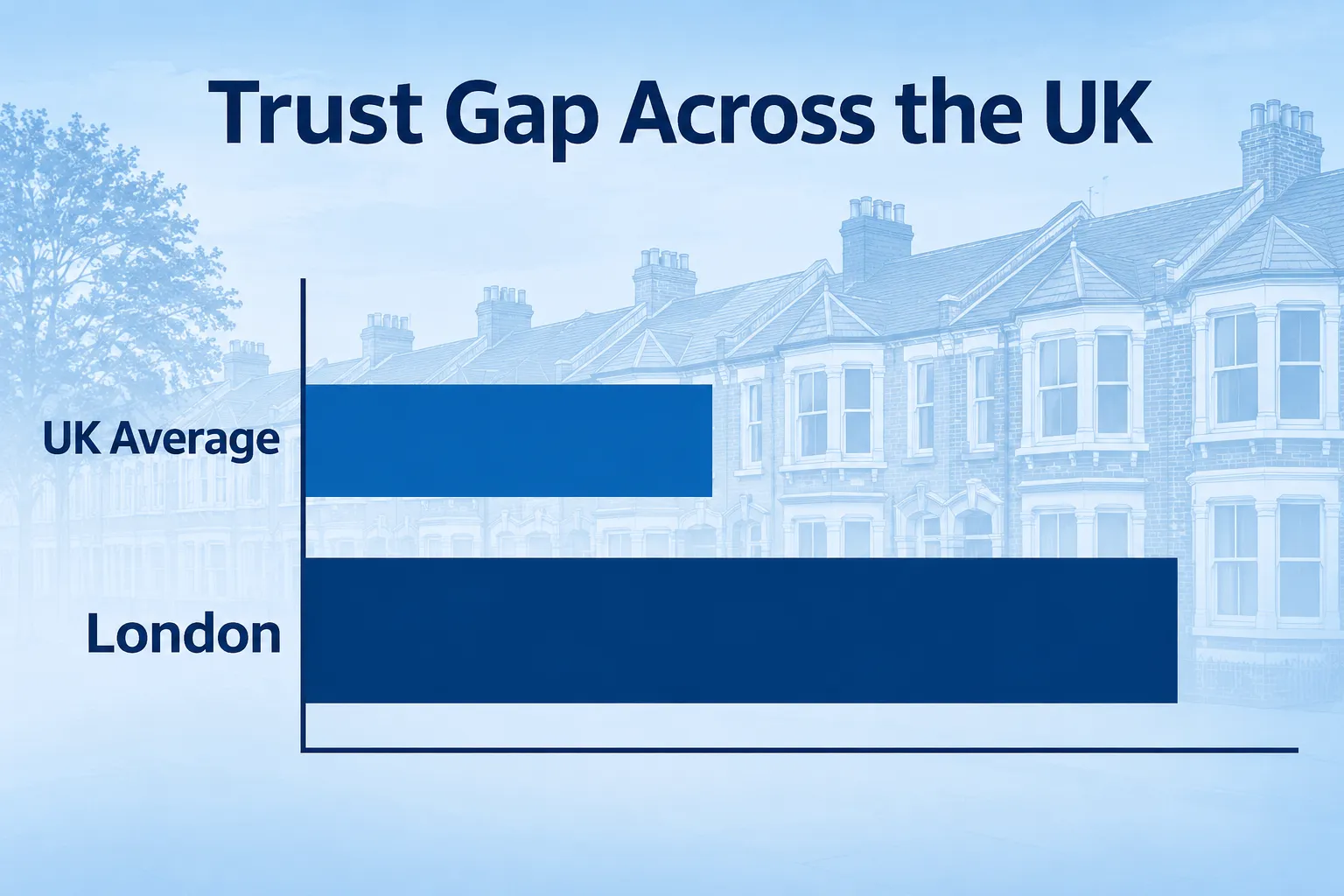
    Thirty-five out of every hundred London homeowners have shelved a home improvement in the past five years simply because they could not find a builder they trust. That is not a vague impression. It is the headline finding from new research published by the Federation of Master Builders (FMB), and it points to a growing bottleneck that is now tangled up with London building work on hold party wall questions for anyone planning an extension, loft conversion, or basement dig.

    The timing matters. The FMB released its findings on 23 October 2026, just five days before the Autumn Budget, clearly aiming to put pressure on ministers to act. For homeowners, the practical question is different: if trustworthy builders are scarce and booked up for months, how do you avoid your project stalling even further once legal notices, neighbour disputes, and scheduling collide?

    Key Takeaways

    • 35% of London homeowners have delayed building work in the last five years because they could not find a trustworthy builder, the highest rate in the UK.
    • Stalled work is worth an estimated £2 billion a year in London alone, part of £11.2 billion nationwide.
    • More than a quarter of homeowners having work done were upgrading electrics, plumbing or heating to keep their homes safe.
    • Rising mortgage rates are pushing more Londoners toward extending rather than moving, adding pressure to an already stretched building trade.
    • Serving party wall notices early, while a reliable builder is still being found, prevents legal delays stacking on top of building delays.

    Why London Building Work on Hold Party Wall Delays Are Piling Up

    London’s trust problem with builders is not evenly spread across the country. According to the FMB, the national average for homeowners delaying work due to lack of trust sits at around one in five. London’s rate of 35% is nearly double that, making it the worst-affected region in the UK.

    Why London Building Work on Hold Party Wall Delays Are Piling Up

    Tom Peardon, FMB London Director, put it bluntly: “London homeowners are the worst affected in the country.” That single line captures why the capital’s housing stock, much of it Victorian and Edwardian terraces sharing party walls, is facing a unique squeeze.

    The £2 billion of delayed work in London is part of a much larger national picture. Across the UK, the FMB puts the figure at £11.2 billion a year. Crucially, this is not all cosmetic spending being postponed. More than a quarter of homeowners having work done were upgrading electrics, plumbing or heating to keep their homes safe, improvements tied directly to safety rather than style.

    The FMB’s asks include:

    • Mandatory licensing of domestic building companies, so homeowners can check credentials before hiring.
    • Faster planning decisions for smaller developers and builders.
    • A UK-wide network of Build Academies to train the next generation of apprentices.

    Until any of that materialises, homeowners are left navigating a market where good builders are rare and in high demand.

    How Rising Mortgage Rates Are Adding Pressure

    There is a second force pushing Londoners toward extending rather than moving. Moneyfacts reported on 4 November 2026 that the average new mortgage rate had reached a three-year high of 5.89%, with the average two-year fixed rate at 5.97%. Moving house now carries a heavier borrowing cost than it did a year or two ago.

    The logical response for many owners is to stay put and improve what they already have: a side-return extension, a loft conversion, a basement dig, or a garden room. That decision adds even more demand onto a building sector already struggling to supply enough trusted labour, which is exactly why London building work on hold party wall issues are becoming more common rather than less.

    Party Wall Notices and London Building Work on Hold: What the Law Actually Requires

    Here is where many projects grind to an unexpected halt. Even once a trustworthy builder is finally booked, the legal clock on party wall matters has its own rules, and ignoring them can stall a project just as effectively as a missing tradesperson.

    Party Wall Notices and London Building Work on Hold: What the Law Actually Requires

    Under the Party Wall etc. Act 1996, which applies in England and Wales, building owners must serve formal notice before:

    Type of work Minimum notice period
    Work to a party wall or party structure 2 months
    Building a new wall at the line of junction 1 month
    Excavating within 3 metres of a neighbour’s structure (to a lower level than its foundations) 1 month
    Excavating within 6 metres where a 45-degree line from the neighbour’s foundations is cut 1 month

    Once a notice is served, the adjoining owner has 14 days to respond. If they dissent, or simply do not respond to a party structure or excavation notice, a dispute is deemed to have arisen automatically. At that point, surveyors are appointed to agree a party wall award before work can proceed. A schedule of condition recording the neighbour’s property is normally carried out before work starts, protecting both sides if damage is later disputed.

    One detail trips up many homeowners: a served notice lapses if work does not begin within 12 months. And the Party Wall Act process is entirely separate from planning permission and Building Regulations approval, so ticking one box does not tick the others.

    “Neighbours should not be left to find out a party wall project is happening when the scaffolding arrives.”

    Serving Notices Early Avoids Compounding Delays

    With good builders booked months in advance, the smartest move is to start the party wall notice process as soon as a project is confirmed, not after a contractor is finally secured. Because the response window and potential award process can take weeks, running it in parallel with the search for a builder, rather than afterward, prevents two separate delays from stacking on top of each other.

    Homeowners should also treat the trust problem the FMB has identified as a reason to vet contractors more carefully, not less. Before signing anything, check:

    • Proof of public liability insurance.
    • References from recent, comparable local jobs.
    • A written contract setting out scope, timescales, and payment stages.

    A trustworthy builder and a properly served party wall notice are two separate safeguards. Skipping either one is how projects stall for months.

    FAQ: London Building Work on Hold Party Wall Questions

    What percentage of London homeowners have delayed building work due to lack of trust in builders? The FMB’s October 2026 research found 35% of London homeowners had put off work in the last five years because they could not find a builder they trust, the highest rate in the UK.

    How much building work is currently on hold in London? The FMB estimates £2 billion a year of building work is delayed in London, part of a £11.2 billion total across the UK.

    Do I need a party wall notice for a loft conversion? If the work affects a shared party wall or structure, a notice is required with at least two months’ notice under the Party Wall etc. Act 1996.

    What happens if my neighbour does not respond to a party wall notice? If there is no response within 14 days to a party structure or excavation notice, a dispute is deemed to have arisen and surveyors are appointed to agree an award.

    Does a party wall notice replace the need for planning permission? No. The Party Wall Act process is entirely separate from planning permission and Building Regulations approval.

    How long does a served party wall notice remain valid? A notice lapses if the work does not begin within 12 months of being served.

    Conclusion

    The FMB’s findings make one thing clear: London’s building trade is under strain, and the trust gap between homeowners and contractors is now large enough to stall £2 billion of work a year. With mortgage rates pushing more owners toward extending rather than moving, demand for reliable builders will likely keep rising faster than supply.

    The practical response is to decouple the two sources of delay. Vet builders thoroughly using insurance checks, references, and written contracts, and start the party wall notice process the moment a project is confirmed rather than waiting for a contractor to be secured. Taking both steps early, rather than sequentially, is the clearest way to keep an extension, loft conversion, or basement project moving instead of joining the backlog.

  • Extend or Move? London October 2026 Party Wall Rules Explained as Sales Slow and Mortgages Bite

    Extend or Move? London October 2026 Party Wall Rules Explained as Sales Slow and Mortgages Bite

    Last updated: October 20, 2026

    Eight percent fewer sales were agreed across Britain in the four weeks to mid-October 2026 than in the same period last year, according to Rightmove’s October House Price Index, published 19 October 2026. In London, where the average asking price now sits at £673,942, homes are taking 78 days to find a buyer. For many homeowners, that arithmetic is tipping the extend-or-move decision firmly towards staying put and building out.

    Quick Answer

    With London sales down 8%, buyer enquiries down 9%, and typical new mortgage costs up roughly £250 a month according to Rightmove’s October 2026 data, extending has become the more attractive option for many London homeowners this autumn. Anyone planning a loft conversion, rear extension or basement dig that touches a shared wall, boundary or nearby foundations needs to understand the Party Wall etc. Act 1996, because skipping notices can delay or derail a project even when the building work itself is straightforward.

    Key Takeaways

    • Agreed sales in Britain fell 8% and buyer enquiries fell 9% in October 2026 versus October 2025 (Rightmove).
    • 38% of London listings have had a price reduction; reduced homes take 119 days to sell versus 39 days for correctly priced ones (Rightmove, October 2026).
    • Rightmove’s average two-year fixed mortgage rate is 5.55%, up from 5.29% a month earlier and 4.25% in February 2026, adding about £250 a month to a typical new mortgage.
    • Tembo reported average two-year and five-year fixed rates near 6% (5.97% and 5.99%) on 15 October 2026.
    • The Autumn Budget lands on 28 October 2026 and the Bank of England’s next rate decision is 5 November 2026, with markets pricing in a possible rise.
    • The Prime Minister has ruled out changing stamp duty in this Budget, removing one layer of uncertainty for movers.
    • The Party Wall etc. Act 1996 applies to work on shared walls, boundary building, and excavation within 3 or 6 metres of a neighbour’s structure.
    • Notice periods are two months for party structure works and one month for line of junction or adjacent excavation works.
    • A dissenting neighbour triggers the surveyor appointment process and a formal party wall award before work can proceed.

    Is it cheaper to extend your house or move in London 2026?

    Moving has become materially more expensive and slower in London this autumn, which is pushing the balance towards extending for owners who already have reasonable space and equity. Rightmove’s October 2026 figures show London homes taking 78 days on average to find a buyer, with 38% of listings already reduced and those reduced homes taking 119 days to sell against 39 days for correctly priced stock.

    Moving costs stack up quickly: estate agency fees, legal fees, removals, and a new mortgage priced at close to the 5.55% average two-year fix Rightmove reports (or nearer 6% on some products, per Tembo’s 15 October 2026 figures). That £250-a-month increase in typical new mortgage costs since February 2026 changes affordability calculations for anyone trading up.

    Extending avoids stamp duty, estate agency fees and the uncertainty of a chain entirely. It also sidesteps the slower market: a seller currently needs 78 days just to find a buyer, then more time to complete.

    Choose to extend if: you like your location, your current mortgage rate is lower than today’s market rate, and the extension cost is less than the stamp duty and moving costs of an equivalent upsize. Choose to move if: your current property cannot physically accommodate the space you need, or planning restrictions rule out extending.

    What is a party wall and when do I actually need one?

    A party wall is a wall shared between two properties, such as the dividing wall between two terraced or semi-detached houses, or a garden wall built astride a boundary. The Party Wall etc. Act 1996 governs any building work that affects that shared structure or nearby boundaries.

    The Act applies in three main situations:

    • Work directly on a party wall or party structure, cutting into it, raising it, underpinning it, or demolishing and rebuilding it.
    • Building a new wall at or astride the boundary line (the “line of junction”) with a neighbouring property.
    • Excavating within 3 metres of a neighbour’s building where the new foundations will go deeper than the neighbour’s existing foundations, or within 6 metres if the excavation is deep and at a certain angle to their foundations.
    What is a party wall and when do I actually need one?

    Most London terraced and semi-detached properties built in the Victorian and Edwardian eras have at least one shared wall, so the Act is relevant to the majority of loft conversions, side-return extensions, and basement projects in the capital.

    Do you need a party wall for a loft conversion?

    Yes, in most cases, because loft conversions typically involve inserting beams into, or raising, a party wall shared with a neighbouring property. Even a modest dormer loft conversion in a typical London terrace usually requires a party structure notice before work starts.

    Exceptions exist: a loft conversion that stays entirely within the roof void without touching the party wall, and does not involve any new load-bearing work on the shared structure, may fall outside the Act. This is uncommon in practice, since most loft conversions need new steel beams that bear on the party wall for structural support.

    Can you extend a house without dealing with party walls?

    Yes, if the extension does not touch a shared wall, does not sit on or near the boundary, and does not involve excavation within the 3-metre or 6-metre thresholds described above. A free-standing rear extension set well away from both boundaries, with shallow foundations that don’t affect a neighbour’s foundations, might not trigger the Act.

    In practice, this is rare in London, where plots are narrow and side-return and rear extensions almost always come close to a boundary or involve foundations near a neighbour’s wall. Always check the specific site layout with a surveyor before assuming the Act doesn’t apply.

    When don’t you legally need a party wall agreement?

    The Act does not apply where none of the three trigger conditions above are met, for example minor internal work that doesn’t touch a shared structure, loft insulation with no structural alteration, or an extension sited far enough from both boundaries and deep enough to avoid the excavation distance rules. Routine redecoration, replacing fixtures, or re-roofing within your own property line generally fall outside the Act entirely.

    Do I need my neighbour’s permission for a party wall?

    You don’t need permission in the sense of a yes/no approval, but you must serve formal written notice and allow your neighbour the chance to respond, consent, or dissent. Consent in writing means work can proceed without a surveyor being appointed; dissent, or no response within the statutory period, means the dispute resolution procedure in the Act kicks in automatically.

    What happens if you build an extension without a party wall agreement?

    Building without serving required notices leaves a homeowner exposed to an injunction stopping work, a claim for damages, or a neighbour disputing liability for any damage caused. Courts take the absence of proper notice seriously, and a neighbour who later discovers unauthorised work near their foundations or wall can demand remedial action at the homeowner’s expense.

    What happens if you build an extension without a party wall agreement?

    How long does the party wall process take start to finish?

    The statutory minimum is one to two months from serving notice before work can begin, but add time for response, negotiation, and any dispute resolution. For a straightforward project with a cooperative neighbour, expect six to ten weeks from notice to award or consent. Where a neighbour dissents, factor in several additional weeks for surveyor appointment and drafting of the award.

    • Party structure notice: two months’ notice required before starting work.
    • Line of junction notice (new wall at the boundary): one month’s notice.
    • Adjacent excavation notice: one month’s notice.
    • If a neighbour dissents or fails to respond within 14 days of a party structure notice, a dispute is deemed to exist and surveyors must be appointed.

    What happens if a neighbour dissents, and what does an award cover?

    If a neighbour dissents, each party appoints a surveyor (or they agree to use one “agreed surveyor”), and those surveyors produce a party wall award covering the work, timing, access arrangements, and a schedule of condition for the neighbouring property. The award is legally binding on both owners and sets out exactly what can be done and how disputes over damage will be resolved.

    How much does a party wall surveyor cost in London, and what’s included in the fees?

    Party wall surveyor fees vary by project complexity and the number of surveyors involved, but typically cover the notice drafting, site inspections, the schedule of condition, negotiation between parties, and preparation of the award itself. Where a neighbour appoints their own surveyor, the building owner usually pays both surveyors’ reasonable fees under the Act.

    Budget considerations:

    • Simple single-wall notices with a cooperative neighbour cost less than multi-surveyor disputes.
    • Basement and excavation projects typically involve higher fees due to structural monitoring and more detailed schedules of condition.
    • Fees are separate from, and additional to, any building contractor or architect costs.

    Average cost of a house extension in London right now

    Extension costs vary enormously by type and finish, and this article does not have a verified 2026 figure to cite for London-specific build costs. Homeowners should obtain quotes from builders and quantity surveyors for an accurate, current estimate rather than relying on generic national averages, since London labour and material costs typically run higher than the rest of the country.

    Most common party wall mistakes people make

    The most frequent mistake is starting building work before notices have been served or before the notice period has expired, which risks injunctions and disputes. Other recurring errors include:

    • Assuming a verbal chat with a neighbour counts as formal notice (it does not; notice must be in writing).
    • Underestimating how long dissent and surveyor appointment can add to a project timeline.
    • Failing to commission a schedule of condition, which makes it harder to resolve later disagreements about damage.
    • Serving notice too close to the planned start date, leaving no buffer for response or negotiation.

    Are listed buildings and Victorian terraces treated differently for party walls?

    The Party Wall etc. Act 1996 itself applies the same way regardless of a building’s age or listed status, but listed buildings carry additional planning and conservation consents that run alongside, not instead of, party wall requirements. Victorian and Edwardian terraces, common across London, are especially likely to trigger the Act because of their shared party walls and shallow historic foundations, which make adjacent excavation rules particularly relevant.

    Is it worth extending if you’re planning to sell soon?

    Extending shortly before selling is worth it only if the added space clearly lifts resale value by more than the build cost and the time lost to construction and notice periods. With homes taking 78 days to find a buyer in London and reduced-price homes taking 119 days according to Rightmove’s October 2026 data, a poorly planned extension that delays a sale into a softer market can cost more than it gains. Sellers under time pressure may do better pricing correctly from the outset rather than extending.

    What this means for you

    For London homeowners weighing extend or move in October 2026, party wall compliance should be factored into the decision alongside build costs and mortgage rates. With the Autumn Budget on 28 October 2026 and the Bank of England’s decision on 5 November 2026 adding further uncertainty to mortgage pricing, those planning to extend should start the notice process as early as possible to avoid delays stacking up during an already slower market. Anyone unsure whether their project triggers the Act should get a professional assessment before finalising design drawings, since retrofitting party wall compliance after planning permission is granted can cost valuable weeks.

    FAQ

    Does the Party Wall Act apply to flats as well as houses? Yes, where flats share a structural wall or floor with a neighbouring unit, the same notice and award principles apply.

    Can I serve a party wall notice myself? Yes, homeowners can serve notice without a surveyor, but professional advice reduces the risk of invalid notices or missed timescales.

    What if my neighbour simply ignores the notice? No response within 14 days of a party structure notice is treated as dissent, triggering the surveyor appointment process automatically.

    Does a party wall award affect building regulations or planning permission? No, a party wall award is separate from planning permission and building regulations approval; all three may be needed for a single project.

    How soon before building work should I serve notice? Serve a party structure notice at least two months, and a line of junction or excavation notice at least one month, before the planned start date, ideally with extra buffer for negotiation.

    Will extending cost less than moving in London right now? It can, given Rightmove’s October 2026 data showing slower sales, more reductions, and mortgage rates up about £250 a month since February, but the answer depends on individual build costs versus moving costs.

    Conclusion

    London’s housing market in October 2026 is giving homeowners a clear signal: moving is slower and more expensive than it was a year ago, and extending is becoming the more practical route for many. But building out only works smoothly when party wall obligations are handled correctly from the start. Anyone planning a loft conversion, rear extension or basement project should identify whether the Party Wall etc. Act 1996 applies, serve the correct notices early, and budget for a surveyor’s involvement if a neighbour dissents. Getting this right protects the project timeline and the relationship with the people next door, both of which matter more than ever when the wider market is moving this slowly.

  • Improve, Don’t Move: London Home Extensions, Mansion Tax Valuation and Party Wall Rules for September 2026

    Five point nine two per cent. That is the average two-year fixed mortgage rate Moneyfacts recorded on 28 September 2026, up from 5.59% just a month earlier. For a homeowner weighing up a bigger house against a bigger loft, that jump alone can decide the argument. Add prime London sale prices down 8% annually, with sellers accepting an average 10.4% discount to their original asking price according to LonRes, and the maths on moving looks increasingly unattractive. This is why the conversation around London home extensions mansion tax valuation party wall September 2026 has become so pressing for homeowners across the capital: building up, back or down is now often cheaper and less risky than selling and buying again, but it brings its own valuation questions and legal obligations, particularly under the Party Wall etc. Act 1996.

    This article sets out where mortgage rates and prices stand today, how a new High Value Council Tax Surcharge due in 2028 could interact with extension plans, what you can build without planning permission, and exactly which building works trigger party wall notices, with timelines, costs and a pre-works checklist for autumn 2026.

    Key Takeaways

    • Two-year fixed mortgage rates hit 5.92% on 28 September 2026, up sharply in a month, while Bank Rate held at 3.75% on 17 September, making home improvement more attractive than a house move for many Londoners.
    • A new High Value Council Tax Surcharge starts April 2028 on homes worth £2m or more, with bands of £2,500 to £7,500 a year; a national valuation exercise is under way and owners will be notified in autumn 2027.
    • Most single-storey rear extensions and loft conversions still fall within permitted development limits, but side returns, shared foundations and basement digs almost always require formal party wall notices.
    • Section 1, 2 and 6 notices carry one- or two-month notice periods; ignoring them risks injunctions, delays and additional cost.
    • Specialist party wall surveyors can prepare notices, negotiate awards, act as agreed surveyor, and produce a schedule of condition to protect both neighbours.

    Rates, Prices and the “Improve, Don’t Move” Calculation

    The Bank of England held Bank Rate at 3.75% on 17 September, a split 6-3 decision, with markets widely expecting a rise at the next meeting on 5 November. That backdrop has not stopped mortgage pricing from climbing: the average five-year fix now stands at 5.94%, barely below the two-year rate. For anyone comparing a remortgage-funded extension against selling up, the sums increasingly favour staying put.

    Meanwhile, LonRes data shows prime London sale prices down 8% year-on-year, with sellers typically settling for a 10.4% discount against their original asking price. Selling a family home in this market, only to compete for a bigger one at inflated borrowing costs, is a hard sell. Extending, a side return, a loft conversion, a basement, lets families gain space without re-entering a stalling sales market or resetting a mortgage at today’s higher rates.

    The Value Question: Could Your Extension Trigger the £2m Surcharge?

    Any serious discussion of London home extensions mansion tax valuation party wall September 2026 has to address the elephant in the room: the incoming High Value Council Tax Surcharge. From April 2028, homes valued at £2m or more will attract an additional charge on top of standard council tax, set across four bands from £2,500 to £7,500 a year. Around 165,000 households are expected to be affected nationally. Roughly half of England’s £2m-plus homes sit in London, and 85% are in London and the South East, meaning this is overwhelmingly a London and commuter-belt story.

    The valuation exercise behind the surcharge is the first of its kind since 1991. It is under way now, with owners due to be notified of their band in autumn 2027 and given six months to challenge the figure. Expected revenue from the surcharge is £0.4bn in 2029-30.

    There are unconfirmed reports suggesting the £2m threshold could be lowered to £1.5m. This remains speculation only, unconfirmed by government, and should not drive extension decisions today, but it is worth watching as the valuation exercise progresses.

    Will an Extension Push You Into the Band?

    A well-executed loft conversion, side-return kitchen or basement can add meaningful value to a London property, sometimes enough to cross the £2m line where a home previously sat just below it. In most cases, though, the added value from a sensible extension will outweigh a £2,500 to £7,500 annual surcharge many times over. For most owners, the surcharge is a modest ongoing cost relative to the capital gain and improved living space an extension delivers.

    Where the valuation looks wrong, for example, if the automated exercise overstates a property’s worth based on a neighbouring sale rather than its own condition, an independent RICS valuation, commissioned ahead of or during the autumn 2027 notification window, is the sensible way to support a formal challenge. Keeping renovation records, photographs and receipts from any extension work will also help demonstrate the property’s true condition and value if a challenge becomes necessary.

    What You Can Build Under Permitted Development vs Planning Permission

    No permitted development changes have taken effect in 2026, so the long-standing limits still apply. Understanding them matters before any party wall question even arises.

    Rear extensions (single storey):

    • Up to 3m for terraced and semi-detached houses, or 4m for detached houses, without planning permission.
    • Up to 6m (terraced/semi-detached) or 8m (detached) under the prior approval neighbour consultation scheme, which involves a 21-day neighbour comment period and a 42-day council decision.

    Loft conversions:

    • Up to 40 cubic metres of additional roof space for terraced houses.
    • Up to 50 cubic metres for detached and semi-detached houses.

    Outbuildings and overall coverage:

    • Extensions and outbuildings combined must not cover more than 50% of the property’s curtilage (garden and grounds).

    Staying within these limits avoids a planning application, but it does not exempt anyone from the Party Wall etc. Act 1996. Permitted development and party wall law are entirely separate legal frameworks, and many homeowners are caught out assuming that “no planning permission needed” means “no notice needed” too.

    Which Works Trigger the Party Wall Act

    The Party Wall etc. Act 1996 applies regardless of whether your project needs planning permission. The works most commonly triggering formal notice in London extension projects include:

    • Side return extensions that build against or connect to a shared party wall.
    • Rear extension foundations that go below the level of a neighbour’s foundations, particularly in Victorian and Edwardian terraces with shallow original footings.
    • Loft conversions where steel beams are inserted into or bear on a party wall to support new floor loads.
    • Basement excavation and underpinning, which almost always falls within the Act’s excavation provisions given typical London plot widths.

    The Act sets out three key notice types, explained in detail in our guide to party wall notices:

    • Section 1, building a new wall at or astride the boundary. Requires one month’s notice.
    • Section 2, carrying out works to an existing party wall or structure, such as cutting in beams or raising a shared wall. Requires two months’ notice.
    • Section 6, excavating within 3m of a neighbouring structure where the new work goes deeper than the neighbour’s foundations, or within 6m on a deeper trajectory. Requires one month’s notice.

    Neighbours have 14 days to respond to a notice. If they dissent, or fail to respond, surveyors are appointed and a party wall award is prepared before work can lawfully proceed.

    Notice Type Triggering Work Notice Period Neighbour Response
    Section 1 New wall at/astride boundary 1 month 14 days
    Section 2 Works to existing party wall/structure 2 months 14 days
    Section 6 Excavation within 3m/6m below neighbour’s foundations 1 month 14 days

    Once dissent is registered, surveyors typically prepare a party wall award covering the scope of works, working hours, access arrangements and protective measures. A schedule of condition, a detailed photographic and written record of the neighbouring property before work starts, is standard practice and protects both sides against later disputes over pre-existing damage.

    The Cost of Skipping Notices

    Serving notice properly is far cheaper than the alternative. Where a homeowner proceeds without serving the required notice, or ignores a neighbour’s dissent, the neighbour can seek an injunction to halt work, generally a slow, stressful and costly outcome for everyone involved, on top of legal fees and potential remedial costs if damage occurs. Our guide to party wall costs explains typical surveyor fees and how to keep them proportionate, while our article on keeping party wall costs down covers practical steps to avoid unnecessary expense.

    It is possible, in principle, to reach a party wall agreement without appointing a surveyor where neighbours are cooperative, but once there is any dissent, appointing a qualified surveyor (either an agreed surveyor for both parties, or one each) becomes the only route to a lawful award.

    Advice for Neighbours Receiving a Notice

    If you receive a Section 1, 2 or 6 notice from a neighbour planning works this autumn:

    • Read it carefully and note the response deadline, you have 14 days.
    • You are entitled to a schedule of condition of your own property before work begins.
    • Consent, dissent, or appoint a surveyor, doing nothing is not a safe option, as it can be treated as dissent and slow the process.
    • Our explainer on how to respond to a party wall notice walks through each option in plain language.

    Checklist Before Starting Works This Autumn

    • Confirm whether your extension or loft conversion sits within permitted development limits or needs a planning application.
    • Identify every wall, boundary and excavation point that could fall under Sections 1, 2 or 6.
    • Serve notices with the correct notice period, one month for Sections 1 and 6, two months for Section 2.
    • Commission a schedule of condition on neighbouring properties before work starts.
    • Keep a file of extension costs and improvements in case a future council tax valuation challenge is needed.
    • Budget for surveyor fees as part of the project, not an afterthought.

    Homeowners in outer boroughs should also check local variations, see our location guides for East London, North London, West London, Central London and South London.

    FAQ

    Does every rear extension need a party wall notice? Not necessarily. A detached extension away from any shared wall may not trigger the Act, but most terraced and semi-detached rear extensions involve foundations near a neighbour’s, triggering Section 6.

    Will the £2m surcharge apply immediately if my extension pushes value over the line? No. The surcharge starts in April 2028, following the current valuation exercise. Owners will be notified in autumn 2027 and have six months to challenge.

    Can I challenge a valuation I think is wrong? Yes. A RICS valuation report, supported by evidence about the property’s actual condition and any works carried out, is the standard basis for a challenge during the six-month window.

    What happens if my neighbour ignores my party wall notice? No response within 14 days is generally treated as dissent, which leads to the appointment of surveyors and a formal award before work can proceed.

    Is the £1.5m threshold change confirmed? No. It is reported speculation only and has not been confirmed by government. Plans should be based on the confirmed £2m threshold.

    Do I need a surveyor if my neighbour agrees straight away? It is possible to proceed without one where both parties are in full agreement, but any dissent, or works involving excavation and shared structures, generally requires an appointed surveyor to issue a valid award.

    Conclusion

    With mortgage rates climbing and prime London prices under pressure, extending has become the rational choice for many homeowners rather than moving. But bigger projects bring bigger obligations, both towards the coming council tax valuation regime and towards neighbours under the Party Wall etc. Act 1996. Getting notices, schedules of condition and awards right from the outset avoids injunctions, delays and disputes later. Party Wall Surveyor London prepares Section 1, 2 and 6 notices, acts as agreed surveyor or appointed surveyor, negotiates awards, and produces detailed schedules of condition for homeowners and neighbours across the capital. Before works begin this autumn, get the paperwork right, it is far cheaper than fixing problems after the diggers arrive.