Looking for expert solutions?
Request a Quote

Tag: london extensions

  • Housebuilding Slump Drags the UK Construction PMI Down to 43.6: What October’s Figures Mean for London Extensions, Builders’ Quotes and Party Wall Notices (November 2026)

    Housebuilding Slump Drags the UK Construction PMI Down to 43.6: What October’s Figures Mean for London Extensions, Builders’ Quotes and Party Wall Notices (November 2026)

    Forty-three point six. That is the number construction economists woke up to on Thursday 5 November 2026, and it is below what economists had expected. For anyone in London weighing up a side-return extension, a loft conversion or a basement dig, the figure is not just a City statistic. It touches builder availability, material costs and the timing of party wall notices.

    This article explains what the figures actually say, what they do not say, and what a measured, caveated reading of them means for homeowners and their neighbours across London.

    Key Takeaways

    • The headline UK Construction PMI fell to 43.6 in October 2026, down from 46.1 in September and below the 50 mark that separates growth from contraction.
    • Housebuilding was the weakest part of the industry at 35.1, its lowest reading since December 2025.
    • Input costs rose sharply, with 48% of firms reporting higher costs in October against 25% in September, while supplier delivery times lengthened further.
    • The PMI is a UK-wide survey of construction firms, not a London-specific or domestic-extension-specific measure; any homeowner implications below are reasonable inferences, not hard facts.
    • Statutory Party Wall etc. Act 1996 notice periods run on fixed timescales regardless of a builder’s order book, so early notice-serving remains sound practice.

    What the October 2026 Construction PMI Actually Shows

    The S&P Global UK Construction PMI is a monthly survey of purchasing managers at construction firms across the country. It asks about activity, new orders, employment, costs and delivery times; the headline figure is the total activity index. A reading above 50 signals growth. A reading below 50 signals contraction. It is a UK-wide barometer, not a London-specific survey, and it does not measure household extension or loft conversion work directly.
    What the October 2026 Construction PMI Actually Shows

    October’s headline figure was 43.6, down from 46.1 in September and below the 46.5 that economists had pencilled in. That is the sharpest monthly fall in activity since June 2026. The index has now sat below the 50 growth line for 22 consecutive months.

    Breaking the headline number down by sector:

    Segment October 2026 reading Notes
    Headline PMI 43.6 Down from 46.1 in September; sharpest fall since June 2026
    Housebuilding 35.1 Lowest since December 2025; weakest segment
    Commercial work 46.3 Down from a 16-month high in September
    Civil engineering 45.9 Slowest rate of decline since May 2025, helped by infrastructure, data centre and energy work

    Total new work fell at its sharpest pace since June. Input cost inflation accelerated from a seven-month low in September to its steepest rate since June, with 48% of firms reporting higher input costs in October, up from 25% in September. Supplier delivery times lengthened for a third month running, at the fastest rate since May. Business optimism also weakened: 34% of firms expect output to rise over the next year, while 27% expect a decline.

    Tim Moore, Economics Director at S&P Global Market Intelligence, said: “October data indicated a setback for the UK construction sector after some signs of stabilisation in the previous month.” He added that “Construction companies commented on severe headwinds in the house building sector from rising borrowing costs” and that “The degree of optimism towards activity growth eased again in October and now sits at one of the lowest levels since the end of 2022.”

    The timing matters. The Bank of England raised Bank Rate from 3.75% to 4% on 5 November 2026, the first increase since August 2023, the same week the PMI figures landed.

    What This Means for London Homeowners Planning Extensions, Loft Conversions or Basements

    None of the PMI figures above describe London specifically, and none measure domestic extension or loft conversion work in isolation. What follows is reasonable inference, not established fact.

    A weaker national order book, particularly in housebuilding, may mean some contractors who usually focus on new-build sites have spare capacity and could be more willing to take on extension or loft work. That could translate into slightly more choice of builder for some London homeowners. It is not guaranteed, and it says nothing about quality or reliability.

    Set against that, the cost and delivery data point the other way. With 48% of firms reporting higher input costs in October and delivery times stretching for a third straight month, materials such as timber, steel, insulation or specialist glazing could become more expensive or slower to arrive during a live project. That could affect the accuracy of a quote given weeks or months earlier, and it could stretch a build programme beyond what was originally promised.

    Practical points worth considering, bearing in mind these are sensible precautions rather than guarantees:

    • Ask whether a quote has a validity period, and get any extension of that validity in writing.
    • Build in a reasonable contingency for both cost and time, given the lengthening delivery times reported nationally.
    • Check a contractor’s trading history and financial stability before signing, particularly if the PMI context above suggests the wider sector is under strain.
    • Use a written contract that sets out price, programme, variations and what happens if materials are delayed.
    • Keep a close eye on any contractor showing signs of financial difficulty partway through a job, since a struggling supply chain can affect smaller firms first.

    Serving Party Wall Notices When Builders’ Programmes Are Uncertain

    The Party Wall etc. Act 1996 timetable does not move for market conditions. A building owner must serve notice on adjoining owners before starting notifiable work. The statutory minimum periods are at least two months for works to a party wall or party structure under section 3, and at least one month for new walls at the line of junction under section 1 and for adjacent excavations under section 6. An adjoining owner then has 14 days to respond. If they do not consent, a dispute is deemed to have arisen, and surveyors are appointed to agree a party wall award.

    Serving Party Wall Notices When Builders' Programmes Are Uncertain

    Given the uncertainty around contractor availability and delivery times implied by the October PMI data, it is sensible for building owners to serve notice as early as the statutory minimum allows, rather than waiting until a builder is confirmed and ready to start. This keeps the legal process running in parallel with the practical search for a contractor.

    One timing point deserves particular attention in the current climate. A party wall notice lapses if the work has not begun within 12 months of service. If a project is delayed because of contractor availability, cost renegotiation or supply issues, a building owner may need to track that 12-month clock closely and consider re-serving notice if the start date slips beyond it.

    Agreeing a realistic start date with the appointed surveyor and the adjoining owner, rather than an optimistic one, is worth discussing openly, especially where the builder’s own programme already carries some uncertainty.

    A schedule of condition of the neighbouring property is normally recorded before work starts. This record becomes more valuable, not less, if a project stalls partway through, since it provides a clear baseline against which any later damage or dispute can be assessed, whatever stage the building work reaches.

    What Adjoining Owners Should Do if They Receive a Notice

    Receiving a party wall notice does not commit a neighbour to anything beyond the 14-day response window. Adjoining owners should read the notice carefully, note the type of work described, and respond within 14 days, either consenting, dissenting, or asking for a surveyor to be appointed. Given the cost and delivery pressures reported in the October PMI, it may be sensible for adjoining owners to ask about the likely start date and whether it is firm, since statutory notices are time-limited and a vague start date can leave both sides uncertain.

    Frequently Asked Questions

    Does the UK Construction PMI measure London extension work directly? No. It is a UK-wide survey of construction firms covering housebuilding, commercial and civil engineering activity. It does not isolate London or domestic extension and loft conversion work.

    Does a weak PMI reading mean builders will be cheaper for my extension? Not necessarily. The October data shows rising input costs and longer delivery times alongside weaker demand, so any effect on quotes could go either way, and no specific cost figures for domestic extensions are available from this data.

    Do party wall notice periods change if my builder is delayed? No. The statutory minimum periods under the Party Wall etc. Act 1996, two months for party structure works and one month for new walls or excavations, are fixed by law and do not depend on contractor scheduling.

    What happens if my party wall notice runs out before work starts? A notice lapses if work has not begun within 12 months of service. If a delay looks likely to pass that point, it is worth discussing re-serving notice with a surveyor.

    Why does a schedule of condition matter if my build stalls partway through? It records the state of the neighbouring property before work began, which is the reference point for assessing any damage claim, regardless of how far the building work has progressed.

    Conclusion

    October’s UK Construction PMI reading of 43.6 is a national signal of a construction industry under pressure, led by a sharp housebuilding downturn and rising input costs. It is not a London-specific or extension-specific statistic, and it should be read with that caveat firmly in mind.

    For London homeowners, the sensible response is not to assume cheaper or faster building work, but to build in realistic contingencies on cost and time, check contractor stability, and keep party wall notices moving on their own statutory timetable regardless of how a building contract develops. Adjoining owners receiving a notice should respond within the 14-day window and ask early about firm start dates.

    Party Wall Surveyor London acts for building owners and adjoining owners across London on notices, schedules of condition and party wall awards, and can be contacted to discuss a specific project.

  • From 31 October 2026, Planning Officers Decide Extensions: What London Homeowners Need to Know

    Three days from now, the rules for who approves your loft conversion or rear extension change permanently. Starting 31 October 2026, planning officers decide extensions in nearly every London borough, stripping ward councillors and planning committees of the power to intervene in most householder applications. If you are currently drawing up plans, or you have a neighbour who is, this shift matters more than most people realise.

    This is not a tweak to planning policy. It is a structural overhaul of who holds the pen on your decision notice. And it arrives alongside a separate, unchanged legal duty that still trips up homeowners every year: the Party Wall Act 1996.

    Key Takeaways

    • From 31 October 2026, planning officers decide extensions and loft conversions under a new National Scheme of Delegation, committees are no longer involved in standard householder applications.
    • Ward councillors can no longer “call in” applications, and public objection numbers no longer force a committee hearing.
    • Larger schemes (Schedule 2) can still reach committee, but only if they pass a statutory significance test and get sign-off from both a senior officer and a nominated councillor.
    • Planning permission and Party Wall Act consent remain entirely separate. Getting planning approval does not remove your legal duty to serve party wall notices.
    • Homeowners should align their party wall notice timeline with their planning application from the outset, not after approval lands.

    Why Planning Officers Decide Extensions From 31 October 2026

    The change comes from the Town and Country Planning (Discharge of Local Planning Authority Functions) (England) Regulations 2026, following government guidance published on 1 June 2026. It introduces a National Scheme of Delegation that every council in England must adopt.

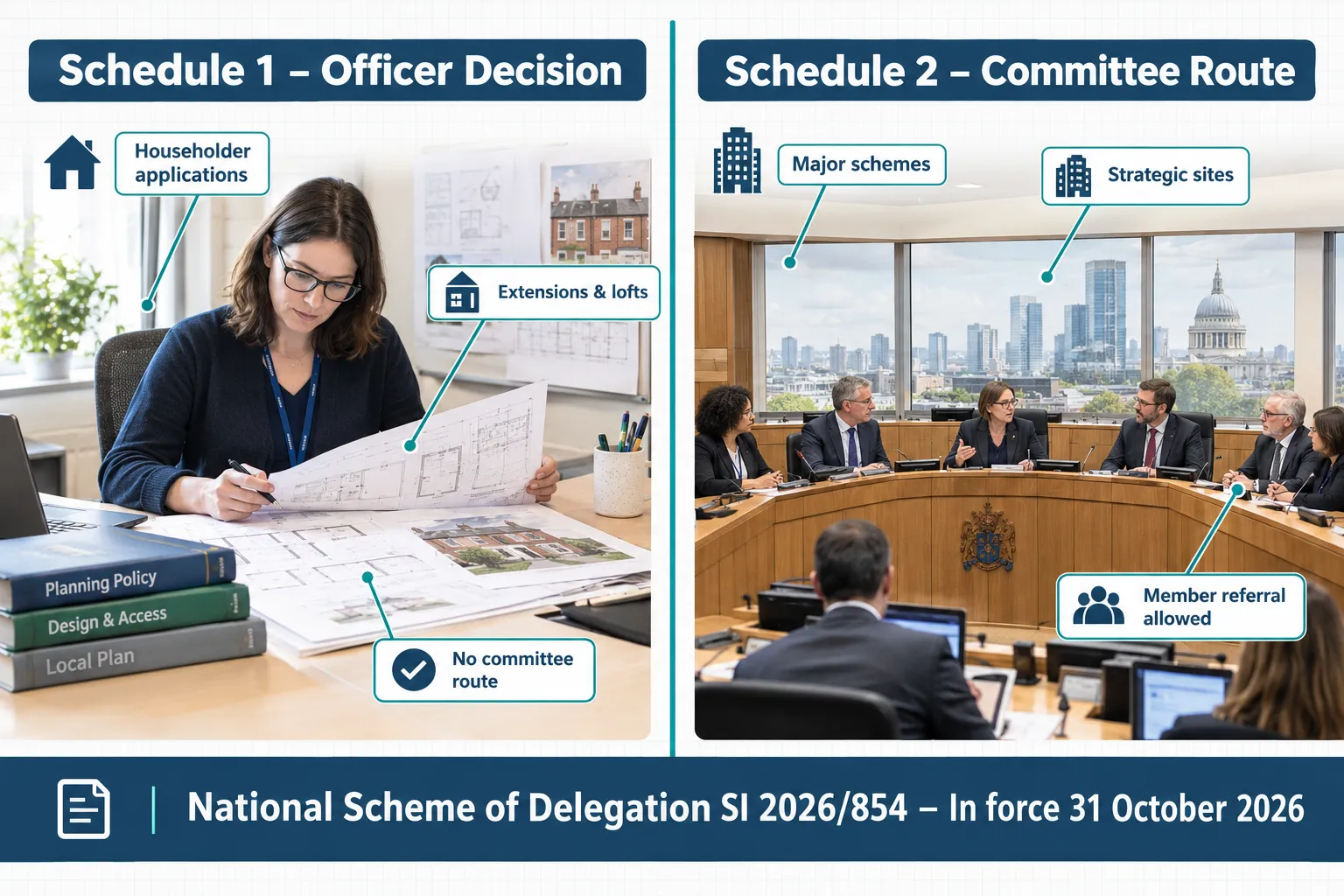
    Under Schedule 1 of the new scheme, officers, not committees, must decide:

    • Householder applications, including extensions and loft conversions
    • Minor commercial development
    • Minor residential development of up to 9 homes on sites under 0.5 hectares
    • Reserved matters and discharge of conditions
    • Prior approval for permitted development rights
    • Permission in principle
    • Non-material amendments
    • Certificates of lawfulness
    • Biodiversity gain plans

    This is the category almost every London homeowner’s extension, side return, or loft conversion falls into. Once the scheme applies, your application goes to a planning officer’s desk for a delegated decision. There is no councillor vote, no committee agenda item, and no public meeting where neighbours can argue their case in person.

    When a Committee Can Still Get Involved

    Larger or more complex schemes move to Schedule 2. Even there, committee referral is now the exception rather than the norm. For a Schedule 2 application to reach committee, it must pass a statutory significance test, and both a nominated senior planning officer and a nominated committee member must agree to the referral.

    Exceptions also apply where an application is linked to listed building consent, is retrospective under section 73A, or is submitted by or on behalf of the council itself. These cases bypass the officer-only route and can still go to committee without the significance test.

    Councils are required to update their constitutions to reflect these rules and publish records of every referral decision. Planning committees themselves are now capped at 13 councillors. Legal commentary, including guidance from law firm Freeths, has warned that committee decisions made in breach of the new scheme could be vulnerable to judicial review.

    What Changes in Practice for Homeowners

    The headline effect: ward councillors can no longer call applications in, and a set number of public objections no longer automatically triggers a committee hearing. For years, a vocal group of neighbours writing to their councillor could sometimes force a straightforward extension into a committee room, adding months of delay and uncertainty. That route has effectively closed for standard householder schemes.

    This has several practical consequences.

    More consistency, less local politics. Decisions now rest on planning policy and officer judgement rather than ward-level lobbying. A well-designed, policy-compliant extension should move through the system on its merits.

    Design compliance matters more than ever. Since officers are applying published planning policy directly, schemes that sit comfortably within permitted development thinking and local design guidance are far more likely to sail through without drama.

    Objections still count, but differently. Neighbours can still object, and officers must consider those objections. What has changed is that objections alone no longer force escalation to committee. The officer weighs them against policy and decides.

    Faster, but not guaranteed faster for everyone. Removing the committee bottleneck should reduce delay for the vast majority of standard cases. Complex or controversial Schedule 2 schemes may still face the same scrutiny as before.

    Permitted Development Limits Have Not Moved

    It is worth stressing: this reform changes who decides, not what you’re allowed to build. The physical limits for permitted development remain exactly as they were.

    Type of work Limit
    Single-storey rear extension (terraced/semi) 3m, extendable to 6m under prior approval
    Single-storey rear extension (detached) 4m, extendable to 8m under prior approval
    Two-storey rear extension 3m
    Maximum single-storey height 4m
    Loft conversion volume (terraced) 40m³
    Loft conversion volume (detached/semi) 50m³
    Garden coverage No more than 50% built on

    Under the prior approval neighbour consultation scheme, neighbours still get 21 days to comment, and the council still has 42 days to decide. None of that machinery has changed, only the committee layer above standard applications has gone.

    Planning Officers Decide Extensions, But the Party Wall Act Still Applies

    This is the point many homeowners miss, and it is the one that causes real problems on site. Planning permission and Party Wall Act consent are two completely separate legal processes. Securing a swift decision from a planning officer does nothing to discharge your duty under the Party Wall Act 1996.

    If your project involves:

    • Work to a shared wall with a neighbour
    • Building on or astride the boundary line
    • Excavating within 3 metres (or 6 metres in some cases) of a neighbour’s foundations, where your work goes below their foundation level

    …you must serve formal notice. The standard timeframes are two months’ notice for party structure works, and one month’s notice for new walls at the boundary and for adjacent excavation. Neighbours then have 14 days to respond. If they dissent, the matter proceeds to a Party Wall Award, prepared by either an agreed surveyor or two surveyors, one appointed by each side.

    Planning approval tells you that you can build. The Party Wall Act governs how you build next to a neighbour. One does not replace the other.

    Timing Your Notices Around the New Decision Process

    With planning officers now deciding extensions faster and with fewer delays, many homeowners may find themselves approved and ready to build sooner than expected. That makes early party wall planning even more important. Serve notices once your design is settled, ideally while your planning application is still being assessed, rather than waiting for the decision notice to land. This avoids a scenario where planning is approved but party wall matters stall your start date by weeks or months.

    FAQ

    Does the 31 October 2026 change affect permitted development rights? No. Permitted development limits and the prior approval process remain unchanged. Only the decision-making route for applications requiring full planning permission has shifted.

    Can my neighbours still object to my extension after this change? Yes. Objections are still considered by the planning officer. What has ended is the automatic escalation to committee based on objection numbers.

    Will my application be decided faster now that planning officers decide extensions? Likely yes for standard householder applications, since the committee bottleneck is removed. Complex or Schedule 2 cases may still take longer.

    Do I still need Party Wall Act notice if I have planning permission? Yes. Planning permission and the Party Wall Act are entirely separate legal requirements. Planning approval does not substitute for party wall notice or consent.

    What happens if my neighbour dissents to my party wall notice? A Party Wall Award is prepared, either by a surveyor agreed by both parties or by two surveyors, one for each side, resolving the terms of the works.

    Can a council still send my extension to committee? Only if it falls under Schedule 2 and passes the statutory significance test with sign-off from a senior officer and a nominated committee member, or falls under specific exceptions like listed building links or retrospective applications.

    Conclusion

    The move to officer-only decisions for standard applications marks one of the most significant procedural shifts in English planning in years. For London homeowners, the message is clear: policy-compliant, well-prepared extension plans should move through the system more predictably once planning officers decide extensions without committee interference. But this reform says nothing about your neighbour’s legal rights under the Party Wall Act 1996.

    Before you submit your application or break ground, get your party wall notices drafted and timed correctly. Speak with Party Wall Surveyor London to confirm your notice requirements, align your timeline with your planning submission, and avoid a situation where a fast planning decision is undermined by an unresolved party wall dispute.

  • Householder Extension Planning Officer Decision 31 October 2026 London Party Wall Rules Explained

    Householder Extension Planning Officer Decision 31 October 2026 London Party Wall Rules Explained

    A single regulation change on 31 October 2026 will strip London councillors of the power to block most extensions, lofts and basements, even when dozens of neighbours object. That is not a slow bureaucratic shift; it is a rewrite of who decides what happens to your house, and it lands in just a few weeks.

    For anyone planning a rear extension, loft conversion or basement dig in London this autumn, the householder extension planning officer decision 31 October 2026 London party wall story matters on two fronts. Planning will become faster and more predictable, but it will also become less of a venue for neighbour disputes. That means the Party Wall etc. Act 1996, not the planning committee, becomes the real place where neighbours’ rights are protected.

    Key Takeaways

    • From 31 October 2026, the National Scheme of Delegation (SI 2026/854) hands almost all householder extension decisions to planning officers, with no committee route regardless of objection numbers.
    • Objections can still shape conditions, but they can no longer trigger a committee hearing or vote on a standard extension or loft conversion.
    • Planning permission has never authorised interference with a neighbour’s structure, the Party Wall Act 1996 remains unchanged and is now the primary safeguard for neighbours.
    • With mortgage rates at 5.93% and Bank Rate decided on 5 November 2026, build cost and finance planning matter as much as design.
    • The safe sequence is design, then planning, then party wall notices, then award, then build, rushing this order risks delay or dispute.

    What Changes for a Householder Extension Planning Officer Decision 31 October 2026 London Party Wall Applications

    The Town and Country Planning (Discharge of Local Planning Authority Functions) (England) Regulations 2026, known as the National Scheme of Delegation, comes into force on 31 October 2026. It sorts planning applications into two schedules. Schedule 1 covers householder applications, extensions, loft conversions and similar domestic works, and these must be decided by a planning officer. They cannot be sent to committee, no matter how many letters of objection a scheme attracts.

    What Changes for a Householder Extension Planning Officer Decision 31 October 2026 London Party Wall Applications

    Schedule 2 covers larger or more contentious applications, which can only reach committee if a nominated officer and a nominated committee member both agree the case passes a gateway test. Committees themselves are capped at 13 members. The old practice of automatic referral once objection numbers hit a local threshold is abolished, as is routine councillor call-in. Statutory guidance is explicit: a committee decision taken on an application that should have been delegated risks judicial review. Local councils can no longer write their own override procedures.

    For London homeowners, the practical effect is a more consistent, policy-led process. Decisions will be made against the local plan and national guidance rather than the mood of a committee room. For neighbours who previously relied on turning up to object at a meeting, that avenue effectively closes for standard extension schemes.

    Why This Makes the Party Wall Act the Real Protection for Neighbours

    This is the point many homeowners and neighbours miss. Planning permission has never given anyone the right to damage, build on, or excavate near a neighbour’s wall or foundations. It regulates land use, design and amenity, not who can touch a shared structure. That job belongs entirely to the Party Wall etc. Act 1996, and the Act is unchanged by the new planning regulations.

    Under the Act, notice is required before:

    • Section 2, work to an existing shared or party wall, requiring two months’ notice.
    • Section 1, building a new wall on the boundary line, requiring one month’s notice.
    • Section 6, excavation within 3 metres of a neighbouring structure (or 6 metres on a 45-degree line) where the new work goes deeper than the neighbour’s foundations, requiring one month’s notice.

    A neighbour who receives a notice has 14 days to consent or dissent. Silence counts as dissent. Dissent triggers the appointment of party wall surveyors and a formal party wall award, which includes a schedule of condition recording the state of the neighbouring property before work starts. Full detail on this process is set out in our guide to the Party Wall Etc Act 1996.

    With planning objections carrying less weight at the committee stage, the party wall notice has become the moment neighbours should pay closest attention, not the planning portal comments box.

    The Correct Sequence: Design, Planning, Party Wall Notices, Award, Build

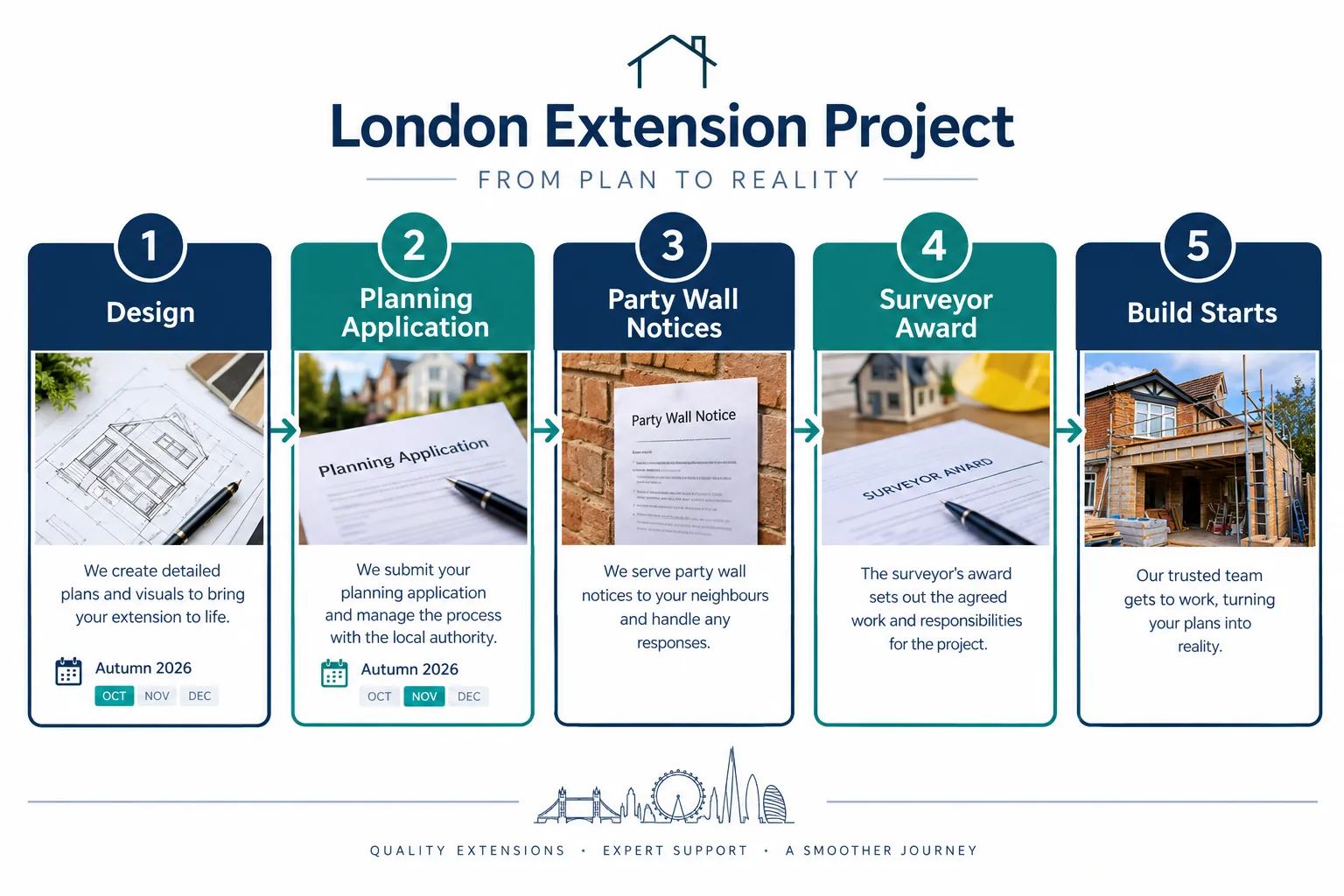
    Getting the order right avoids wasted money and avoidable arguments. The recommended sequence for an autumn or winter 2026 project is:

    1. Design, finalise drawings, structural calculations and specification before anything is submitted.
    2. Planning application, submit for householder consent, now decided by an officer under the delegated scheme.
    3. Party wall notices, serve section 1, 2 or 6 notices as soon as the design is fixed, ideally once planning is granted or close to decision.
    4. Party wall award, if a neighbour dissents (or stays silent), surveyors are appointed and an award is agreed, with a schedule of condition.
    5. Build, work starts only once planning permission and any required award are in place.

    Realistic timelines matter here. A householder planning decision typically takes around eight weeks from validation, though the new delegated process should reduce delay caused by committee scheduling. Section 2 notices need two months, section 1 and 6 notices need one month, and if a dispute arises, a surveyor-led award can add several more weeks. Builders booked for a January 2027 start should be serving party wall notices well before Christmas 2026, not after. Homeowners wanting to serve notices themselves before appointing a surveyor can review Having A Party Wall Agreement Without A Surveyor for what is and is not advisable.

    Common London Scenarios Under the New Rules

    Rear extension on a terrace. The classic London single-storey rear extension usually involves work to the party wall shared with next door. A section 2 notice is almost always required. Under the new delegation rules, the planning officer will assess the application on policy grounds such as light, outlook and design, objections about noise or disruption during construction carry little planning weight but remain central to the party wall process.

    Common London Scenarios Under the New Rules

    Loft conversion with steel beams into the party wall. Loft conversions often need padstones or steel beams bearing into the shared wall. This is party wall work even where no excavation is involved, so a section 2 notice applies. Homeowners should check our Types Of Party Wall Works guide to confirm which notices their specific build triggers.

    Basement excavation. Basement projects are the highest-risk category. Excavation near a neighbour’s foundations almost always triggers a section 6 notice, and deep digs close to shared walls routinely lead to a full award with a detailed schedule of condition, given the risk of settlement or cracking next door.

    Homeowners in different parts of the capital can find locally based support through Party Wall Surveyor West London, Party Wall Surveyor North London, Party Wall Surveyor Central London, Party Wall Surveyor East London and Party Wall Surveyor South London.

    Costs, Finance and Who Pays for Party Wall Work

    Finance conditions are tightening at the same time as these planning reforms. The average two-year fixed mortgage sits at 5.93%, its highest level since July 2024, and sub-5% deals have almost disappeared. Bank Rate is 3.75%, with the next decision due 5 November 2026 and markets pricing in a rise to 4%. Nationwide’s 1 October 2026 figures show UK house prices up 0.8% annually, London up a more modest 0.4%, while terraced houses, the classic extension candidate, led growth at 1.8%.

    Against that backdrop, controlling party wall costs matters. The building owner carrying out the work generally pays the surveyor’s fees, including any surveyor appointed on the neighbour’s behalf, plus the cost of the schedule of condition. Our guide on How To Keep Party Wall Costs Down explains practical ways to manage this, and Costs Of Party Wall The Process sets out what a typical award process involves.

    What Neighbours Should Do When a Notice Arrives

    Receiving a party wall notice is not something to ignore, and it is not the same as a planning consultation letter. Neighbours should:

    • Read the notice carefully and note the type (section 1, 2 or 6) and the deadline for responding.
    • Respond within 14 days, consenting, dissenting, or requesting more information.
    • Consider appointing a surveyor if there are concerns about structural risk, even where consenting feels like the easier option.
    • Keep records and photographs of the shared wall and nearby structure before work begins.

    Further detail on responding properly is covered in Party Wall Act Notices What They Are And How To Respond and What Is A Party Structure Notice How Do I Serve It In London. Those wanting to see what a formal agreement looks like can review the Free Download Sample Party Wall Agreement Template Word or the broader Party Wall Contract Template Guide On Party Wall Awards.

    FAQ

    Does the new delegation scheme change how long planning permission takes? Not directly, but removing committee referral for householder applications should reduce delays caused by waiting for a committee date, since officers decide Schedule 1 applications themselves.

    Can neighbours still object to a planning application after 31 October 2026? Yes, objections can still be submitted and may influence conditions, but they cannot force a householder extension to committee.

    Does planning permission remove the need for party wall notices? No. Planning and party wall matters are entirely separate. Permission to build does not authorise work on a neighbour’s wall or foundations.

    What happens if a neighbour does not respond to a notice? Silence after 14 days is treated as dissent, which leads to surveyor appointment and a formal award.

    Who pays for the party wall surveyor? Normally the building owner carrying out the works pays all reasonable surveyor fees, including those of a surveyor appointed for the neighbour.

    Is a basement extension more likely to need an award? Yes, because excavation close to a neighbour’s foundations almost always triggers a section 6 notice and a detailed schedule of condition.

    Conclusion

    The 31 October 2026 reforms make London’s planning system faster and more rule-based, but they shift the real decision-making power away from public objection and towards policy and procedure. That makes the Party Wall Act 1996 more important than ever for protecting neighbours and for giving homeowners certainty before building work starts. Anyone planning an extension, loft conversion or basement this autumn should finalise designs now, submit for planning promptly, and serve party wall notices in good time, ideally with guidance from a qualified surveyor at Party Wall Etc Act 1996 and Party Wall Awards, so that planning approval and a party wall award arrive together, not in conflict.

  • London Party Wall Notices September 2026: BoE Rate Hold, Autumn Budget Speculation and the Renovation Surge

    London Party Wall Notices September 2026: BoE Rate Hold, Autumn Budget Speculation and the Renovation Surge

    Last updated: September 17, 2026

    Quick Answer

    The Bank of England held Bank Rate at 3.75% at today’s meeting on 17 September 2026, extending a stable borrowing environment that is encouraging London homeowners to press ahead with extensions, loft conversions and basement digs before any Autumn Budget property-tax changes land.[1][3][6] That construction activity is pushing up the number of party wall notices being served across the capital, with typical surveyor fees for September 2026 running from £950 to £2,500 or more depending on complexity and whether a dispute arises.

    Key Takeaways

    • The Bank of England kept Bank Rate at 3.75% on 17 September 2026, matching near-unanimous economist expectations from a Reuters poll of 65 forecasters.[9][5]
    • Nearly 90% of polled economists expect rates to stay at 3.75% for the rest of 2026, giving renovation borrowers a predictable financing backdrop.[9]
    • Autumn Budget 2026 speculation about capital gains tax, a possible mansion tax and wider property-tax reform remains unconfirmed but is fuelling homeowner urgency.[7][11]
    • Party wall notices are legally required under the Party Wall etc. Act 1996 for most work on or near a shared boundary wall, including many extensions and loft conversions.
    • Notice periods are two months for wall works and one month for excavations near a neighbour’s foundations.
    • London surveyor fees for party wall matters in September 2026 typically range from £950 to £2,500+, rising with dissent or dispute.
    • A neighbour who dissents does not stop the project outright, it triggers a formal Party Wall Award process instead.
    • Skipping a required notice can lead to injunctions, forced remedial work and personal liability for damage.

    What Is a Party Wall Notice in London Party Wall Notices September 2026?

    A party wall notice is a formal written document served on a neighbouring owner under the Party Wall etc. Act 1996, giving legal notice of planned building work that touches or affects a shared wall, boundary or nearby foundations. It is separate from planning permission and building regulations, a homeowner can have full planning approval and still be legally required to serve notice on next door.

    In practice, the notice sets out:

    • What work is planned and roughly when it will start
    • Which wall, boundary or foundation area is affected
    • The homeowner’s proposed method of construction (for excavations near a boundary)

    The Act applies specifically in England and Wales, and London’s dense terraced and semi-detached housing stock means a very high proportion of extensions, loft conversions and basement projects trigger at least one notice. Choose a party wall notice service if works involve a shared wall, boundary excavation, or building astride the line of junction, this covers most inner and outer London terrace and semi projects.

    Do I Need a Party Wall Notice for My Renovation?

    A party wall notice is needed whenever work involves cutting into, underpinning, raising, or building against a shared wall, or excavating within three to six metres of a neighbour’s foundations at certain depths. It is not automatically required for every home improvement, many internal-only projects fall outside the Act entirely.

    Common trigger scenarios in London:

    • Rear or side return extensions that connect to or sit on a shared boundary wall
    • Loft conversions requiring new steel beams bearing on a party wall
    • Basement or lower-ground-floor digs that excavate close to a neighbour’s footings
    • Building a new wall on, or astride, the line of junction between two properties
    • Cutting into a party wall for damp-proofing, chimney removal, or flashing work

    Decision rule: if the nearest point of digging or structural alteration is within three metres of the neighbouring foundation (or six metres where deeper excavation reduces load-bearing angle rules), a notice is very likely required. When in doubt, a short consultation with a chartered party wall surveyor resolves the question quickly and cheaply compared with getting it wrong.

    Party Wall Notice for Extensions vs Loft Conversions

    Extensions and loft conversions trigger different notice types under the same Act, and mixing them up is a common mistake. Extensions typically fall under Section 1 (line of junction) or Section 2 (party structure) notices, while loft conversions usually fall under Section 2 because new steel beams or padstones bear directly onto the existing party wall.

    • Extensions: often need a Line of Junction notice (new wall on the boundary) plus a party structure notice if the extension connects into an existing shared wall.
    • Loft conversions: almost always need a party structure notice because ridge beams, steel supports or chimney breast alterations touch the party wall between terraced or semi-detached homes.
    • Basement conversions: need notice under Section 6 (adjacent excavation), which has the shorter one-month notice period.

    Is a Party Wall Notice Required for Internal Walls?

    Purely internal, non-shared walls within a single property do not require a party wall notice, because the Act only governs walls, boundaries and structures shared with, or adjacent to, a neighbouring owner. Removing an internal stud wall in the middle of a house, for example, sits entirely outside the Act.

    A notice becomes necessary only when the “internal” wall in question is actually a party wall, meaning it straddles or forms part of the boundary between two properties, even if it feels internal to the homeowner doing the work.

    Party Wall Notice Requirements September 2026: Timing and the Line of Junction

    Notice periods under the Party Wall etc. Act 1996 are fixed by law and have not changed for September 2026: two months for work to an existing party wall or structure, and one month for excavation-only projects under Section 6. These periods start from the date the notice is validly served, not from the date work is planned to begin.

    Type of work Section of the Act Notice period Typical London trigger
    Party structure alterations Section 2 2 months Loft conversion beams, chimney removal
    New wall on the boundary Section 1 (Line of Junction) 1 month Rear extension wall on the boundary line
    Excavation near foundations Section 6 1 month Basement dig, deep footings

    The Line of Junction is the legal boundary line between two properties, and Section 1 notices apply when a homeowner wants to build a new wall on or astride that line. Neighbours can agree to a wall built entirely on the boundary (shared cost, shared use) or insist it sits wholly on the building owner’s own land, the notice period gives them a month to state a preference.

    Common mistake: starting building work before the notice period has run its course, even with a friendly neighbour, invalidates the statutory protection and can leave the homeowner exposed if a dispute later emerges.

    How Much Does a Party Wall Notice Cost in London September 2026?

    London homeowners in September 2026 should budget roughly £950 to £2,500 or more in surveyor fees per party wall matter, with the final figure depending on the number of adjoining owners, project complexity, and whether the neighbour appoints their own surveyor.

    Scenario Typical September 2026 London cost
    Simple loft conversion, agreed neighbour, one surveyor acting for both £950,£1,400
    Single-storey rear extension, one adjoining owner £1,200,£1,800
    Basement or excavation works, two adjoining owners £1,800,£2,500
    Dissenting neighbour, separate surveyors appointed, formal Award needed £2,500,£4,000+

    Edge case: where a neighbour appoints their own surveyor rather than accepting the building owner’s proposed surveyor, the building owner is normally responsible for paying both surveyors’ reasonable fees. This is a legal obligation under the Act, not a courtesy, and it is a major reason costs escalate once a notice is contested.

    Party Wall Notice vs Party Wall Award: What’s the Difference?

    A party wall notice is the initial written warning of intended works, while a party wall award is the binding legal document a surveyor (or surveyors) produces once a notice has been served and either agreed or disputed. The notice starts the clock; the award sets the rules.

    • Notice: served by the building owner, states intent, starts the one- or two-month statutory period.
    • Award: drawn up by an agreed surveyor or two appointed surveyors, sets out the work method, timing, access rights, and a schedule of condition for the neighbouring property.

    If a neighbour consents in writing to a notice, no award is strictly needed. If they dissent, stay silent for 14 days, or ask for more detail, an award becomes the mechanism that lets works legally proceed while protecting both properties.

    Can My Neighbour Reject a Party Wall Notice?

    A neighbour cannot simply refuse to allow lawful party wall works to happen, but they can dissent from the notice, which moves the matter into the formal surveyor and award process rather than stopping the project. Dissent is common and does not signal a hostile relationship, it is often the safer legal route for both sides.

    Three outcomes follow a served notice:

    1. Written consent, works proceed on the terms proposed, no award needed.
    2. No response after 14 days, treated in law as a dispute, triggering surveyor appointment.
    3. Written dissent, the neighbour appoints their own surveyor (or agrees to share one), and an award is drawn up.

    Choose formal dissent if: the neighbour wants an independent schedule of condition recorded before work starts, wants their own surveyor reviewing the excavation method, or is concerned about vibration, noise, or access. This protects both parties and rarely delays a well-managed project by more than a few weeks.

    What Happens If You Don’t Serve a Party Wall Notice?

    Failing to serve a required party wall notice exposes the building owner to a court injunction halting work, liability for any damage caused to the neighbouring property, and potential legal costs even where the work itself was otherwise lawful and well built. Courts take the absence of notice seriously because it removes the neighbour’s statutory right to inspect, comment, or record a schedule of condition beforehand.

    Practical consequences seen across London include:

    • Stop-work orders issued mid-build, adding weeks of delay and site costs
    • Disputes over pre-existing cracks or damp being blamed on the unnotified works
    • Difficulty selling the property later, since conveyancing solicitors routinely ask for party wall paperwork

    Common mistake: assuming a friendly relationship with a neighbour removes the legal requirement to serve notice. Verbal agreement offers no protection if damage occurs later and there is no schedule of condition on record.

    How the BoE Rate Hold and Autumn Budget 2026 Speculation Are Driving London’s Renovation Surge

    The Bank of England’s decision to hold Bank Rate at 3.75% on 17 September 2026 gives London homeowners a stable, largely predictable borrowing cost for extension and conversion loans, and this stability is one factor behind sustained renovation activity feeding into party wall notice volumes.[1][3][6] Bank Rate has sat at 3.75% since December 2025, and a Reuters poll of 65 economists conducted 4-8 September 2026 found near-unanimous agreement that the rate would hold this month, with most expecting no change through the rest of 2026.[9][5]

    Alongside that, Autumn Budget 2026 previews have discussed, though not confirmed, potential reforms to property taxation, including speculation around capital gains tax treatment and a so-called mansion tax on higher-value homes, alongside broader modelling exercises such as replacing stamp duty and council tax with an annual property tax.[7] Sector commentary is clear that these remain rumours and modelling scenarios rather than confirmed policy, and that a full stamp-duty and council-tax replacement, along with a specific land-value tax proposal, have reportedly been ruled out for this Budget.[7] There is no official confirmation of any change until the Chancellor’s statement in Parliament, expected around the Autumn Budget date.

    How the two forces combine:

    • A stable Bank Rate reduces uncertainty around mortgage top-ups or renovation loans used to fund extensions and loft conversions.
    • Budget speculation about property taxes, even unconfirmed, motivates some owners to complete or lock in improvements before any rule changes take effect.
    • More live building projects on shared boundaries directly means more required party wall notices across London boroughs.

    It is worth stressing that this renovation-to-party-wall-notice link is an inferred pattern based on market and policy context rather than a published, verified statistic, there is no official national dataset tracking party wall notice volumes, since these are handled by private surveyors rather than government bodies.

    How to Choose a Party Wall Surveyor

    Choose a party wall surveyor who holds recognised professional accreditation (such as RICS or FPWS membership), has direct experience with London terraced and semi-detached properties, and is transparent about fees before any notice is served. The right surveyor should also be willing to act as an “agreed surveyor” for straightforward cases to keep costs down for both sides.

    Checklist for choosing well:

    1. Confirm professional accreditation and ask for two recent London-based references.
    2. Ask for a written fee estimate covering notice drafting, site inspection, and award preparation.
    3. Check whether they are comfortable acting as an agreed surveyor for both owners on simple projects.
    4. Ask how they handle a schedule of condition and photographic evidence.
    5. Clarify response times, a slow surveyor can eat into the one- or two-month notice window unnecessarily.

    Example: a homeowner in Islington planning a loft conversion appoints a surveyor who also drafts the notice, serves it correctly on both neighbouring flats, and negotiates one agreed surveyor role for a straightforward case, keeping total fees near the lower end of the £950,£1,400 range.

    Party Wall Notice Disputes: How to Resolve Them

    Most party wall disputes are resolved through the surveyor and award process rather than court, and early communication with the neighbour before formal notice is served prevents the majority of conflicts. A short, friendly conversation explaining the planned dates, likely noise, and access needs often heads off formal dissent altogether.

    Practical steps to avoid and resolve disputes:

    • Talk first, notify second: share plans informally before the statutory notice lands on the doormat.
    • Commission a schedule of condition: a dated, photographed record of the neighbouring property’s current state protects both owners against later blame.
    • Use one agreed surveyor where possible: cheaper and faster than two competing surveyors, provided both owners trust the process.
    • Respond to dissent calmly: dissent is a legal safeguard, not an attack, and usually just adds a surveyor appointment step.
    • Keep to the agreed method statement: deviating from the award’s approved construction method is the single most common cause of escalated disputes mid-build.

    Frequently Asked Questions

    Do I need a party wall notice for a small single-storey extension in London? Most likely yes, if the extension connects to or is built on a shared boundary wall, or involves excavation within three to six metres of a neighbour’s foundations. A quick check with a surveyor confirms whether the specific footprint triggers the Act.

    How long before starting work should I serve a party wall notice? Serve a Section 2 party structure notice at least two months before starting wall works, and a Section 6 excavation notice at least one month before digging begins. Building before these periods expire, even with a cooperative neighbour, removes statutory protection.

    What if my neighbour ignores the notice completely? No response within 14 days is treated in law as a dispute, which automatically triggers the surveyor appointment and award process rather than leaving the project stuck.

    Can I serve a party wall notice myself without a surveyor? Yes, homeowners can legally serve their own notice, but incorrect wording or timing is a common reason disputes escalate, so many choose a surveyor-appointed service to draft and serve it correctly from the outset.

    Will the September 2026 Bank Rate hold change my renovation loan costs? The Bank of England’s hold at 3.75% on 17 September 2026 means existing tracker-rate borrowing costs should not shift immediately, though fixed-rate products depend on wider swap rate movements rather than Bank Rate alone.[1][3][9]

    Is the Autumn Budget 2026 definitely bringing in a mansion tax or CGT change? No. As of mid-September 2026, mansion tax and capital gains tax changes remain speculation reported in Budget previews, not confirmed government policy, and details will only be confirmed in the Chancellor’s Autumn Budget statement.[7][11]

    Conclusion

    London’s party wall system has not changed for September 2026, but the environment around it has: a held Bank Rate of 3.75% gives renovation borrowing a settled backdrop, while Autumn Budget speculation about property taxes is nudging some homeowners to bring extension and loft conversion plans forward.[1][7][9] That combination is a sensible reason to plan carefully rather than rush. Homeowners should confirm early whether their project triggers a Section 1, 2 or 6 notice, budget realistically for surveyor fees between £950 and £2,500 or more, and build in the full one- or two-month statutory notice period before setting a start date. Talking to the neighbour before the formal notice lands, and appointing an accredited party wall surveyor to draft and serve the notice correctly, remains the most reliable way to keep a London renovation on schedule and off the dispute list.

    References

    [1] Monetary Policy – bankofengland.co.uk [3] The Interest Rate Bank Rate – bankofengland.co.uk [5] Bank England Set Hold Rates Steady Slow Qt 2026 09 14 – reuters.com [6] Current Interest Rate – bankofengland.co.uk [7] Autumn Budget 2026 Predictions – financeclearly.com [9] Bank England Hold Rates Show Patience With War Driven Inflation 2026 09 08 – reuters.com [11] Autumn Budget 2026 Predictions – financeclearly.com

    Party Wall Notice Timeline & Cost Estimator .cg-pw-wrap{font-family:Arial,Helvetica,sans-serif;max-width:640px;margin:0 auto;background:#f7f9fb;border:1px solid #d7dee5;border-radius:8px;padding:20px} .cg-pw-wrap h2{font-size:1.1rem;color:#1a2c42;margin-top:0} .cg-pw-row{margin-bottom:12px} .cg-pw-row label{display:block;font-weight:bold;font-size:0.9rem;color:#1a2c42;margin-bottom:4px} .cg-pw-row select{width:100%;padding:8px;border-radius:5px;border:1px solid #b9c4cf;font-size:0.9rem} .cg-pw-result{margin-top:16px;background:#eaf2fb;border-left:4px solid #1a5fb4;padding:12px 14px;border-radius:5px} .cg-pw-result strong{color:#1a2c42} .cg-pw-note{font-size:0.78rem;color:#5a6b7a;margin-top:10px} @media(max-width:480px){.cg-pw-wrap{padding:14px}}

    Party Wall Notice: Timeline & Cost Estimator (London, Sept 2026)

    Loft conversion (party structure) Rear/side extension on boundary Basement / deep excavation
    Likely to agree / one shared surveyor May dissent / separate surveyors
    Select options above to see your estimate.
    Estimates only, based on typical London September 2026 ranges. Actual notice periods and fees depend on project detail and surveyor appointed.
    function cgPwCalc(){ var type=document.getElementById(‘cg-pw-type’).value; var neigh=document.getElementById(‘cg-pw-neighbour’).value; var period, base; if(type===’loft’){period=’2 months (Section 2 party structure notice)’;base=[950,1400];} else if(type===’ext’){period=’1-2 months (Section 1 Line of Junction and/or Section 2)’;base=[1200,1800];} else {period=’1 month (Section 6 excavation notice)’;base=[1800,2500];} var low=base[0], high=base[1]; if(neigh===’dissent’){low=Math.round(low*1.5);high=Math.round(high*1.7)+300;} var out=document.getElementById(‘cg-pw-result’); out.innerHTML=’Notice period: ‘+period+’
    Estimated surveyor fees: £’+low.toLocaleString()+’ – £’+high.toLocaleString()+(neigh===’dissent’?’+’:”); } document.getElementById(‘cg-pw-type’).addEventListener(‘change’,cgPwCalc); document.getElementById(‘cg-pw-neighbour’).addEventListener(‘change’,cgPwCalc); cgPwCalc();