
Looking for expert solutions?
Request a Quote

Tag: move

  • Remortgaging Jumps 25% While House-Purchase Approvals Hit a Three-Year Low: London’s ‘Improve, Don’t Move’ Autumn and What It Means for Party Wall Notices (November 2026)

    Remortgaging Jumps 25% While House-Purchase Approvals Hit a Three-Year Low: London’s ‘Improve, Don’t Move’ Autumn and What It Means for Party Wall Notices (November 2026)

    Mortgage approvals for house purchase just fell to their lowest level since December 2023. At the same time, remortgage approvals leapt by roughly a quarter in a single month. Put those two numbers side by side and a clear picture emerges: London homeowners are staying put and borrowing against the home they already own to pay for the extension, loft conversion or basement they once might have funded by moving. This autumn’s improve not move London extensions party wall notice 2026 story is not just a property-market curiosity, it has real, practical consequences for anyone planning building work next to a shared wall, and for the neighbours who will receive a notice through the letterbox.

    This article explains what the latest Bank of England and Nationwide figures mean for extension plans across the capital, and walks through exactly how and when the Party Wall etc. Act 1996 applies.

    Key Takeaways

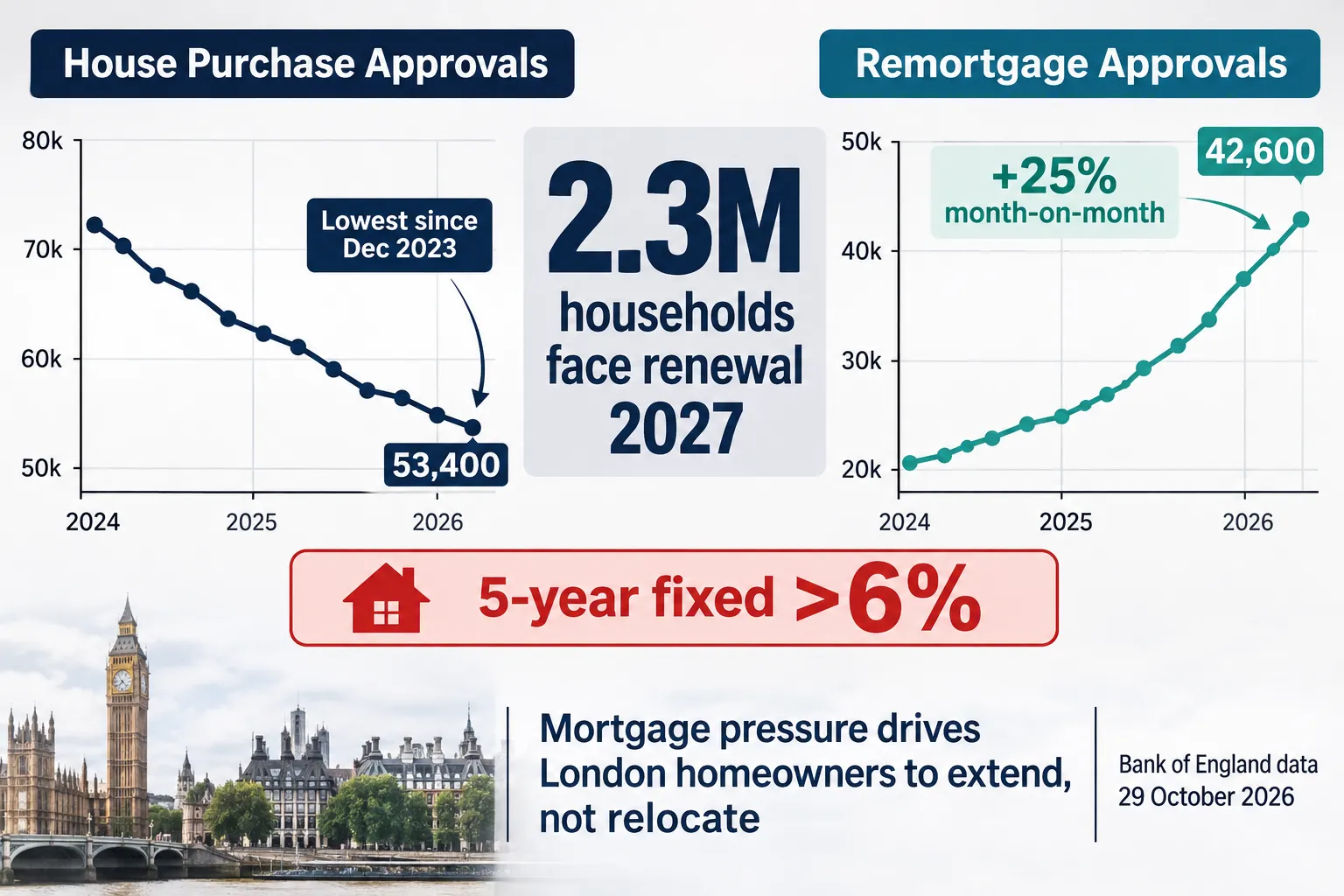
    • Bank of England data (29 October 2026) shows house-purchase approvals at 53,400, the lowest since December 2023, while remortgage approvals jumped to 42,600, up about 25% month on month.
    • 2.3 million UK households face a mortgage renewal in 2027, with five-year fixed rates above 6% since early October 2026, pushing many to extend rather than move.
    • Common London projects, rear and side-return extensions, loft conversions with steel beams, basements, and chimney breast removal, frequently trigger the Party Wall Act.
    • Notice periods are fixed by law: one month for new walls and most excavation work, two months for work to an existing party wall.
    • Starting work without serving notice, or before an Award is in place, risks injunctions and leaves owners without legal protection.

    The numbers behind London’s “improve, don’t move” autumn

    The Bank of England’s Money and Credit release for September 2026, published on 29 October 2026, tells a consistent story. Approvals for house purchase fell to 53,400, down from 54,800 in August and the weakest reading since December 2023. Remortgage approvals, by contrast, jumped to 42,600 from 34,000, an increase of about 25%. Net mortgage borrowing eased slightly to £3.9 billion from £4.2 billion, and the effective rate on new mortgages stood at 4.63%.
    The numbers behind London's "improve, don't move" autumn

    Layered on top of this, reporting on 2 November 2026 highlighted that 2.3 million UK households face a mortgage renewal across 2027, nearly half a million more than in 2026. Average five-year fixed rates have sat above 6% since early October 2026, compared with Moneyfacts averages of 3.25% (two-year) and 3.37% (five-year) back in 2022. On a typical £200,000, 25-year mortgage, that shift takes monthly payments from around £986 in 2022 to about £1,289 now, more than £3,600 extra a year.

    Bank Rate currently stands at 3.75%, and a rise to 4% is widely expected at the Monetary Policy Committee meeting on Thursday 5 November 2026, which would be the first increase since August 2023. Barclays anticipates a 7-2 vote; RSM UK’s Thomas Pugh expects a closer 6-3 split. CPI inflation was 3.5% in September. Meanwhile, Nationwide’s October 2026 house price index put the UK average at £273,566, up just 0.5% year on year, the weakest annual growth since January 2024. The Autumn Budget on 28 October 2026, delivered by Chancellor John Healey, left stamp duty unchanged, so the cost of moving home remains as high as ever, while property income tax for landlords is set to rise to 24/44/49% from April 2027.

    Taken together, it is easy to see why so many London households are choosing to remortgage and extend rather than sell up and buy again.

    Which projects trigger the Party Wall Act?

    Not every home improvement needs a party wall notice. The Party Wall etc. Act 1996 is concerned specifically with work that affects a shared structure or boundary, or excavation close to a neighbour’s foundations. Purely internal works that do not touch a party structure fall outside the Act entirely.

    The projects that commonly arise during this “improve not move” period, and that typically engage the Act, include:

    • Rear and side-return extensions on terraced or semi-detached houses, where new foundations are dug within 3 metres of the neighbour’s foundations (and below their depth), or within 6 metres on a 45-degree line, this is Section 6 territory.
    • Loft conversions that involve cutting steel beams into the party wall to support new floor joists or a dormer, this falls under Section 2, as does raising or underpinning a party wall.
    • Basements and digs, where excavation close to or below a neighbour’s foundations is almost always notifiable under Section 6.
    • Chimney breast removal, where the breast forms part of a party wall, this is Section 2 work, even if the alteration seems minor.
    • New boundary walls built astride or up to the line of junction between two properties, Section 1, requiring at least one month’s notice.

    If you are unsure whether your project counts, our guide to types of party wall works sets out examples in more detail, and the distinction between a true party wall and a garden boundary is explained in our piece on what is a party fence wall.

    A realistic timeline from notice to start on site

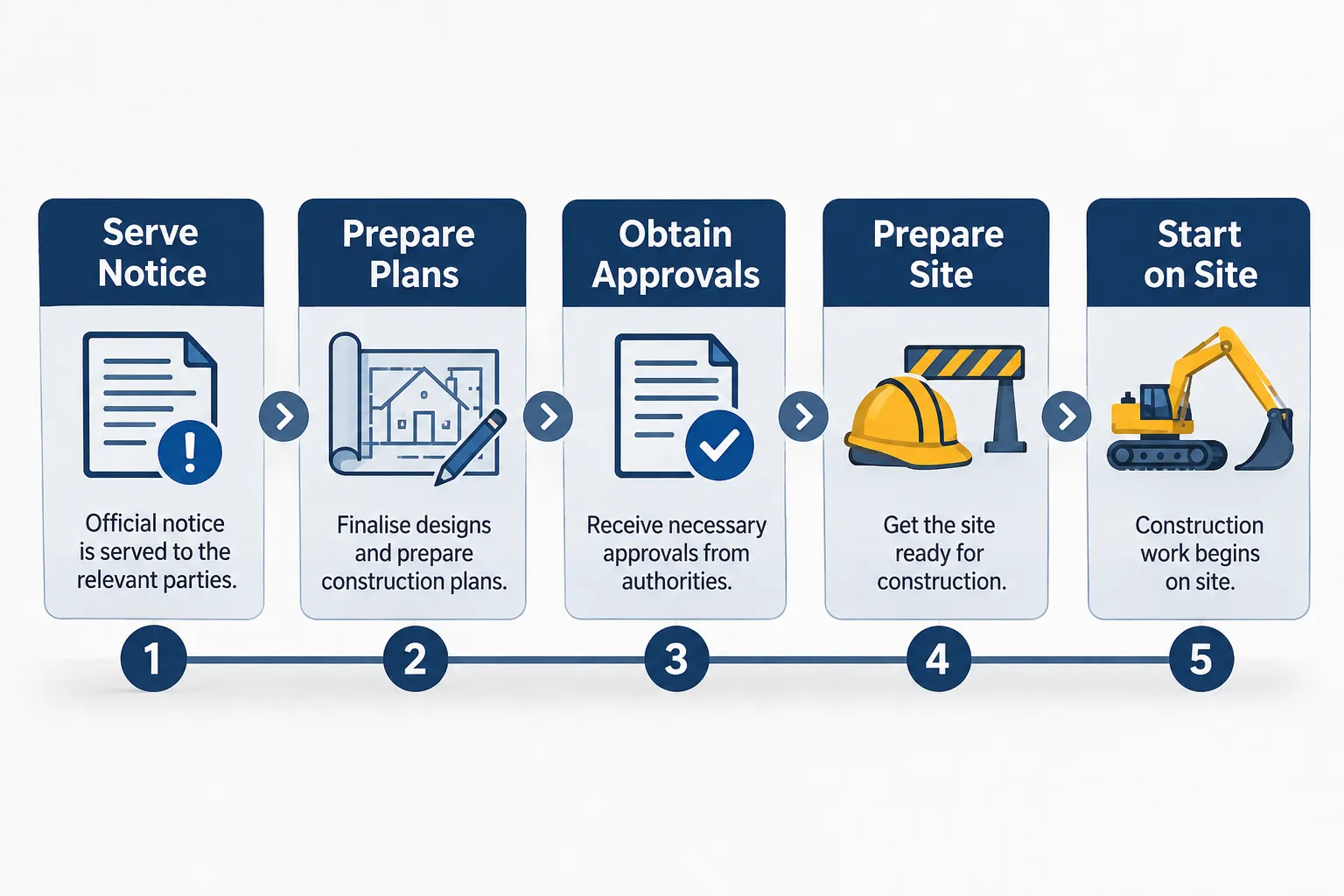
    With remortgage funds often released against a fixed drawdown date and builders booked months in advance, timing matters more than ever this autumn. The Act sets minimum, not maximum, notice periods, and delays on the neighbour’s side can push a start date back considerably.
    A realistic timeline from notice to start on site
    Stage Typical duration
    Section 1 notice (new wall at boundary) At least 1 month before work starts
    Section 2 notice (work to existing party wall) At least 2 months before work starts
    Section 6 notice (excavation/foundations) At least 1 month before work starts
    Adjoining owner’s response window 14 days to consent in writing
    If dispute deemed to arise Surveyor(s) appointed, schedule of condition recorded
    Award preparation Several weeks, depending on complexity and cooperation

    If an adjoining owner does not give written consent within 14 days of receiving notice, a dispute is automatically deemed to have arisen. At that point, either an agreed surveyor is appointed, or each owner appoints their own surveyor and the two select a third surveyor. A schedule of condition of the neighbouring property is usually recorded before work begins, and the process concludes with a Party Wall Award.

    Working backwards from a desired start date, most London homeowners should be serving notices at least three to four months ahead for loft conversions or basements, allowing for the two-month Section 2 period plus time for surveyor appointment and Award drafting if consent is not given straight away. Leaving notice until builders are ready to start is one of the most common and avoidable causes of delay this season. Our overview of Party Wall Notices and the step-by-step explanation of what is a party structure notice and how do I serve it are useful starting points.

    What neighbours should do when a notice lands

    Receiving a party wall notice is not a cause for alarm, but it should not be ignored either. Adjoining owners have three options: consent in writing, dissent and appoint their own surveyor, or do nothing, which, after 14 days, is treated as dissent and triggers the surveyor-appointment process automatically. Our article on Party Wall Act notices: what they are and how to respond walks through each option in plain language. Neighbours are entitled to have a schedule of condition recorded before work starts, which protects both sides if damage is later disputed.

    The risks of starting without notice

    Carrying out notifiable work without serving notice, or before an Award is finalised, leaves a building owner exposed. A neighbour can apply to the county court for an injunction to halt work, and any damage caused without a schedule of condition in place is far harder to resolve fairly. There is also no Award to rely on if a dispute over access, working hours or remedial work arises later. Given that remortgage funds are frequently tied to specific drawdown and completion dates, a stalled project caused by a missed notice can be costly in ways that go well beyond the building work itself.

    Homeowners wanting to avoid a surveyor dispute altogether should read our guide on how to keep party wall costs down, and those considering a DIY approach should first review having a party wall agreement without a surveyor to understand the limits of that approach.

    FAQ

    Does the Party Wall Act apply to my extension if I’m not touching the wall itself? If your foundations will be dug within 3 metres of the neighbour’s foundations (and lower than them), or within 6 metres on a 45-degree line, Section 6 applies even if you never physically touch the wall.

    How much notice do I need to give for a loft conversion with steel beams? At least two months under Section 2, since cutting beams into a party wall counts as work to an existing party structure.

    What happens if my neighbour ignores the notice? If there is no written consent within 14 days, a dispute is deemed to have arisen and surveyors must be appointed to produce a Party Wall Award.

    Can I start building work while remortgage funds are being finalised but before notice periods expire? No, starting notifiable work before the statutory notice period has passed, or before an Award is in place where a dispute exists, risks an injunction and leaves you without the legal protection an Award provides.

    Conclusion

    The combination of a three-year low in house-purchase approvals and a 25% jump in remortgage approvals confirms what many London surveyors are already seeing on the ground: more homeowners extending in place rather than moving. For anyone planning a rear extension, loft conversion, basement dig or chimney breast removal this autumn, the lesson is simple, serve party wall notices early, understand which section of the Act applies, and do not let a tight builder schedule or remortgage drawdown date push you into starting work before the legal process is complete.

    For tailored advice on notices, Awards and schedules of condition in your part of the capital, speak to specialists covering West London, East London, Central London, South London and North London. Contact Party Wall Surveyor London today to keep your extension project on schedule and fully compliant with the Party Wall etc. Act 1996.

    party wall act, party wall notice, London extensions, loft conversion, basement excavation, remortgage 2026, Bank of England mortgage data, house purchase approvals, party wall award, Section 6 notice, London homeowners, building regulations

  • Improve, Don’t Move: Why 5.29% Mortgage Rates and 27-Year-High Gilt Yields Are Pushing Londoners Towards Extensions in October 2026

    A London homeowner refinancing this month will pay roughly £180 more every single month than they would have paid in February 2026 for the same mortgage. That single figure, buried in Rightmove’s latest data, explains why phones at party wall surveying firms across the capital have been ringing more than estate agents’ phones this autumn. When borrowing becomes this expensive and selling takes this long, staying put and building up or out starts to look like the smarter financial move. This is the story of improve not move London extensions mortgage rates economics in October 2026, and what homeowners need to know before they pick up a tape measure.

    Key Takeaways

    • Average two-year fixed mortgage rates hit 5.29% in September 2026, up from 4.25% in February, adding about £180 a month to typical repayments.
    • A 10-year gilt auction on 30 September 2026 priced at 5.38%, the highest since 1999, which pushes mortgage swap rates higher still.
    • Mortgage approvals fell to 54,900 in August 2026, the lowest since December 2023, while London homes now take 78 days on average to sell and only 42% find a buyer.
    • With moving costly and slow, extending under the Party Wall etc. Act 1996 is becoming the practical alternative for homeowners who need more space.
    • Correct notices, awards and schedules of condition protect both homeowners and neighbours and keep extension projects on schedule.

    The Cost of Moving Has Jumped in 2026

    Borrowing to buy a home in London has become noticeably more expensive over the course of 2026. Rightmove’s 21 September 2026 figures show the average two-year fixed mortgage rate reached 5.29%, up from 5.09% just a month earlier and a full percentage point above the 4.25% recorded in February 2026. For a typical borrower, that climb translates into approximately £180 extra per month compared with February levels, a meaningful hit to household budgets in a city where monthly outgoings are already stretched.

    The pressure is not confined to the mortgage market. On 30 September 2026, the UK Government paid 5.38% to borrow £4.25bn over 10 years, the highest 10-year gilt rate since 1999. This matters well beyond Westminster because gilt yields feed directly into the swap rates that lenders use to price fixed-rate mortgages. When gilts rise, mortgage pricing tends to follow, and the September auction result signalled that cheaper borrowing is unlikely to return quickly.

    The Bank of England’s Money and Credit release, published 29 September 2026, confirmed the knock-on effect. Mortgage approvals for house purchase fell to 54,900 in August 2026, the lowest level since December 2023. The effective interest rate on newly drawn mortgages stood at 4.6%. Fewer approvals mean fewer completed moves, and that slowdown is now visible across London’s property market.

    A Slow London Sales Market

    Zoopla’s House Price Index, released on 1 October 2026, paints a picture of a market losing momentum. London property prices are down 1% year on year, while sales agreed across the UK have fallen by 9%. Across the UK, flats fell in value in 9 of the 11 regions tracked, a sign that the affordability squeeze is being felt well beyond the capital, even if London’s own price movement is more modest. The stock of unsold homes has reached its highest level in 12 years, meaning sellers face more competition and less urgency from buyers.

    Rightmove’s figures sharpen the picture for London specifically. The average London home now takes 78 days to find a buyer, and only 42% of London listings succeed in finding one at all. That means well over half of properties listed in London this year have not sold.

    Lucian Cook of Savills said upsizers are putting off plans to move until they have more confidence in their personal finances. That single observation captures the mood driving this shift: households who might have traded up to a bigger home are choosing to wait, and many are choosing to build instead.

    Why Extending Is Winning: Lofts, Side Returns, Rear Extensions and Basements

    Against this backdrop, extending has become an increasingly attractive route to extra space. Rather than selling in a market where fewer than half of listings find buyers, and rather than taking on a mortgage at 5.29% to fund a move, many London homeowners are choosing to improve the property they already own.

    The most common projects in London remain familiar: loft conversions, side return infill extensions, rear extensions, and basement digs. Each of these works differently affects neighbouring properties, which is exactly where the Party Wall etc. Act 1996 becomes relevant. A loft conversion may only need internal structural work, but a rear extension that touches a shared wall, or a basement dig that excavates near a neighbour’s foundations, triggers specific legal notice requirements that cannot be skipped.

    This is the heart of the improve not move London extensions mortgage rates trend: homeowners are recognising that the money saved by not moving, in stamp duty, agents’ fees, and higher mortgage interest, can fund a well-planned extension instead.

    What the Party Wall etc. Act 1996 Requires Before You Build

    Before any spade goes into the ground, homeowners planning qualifying works need to understand their legal obligations under the Party Wall etc. Act 1996.

    Three main types of notice apply:

    • Section 1 covers new walls built at the line of junction between two properties and requires one month’s notice to the adjoining owner.
    • Section 2 covers works to an existing party structure, such as cutting into a party wall to insert a beam, and requires two months’ notice.
    • Section 6 covers excavation near a neighbour’s property, specifically within 3 metres (or 6 metres where the 45-degree rule applies) of their foundations, and also requires one month’s notice.

    These notice periods are not optional extras. They give neighbours a fair chance to understand what is proposed and to raise concerns before work begins.

    Notices, Awards and Schedules of Condition: A Practical Timeline

    Serving notice is only the first step. Once a notice has been served, the adjoining owner has 14 days to respond. If they do not consent within that window, the law treats a dispute as having arisen automatically, even if no argument has actually taken place.

    At that point, surveyors must be appointed. The two owners can agree to use a single agreed surveyor, or each can appoint their own surveyor, who then select a third surveyor in case of disagreement.

    The surveyor’s job centres on two documents:

    1. The award, a formal document setting out exactly what work is permitted, how and when the builder may access the neighbour’s property if needed, and what protections must be put in place to prevent or address damage.
    2. The schedule of condition, a detailed record of the neighbour’s property before work starts, covering existing cracks, finishes and any pre-existing defects, so that any later dispute about damage can be assessed against a clear baseline.

    Homeowners who build in extra time for this process tend to have smoother, faster projects overall, because disputes are resolved on paper before they can delay the build on site.

    What This Means for London Homeowners and Why a Party Wall Surveyor Matters

    The numbers tell a consistent story. Mortgage rates near 5.29%, gilt yields at their highest since 1999, approvals at their lowest since 2023, and a London sales market where more than half of listings fail to find a buyer within a reasonable time. Together, these conditions make extending look like sound financial planning rather than a lifestyle indulgence.

    But building well, and lawfully, requires getting the Party Wall etc. Act 1996 process right from day one. A qualified party wall surveyor manages notices, negotiates awards, prepares schedules of condition and keeps neighbour relationships intact, all of which protects the homeowner’s investment and timeline. In a market where moving is expensive and slow, a well-managed extension project is one of the few variables a homeowner can actually control.

    Frequently Asked Questions

    Is extending cheaper than moving in London right now? No reliable extension cost data is cited here, but the broader financial pressures are clear: mortgage rates have risen sharply in 2026 and London sales are slow, which is why many homeowners are weighing up improving instead of moving.

    Do I need a party wall surveyor for every extension? Not every project triggers the Act. It applies specifically to work on a shared party structure, new walls at the boundary, or excavation near a neighbour’s foundations within the distances set out in Section 6.

    What happens if my neighbour ignores my party wall notice? If there is no response within 14 days, a dispute is deemed to have arisen automatically, and surveyors must then be appointed to resolve matters through an award.

    How long does the party wall notice process take? Notice periods are one month for Section 1 and Section 6 works, and two months for Section 2 works, before building can start, though the full surveyor and award process can take longer if a dispute arises.

    Why have mortgage rates risen so much in 2026? Rising gilt yields, including the 5.38% rate paid at the 30 September 2026 government bond auction, feed into the swap rates lenders use to price fixed mortgages, pushing rates such as the 5.29% average two-year fix higher through the year.

    Conclusion

    October 2026’s figures leave little doubt about the direction of travel. Mortgage rates have climbed to 5.29%, gilt yields sit at their highest since 1999, and London’s sales market is moving slowly, with homes taking 78 days to sell and fewer than half of listings succeeding. For many homeowners, the improve not move London extensions mortgage rates calculation now favours staying put and building. Anyone planning a loft conversion, rear extension or basement dig should start the Party Wall etc. Act 1996 process early, serve the correct notices, and engage a party wall surveyor to prepare the schedule of condition and award before work begins. Getting this right protects the project, the budget and the neighbourly relationship, all at once.

    party wall surveyor, Party Wall etc Act 1996, London extensions, improve not move, mortgage rates 2026, loft conversion London, rear extension, basement extension, schedule of condition, gilt yields, London property market, house price index