Looking for expert solutions?
Request a Quote

Tag: moving

  • London Prices Down 2.2%: Why More Homeowners Are Extending Instead of Moving, and the Party Wall Steps to Take in October 2026

    London house prices just fell 2.2% year-on-year, the weakest performance of any UK region, according to the latest ONS/HM Land Registry figures released on 21 October 2026. For thousands of homeowners sitting on properties worth less than they expected, the maths on moving no longer adds up. A growing number are choosing to extend not move, and that decision in party wall London October 2026 means one thing: the Party Wall etc. Act 1996 is about to become very relevant to a lot of households who have never dealt with it before.

    Why Extend Not Move Is the Smart Call in Party Wall London October 2026

    The numbers tell their own story. London flats are down 5.0% annually, the weakest segment in the capital. The UK average sits at £273,000, up just 0.9% on the year, the slowest growth since March. Detached houses are holding up better, up 0.7% to £443,846, while flats have dropped 1.6% to £194,148.

    Add in the wider financial picture: CPI inflation at 3.5% in September, Bank Rate at 3.75% with another quarter-point rise expected on 5 November, and rents climbing 3.8%. Chancellor John Healey has ruled out stamp duty changes ahead of the 28 October Budget, so moving costs stay high, while a mansion tax on £2 million-plus properties lands from April 2028. Selling into a falling market, paying hefty transaction costs, and facing a tighter mortgage environment makes staying put, and building out or up, look far more sensible for many London owners.

    This is why the extend not move party wall London October 2026 trend is worth watching closely. Loft conversions, rear extensions, side-return additions, and basement digs are the natural next step when moving house no longer makes financial sense. This trend reflects a pattern seen in the firm’s own enquiries over recent months rather than a published industry statistic.

    Key Takeaways

    • London prices fell 2.2% annually in the year to August 2026 (published October), the weakest of any UK region, with flats down 5.0%.
    • Stamp duty changes have been ruled out ahead of the 28 October Budget, meaning moving remains expensive relative to extending.
    • More London homeowners are choosing to extend not move, triggering Party Wall etc. Act 1996 obligations.
    • Section 1, 2, and 6 works each carry different notice periods and procedures.
    • Acting early in October avoids delays to winter and spring 2027 building schedules.

    What Counts as Notifiable Work Under the Party Wall Act

    Not every extension needs a party wall notice, but most London projects involving shared walls, boundaries, or nearby excavation do. The Act breaks notifiable work into three categories.

    Section 1, Line of Junction Covers new walls built on or near the boundary line with a neighbour, even if no existing wall is there yet. Requires one month’s notice before work starts.

    Section 2, Party Structure Works Covers work directly to a shared wall or structure: cutting into it, raising it, underpinning it, or inserting beams. This is the most common trigger for loft conversions and extensions. Requires two months’ notice.

    Section 6, Excavation Near Neighbouring Buildings Applies to excavation within 3 metres of a neighbour’s building (if the new work goes deeper than their foundations) or within 6 metres if it cuts a line drawn at 45 degrees from their foundation base. Common with basements and deep footings. Requires one month’s notice.

    Work Type Section Notice Period Typical Trigger
    Boundary wall Section 1 1 month New wall at line of junction
    Shared wall alterations Section 2 2 months Loft conversions, extensions
    Nearby excavation Section 6 1 month Basements, deep foundations

    The 14-Day Response Window Neighbours Must Know

    Once a notice is served, the neighbour (the adjoining owner) has 14 days to respond. There are three outcomes:

    1. Consent, the neighbour agrees in writing, and work can proceed without a surveyor.
    2. Dissent, the neighbour disagrees or simply does not reply within 14 days, which counts as dissent by default.
    3. Counter-notice, available to the adjoining owner specifically for Section 2 (party structure) works, allowing them to request specific additional work be carried out at the same time. A counter-notice must be served within one month of the original notice.

    Dissent, a counter-notice dispute, or simply no reply within 14 days all trigger the same outcome: the two-surveyor (or agreed surveyor) procedure must begin before work can proceed.

    “Silence is not agreement under the Party Wall Act, no response after 14 days automatically becomes a dispute requiring surveyors.”

    Appointing Surveyors When Parties Dissent

    If a dispute arises, the Act requires surveyor involvement before work can legally continue. There are two routes:

    • Agreed Surveyor: Both parties use one independent surveyor who acts impartially for everyone. This is usually faster and cheaper.
    • Two Surveyors: Each party appoints their own surveyor. If those two cannot agree on terms, they jointly select a third surveyor to resolve any sticking points.

    The surveyor’s job is to produce a Party Wall Award, a legally binding document setting out what work can happen, when, and under what conditions. This typically includes a schedule of condition: a detailed, photographed record of the neighbouring property’s current state, protecting both sides if cracks or damage are later disputed.

    Cost Responsibility: Who Pays for What

    Generally, the homeowner carrying out the work pays all reasonable party wall costs, including:

    • The surveyor’s fees (whether agreed surveyor or two separate surveyors)
    • The schedule of condition survey
    • Any remedial work needed if damage occurs during construction

    Neighbours are not expected to pay simply because they received a notice, unless they request additional works under a counter-notice, in which case cost-sharing can apply.

    Timing Matters: Why October Action Avoids Spring Delays

    Section 2 notices require two months’ notice before work can begin. Homeowners planning to start building in January or February 2027 should be serving notices in October or November 2026 at the latest. Factor in the 14-day response window, potential dissent, and surveyor appointment, which can add several more weeks, and projects started too late risk sliding into late spring.

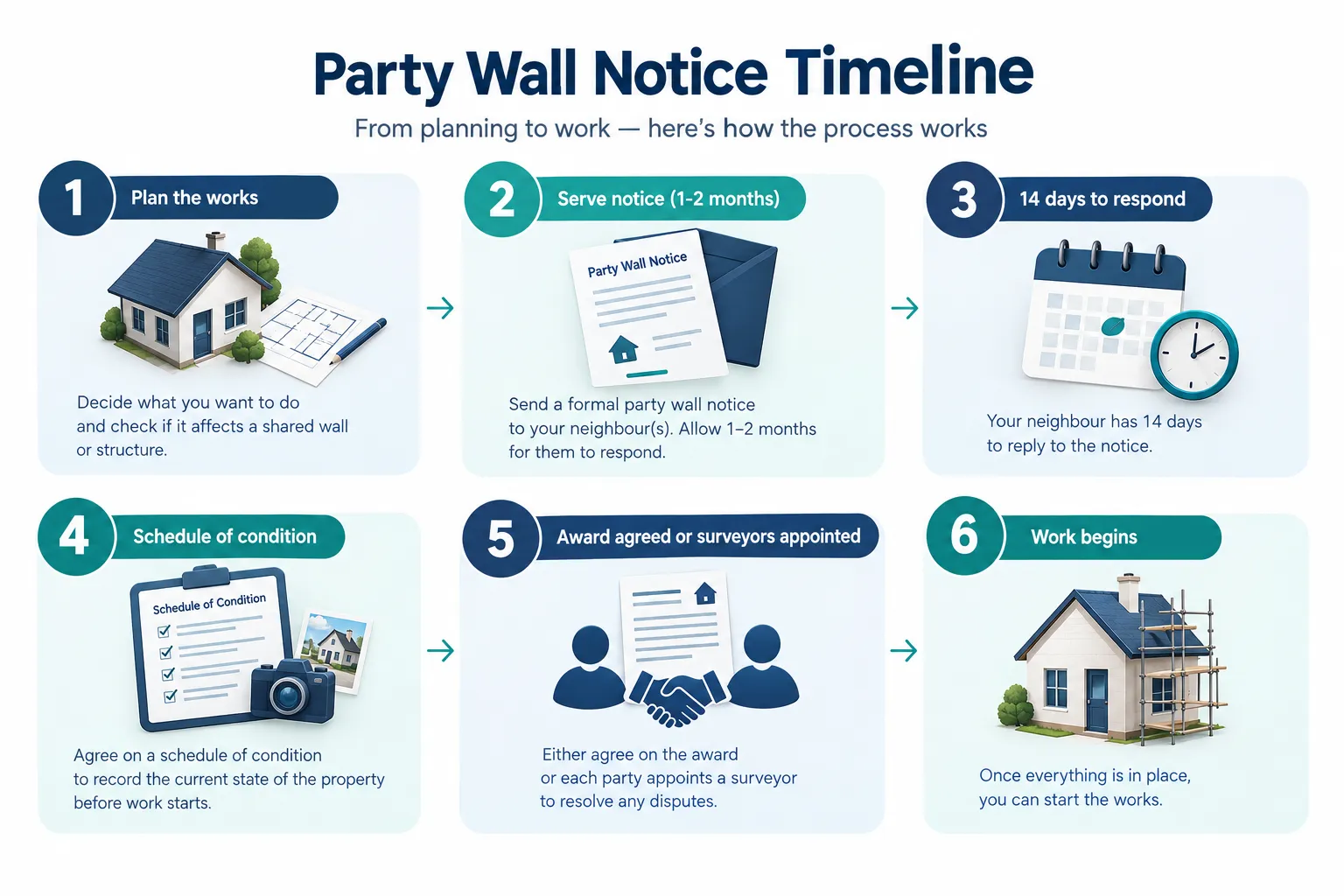
    Practical sequencing for an extend not move party wall London October 2026 project:

    1. Finalise structural drawings and identify affected neighbours.
    2. Serve the correct notice (Section 1, 2, or 6) with enough lead time.
    3. Allow the full 14-day response window.
    4. If dissent occurs, appoint a surveyor (agreed or two-surveyor route) promptly.
    5. Complete the schedule of condition before any work starts.
    6. Obtain the Party Wall Award before builders break ground.

    FAQ

    Does every extension need a party wall notice? No. Only work affecting a shared wall, boundary, or nearby excavation within the specified distances triggers the Act. A simple rear extension with no shared wall impact may not need notice.

    What happens if a neighbour ignores the notice? After 14 days with no response, it is treated as dissent, and the dispute resolution process with surveyors begins automatically.

    Can work start before the Award is finalised? No. Starting notifiable work without consent or an Award can lead to injunctions, legal costs, and forced removal of completed work.

    Who chooses the surveyor if there is a dispute? Each party can appoint their own surveyor, or both can agree on one shared surveyor. The two surveyors appoint a third if they cannot resolve a disagreement between themselves.

    How long does the whole process typically take? Straightforward cases with consent can conclude within the minimum notice period. Disputed cases involving two surveyors and an Award can take two to four months.

    Conclusion

    With London prices down 2.2% and stamp duty changes ruled out ahead of the 28 October Budget, extending rather than moving is increasingly the rational choice for London homeowners. But that choice carries legal obligations under the Party Wall etc. Act 1996 that cannot be skipped. Homeowners planning loft conversions, extensions, or basement work should identify affected neighbours now, serve the correct notice type, and build in time for the 14-day response window and possible surveyor appointment. Acting in October 2026, rather than waiting until the new year, is the surest way to keep a 2027 building project on schedule and legally sound.

  • London Homeowners Extending Instead of Moving: Party Wall Notices in October 2026

    London Homeowners Extending Instead of Moving: Party Wall Notices in October 2026

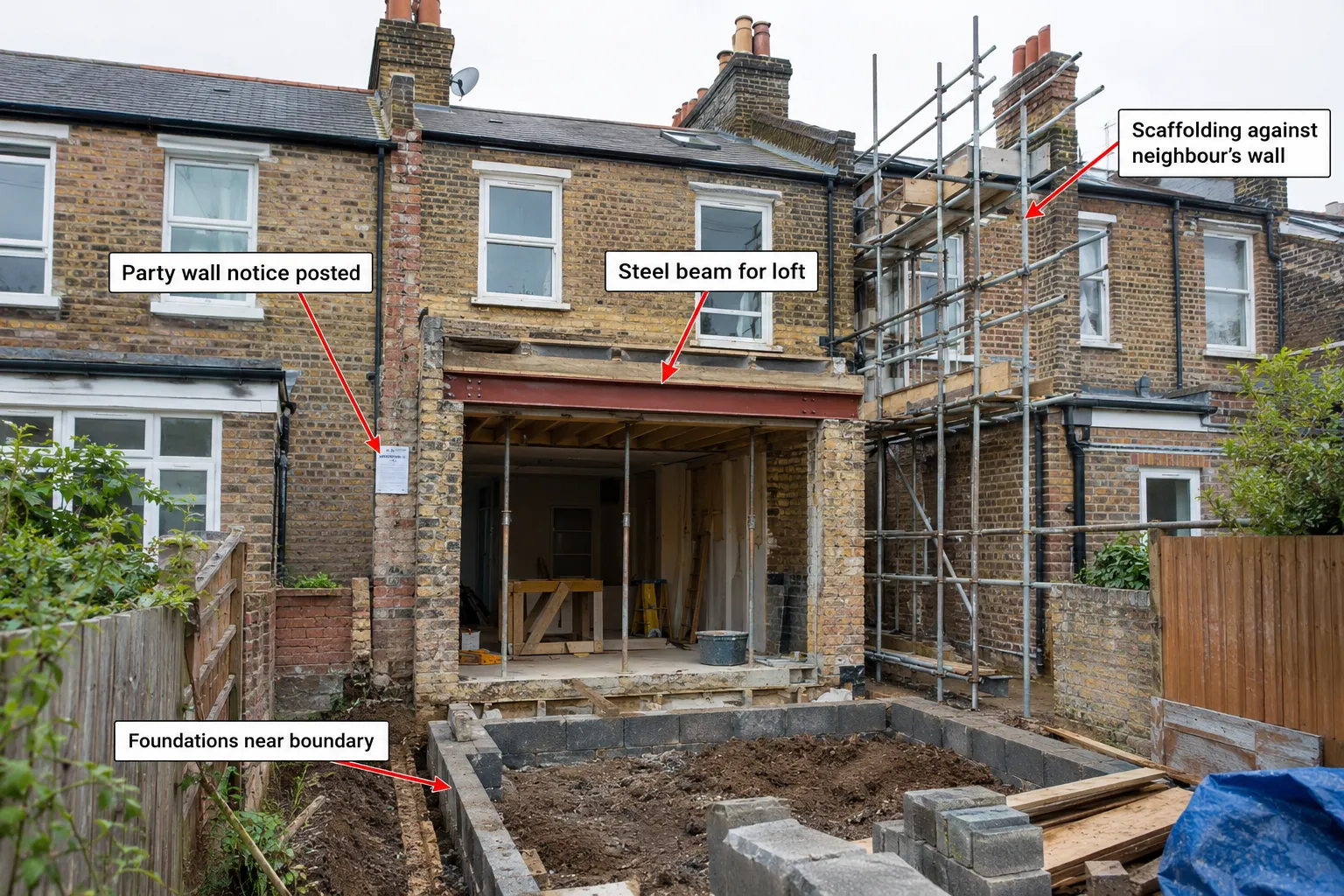
    Average London house prices fell for the eleventh month running in July 2026, according to the Office for National Statistics, and the typical property now sits £19,000 below where it stood a year earlier. That single fact, more than any marketing slogan, explains why skips, scaffolding and party wall notices are becoming a familiar sight on streets across the capital. When selling looks unattractive and borrowing is expensive, staying put and building up or out starts to make financial sense, and for most of those projects, the law requires a formal notice to the neighbours next door.

    This article looks at the trend of London homeowners extending instead of moving party wall notices 2026, why the sales market is pushing people towards building work, and what that means practically for anyone planning a rear extension, loft conversion or basement dig this autumn and winter.

    Key Takeaways

    • ONS data (16 September 2026) shows London’s average house price at £569,000 in July 2026, down 3.3% year-on-year and £19,000 below the July 2025 peak, a market backdrop that makes extending look more attractive than moving.
    • RICS’s September 2026 survey recorded a -32% house price net balance and an 18% fall in agreed sales, with London performing notably worse than the UK average.
    • Rising mortgage rates, average viewings per listing down 57% in two years, and a ruled-out stamp duty reform are all keeping homeowners in place rather than moving.
    • Most rear extensions, loft conversions and basement projects legally require Party Wall etc. Act 1996 notices, serving them late is one of the most common and costly planning mistakes.
    • Notice periods (one or two months) plus a 14-day response window mean notices should go out well before a builder is due on site.

    Why London Homeowners Are Extending Instead of Moving Party Wall Notices 2026

    The case for staying put is built from several overlapping pressures. ONS figures released on 16 September 2026 put the average London house price at £569,000 in July 2026, a 3.3% annual fall and the eleventh consecutive month of year-on-year decline, against a UK average of £273,000 that actually rose 1.4%. London is, unusually, moving in the opposite direction to the rest of the country. The next ONS house price release lands on 21 October 2026, and will be watched closely for signs of whether that run of falls continues.

    Why London Homeowners Are Extending Instead of Moving Party Wall Notices 2026

    RICS’s September 2026 survey, published 8 October, paints a similarly subdued picture: new buyer enquiries down 22%, agreed sales down 18%, and a house price net balance of -32% in current prices. RICS economist Tarrant Parsons noted that “a renewed rise in interest rate expectations has created a fresh headwind” for the market. London, the survey noted, has performed notably worse than the national average.

    Demand-side data backs this up. Analysis of Rightmove figures by Tembo (15 October 2026) found the average number of viewings per listing has fallen to just 1.7 in August 2026, down 57% from nearly four viewings two years earlier. Eighty-six per cent of estate agents reported homes selling below asking price. Mortgage rates are not helping either: the average two-year fix stood at 5.97% and the five-year at 5.99%, with nearly two million fixed-rate deals due to expire across 2026. Yorkshire Building Society data reported by Moneyfacts (14 October 2026) showed home-mover mortgage applications down 10.2% year-on-year between late June and late September 2026.

    Stamp duty is compounding the problem. HomeOwners Alliance research found that over 800,000 homeowners have shelved moving plans because of the tax, and the Prime Minister has ruled out reform ahead of the 28 October 2026 Budget, saying plainly: “That won’t be happening.” With moving costs fixed and sale prices soft, many households are turning their budgets inward instead.

    That shift mirrors wider renovation trends. Legal & General’s “Great Home Renovation” study of 2,000 UK homeowners who had renovated in the past year (reported November 2025) found almost half preferred improving their home to moving, with three in ten citing financial reasons for staying put and 77% funding work from savings. The UK home improvement sector was valued at £29.7 billion in 2024, up 5.1% on the year before. Separately, Propertymark warned on 13 October 2026 that the draft London Plan must turn housing ambition into actual homes, a reminder that denser development across the capital means more building work happening next to existing neighbours, not less.

    Which Projects Trigger the Party Wall etc. Act 1996

    Not every home improvement needs a party wall notice, but most of the popular ones in London terraces and semis do. The Party Wall etc. Act 1996 applies whenever work affects a shared structure, a boundary, or ground near a neighbour’s foundations. Common trigger projects include:

    • Rear extensions where new foundations are dug within 3 metres of a neighbour’s foundations, or deeper than them.
    • Loft conversions that cut into the party wall to support steel beams or install padstones.
    • Basement and lightwell digs, which almost always involve excavation close to, or below, next door’s footings.
    • Chimney breast removal, where the stack is shared between two properties.
    • New boundary walls built astride or up to the line of junction with a neighbour.

    Under the Act, excavation within 3 metres of a neighbour’s building, and deeper than their foundations, is notifiable, as is excavation within 6 metres if it falls within a 45-degree line drawn down from their foundations. Flats above and below a property can also count as adjoining owners, something that is easy to overlook in converted Victorian buildings.

    Timeline Planning for London Homeowners Extending Instead of Moving Party Wall Notices 2026

    Serving notice late is one of the easiest ways to derail a building schedule. Section 2 notices, covering works to an existing party wall or structure, require two months’ notice. Section 1 notices, for new walls at the boundary, and Section 6 notices, for adjacent excavation, each require one month. Once served, a neighbour has 14 days to respond, consent, dissent, or silence (which, after the notice period, is treated as a dispute requiring a surveyor).

    Given those timeframes, notices should ideally be served as soon as drawings are finalised, not once a contractor’s start date is confirmed. Builders booked for a January start, for example, should expect notices to go out well before November to allow for response time, any dissent, and the drafting of an award. For a full breakdown of what a valid notice must contain, see this guide to party wall notices and the explanation of how to serve a party structure notice in London.

    What Happens If a Neighbour Dissents

    A neighbour is entitled to dissent, and this is not unusual, particularly where excavation or structural steel is involved. Once that happens, the parties either agree to appoint a single “agreed surveyor” to act for both, or each appoints their own surveyor, who then select a third surveyor to resolve any disagreement between them. The surveyors produce a party wall award, which sets out the work permitted, any protective measures, and working hours. The building owner, the person carrying out the works, is almost always responsible for the reasonable surveyor fees on both sides, even where two surveyors are appointed. More detail on how awards work is covered in this party wall award and contract template guide, and the costs involved in the party wall process are worth budgeting for early.

    What Happens If a Neighbour Dissents

    Schedule of Condition: Protection for Both Sides

    A schedule of condition is standard practice before notifiable works begin, especially in terraced housing where vibration and settlement can travel between properties. It is a detailed photographic and written record of the adjoining property’s condition, cracks, cornices, floors, taken before work starts. If a dispute arises later about new cracking or damage, the schedule gives both the building owner and the adjoining owner independent evidence of the starting condition. It protects homeowners from unfair blame and protects neighbours from being left to prove damage without a baseline record.

    Common Mistakes to Avoid

    Several avoidable errors come up repeatedly in London party wall disputes:

    • Starting work before notices expire. Even with planning permission granted, works affecting a party wall cannot lawfully begin until the notice period has passed or an award is in place.
    • Assuming planning permission covers everything. Planning consent and building regulations are entirely separate from party wall consent; having one does not remove the need for the other.
    • Missing adjoining owners. In converted houses or blocks, this can mean notifying flats above and below, not just next door, and every leaseholder with an interest, not only the freeholder.
    • Skipping the schedule of condition. Without one, both sides are left arguing from memory if cracks appear later.
    • Treating the 14-day window loosely. Silence after the deadline is a dispute, not consent, and should trigger surveyor appointment promptly rather than being ignored.

    Homeowners in flats and converted properties should also check whether boundary or fence works fall under party wall or separate boundary wall rules, as the two are often confused. Those extending in different parts of the capital can find locally focused guidance, for example from party wall surveyors in East London or party wall surveyors in North London, reflecting the mix of Victorian terraces, conversions and new-build infill common in each area.

    What to Watch Next

    Three dates matter for anyone weighing up whether to move or extend. The ONS releases fresh house price data on 21 October 2026, which will show whether London’s run of annual price falls has reached a twelfth month. The Budget follows on 28 October 2026, where stamp duty reform has already been ruled out, but other housing or tax measures could still shift the moving-versus-improving calculation. The Bank of England’s November decision on interest rates will also influence mortgage pricing at a point when nearly two million fixed-rate deals are due to expire this year.

    Frequently Asked Questions

    Do I need a party wall notice for a loft conversion? Usually yes, if the work involves cutting into the party wall to insert steel beams or padstones for structural support. A straightforward loft conversion that does not touch the shared wall may not require one, but most do.

    How long before building work should I serve a party wall notice? Serve notices as soon as plans are finalised. Section 2 notices need two months, while Section 1 and Section 6 notices need one month, plus a 14-day response period and time to resolve any dissent.

    What if my neighbour ignores the notice? If there is no response within 14 days, this is treated as a dispute. Surveyors are then appointed to produce an award before work can lawfully proceed.

    Who pays for the party wall surveyor? The building owner carrying out the works typically pays reasonable surveyor fees, including where the adjoining owner appoints their own surveyor.

    Does planning permission remove the need for a party wall notice? No. Planning permission and party wall consent are separate legal processes, and both may be required for the same project.

    Conclusion

    A stalled London sales market, expensive mortgages, and a stamp duty system left untouched in the upcoming Budget are combining to make extending look more sensible than moving for many homeowners this autumn. But a cheaper alternative to moving is not a shortcut around the law: rear extensions, loft conversions, basement digs and chimney breast removals typically still require formal party wall notices, correct timing, and often a schedule of condition. Homeowners planning work should check early whether their project is notifiable, identify every adjoining owner, and build notice periods into their build programme rather than their contractor’s start date. Getting this right protects relationships with neighbours as much as it protects the build itself.

    party wall act 1996, party wall notices London, London house extensions, loft conversion rules, basement extension London, party wall surveyor, schedule of condition, London property market 2026, stamp duty reform, ONS house prices, RICS survey, home improvement trends