
Nearly 40% of homeowners who carry out extensions or loft conversions in England and Wales fail to serve the correct party wall notices before work begins, a costly oversight that can halt construction, trigger legal disputes, and expose building owners to compensation claims. Understanding the full scope of Extensions and Loft Conversions: Party Wall Notice, Agreement and Award Requirements Explained is not optional; it is a legal duty under the Party Wall etc. Act 1996 [7].
Whether a homeowner is adding a rear extension to a London terrace or converting a loft in a semi-detached property, the Act imposes clear obligations on the “building owner” (the person carrying out the works). Permitted development rights allow certain works without planning permission, but they do not remove party wall duties, a distinction that continues to catch homeowners off guard [5][6].
Key Takeaways
- The Party Wall etc. Act 1996 applies to extensions and loft conversions that affect shared walls, boundaries, or foundations within defined distances.
- Three distinct notice types exist: a Party Structure Notice, a Line of Junction Notice, and a Three/Six Metre Notice, each triggered by different types of work.
- Neighbours have 14 days to respond to a notice; failure to respond triggers a deemed dispute, requiring surveyor appointment.
- A Party Wall Award is a legally binding document that governs how works proceed; it is not the same as a party wall agreement.
- Permitted development rights do not override party wall obligations, both sets of rules apply independently.
What the Party Wall etc. Act 1996 Actually Covers
The Party Wall etc. Act 1996 is the sole statutory framework governing works to shared walls, boundary structures, and foundations in England and Wales. It applies to three categories of work, each governed by a different notice type:
- Works to an existing party wall or party structure (Section 2), cutting into, raising, underpinning, or inserting beams into a shared wall.
- New building at or on the boundary line (Section 1), erecting a new wall astride or adjacent to the boundary.
- Excavation near a neighbouring building (Section 6), digging foundations within 3 metres of a neighbour’s structure to a depth below their foundations, or within 6 metres under a 45-degree line.
For extensions and loft conversions, all three categories can be triggered simultaneously. A rear extension, for example, may involve new foundations close to the boundary (Section 6), a new wall on the boundary (Section 1), and structural work to the existing shared wall (Section 2) [1].
“Permitted development rights and party wall obligations are entirely separate legal regimes. Having one does not substitute for the other.” [5]
When Loft Conversions Trigger Party Wall Obligations
Loft conversions are among the most commonly misunderstood works in relation to party wall law. Many homeowners assume that because the works are “internal,” no notice is required. This is incorrect.
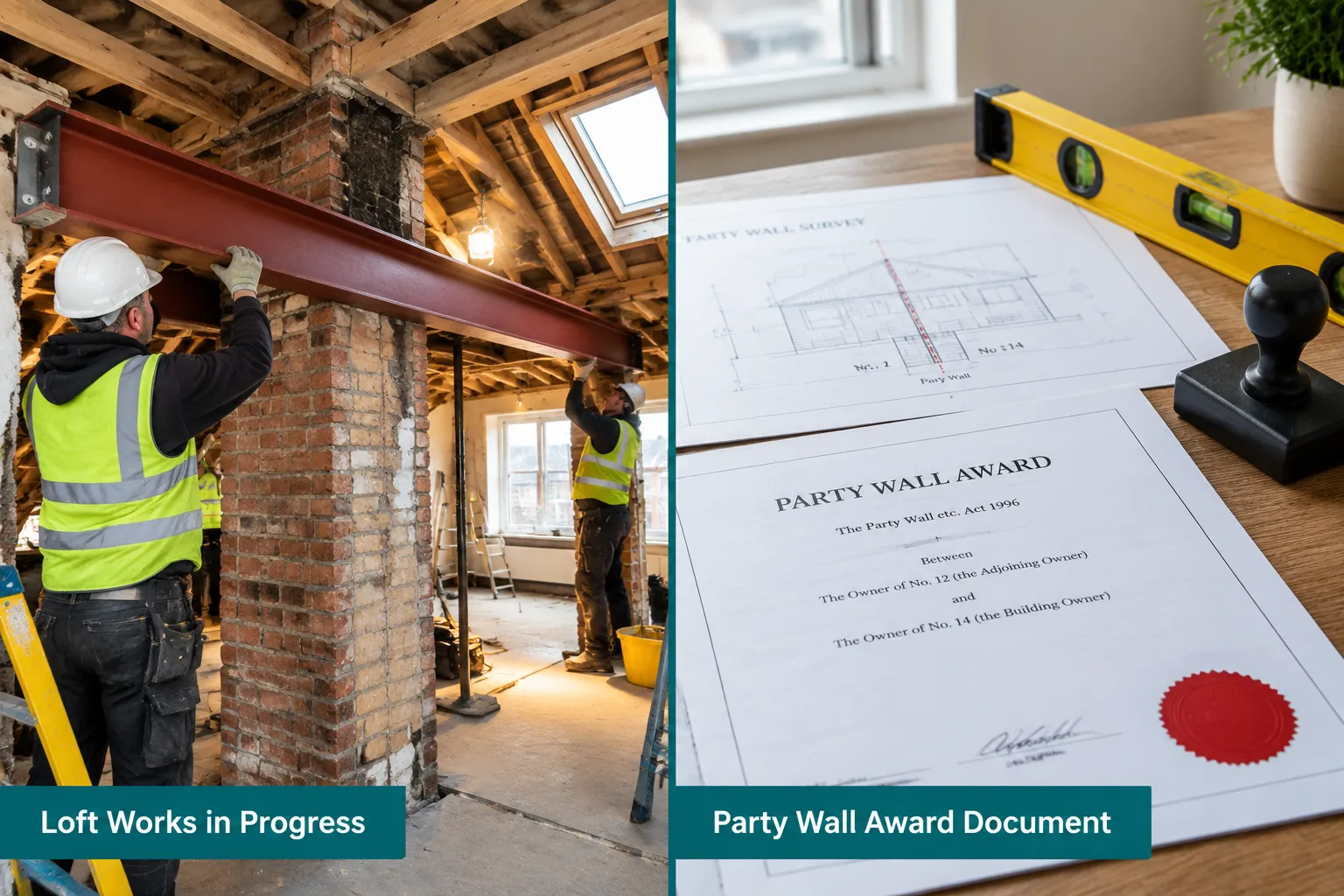
The following loft conversion activities are almost always notifiable under the Act [10]:
- Installing steel RSJ beams that bear on or are built into a party wall
- Raising the height of a party wall to accommodate a new roof structure
- Cutting into the party wall to form a new structural connection
- Inserting padstones or bearing plates into the shared wall
- Underpinning the party wall as part of structural alterations
In a typical London Victorian terrace, the party wall runs along the full depth of the property. Any loft conversion involving a steel beam spanning across the party wall, which is standard practice, will require a Party Structure Notice to be served on the adjoining owner before work begins [2].
Extensions and Loft Conversions: Party Wall Notice Types and Timeframes
Understanding which notice applies to which works is central to Extensions and Loft Conversions: Party Wall Notice, Agreement and Award Requirements Explained. Serving the wrong notice type, or no notice at all, does not make the works lawful; it simply means the building owner is proceeding without statutory protection.
| Notice Type | Relevant Section | Typical Trigger | Minimum Notice Period |
|---|---|---|---|
| Party Structure Notice | Section 2 | Steel beams in party wall, raising, cutting | 2 months |
| Line of Junction Notice | Section 1 | New wall on or at the boundary | 1 month |
| Three/Six Metre Notice | Section 6 | Excavation near neighbour’s foundations | 1 month |
How to Serve a Valid Party Wall Notice
The government’s official guidance on preventing and resolving party wall disputes sets out the minimum content requirements for a valid notice [7]. A notice must include:
- The name and address of the building owner
- The address of the property where works will take place
- A description of the proposed works
- The proposed start date
- A statement that it is served under the relevant section of the Party Wall etc. Act 1996
Notices must be served on every adjoining owner, which includes all registered proprietors of the neighbouring property. In a block of flats, this can mean serving multiple notices on different leaseholders and the freeholder. For a comprehensive overview of how party wall notices work and what they must contain, practitioners and homeowners should review the full statutory requirements carefully.
What Happens After a Notice Is Served
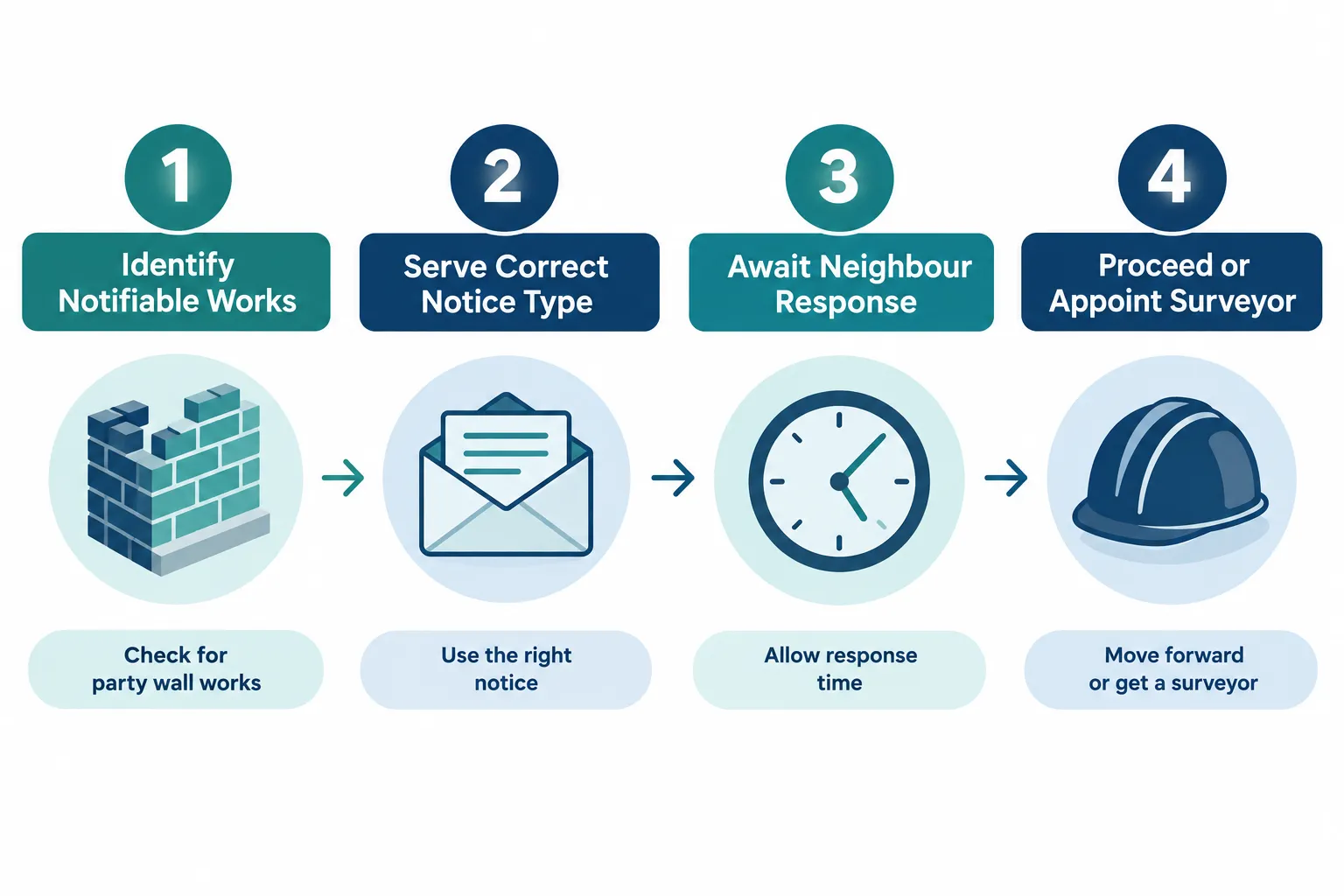
Once a valid notice is served, the adjoining owner has 14 days to respond in writing. Three outcomes are possible:
- Consent in writing, works may proceed after the notice period expires; no award is needed.
- Counter-notice (under Section 2 only), the adjoining owner requests additional works or modifications.
- Dissent or no response, a dispute is deemed to have arisen, triggering the surveyor appointment process.
If no response is received within 14 days, the Act deems a dispute to exist automatically. At that point, both parties must appoint surveyors, either an agreed single surveyor or one each, to produce a Party Wall Award [6].
For a detailed breakdown of how to respond to a notice as an adjoining owner, the guide on Party Wall Act notices, what they are and how to respond provides practical step-by-step guidance.
Party Wall Agreements and Awards: The Critical Distinction
One of the most persistent sources of confusion in Extensions and Loft Conversions: Party Wall Notice, Agreement and Award Requirements Explained is the difference between a party wall agreement and a party wall award. These are not interchangeable terms.
A party wall agreement is an informal, consensual arrangement between neighbours. It is not produced by surveyors and carries no statutory force beyond what the parties agree. It is only valid where both owners consent to the works without dispute.
A party wall award is a formal, legally binding document produced by appointed surveyor(s) under the Act. It sets out:
- The works permitted and how they must be carried out
- The hours during which works may take place
- Access rights for the building owner
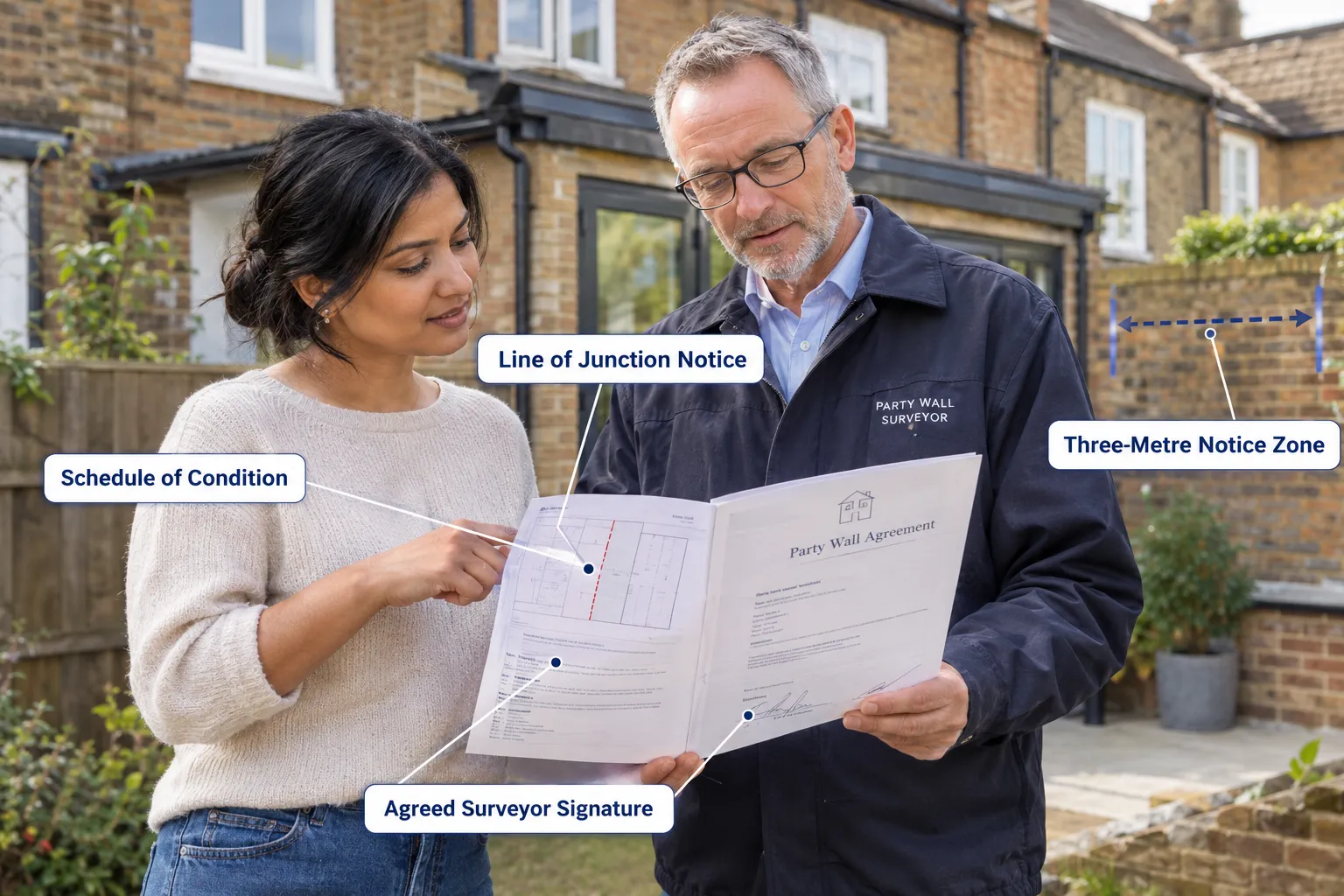
- A schedule of condition of the adjoining property (before works begin)
- Provisions for making good any damage caused
- Who bears the costs of the award
The award is enforceable in the county court. Either party may appeal it within 14 days of service, but the works may proceed while an appeal is pending unless the court orders otherwise [7].
For a thorough explanation of what a party wall award contains and how it is structured, the party wall awards resource provides authoritative detail. Homeowners who want to understand the template format before engaging surveyors may also find the party wall contract template guide on party wall awards a useful starting point.
Can Homeowners Proceed Without a Surveyor?
In some circumstances, where both parties consent and the works are straightforward, it is possible to document the agreement without appointing a surveyor. However, this approach carries significant risk, particularly for loft conversions involving structural works to a shared wall. Without a schedule of condition, there is no baseline record of the neighbouring property’s pre-works state, which makes resolving any damage claims extremely difficult [10].
For homeowners exploring this route, the guide on having a party wall agreement without a surveyor outlines both the process and the risks involved.
Practical Scenarios: London Terraces and Semi-Detached Properties
The following scenarios illustrate how party wall obligations play out in the most common residential contexts in London.
Scenario 1: Rear Extension on a Victorian Terrace
A homeowner in North London plans a single-storey rear extension with new strip foundations extending 1.2 metres below ground level. The neighbouring property’s foundations are at 0.9 metres. Because the new foundations will be deeper than the neighbour’s within 3 metres, a Three Metre Notice under Section 6 is required. If the new side wall is to be built astride the boundary, a Line of Junction Notice under Section 1 is also needed. Both notices must be served at least one month before work starts [1].
A party wall surveyor in North London can advise on the specific notice requirements based on the structural drawings.
Scenario 2: Loft Conversion on a Semi-Detached Property
A homeowner in South London is converting a loft with a hip-to-gable extension. The works involve:
- Raising the party wall gable by 600mm
- Installing two steel RSJ beams bearing on the party wall
- Cutting pockets into the party wall for padstones
All three elements require a Party Structure Notice under Section 2, served at least two months before work begins. If the neighbour dissents or fails to respond within 14 days, surveyors must be appointed and an award produced before any structural work to the party wall can commence [2][10].
A party wall surveyor in South London familiar with the typical construction of Victorian and Edwardian semis can prepare the notice and, if needed, act as agreed surveyor for both parties.
Scenario 3: Basement Extension Beneath an Extension
Basement extensions beneath rear additions are increasingly common in London. These almost always trigger Section 6 notices due to the depth of excavation required. In some cases, right to light concerns also arise, particularly where a new extension or raised loft reduces natural light to a neighbouring habitable room [2].
“Right to light disputes are increasingly being identified during party wall surveys on loft extensions, adding a layer of complexity that surveyors must address proactively.” [2]
Costs, Timeframes, and Common Pitfalls
Typical Costs
Party wall surveyor costs vary depending on the complexity of the works and whether one or two surveyors are appointed. As a general guide:
- Agreed surveyor (both parties): Lower overall cost; typically suitable for straightforward works
- Two surveyors (one each): Higher cost; the building owner typically bears both fees unless the adjoining owner’s surveyor acts unreasonably
- Third surveyor: Appointed only if the two party surveyors cannot agree; rarely needed
For a detailed breakdown of what drives party wall costs and how to manage them, the guide on how to keep party wall costs down offers practical strategies.
Common Pitfalls to Avoid
- Serving notice too late: The two-month notice period for Section 2 works is a minimum. Serving notice after works have started is a breach of the Act.
- Incomplete notice content: A notice that omits the proposed start date or a description of works is invalid and must be re-served, resetting the clock.
- Failing to identify all adjoining owners: In leasehold properties, both the leaseholder and the freeholder may be “adjoining owners” under the Act.
- Assuming consent means no award is needed: Consent removes the need for an award, but only if given in writing within the 14-day response period.
- Ignoring counter-notices: A counter-notice must be responded to within one month; failure to do so can create further delays.
Forthcoming Changes to Professional Standards
RICS is currently finalising the 8th edition of its Party Wall Legislation and Procedure guidance, following a formal consultation process [4]. Expert commentary in 2026 suggests the updated guidance will tighten standards on the content and service of notices, and clarify the obligations of surveyors when producing awards for complex structural works such as loft conversions [2][4]. Building owners and their surveyors should monitor these updates, as revised professional standards will influence best practice expectations across the industry.
Conclusion
Extensions and loft conversions are among the most significant investments a homeowner can make, and the party wall process is a legal safeguard that protects both the building owner and their neighbours. The core requirements of Extensions and Loft Conversions: Party Wall Notice, Agreement and Award Requirements Explained are clear: identify the correct notice type, serve it within the required timeframe, and respond appropriately to the neighbour’s reply.
Actionable next steps for homeowners planning works in 2026:
- Obtain structural drawings early, party wall obligations cannot be assessed without knowing the depth of foundations and the structural connection to the party wall.
- Identify all adjoining owners before serving any notice, including freeholders and leaseholders in leasehold properties.
- Serve the correct notice type at least one month (Sections 1 and 6) or two months (Section 2) before the proposed start date.
- Do not assume consent, if no written response is received within 14 days, a dispute is deemed to exist and surveyors must be appointed.
- Engage a qualified party wall surveyor for any loft conversion involving steel beams, wall raising, or cutting into the party wall, the schedule of condition alone is worth the cost.
- Keep costs proportionate by exploring the agreed surveyor route where both parties are cooperative and the works are well-defined.
The party wall process exists to enable works to proceed, not to prevent them. Approached correctly and early, it protects everyone involved.
References
[1] London Party Wall Extensions 2026 Rules Disputes And Neighbour Rights Explained – https://princesurveyors.co.uk/blog/london-party-wall-extensions-2026-rules-disputes-and-neighbour-rights-explained/
[2] Party Wall Surveys For Right To Light Disputes In 2026 Loft Extensions Rics Protocols Post Planning Reforms – https://princesurveyors.co.uk/blog/party-wall-surveys-for-right-to-light-disputes-in-2026-loft-extensions-rics-protocols-post-planning-reforms/
[4] Rics Launches Consultation On Updated Party Wall Practice Guidance – https://www.rics.org/news-insights/rics-launches-consultation-on-updated-party-wall-practice-guidance
[5] Permitted Development Guide – https://hoa.org.uk/advice/guides-for-homeowners/i-am-improving/permitted-development-guide/
[6] Party Wall Agreement – https://hoa.org.uk/advice/guides-for-homeowners/i-am-improving/party-wall-agreement/
[7] Preventing And Resolving Disputes In Relation To Party Walls – https://www.gov.uk/government/publications/preventing-and-resolving-disputes-in-relation-to-party-walls
[10] Party Wall Agreement Loft Conversion – https://www.houseup.co.uk/news/party-wall-agreement-loft-conversion