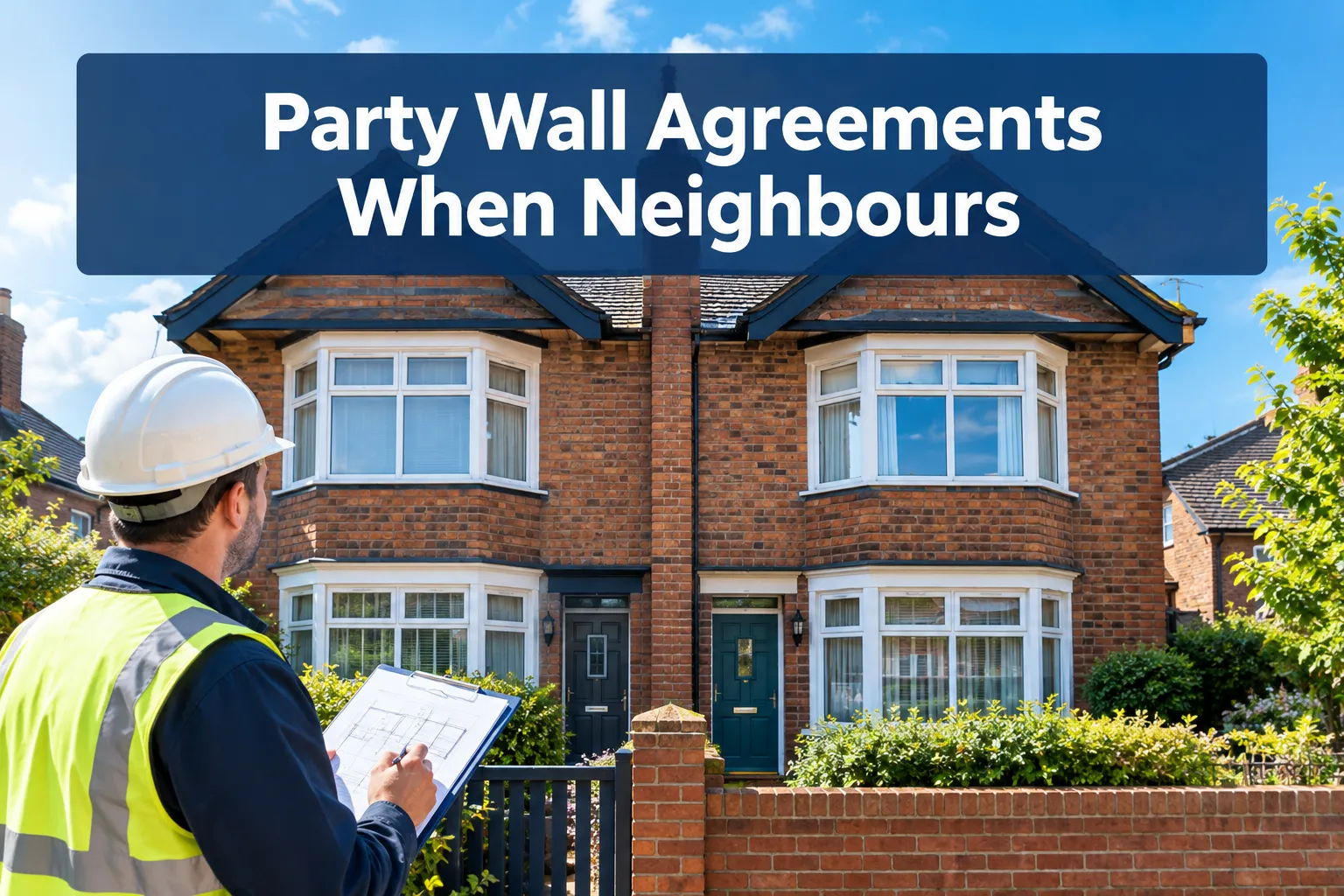
Nearly 40% of party wall matters in England and Wales are resolved without a formal dispute ever arising, yet many building owners still assume the process must be adversarial, expensive, and slow. Party Wall Agreements When Neighbours Consent Upfront: Streamlined Routes Without a Dispute represent one of the most practical and underused efficiencies within the Party Wall etc. Act 1996. When a neighbour gives written consent promptly after receiving a valid notice, the entire process can be compressed into weeks rather than months, without sacrificing the legal protections the Act was designed to provide [3].
Understanding exactly how that streamlined route works, and where it can still go wrong, is essential for any building owner planning works in 2026.
Key Takeaways
- A neighbour’s written consent within 14 days of receiving a party wall notice removes the need for a formal party wall award, but the notice itself remains legally mandatory.
- Consent does not waive the adjoining owner’s statutory rights; the building owner must still follow the Act’s procedures and avoid unnecessary damage.
- Even on a consent route, a schedule of condition and a written record of agreed works are strongly advisable to prevent disputes arising mid-build.
- A formal party wall award is still recommended when works are complex, when the boundary situation is unclear, or when either party has concerns about damage.
- The 2026 RICS consultation on updated party wall practice guidance signals better communication standards ahead, without changing the underlying law.
What the Party Wall etc. Act 1996 Actually Requires
The Party Wall etc. Act 1996 is the statutory framework governing works to shared walls, boundary structures, and excavations near neighbouring buildings in England and Wales [6]. It applies to three broad categories of work:
- Works to an existing party wall or party structure (for example, cutting into a wall to insert a steel beam, raising the height of a shared wall, or underpinning)
- Building a new wall on or at the boundary line between two properties
- Excavations within 3 or 6 metres of a neighbouring structure, depending on depth [5]
For each category, the building owner must serve a formal written notice on every adjoining owner before work begins. The notice periods vary: two months’ notice is required for party structure works and new walls on the line of junction, while excavation notices require one month [5].
Understanding what party wall notices are and how to respond to them is the essential first step before any consent conversation takes place.
“The Act is designed to facilitate building works while protecting the interests of adjoining owners, not to obstruct reasonable development.”, RICS Consumer Guide to Party Walls [2]
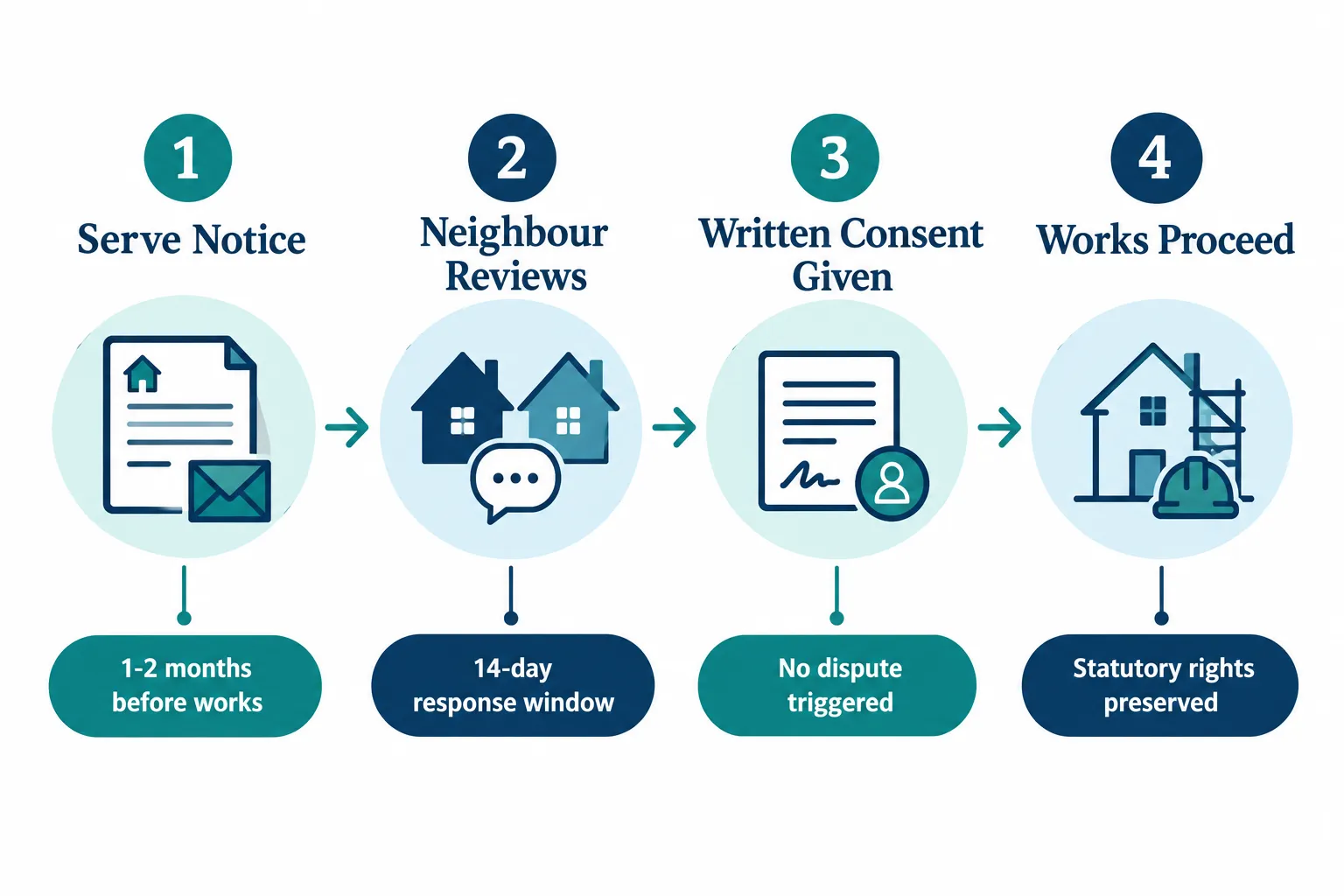
Once a valid notice is served, the adjoining owner has 14 days to respond. Their options are:
| Response | Outcome |
|---|---|
| Written consent | Consent route, no award needed |
| No response within 14 days | Deemed dispute, surveyors appointed |
| Written dissent | Dispute, surveyors appointed |
The consent route is the subject of this article. It is the fastest and least costly path available under the Act [3].
How the Consent Route Works: Party Wall Agreements When Neighbours Consent Upfront
When an adjoining owner gives written consent within the 14-day window, a formal party wall award is not required. Works may proceed once the notice period expires, provided the building owner carries out the notifiable works in accordance with the Act [3].
This is the core of Party Wall Agreements When Neighbours Consent Upfront: Streamlined Routes Without a Dispute, the building owner and adjoining owner reach an informal but legally significant agreement without appointing surveyors or producing a formal award document.
What “Written Consent” Must Include
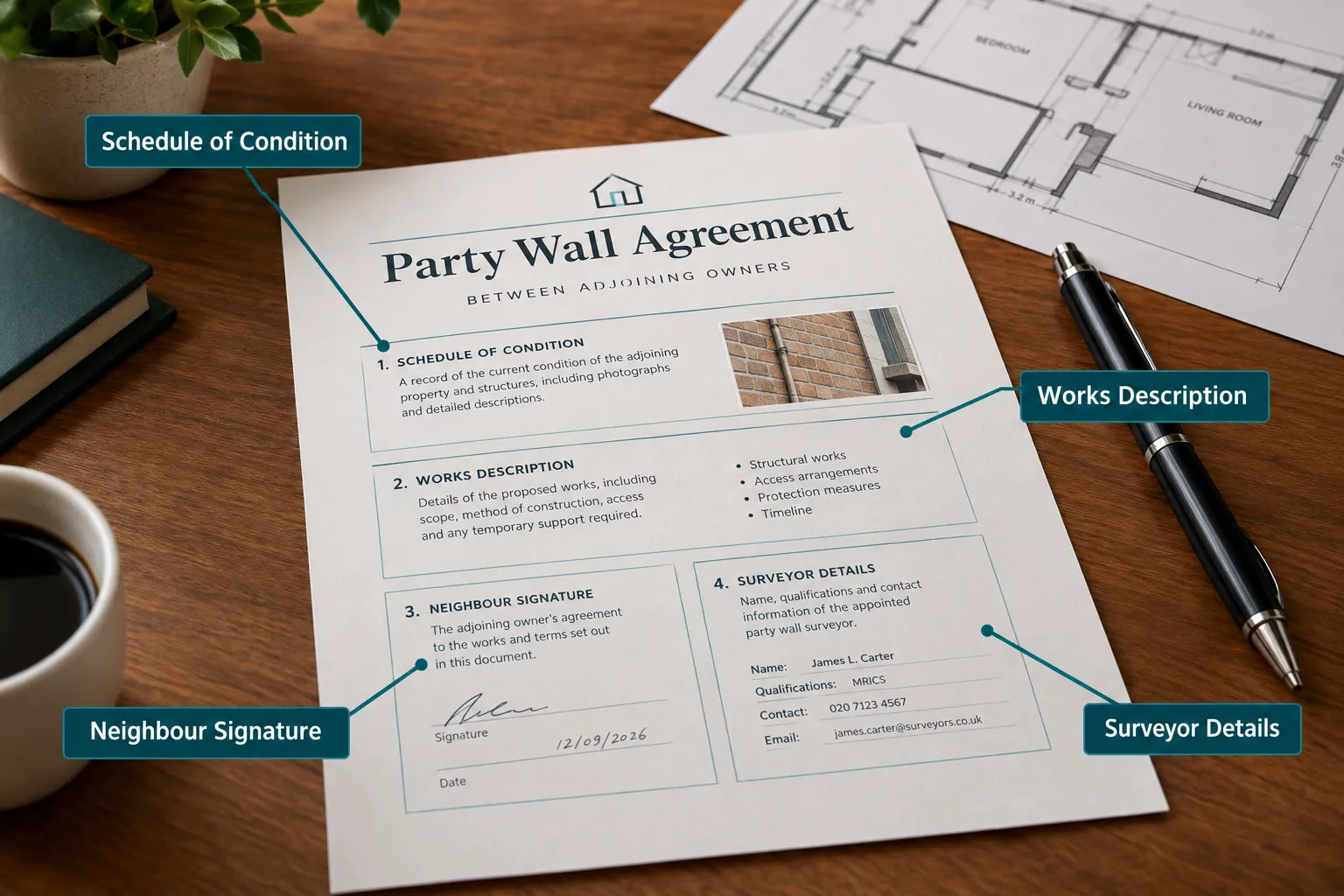
The Act does not prescribe a rigid format for consent, but best practice requires that the consent:
- Identifies the notice it is responding to (by date and description of works)
- Is signed by the adjoining owner or their authorised representative
- Is unconditional, conditional consent can create ambiguity
- Is retained by both parties as a permanent record
A free sample party wall agreement template can help building owners and their neighbours structure this documentation correctly from the outset.
What Consent Does Not Remove
A common misconception is that written consent from a neighbour removes all obligations under the Act. It does not. The building owner remains legally required to:
- Carry out only the works described in the notice
- Avoid unnecessary inconvenience to the adjoining owner
- Make good any damage caused to the adjoining property
- Provide adequate security if required
- Comply with any reasonable hours of working [5]
The adjoining owner retains the right to appoint a surveyor at any point if damage occurs or the building owner exceeds the scope of the notified works. Consent is not a blank cheque [2].
Consent vs. Party Wall Award: Knowing When a Formal Award Is Still Advisable
The distinction between a consent-based arrangement and a formal party wall award is one of the most important practical decisions in the entire process. Party Wall Agreements When Neighbours Consent Upfront: Streamlined Routes Without a Dispute are efficient, but they are not always the safest option for either party.

When the Consent Route Is Appropriate
The consent route works well when:
- Works are straightforward (for example, a standard loft conversion or single-storey rear extension)
- The party wall is in good condition and unlikely to be significantly affected
- Both parties have a cooperative relationship and clear communication
- The building owner is using a reputable, experienced contractor
In these circumstances, having a party wall agreement without a surveyor is a realistic and legally sound option.
When a Formal Party Wall Award Remains Advisable
Despite upfront consent, a formal party wall award, produced by an agreed or appointed surveyor, offers protections that a simple consent letter cannot replicate. A formal award should still be considered when:
- Works are complex or high-risk: deep excavations, underpinning, or significant structural alterations to a shared wall
- The party wall is in poor condition: pre-existing cracks or structural weakness mean damage attribution disputes are likely
- The boundary is unclear: disputes about the exact line of junction can arise mid-build without a surveyor’s input
- Either party is risk-averse: a formal award is enforceable in the county court; a consent letter is not a court-enforceable document in the same way [4]
- The adjoining property is tenanted or has multiple owners: ensuring all parties have consented correctly is more complex
A party wall contract template and guide on party wall awards provides a clear overview of what a formal award contains and why it offers stronger protection in complex cases.
The Schedule of Condition: A Non-Negotiable Best Practice
Whether or not a formal award is produced, a schedule of condition should always be prepared before works begin. This is a photographic and written record of the adjoining property’s condition at the time works commence. It serves one critical purpose: if damage is alleged after works finish, the schedule of condition shows what was pre-existing and what is new.
Without a schedule of condition, even the most cooperative neighbour relationship can deteriorate rapidly once cracks appear in a shared wall.
Practical Steps to Streamline a No-Dispute Party Wall Route
The following process represents best practice for building owners seeking to use Party Wall Agreements When Neighbours Consent Upfront: Streamlined Routes Without a Dispute effectively in 2026.
Step 1: Identify All Notifiable Works Early
Before any drawings are finalised, confirm which elements of the proposed works trigger the Act. This is not always obvious, for example, the difference between a party fence wall and a boundary wall affects whether the Act applies at all. Reviewing the types of party wall works that trigger notice obligations at this stage prevents costly delays later.
Step 2: Communicate With Neighbours Before Serving Notice
Informal early communication significantly increases the likelihood of upfront consent. Sharing plans informally, explaining the scope of works, and answering questions before serving the formal notice builds trust and reduces the chance of a reflexive dissent.
Step 3: Serve a Clear, Complete Notice
A poorly drafted notice is one of the most common reasons neighbours dissent or fail to respond. The notice must:
- Describe the works clearly and in sufficient detail
- State the proposed start date
- Be served on all adjoining owners (including any mortgagees in some circumstances)
- Allow the correct statutory notice period [5]
Step 4: Request Written Consent Promptly
Once the notice is served, follow up with the adjoining owner before the 14-day window expires. Provide a simple consent form for them to sign and return. Keep a copy of the signed consent alongside the original notice.
Step 5: Prepare a Schedule of Condition
Commission a schedule of condition of the adjoining property before any works begin. This can be done by a party wall surveyor, a building surveyor, or even, for straightforward cases, by the building owner and neighbour jointly, using a detailed photographic record.
Step 6: Carry Out Works Within the Notified Scope
Any variation to the works that affects the party wall or boundary must be re-notified. Do not assume that consent to the original works covers additional or altered works.
Step 7: Make Good Any Damage Promptly
If any damage occurs during works, address it immediately and document the repair. Prompt action prevents minor issues from escalating into formal disputes after the fact.
The 2026 Regulatory Landscape: Refinement, Not Revolution
The legal framework governing party wall matters in England and Wales has remained stable since the Party Wall etc. Act 1996 came into force. There is no current legislation to replace or significantly amend it [6].
However, RICS launched a consultation in 2025 on updated party wall practice guidance, signalling a move toward clearer professional standards and better communication practices between surveyors and the parties they serve [8]. The direction of travel in 2026 is toward:
- Improved transparency in how surveyors communicate fees and timelines
- Stronger guidance on the use of agreed surveyors to reduce costs
- Better documentation standards for consent-based arrangements
- Clearer protocols for schedules of condition
This is a refinement of practice, not a change in the law. The 14-day consent window, the notice periods, and the statutory rights of adjoining owners all remain unchanged [4].
For building owners in London, local expertise matters. Whether the project is in West London, North London, or South London, a surveyor familiar with local property types and boundary conventions can help facilitate the consent route efficiently.
Interaction With Planning Permission and Building Regulations
Party wall consent operates entirely independently of planning permission and building regulations approval. Obtaining planning consent does not remove the obligation to serve party wall notices, and a neighbour’s party wall consent does not constitute planning approval.
Building owners should ensure all three regimes are addressed in parallel:
- Planning permission (where required)
- Building regulations approval (for structural works)
- Party wall notices and consent (for notifiable works under the 1996 Act)
Conflating these processes is a common and costly mistake [5].
Keeping Costs Down on the Consent Route
One of the principal advantages of the consent route is cost. When neighbours consent upfront, neither party needs to appoint a surveyor, and no party wall award fee is incurred. The costs of the party wall process can be significant when a dispute arises, typically several hundred to several thousand pounds per surveyor, depending on complexity.
Practical steps to keep party wall costs down include:
- Pursuing the consent route wherever genuinely appropriate
- Using an agreed surveyor (a single surveyor acting for both parties) when a formal award is needed
- Preparing clear, detailed notices to avoid re-service
- Addressing neighbour concerns early to prevent dissent
The consent route is not just faster, it is typically the most cost-effective outcome for both parties [7].
Conclusion
Party Wall Agreements When Neighbours Consent Upfront: Streamlined Routes Without a Dispute offer a legally sound, cost-effective, and time-efficient alternative to the full dispute resolution process under the Party Wall etc. Act 1996. The route is available to any building owner whose neighbour provides written consent within 14 days of receiving a valid notice, and it is more achievable than many assume when the groundwork is laid correctly.
Actionable next steps for building owners in 2026:
- Identify all notifiable works before finalising designs and consult the Act’s explanatory guidance if uncertain about scope.
- Speak informally with neighbours before serving formal notice, early communication is the single most effective way to secure upfront consent.
- Serve a clear, complete, and correctly timed notice using a reliable template.
- Obtain written consent in a signed, dated document and retain it permanently.
- Always prepare a schedule of condition before works begin, regardless of how cooperative the relationship appears.
- Seek professional advice whenever works are complex, the boundary is unclear, or either party has reservations, a formal party wall award remains the gold standard for high-risk projects.
The consent route is not a shortcut around the law. It is the law working exactly as Parliament intended: enabling reasonable building works to proceed efficiently while protecting the rights of everyone affected.
References
[1] Party Walls – rics.org
[2] Rics Consumer Guide Party Walls 1 – chpk.co.uk
[3] Reaching Agreement With Neighbours – gov.uk
[4] Party Wall Legislation And Procedure – rics.org
[5] The Party Wall Etc Act 1996 Explanatory Booklet – gov.uk
[6] legislation.gov.uk – legislation.gov.uk
[7] Party Walls Consumer Guide 2022 – rics.org
[8] Rics Launches Consultation On Updated Party Wall Practice Guidance – rics.org