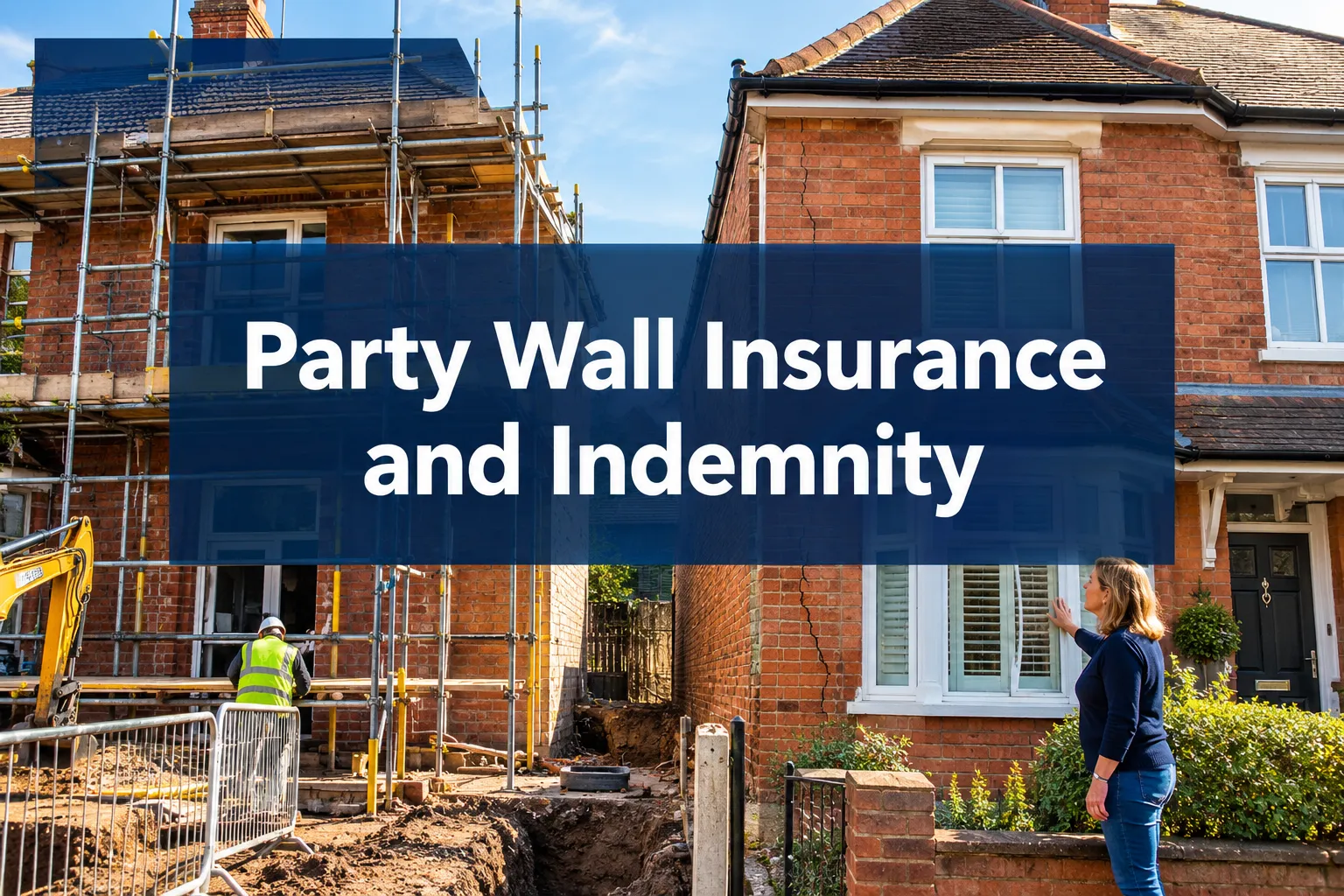
Structural cracks appearing on an interior wall after a neighbour begins a loft conversion are among the most stressful discoveries a homeowner can make, and they are far more common than most people realise. Understanding the intersection of party wall insurance and indemnity, the statutory framework under the Party Wall etc. Act 1996, and the practical claim routes available is essential for any adjoining owner facing this situation in 2026.
This article breaks down how insurance, indemnity clauses, and the Party Wall Award interact when damage occurs, who bears the financial responsibility, and how a properly prepared schedule of condition can be the difference between a swift settlement and a protracted legal dispute.
Key Takeaways
- The building owner is legally responsible under section 7(2) of the Party Wall etc. Act 1996 for compensating any loss or damage caused by their works, even when procedures were correctly followed.
- A schedule of condition prepared before works begin is the single most powerful piece of evidence an adjoining owner can use to support a compensation claim.
- A Party Wall Award issued by appointed surveyors is a binding legal document that sets out the works permitted, the access rights, and the obligation to make good any damage.
- Compensation can cover direct repair costs, professional fees, loss of value, and landscape or garden restoration, not just visible cracks.
- If no party wall notice was served, the adjoining owner can still invoke the Act’s dispute provisions and pursue a claim through the statutory framework or common law.
The Legal Foundation: Who Is Responsible When Damage Occurs?
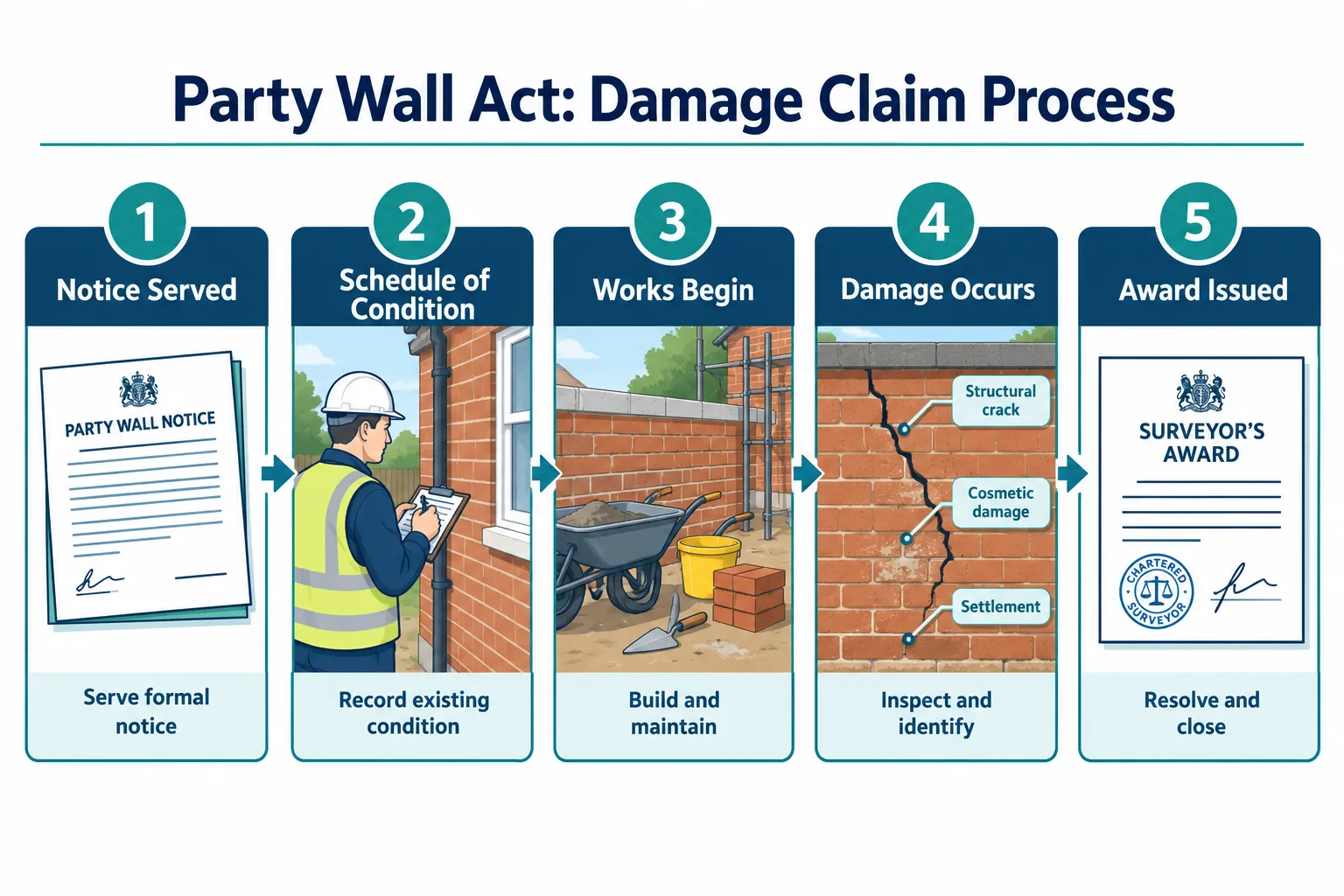
The Party Wall etc. Act 1996 places a clear statutory duty on the “building owner”, the person carrying out the works, to protect the adjoining owner’s property throughout the construction process. Section 7(2) of the Act states that the building owner must compensate the adjoining owner and any other person for any loss or damage arising as a consequence of the works. Critically, this liability applies even when the building owner has followed every procedural step correctly [2].
This is a strict liability provision in practical terms. The adjoining owner does not need to prove negligence; they need only demonstrate that the damage was caused by the notifiable works. The GOV.UK guidance on party walls confirms that the building owner is responsible for making good any damage caused to the adjoining property, or for paying compensation if making good is not practicable [6].
What Works Trigger the Party Wall Act?
Not every construction activity at a shared boundary requires formal notice. GOV.UK guidance confirms that written notice must be given before:
- Carrying out work on an existing party wall or party structure, such as cutting into it, raising it, or underpinning it
- Building on or at the boundary line between two properties
- Excavating below and near the foundation level of a neighbour’s property [7]
Minor works such as plastering, drilling for shelves, or inserting plugs do not require notice [3]. For a full breakdown of notifiable activities, the guide on types of party wall works provides a useful reference.
Understanding whether works are notifiable is the first step. If they are, the statutory protections, including the indemnity provisions, are engaged automatically.
How the Party Wall Award Interacts with Insurance and Indemnity
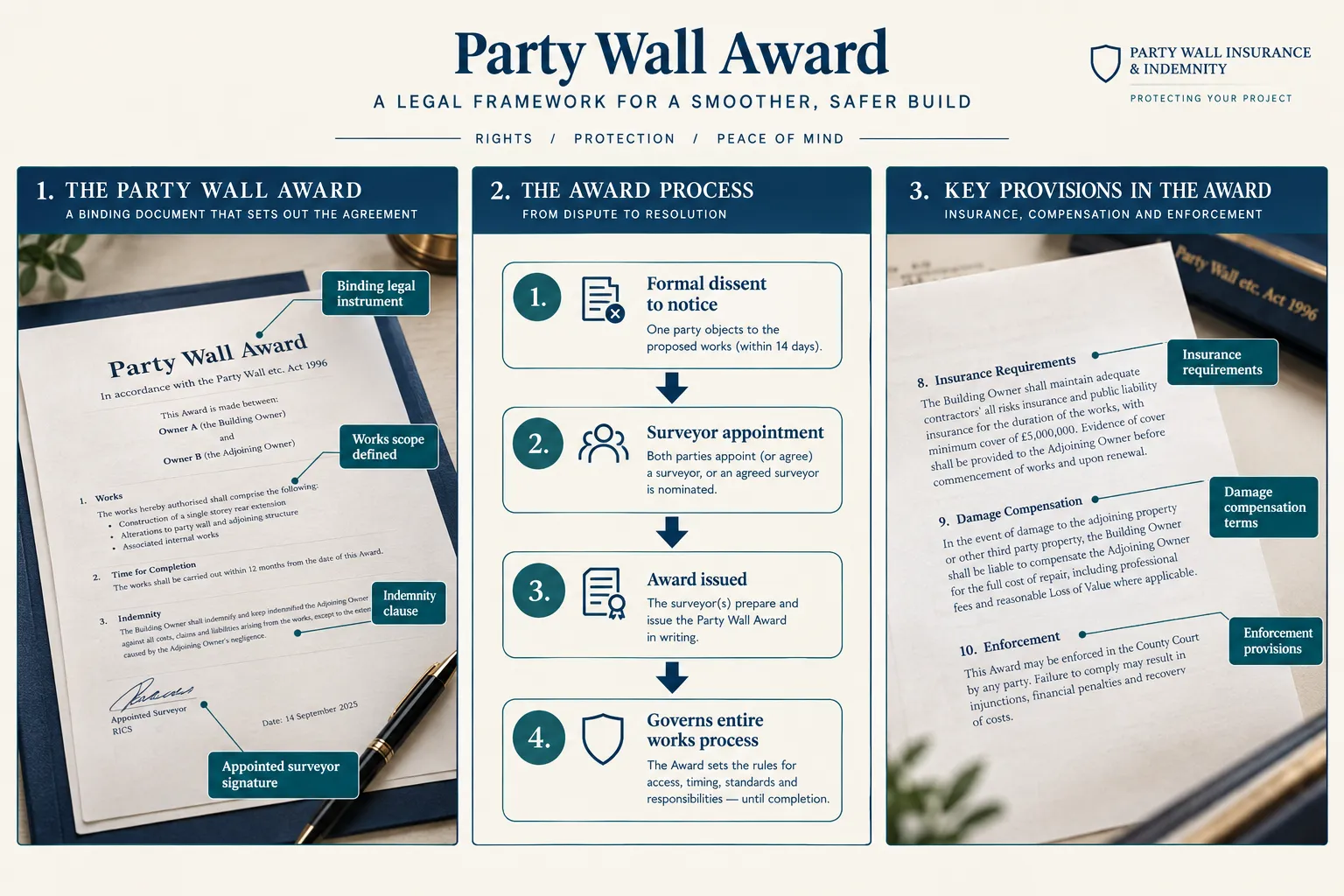
The Party Wall Award is the central document in any dispute or damage claim. It is issued by the appointed surveyor or surveyors after a formal dissent to a party wall notice, and it functions as a binding legal instrument that governs the entire works process [2].
What the Party Wall Award Contains
A well-drafted Party Wall Award will typically address:
| Element | Purpose |
|---|---|
| Description of permitted works | Defines the scope of what the building owner may carry out |
| Schedule of condition | Records the pre-works state of the adjoining property |
| Access rights | Sets out when and how the building owner may access the adjoining property |
| Making good obligations | Specifies how damage must be repaired or compensated |
| Security for expenses | May require the building owner to deposit funds before works begin |
The Party Wall Awards process exists precisely to create this documented framework. Without it, disputes become far harder to resolve.
The Schedule of Condition: Your Most Important Protection
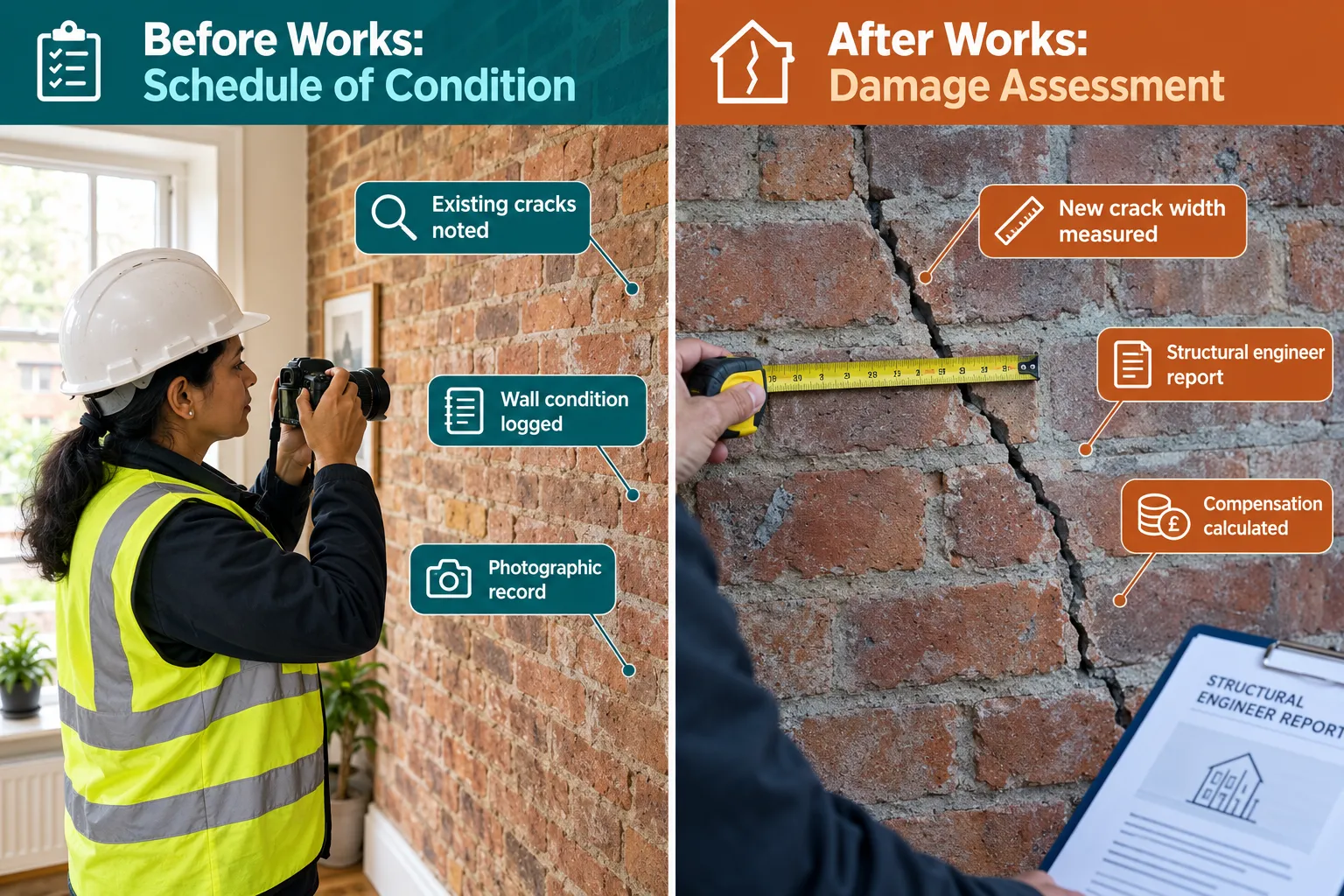
A schedule of condition is a detailed photographic and written record of the adjoining property’s state immediately before works begin. It is typically prepared by the adjoining owner’s surveyor and appended to the Party Wall Award.
Its importance cannot be overstated. When cracks or other damage appear after works begin, the schedule of condition provides the baseline against which new damage is measured. Without it, a building owner can argue that a crack was pre-existing, making it significantly harder for the adjoining owner to establish causation and claim compensation.
“A schedule of condition is not merely a procedural formality, it is the evidentiary foundation of any successful damage claim under the Party Wall etc. Act 1996.”
Insurance and the Building Owner’s Obligations
The building owner’s standard buildings insurance policy may or may not cover damage caused to a neighbour’s property. Many policies exclude third-party property damage arising from construction works, which is why specialist party wall insurance, sometimes called contractor’s liability or adjacent property insurance, is often required.
From the adjoining owner’s perspective, the key point is that the building owner’s insurance arrangements do not affect the statutory liability owed under section 7(2). Whether or not the building owner has adequate insurance, they remain personally liable to compensate the adjoining owner for damage caused. If the building owner’s insurer declines the claim, the adjoining owner can still pursue the building owner directly through the party wall dispute mechanism or, where necessary, through the courts.
The RICS consumer guidance on party walls also notes that chartered surveyors acting in party wall matters must maintain adequate professional indemnity insurance [10]. This matters for adjoining owners because if a negligent surveyor appointment contributes to loss, for example, by failing to prepare an adequate schedule of condition, the surveyor’s professional indemnity policy provides an additional layer of financial protection.
Claim Routes, Compensation Ranges, and What You Can Recover
When damage occurs, the adjoining owner has several routes available, and these can run concurrently in serious cases.
Route 1: The Party Wall Award Mechanism
Where a Party Wall Award is already in place, the adjoining owner’s surveyor can issue a supplementary award dealing specifically with the damage. This award will typically:
- Identify the damage and its cause
- Specify the remedial works required
- Allocate the cost to the building owner
- Address professional fees
Under section 10(13) of the Act, the costs of the party wall procedure, including surveyor fees on both sides, are generally paid by the building owner [2]. This means the adjoining owner should not ordinarily bear the cost of appointing their own surveyor to deal with a legitimate damage claim.
Route 2: Invoking the Act Without a Prior Award
If the building owner failed to serve a valid party wall notice before starting works, the adjoining owner is not left without remedy. The Act’s dispute provisions can be invoked retrospectively, allowing the appointment of surveyors and the production of an award even after works have begun or been completed. This is a critical protection for adjoining owners who discover damage but were never formally notified [1].
Route 3: Common Law Claims
Party wall damage can also give rise to claims in private nuisance and negligence, entirely separate from the statutory framework. Substantial physical damage to a property, encroachment, or significant interference with the enjoyment of land may support these causes of action [5]. Legal expenses insurance, often included in home insurance policies as an add-on, may cover the cost of pursuing such claims.
What Compensation Can Cover
Compensation under the Act is not limited to the cost of repairing visible cracks. Recoverable losses can include:
- Direct repair costs, plastering, structural reinforcement, underpinning
- Professional fees, structural engineers, surveyors, architects
- Loss of value, where the property’s market value is demonstrably reduced
- Temporary accommodation costs, if the property is uninhabitable during repairs
- Garden and landscape restoration, damage to gardens, patios, or boundary features
The scale of potential liability varies considerably. Industry data cited by party wall practitioners indicates typical compensation ranges:
- Minor cosmetic cracks: approximately £2,400 to £4,800
- Settlement cracks requiring plaster repair: approximately £6,200 to £11,500
- Structural cracks requiring reinforcement: approximately £18,000 to £45,000
- Severe subsidence cases: approximately £75,000 to £180,000
These figures illustrate why adequate insurance and indemnity provisions are not optional extras, they are fundamental to managing the financial risk on both sides of the party wall.
Practical Steps for Adjoining Owners: Before, During, and After Works
Before Works Begin
1. Respond formally to any party wall notice. When a neighbour serves notice, the adjoining owner has 14 days to consent or dissent. Consenting without conditions removes most statutory protections. Dissenting triggers the appointment of surveyors and the production of a Party Wall Award [4]. The guide on party wall notices and how to respond covers this process in detail.
2. Appoint a surveyor. Even where the adjoining owner is tempted to agree informally, having a surveyor involved ensures that a schedule of condition is prepared and that the Party Wall Award contains robust making-good provisions. The risks of having a party wall agreement without a surveyor are significant and should not be underestimated.
3. Check the building owner’s insurance. Ask for confirmation that the building owner holds adequate public liability or adjacent property insurance covering damage to neighbouring properties during construction. This does not replace the statutory liability but provides a practical route to compensation.
During Works
- Monitor the property regularly for new cracks, movement, or water ingress
- Photograph any new damage immediately, with date stamps
- Report damage to the building owner and their surveyor in writing without delay
- Keep records of all communications
After Works
If damage is discovered after works are complete, act promptly. The ability to invoke the Act’s dispute provisions does not expire immediately, but delay can complicate the causation argument. Seek advice from a qualified party wall surveyor and, where the damage is significant, instruct a structural engineer to provide an independent assessment.
For those in the capital, specialist advice is available from surveyors covering Party Wall Surveyor Central London, Party Wall Surveyor South London, and Party Wall Surveyor North London depending on location.
Common Misconceptions About Party Wall Insurance and Indemnity
“My neighbour’s builder is responsible, not my neighbour.” Under the Act, the building owner, the property owner commissioning the works, bears the statutory liability, not the contractor. The building owner may have a separate claim against their contractor, but that is a private matter between them. The adjoining owner’s claim is against the building owner directly [2].
“If my neighbour followed the Act correctly, I cannot claim.” This is incorrect. Section 7(2) imposes liability regardless of procedural compliance. A building owner who serves all the correct notices, obtains a Party Wall Award, and still causes damage remains liable to compensate the adjoining owner [2][6].
“I need to go to court to recover compensation.” In most cases, the party wall surveyor mechanism resolves compensation disputes without litigation. The Party Wall Award is enforceable as a court order, and surveyors have wide powers to deal with damage claims within the statutory framework. Court proceedings are typically a last resort [4].
“A verbal agreement is sufficient.” Verbal agreements provide no enforceable record of the pre-works condition of the property or the agreed scope of works. Written agreements, and ideally a formal Party Wall Award, are essential for protecting both parties [8].
Conclusion
Party wall insurance and indemnity, what happens if your neighbour’s works cause damage to your property, is a question with a clear statutory answer: the building owner is liable, the Party Wall Award is the enforcement mechanism, and the schedule of condition is the evidentiary foundation of any successful claim.
Actionable next steps for adjoining owners in 2026:
- Never ignore a party wall notice. Respond within 14 days, and consider dissenting to trigger the full surveyor and award process.
- Insist on a schedule of condition being prepared and appended to the Party Wall Award before any works begin.
- Ask for evidence of the building owner’s insurance covering adjacent property damage before works commence.
- Document everything, photograph your property before, during, and after works, and keep written records of all communications.
- Act promptly if damage occurs, instruct a party wall surveyor immediately and obtain an independent structural assessment.
- Know that you have multiple routes, the statutory party wall mechanism, common law nuisance and negligence claims, and legal expenses insurance can all be engaged where warranted.
If a neighbour is already carrying out works and damage has appeared, the resource on what to do when your neighbour is carrying out works is a practical starting point. The statutory framework exists to protect adjoining owners, but only those who engage with it proactively will benefit from its full protections.
References
[1] How To Get Redress When A Neighbours Building Work Damages Your Property Know Your Rights – hklaw.uk
[2] The Party Wall Etc Act 1996 Explanatory Booklet – gov.uk
[3] Preventing And Resolving Disputes In Relation To Party Walls – gov.uk
[4] Reaching Agreement With Neighbours – gov.uk
[5] Party Wall Disputes – lexisnexis.co.uk
[6] When Works Begin – gov.uk
[7] Work Tell Your Neighbour About – gov.uk
[8] If You Disagree With Your Neighbour About A Wall Or Fence – citizensadvice.org.uk
[9] Party Walls Building Works – gov.uk
[10] Party Walls – rics.org