
Nearly one in three party wall disputes that reach a formal surveyor involves a neighbour claiming that building works caused damage that was, in fact, already there before construction began. That single statistic explains why a Schedule of Condition for party wall works has become the most practical protective document in the entire party wall process. This article explains what a schedule of condition should contain, which photographs to take and how this document prevents damage claims from spiralling into costly, time-consuming disputes.
Key Takeaways
- A Schedule of Condition is a systematic written and photographic record of an adjoining property’s condition taken before notifiable works begin, creating a clear baseline for any future claims [2][10].
- Although the Party Wall etc. Act 1996 does not make schedules of condition a statutory requirement, RICS guidance and professional practice have made them the de facto standard for all party wall awards [1][2].
- The schedule should cover all elements within the area likely to be affected by the works, typically within a 3-metre radius for minor projects, and must be compiled before any construction starts [1][7].
- Photographs must be dated, time-stamped, well-lit, and include both wide-angle context shots and close-up defect images with a scale reference [10][14].
- A properly compiled schedule protects both the building owner and the adjoining owner by limiting unfounded claims and providing clear evidence if genuine damage does occur [5][10].
What Is a Schedule of Condition and Why Does It Matter for Party Wall Works
A Schedule of Condition is a formal, itemised record of the visible state of an adjoining owner’s property immediately before notifiable building works begin. It captures every pre-existing crack, damp patch, settlement mark, and structural defect so that none of those features can later be attributed to the new works [2][10].
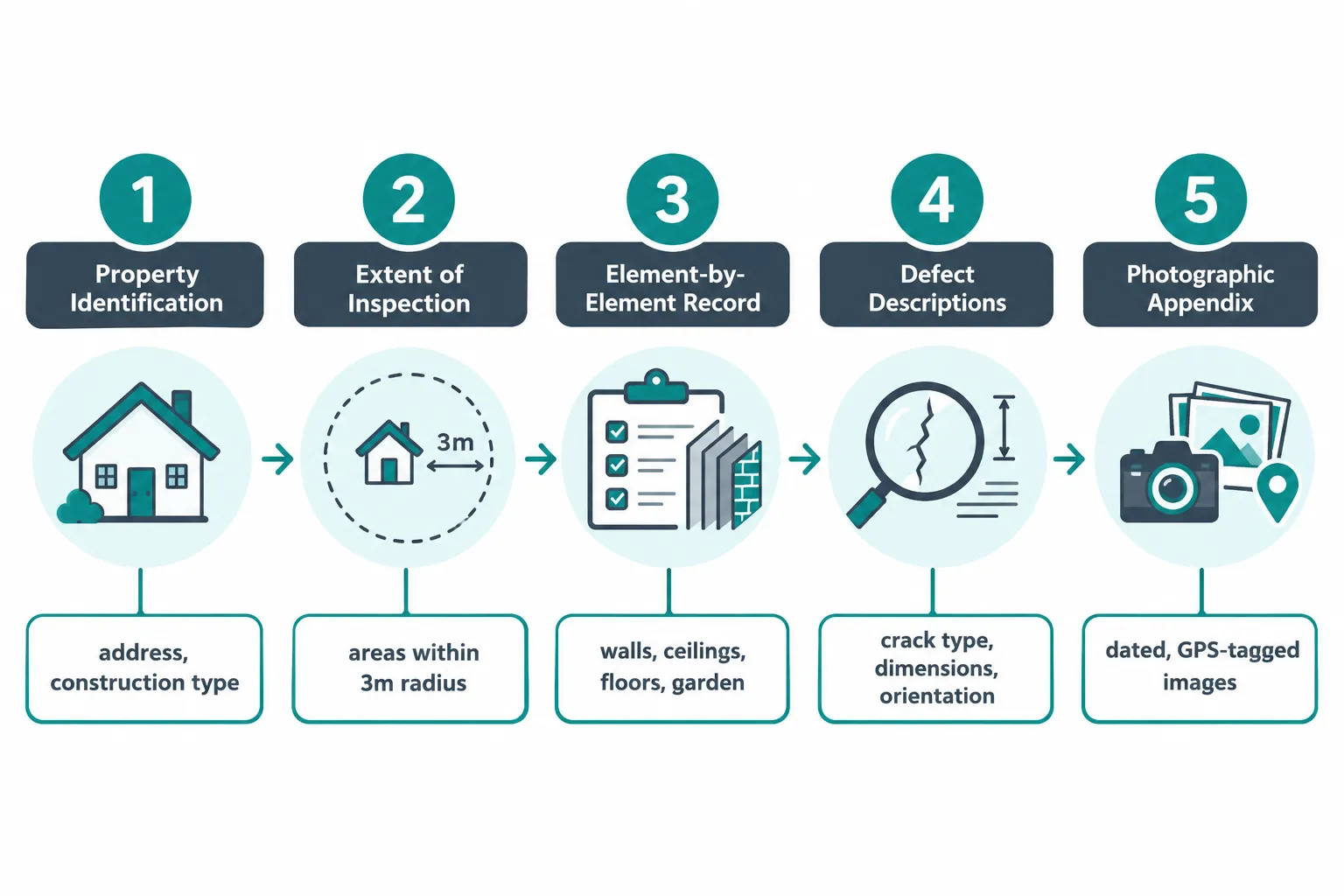
The document sits at the heart of the party wall process. Under the Party Wall etc. Act 1996, building owners must serve formal notice before carrying out a range of notifiable works. Once a dispute arises, or is deemed to have arisen, a party wall award is prepared by one or more surveyors. That award will almost always reference and append a Schedule of Condition as evidence of the property’s state before works commenced [1][3].
The RICS 7th edition guidance on party wall legislation and procedure explicitly recommends that surveyors record and append a schedule of condition to the party wall award. While statute does not compel it, this recommendation has made the schedule the professional standard across the industry [1][2]. For homeowners and building owners unfamiliar with the process, understanding types of party wall works that trigger the Act is a useful starting point before considering what protective documentation is needed.
“A comprehensive Schedule of Condition is critical to party wall agreements because it creates a clear baseline against which any alleged damage is assessed.” [5]
The schedule is not simply a bureaucratic formality. It is a legal document that can be relied upon in disputes, insurance claims, and even court proceedings. Its absence leaves both parties exposed: the adjoining owner cannot prove that a crack was caused by the works, and the building owner cannot prove it was pre-existing.
What a Schedule of Condition for Party Wall Works Should Include
Authoritative surveying guidance sets out a clear structure for what a well-prepared schedule must contain [9][12]. The following table summarises the core components.
| Component | What It Records |
|---|---|
| Statement of Purpose | Explains why the schedule was prepared and its role within the party wall award |
| Property Identification | Full address, tenure, construction type, approximate age of building |
| Extent of Inspection | Which areas were inspected and which were excluded, with reasons for any limitations |
| Reference to Plans | Cross-reference to the building owner’s drawings so the scope of works is clear |
| Element-by-Element Record | Room-by-room and element-by-element descriptions of defects, including location, type, dimensions and orientation |
| Notes on Existing Repairs | Records of any previously repaired cracks, filled joints or patched plasterwork |
| Photographic Appendix | Dated, time-stamped photographs cross-referenced to the written descriptions |
| Inspection Date | Clearly recorded date confirming the schedule was compiled before works started |
The Element-by-Element Written Record
The written record is the backbone of the schedule. For each inspected element, walls, ceilings, floors, staircases, chimney breasts, garden walls, outbuildings, and the party wall face itself, the surveyor must note [9][12][14]:
- Location: which room, which wall face, which elevation
- Type of defect: hairline crack, diagonal crack, damp staining, spalling brickwork, settlement crack
- Dimensions: approximate length and width of each crack or affected area
- Orientation: vertical, horizontal, diagonal, or stepped along mortar joints
- Existing repairs: filled cracks, repointed joints, patched render
The inspection is typically limited to those parts of the adjoining property that may reasonably be affected by the works. For minor extensions or loft conversions, this is often all areas within roughly a 3-metre radius of the proposed works [1][2][7].
Scope and Alignment with the Party Wall Award
One detail that is frequently overlooked is the need to align the schedule explicitly with the defined scope of works in the party wall award. This alignment limits “scope creep”: if the building owner later carries out unauthorised additional works, any resulting damage cannot easily be claimed under the original award because the schedule clearly documents what was and was not within scope [1].
For higher-risk situations, such as works near foundations, structural collapse hazards, or social housing projects subject to Awaab’s Law, 2026 RICS protocols recommend a more formal structural assessment within the schedule. This includes crack mapping to standard categories, checks on wall ties, lintels and foundations near the party wall, hazard tier classifications, and a minimum of approximately 20 GPS-tagged photographs plus a video walkthrough, all stored in secure digital form [6][4].
Photos to Take: Best Practices for the Photographic Record
The photographic record is arguably the most powerful part of a Schedule of Condition for party wall works. Dark, unclear or poorly framed images have limited evidential value, while a systematic, high-quality photographic record can resolve a dispute before it escalates [14][6][11].
Essential Photographic Requirements
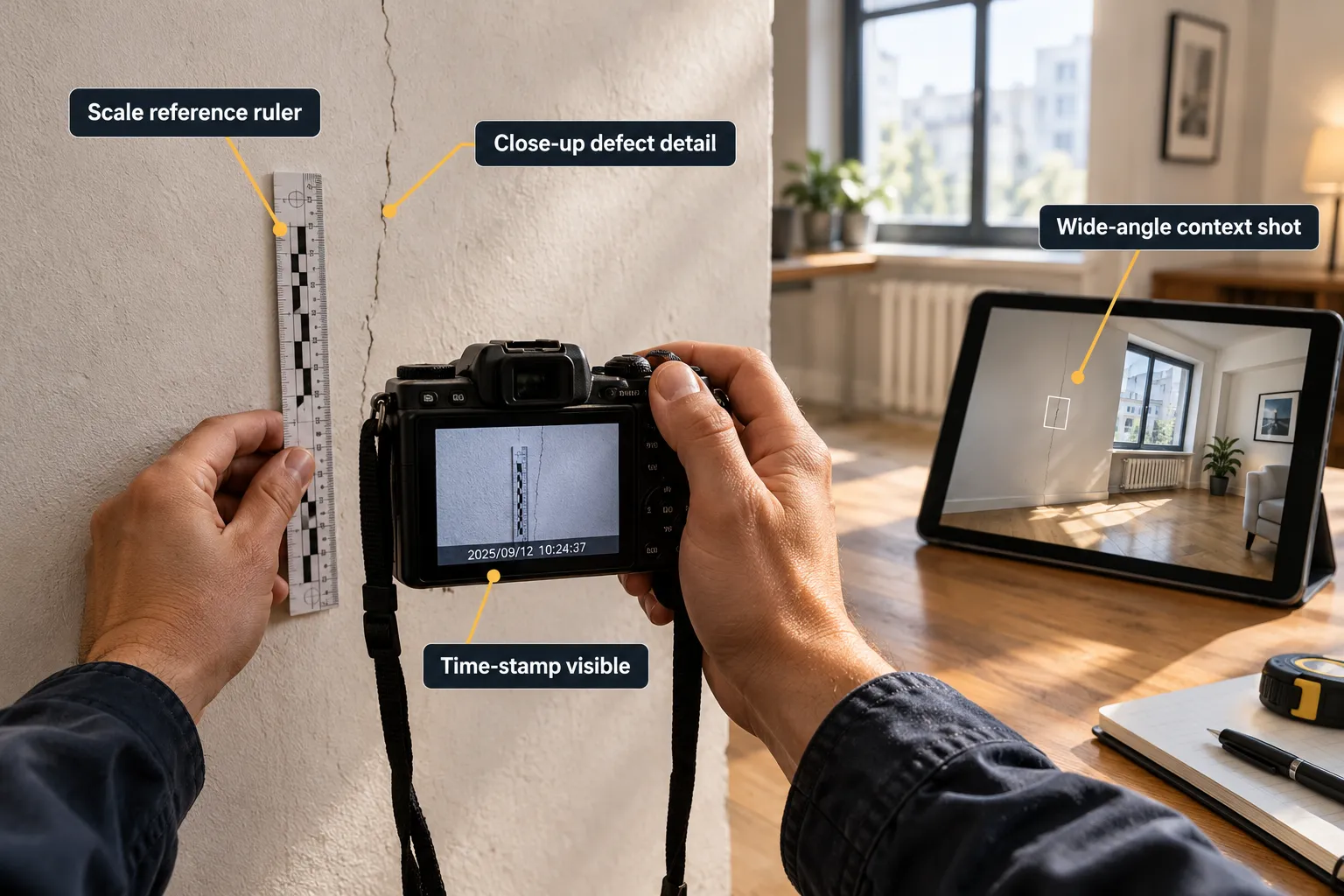
Every photograph in the schedule should meet the following standards [10][14]:
- Date and time stamp: Automatically embedded via camera settings or a visible display in the frame. This confirms the images were taken before works began.
- Wide-angle context shot: Shows the defect in the context of the full room or wall elevation, so its location is unambiguous.
- Close-up detail shot: A second image of the same defect taken close enough to show its character and extent clearly.
- Scale reference: A ruler, coin, or standard scale card placed beside each crack or defect. Without a scale reference, it is impossible to assess the size of a defect from a photograph alone.
- Good lighting: Natural light supplemented by a flash or portable light source where rooms are dark. Shadows obscuring a crack reduce the image’s evidential value significantly.
- Multiple angles: For cracks on corners, returns, or complex surfaces, at least two angles should be captured.
Room-by-Room Coverage
The photographic survey should follow a logical, room-by-room sequence that mirrors the written record. Recommended coverage includes [10][11]:
- External elevations: All faces of the adjoining property, including the party wall face, garden walls, boundary structures, and outbuildings
- Internal walls: Each wall in every room within the affected zone, even where no defects are visible (absence of defects is itself evidence)
- Ceilings: Particularly important for loft conversions and works involving the roof structure
- Floors: Screed cracks, tile lifting, and floor-level gaps at skirting boards
- Staircases: Cracks at stringer-wall junctions and plaster above stair strings
- Chimney breasts: Cracking at the junction with the party wall is common and frequently disputed
GPS-Tagged and Digitally Archived Images
For higher-risk projects, GPS-tagged photographs provide an additional layer of verification, confirming not only when but where each image was taken [6]. Digital archiving in a secure, time-stamped format ensures the record cannot be altered after the fact. This is increasingly expected as standard practice in 2026, particularly for larger residential and commercial party wall projects [4][5].
How a Schedule of Condition Prevents Damage Claims
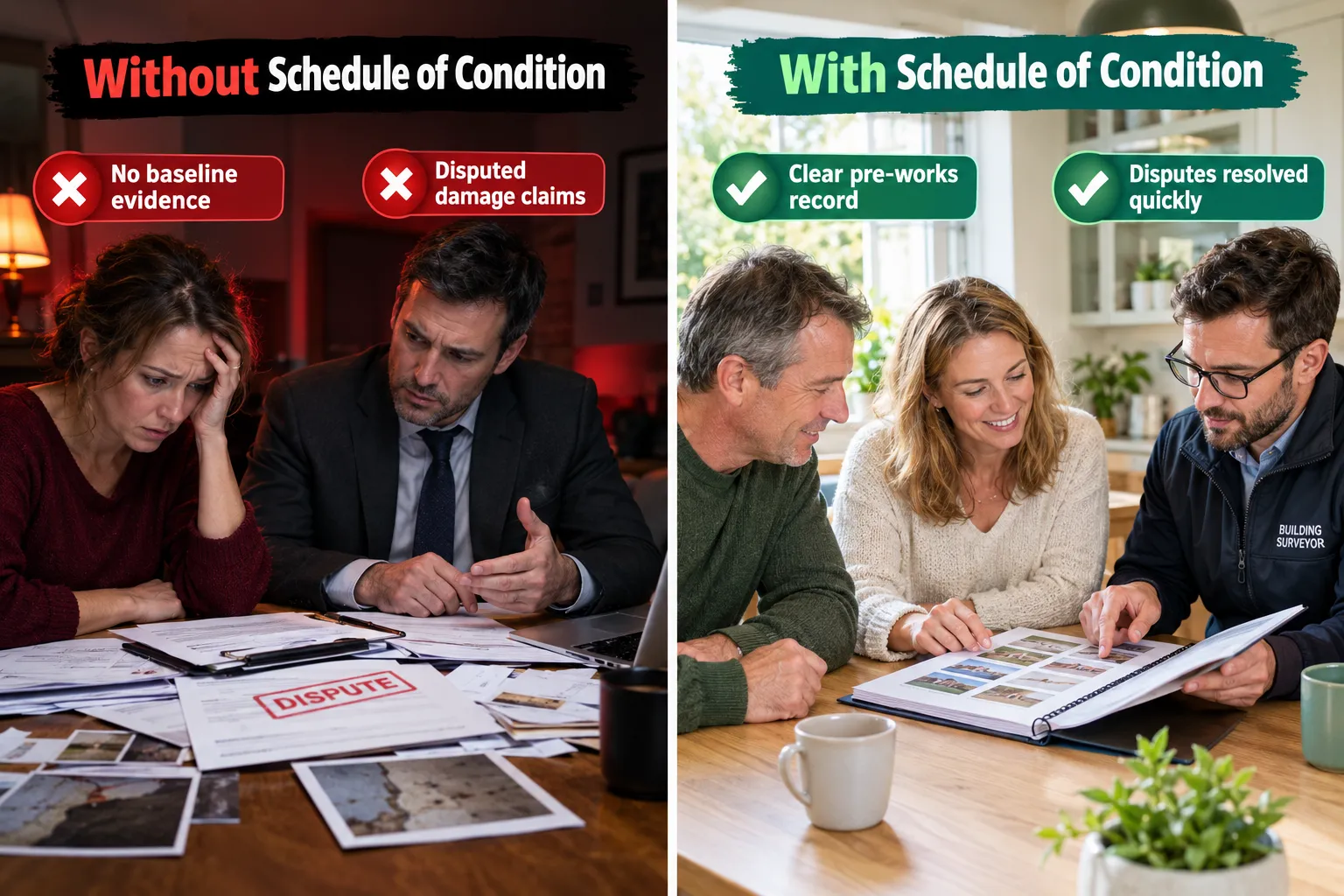
The protective function of a Schedule of Condition for party wall works operates on two levels: it deters unfounded claims and it resolves genuine ones quickly.
Deterring Unfounded Claims
When an adjoining owner knows that every pre-existing defect in their property has been systematically recorded and photographed before works begin, the incentive to attribute old damage to the new works is significantly reduced. The schedule creates a clear, objective baseline that is difficult to dispute [2][10][5].
Industry commentary in 2026 stresses that this deterrent effect is one of the most practical benefits of the document, particularly in urban areas where terraced and semi-detached properties share walls with multiple neighbours and where minor cracking is almost universally present before any works begin [5][13].
Resolving Genuine Claims Efficiently
Where damage does occur as a result of the works, the schedule enables a straightforward comparison between the pre-works condition and the post-works condition. A surveyor can quickly determine whether a crack is new, whether an existing crack has widened, or whether a damp patch has spread [2][7][10].
This comparison process is far more efficient, and far less expensive, than a contested dispute in which both parties argue from memory or anecdote. The costs of the party wall process can escalate significantly when disputes are unresolved, making the relatively modest investment in a thorough schedule of condition highly cost-effective.
Protecting Both Parties
It is important to understand that the schedule protects both the building owner and the adjoining owner equally [10][11]:
- For the adjoining owner: If the works do cause damage, the schedule provides the evidence needed to support a claim for repair or compensation.
- For the building owner: The schedule prevents a neighbour from claiming compensation for damage that predates the works entirely.
This mutual protection is why experienced surveyors recommend a schedule of condition even when neighbours are on good terms and have reached a party wall agreement without a formal surveyor. Relationships can change, properties can be sold, and memories are unreliable. A written and photographic record is not.
The Schedule Within the Formal Award
The schedule is typically appended to and explicitly referenced within the party wall award. This formal incorporation means it carries the legal weight of the award itself. Any post-works inspection can be directly compared against it, and any remediation required can be scoped precisely against the documented baseline [1][3][7].
For those who want to understand how the award is structured and what it covers, the guide on party wall awards and contract templates provides useful context.
When to Commission a Schedule of Condition
Timing is critical. The schedule must be compiled before any building works start. Once construction begins, the baseline is compromised. Even a single day of vibration from demolition or excavation can alter the condition of an adjoining property, and any crack appearing after that point becomes contested [1][2][7].
The inspection date must be clearly recorded in the document. If the schedule is prepared as part of the party wall award process, the surveyor will typically carry out the inspection after the award is agreed but before the building owner’s contractor mobilises on site.
For anyone in the early stages of planning notifiable works, understanding party wall act notices and how to respond to them is the logical first step. The notice process triggers the formal party wall procedure, within which the schedule of condition sits.
Conclusion
A Schedule of Condition for party wall works is not a luxury or an optional extra. It is the single most effective tool available for preventing and resolving damage disputes between neighbours before, during, and after construction. When compiled correctly, with a thorough written record, systematic room-by-room coverage, and a high-quality photographic appendix, it protects both the building owner and the adjoining owner with equal force.
Actionable next steps for property owners and surveyors in 2026:
- Commission the schedule before works begin, even one day of construction activity can compromise the baseline.
- Ensure the schedule is formally appended to the party wall award and explicitly cross-referenced within it.
- Follow photographic best practice: date-stamped, well-lit, wide-angle and close-up images with a scale reference for every defect.
- Align the schedule with the defined scope of works to prevent scope-creep disputes later.
- For higher-risk projects, adopt GPS-tagged images, crack mapping to standard categories, and digital archiving as standard.
- Seek a qualified party wall surveyor, particularly for complex or high-value projects, to ensure the schedule meets current RICS standards and will withstand scrutiny if a claim arises.
For those planning works or responding to a neighbour’s notice, the Schedule of Condition service page provides further guidance on how a professional surveyor can help compile this essential document.
References
[1] Jan 22 Party Wall Legislation And Procedure 7th Edition – rics.org
[2] Schedule Of Condition Report Party Wall Awards – howorth.uk
[3] Schedule Of Condition – partywall.expert
[4] 17 Neighbourly Matters Services Ew May 2022 – rics.org
[5] 2026 Party Wall Act Updates Key Changes Impacting Awards And Agreements In Stabilizing Property Markets – 2026 party wall act updates key changes impacting awards and agreements in stabilizing property markets
[6] Party Wall Surveys For Structural Collapse Hazards 2026 Rics Protocols Under Awaabs Law Retrofit Mandates – princesurveyors.co.uk
[7] Schedules Of Condition For Party Wall Awards – taylor-mitchell.co.uk
[9] Party Walls Specimen Schedule Of Condition – isurv.com
[10] Party Wall Agreement – hoa.org.uk