
Nearly half of all neighbour disputes in England and Wales that escalate to formal legal action involve a failure to properly separate two distinct legal frameworks: the Party Wall etc. Act 1996 and Building Regulations. These are not interchangeable. They are not alternatives. They are parallel obligations that apply simultaneously on the vast majority of residential construction projects, and confusing them is one of the most expensive mistakes a building owner can make in 2026.
Understanding the Party Wall Act 1996 vs Building Regulations distinction is not just a legal technicality. It is a practical necessity that shapes project timelines, contractor procurement, neighbour relations, and liability exposure from the first day of design through to the final completion certificate.
Key Takeaways
- The Party Wall etc. Act 1996 and Building Regulations are entirely separate legal regimes with different purposes, authorities, and procedures.
- Most domestic projects, extensions, loft conversions, basement excavations, trigger both frameworks simultaneously.
- Failing to comply with either regime can halt a project, expose the building owner to civil liability, and damage neighbour relationships permanently.
- Sequencing matters: Party Wall notices should be served early in the design stage, not after Building Regulations approval is granted.
- Professional guidance from a qualified party wall surveyor reduces risk, cost, and delay on any project where a shared wall or boundary is involved.
Two Legal Regimes, One Building Project
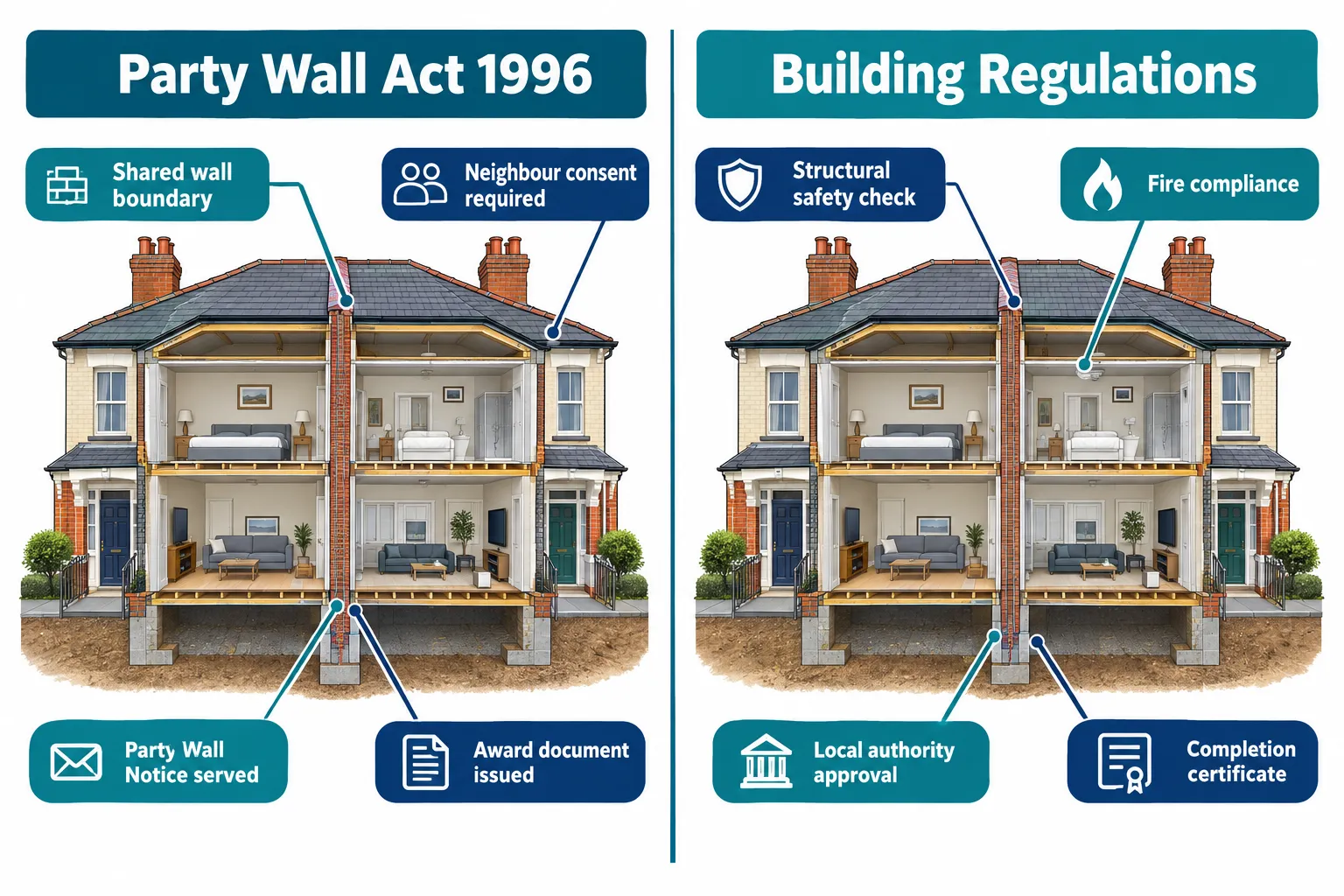
The single most common misconception encountered on residential building projects is that obtaining Building Regulations approval somehow covers the Party Wall process, or vice versa. It does not. These two frameworks operate entirely independently of each other, enforced by different bodies, serving different purposes. [1]
Building Regulations set minimum technical standards for the design and construction of buildings in England and Wales. They cover structural integrity, fire safety, energy efficiency, drainage, ventilation, and accessibility. Compliance is assessed and enforced by the local authority’s Building Control department, or by an approved inspector. A Building Regulations approval confirms that the proposed works meet those technical standards.
The Party Wall etc. Act 1996, by contrast, is a civil piece of legislation. It governs the rights and obligations of property owners when construction works affect a shared wall, boundary structure, or the land adjacent to a neighbouring property. [4] It does not assess whether a building is structurally sound in the abstract, it protects the specific interests of the adjoining owner whose property could be affected by the works. [2]
“Building Regulations approval does not remove the obligation to serve Party Wall notices. Both requirements exist independently and must both be satisfied.”
Local authorities consistently reinforce this point in their guidance to homeowners. The two regimes answer entirely different questions:
| Question | Answered by |
|---|---|
| Is this structure safe to build? | Building Regulations |
| Does my neighbour have rights over how I build it? | Party Wall etc. Act 1996 |
| Will the design meet fire and energy standards? | Building Regulations |
| Is my neighbour protected from damage to their property? | Party Wall etc. Act 1996 |
| Who certifies the completed work? | Building Control (Regulations) |
| Who records the condition of adjoining property before works? | Party Wall surveyor (Act 1996) |
Understanding this table is the foundation of any competent approach to the Party Wall Act 1996 vs Building Regulations question on real projects.
How the Party Wall Act 1996 vs Building Regulations Apply to Real Projects
The practical interaction between these two frameworks becomes clearest when mapped against common project types. Three scenarios illustrate the point well.
Rear Single-Storey Extension on a Terraced House
A homeowner in East London plans a rear extension that will involve cutting into the rear wall of the property, a wall shared with the neighbour. This triggers the Party Wall etc. Act 1996 under Section 2, which covers works to an existing party wall or party structure. [10]
At the same time, the extension requires Building Regulations approval because it involves structural alterations, new foundations, and changes to drainage.
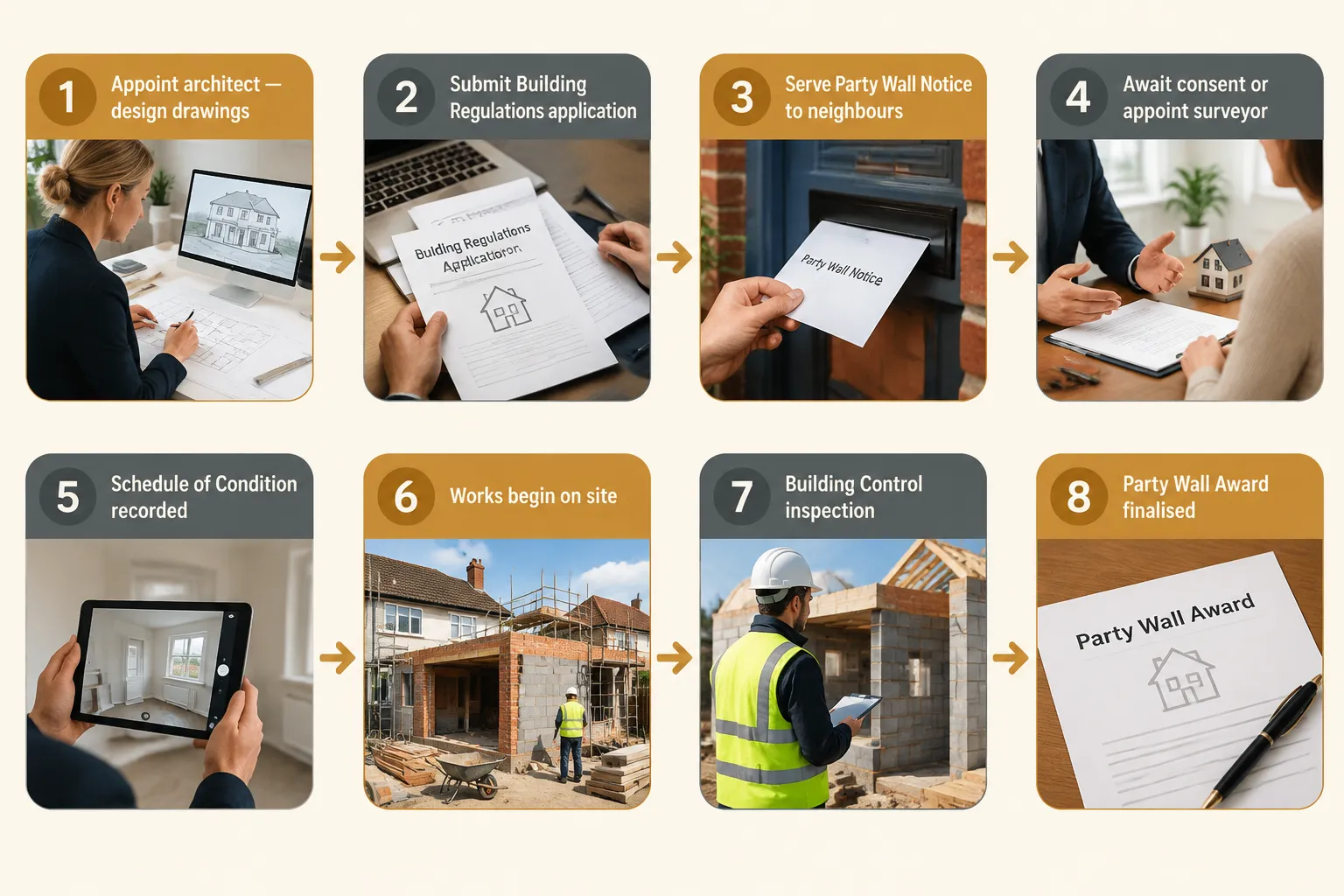
The correct sequence is:
- Appoint an architect and produce design drawings.
- Submit a Building Regulations application (full plans application recommended for structural works).
- Serve a Party Wall Notice on the adjoining owner, this must happen at least two months before works commence where Section 2 works are involved.
- Await the neighbour’s response. If they consent in writing, works can proceed. If they dissent or do not respond within 14 days, a dispute is deemed to have arisen and surveyors must be appointed.
- A Party Wall Award is prepared, setting out the manner and conditions under which works are to be carried out.
- Building Control inspections proceed alongside the works, independently of the Party Wall process.
A critical point: Building Regulations approval does not satisfy the notice requirements under the Act. The two processes run in parallel, not in sequence. [3]
Loft Conversion Involving a Party Wall
A loft conversion that requires raising a party wall, inserting steel beams into the party wall, or cutting into the party wall structure will trigger the Act. [2] Building Regulations will also apply because the conversion creates a new habitable floor, requiring compliance with fire escape routes, structural loading, insulation, and staircase standards.
For types of party wall works such as these, the notice period under the Act is two months. Homeowners who apply for Building Regulations approval and then only serve the Party Wall notice afterwards will find their project delayed by at least two months, a costly and entirely avoidable mistake.
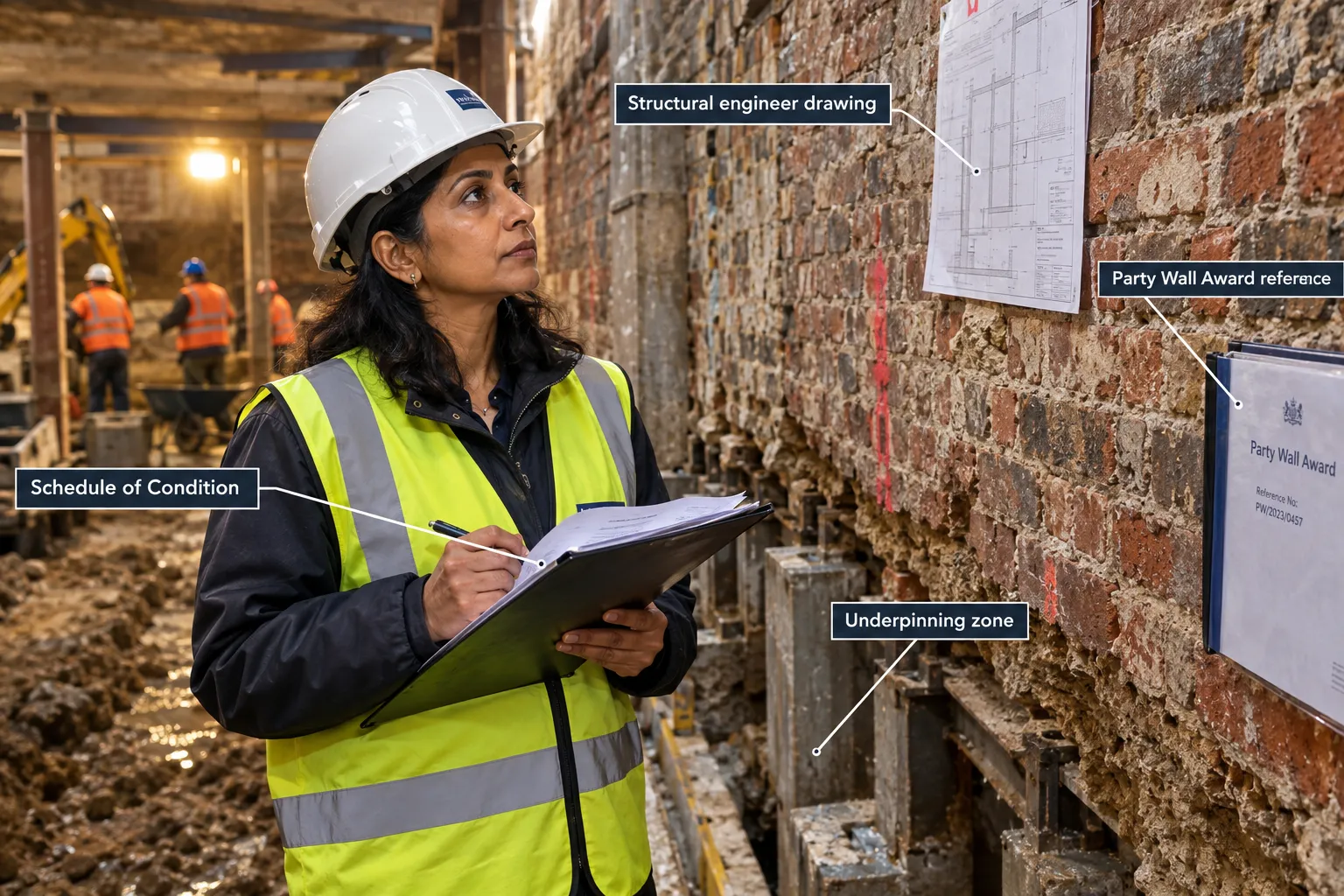
The loft conversion also illustrates why a Schedule of Condition matters. Before any works begin, the party wall surveyor will inspect and document the current condition of the adjoining property, cracks, finishes, existing damage. This protects both parties: the building owner is not held liable for pre-existing damage, and the adjoining owner has a clear record if new damage does occur. [3]
Basement Excavation Near a Neighbouring Foundation
Basement projects are the highest-risk category under the Act. Section 6 of the Party Wall etc. Act 1996 applies where excavation is carried out within three metres of a neighbouring structure and to a lower depth than the neighbour’s foundations, or within six metres where the excavation would cut a line drawn downwards at 45 degrees from the bottom of the neighbour’s foundations. [10]
Building Regulations will require structural calculations, drainage details, waterproofing specifications, and often a structural engineer’s sign-off. The Party Wall process will require a notice, a Schedule of Condition, and almost certainly a formal Award given the complexity of the works.
For basement projects in particular, the interaction between the two regimes is intense. Building Control inspectors may request evidence that Party Wall procedures are in place before signing off on structural stages. Contractors should not commence excavation until both a Building Regulations application has been submitted and a Party Wall Award (or written consent from the adjoining owner) is in place.
Why You Need Both: Risk, Liability, and Common Misconceptions
The professional bodies representing surveyors and construction professionals are unambiguous: both regimes are necessary, and neither substitutes for the other. The risks of ignoring either are substantial.
The Risk of Ignoring Building Regulations
Carrying out notifiable works without Building Regulations approval is a criminal offence. The local authority can require the works to be opened up for inspection or even demolished if they cannot be shown to comply. This creates a defect in the property’s title that will surface on any future sale.
The Risk of Ignoring the Party Wall Act
The Party Wall etc. Act 1996 does not carry criminal penalties for non-compliance, but the civil consequences are serious. An adjoining owner can seek an injunction to stop the works. Courts have consistently held that building owners who proceed without complying with the Act do so at their own risk. Any damage caused to the adjoining property will be the building owner’s liability, with no procedural protection. [2]
Homeowners sometimes assume that because their neighbour has not complained, the Party Wall Act does not apply. This is incorrect. The obligation to serve notice arises from the nature of the works, not from the neighbour’s attitude. [1]
Common Misconceptions Addressed
“My architect said I only need planning permission and Building Regs.” Planning permission, Building Regulations, and the Party Wall Act are three separate requirements. A project may need all three, or any combination. None replaces another.
“The works are entirely within my own property.” Section 6 of the Act applies to excavation near neighbouring foundations even where the excavation is entirely within the building owner’s own land. [10] The boundary of the land is not the boundary of the Act’s reach.
“We have a good relationship with our neighbours, we don’t need a formal agreement.” Neighbour relationships can change. A verbal agreement provides no legal protection if the neighbour sells, if damage occurs, or if the relationship deteriorates. A formal Party Wall Agreement without a surveyor is possible in limited circumstances, but the risks of proceeding without proper documentation are significant.
“The Party Wall Award covers the building work.” A Party Wall Award governs the manner in which works affecting the party wall or adjoining property are carried out. It does not certify that the works are structurally safe or compliant with Building Regulations. Both are required. [3]
Sequencing and Coordination: Getting the Order Right
Getting the sequence right between Party Wall procedures and Building Regulations is one of the most practical challenges on a real project. Industry guidance consistently points to the following best practice:
Stage 1, Design: Appoint an architect. Identify at the design stage whether the works will trigger the Act. Most competent architects will flag this, but the ultimate responsibility lies with the building owner.
Stage 2, Pre-application: Before submitting a Building Regulations application, serve Party Wall notices. For Section 3 (party structure notices) and Section 6 (adjacent excavation notices), the minimum notice period is two months. For Section 1 (building on the line of junction), the notice period is one month. [4]
Stage 3, Parallel processing: Run the Building Regulations application and the Party Wall process simultaneously. There is no legal requirement for one to precede the other, but serving notices early avoids the scenario where Building Regulations approval is granted but works cannot start because the Party Wall process is incomplete.
Stage 4, Pre-commencement: Before any works begin on site, confirm that either written consent has been received from all adjoining owners or a Party Wall Award is in place. Confirm that Building Regulations approval (or a valid building notice) is also in place.
Stage 5, During works: Keep both processes active. Building Control will carry out stage inspections. The party wall surveyor may need access to inspect works affecting the party wall. Ensure the contractor is aware of both sets of obligations.
Stage 6, Completion: Obtain the Building Regulations completion certificate. Confirm that any outstanding matters under the Party Wall Award have been resolved.
Understanding the costs of the party wall process at the outset allows building owners to budget accurately and avoid surprises. Surveyor fees, notice preparation, and Award drafting are all foreseeable costs that should be included in the project budget from day one.
Practical Guidance for Building Owners in 2026
The updated official guidance published by the UK government reinforces that the Party Wall etc. Act 1996 is a practical tool for preventing disputes, not just resolving them. [2] The emphasis in 2026 is on early communication, early notice, and early documentation, all of which reduce the likelihood of costly disputes and injunctions.
For building owners undertaking works in London, local expertise matters. Whether the project is in a dense terrace in Central London or a Victorian semi-detached in South London, the interaction between the Act and Building Regulations follows the same legal framework, but local knowledge of typical construction conditions, common party wall configurations, and local authority Building Control practices adds real value.
Key practical steps for building owners in 2026:
- Identify all adjoining owners early, including those above, below, and to the side in flats and maisonettes.
- Serve notices in the correct form and within the correct notice periods. [3]
- Do not wait for Building Regulations approval before serving Party Wall notices.
- Appoint a qualified party wall surveyor if the neighbour dissents or fails to respond.
- Ensure the contractor has seen and understood both the Building Regulations drawings and any Party Wall Award before starting work.
- Retain all documentation, notices, consents, Awards, Schedules of Condition, for the full duration of the project and beyond.
The Building Owners section of the Act places clear obligations on the person carrying out the works. Ignorance of those obligations is not a defence, and the courts have shown limited sympathy for building owners who proceed without compliance.
Conclusion
The Party Wall Act 1996 vs Building Regulations question is not a matter of choosing one over the other. Both frameworks apply, both serve distinct and essential purposes, and both must be managed with equal care on any project that involves a shared wall, boundary structure, or excavation near a neighbouring foundation.
Building Regulations protect the public and future occupants by ensuring that construction meets minimum technical standards. The Party Wall etc. Act 1996 protects the specific property rights and interests of adjoining owners. Together, they form the legal framework within which safe, compliant, and neighbourly construction takes place in England and Wales.
Actionable next steps for building owners:
- At the design stage, ask the architect to confirm whether the works trigger the Party Wall etc. Act 1996 and which sections apply.
- Serve Party Wall notices as early as possible, ideally before or simultaneously with the Building Regulations application.
- Budget for party wall surveyor fees from the outset. Costs are predictable and manageable when planned early.
- Do not begin any notifiable works on site until both Building Regulations approval and Party Wall compliance (consent or Award) are confirmed in writing.
- Consult a qualified party wall surveyor if there is any doubt about whether the Act applies or how to serve notices correctly.
References
[1] Party Walls Building Works – gov.uk
[2] Preventing And Resolving Disputes In Relation To Party Walls – gov.uk
[3] The Party Wall Etc Act 1996 Explanatory Booklet – gov.uk
[4] Contents – legislation.gov.uk
[10] Section – legislation.gov.uk