Party wall surveyor fees in London have climbed by an estimated 15 to 25 percent over the past two years, and 2026 is proving to be the year that homeowners and developers can no longer absorb those increases quietly. Recent analysis of 2026 party wall agreement and award costs confirms that what was once a modest administrative line item has become one of the most scrutinised expenses in any residential construction budget. Understanding why fees are rising, what drives the total cost of a party wall award, and how to manage those costs strategically is now essential knowledge for anyone planning notifiable works.
Key Takeaways
- Party wall surveyor fees in 2026 are significantly higher than in previous years, with hourly rates and fixed-fee packages both increasing.
- The total cost of a party wall award depends on project complexity, surveyor appointment type, and London location.
- Appointing an agreed surveyor rather than two separate surveyors is the single most effective way to reduce costs.
- Failing to serve correct notices on time can trigger disputes that multiply fees several times over.
- Proactive budget planning and early surveyor engagement are the clearest paths to cost control in 2026.
What Is a Party Wall Agreement and Why Do Costs Matter in 2026
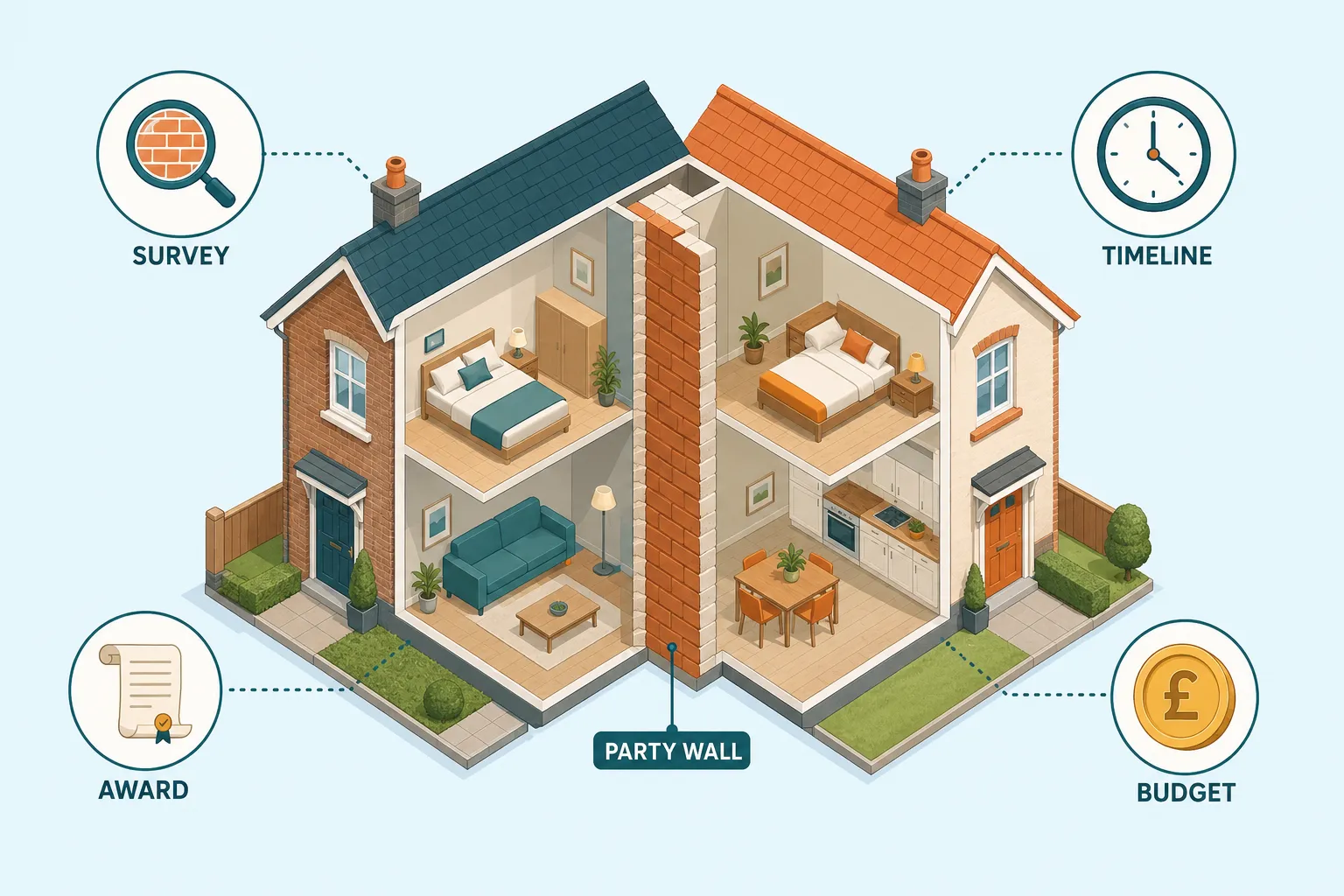
Before examining the numbers, it helps to understand what the process actually involves. The Party Wall etc. Act 1996 requires building owners to notify adjoining neighbours before carrying out specific types of construction work. These include loft conversions, rear extensions, basement excavations, and any work directly on or near a shared wall. If a neighbour dissents or does not respond, the Act triggers a formal dispute resolution process that results in a legally binding document called a party wall award.
A party wall award sets out the rights and responsibilities of both parties, the method of working, and the schedule of condition of the adjoining property. Surveyors, either an agreed single surveyor or two separate surveyors, are appointed to produce this document. Their fees form the core of the total cost.
For a full breakdown of what the process involves financially, the costs of the party wall process guide provides a useful reference point. What has changed in 2026 is not the structure of those costs but their scale.
The 2026 Cost Landscape: What Surveyors Are Charging Now
Hourly Rates and Fixed Fees
The 2026 party wall agreement and award costs: how rising surveyor fees are reshaping budgets story begins with the numbers themselves. Surveyor hourly rates in London now typically range from £150 to £350 per hour, with some specialist or central London practices charging above that band [1][8]. Fixed-fee packages for straightforward single-neighbour agreements generally start at around £700 to £1,000 for a notice-only service, rising to £1,500 to £2,500 or more when a full award is required [2][5].
For projects involving multiple adjoining owners, common in terraced streets or apartment blocks, costs escalate quickly. A basement excavation affecting two neighbours on either side, for example, could generate surveyor fees of £4,000 to £8,000 or more before any construction work begins [3][9].
Key figure:In 2026, the average total cost of a party wall award in London, including schedule of condition, surveyor attendance, and award drafting, sits between £1,800 and £3,500 for a typical single-neighbour loft conversion or rear extension. [5][7]
What Is Driving Fee Increases
Several converging pressures explain why 2026 party wall costs are higher than in previous years:
- Inflation in professional services: General inflationary pressure on wages and overheads has pushed surveying firm costs upward, and those costs are passed to clients [4].
- Increased demand: The post-pandemic home improvement boom has not fully subsided. High mortgage rates have kept many homeowners extending rather than moving, sustaining demand for party wall services [7].
- Greater project complexity: Modern extensions increasingly involve basement works, structural steel, and proximity to foundations, all of which require more detailed surveys and longer award documents [6].
- Shortage of qualified surveyors: The pool of surveyors with specific party wall expertise has not grown proportionally with demand, giving established practitioners pricing power [10].
- Rising schedule of condition costs: Photographic and video condition surveys have become more thorough, and more expensive, as disputes over pre-existing damage become more common [8].
London Location Premiums
Location within London adds a further layer of cost variation. Central London projects consistently attract the highest fees. Surveyors working in Central London and West London typically charge at the upper end of published ranges, reflecting higher business costs and property values. South London, North London, and East London practices tend to offer slightly more competitive rates, though the gap has narrowed in 2026 [9].
| London Zone | Typical Award Cost Range (2026) |
|---|---|
| Central London | £2,500, £5,000+ |
| West London | £2,000, £4,000 |
| North / South London | £1,800, £3,500 |
| East London | £1,500, £3,000 |
Figures are indicative ranges for a single-neighbour award on a standard residential extension. [5][8][9]
How the Award Process Works and Where Costs Accumulate
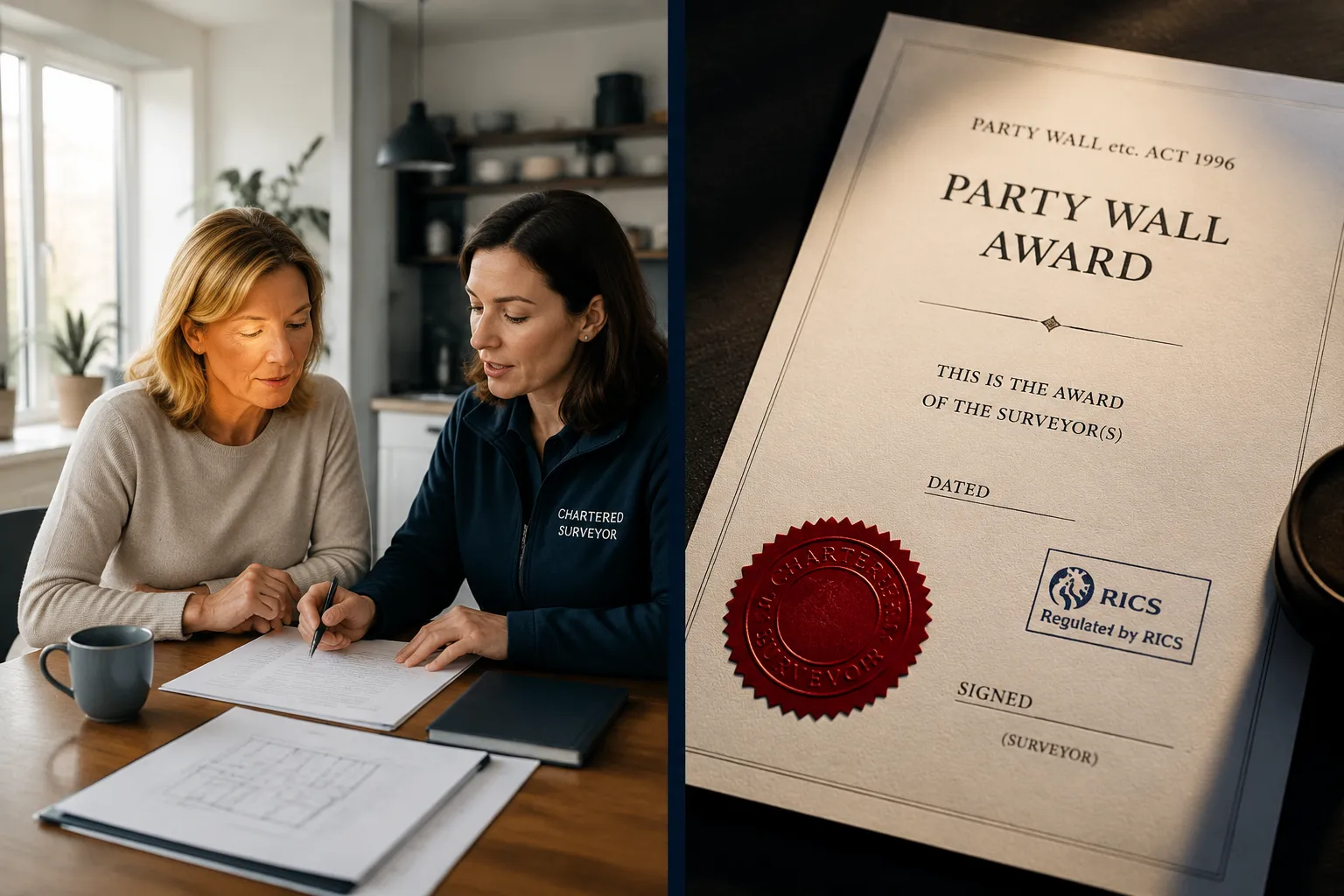
Understanding the mechanics of a party wall award helps identify exactly where money is spent, and where it can be saved.
Stage 1: Serving Party Wall Notices
The process begins when the building owner serves a party wall notice on all adjoining owners. Notices must be served within specific timeframes: two months before works begin for party structure notices, and one month for line of junction notices. Errors in notice service are a common and costly mistake, because an invalid notice restarts the clock and can delay projects by weeks or months [5].
Some building owners attempt to serve notices themselves using a sample party wall agreement template to reduce upfront costs. This is legally permissible but carries risk if the notice content or service method is incorrect.
Stage 2: Neighbour Response and Surveyor Appointment
If the adjoining owner consents in writing, no award is needed and costs remain low. If they dissent or fail to respond within 14 days, a dispute is deemed to exist and surveyors must be appointed. At this point, costs diverge significantly depending on the appointment structure:
- Agreed surveyor: Both parties appoint a single neutral surveyor. This is almost always the most cost-effective route, as only one set of fees is generated.
- Two surveyors: Each party appoints their own surveyor. Both surveyors’ fees are typically paid by the building owner, effectively doubling the professional cost.
- Three surveyors: If the two appointed surveyors cannot agree, they appoint a third surveyor to adjudicate. This is the most expensive outcome and should be avoided wherever possible [2][4].
Stage 3: Schedule of Condition
Before works begin, surveyors inspect and document the condition of the adjoining property. This photographic and written record protects both parties if damage claims arise later. In 2026, thorough schedules of condition, particularly for basement works or projects near older properties, can add £400 to £900 to the total bill [3][7].
Stage 4: Drafting and Serving the Award
The award document itself sets out the permitted works, working hours, protective measures, and compensation provisions. Drafting a complex award for a basement excavation or structural alteration can take considerably longer than a straightforward loft conversion, and surveyor time is billed accordingly [6][10].
Stage 5: Post-Award Attendance
Many surveyors charge for site visits during construction to monitor compliance with the award. These visits are not always mandatory but are strongly recommended for high-risk works. Each visit typically costs £150 to £300 [1][5].
Practical Strategies for Managing 2026 Party Wall Costs
The 2026 party wall agreement and award costs: how rising surveyor fees are reshaping budgets challenge is real, but it is manageable with the right approach. The following strategies have the strongest track record for keeping total costs under control.
Pursue the Agreed Surveyor Route
The single most impactful cost decision is to encourage the adjoining owner to agree to a single shared surveyor. A building owner can approach their neighbour directly and explain the financial benefit to both parties. When neighbours understand that a two-surveyor scenario means the building owner pays both sets of fees, which can amount to an additional £1,500 to £3,000, many are receptive to the agreed surveyor approach [4][7].
Serve Notices Early and Correctly
Delays caused by invalid or late notices are a significant hidden cost driver. Serving correct notices at the earliest permissible stage gives the maximum time for neighbours to respond, reduces the risk of last-minute disputes, and avoids the programme costs of construction delays. A detailed guide on party wall act notices and how to respond is a useful starting point for getting this right.
Obtain Fixed-Fee Quotes Upfront
Hourly billing is the least predictable cost structure for party wall work. Many surveyors in 2026 offer fixed-fee packages for standard residential projects. Requesting fixed-fee proposals from two or three surveyors before appointing one provides both cost certainty and a market comparison. Always confirm what is included, some fixed fees exclude schedule of condition or post-award site visits [2][6].
Consider Whether a Surveyor Is Strictly Required
In limited circumstances, neighbours can reach an informal agreement without a surveyor. The party wall agreement without a surveyor route is only appropriate for very minor, low-risk works where both parties have a good relationship and full understanding of the Act. For any structural work, this approach carries significant legal and financial risk and is not recommended as a general cost-saving measure.
Budget Realistically from the Start
Given current market conditions, the following budget benchmarks are a reasonable starting point for 2026 planning:
- Simple loft conversion, single neighbour, agreed surveyor: £1,200, £2,000
- Rear extension, single neighbour, two surveyors: £2,500, £4,000
- Basement excavation, two neighbours, two surveyors each: £5,000, £10,000+
- Complex multi-neighbour development: £8,000, £20,000+
Sources [5][7][9] broadly support these ranges, though individual quotes will vary based on project specifics and surveyor.
For additional practical guidance on reducing the financial burden, the resource on how to keep party wall costs down covers several further tactics worth reviewing before appointing a surveyor.
Understand Who Pays
The default rule under the Party Wall etc. Act 1996 is that the building owner pays all reasonable surveyor fees, including those of the adjoining owner’s surveyor, unless the adjoining owner has been unreasonable or has requested unnecessary work. This means the building owner carries the financial risk of escalating disputes. Keeping communication with neighbours positive and transparent is therefore not just courteous; it is financially prudent [1][3].
The Broader Budget Impact: Why This Matters Beyond the Fee Invoice
The cumulative effect of rising 2026 party wall costs extends beyond the surveyor’s invoice. Construction lenders and project managers are now factoring party wall fees into feasibility assessments at an earlier stage. For smaller residential developers working on tight margins, a £6,000 to £10,000 party wall bill on a terrace conversion can shift a project from viable to marginal.
For individual homeowners, the psychological impact is also significant. A process that was once seen as a bureaucratic formality is now a meaningful financial commitment that requires the same planning rigour as any other professional service in the project. Homeowners who discover mid-project that they need to appoint a second surveyor, because their neighbour dissented after an initially positive conversation, often face both cost shock and programme disruption simultaneously [4][10].
The answer is not to avoid the party wall process, compliance with the Act is a legal obligation, but to engage with it proactively, budget for realistic worst-case scenarios, and use every legitimate tool available to reduce unnecessary cost.
Conclusion
The 2026 party wall agreement and award costs: how rising surveyor fees are reshaping budgets is not a temporary blip. Structural factors, sustained demand, inflation in professional services, greater project complexity, and a constrained supply of qualified surveyors, point to continued upward pressure on fees beyond 2026. For homeowners and developers, the response must be proactive rather than reactive.
Actionable next steps:
- Engage a party wall surveyor at the design stage, before planning permission is granted, to get a realistic cost estimate for your specific project.
- Serve notices as early as legally permitted to maximise response time and reduce the risk of programme-disrupting disputes.
- Have an honest conversation with your neighbour about the agreed surveyor option before notices are formally served, it is the single most effective cost-reduction lever available.
- Request fixed-fee proposals from at least two surveyors and confirm precisely what each fee covers.
- Build a contingency of at least 20 percent on top of the surveyor’s quoted fee to cover post-award site visits, any additional award variations, and the possibility of a more complex schedule of condition than initially anticipated.
Party wall costs in 2026 are higher, but they are manageable with the right preparation. The homeowners and developers who treat the party wall process as a professional project in its own right, rather than an afterthought, consistently achieve better outcomes, lower costs, and fewer disputes.
References
[1] Party Wall Surveyor Cost – checkatrade.com [2] Party Wall Surveyor Cost – hoa.org.uk [3] Party Wall Surveyor Cost UK – bestbuilders.co.uk [4] Party Wall Surveyor Costs – princesurveyors.co.uk [5] Costs Of Party Wall Surveyors In 2026 Who Pays And Factors Influencing Fees For Awards And Notices – Costs of party wall surveyors in 2026 who pays and factors influencing fees for awards and notices [6] Party Wall Surveyor Costs – harperlatterarchitects.co.uk [7] Party Wall Surveyor Cost 2026 – bookabuilderuk.com [8] Party Wall Cost London Guidelines – surveyofpartywall.co.uk [9] Party Wall Agreement Cost London – alstruct.co.uk [10] Party Wall Surveyor Cost Analysis How Much Does A Party Wall Agreement Cost – surveymerchant.com