

Fewer than one in five homeowners who plan a demolition project realise that pulling down a wall shared with a neighbour is governed by an entirely different set of rules from standard building works. Party wall notices for demolition carry special rules, extra risks and surveyor requirements that go well beyond what most people expect when they first read about the Party Wall etc. Act 1996. Getting these rules wrong does not just delay a project, it can strip the building owner of statutory protection and force a costly dispute into common law, where outcomes are far less predictable [1].
Key Takeaways
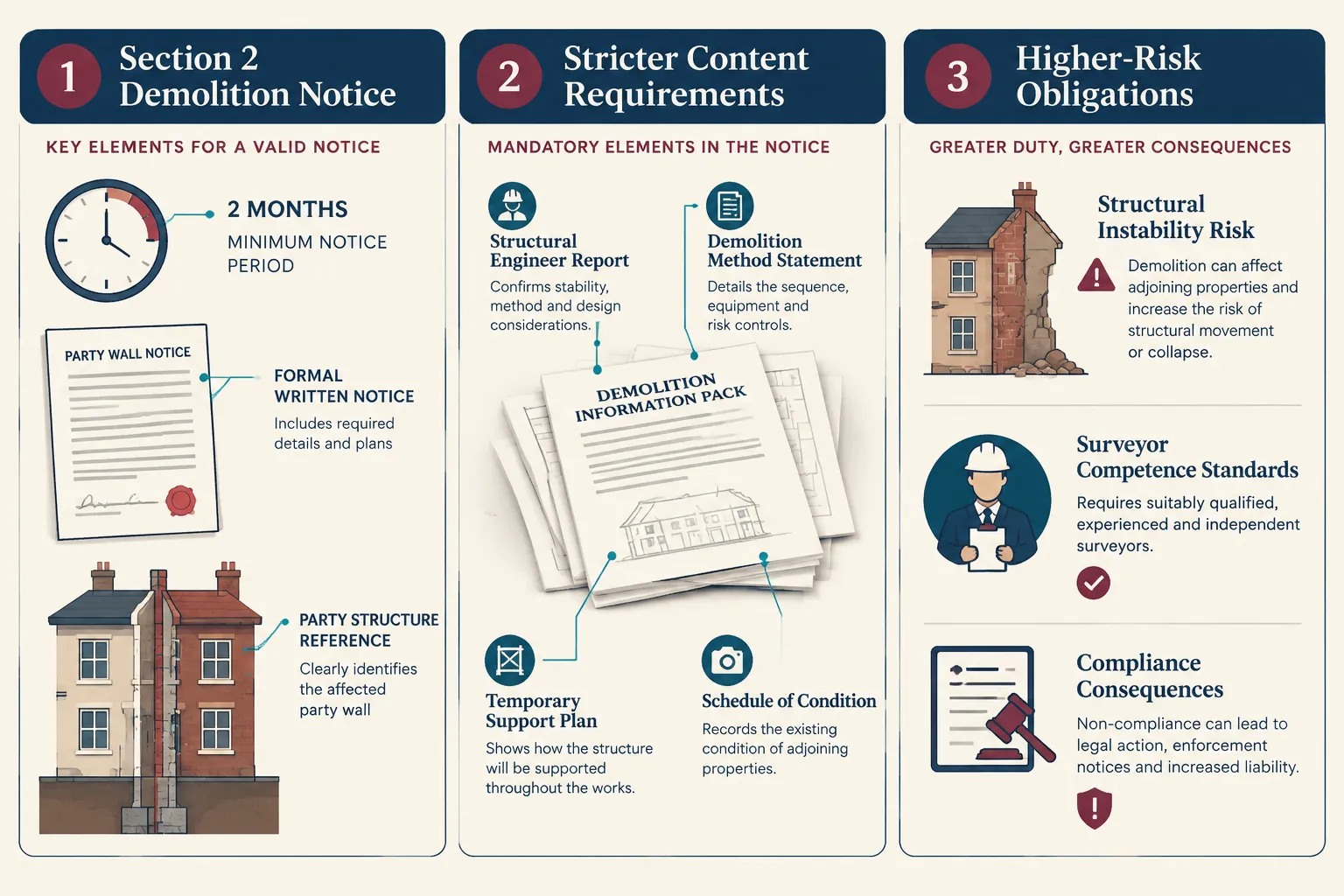
- Demolition of a party wall or structure is notifiable “Section 2” work under the Party Wall etc. Act 1996 and requires a formal notice served at least two months before work begins.
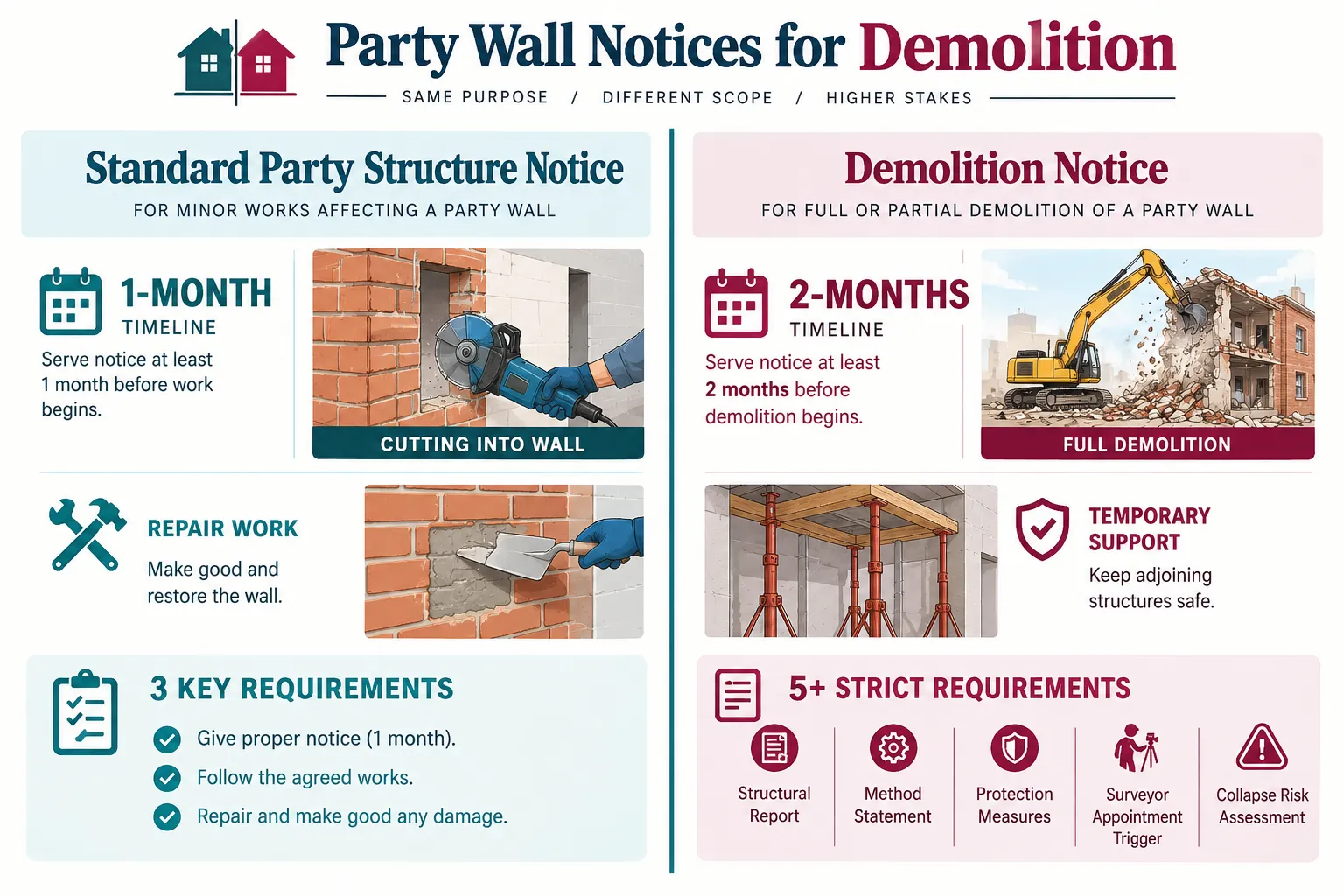
- Demolition notices carry stricter content requirements and trigger higher-risk obligations than standard party wall notices for cutting or repairing.
- Surveyors appointed for demolition disputes routinely insist on detailed Schedules of Condition, method statements and monitoring provisions within the party wall award.
- Failure to serve a valid demolition notice removes Act protections and exposes the building owner to common law liability for any damage caused.
- Where demolition involves excavation for new foundations or a basement, separate Section 6 notice obligations also apply, adding another layer of procedural compliance.
When Does Demolition Trigger a Party Wall Notice
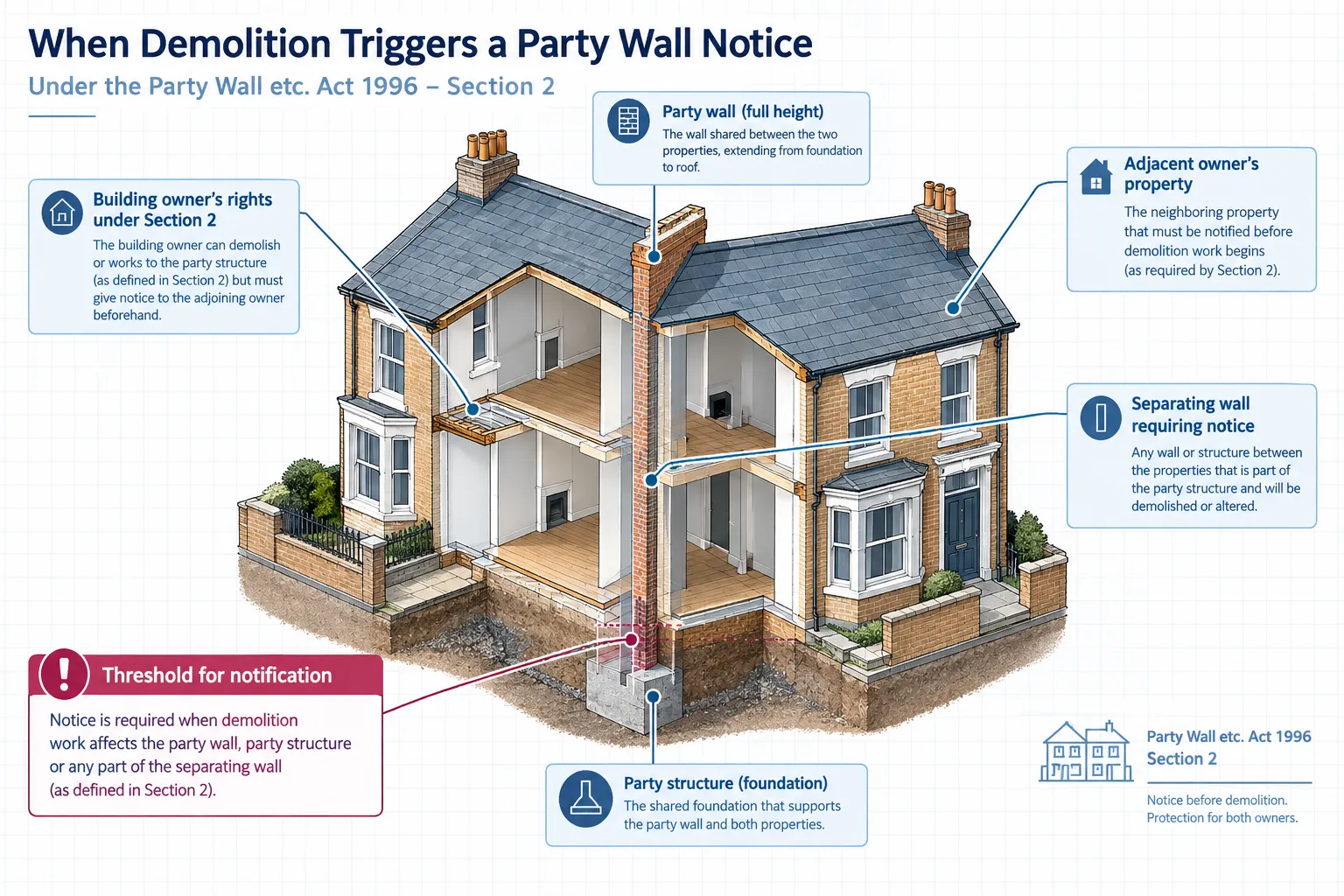
Not every act of demolition requires a party wall notice, but the threshold is lower than most people assume. Under the Party Wall etc. Act 1996, Section 2 sets out the specific rights a building owner has in relation to party structures, and demolition sits squarely within those rights [8]. A “party structure” includes any wall, floor or ceiling that separates buildings or parts of buildings belonging to different owners.
The key trigger is whether the structure being demolished is a party structure as defined by the Act. If a building owner intends to demolish a shared party wall entirely, for example, when combining two terraced properties or removing a rear outrigger, the Act applies. The same is true when demolition is partial but affects the structural integrity of a wall that the adjoining owner relies upon [9].
It is worth distinguishing this from demolition of a purely internal wall that does not form a boundary or shared structure. That type of work may not engage the Act at all. However, where there is any doubt, the safer course is always to seek professional advice before assuming no notice is needed.
Works most likely to require a demolition party wall notice include:
- Full demolition of a shared party wall between terraced or semi-detached properties
- Removal of a party fence wall at the boundary between two properties
- Demolition of a rear outrigger or extension that shares a wall with a neighbour
- Partial demolition that removes a section of a party structure
For a broader understanding of the different types of work covered by the Act, the types of party wall works page provides a useful reference.
How Demolition Notices Differ from Standard Party Wall Notices
Understanding party wall notices for demolition, the special rules, extra risks and surveyor requirements, begins with recognising how demolition notices differ from the more common party structure notice used for cutting into or repairing a shared wall.
Notice Type and Timing
Standard party wall works, such as cutting into a wall to insert a beam or carry out repairs, require a party structure notice served at least one month before work begins [8]. Demolition, however, falls under the Section 2 rights that require a minimum of two months’ notice before the planned start date [9]. This longer lead time reflects the greater disruption and risk involved.
The Party Wall Act Notices: what they are and how to respond guide explains the general framework for all types of notice, but demolition-specific notices have additional content requirements that must be met for the notice to be valid.
Content Requirements for a Demolition Notice
A valid demolition notice must include:
| Required Element | Details |
|---|---|
| Full name and address of the building owner | Identifies the party serving notice |
| Description of the proposed works | Must specifically describe the demolition |
| Planned start date | At least two months from service |
| Address of the property affected | The party structure location |
| Statement that the Act applies | Confirms the statutory basis |
Vague descriptions, such as “demolition works” without specifying what is being demolished, can render a notice invalid. Surveyors and legal practitioners increasingly insist on precise descriptions, particularly given the higher stakes involved in demolition [2].
The Consent and Dispute Mechanism
Once a demolition notice is served, the adjoining owner has 14 days to respond. If they give written consent, work can proceed after the two-month notice period. If they dissent, or fail to respond, a dispute is deemed to have arisen automatically under the Act, and surveyors must be appointed under Section 10 [4]. This automatic dispute mechanism is a critical feature: it means silence from a neighbour is never a green light to proceed.
Extra Risks Unique to Demolition Works
Demolition is inherently more destructive than most other party wall works, and the extra risks it creates are precisely why party wall notices for demolition carry special rules, extra risks and surveyor requirements that go beyond the standard framework.
Structural Instability and Collapse Risk
When a party wall is demolished, the adjoining owner’s building may lose lateral support it has relied upon for decades. This is not a theoretical risk, it is one of the most common causes of serious damage in urban demolition projects. The Act imposes a duty on the building owner to make good any damage caused to the adjoining owner’s property [8]. This duty to make good is not discretionary; it is a legal obligation that survives the completion of works.
“The right to demolish is always paired with the duty to remedy, a building owner who demolishes without adequate protection measures faces significant liability exposure.”
Exposure of Adjoining Structures
Demolition can expose previously protected elements of the adjoining property, internal wall finishes, insulation, damp-proof courses and even structural timbers. Once exposed, these elements are vulnerable to weather, moisture and physical damage. Surveyors routinely require the building owner to specify in advance how exposed surfaces will be protected and made weathertight [5].
Vibration and Ground Movement
Even carefully managed demolition creates vibration. In older terraced housing stock, common across London and other urban areas, vibration can cause cracking, settlement and damage to foundations. Where demolition involves machinery, the risk is amplified significantly.
Demolition of Party Fence Walls: A Special Case
The demolition of a party fence wall, the type of wall that sits on the boundary between two gardens, carries its own procedural requirements. These walls are defined differently from party walls under the Act, and their demolition may engage both Section 2 rights and boundary law considerations. Understanding the difference between a party fence wall and a boundary wall is essential before serving any notice.
Excavation and Section 6 Notice Obligations
Demolition projects frequently involve excavation, for new foundations, a basement or drainage works. Where excavation is planned within three metres of a neighbouring building and to a depth below the neighbour’s foundations, a separate Section 6 notice must also be served [9]. This adds a second notice requirement running alongside the demolition notice, with its own one-month minimum period and its own potential for dispute.
Failure to serve a Section 6 notice where one is required is a separate breach of the Act, compounding the risk for building owners who overlook this obligation.
Surveyor Requirements for Demolition: What the Act Demands
When a dispute arises, or is deemed to have arisen, following a demolition notice, the surveyor appointment process under Section 10 of the Act comes into play [4]. For demolition works, professional standards in 2026 place a particularly strong emphasis on surveyor competence and impartiality.
Appointment Options Under Section 10
The Act provides three routes for surveyor appointment:
- Agreed surveyor, both parties appoint a single surveyor to act impartially for both
- Two surveyors, each party appoints their own surveyor, who together select a third surveyor if needed
- Third surveyor, called upon by either appointed surveyor to resolve a deadlock
For demolition disputes, the two-surveyor route is more common because the stakes are higher and each party typically wants independent representation. The building owner’s surveyor and the adjoining owner’s surveyor each have defined roles and duties under the Act.
What Surveyors Insist on for Demolition Awards
A party wall award for demolition works is considerably more detailed than one for standard cutting-in works. Best practice in 2026, as reflected in RICS guidance, requires the award to address [5][6]:
- Schedule of Condition, a detailed photographic and written record of the adjoining property’s condition before demolition begins
- Method statement, a step-by-step description of how demolition will be carried out, including sequencing and temporary support measures
- Temporary propping and support, specific requirements for how the adjoining structure will be supported during and after demolition
- Weather protection, measures to protect exposed surfaces
- Monitoring provisions, crack monitors, settlement pins or regular surveyor inspections during the works
- Reinstatement obligations, clear terms for making good any damage
The Schedule of Condition is particularly important. Without a pre-works record, disputes about whether damage was caused by the demolition become very difficult to resolve. Surveyors who fail to insist on a thorough Schedule of Condition expose their clients, and themselves, to significant risk [10].
Competence and Impartiality Standards
The RICS guidance on party wall legislation and procedure makes clear that surveyors acting in demolition cases must have sufficient technical knowledge to assess structural risks and specify appropriate protective measures [5]. An experienced party wall surveyor will understand structural engineering principles well enough to challenge inadequate method statements and insist on revisions before an award is made.
For those in London seeking specialist support, qualified surveyors are available across North London, South London, East London and West London.
What Happens If You Fail to Serve a Demolition Notice
The consequences of failing to serve a valid demolition notice are serious and often underestimated. The Act provides a framework of rights and protections, but those protections only apply to parties who have followed the statutory process [8].
Key consequences of non-compliance:
- The building owner loses the right to rely on Act procedures to resolve disputes
- Any damage caused must be pursued through common law, which is slower and more expensive
- Courts may grant injunctions to stop works already underway
- The adjoining owner may seek damages for trespass or nuisance
- Insurance may not cover losses arising from unlawful demolition works
The government’s own explanatory booklet on the Act is explicit: works carried out without proper notice are unlawful under the Act, and the building owner assumes full liability for any resulting damage [8]. This is not a technicality, it is a fundamental shift in legal exposure.
Practical Steps for Building Owners Planning Demolition
Given the complexity of party wall notices for demolition, the special rules, extra risks and surveyor requirements involved, building owners benefit from a structured approach from the outset.
Before serving notice:
- Confirm whether the structure is a party structure under the Act
- Identify all adjoining owners and their contact details
- Prepare a clear description of the demolition works
- Check whether Section 6 excavation notices are also required
- Engage a qualified party wall surveyor early
After serving notice:
- Keep records of service (recorded delivery or personal service with a witness)
- Monitor the 14-day response window carefully
- If consent is not received, move promptly to surveyor appointment
- Do not begin works until a valid award is in place or consent has been given in writing
Understanding the costs of the party wall process at an early stage also helps building owners budget realistically for surveyor fees, which in demolition cases are typically higher than for standard works due to the additional complexity involved.
Conclusion
Demolition is one of the most consequential categories of party wall work, and the legal framework surrounding it demands careful attention. Party wall notices for demolition carry special rules, extra risks and surveyor requirements that distinguish them sharply from the notices used for routine cutting-in or repair works. The two-month notice period, the strict content requirements, the automatic dispute mechanism and the detailed award provisions all exist because the risks to adjoining owners are real and potentially severe.
Actionable next steps for anyone planning demolition works:
- Confirm whether the Act applies to the structure being demolished, seek professional advice if in doubt
- Serve a valid, detailed notice at least two months before the planned start date
- Check whether Section 6 excavation notices are also required
- If a dispute arises, appoint a qualified and experienced party wall surveyor promptly
- Ensure the party wall award includes a Schedule of Condition, method statement and monitoring provisions before any work begins
- Do not proceed without written consent or a valid award in place
For those navigating this process in London, specialist support is available from qualified surveyors who understand the full scope of demolition-related party wall obligations. Taking the right steps early is always less costly than resolving the consequences of getting them wrong.
References
[1] News – whmatthews.com
[2] Uk Party Wall Agreement Guide 2026 – calchub.uk
[3] Party Wall Notices – party-wall-advice.co.uk
[4] legislation.gov.uk – legislation.gov.uk
[5] Jan 22 Party Wall Legislation And Procedure 7th Edition – rics.org
[6] Party Wall Legislation And Procedure – isurv.com
[7] 130618 Circular Letter Revised Party Wall Act Explanatory Booklet Final – assets.publishing.service.gov.uk
[8] The Party Wall Etc Act 1996 Explanatory Booklet – gov.uk
[9] When How Tell Them – gov.uk
[10] Do I Need A Party Wall Agreement – corinthiansurveyorslondon.co.uk