
Half a million homes. That is the upper estimate now sitting in a letter from the London Assembly’s Planning and Regeneration Committee to Mayor Sadiq Khan, and it is built entirely on space London already owns: the air above its existing rooftops. On 7 October 2026, the committee argued that between 140,000 and 500,000 new homes could be built upward rather than outward, without touching a single green belt field. For owners already weighing a loft conversion or mansard, the politics are suddenly moving fast, but the legal mechanics of rooftop extensions London party wall law have not changed at all, and they remain the part most people get wrong.
This matters right now because London homes are sitting on the market for an average of 78 days before finding a buyer, according to Rightmove data from September 2026. Many owners are choosing to extend rather than sell. Whether that extension is a single loft conversion or a full mansard across a terrace, the Party Wall etc. Act 1996 will almost certainly apply, and ignoring it is the fastest way to turn a profitable project into a legal dispute.
Key Takeaways
- The London Assembly’s Planning and Regeneration Committee wants a citywide rooftop-extension “pattern book,” citing estimates of up to 500,000 potential new homes built above existing buildings.
- Planning permission and the Party Wall Act are separate legal processes, getting planning consent does not remove the need for party wall notices.
- Any work raising, cutting into, or resting on a party wall or party structure needs a Party Structure Notice served at least two months before work starts.
- Boroughs like Tower Hamlets and Haringey already show that clear design guidance accelerates approvals, but Article 4 Directions in places like Islington still require full planning permission for many roof extensions.
- Owners in terraces and converted flats face more complex party wall arrangements because one mansard can affect several adjoining owners and leaseholders at once.
Why the London Assembly Wants Rooftop Extensions Across London
The Assembly’s push is not a new idea dressed up for 2026, it is a decade-old argument finally gaining institutional weight. A 2018 estimate already suggested residential rooftop developments could provide up to 180,000 new homes in London. The October 2026 letter, based on evidence heard at a July 2026 committee session chaired by James Small-Edwards AM, pushes that figure far higher, drawing on testimony from HTA Design, WSP, Historic England, Create Streets, Tower Hamlets, Haringey, Populo Living and Apex Airspace.
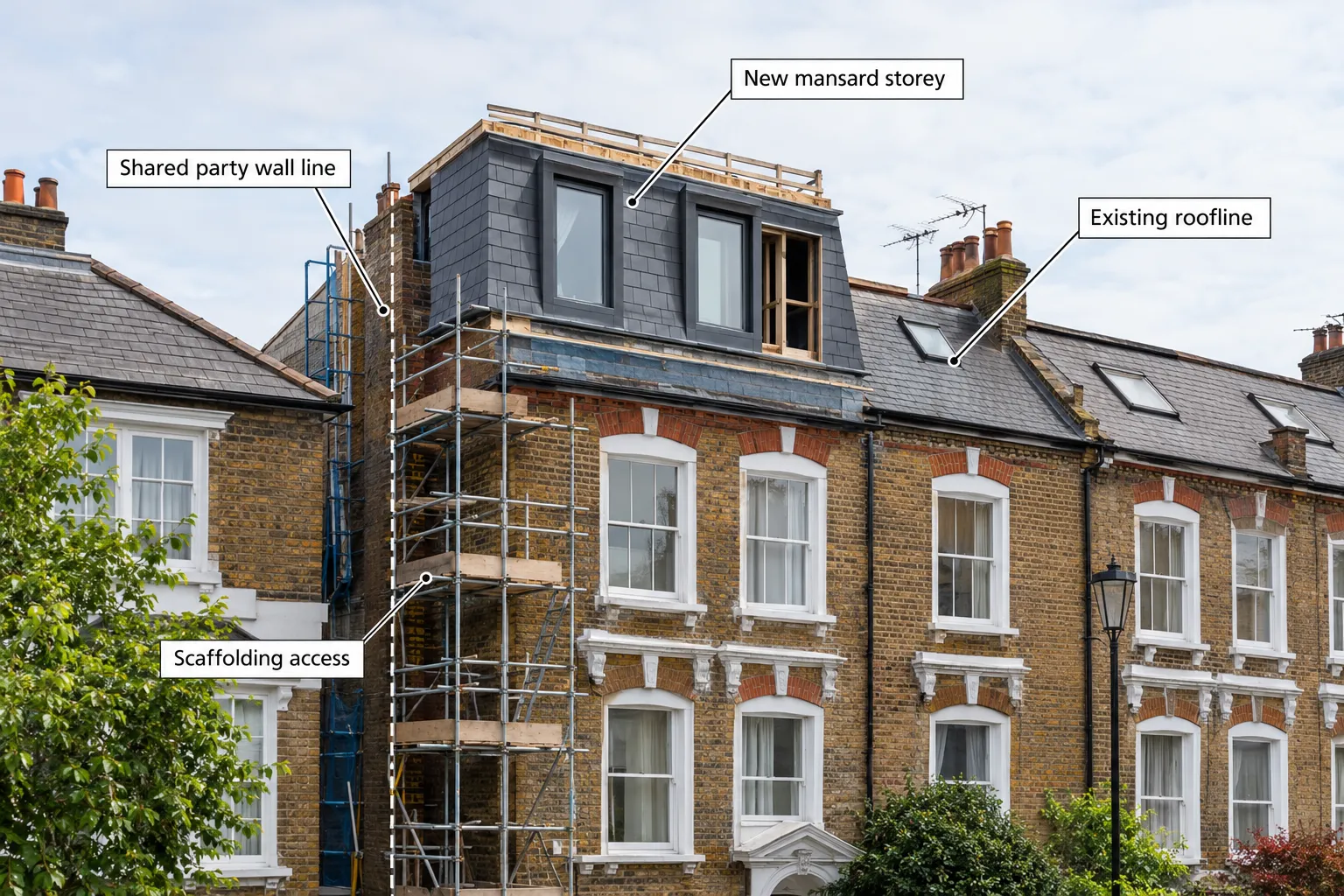
The case studies cited are concrete. Haringey’s 2013 design guide for South Tottenham has already produced at least 200 rooftop extensions. Since Tower Hamlets adopted mansard design guidelines across five conservation areas in 2017, mansard applications and approvals have risen sharply. Create Streets’ 2024 report “The Mansard Revolution” goes further, arguing that mansards impose “very little visual burden” on a street when designed well. The revised National Planning Policy Framework, updated in December 2024, now explicitly supports mansards and the use of airspace above existing buildings under certain conditions.
Permitted development rights under Class AA, introduced in 2020, already allow some houses and blocks to add storeys with only prior approval rather than full planning permission. But many boroughs restrict this heavily inside conservation areas and Article 4 zones, Islington is a clear example, where even standard loft conversions usually need full planning permission regardless of Class AA.
Planning Permission and Rooftop Extensions London Party Wall Law Are Not the Same Thing
This is the point owners most often misunderstand. Winning planning permission, or qualifying under permitted development, tells you the design is acceptable to the borough. It says nothing about your legal obligations to the neighbours who share your structure.
The Party Wall etc. Act 1996 is a separate, private law matter between adjoining owners. It applies regardless of what planning consent says, and it covers:
- Section 2 works, raising a party wall or party parapet, cutting into a party wall to insert new beams or steels, or any work to a party structure, including floors and ceilings separating flats.
- Section 6 works, excavating within 3 metres of a neighbouring structure (or within 6 metres where the 45-degree rule applies), relevant for new foundations supporting an added storey.
A mansard or rooftop extension almost always triggers Section 2, because raising a party wall to carry the new storey, or resting new steelwork on it, is exactly what the Act was written to cover.
The Party Wall Act Step-by-Step for Rooftop Extensions London
Once planning matters are settled, or run in parallel, the party wall process follows a fixed legal sequence. Skipping steps does not speed anything up, it usually causes delay and risk.
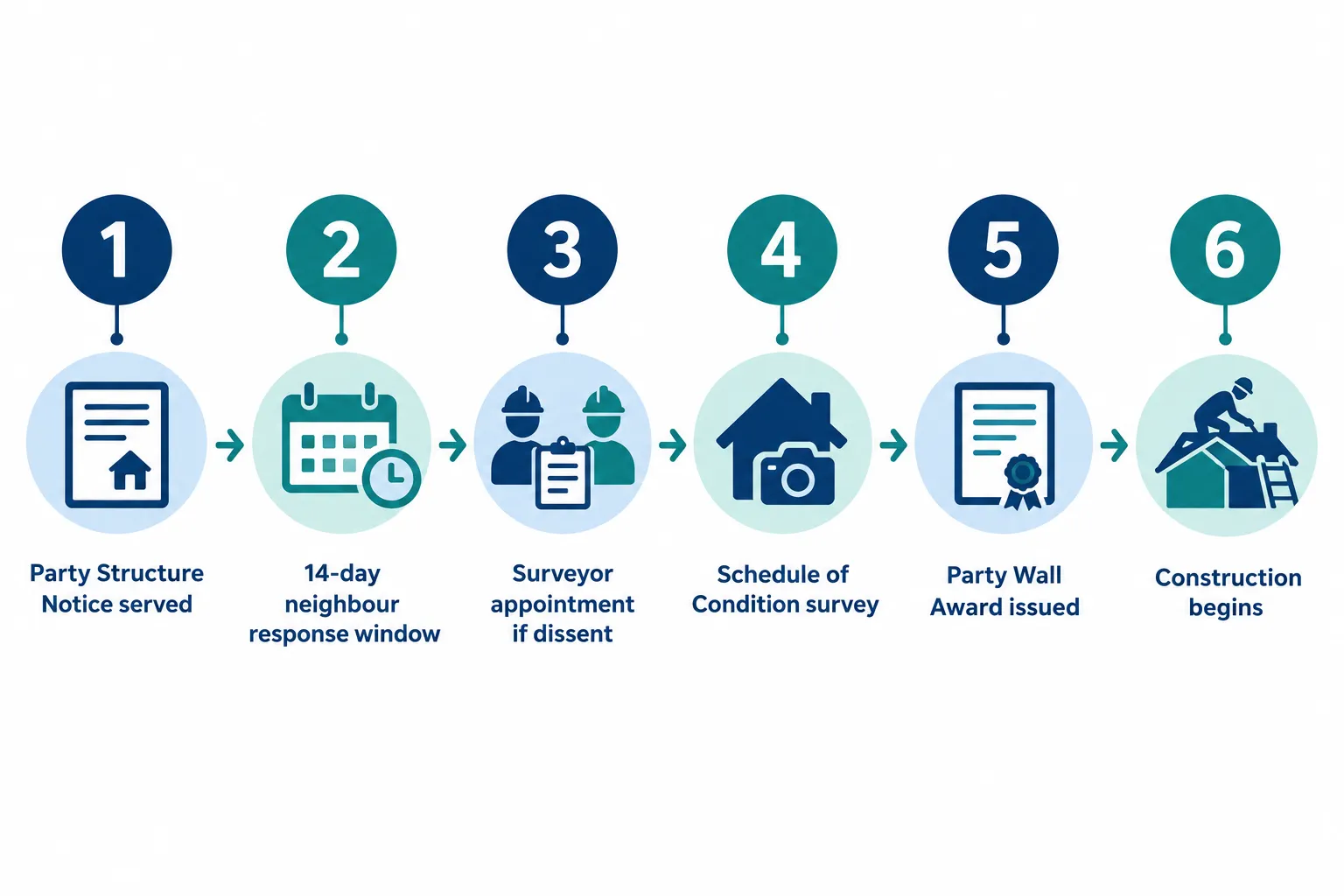
- Identify every adjoining owner. On a terrace, a mansard can affect the neighbour on each side, and sometimes the building behind. In converted blocks, leaseholders below and beside the works may also qualify as adjoining owners.
- Serve a Party Structure Notice. This must go out at least two months before work begins, describing the proposed works to the party wall or structure.
- Wait for a response. Neighbours have 14 days to consent, dissent, or stay silent. Silence after 14 days is treated as dissent under the Act.
- Appoint surveyors if there is dissent. Owners can agree on one shared surveyor or each appoint their own. Surveyors then negotiate the terms of the Award together.
- Complete a Schedule of Condition. This records the state of the neighbouring property before work starts, protecting both sides if damage is later disputed.
- Receive the Party Wall Award. This legally binding document sets out what work is permitted, access rights, and any conditions to protect the adjoining structure.
Starting construction without serving notice is a genuine legal risk, not a formality. Affected neighbours can seek an injunction to halt work, and claims for damage become far harder to resolve cleanly without a prior Schedule of Condition.
Costs, Timelines and Common Pitfalls
Party wall timelines run in parallel with, not instead of, the two-month statutory notice period, so owners who leave this until after planning approval often lose weeks they did not plan for. Typical pitfalls include:
- Assuming permitted development removes the need for party wall notices (it does not).
- Underestimating how many adjoining owners a single mansard touches on a terrace.
- Failing to budget time for surveyor appointment when a neighbour dissents.
- Starting demolition or steel-cutting before the Award is finalised.
Surveyor fees and project costs vary significantly by property size, number of adjoining owners, and whether disputes arise, so owners should request a tailored estimate rather than relying on generic figures.
What This Means for Flat Owners and Freeholders in Terraces
Upward extensions on shared buildings are legally more layered than a single-family loft conversion. A mansard across a converted terrace house can affect the freeholder, multiple leaseholders, and neighbouring freeholders simultaneously. Each may qualify as a separate adjoining owner under the Act, each entitled to their own notice period and, if they choose, their own surveyor. Developers eyeing the Assembly’s pattern-book vision will need to plan for this complexity at the outset, not as an afterthought once scaffolding is already up.
Frequently Asked Questions
Does planning permission remove the need for a party wall notice? No. Planning and the Party Wall Act are entirely separate legal processes. Consent from the borough does not satisfy your obligations to adjoining owners.
How much notice must I give neighbours before a rooftop extension? At least two months under Section 2 for work to a party wall or structure, and one month under Section 6 for nearby excavation.
What happens if my neighbour ignores the notice? Silence after 14 days counts as dissent. Surveyors must then be appointed to agree a Party Wall Award before work can lawfully proceed.
Can I start work while waiting for the Award? No. Starting works without a valid notice or before the Award is settled risks an injunction and complicates any later damage claims.
Does the London Assembly’s proposal change the Party Wall Act? No. The Assembly’s pattern-book idea concerns planning policy and design guidance. The Party Wall etc. Act 1996 remains unchanged and still applies to qualifying works.
Conclusion
The London Assembly’s push for rooftop extensions could reshape how London adds housing over the coming decade, but for individual owners the immediate priority has not shifted: planning approval and party wall compliance are two separate legal tracks that must both be managed correctly. Anyone planning a mansard, loft conversion, or added storey should confirm their borough’s planning rules, then identify every adjoining owner affected and serve the correct Party Structure Notice well before the two-month clock needs to start. Engaging a qualified party wall surveyor early, before scaffolding goes up, remains the single most effective way to avoid delay, disputes, and legal exposure as this rooftop extensions London party wall policy debate continues through the Autumn Budget on 28 October 2026 and beyond.