
Nearly 40% of party wall disputes in 2026 stem from improperly served notices rather than disagreements about the actual construction work. When a notice fails to meet legal requirements, the entire project timeline collapses—yet most building owners remain unaware their documentation is invalid until an injunction halts their excavators mid-dig. Understanding the Validity of Party Wall Notices: Common Errors and How Surveyors Validate Compliance has become essential for anyone planning construction work that affects shared structures.
The Party Wall etc. Act 1996 establishes clear requirements for serving notices, but the gap between legal requirements and real-world practice creates significant risk. Professional surveyors have developed systematic validation processes to identify defects before they escalate into costly legal battles. This guide examines the most frequent errors that invalidate notices and provides a comprehensive framework for ensuring compliance.
Key Takeaways
- Party wall notices expire after 12 months from service date, requiring precise timing documentation to ensure work commences within the validity window[2]
- Incorrect service methods represent the most common error, with hand-delivered notices lacking proof of receipt causing disputes
- Missing or inadequate plans and specifications frequently invalidate notices, as neighbours cannot properly assess proposed works without technical details
- Professional surveyors use systematic checklists to validate notice compliance before work begins, preventing injunctions and project delays
- Schedule of Condition documentation must be completed before works commence to establish baseline property conditions and protect all parties[3]
Common Errors That Invalidate Party Wall Notices
Incorrect Notice Type Selection
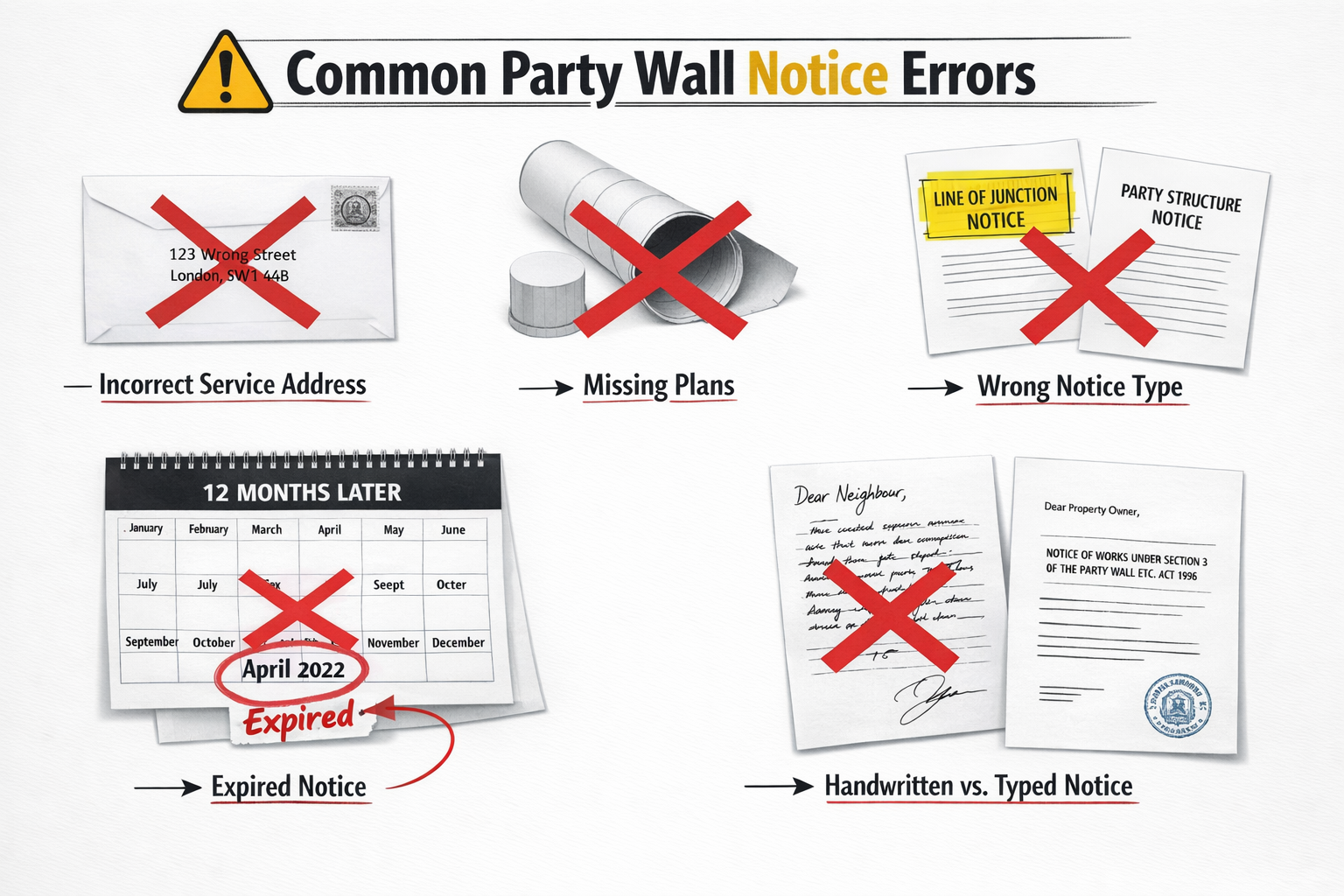
The Party Wall etc. Act 1996 specifies three distinct notice types, each designed for specific work categories. Selecting the wrong notice type immediately invalidates the documentation, regardless of how well-prepared the remaining content may be.
Line of Junction Notice applies when building a new wall directly on the boundary line between properties. Many building owners mistakenly serve a Party Structure Notice for this work, creating legal confusion and requiring the entire notice process to restart.
Party Structure Notice covers work to existing party walls, including cutting into walls for beam insertions, raising party walls, or underpinning shared foundations. This notice type requires the most detailed specifications, as it directly affects the structural integrity of both properties.
Adjacent Excavation Notice (3-meter and 6-meter notices) applies when digging foundations near a neighbour’s structure. The distinction between these two sub-types depends on excavation depth relative to neighbouring foundations—a technical calculation that frequently contains errors.
Service Method Failures
How a notice is delivered matters as much as its content. The Act permits several service methods, but each requires specific documentation to prove compliance.
Hand delivery seems straightforward but creates problems when neighbours dispute receiving the notice. Without a signed acknowledgment, building owners cannot prove service occurred. Professional practice now requires photographic evidence of delivery, ideally with timestamp metadata.
Registered or recorded post provides tracking confirmation but doesn’t guarantee the recipient actually received or opened the envelope. Surveyors recommend combining postal service with follow-up confirmation.
Email service has gained acceptance in 2026, but only when the recipient has previously agreed to electronic communication in writing. Many notices served via email remain legally questionable without this prior consent.
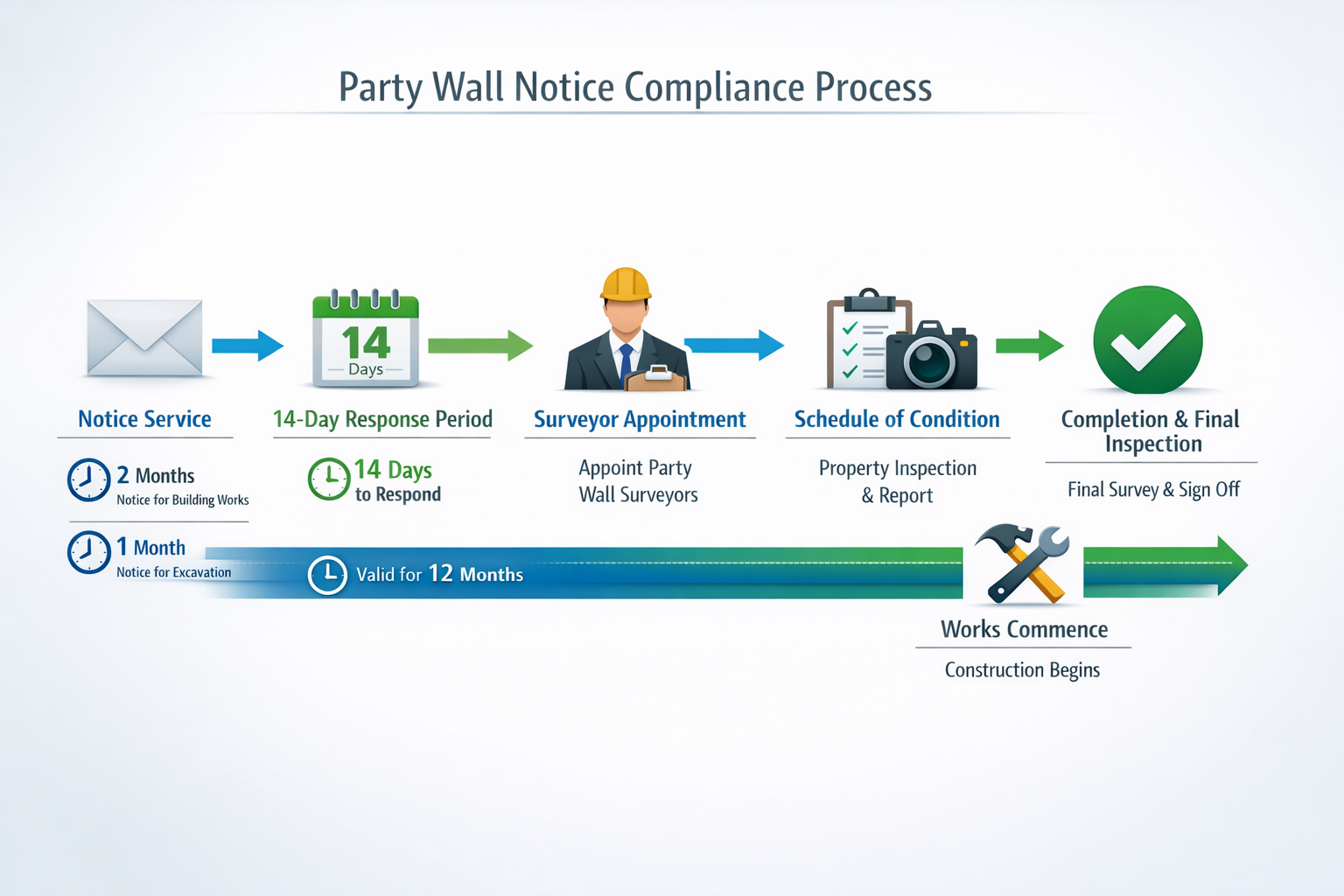
The standard notice period is 2 months for building works affecting a party wall or boundary, allowing neighbours adequate time to respond or raise concerns[3]. For excavation work or building a new wall at the boundary line, the notice period is reduced to one month[3]. Calculating these periods incorrectly—particularly when counting from the wrong date—represents another frequent error.
Missing or Inadequate Plans and Specifications
A party wall notice must contain sufficient detail for the adjoining owner to understand the proposed works and their potential impact. Vague descriptions like “loft conversion” or “basement extension” fail this requirement.
Essential technical details include:
- Precise dimensions of excavations or structural alterations
- Depth and width of new foundations
- Beam sizes and insertion points for structural work
- Materials to be used in construction
- Proposed working hours and project duration
- Access requirements to neighbouring property
Architectural drawings must be to scale and show both existing and proposed conditions. Hand-drawn sketches rarely meet this standard. Surveyors validating notices check that plans include:
| Required Element | Common Omission | Impact on Validity |
|---|---|---|
| Scale notation | No scale indicated | Notice invalid |
| North point orientation | Missing directional reference | Reduces clarity, may invalidate |
| Boundary lines | Property lines unclear | Cannot assess boundary work |
| Existing structures | Only shows new work | Neighbour cannot assess impact |
| Cross-sections | Only plan views provided | Depth/height unclear |
Timing and Validity Period Errors
Party Wall notices are only valid for 12 months from the date of service, requiring careful documentation of timing to ensure work begins within this window[2]. This limitation creates several common problems:
Premature service occurs when building owners serve notices before obtaining planning permission or finalizing designs. When construction details change, the original notice becomes invalid, requiring a new notice and resetting the entire timeline.
Expiration before commencement happens when projects face unexpected delays. A notice served in January 2026 expires in January 2027—if construction hasn’t started by then, the entire process must restart, including new surveys and potentially new agreements.
Incorrect calculation of notice periods frequently occurs around weekends and bank holidays. The notice period begins the day after service, and many building owners miscalculate the exact date when work can legally commence.
Failure to Include Required Information
Beyond plans and specifications, notices must contain specific legal information. Missing any of these elements can invalidate the entire notice:
- Building owner’s full legal name and address (not just the property undergoing work)
- Precise description of intended works using terminology from the Act
- Statement of rights explaining the adjoining owner’s response options
- Clear indication of which section(s) of the Act the notice is served under
- Date of service clearly stated (not just postmark date)
Many template notices downloaded from general websites omit the statement of rights, leaving adjoining owners unaware they have exactly 14 days to respond[3]. This omission doesn’t necessarily invalidate the notice but creates confusion that often leads to disputes.
Understanding what party wall notices are and how to respond helps both building owners and neighbours navigate these requirements effectively.
How Surveyors Validate Party Wall Notice Compliance
Pre-Commencement Notice Review Checklist
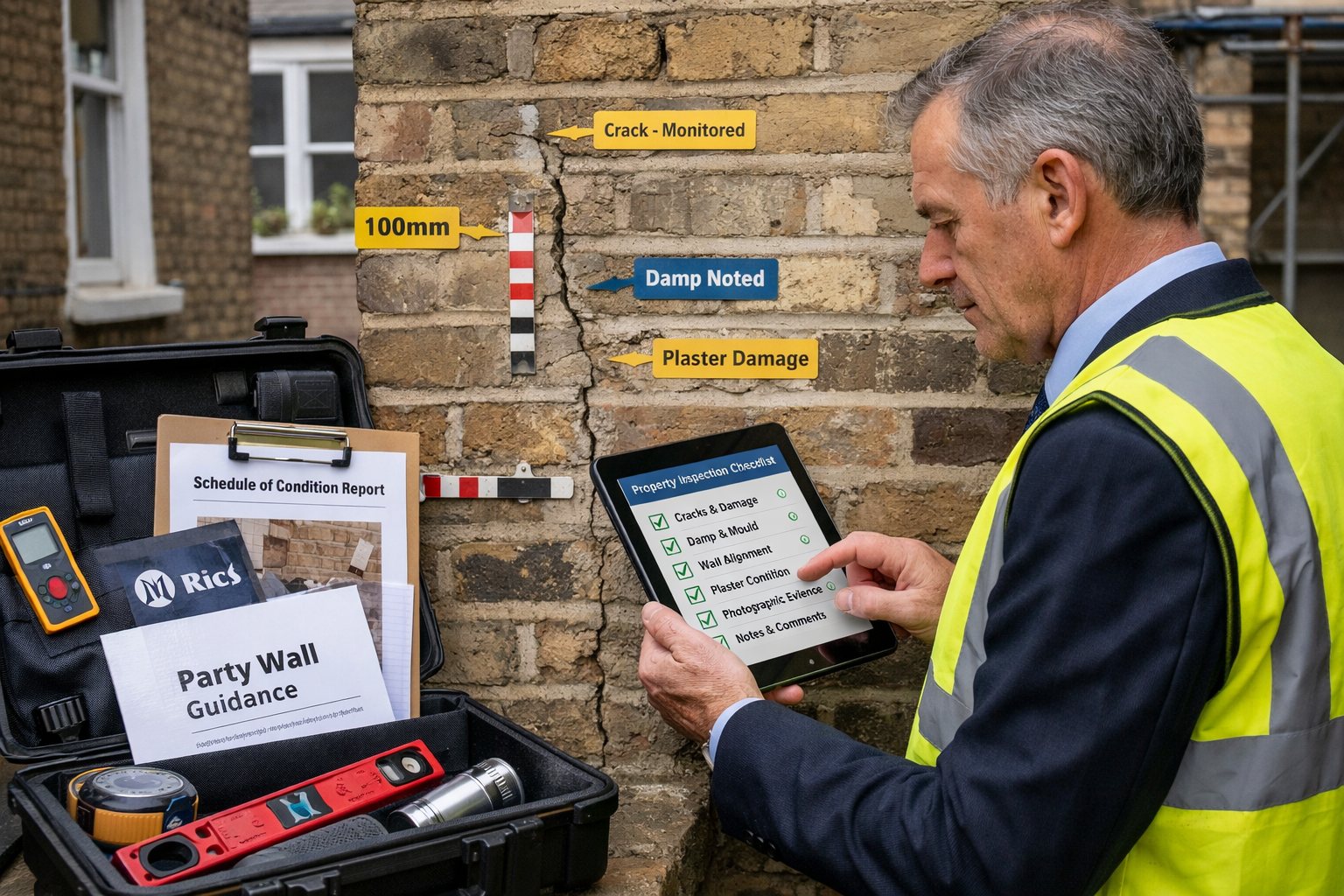
Professional surveyors acting as building owners’ surveyors or adjoining owners’ surveyors employ systematic validation processes before works commence. This prevents the severe consequence of neighbours applying for a party wall injunction to stop work until notice is properly served[3].
Document Completeness Verification
The first validation step examines whether all required documentation exists:
✅ Original notice document with all sections completed
✅ Architectural drawings showing existing and proposed conditions
✅ Structural calculations (where applicable for beam insertions or underpinning)
✅ Proof of service documentation (postal receipts, signed acknowledgments, or photographic evidence)
✅ Response from adjoining owner (consent or surveyor appointment)
✅ Party Wall Award (if surveyors were appointed)
✅ Schedule of Condition completed before works commence[3]
A critical error is failing to prepare a Schedule of Condition before work begins—without this independent expert documentation, it becomes extremely difficult to establish which damage was caused by the works versus pre-existing damage, creating legal liability[3]. Professional surveyors insist on this documentation regardless of whether the adjoining owner requests it.
Technical Accuracy Assessment
Surveyors with construction knowledge validate the technical content:
- Structural feasibility of proposed works as described
- Accuracy of measurements against site conditions
- Appropriateness of specified materials for the work type
- Compliance with building regulations (separate from party wall requirements but relevant)
- Realistic timeline for project completion
This technical review often reveals discrepancies between what the notice describes and what contractors actually plan to do. When surveyors identify these gaps, they require amended notices before validating compliance.
Legal Compliance Verification
Surveyors check that notices meet all statutory requirements under the Party Wall etc. Act 1996:
- Correct notice type for the described works
- Appropriate notice period observed (2 months for most works, 1 month for excavations)[3]
- All required information included
- Service method legally valid
- Response period properly observed (14 days from service)[3]
The Party Wall Act 1996 applies only to England and Wales, not Scotland or Northern Ireland[3]. Surveyors working across UK regions must verify jurisdictional applicability—a notice served for Scottish property has no legal standing.
RICS Guidance and Professional Standards
The Royal Institution of Chartered Surveyors (RICS) provides professional guidance that extends beyond statutory minimums. Surveyors validating compliance reference these standards to ensure best practice.
RICS Party Wall Guidance Note establishes expectations for:
- Minimum content requirements for notices
- Appropriate level of detail in plans and specifications
- Professional conduct standards for appointed surveyors
- Fee structures and cost allocation
- Dispute resolution procedures
Surveyors validating notices check whether the documentation would withstand scrutiny if a dispute reached the County Court. Both the building owner and adjoining owners have 14 days to appeal a party wall award to County Court[3], making thorough initial validation essential.
Professional Indemnity Considerations
Surveyors carry professional indemnity insurance that requires them to follow established validation procedures. This creates an additional quality control layer—surveyors who approve defective notices face potential insurance claims.
Insurance requirements typically mandate:
- Written validation reports documenting the review process
- Photographic evidence of site conditions
- Correspondence files showing all communications
- Professional opinion letters explaining technical assessments
These documentation requirements benefit all parties by creating a clear compliance trail.
Case Examples: When Notices Fail Validation
Case Study 1: The Expired Notice
A building owner in West London served notice in March 2025 for a loft conversion. Planning permission delays pushed construction to April 2026—beyond the 12-month validity period[2]. The surveyor identified this expiration during pre-commencement validation, requiring a new notice and delaying the project by another three months.
Learning Point: Surveyors now recommend serving notices only after all permissions are secured and contractors are scheduled, maximizing the validity window.
Case Study 2: Inadequate Plans
A South London basement excavation notice included only a single floor plan with no cross-sections. The adjoining owner’s surveyor rejected the notice as invalid because it didn’t show excavation depth relative to neighbouring foundations—critical information for assessing risk.
Learning Point: Cross-sectional drawings are essential for any excavation work, showing precise depths and proximity to adjacent structures.
Case Study 3: Wrong Notice Type
A building owner in Central London served a Party Structure Notice for building a new garden wall on the boundary line. The surveyor identified this should have been a Line of Junction Notice, invalidating the entire submission.
Learning Point: Professional surveyor review before serving notices prevents this common error and avoids timeline delays.
Validation Timeline and Process Flow
Understanding when validation occurs helps building owners plan appropriately:
Stage 1: Pre-Service Validation (Recommended)
Before serving notice, engage a surveyor to review documentation. This prevents serving defective notices that waste the 14-day response period.
Stage 2: Post-Service, Pre-Response Validation
After serving notice but before the 14-day response period expires, adjoining owners’ surveyors review for validity. Defects identified here require new notices.
Stage 3: Pre-Award Validation
When surveyors are appointed, they validate notices as part of preparing the Party Wall Award. This represents the final opportunity to identify defects before work begins.
Stage 4: Pre-Commencement Validation
Immediately before construction starts, surveyors confirm all documentation remains valid and complete, including the Schedule of Condition.
Professional practice in 2026 emphasizes Stage 1 validation as the most cost-effective approach. Identifying errors before service prevents timeline delays and reduces overall project costs. Many building owners wonder about having a party wall agreement without a surveyor, but professional validation significantly reduces dispute risk.
Practical Checklist for Building Owners and Surveyors
Before Serving Notice: Preparation Checklist
Building owners can validate their own documentation before engaging surveyors using this systematic approach:
✅ Work Classification
- Identify which types of party wall works apply to your project
- Determine correct notice type (Line of Junction, Party Structure, or Adjacent Excavation)
- Confirm work actually requires notice (minor works like plastering, electrical work, and drilling internal walls for fixtures do not require formal agreements[3])
- Verify property is in England or Wales (Act doesn’t apply elsewhere)
✅ Documentation Preparation
- Obtain scale architectural drawings showing existing and proposed conditions
- Include cross-sectional views for any excavation or vertical work
- Prepare written specifications detailing materials, dimensions, and methods
- Calculate correct notice period (2 months for most work, 1 month for excavations)[3]
- Draft notice using appropriate legal terminology from the Act
✅ Service Planning
- Identify all adjoining owners who must receive notice (may include multiple properties)
- Verify current ownership details through Land Registry if uncertain
- Select service method and prepare proof-of-service documentation
- Schedule service date to allow adequate notice period before intended start date
- Confirm work will commence within 12-month validity period[2]
✅ Financial Preparation
- Understand costs of the party wall process and budget accordingly
- Review strategies for keeping party wall costs down
- Prepare for potential surveyor appointment fees
Post-Service: Monitoring Compliance
After serving notice, building owners must track response deadlines and maintain compliance:
📅 Day 1-14: Response Period
- Monitor for adjoining owner response
- Be prepared for three possible outcomes:
- Written consent (no surveyor needed, proceed with works)[3]
- Surveyor appointment (proceed to Award process)
- No response (deemed dispute, surveyors must be appointed)
📅 Day 15-60: Award Preparation (if applicable)
- Appointed surveyors prepare Party Wall Award
- Schedule of Condition survey conducted
- Award specifies working conditions and protections
- Both parties have 14 days to appeal Award to County Court[3]
📅 Before Commencement: Final Validation
- Confirm all documentation complete
- Verify Schedule of Condition finalized
- Ensure contractors understand Award conditions
- Check work will commence within validity period
Surveyor’s Professional Validation Protocol
Professional surveyors follow this systematic protocol when validating notices:
🔍 Initial Document Review
- Completeness Check: Verify all required documents present
- Accuracy Assessment: Confirm technical specifications match site conditions
- Legal Compliance: Validate statutory requirements met
- Timeline Verification: Confirm notice periods and validity windows correct
🔍 Technical Site Assessment
- Site Visit: Physical inspection of party wall and surrounding structures
- Measurement Verification: Confirm drawings accurately represent conditions
- Risk Assessment: Evaluate potential impact on adjoining property
- Access Requirements: Determine if neighbouring property access needed
🔍 Documentation and Reporting
- Validation Report: Written confirmation of compliance or list of defects
- Photographic Evidence: Site condition documentation
- Correspondence File: Record of all communications
- Professional Opinion: Technical assessment of proposed works
This systematic approach ensures consistent validation standards across all projects, whether in North London, East London, or elsewhere.
Legislative Updates and 2026 Compliance Requirements
The Party Wall Act 1996 remains the primary legislation, but 2026 has brought important contextual changes affecting how notices are managed. The Renters Rights Act has repositioned tenant rights as central to all party wall notices and procedures[1], particularly when landlord-initiated works affect rental properties.
Key 2026 Considerations:
🏠 Tenant Notification Requirements: Landlords must now provide additional notice to tenants before serving party wall notices for works affecting rental properties. This adds a preliminary step to the compliance process.
📋 Enhanced Documentation Standards: Professional bodies have strengthened guidance on minimum documentation standards, making thorough validation even more critical.
⚖️ Dispute Resolution Emphasis: Courts are increasingly scrutinizing whether proper notice procedures were followed, making validation documentation essential for legal protection.
While these changes don’t alter the fundamental notice requirements, they emphasize the importance of thorough compliance validation before works commence.
Common Misconceptions About Notice Requirements
Several widespread misunderstandings lead to compliance errors:
Myth: All construction work requires party wall notices
Reality: Minor works commonly assumed to require party wall agreements actually do not require formal agreements, including plastering, electrical work, and drilling internal walls for fixtures—this misunderstanding wastes resources and causes unnecessary delays[3].
Myth: Verbal agreement with neighbour is sufficient
Reality: When neighbours provide written assent to proposed works, no surveyor appointment or Party Wall Award is necessary—but the assent must be in writing to be valid[3].
Myth: Party wall notices apply throughout the UK
Reality: The Act applies only to England and Wales[3]. Scotland and Northern Ireland have different legal frameworks.
Myth: Once served, a notice remains valid indefinitely
Reality: Notices expire after 12 months[2], requiring careful project timing.
Understanding what actually requires notice helps building owners avoid unnecessary delays. Party wall agreements are most commonly required for loft conversions, insertion of damp proof courses, and excavation for new foundations associated with building extensions[3].
Risk Mitigation Through Proper Validation
The consequences of invalid notices extend beyond project delays:
Legal Risks:
- Injunctions halting work mid-construction
- Liability for damage without Schedule of Condition protection[3]
- County Court proceedings and associated legal costs
- Potential claims from adjoining owners for losses
Financial Risks:
- Contractor standby costs during compliance resolution
- Additional surveyor fees for correcting defective notices
- Increased insurance premiums following disputes
- Property value impact from unresolved neighbour disputes
Relationship Risks:
- Damaged neighbour relations affecting future cooperation
- Community reputation impact
- Stress and conflict during construction period
Professional validation mitigates these risks by ensuring compliance before problems emerge. The modest cost of surveyor review before serving notice represents excellent value compared to the potential costs of defective notices.
Conclusion
The Validity of Party Wall Notices: Common Errors and How Surveyors Validate Compliance represents a critical knowledge area for anyone planning construction work affecting shared structures. Invalid notices create cascading problems—project delays, legal disputes, financial losses, and damaged neighbour relationships—all preventable through systematic validation.
The most common errors—incorrect service methods, missing technical specifications, wrong notice types, and timing miscalculations—occur because building owners attempt to navigate complex legal requirements without professional guidance. Professional surveyors bring systematic validation protocols that identify defects before they become disputes.
Actionable Next Steps
For Building Owners Planning Works:
- Engage a professional surveyor before serving notices to validate documentation completeness and accuracy
- Prepare comprehensive technical drawings including cross-sections and accurate measurements
- Calculate timing carefully to ensure work commences within the 12-month validity period[2]
- Document service method thoroughly with photographic or postal evidence
- Budget for Schedule of Condition as essential protection against damage claims[3]
For Adjoining Owners Receiving Notices:
- Respond within 14 days to preserve your rights under the Act[3]
- Engage your own surveyor if you have concerns about proposed works
- Request clarification if technical specifications are unclear or incomplete
- Insist on Schedule of Condition before works commence to protect your property[3]
For Surveyors Validating Compliance:
- Follow systematic validation protocols covering document completeness, technical accuracy, and legal compliance
- Document all validation steps in writing with photographic evidence
- Maintain professional standards aligned with RICS guidance
- Identify defects early before works commence to prevent disputes
The Party Wall Act 1996 provides a framework for managing construction work affecting shared structures, but the framework only functions when notices meet validity requirements. Professional validation represents the bridge between legal requirements and practical compliance, protecting all parties and enabling construction projects to proceed smoothly.
As construction activity continues to intensify in 2026, particularly in urban areas where properties share walls and boundaries, the importance of valid party wall notices will only increase. Building owners who invest in proper validation before serving notices protect themselves, their neighbours, and their projects from preventable complications.
References
[1] Party Wall Surveys For Renters Rights Act Compliance Managing Notices When Landlord Initiated Works Face New Section 8 Ground Requirements – https://nottinghillsurveyors.com/blog/party-wall-surveys-for-renters-rights-act-compliance-managing-notices-when-landlord-initiated-works-face-new-section-8-ground-requirements
[2] How To Serve A Party Wall Notice – onlinearchitecturalservices.com
[3] Party Wall Agreement – hoa.org.uk
Speak to a RICS chartered party wall surveyor
Free initial consultation. Notices, awards and schedules of condition across London and nationwide.