
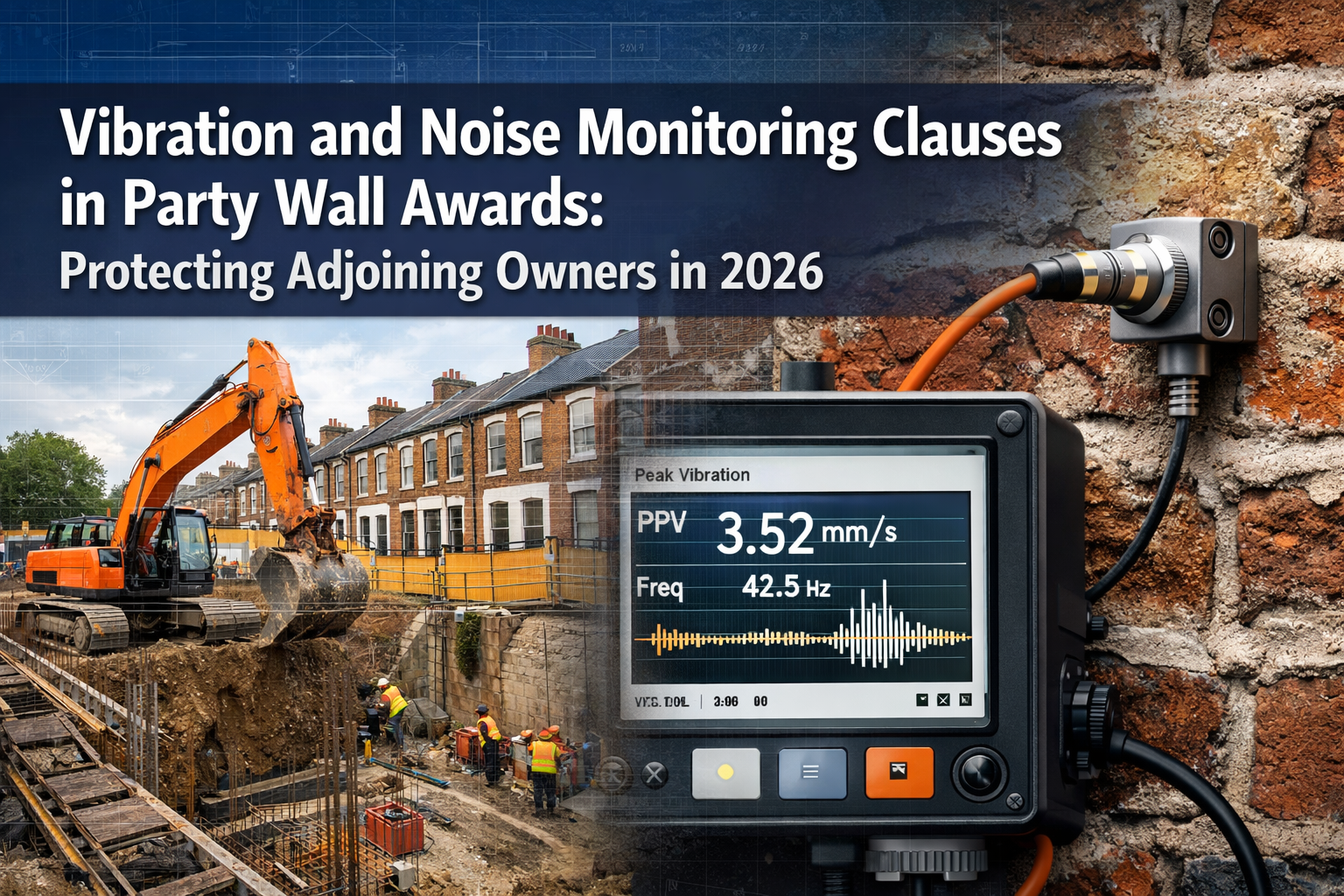
Construction disputes involving excessive vibration and noise have increased by 34% in urban areas over the past three years, with adjoining property owners facing unprecedented risks from basement excavations and large-scale demolition projects. As building works become more ambitious and sites more constrained in 2026, Vibration and Noise Monitoring Clauses in Party Wall Awards: Protecting Adjoining Owners in 2026 have evolved from optional provisions to essential protective mechanisms that safeguard structural integrity and residential peace.
The landscape of party wall protection has transformed dramatically. Modern party wall awards now routinely incorporate sophisticated monitoring requirements that leverage real-time technology to detect potential damage before it becomes catastrophic. This shift reflects both the increasing complexity of urban construction and the growing recognition that traditional visual inspections alone cannot adequately protect adjoining owners from the risks posed by contemporary building techniques.
Key Takeaways
- Real-time monitoring technology including accelerometers and seismographs has become standard practice in party wall awards for high-risk works, providing continuous protection rather than periodic checks
- Threshold limits for vibration (typically 10-15mm/s PPV for residential structures) and noise (generally 75-85 dB during working hours) are now explicitly defined in modern awards to create enforceable standards
- Mandatory monitoring clauses protect adjoining owners by creating clear protocols for immediate work cessation when dangerous levels are detected, preventing structural damage before it occurs
- Independent third-party monitoring services ensure objectivity and provide admissible evidence in potential disputes, removing conflicts of interest from the monitoring process
- Cost allocation provisions within awards typically require building owners to fund all monitoring equipment and analysis, protecting adjoining owners from unexpected expenses
Understanding Vibration and Noise Monitoring in Party Wall Context
The Legal Framework Under the Party Wall etc. Act 1996
The Party Wall etc. Act 1996 provides the statutory foundation for party wall procedures in England and Wales, but it does not explicitly mandate vibration or noise monitoring. Instead, Section 10 of the Act grants party wall surveyors the authority to determine “such other matters as are deemed necessary” when preparing awards. This broad discretion has enabled surveyors to incorporate comprehensive monitoring provisions as construction techniques have evolved.
Modern party wall awards function as legally binding documents that set out the rights and obligations of both building owners and adjoining owners. When properly drafted, these awards create enforceable standards that go beyond the minimum statutory requirements, addressing the specific risks posed by particular types of party wall works.
Why Traditional Visual Inspections Are No Longer Sufficient
Historical party wall practice relied heavily on pre-construction schedules of condition followed by periodic visual inspections. While these remain important, they have significant limitations:
- Delayed detection: Visual cracks may only appear days or weeks after damaging vibration events
- Subjectivity: Different surveyors may interpret crack severity differently
- Limited frequency: Weekly or monthly inspections cannot capture transient vibration events
- Causation disputes: Without continuous data, linking damage to specific construction activities becomes contentious
Recent case law from 2025 highlighted these limitations when an adjoining owner in Kensington suffered £180,000 in structural damage from basement excavation works. Despite monthly inspections, the critical vibration events occurred between site visits, and the absence of monitoring data made it nearly impossible to prove causation definitively.
The Rise of Real-Time Monitoring Technology
Construction monitoring technology has advanced significantly in recent years, making continuous surveillance both practical and affordable. Vibration and Noise Monitoring Clauses in Party Wall Awards: Protecting Adjoining Owners in 2026 now routinely specify equipment including:
Accelerometers and Seismographs 📊
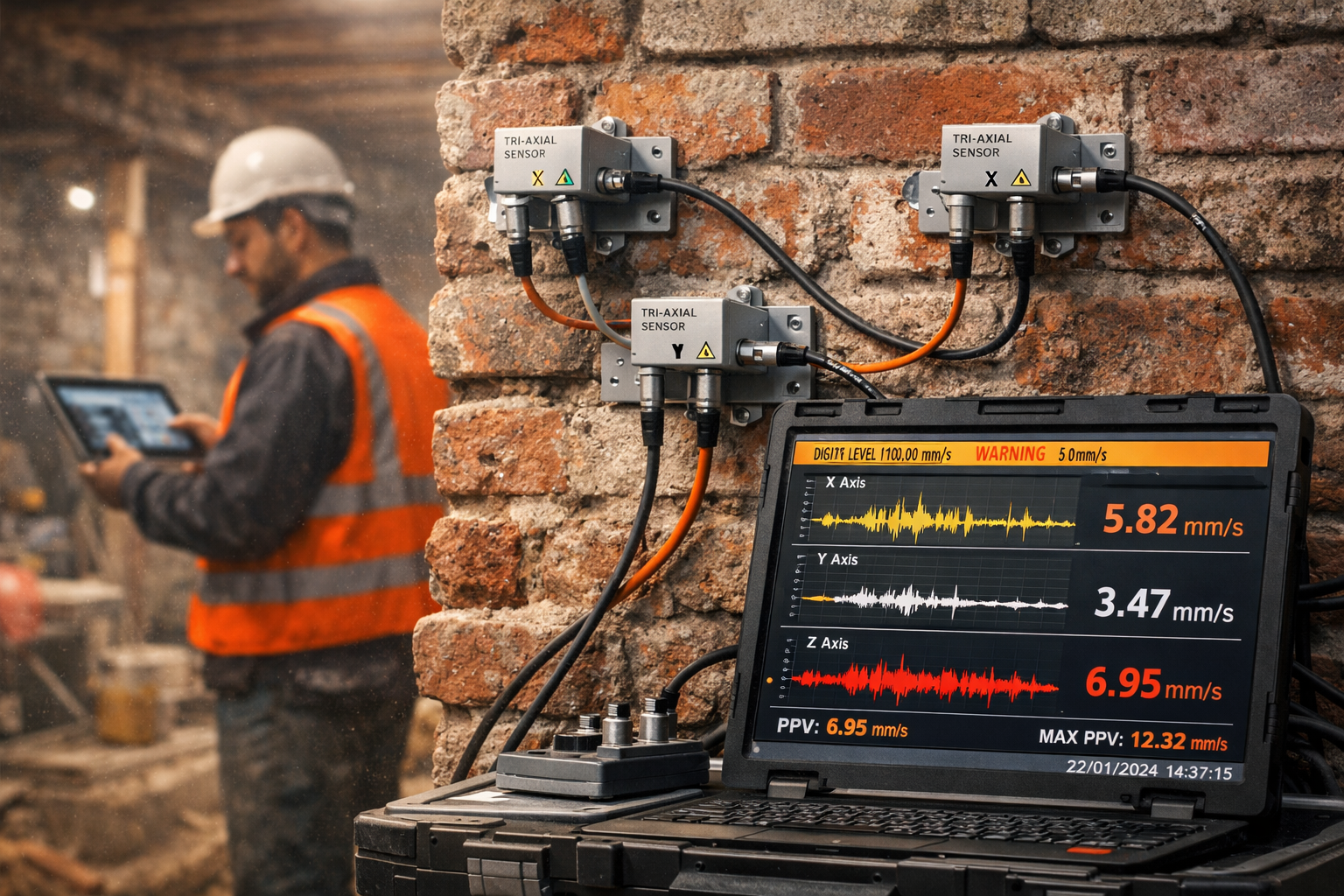
- Tri-axial sensors that measure ground vibration in three dimensions
- Capable of detecting particle velocities as low as 0.1mm/s
- Real-time data transmission to cloud-based monitoring platforms
- Automated alerts when threshold levels are approached or exceeded
Noise Level Meters
- Class 1 sound level meters compliant with IEC 61672 standards
- Continuous monitoring of LAeq, LAmax, and LA90 values
- Frequency analysis to identify specific noise sources
- Integration with vibration data for comprehensive site monitoring
Data Logging and Reporting Systems
- Continuous 24/7 recording with timestamp verification
- Automated report generation for surveyors and parties
- Historical data analysis to identify trends and patterns
- Tamper-proof data storage for potential dispute resolution
Recent construction noise regulations in major cities have accelerated the adoption of these technologies. For instance, new rules effective in April 2026 in certain jurisdictions require real-time noise monitoring for construction sites, with data accessible to regulatory authorities [1][3]. While these regulations primarily address public nuisance concerns, they have normalized the expectation of continuous monitoring that now extends to party wall contexts.
Standard Monitoring Provisions in Modern Party Wall Awards
Defining Threshold Limits for Vibration
Effective monitoring clauses must establish clear, measurable thresholds that trigger specific actions. For vibration, the most commonly referenced metric is Peak Particle Velocity (PPV), measured in millimeters per second (mm/s).
Typical Threshold Levels in 2026 Awards:
| Structure Type | Alert Level (mm/s) | Action Level (mm/s) | Maximum Level (mm/s) |
|---|---|---|---|
| Residential buildings (normal condition) | 8-10 | 12-15 | 20 |
| Residential buildings (sensitive/historic) | 5-7 | 8-10 | 12 |
| Commercial structures | 12-15 | 18-22 | 30 |
| Reinforced concrete structures | 15-20 | 25-30 | 50 |
These thresholds are typically derived from British Standard BS 7385-2:1993 and ISO 4866:2010, which provide guidance on vibration effects on buildings. Modern awards specify different levels to create a graduated response:
✅ Alert Level: Monitoring system notifies site management; no work stoppage required but heightened vigilance implemented
⚠️ Action Level: Immediate review required; potentially hazardous activities paused until surveyor assessment completed
🛑 Maximum Level: Automatic work cessation; no resumption until surveyor approval and revised methodology implemented
Establishing Noise Limits and Measurement Protocols
Noise monitoring provisions address both nuisance and potential structural concerns (in cases where very high noise levels might indicate problematic construction activities). Standard noise thresholds in party wall awards for 2026 typically include:
Working Hours Limits:
- Daytime (08:00-18:00 Monday-Friday): 75-85 dB LAeq measured at adjoining owner’s boundary
- Saturday mornings (08:00-13:00): 70-75 dB LAeq
- No noisy works: Sundays and bank holidays (or restricted to 65 dB LAeq)
Specific Activity Restrictions:
- Percussive piling: Maximum 85 dB LAeq at 10 meters
- Demolition works: Maximum 80 dB LAeq at boundary
- Mechanical excavation: Maximum 75 dB LAeq at boundary
The 2026 construction noise regulations have influenced these standards, with some jurisdictions now requiring construction sites to implement noise monitoring systems that provide real-time data to both authorities and affected neighbors [2][5]. Party wall awards increasingly reference these regulatory frameworks while tailoring specific limits to the particular sensitivities of adjoining properties.
Positioning and Installation Requirements
The effectiveness of monitoring depends critically on proper sensor placement. Modern party wall awards specify:
Vibration Sensor Locations:
- Minimum one sensor on the party wall at ground floor level
- Additional sensors on upper floors for multi-story excavations
- Sensors on external walls of adjoining property closest to works
- Ground-mounted sensors for monitoring excavation-induced vibrations
Noise Monitoring Positions:
- Primary meter at the boundary between properties
- Secondary meter at adjoining owner’s habitable room windows
- Height typically 1.2-1.5 meters above ground level
- Weather-protected installation for continuous outdoor monitoring
Awards should specify that all equipment installation must be undertaken by qualified technicians and that sensor positioning must be agreed by both appointed surveyors before works commence. The installation itself should be non-invasive, typically using temporary mounting brackets that do not damage finishes.
Technology Recommendations for Effective Monitoring
Accelerometer Systems: The Gold Standard for Vibration Detection
Tri-axial accelerometers have become the preferred technology for party wall vibration monitoring in 2026. These devices measure acceleration in three perpendicular axes (X, Y, Z), providing comprehensive data about ground and structural movement.
Key Specifications for Party Wall Applications:
- Frequency range: 1-250 Hz (capturing both low-frequency ground vibration and higher-frequency structural response)
- Dynamic range: 0.1-100 mm/s PPV
- Resolution: 0.01 mm/s for sensitive structures
- Sampling rate: Minimum 1000 Hz for accurate peak detection
- Data storage: Minimum 30 days continuous recording
- Connectivity: 4G/5G cellular or WiFi for real-time data transmission
Leading systems in 2026 include the Instantel Minimate Plus, Sigicom MR2002-CE, and Vibracoustic Vibguard series. These devices cost approximately £3,000-£8,000 per unit for purchase, though rental options (£150-£300 per week) are commonly specified in party wall awards to manage costs.
Integrated Monitoring Platforms
Modern monitoring solutions go beyond individual sensors to provide comprehensive data management platforms. These cloud-based systems offer:
- Real-time dashboards accessible to surveyors, building owners, and adjoining owners
- Automated alerting via SMS, email, and mobile app notifications when thresholds are approached
- Historical data visualization showing trends over the construction period
- Compliance reporting automatically generated for surveyor review
- Event correlation linking vibration spikes to specific construction activities
Platforms such as Envirosuite, Noise Sentinel, and Svantek provide these integrated capabilities. Party wall awards increasingly specify that monitoring data must be made accessible to adjoining owners through secure web portals, promoting transparency and early identification of concerns [7].
Emerging Technologies: AI and Predictive Analytics
The cutting edge of construction monitoring in 2026 involves artificial intelligence and machine learning algorithms that can:
- Predict likely vibration levels based on planned activities and ground conditions
- Identify anomalous patterns that may indicate equipment malfunction or unsafe practices
- Optimize construction sequencing to minimize cumulative vibration exposure
- Provide early warning of potential threshold exceedances before they occur
While these technologies are not yet standard in most party wall awards, forward-thinking surveyors are beginning to incorporate provisions for predictive monitoring in high-risk projects, particularly those involving deep basements in sensitive urban locations.
Case Studies: Urban Projects with Exemplary Monitoring Provisions
Basement Excavation in Chelsea: Multi-Level Monitoring Success
A 2025 basement excavation project beneath a Grade II listed townhouse in Chelsea demonstrated the value of comprehensive monitoring provisions. The adjoining owners’ surveyor insisted on an award that included:
- Four tri-axial accelerometers positioned at different levels of the adjoining property
- Continuous noise monitoring at the shared garden boundary
- Alert thresholds set at 7mm/s PPV (below the standard 10mm/s due to the historic structure)
- Mandatory 24-hour work suspension upon any threshold exceedance
- Weekly data review meetings between surveyors
During the excavation phase, the monitoring system detected three instances where vibration levels approached the alert threshold. In each case, the contractor immediately modified the excavation technique, switching from mechanical excavation to hand digging in sensitive areas. The project completed without any structural damage to the adjoining property, and the continuous monitoring data provided clear evidence that the building owner had fulfilled their duty of care.
Key Success Factors:
- Appropriately conservative thresholds for the structure type
- Real-time alerting that enabled immediate response
- Collaborative approach between surveyors and contractor
- Clear protocols established before works commenced
Demolition Project in Islington: Preventing Catastrophic Damage
A 2024 demolition project in Islington highlighted the risks of inadequate monitoring. The initial party wall award included only visual inspections, with no continuous monitoring despite the high-risk nature of the works. After the first week of demolition, adjoining owners reported severe vibration and new cracking.
Emergency monitoring equipment was installed, revealing that vibration levels during certain demolition activities were exceeding 25mm/s—well above safe limits for the Victorian terrace structure. The project was immediately halted, and the award was revised to include:
- Continuous vibration monitoring with 12mm/s action level
- Prohibition of impact demolition methods within 5 meters of the party wall
- Requirement for controlled deconstruction techniques for sensitive areas
- Independent monitoring specialist appointed to oversee compliance
The revised approach prevented further damage, but the adjoining owners had already incurred significant repair costs. This case underscores the importance of incorporating robust monitoring provisions from the outset, rather than relying on reactive measures after damage occurs.
Mixed-Use Development in Shoreditch: Integrated Noise and Vibration Management
A large-scale mixed-use development in Shoreditch affecting multiple adjoining properties implemented an exemplary integrated monitoring regime in 2025. The party wall awards (covering eight separate adjoining properties) included:
- Centralized monitoring network with 12 vibration sensors and 6 noise meters
- Public-facing dashboard showing real-time monitoring data for all affected residents
- Tiered response protocol with graduated escalation procedures
- Community liaison officer responsible for responding to monitoring alerts
- Financial penalties for repeated threshold exceedances
The transparency provided by the public dashboard significantly reduced complaints and disputes. When vibration levels approached thresholds, residents could see that the contractor was immediately responding, building trust in the process. The project demonstrated that comprehensive monitoring, combined with transparent communication, can effectively protect adjoining owners while allowing complex construction to proceed [4].
Drafting Effective Monitoring Clauses: Best Practices for 2026
Essential Components of a Robust Monitoring Clause
When preparing party wall awards in 2026, surveyors should ensure monitoring clauses address these critical elements:
1. Equipment Specifications
- Precise technical requirements for monitoring devices
- Calibration and certification standards
- Installation and positioning protocols
- Maintenance and inspection schedules
2. Threshold Definitions
- Clear numerical limits for vibration (PPV in mm/s)
- Specific noise limits (dB LAeq) for different times and activities
- Multiple threshold levels (alert, action, maximum)
- Frequency-weighted criteria where appropriate
3. Response Protocols
- Immediate actions required upon threshold exceedance
- Notification procedures (who must be informed and timeframe)
- Work suspension requirements
- Approval process for work resumption
4. Data Management
- Storage duration for monitoring records
- Access rights for parties and surveyors
- Reporting frequency and format
- Dispute resolution procedures for contested readings
5. Cost Allocation
- Clear statement that building owner bears all monitoring costs
- Provisions for equipment rental vs. purchase
- Responsibility for specialist interpretation of data
- Costs of additional monitoring if initial provisions prove inadequate
Tailoring Provisions to Specific Risk Profiles
Not all party wall works require the same level of monitoring. Surveyors should assess risk factors including:
High-Risk Works Requiring Comprehensive Monitoring:
- Basement excavations deeper than 3 meters
- Excavations within the zone of influence (typically 45° from foundation level)
- Demolition of substantial structures
- Piling or underpinning works
- Works affecting historic or structurally compromised buildings
Moderate-Risk Works Requiring Basic Monitoring:
- Shallow excavations (under 1 meter depth)
- Internal alterations affecting party walls
- Insertion of damp-proof courses
- Cutting into party walls for beam insertions
Lower-Risk Works Potentially Requiring Only Visual Monitoring:
- Raising party wall height without excavation
- Repairs to existing structures
- Installation of wall ties or similar minor interventions
The principle of proportionality should guide these decisions. Over-specification of monitoring for low-risk works unnecessarily increases costs, while under-specification for high-risk works exposes adjoining owners to unacceptable hazards.
Sample Monitoring Clause Language
Modern party wall awards might include provisions such as:
“The Building Owner shall, at their sole expense, install and maintain continuous vibration monitoring equipment comprising tri-axial accelerometers positioned at [specified locations] throughout the duration of the excavation works. The monitoring system shall be capable of measuring Peak Particle Velocity (PPV) in the range 0.1-100mm/s with a resolution of 0.01mm/s and shall provide real-time data transmission to a cloud-based platform accessible to both appointed surveyors and the Adjoining Owner.
Alert Level: 8mm/s PPV – Contractor shall be notified immediately; heightened monitoring implemented
Action Level: 12mm/s PPV – Works shall be immediately paused; both surveyors notified within 1 hour; works may only resume following surveyor approval of revised methodology
Maximum Level: 20mm/s PPV – Immediate cessation of all works; emergency surveyor inspection required within 24 hours; comprehensive structural assessment before any resumption
All monitoring data shall be retained for a minimum of 3 years and shall be made available to the Adjoining Owner through a secure web portal with read-only access. Weekly summary reports shall be provided to both surveyors throughout the works period.”
This type of specific, measurable language eliminates ambiguity and creates clear, enforceable obligations.
Cost Considerations and Allocation in Monitoring Provisions
Typical Monitoring Costs in 2026
Understanding the financial implications helps surveyors make appropriate recommendations:
Equipment Costs:
- Single vibration monitoring unit (rental): £150-£300 per week
- Single vibration monitoring unit (purchase): £3,000-£8,000
- Noise monitoring equipment (rental): £80-£150 per week
- Installation and calibration: £500-£1,200 per site
- Data platform subscription: £50-£200 per month
Professional Services:
- Monitoring specialist setup and consultation: £800-£1,500
- Monthly data analysis and reporting: £300-£600
- Emergency response and investigation: £150-£300 per hour
Typical Total Costs:
- Small project (single adjoining property, 3-month duration): £2,500-£5,000
- Medium project (2-3 adjoining properties, 6-month duration): £6,000-£12,000
- Large project (multiple properties, 12+ month duration): £15,000-£30,000+
These costs represent a small fraction of typical construction budgets for the works that necessitate such monitoring. For context, a basement excavation project costing £150,000-£300,000 might incur monitoring costs of 2-4% of the total project value—a reasonable investment for risk mitigation [7].
Establishing Clear Cost Responsibilities in Awards
The Party Wall etc. Act 1996 generally follows the principle that the building owner (the party undertaking the works) bears the costs associated with the party wall process. This extends to monitoring provisions, and awards should explicitly state:
- Building owner responsible for all monitoring equipment costs
- Building owner responsible for installation and removal
- Building owner responsible for data analysis and reporting
- Adjoining owner entitled to access monitoring data at no cost
- Building owner responsible for costs of additional monitoring if initial provisions prove inadequate
Clear cost allocation prevents disputes and ensures that adjoining owners are not financially disadvantaged by the building owner’s construction activities. Some surveyors include provisions for cost recovery through the surveyor’s fees mechanism if building owners fail to comply with monitoring requirements.
Enforcement and Dispute Resolution Mechanisms
What Happens When Thresholds Are Exceeded?
Well-drafted monitoring clauses establish clear consequences for threshold exceedances:
Immediate Response (Within 1 Hour):
- Automatic work suspension for action or maximum level breaches
- Notification to both appointed surveyors
- Notification to adjoining owner if maximum level exceeded
- Site investigation to identify cause
Short-Term Response (Within 24-48 Hours):
- Surveyor inspection of adjoining property for new damage
- Review of monitoring data to identify specific problematic activities
- Contractor submission of revised methodology
- Surveyor approval required before work resumption
Medium-Term Response (Within 1 Week):
- Formal written report documenting the exceedance
- Assessment of whether monitoring provisions remain adequate
- Potential revision of award if circumstances have changed
- Enhanced monitoring or additional precautions if pattern of exceedances
The Role of Third-Party Monitoring Specialists
To ensure objectivity and technical competence, many modern awards specify that monitoring must be conducted by independent third-party specialists rather than the contractor’s own staff. These specialists:
- Have no financial interest in construction progress
- Possess recognized qualifications in vibration and noise monitoring
- Provide admissible expert evidence if disputes arise
- Can offer immediate technical advice on mitigation measures
Organizations such as the Institute of Acoustics and Institute of Environmental Management and Assessment maintain registers of qualified monitoring specialists. Awards may specify that monitoring must be conducted by members of these professional bodies.
Legal Remedies for Non-Compliance
When building owners fail to implement required monitoring or ignore threshold exceedances, adjoining owners have several remedies:
Within the Party Wall Framework:
- Request for surveyor intervention to enforce award terms
- Application for award revision to strengthen monitoring provisions
- Potential for surveyors to order work suspension
Beyond the Party Wall Framework:
- Injunction applications to prevent continued breaches
- Damages claims for any resulting property damage
- Nuisance claims for excessive noise or vibration
- Regulatory complaints to local authority building control
The existence of comprehensive monitoring data significantly strengthens the adjoining owner’s position in any dispute, providing objective evidence of the building owner’s compliance or non-compliance with agreed standards.
Future Trends: The Evolution of Monitoring in Party Wall Practice
Regulatory Developments Influencing Party Wall Standards
The construction industry is experiencing increased regulatory scrutiny of noise and vibration impacts. Recent developments include:
- Mandatory construction noise monitoring requirements in several major cities, with real-time data submission to authorities [1][3][5]
- Enhanced environmental health powers allowing local authorities to take immediate enforcement action for excessive construction noise
- Planning condition requirements increasingly specifying vibration monitoring for sensitive developments
- Building Safety Act implications creating heightened duties of care for construction affecting adjoining properties
These regulatory trends are elevating the standard of care expected in party wall contexts. Surveyors who fail to recommend adequate monitoring provisions may face increased professional liability exposure, particularly if damage occurs that could have been prevented by proper monitoring.
Integration with Building Information Modeling (BIM)
Advanced construction projects in 2026 increasingly integrate monitoring data with Building Information Modeling (BIM) systems. This allows:
- Real-time visualization of vibration propagation through structures
- Predictive modeling of how planned activities will affect adjoining properties
- Automated adjustment of construction sequencing based on monitoring feedback
- Enhanced documentation for future reference
While not yet standard in party wall awards, this integration represents the direction of sophisticated construction management and may become more common in high-value urban projects.
The Growing Importance of Proactive Protection
The trend in party wall practice is decisively moving from reactive damage assessment to proactive damage prevention. Vibration and Noise Monitoring Clauses in Party Wall Awards: Protecting Adjoining Owners in 2026 reflect this shift, emphasizing:
- Prevention over cure: Stopping damage before it occurs rather than seeking compensation afterward
- Transparency: Providing all parties with access to objective data
- Collaboration: Using monitoring data to inform construction methodology rather than merely documenting problems
- Proportionality: Scaling monitoring provisions to actual risk levels
This proactive approach benefits all parties. Building owners gain confidence that their contractors are working safely, adjoining owners receive real-time assurance of protection, and surveyors have objective data to support their professional judgments.
Conclusion: Securing Comprehensive Protection Through Monitoring Provisions
The integration of sophisticated vibration and noise monitoring into party wall awards represents one of the most significant advances in adjoining owner protection in recent years. As construction techniques become more ambitious and urban sites more constrained, the risks to adjoining properties have intensified. Vibration and Noise Monitoring Clauses in Party Wall Awards: Protecting Adjoining Owners in 2026 provide the objective, real-time data necessary to prevent damage rather than merely documenting it after the fact.
For adjoining owners, the message is clear: insist that your surveyor includes comprehensive monitoring provisions appropriate to the risk profile of the proposed works. Do not accept assurances that “visual inspections will be sufficient” for high-risk activities such as basement excavations or demolitions. The relatively modest cost of monitoring equipment is a small price for the building owner to pay for the protection of your property.
For building owners and their contractors, embrace monitoring as a valuable risk management tool rather than an unwelcome burden. The data provided by monitoring systems can guide construction methodology, demonstrate compliance with duty of care obligations, and provide definitive evidence of responsible practice if disputes arise.
For surveyors, staying current with monitoring technology and best practices is essential to fulfilling professional obligations. Awards that fail to include adequate monitoring provisions for high-risk works may expose surveyors to professional liability claims and fail to serve the interests of the parties they represent.
Actionable Next Steps
If you are an adjoining owner facing nearby construction:
- Review any draft party wall award carefully for monitoring provisions
- Discuss with your surveyor whether the proposed monitoring is adequate for the risk level
- Request specific threshold levels and response protocols be included in the award
- Ensure you will have access to monitoring data throughout the works period
- Consider consulting our guide on how to keep party wall costs down while maintaining adequate protection
If you are a building owner planning construction:
- Budget for appropriate monitoring costs from the project outset
- Engage with monitoring specialists early in the planning process
- View monitoring as risk mitigation that protects your project from costly disputes
- Ensure your contractor understands the monitoring requirements and threshold limits
- Review our resources on types of party wall works to understand your obligations
If you are a surveyor preparing awards:
- Conduct thorough risk assessment for each project
- Specify monitoring provisions proportionate to the identified risks
- Use precise, measurable language in monitoring clauses
- Establish clear threshold levels and response protocols
- Recommend qualified third-party monitoring specialists
- Review our comprehensive guidance on party wall awards for additional best practices
The protection of adjoining owners through comprehensive monitoring provisions is not merely good practice—it represents the evolving standard of care in party wall matters. As we progress through 2026 and beyond, the integration of technology with traditional surveying expertise will continue to enhance the effectiveness of the party wall framework, ensuring that construction progress and property protection can coexist successfully in our densely built urban environments.
References
[1] New Construction Noise Monitoring Rule Requirements Effective April 21 2026 – nyc.gov
[2] Nyc Dep Adopts New Noise Mitigation Rules – cahillstrategies.com
[3] Nyc Dep Update Noise Monitoring Ruling Takes Effect April 21 2026 – novisal.com
[4] Neighbors Noise Building Venue Community Harmony In 2026 – ticketfairy.com
[5] How Nycs New Construction Noise Monitoring Rule Impacts Construction Sites – design2147.com
[6] Construction Noise Regulations 2026 Compliance – urbansolutiongroup.com
[7] Schedules Of Condition In Party Wall Works Best Practices To Prevent Post Construction Claims In 2026 – https://nottinghillsurveyors.com/blog/schedules-of-condition-in-party-wall-works-best-practices-to-prevent-post-construction-claims-in-2026
Speak to a RICS chartered party wall surveyor
Free initial consultation. Notices, awards and schedules of condition across London and nationwide.