
A shocking reality confronts property owners across England and Wales: the person adjudicating your £10,000+ party wall dispute may have no formal qualifications whatsoever. Unlike doctors, solicitors, or even chartered surveyors, the title “party wall surveyor” carries no legal protection under the Party Wall etc. Act 1996. Anyone—regardless of training, experience, or competence—can legally claim this title and charge fees for administering one of the most contentious areas of property law.
Understanding who can act as a party wall surveyor, the qualifications they should possess, and the impartiality requirements under the Act is crucial for building owners and adjoining owners alike. This comprehensive guide clarifies the statutory rules on surveyor eligibility, examines professional qualifications versus legal requirements, and explains why property owners cannot self-represent in formal disputes.
Key Takeaways
- 🚫 No legal qualifications required: The Party Wall etc. Act 1996 does not mandate specific credentials for party wall surveyors
- ✅ Professional standards matter: RICS membership and construction knowledge represent industry best practice despite not being legally required
- ⚖️ Impartiality is statutory: Section 10 requires surveyors to be independent parties with no direct interest in the dispute
- 👥 Two appointment options: Property owners can appoint an agreed surveyor jointly or select separate surveyors who then appoint a third surveyor
- 📋 Merit-based selection: Choose surveyors based on relevant experience, professional background, and specific expertise with the Act
The Legal Framework: What the Party Wall etc. Act 1996 Actually Requires
The Party Wall etc. Act 1996 establishes the statutory framework for resolving disputes between neighbours regarding shared walls, boundaries, and excavations. However, the legislation remains remarkably silent on surveyor qualifications.
Statutory Silence on Qualifications
The Act contains no mandatory qualification requirements for individuals acting as party wall surveyors[1]. This legislative gap has created a profession with wildly varying levels of competency, from highly experienced chartered surveyors to individuals with minimal construction knowledge.
Section 10 of the Act simply refers to “a surveyor” without defining educational requirements, professional memberships, or minimum experience thresholds. This contrasts sharply with other areas of property law where professional accreditation is legally mandated.
The Only Legal Requirement: Impartiality
The single statutory requirement appears in Section 10(1) of the Party Wall etc. Act 1996, which states that a surveyor must be “any person not being a party to the matter”[1]. This establishes the fundamental principle of impartiality—surveyors cannot have a direct financial or personal interest in the dispute outcome.
This means:
- ❌ Building owners cannot act as their own surveyors in formal disputes
- ❌ Family members with inheritance interests cannot serve as surveyors
- ❌ Business partners or employees of either party are disqualified
- ❌ Anyone with financial stakes in the property development cannot participate
The impartiality requirement ensures that party wall awards are produced by neutral third parties who can objectively assess the proposed works, potential damage risks, and fair compensation arrangements.
Professional Qualifications: Industry Standards vs. Legal Requirements

While the Act imposes no formal qualification mandates, the professional consensus strongly favours surveyors with recognised credentials and construction expertise. Understanding these industry standards helps property owners make informed selection decisions.
RICS: The Gold Standard
The Royal Institute of Chartered Surveyors (RICS) represents the most widely recognised professional body for surveyors in the United Kingdom[1][3]. RICS members undergo rigorous training, assessment, and continuing professional development requirements.
RICS-qualified surveyors typically possess:
- Accredited degree in surveying or related construction discipline
- Minimum two years of structured professional experience
- Assessment of Professional Competence (APC) examination
- Ongoing CPD (Continuing Professional Development) requirements
- Professional indemnity insurance coverage
- Adherence to RICS professional standards and ethics
RICS members specialising in building surveying demonstrate comprehensive knowledge of construction technology, building pathology, contract administration, and dispute resolution—all essential skills for party wall matters[3].
Alternative Professional Bodies
Several other organisations provide credible pathways to party wall surveying competence:
| Professional Body | Designation | Key Requirements |
|---|---|---|
| Chartered Institute of Building (CIOB) | MCIOB/FCIOB | Construction management expertise, professional assessment |
| Chartered Association of Building Engineers (CABE) | MCBuildE | Building engineering knowledge, technical competence |
| Faculty of Party Wall Surveyors (FPWS) | MFPWS | Party Wall Act-specific training, interview assessment |
The FPWS Route: Lower Barriers to Entry
The Faculty of Party Wall Surveyors (FPWS) offers a more accessible qualification pathway specifically focused on party wall matters[1][2]. This route typically involves:
- Attending a short course or seminar on the Party Wall etc. Act 1996
- Demonstrating basic understanding of party wall procedures
- Passing an interview assessment
- Receiving the MFPWS designation upon completion
While FPWS membership demonstrates commitment to party wall specialisation, critics note that the qualification requires significantly less rigorous training than RICS chartered status. The course-and-interview format may not ensure the comprehensive construction knowledge necessary for complex disputes involving structural alterations, underpinning works, or building defects analysis.
Construction Knowledge: The Critical Competency
Regardless of professional memberships, practical construction knowledge represents the most essential qualification for effective party wall surveying[1]. Surveyors must understand:
- 🏗️ Structural engineering principles: Load-bearing capacities, foundation types, structural movement
- 🧱 Building materials and techniques: Masonry construction, timber framing, modern building methods
- 📐 Building regulations compliance: Current standards for structural alterations and safety
- 🔍 Building pathology: Crack diagnosis, subsidence assessment, damp investigation
- 💰 Construction costs: Realistic pricing for remedial works and reinstatement
Without this technical foundation, surveyors cannot properly assess whether proposed works will cause damage, determine appropriate protective measures, or specify fair compensation for temporary inconvenience.
Impartiality Requirements: Why Building Owners Cannot Self-Represent
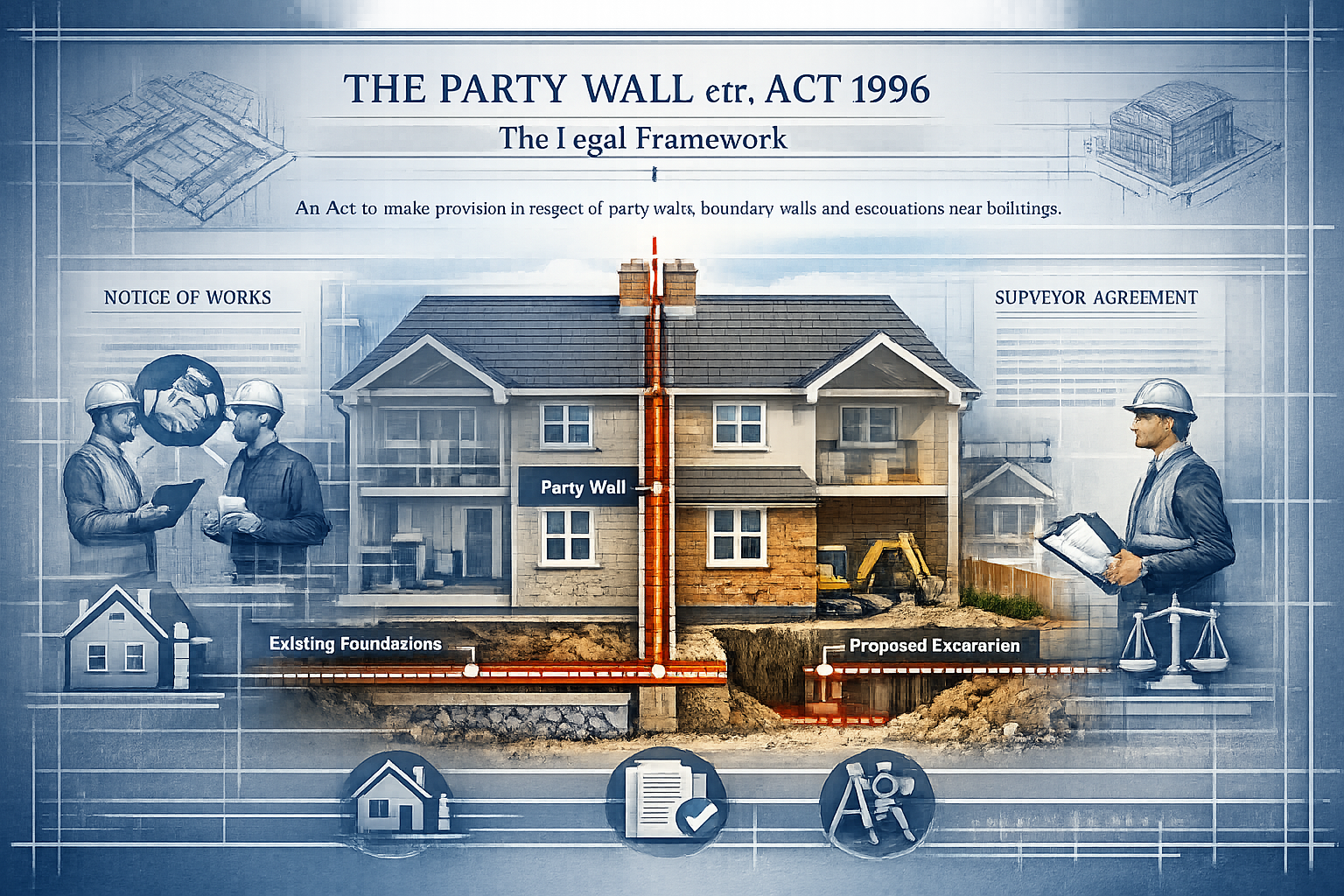
The statutory impartiality requirement under Section 10 creates a fundamental principle: parties to a dispute cannot adjudicate their own case[1]. This prevents conflicts of interest and ensures neutral decision-making.
The “Not Being a Party to the Matter” Test
Section 10’s language—”any person not being a party to the matter”—establishes a clear disqualification criterion. A “party to the matter” includes:
- The building owner proposing the works
- The adjoining owner whose property may be affected
- Anyone with direct financial interest in either property
- Employees or contractors engaged by either party
- Family members who stand to inherit or benefit from the properties
This requirement applies even if the building owner possesses extensive construction expertise or professional surveying qualifications. Personal interest automatically disqualifies individuals from acting as surveyors in their own disputes.
Why Self-Representation Undermines the Act’s Purpose
The Party Wall etc. Act 1996 establishes a quasi-judicial process for resolving neighbour disputes without court intervention. The party wall award produced by surveyors functions as a legally binding determination of rights and obligations.
Allowing self-representation would:
- ❌ Create inherent bias toward the building owner’s interests
- ❌ Undermine the adjoining owner’s right to fair assessment
- ❌ Eliminate the neutral evaluation of damage risks
- ❌ Remove the protective function of independent oversight
- ❌ Increase likelihood of subsequent legal challenges
The impartiality requirement protects both parties by ensuring that technical assessments, damage evaluations, and cost determinations are made by professionals without vested interests in the outcome.
Exceptions and Gray Areas
Some situations create questions about impartiality:
Can a surveyor act for multiple clients on the same street? Generally yes, provided they’re not acting for both parties in the same dispute. However, surveyors should disclose any relationships that might create perceived conflicts.
Can architects or contractors act as party wall surveyors? Yes, if they meet the impartiality test. However, the architect designing the building owner’s extension should not simultaneously serve as the party wall surveyor, as this creates obvious conflicts.
Can surveyors accept gifts or hospitality from clients? Professional standards discourage practices that might compromise independence. RICS members must adhere to strict ethics rules regarding client relationships.
Agreed Surveyors vs. Separate Surveyors: Understanding Your Options
When disputes arise under the Party Wall etc. Act 1996, property owners face a critical decision: appoint a single agreed surveyor jointly, or select separate surveyors who then appoint a third surveyor.
The Agreed Surveyor Approach
An agreed surveyor (also called a “jointly appointed surveyor”) acts for both the building owner and adjoining owner simultaneously. This arrangement offers several advantages:
Benefits of Agreed Surveyors:
- 💰 Lower costs: Single set of surveyor fees shared between parties
- ⏱️ Faster process: No need for surveyor correspondence and third surveyor coordination
- 🤝 Collaborative approach: Encourages cooperative problem-solving
- 📝 Simplified administration: Single party wall award document
Requirements for Agreed Surveyors:
The agreed surveyor must maintain strict impartiality between both parties. They cannot favour either the building owner or adjoining owner in their determinations. Both parties must consent to the appointment and can withdraw consent if they believe the surveyor has become biased.
For straightforward works with cooperative neighbours, the agreed surveyor route often provides the most efficient and cost-effective resolution. Learn more about party wall awards and how they’re produced.
The Separate Surveyors Approach
When parties cannot agree on a single surveyor, or when the dispute involves complex technical issues, separate surveyors provide appropriate representation:
- The building owner’s surveyor represents the building owner’s interests
- The adjoining owner’s surveyor represents the adjoining owner’s interests
- The two surveyors jointly appoint a third surveyor who resolves any disagreements
Benefits of Separate Surveyors:
- 🛡️ Independent representation: Each party has dedicated advocacy
- 🔍 Thorough scrutiny: Multiple professional perspectives on technical issues
- ⚖️ Dispute resolution mechanism: Third surveyor provides binding determinations
- 📊 Complex cases: Better suited for major structural works or contentious relationships
The Third Surveyor’s Role:
The third surveyor acts as an impartial arbiter when the two appointed surveyors cannot reach agreement on specific matters. They do not routinely participate in the process but intervene only when deadlock occurs. The third surveyor’s determination is binding on both parties.
Understanding the building owner’s surveyor and adjoining owner’s surveyor roles helps clarify how this tripartite system functions.
Cost Implications
Agreed surveyor costs are typically split equally between building owner and adjoining owner, though the building owner often bears the full cost under the “initiator pays” principle.
Separate surveyor costs are higher because three professionals are involved. The building owner typically pays:
- Their own surveyor’s fees
- The adjoining owner’s surveyor’s reasonable fees
- The third surveyor’s fees (if involved)
For guidance on managing expenses, see our article on how to keep party wall costs down.
Selection Criteria: Choosing the Right Party Wall Surveyor
Given the absence of mandatory qualifications, property owners must exercise careful judgment when selecting surveyors. Merit-based selection focusing on relevant experience and professional background produces the best outcomes[1].
Essential Selection Criteria
1. Professional Qualifications ✅
Prioritise surveyors with:
- RICS chartered status (MRICS or FRICS)
- Alternative recognised credentials (CIOB, CABE)
- FPWS membership as supplementary qualification
- Professional indemnity insurance coverage
2. Party Wall Experience 📋
Evaluate:
- Number of party wall awards produced annually
- Years of practice under the Party Wall etc. Act 1996
- Experience with similar work types to your project
- Familiarity with local building practices and regulations
3. Construction Knowledge 🏗️
Assess:
- Understanding of structural engineering principles
- Experience with building pathology and defect diagnosis
- Knowledge of construction costs and methods
- Ability to specify appropriate protective measures
4. Communication Skills 💬
Consider:
- Clarity of explanations during initial consultation
- Responsiveness to enquiries
- Ability to translate technical matters into plain language
- Track record of dispute resolution
5. Local Knowledge 📍
Value:
- Familiarity with local building stock and construction types
- Understanding of regional property values
- Relationships with local contractors and specialists
- Experience with specific property types (Victorian terraces, modern developments, etc.)
For property owners in the capital, consider specialists offering party wall surveyor services in East London, West London, North London, Central London, and South London.
Red Flags to Avoid
Be cautious of surveyors who:
- ⚠️ Cannot provide evidence of professional qualifications
- ⚠️ Lack professional indemnity insurance
- ⚠️ Offer unusually low fees (suggesting inexperience or corner-cutting)
- ⚠️ Make guarantees about specific outcomes before assessment
- ⚠️ Show bias toward building owners or adjoining owners
- ⚠️ Cannot explain the party wall process clearly
- ⚠️ Have no track record of producing party wall awards
Questions to Ask Prospective Surveyors
During initial consultations, ask:
- What professional qualifications and memberships do you hold?
- How many party wall awards do you produce annually?
- What experience do you have with [this type of work]?
- What are your fee structures and payment terms?
- What is your typical timeline for producing awards?
- How do you handle disagreements between parties?
- Can you provide references from recent clients?
- Do you carry professional indemnity insurance?
The Party Wall Process: How Qualified Surveyors Add Value
Understanding how qualified surveyors contribute throughout the party wall process illustrates why proper credentials and experience matter.
Initial Assessment and Notice Review
Qualified surveyors evaluate whether proposed works fall within the Act’s scope and ensure party wall notices contain accurate descriptions. They identify potential issues early and recommend appropriate protective measures.
Schedule of Condition Preparation
Experienced surveyors produce comprehensive schedules of condition documenting the adjoining owner’s property before works commence. This baseline evidence proves essential if damage disputes arise later.
Award Drafting and Technical Specifications
Qualified surveyors draft detailed awards specifying:
- Permitted works scope and methodology
- Working hours and access arrangements
- Protective measures and temporary supports
- Damage compensation procedures
- Cost responsibilities and fee arrangements
Technical construction knowledge ensures specifications are practical, enforceable, and adequate to prevent damage.
Dispute Resolution and Negotiation
Professional surveyors facilitate negotiations between parties, finding compromises that satisfy statutory requirements while addressing legitimate concerns. Their impartiality and expertise help avoid costly litigation.
Common Misconceptions About Party Wall Surveyor Qualifications
Misconception 1: “All party wall surveyors are chartered surveyors”
❌ False. Anyone can use the title “party wall surveyor” regardless of qualifications. Always verify credentials.
Misconception 2: “The building owner can act as their own surveyor to save money”
❌ False. Section 10 prohibits parties to the dispute from acting as surveyors. Consider whether having a party wall agreement without a surveyor is possible for simple cases.
Misconception 3: “FPWS membership equals RICS chartered status”
❌ False. FPWS provides specialist party wall training but requires less rigorous assessment than RICS chartered surveyor status.
Misconception 4: “The cheapest surveyor is the best value”
❌ False. Inexperienced surveyors may produce inadequate awards that fail to prevent disputes, ultimately costing more in litigation and remedial works.
Misconception 5: “Party wall surveyors only deal with walls”
❌ False. The Act covers various types of party wall works including excavations, boundary structures, and structural alterations.
2026 Developments and Future Trends
As of 2026, several trends are shaping the party wall surveying profession:
Increased Professionalisation 📈
Industry bodies are pushing for higher standards despite the Act’s silence on qualifications. More surveyors are obtaining RICS accreditation to differentiate themselves in a crowded market.
Technology Integration 💻
Digital tools for condition surveys, 3D modelling, and remote inspections are becoming standard practice among leading surveyors. These technologies improve documentation quality and efficiency.
Renewable Energy Considerations ⚡
The rise of solar panels, heat pumps, and other renewable installations on shared structures creates new party wall considerations[5]. Qualified surveyors must understand these emerging technologies.
Consumer Protection Awareness 🛡️
Property owners are becoming more sophisticated about surveyor selection, demanding evidence of qualifications and experience. This market pressure is gradually raising professional standards.
Practical Steps for Property Owners in 2026
For Building Owners Planning Works
- Identify whether your project requires party wall notices by consulting the Party Wall etc. Act 1996 guidance
- Select a qualified surveyor early in your project planning, ideally before submitting planning applications
- Verify credentials by checking RICS membership, professional indemnity insurance, and references
- Budget appropriately for party wall costs as part of your overall project budget
- Serve notices promptly to avoid project delays—allow 2-3 months for the party wall process
For Adjoining Owners Receiving Notices
- Respond within 14 days to party wall notices to preserve your rights
- Appoint your own surveyor if you have concerns about the proposed works
- Verify your surveyor’s qualifications using the same criteria as building owners
- Request a schedule of condition to document your property’s pre-works state
- Understand your rights under the Act, including compensation entitlements
Understanding party wall act notices and how to respond helps adjoining owners protect their interests effectively.
Conclusion
The question of who can act as a party wall surveyor, their qualifications, and impartiality requirements under the Act reveals a profession with surprisingly few legal barriers to entry but significant practical requirements for competence. While the Party Wall etc. Act 1996 imposes no mandatory qualification standards, the complexity of construction disputes demands surveyors with genuine expertise in building technology, structural engineering, and property law.
The statutory impartiality requirement under Section 10 establishes the fundamental principle that parties to disputes cannot adjudicate their own cases. This protection ensures neutral assessment of proposed works, damage risks, and fair compensation arrangements.
Property owners in 2026 should prioritise RICS-qualified surveyors with demonstrated party wall experience and construction knowledge. While FPWS membership and alternative credentials provide value, they should supplement rather than replace comprehensive professional qualifications and practical expertise.
Next Steps
✅ For building owners: Obtain quotes from at least three qualified surveyors, verify their credentials, and select based on experience rather than lowest price
✅ For adjoining owners: Exercise your right to appoint your own surveyor if you have concerns about proposed works, even if it increases costs
✅ For all parties: Understand that investing in qualified surveyors prevents costly disputes, protects property values, and ensures compliance with statutory requirements
The party wall process functions best when all participants—building owners, adjoining owners, and surveyors—approach it with professionalism, expertise, and good faith. By selecting appropriately qualified and genuinely impartial surveyors, property owners can navigate this complex area of property law successfully while maintaining positive neighbour relationships.
References
[1] How To Become A Party Wall Surveyor – stokemont.com
[2] Qualifications Party Wall Matters – fpws.org.uk
[3] Building Surveying Standards – rics.org
[5] Party Wall Act Essentials For 2026 Uk Renewable Energy Retrofits Solar Panels And Heat Pumps On Shared Walls 2 – https://nottinghillsurveyors.com/blog/party-wall-act-essentials-for-2026-uk-renewable-energy-retrofits-solar-panels-and-heat-pumps-on-shared-walls-2
Speak to a RICS chartered party wall surveyor
Free initial consultation. Notices, awards and schedules of condition across London and nationwide.