

{"cover":"Professional landscape format (1536x1024) hero image featuring bold text overlay 'Party Wall Awards in Office-to-Residential Conversions: Capitalizing on the 2026 Office Market Bifurcation' in extra large 70pt white sans-serif font with dark shadow and semi-transparent navy overlay box, positioned in upper third. Background shows split-screen composition: left side displays modern glass office building exterior with 'For Conversion' signage, right side shows contemporary residential apartment interior with exposed brick party wall. Architectural blueprints and surveyor's measuring tools subtly layered in foreground. Color scheme: deep navy blue, crisp white, warm amber accents. High contrast, editorial magazine quality, professional real estate development aesthetic with urban regeneration theme.","content":["Detailed landscape format (1536x1024) illustration showing the 2026 office market bifurcation concept with modern infographic style. Split composition featuring two distinct office building types: premium Grade A trophy tower on left with gleaming glass facade, high occupancy indicators, upward trending arrows; struggling secondary office building on right with dated architecture, vacancy signs, downward trend indicators. Center shows conversion pathway with architectural transformation symbols, residential floor plans, and party wall demarcation lines highlighted in red. Professional color palette of slate grey, forest green for premium, muted orange for secondary stock, white accents. Clean business editorial style with data visualization elements.","Detailed landscape format (1536x1024) technical illustration demonstrating party wall award process in office-to-residential conversion context. Cutaway architectural cross-section showing multi-story building mid-conversion with clearly marked party walls between units highlighted in bold red lines. Surveyor figures with measuring equipment examining shared structural elements. Layered elements include: Party Wall Act 1996 notice documents, award certificates, structural engineer reports, and timeline flowchart overlay. Annotations pointing to key areas: structural modifications, sound insulation requirements, fire safety upgrades. Professional technical drawing aesthetic with blueprint-style background, clean lines, navy and white color scheme with red highlights.","Detailed landscape format (1536x1024) professional scene showing collaborative party wall surveying process in converted residential building. Modern apartment interior with exposed original office building features (concrete columns, industrial windows) converted to residential use. Two professional surveyors in business attire reviewing documents and examining shared party wall structure. Visible elements include: digital tablets displaying party wall awards, measuring laser equipment, structural assessment notes, neighboring property access documentation. Background shows adjacent residential unit through party wall opening. Warm professional lighting, contemporary urban conversion aesthetic, color palette of charcoal grey, warm wood tones, professional blue accents, high-quality architectural photography style."]}
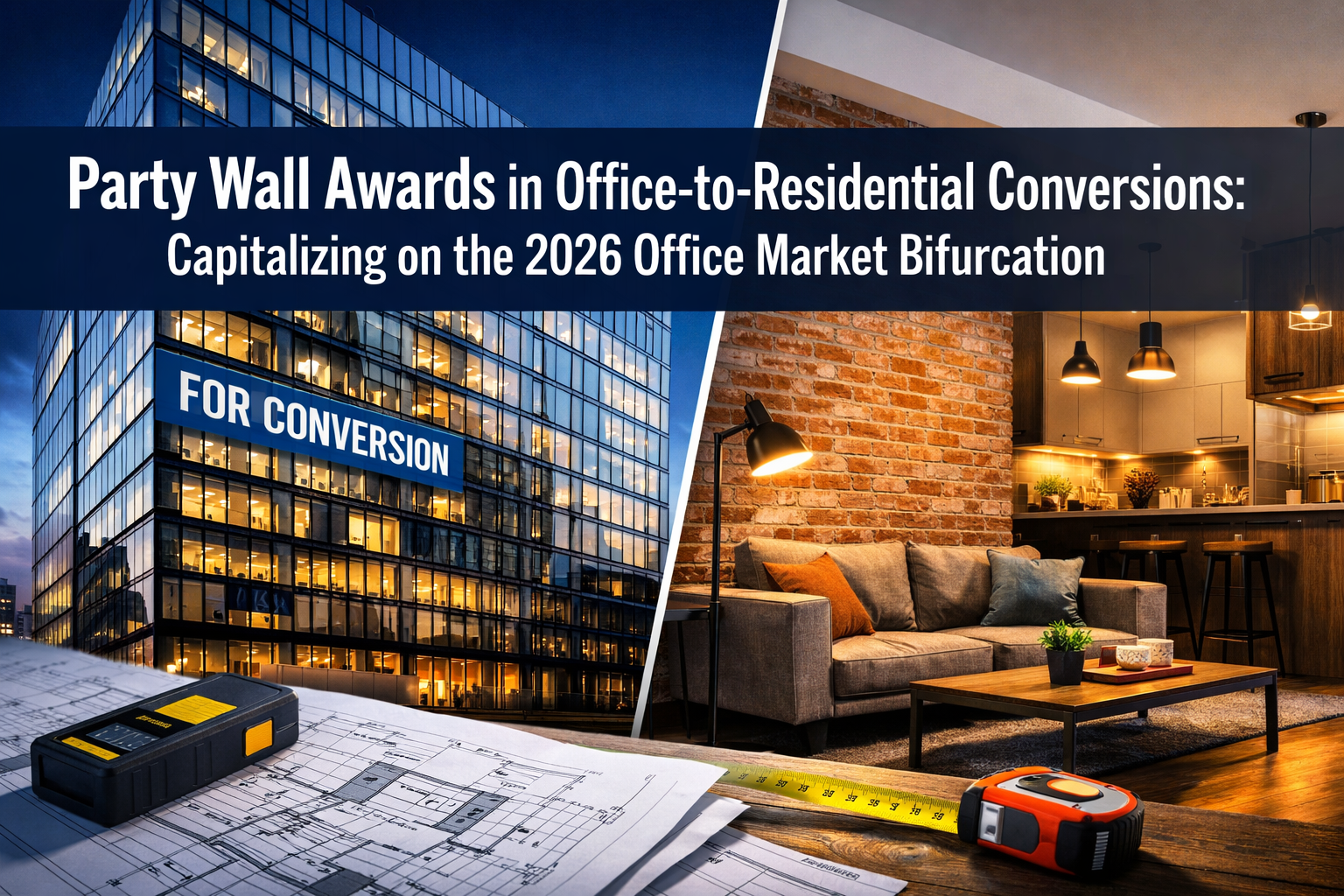
The commercial property landscape in 2026 has reached a critical inflection point. While premium office towers command record rents and near-full occupancy, thousands of secondary and tertiary office buildings sit vacant or underutilized—creating an unprecedented opportunity for residential conversion. For property developers and investors pursuing Party Wall Awards in Office-to-Residential Conversions: Capitalizing on the 2026 Office Market Bifurcation, understanding the specialized party wall procedures is essential to successful project delivery.
This bifurcation—the stark divide between trophy assets and struggling office stock—has accelerated conversion activity across major urban centers. As developers transform outdated office buildings into residential apartments, the complexity of party wall agreements has increased dramatically, requiring specialized knowledge and strategic planning.
Key Takeaways 📋
- The 2026 office market bifurcation creates significant conversion opportunities for lower-grade office buildings while premium assets remain highly sought-after
- Party wall awards in conversion projects are more complex than traditional residential developments due to structural modifications, multiple adjoining owners, and mixed-use scenarios
- Early engagement with party wall surveyors and adjoining owners reduces delays and cost overruns in office-to-residential conversions
- Specialized knowledge of both the Party Wall etc. Act 1996 and conversion-specific challenges is essential for successful project delivery
- Proactive planning for party wall procedures can reduce conversion timelines by 3-6 months and prevent costly disputes
Understanding the 2026 Office Market Bifurcation
The Great Divide in Commercial Real Estate
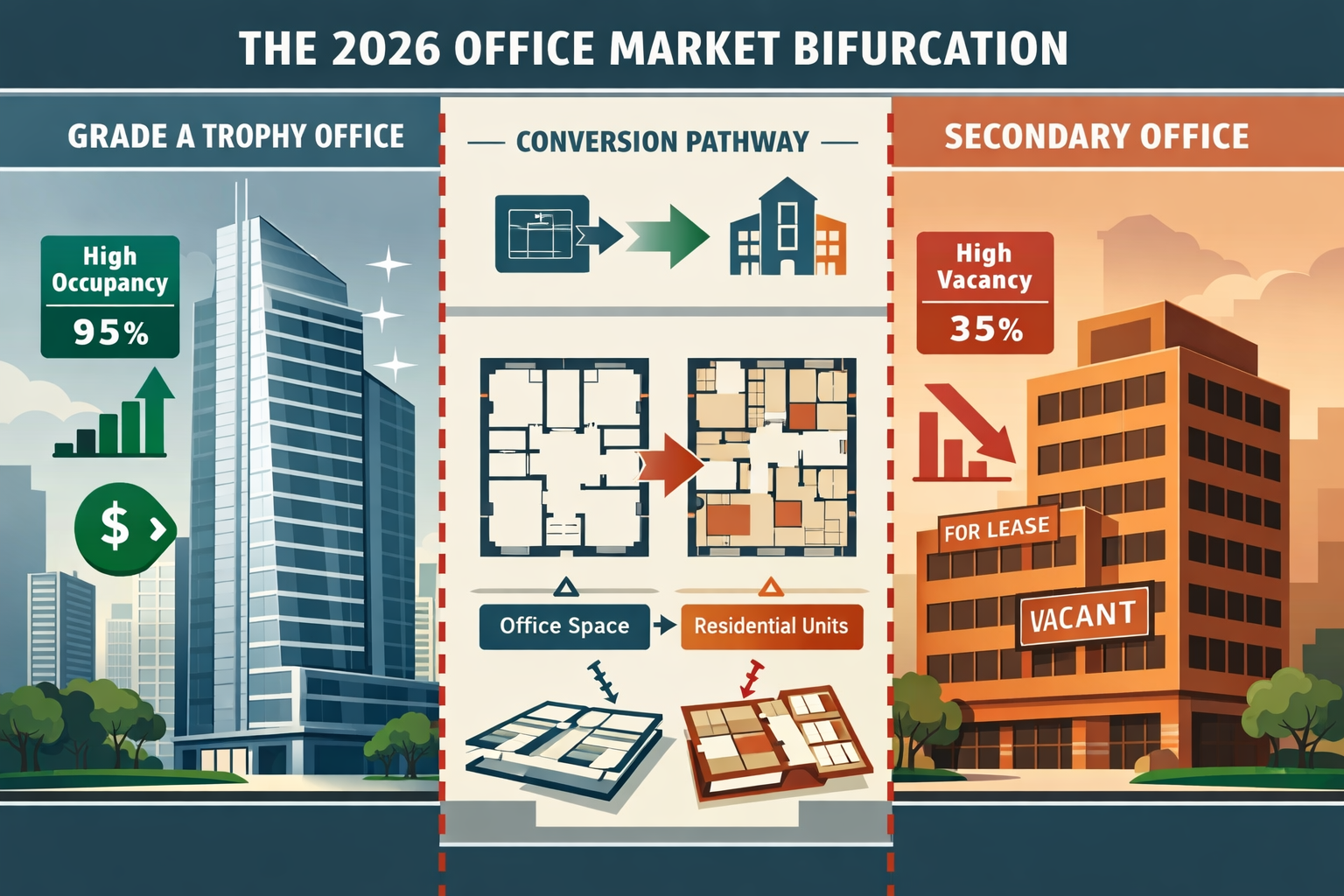
The office market in 2026 has split into two distinct categories. Trophy assets—Grade A buildings with modern amenities, sustainability credentials, and prime locations—continue to thrive with occupancy rates exceeding 90%. These buildings attract premium tenants willing to pay substantial rents for quality workspace.
Conversely, secondary and tertiary office stock faces unprecedented challenges:
- Occupancy rates below 60% in many urban submarkets
- Outdated infrastructure incompatible with modern workplace requirements
- Poor energy efficiency ratings making them uncompetitive
- Limited appeal to post-pandemic workforce preferences
- Declining rental values creating negative cash flow scenarios
This bifurcation has created a perfect storm for residential conversion. Buildings that once housed corporate offices are now prime candidates for transformation into apartments, creating both opportunities and challenges for developers navigating party wall awards.
Why Office-to-Residential Conversions Are Accelerating
Several factors are driving the conversion boom in 2026:
| Driver | Impact |
|---|---|
| Housing shortage | Persistent undersupply in major cities creates strong residential demand |
| Permitted development rights | Streamlined planning processes reduce conversion barriers |
| Declining office values | Lower acquisition costs improve conversion economics |
| Government incentives | Tax breaks and grants for residential development |
| ESG requirements | Adaptive reuse scores better than demolition for sustainability metrics |
For developers pursuing these opportunities, understanding how Party Wall Awards in Office-to-Residential Conversions: Capitalizing on the 2026 Office Market Bifurcation requires specialized expertise becomes immediately apparent when structural modifications begin.
Party Wall Challenges Unique to Office-to-Residential Conversions
Structural Modifications and Shared Elements
Unlike new-build residential developments, office-to-residential conversions involve extensive modifications to existing structures. These transformations create unique party wall considerations:
Core structural changes that trigger party wall procedures include:
- Floor plate subdivisions creating new party walls between residential units
- Vertical penetrations for new staircases, elevators, and service risers
- Load-bearing wall modifications to create residential layouts from open-plan offices
- Foundation underpinning when adding residential floors or changing load distributions
- Façade alterations affecting structural support shared with adjoining properties
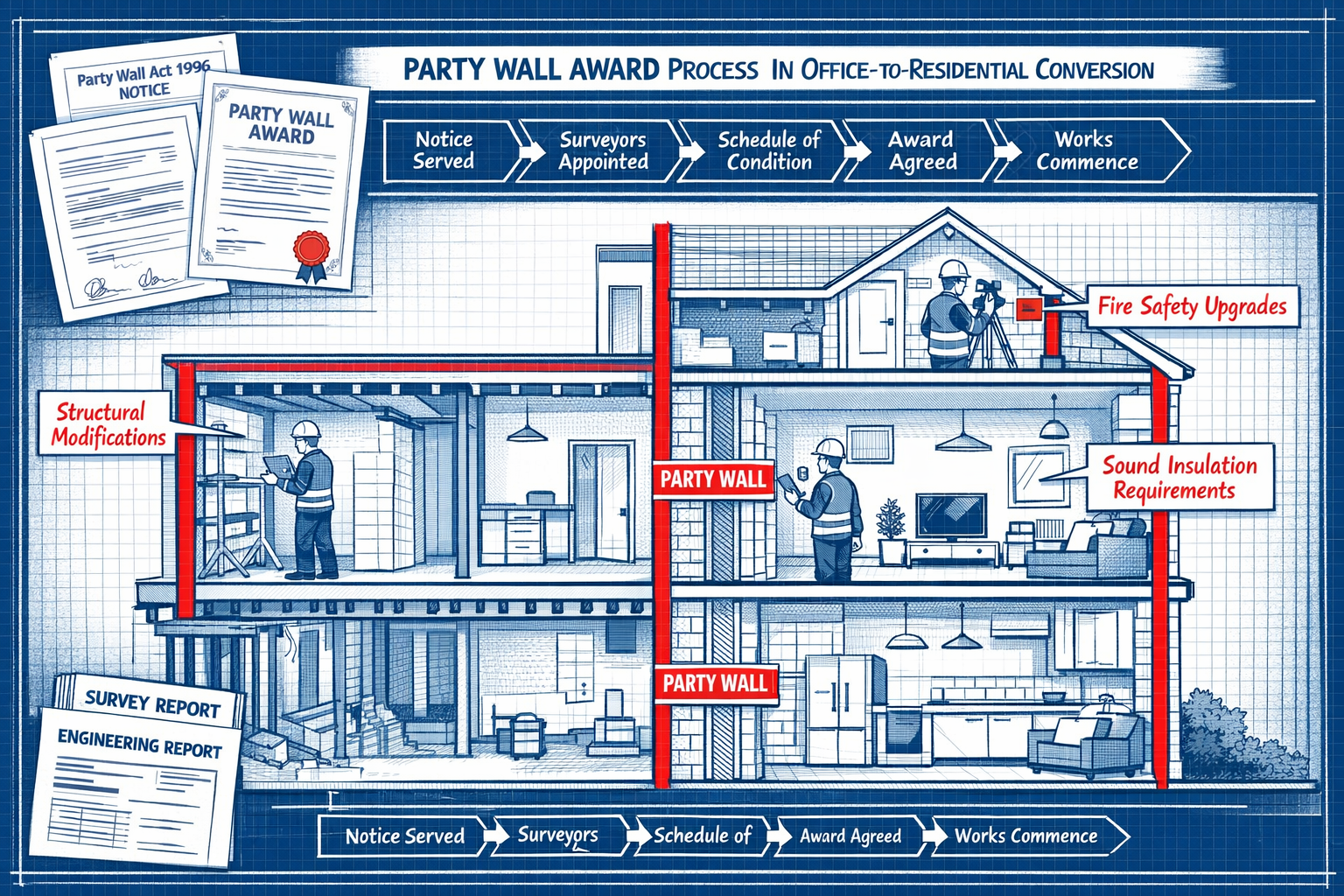
Each of these modifications requires careful consideration under the Party Wall etc. Act 1996, with awards documenting the scope of work, protection measures, and dispute resolution mechanisms.
Multiple Adjoining Owners and Complex Relationships
Office conversions frequently involve multiple adjoining properties with varying ownership structures:
- Adjacent office buildings (potentially also undergoing conversion)
- Ground-floor retail units with separate ownership
- Neighboring residential properties already established
- Mixed-use buildings with multiple tenants and freeholders
- Public infrastructure (roads, utilities) requiring statutory approvals
Managing party wall procedures across this complex web of stakeholders requires strategic coordination. Developers must serve party wall notices to all affected parties and secure awards that protect everyone's interests while allowing conversion work to proceed.
Sound Insulation and Fire Safety Upgrades
Transforming commercial spaces into residential units demands significant building performance upgrades:
🔊 Acoustic requirements: Office buildings typically have minimal sound insulation between floors. Residential conversions require:
- Enhanced floor-ceiling assemblies meeting Building Regulations Part E
- Party wall upgrades with acoustic barriers
- Isolation of mechanical systems from residential spaces
🔥 Fire safety compliance: Converting to residential use triggers stringent fire safety standards:
- Compartmentation of party walls to prevent fire spread
- Protected escape routes through previously open office floors
- Sprinkler systems and fire-resistant materials
- Modifications to shared structural elements requiring party wall awards
These technical requirements significantly impact the scope and complexity of party wall awards, making specialized surveyor expertise essential for successful project delivery.
Navigating Party Wall Awards in Office-to-Residential Conversions: Capitalizing on the 2026 Office Market Bifurcation
Strategic Planning and Early Engagement
Successful conversion projects begin with party wall planning during the feasibility stage, not after construction contracts are signed. Early engagement delivers multiple benefits:
✅ Timeline optimization: Identifying party wall requirements early prevents schedule delays
✅ Cost certainty: Understanding party wall obligations informs accurate budgeting
✅ Risk mitigation: Proactive neighbor engagement reduces dispute likelihood
✅ Design refinement: Party wall constraints inform architectural decisions
Developers should engage qualified party wall surveyors during initial due diligence to:
- Survey existing party wall arrangements and identify all affected neighbors
- Assess conversion plans against party wall notice requirements
- Develop engagement strategies for complex multi-owner scenarios
- Estimate party wall costs including surveyor fees and potential awards
- Create procedural timelines integrated with overall project schedules
Understanding types of party wall works relevant to conversion projects ensures comprehensive planning from the outset.
Serving Notices and Securing Awards
The formal party wall process for office-to-residential conversions follows established procedures but with conversion-specific considerations:
Step 1: Notice Preparation and Service 📄
Developers must serve appropriate notices based on the scope of work:
- Party Structure Notice for works directly affecting party walls
- Line of Junction Notice for new walls built on boundaries
- 3-Meter Notice or 6-Meter Notice for excavation work near adjoining properties
For conversion projects, notices should clearly describe:
- Existing building configuration and proposed residential layout
- Specific structural modifications affecting party walls
- Timeline for phased conversion work
- Access requirements for condition surveys
Step 2: Neighbor Response and Surveyor Appointment 🤝
Adjoining owners have 14 days to respond to party wall notices. In conversion projects with multiple neighbors, responses typically vary:
- Consent: Some neighbors may consent, eliminating the need for awards
- Dissent or non-response: Triggers the award process requiring surveyor appointment
- Conditional consent: Neighbors may request specific protections or monitoring
When awards are required, parties can either:
- Appoint a single Agreed Surveyor to act impartially
- Each appoint their own surveyor, who then select a Third Surveyor if needed
Understanding how to keep party wall costs down while ensuring proper procedures becomes crucial when managing multiple adjoining owners.
Step 3: Award Preparation and Documentation 📋
Party wall awards for conversion projects must comprehensively address:
| Award Component | Conversion-Specific Considerations |
|---|---|
| Scope of works | Detailed structural modifications, phasing plans, residential layout impacts |
| Schedule of condition | Pre-conversion documentation of all adjoining properties |
| Access arrangements | Protocols for accessing neighboring properties during conversion |
| Working hours | Restrictions protecting residential neighbors from construction noise |
| Protection measures | Structural monitoring, vibration limits, dust control |
| Dispute resolution | Procedures for addressing issues during extended conversion timelines |
| Cost allocation | Clear responsibility for surveyor fees and remediation costs |
The award becomes a legally binding document governing the relationship between building owner and adjoining owners throughout the conversion process. For guidance on award templates and structures, developers can reference party wall contract template guides.
Managing Conversion-Specific Complications
Mixed-use scenarios present unique challenges when capitalizing on the 2026 office market bifurcation:
🏪 Retail-office conversions: When ground floors remain commercial while upper floors convert to residential:
- Party wall awards must address different use classes and expectations
- Sound insulation requirements become more stringent
- Access and working hours require careful coordination
- Structural modifications may affect retail tenant operations
🏗️ Phased conversions: Large office buildings often convert in stages:
- Multiple party wall awards may be required as work progresses
- Existing awards may need variation as designs evolve
- Coordination between phases prevents conflicts
- Residential occupants in completed phases require protection during ongoing work
🤝 Neighboring conversions: When adjacent office buildings simultaneously convert:
- Coordinated party wall procedures reduce duplication
- Shared structural concerns require collaborative solutions
- Timing coordination prevents conflicting construction activities
- Joint surveyor appointments may reduce overall costs
For projects in major urban centers, engaging party wall surveyors in Central London or other specialized locations ensures local expertise with conversion-specific challenges.
Best Practices for Successful Party Wall Management in Conversions
Building Collaborative Relationships
Neighbor relations can make or break conversion projects. Successful developers employ proactive engagement strategies:
💬 Pre-notice consultation: Before serving formal notices:
- Meet with adjoining owners to explain conversion plans
- Address concerns and answer questions informally
- Provide visual materials showing proposed changes
- Demonstrate commitment to protecting neighbor interests
📸 Comprehensive condition surveys: Document adjoining properties thoroughly:
- Professional photography of all potentially affected areas
- Structural assessments identifying existing defects
- Video documentation for complex scenarios
- Regular updates during construction phases
🔍 Transparent communication: Throughout the conversion process:
- Regular progress updates to adjoining owners
- Prompt notification of any deviations from agreed works
- Accessible project contacts for neighbor concerns
- Post-completion verification that properties remain undamaged
These relationship-building practices significantly reduce dispute likelihood and facilitate smoother award negotiations.
Technical Expertise and Professional Support
Party Wall Awards in Office-to-Residential Conversions: Capitalizing on the 2026 Office Market Bifurcation requires specialized professional support:
Qualified party wall surveyors should possess:
- ✅ RICS accreditation with party wall specialization
- ✅ Experience with conversion projects specifically
- ✅ Understanding of structural engineering principles
- ✅ Knowledge of Building Regulations for residential conversions
- ✅ Familiarity with local planning and permitted development frameworks
Multidisciplinary coordination ensures comprehensive solutions:
- Structural engineers assessing party wall load transfers
- Acoustic consultants designing sound insulation upgrades
- Fire safety engineers ensuring compartmentation compliance
- Project managers integrating party wall timelines with construction schedules
Developers should budget appropriately for these professional services, recognizing that expert guidance prevents far more expensive disputes and delays.
Cost Management and Budgeting
Party wall costs in conversion projects typically include:
| Cost Category | Typical Range | Notes |
|---|---|---|
| Surveyor fees (building owner) | £2,000-£8,000+ per award | Varies with project complexity |
| Adjoining owner surveyor fees | £1,500-£6,000+ per neighbor | Building owner typically pays |
| Schedule of condition | £500-£2,000 per property | Professional documentation |
| Monitoring and inspections | £1,000-£5,000 | During construction phase |
| Remediation works | Variable | If damage occurs despite precautions |
| Third surveyor fees | £2,000-£10,000+ | If required for dispute resolution |
For large conversion projects with multiple adjoining owners, total party wall costs can reach £50,000-£150,000 or more. However, these costs represent essential risk management investments that protect against far more expensive litigation and project delays.
Developers can optimize costs by:
- Engaging surveyors early in the planning process
- Pursuing agreed surveyor appointments where possible
- Maintaining excellent neighbor relations reducing dispute likelihood
- Properly documenting all procedures to prevent later challenges
Additional guidance on costs of party wall processes helps developers budget accurately for conversion projects.
Case Study Scenarios: Party Wall Awards in Action
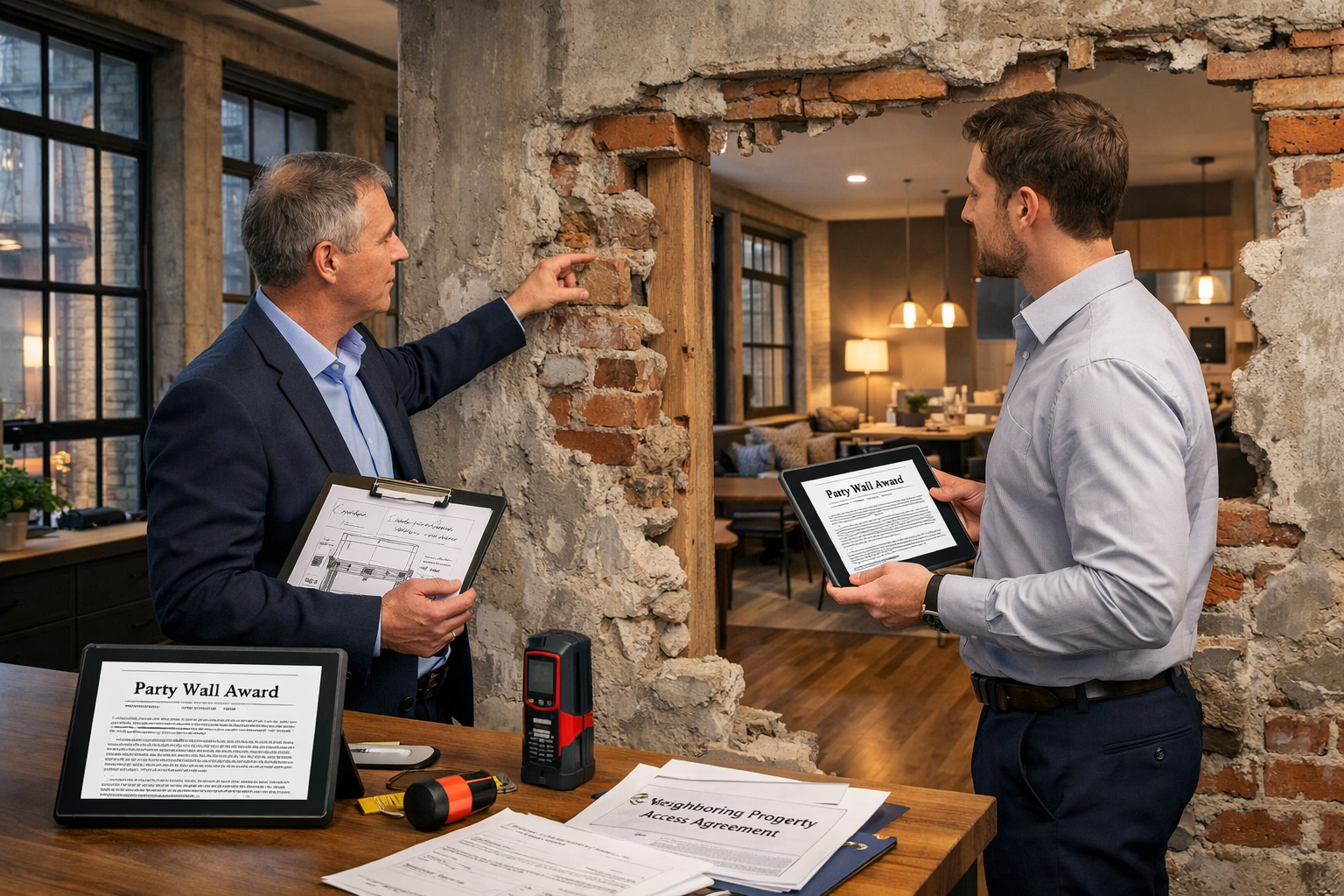
Scenario 1: Mid-Rise Office Block to Apartments
Project: 8-story 1970s office building in East London converting to 64 residential units
Party wall challenges:
- Shared party walls with adjacent 4-story office building (also converting)
- Ground-floor retail units with separate ownership
- Residential properties to the rear with gardens adjacent to development
- Structural modifications including new floor penetrations for residential cores
Solution approach:
- Early consultation with all neighbors before formal notice service
- Coordinated party wall procedures with adjacent conversion project
- Phased awards allowing work to commence while final designs evolved
- Comprehensive monitoring program protecting all adjoining properties
- Agreed surveyor appointment with retail owner reducing costs
Outcome: Project completed on schedule with zero party wall disputes, total party wall costs £42,000 across all awards.
Scenario 2: Historic Office Building Conversion
Project: Grade II listed Victorian office building converting to luxury apartments
Party wall challenges:
- Historic fabric requiring sensitive structural interventions
- Party walls shared with occupied residential properties on both sides
- Foundation underpinning required for basement conversion
- Conservation requirements limiting structural modification options
Solution approach:
- Heritage structural engineer collaboration with party wall surveyor
- Enhanced protection measures given building sensitivity
- Weekly monitoring of adjoining properties during underpinning
- Modified working hours accommodating residential neighbors
- Detailed photographic condition surveys documenting historic features
Outcome: Successful conversion preserving historic character while meeting modern residential standards, party wall costs £68,000 reflecting complexity and enhanced monitoring.
Scenario 3: Large-Scale Campus Conversion
Project: 12-building office campus converting to mixed residential and commercial use
Party wall challenges:
- Multiple buildings with shared structural elements
- Phased conversion over 3-year timeline
- Neighboring office park with multiple owners
- Existing party wall agreements from original construction requiring variation
Solution approach:
- Master party wall strategy coordinating all phases
- Single surveyor team managing all awards for consistency
- Staged notice service aligned with construction phasing
- Collaborative approach with neighboring office park owners
- Comprehensive project communication platform for all stakeholders
Outcome: Complex multi-phase project delivered successfully, party wall procedures streamlined through strategic coordination, total party wall costs £186,000 across all phases and buildings.
Future Trends and Considerations for 2026 and Beyond
Evolving Regulatory Landscape
The regulatory environment for office-to-residential conversions continues evolving in 2026:
Permitted development changes: Ongoing reforms to permitted development rights may:
- Expand conversion eligibility to more building types
- Impose new quality standards for converted residential units
- Require enhanced sustainability performance
- Affect party wall procedure timelines and requirements
Building safety reforms: Post-Grenfell building safety legislation impacts conversions:
- Enhanced fire safety requirements for party walls in residential buildings
- Mandatory building safety case development for higher-risk conversions
- Increased scrutiny of structural modifications affecting fire compartmentation
- Greater accountability for building owners managing conversion projects
Developers must ensure party wall awards align with these evolving regulatory requirements, incorporating flexibility for compliance adaptations.
Technology and Innovation
Digital tools are transforming party wall management in 2026:
📱 Digital notice service: Electronic service of party wall notices with secure verification
🎥 Virtual condition surveys: Drone and 3D scanning technology documenting adjoining properties
📊 Real-time monitoring: IoT sensors tracking structural movement during conversion work
💻 Cloud-based collaboration: Digital platforms coordinating surveyors, neighbors, and contractors
🤖 AI-assisted analysis: Machine learning identifying potential party wall risks from design documents
These innovations improve accuracy, reduce timelines, and enhance transparency throughout the party wall award process.
Sustainability and ESG Considerations
Environmental, social, and governance (ESG) factors increasingly influence conversion decisions:
🌱 Adaptive reuse benefits: Converting existing buildings rather than demolishing scores favorably for:
- Embodied carbon reduction (avoiding demolition and new construction emissions)
- Circular economy principles (extending building lifecycle)
- Urban regeneration (revitalizing underutilized areas)
- Resource efficiency (reusing structural elements)
Party wall awards should document sustainability measures including:
- Recycled and low-carbon materials for party wall modifications
- Energy efficiency improvements benefiting all properties
- Waste management protocols during conversion work
- Long-term maintenance strategies for shared structural elements
Developers positioning conversions as sustainable regeneration projects often find greater neighbor support and smoother party wall procedures.
Conclusion: Mastering Party Wall Awards for Conversion Success
Party Wall Awards in Office-to-Residential Conversions: Capitalizing on the 2026 Office Market Bifurcation represents both a significant opportunity and a complex challenge for property developers. The stark divide between thriving trophy offices and struggling secondary stock has created unprecedented conversion potential, but successful project delivery requires sophisticated party wall management.
Key Success Factors 🎯
Developers who excel in conversion projects consistently demonstrate:
- Early strategic planning integrating party wall procedures from project inception
- Specialized professional support from surveyors experienced in conversion-specific challenges
- Proactive neighbor engagement building collaborative relationships before formal procedures
- Comprehensive documentation protecting all parties and preventing disputes
- Flexible approaches adapting to complex multi-owner scenarios and phased delivery
- Cost discipline budgeting appropriately while optimizing party wall expenditure
Actionable Next Steps 📝
For developers planning office-to-residential conversions in 2026:
Immediate actions:
- Engage qualified party wall surveyors during feasibility assessment
- Conduct preliminary surveys identifying all potential party wall implications
- Develop neighbor engagement strategies before serving formal notices
- Budget comprehensively for party wall procedures and professional fees
Project planning:
- Integrate party wall timelines into overall project schedules
- Coordinate design teams to minimize party wall complications
- Establish monitoring protocols protecting adjoining properties
- Create communication systems managing multiple stakeholder relationships
Risk management:
- Document all party wall procedures meticulously
- Maintain comprehensive condition surveys of adjoining properties
- Ensure adequate insurance coverage for party wall-related risks
- Develop contingency plans for potential disputes or delays
Professional partnerships:
- Build relationships with experienced party wall surveyors specializing in conversions
- Engage multidisciplinary teams including structural and acoustic consultants
- Consider locations-specific expertise for projects in North London, South London, or West London
- Establish legal support familiar with party wall legislation and conversion projects
The Bottom Line 💼
The 2026 office market bifurcation has created a once-in-a-generation opportunity for developers to transform underutilized commercial buildings into much-needed residential housing. Success in this market requires more than architectural vision and financial backing—it demands mastery of the specialized party wall procedures that govern these complex conversions.
By treating party wall awards not as bureaucratic obstacles but as essential risk management tools, developers can navigate conversion projects smoothly, maintain positive neighbor relations, and deliver successful residential developments that capitalize on the changing commercial property landscape.
The developers who thrive in this environment will be those who recognize that Party Wall Awards in Office-to-Residential Conversions: Capitalizing on the 2026 Office Market Bifurcation requires specialized knowledge, proactive planning, and professional excellence—transforming potential challenges into competitive advantages in the race to reimagine our urban office stock for residential futures.