


As urban office markets continue to bifurcate in 2026, with prime buildings commanding premium rents while secondary stock struggles with vacancy, property developers are increasingly turning to office-to-residential conversions as a strategic solution. This transformation of underutilized commercial space into much-needed housing represents one of the most significant urban regeneration trends of the decade. However, the success of these projects hinges on a critical yet often overlooked factor: properly navigating party wall notices for 2026 office-to-residential conversions through essential surveyor protocols.
Party wall surveyors have emerged as pivotal professionals in smoothing these complex conversions, ensuring that structural alterations comply with the Party Wall etc. Act 1996 while maintaining positive relationships between building owners and adjoining property stakeholders. Understanding the notice timelines, dispute avoidance strategies, and award drafting protocols specific to these urban redevelopment projects is essential for developers, surveyors, and property owners alike.
Key Takeaways
- Two-month notice periods are mandatory for party wall works affecting office-to-residential conversions, with neighbors receiving a 14-day response window [1]
- Class MA permitted development rights remain viable in 2026 for qualifying office buildings, but Article 4 Directions must be verified before proceeding [4]
- Professional surveyor protocols include comprehensive schedules of condition, formal party wall awards, and specialized knowledge of conversion-specific structural implications
- Written consent or surveyor appointment must be secured before conversion work begins to avoid legal consequences and project delays [5]
- Higher-risk building regulations apply to conversions creating buildings 18+ meters tall or 7+ storeys, requiring Building Safety Regulator approval [4]
Understanding Party Wall Requirements for Office-to-Residential Conversions in 2026
The Legal Framework Governing Conversion Projects
The Party Wall etc. Act 1996 provides the statutory framework that applies to office-to-residential conversions throughout England and Wales [1]. This legislation becomes particularly relevant when conversion works involve:
- Structural alterations to shared walls between commercial and residential properties
- Raising or modifying party walls to create additional residential floors
- Excavation works within specified distances of adjoining buildings
- Installation of new structural elements that affect party structures
For developers undertaking conversions in 2026, understanding which works trigger party wall notice requirements is fundamental. According to recent guidance, works must have a direct effect on a party wall to fall within the Act's scope [2]. Minor works such as plastering, electrical installations, or drilling internal walls for fixtures are excluded from formal party wall agreements [1].
Class MA Conversions and Prior Approval Considerations
Class MA permitted development rights continue to offer a streamlined pathway for office-to-residential conversions in 2026, provided the building has been in Class E use for at least two continuous years [4]. This route can transform "tired offices with weak demand into viable housing quickly" without full planning permission.
However, developers must verify several critical factors before relying on permitted development:
| Verification Step | Requirement | Timeline |
|---|---|---|
| Article 4 Direction Check | Confirm Class MA coverage not removed | Before design phase |
| Prior Approval Application | Submit to local council | 56-day determination period [4] |
| Building Safety Assessment | Evaluate if 18m+ height or 7+ storeys | Before work commences |
| Party Wall Notice Service | Issue formal notices to affected parties | Minimum 2 months before work [1] |
🏢 Important Note: Article 4 Directions must be checked first before committing resources to design or surveys, as removal of Class MA coverage requires full planning permission rather than prior approval [4].
For comprehensive guidance on party wall notices and their application to conversion projects, developers should consult qualified surveyors early in the planning process.
Essential Surveyor Protocols for Navigating Party Wall Notices in 2026 Office Conversions
Notice Service Timelines and Procedures
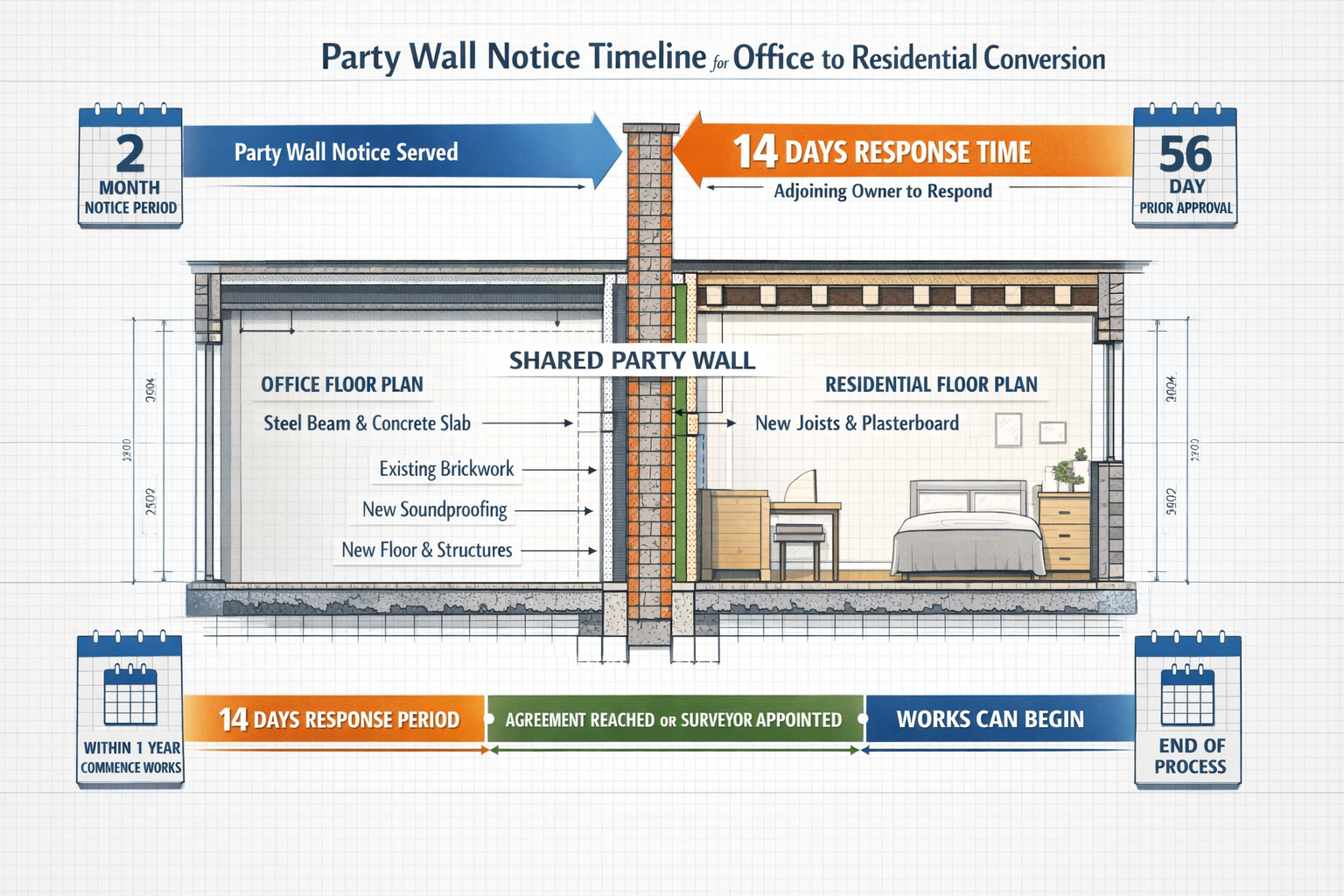
Timing is everything when navigating party wall notices for 2026 office-to-residential conversions. The standard two-month notice period provides adjoining owners adequate time to assess the proposed works and respond appropriately [1]. This timeline breaks down as follows:
Initial Notice Period:
- Day 0: Building owner serves formal party wall notice
- Day 1-14: Adjoining owner's response window [3]
- Day 15-60: Preparation period if consent given, or surveyor appointment if dissent
- Day 60+: Earliest commencement date (if consent received)
Once service is complete, homeowners and developers have up to one year before work must start [1], providing flexibility for project scheduling while maintaining legal compliance.
Understanding party wall act notices and how to respond is crucial for both building owners initiating conversions and adjoining owners receiving notices.
The 14-Day Response Window: Critical Decision Point
The fourteen-day neighbor response window following formal service represents a critical juncture in the party wall process [3]. During this period, adjoining owners can:
✅ Provide written consent – Allows work to proceed without formal award
✅ Raise concerns – Triggers surveyor appointment and award preparation
✅ Appoint their own surveyor – Ensures independent representation
✅ Request additional information – Clarifies scope and impact of works
If written consent isn't received within 14 days, a party wall surveyor must prepare a formal party wall award and schedule of condition [5]. This procedural requirement protects all parties' interests and establishes clear protocols for the conversion works.
Specialized Protocols for Office Conversion Works
Office-to-residential conversions present unique challenges that require specialized surveyor expertise:
Structural Considerations:
- Load redistribution from open-plan office floors to residential compartmentation
- Party wall raising for loft conversions or additional residential storeys under section 2(2)(a) [2]
- New openings for residential access or services through party structures
- Sound insulation upgrades to meet residential building regulations
Documentation Requirements:
- Comprehensive schedules of condition for all adjoining properties
- Detailed specifications of conversion works affecting party structures
- Photographic evidence of pre-existing conditions
- Structural calculations demonstrating party wall integrity
For projects in specific London areas, engaging local specialists such as a party wall surveyor in Central London or party wall surveyor in South London ensures familiarity with local building stock and conversion precedents.
Fee Structures and Cost Considerations
Recent guidance from February 2026 confirms that surveyor fees for conversion projects typically start at £75 plus VAT per adjoining owner for notice preparation and service [2]. However, complex conversion projects often require additional services:
- Initial consultation and feasibility assessment
- Detailed schedule of condition preparation
- Party wall award drafting and negotiation
- Ongoing monitoring during construction phase
- Dispute resolution and arbitration services
Developers can learn how to keep party wall costs down while maintaining compliance and professional standards through strategic planning and early surveyor engagement.
Dispute Avoidance and Award Drafting for Office-to-Residential Projects

Proactive Communication Strategies
Preventing disputes before they arise represents the most effective protocol for navigating party wall notices in 2026 office-to-residential conversions. Experienced surveyors employ several proactive strategies:
🔑 Early Engagement: Contact adjoining owners before formal notice service to explain conversion plans and address initial concerns.
🔑 Transparent Documentation: Provide clear, jargon-free explanations of proposed works alongside technical specifications.
🔑 Accessible Communication: Offer multiple channels for questions and maintain responsive dialogue throughout the process.
🔑 Realistic Expectations: Set clear timelines for construction phases and potential disruption periods.
For adjoining owners receiving notice of conversion works, understanding your rights and options helps facilitate constructive dialogue rather than adversarial proceedings.
Drafting Comprehensive Party Wall Awards
When written consent cannot be obtained, the party wall award becomes the governing document for conversion works. Essential components include:
Award Structure:
- Preamble – Identifies parties, properties, and statutory basis
- Description of Works – Detailed specification of conversion activities affecting party structures
- Schedule of Condition – Comprehensive documentation of pre-existing conditions
- Working Hours – Permitted times for noisy or disruptive operations
- Access Provisions – Rights of entry for inspections and monitoring
- Security for Expenses – Financial protections for adjoining owners
- Dispute Resolution – Procedures for addressing unforeseen issues
"A well-drafted party wall award anticipates potential conflicts and provides clear mechanisms for resolution, transforming potential disputes into manageable procedural matters."
For guidance on award templates and structures, developers can review information about party wall contract templates and awards.
Schedules of Condition: Documentation Best Practices
The schedule of condition represents perhaps the most critical protective document in office-to-residential conversions. Best practice protocols include:
Photographic Documentation:
- High-resolution images of all rooms in adjoining properties
- Detailed close-ups of existing cracks, defects, or damage
- External elevations showing party wall conditions
- Date-stamped and location-tagged imagery
Written Descriptions:
- Room-by-room condition assessments
- Specific notation of pre-existing defects
- Material specifications and finishes
- Structural observations and concerns
Technical Measurements:
- Crack width monitoring at key locations
- Level surveys for floors and ceilings
- Plumb measurements for walls
- Baseline vibration or noise readings if relevant
This comprehensive documentation protects both building owners undertaking conversions and adjoining owners from spurious damage claims, establishing clear pre-work baselines against which post-construction conditions can be assessed.
Legal Consequences of Notice Failure
Failure to serve proper party wall notices carries significant legal consequences that can derail conversion projects [1]:
⚠️ Difficulty proving pre-existing damage without formal schedules of condition
⚠️ Neighbor injunctions halting work until proper notice is served
⚠️ Liability for all damages regardless of causation
⚠️ Project delays while retrospective procedures are completed
⚠️ Increased costs from legal proceedings and work stoppages
For building owners initiating conversions, understanding whether having a party wall agreement without a surveyor is advisable depends on project complexity and relationship with adjoining owners.
Higher-Risk Building Considerations
The higher-risk building regime introduced in recent years applies to conversions creating buildings 18+ meters tall or 7+ storeys with 2+ residential units [4]. These projects require:
- Building Safety Regulator approval before work starts
- Enhanced fire safety measures and compartmentation
- Additional structural assessments and certifications
- More rigorous party wall protocols given increased risk profile
Surveyors working on these larger conversion projects must coordinate party wall procedures with building safety requirements, ensuring comprehensive compliance across all regulatory frameworks.
Regional Considerations for London Office Conversions
London's diverse property landscape requires location-specific expertise when navigating party wall notices for office-to-residential conversions. Different areas present unique challenges:
Central London: High-density mixed-use developments with complex ownership structures require sophisticated coordination. A party wall surveyor in Central London brings essential knowledge of listed buildings and conservation areas.
East London: Rapid regeneration zones with numerous conversion projects benefit from surveyors familiar with East London party wall protocols and emerging development patterns.
West London: Premium residential areas with sensitive neighbors require diplomatic approaches. Specialists in West London understand local expectations and communication preferences.
North London: Victorian and Edwardian terraces common in this area present specific structural considerations for conversion projects, making North London party wall expertise valuable.
Conclusion: Strategic Protocols for Successful 2026 Conversions
Navigating party wall notices for 2026 office-to-residential conversions requires a strategic combination of legal compliance, technical expertise, and diplomatic communication. As urban regeneration continues to transform underutilized commercial buildings into much-needed housing, party wall surveyors serve as essential facilitators of this transition.
The essential surveyor protocols outlined in this guide—from understanding two-month notice timelines and 14-day response windows to drafting comprehensive awards and schedules of condition—provide the framework for successful conversion projects. By prioritizing early engagement, transparent communication, and meticulous documentation, developers can minimize disputes while protecting the interests of all stakeholders.
Actionable Next Steps
For developers planning office-to-residential conversions in 2026:
- Verify Article 4 Direction status before committing design resources
- Engage qualified party wall surveyors during early feasibility stages
- Serve formal notices at least two months before planned commencement
- Prepare comprehensive schedules of condition for all adjoining properties
- Maintain open communication with neighbors throughout the process
- Document all procedures to demonstrate compliance with the Party Wall etc. Act 1996
For adjoining owners receiving conversion notices:
- Respond within the 14-day window to preserve your rights
- Consider appointing your own surveyor for independent representation
- Request detailed information about proposed works and timelines
- Ensure comprehensive schedule of condition documents your property's pre-work state
- Understand your rights under the Act and within party wall awards
The bifurcation of office markets in 2026 presents both challenges and opportunities. With proper party wall protocols, conversion projects can proceed smoothly, transforming vacant office space into vibrant residential communities while maintaining positive relationships between neighbors and protecting property values for all stakeholders.
For additional support and professional guidance, consult the comprehensive resources available on understanding the Party Wall etc. Act 1996 and explore types of party wall works relevant to your specific conversion project.
References
[1] Party Wall Agreement – https://hoa.org.uk/advice/guides-for-homeowners/i-am-improving/party-wall-agreement/
[2] Loft Conversions And The Party Wall Act – https://www.peterbarry.co.uk/blog/loft-conversions-and-the-party-wall-act/
[3] Party Walls Notices – https://extensionplansuk.co.uk/expertise/party-walls-notices/
[4] How To Convert Offices Into Homes Without Planning Permission – https://urbanistarchitecture.co.uk/how-to-convert-offices-into-homes-without-planning-permission/
[5] Permitted Development Guide – https://hoa.org.uk/advice/guides-for-homeowners/i-am-improving/permitted-development-guide/
