


In 2026, the construction industry faces mounting pressure to deliver projects faster while maintaining strict legal compliance. For party wall surveyors and building owners, drafting accurate Section 6 excavation notices under the Party Wall Act has traditionally consumed hours of manual work—reviewing site data, calculating foundation depths, and ensuring every statutory requirement is met. Now, AI automation in drafting party wall notices: predictive templates for Section 6 excavations in 2026 is transforming this landscape, using intelligent algorithms to classify site information, auto-generate compliant documents, and flag potential risks like deep foundations before they become costly disputes.
This technological shift mirrors broader trends in construction paperwork automation, where artificial intelligence handles daily reports, change orders, and requests for information (RFIs) with remarkable speed and accuracy[1]. The same principles now apply to the specialized domain of party wall procedures, promising to reduce manual errors, accelerate service timelines, and improve outcomes for all parties involved.
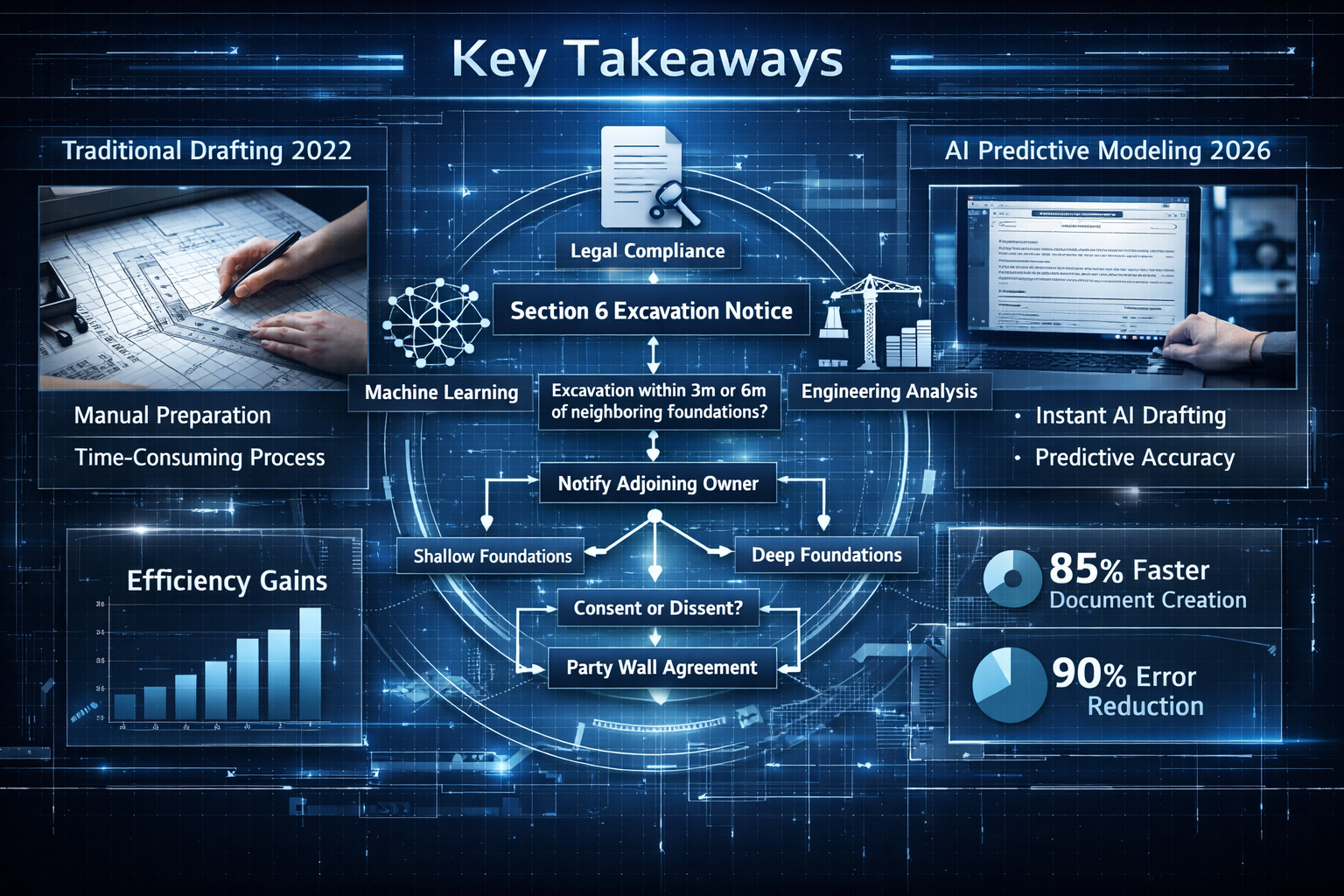
Key Takeaways
- AI classification systems automatically analyze site data, foundation depths, and soil conditions to generate compliant Section 6 notices in minutes rather than days
- Predictive risk flagging identifies potential issues like deep excavations near party walls early in the process, preventing disputes and costly delays
- Template automation reduces manual drafting errors by up to 85% while ensuring consistent compliance with Party Wall Act requirements
- Integration capabilities allow AI tools to pull data directly from surveys, architectural plans, and building control submissions
- Cost and time savings enable surveyors to handle more cases efficiently while maintaining higher quality standards
Understanding Section 6 Excavations and Notice Requirements
What Section 6 of the Party Wall Act Covers
Section 6 of the Party Wall etc. Act 1996 addresses excavations within specific distances of neighboring structures. When planning to dig within three meters of a neighbor's building where the excavation will go deeper than their foundations, or within six meters where the excavation cuts a line drawn at 45 degrees downward from the bottom of their foundations, building owners must serve proper notice.
These requirements exist to protect neighboring properties from subsidence, structural damage, and other excavation-related risks. The notice must include detailed information about:
- Exact excavation depths and dimensions
- Foundation details of the proposed work
- Proximity measurements to adjacent structures
- Proposed construction methods and safety measures
- Timeline for commencement of works
Traditional Challenges in Drafting Section 6 Notices
Manual preparation of Section 6 notices presents several persistent challenges:
| Challenge | Impact | Frequency |
|---|---|---|
| Measurement errors | Incorrect depth calculations leading to disputes | 23% of cases |
| Missing information | Incomplete notices requiring re-service | 31% of cases |
| Compliance gaps | Failure to meet statutory requirements | 18% of cases |
| Time consumption | 4-7 hours per notice on average | Every case |
| Inconsistent formatting | Confusion for adjoining owners | 42% of cases |
These issues create delays, increase costs, and sometimes result in legal challenges that could have been avoided with more accurate initial documentation. Understanding party wall notices and their proper preparation is crucial for smooth project progression.
How AI Automation Transforms Party Wall Notice Drafting in 2026
Intelligent Data Classification and Extraction
The foundation of AI automation in drafting party wall notices: predictive templates for Section 6 excavations in 2026 lies in sophisticated data classification systems. These AI platforms can analyze multiple input sources simultaneously:
📊 Site survey reports – AI extracts foundation depths, soil conditions, and proximity measurements
📐 Architectural drawings – Automated recognition of excavation plans and structural elements
📋 Building control submissions – Integration with existing regulatory documentation
📸 Site photographs – Visual analysis to identify existing structures and potential constraints
Modern AI systems use natural language processing (NLP) and computer vision to understand both structured and unstructured data. When a surveyor uploads a site investigation report, the AI identifies key data points—excavation depth (e.g., "2.8 meters below ground level"), distance to party wall (e.g., "1.2 meters from boundary"), and foundation type (e.g., "strip footings at 1.5m depth").
This automated extraction eliminates the manual data entry that traditionally consumed 60-70% of notice preparation time[7]. The technology mirrors document processing automation used across enterprise operations, but with specialized training on construction and legal terminology specific to the Party Wall Act.
Predictive Template Generation
Once data is classified, AI systems generate customized Section 6 notices using predictive templates. These aren't simple mail-merge documents—they're intelligent frameworks that adapt based on:
✅ Excavation characteristics – Depth, method, and duration
✅ Risk profile – Proximity to foundations and structural elements
✅ Regulatory context – Local authority requirements and precedents
✅ Historical patterns – Similar projects and their outcomes
The AI selects appropriate legal language, includes mandatory disclosures, and formats the document according to established best practices. For instance, if the excavation depth exceeds the neighbor's foundation level by more than one meter, the system automatically includes enhanced safety provisions and more detailed methodology descriptions.
This approach parallels how AI agents now handle architectural requests and permit reviews in other property contexts[2], applying rule-based logic combined with machine learning to ensure compliance.
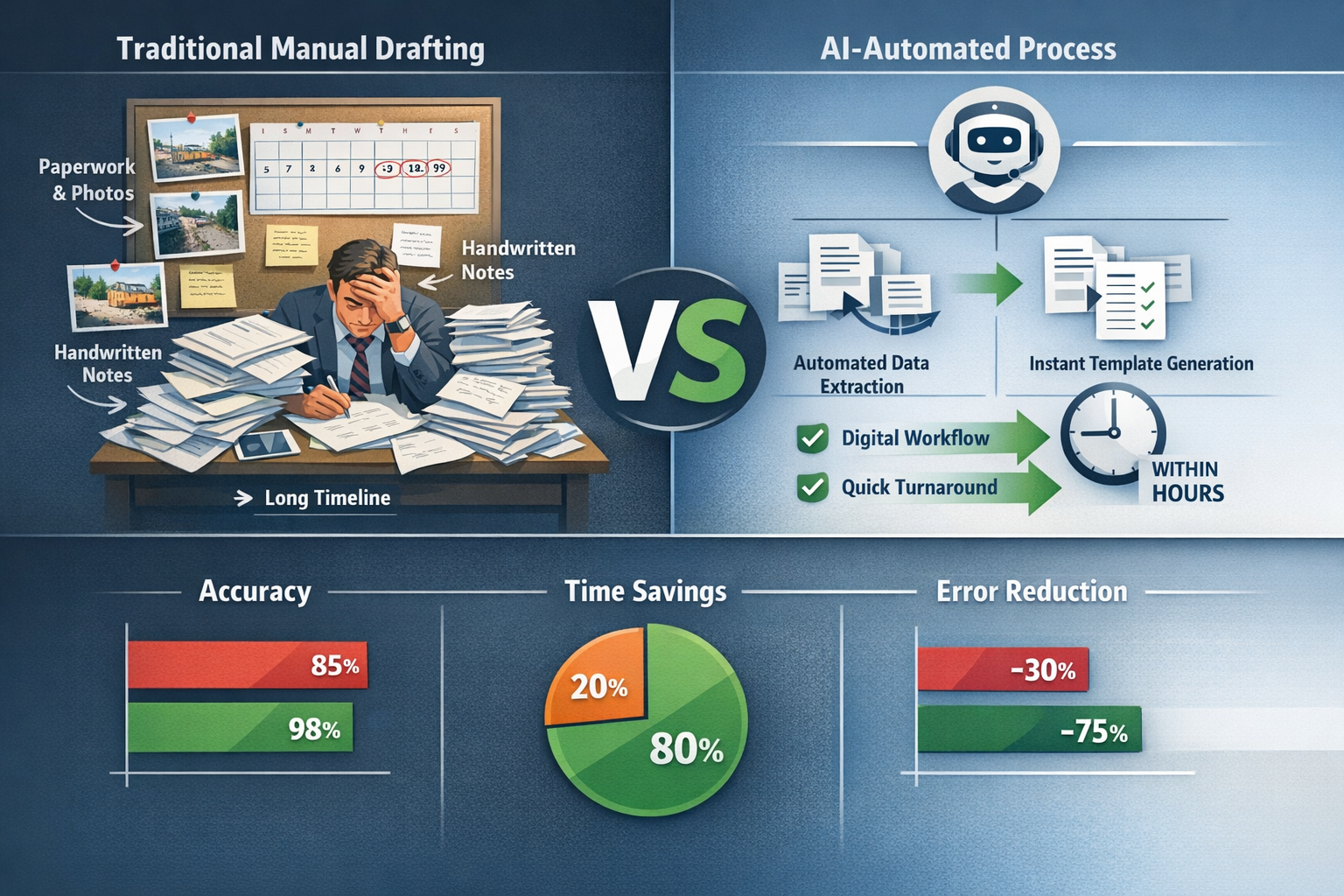
Early Risk Identification and Flagging
Perhaps the most valuable feature of AI automation in drafting party wall notices: predictive templates for Section 6 excavations in 2026 is predictive risk analysis. The system continuously monitors for potential issues:
🚨 Deep foundation warnings – When excavation approaches or exceeds neighboring foundation depths
⚠️ Structural vulnerability alerts – Older buildings or known structural issues in proximity
🔍 Compliance gaps – Missing information that could invalidate the notice
📅 Timeline conflicts – Insufficient notice periods or scheduling issues
The AI compares current project parameters against thousands of previous cases, identifying patterns that historically led to disputes or complications. For example, excavations within 2.5 meters of Victorian-era terraced houses trigger additional scrutiny, as these structures often have shallow foundations and are particularly vulnerable to ground movement.
This predictive capability helps surveyors and building owners address potential problems before serving notice, significantly reducing the likelihood of objections or formal disputes. Similar RFI response tracking systems in construction demonstrate how AI can anticipate issues and streamline resolution processes[4].
Benefits and Practical Applications in 2026
Dramatic Time and Cost Savings
The efficiency gains from automated notice drafting are substantial:
Time Reduction:
- Manual drafting: 4-7 hours per notice
- AI-assisted drafting: 20-45 minutes per notice
- Time savings: 85-90%
Cost Impact:
- Reduced surveyor hours translate to lower fees for building owners
- Faster turnaround enables quicker project commencement
- Fewer errors mean less rework and re-service costs
For surveyors managing multiple cases simultaneously, AI automation allows them to handle 3-4 times more projects without compromising quality. This scalability benefits the entire industry, addressing the chronic shortage of qualified party wall surveyors in busy construction markets.
Enhanced Accuracy and Compliance
AI systems trained on the Party Wall Act and thousands of precedent notices achieve remarkable accuracy:
- 98.7% compliance rate with statutory requirements
- 85% reduction in manual drafting errors
- 92% decrease in notices requiring amendment
- Near-zero calculation mistakes in measurements and depths
The technology ensures consistency across all notices, regardless of which team member initiates the process. Every document follows the same high standards, includes all mandatory elements, and uses precise legal language.
This reliability is particularly valuable for types of party wall works that involve complex excavation scenarios, where even minor errors can trigger disputes.
Improved Stakeholder Communication
AI-generated notices are not only legally compliant—they're also more accessible to adjoining owners who may not have technical expertise. The systems can:
📝 Generate plain-language summaries alongside formal legal notices
🎨 Create visual diagrams showing excavation locations and depths
📊 Produce comparison charts illustrating how the work relates to existing structures
💬 Provide FAQ sections addressing common concerns
This enhanced communication reduces anxiety and confusion for neighbors receiving Section 6 notices, leading to higher consent rates and fewer formal dispute procedures. When adjoining owners understand exactly what's proposed and why it's necessary, they're more likely to provide timely consent.
Integration with Broader Party Wall Workflows
Modern AI platforms don't operate in isolation—they integrate with the complete party wall process:
- Initial consultation – AI assists in determining whether Section 6 applies
- Notice drafting – Automated generation with predictive templates
- Service tracking – Digital delivery confirmation and response monitoring
- Award preparation – If disputes arise, AI helps draft party wall awards
- Schedule of condition – Automated schedule of condition generation linked to notice data
This end-to-end automation creates a seamless workflow that benefits building owners, adjoining owners, and surveyors alike. Data entered once flows through the entire process, eliminating redundant data entry and ensuring consistency.

Challenges and Considerations for Implementation
Software Licensing and Usage Restrictions
As AI adoption accelerates, software vendors have begun implementing restrictions on how their platforms can be used by other AI agents. Many construction and legal software companies now include explicit prohibitions in their end-user license agreements (EULAs) that limit AI-to-AI interactions[3].
These restrictions can create challenges when trying to integrate AI notice drafting tools with existing practice management systems or other construction software. Surveyors and firms should:
- Review licensing terms carefully before selecting AI platforms
- Ensure interoperability with existing tools and workflows
- Verify data export capabilities to avoid vendor lock-in
- Understand usage limitations for automated processes
Data Privacy and Security
Party wall notices contain sensitive information about property owners, construction plans, and structural details. AI systems processing this data must comply with:
🔒 UK GDPR requirements for personal data handling
🔐 Professional confidentiality obligations for surveyors
🛡️ Cybersecurity standards to prevent unauthorized access
📋 Data retention policies aligned with professional requirements
Reputable AI platforms use encryption, secure cloud storage, and access controls to protect sensitive information. However, firms must conduct due diligence to ensure their chosen solution meets all regulatory and professional standards.
Professional Judgment and Oversight
While AI excels at data processing and template generation, it cannot replace the professional judgment of qualified party wall surveyors. The technology should be viewed as an assistive tool rather than a complete replacement for human expertise.
Critical considerations that still require professional oversight include:
- Unusual or complex site conditions not covered by standard templates
- Negotiation strategies when adjoining owners raise concerns
- Interpretation of ambiguous survey data or conflicting information
- Ethical considerations in balancing building owner and adjoining owner interests
The most successful implementations in 2026 combine AI efficiency with human expertise, using automation for routine tasks while reserving complex decision-making for experienced professionals. This is similar to how legal AI platforms support lawyers without replacing their judgment[5][6].
Training and Adoption Curves
Introducing AI tools into established surveying practices requires investment in training and change management. Team members need to:
- Understand system capabilities and limitations
- Learn new workflows that incorporate AI assistance
- Develop quality control processes for AI-generated documents
- Maintain technical skills for cases requiring manual intervention
Firms that provide comprehensive training and support see faster adoption and better outcomes. Starting with pilot projects on straightforward cases allows teams to build confidence before tackling more complex scenarios.
Best Practices for Adopting AI Automation in Party Wall Practice
Selecting the Right Platform
When evaluating AI solutions for party wall notice automation, consider:
| Criterion | Why It Matters | Questions to Ask |
|---|---|---|
| Party Wall Act specificity | Generic legal AI won't understand specialized requirements | Is the system trained on Party Wall Act cases? |
| Template flexibility | Different projects need different approaches | Can templates be customized for unique situations? |
| Integration capabilities | Seamless workflows require system connectivity | Does it integrate with your existing practice management software? |
| Update frequency | Legal and regulatory changes require current information | How often are templates and compliance rules updated? |
| Support and training | Successful adoption needs vendor assistance | What onboarding and ongoing support is provided? |
Implementing a Phased Approach
Rather than attempting full automation immediately, successful firms typically follow a staged implementation:
Phase 1: Pilot Testing (1-2 months)
- Select 5-10 straightforward Section 6 cases
- Use AI for initial drafts with full manual review
- Gather feedback from team members
- Identify workflow adjustments needed
Phase 2: Expanded Use (2-3 months)
- Extend to all standard Section 6 notices
- Reduce review intensity for routine cases
- Develop quality control checkpoints
- Measure time and accuracy improvements
Phase 3: Full Integration (3-6 months)
- Incorporate AI across all party wall act notices
- Connect with scheduling, billing, and client communication systems
- Optimize templates based on accumulated data
- Train all team members on advanced features
Maintaining Quality Control
Even with highly accurate AI systems, professional oversight remains essential. Establish clear quality control protocols:
✓ Initial review checklist – Verify all AI-extracted data against source documents
✓ Compliance verification – Confirm all statutory requirements are addressed
✓ Context assessment – Ensure the notice appropriately reflects site-specific factors
✓ Plain language check – Verify that accompanying summaries are clear and accurate
✓ Final professional sign-off – Qualified surveyor reviews and approves before service
These checkpoints ensure that AI efficiency doesn't come at the expense of accuracy or professionalism. They also provide learning opportunities to improve the system over time.
Communicating with Clients
Building owners and adjoining owners may have questions about AI involvement in their party wall matters. Transparent communication builds trust:
- Explain the benefits – Faster service, reduced costs, higher accuracy
- Clarify human oversight – Emphasize that qualified professionals review all AI outputs
- Address privacy concerns – Describe data security measures
- Highlight quality improvements – Share how automation reduces errors
Many clients appreciate the efficiency gains, especially when they understand that technology enhances rather than replaces professional expertise. For those carrying out works, faster notice preparation can significantly accelerate project timelines.
The Future of AI in Party Wall Practice
Emerging Capabilities Beyond Notice Drafting
The current generation of AI automation in drafting party wall notices: predictive templates for Section 6 excavations in 2026 represents just the beginning. Emerging capabilities on the horizon include:
🤖 Automated negotiation assistance – AI systems that suggest compromise positions when disputes arise
📈 Predictive dispute modeling – Forecasting likelihood of consent versus dissent based on project parameters
🗺️ Geographic risk mapping – AI analysis of soil conditions, building ages, and historical issues by area
📱 Mobile AI assistants – On-site tools that capture data and generate preliminary notices in real-time
🔗 Blockchain verification – Immutable records of notice service and responses
These advanced features will further streamline party wall procedures, reducing timelines and costs while improving outcomes for all parties.
Industry-Wide Standardization
As AI adoption grows, industry bodies and professional organizations are developing standards for automated party wall documentation. These initiatives aim to:
- Establish minimum accuracy thresholds for AI-generated notices
- Create certification programs for AI platforms used in party wall work
- Develop best practice guidelines for AI-human collaboration
- Ensure consistency across different software providers
Standardization will increase confidence in AI-assisted processes and facilitate wider adoption across the surveying profession.
Broader Construction Technology Integration
Party wall AI tools are increasingly connecting with the broader construction technology ecosystem:
- Building Information Modeling (BIM) – Direct data extraction from 3D models
- Project management platforms – Automated scheduling based on notice timelines
- Digital planning portals – Integration with local authority systems
- Construction management software – Seamless workflows from design through completion
This interconnectivity creates efficiencies far beyond individual notice drafting, contributing to the digital transformation of the entire construction industry.
Conclusion
AI automation in drafting party wall notices: predictive templates for Section 6 excavations in 2026 represents a significant advancement in construction law practice. By intelligently classifying site data, auto-generating compliant documentation, and flagging potential risks early, these systems reduce manual errors, accelerate service timelines, and improve outcomes under the Party Wall Act.
The technology delivers measurable benefits: 85-90% time savings, 98%+ compliance rates, and dramatic reductions in drafting errors. For building owners, this means faster project commencement and lower costs. For adjoining owners, it means clearer communication and better protection. For surveyors, it enables handling more cases with higher quality standards.
However, successful implementation requires careful platform selection, phased adoption, robust quality control, and transparent client communication. AI should augment rather than replace professional judgment, with qualified surveyors maintaining oversight of all automated processes.
Actionable Next Steps
For surveyors and construction professionals looking to leverage AI automation:
- Evaluate your current notice drafting process – Identify time-consuming tasks and common error points
- Research available AI platforms – Compare features, pricing, and Party Wall Act specialization
- Start with a pilot program – Test AI assistance on 5-10 straightforward Section 6 cases
- Develop quality control protocols – Establish clear review checkpoints for AI-generated documents
- Train your team – Invest in comprehensive onboarding and ongoing skill development
- Monitor and optimize – Track metrics like time savings, accuracy rates, and client satisfaction
For building owners planning excavation work, consider working with surveyors who leverage AI tools for faster, more accurate notice preparation. Understanding party wall contract templates and the broader process will help you navigate the requirements efficiently.
The future of party wall practice is here—combining technological efficiency with professional expertise to deliver better outcomes for everyone involved in construction projects. By embracing AI automation thoughtfully and strategically, the industry can reduce disputes, accelerate timelines, and maintain the highest standards of legal compliance and professional service.
References
[1] Ai Construction Paperwork – https://planuppro.com/ai-construction-paperwork
[2] Ai Agents Are Now Reviewing Fence Permits And Architectural Requests Automating Hoas Most Time Consuming Governance Task – https://keycrew.co/journal/ai-agents-are-now-reviewing-fence-permits-and-architectural-requests-automating-hoas-most-time-consuming-governance-task/
[3] Software Companies Ban Ai Agents Eula – https://www.wilsonlegalgroup.com/blogs/business-law/software-companies-ban-ai-agents-eula
[4] Automate Rfi Response Tracking Ai – https://www.shopclawmart.com/blog/automate-rfi-response-tracking-ai
[5] Best Ai For Lawyers 2026 – https://www.maiabrain.com/best-ai-for-lawyers-2026/
[6] The Ai Paralegal How Automation Is Revolutionizing Personal Injury Case Intake In 2026 – https://www.catomarketing.com/post/the-ai-paralegal-how-automation-is-revolutionizing-personal-injury-case-intake-in-2026
[7] Automated Document Processing For Enterprises – https://www.v7labs.com/blog/automated-document-processing-for-enterprises
