


Approximately 40% of party wall disputes in 2026 stem from preventable errors at the initial notice stage — yet the harder problem is what happens after a valid award is issued and a building owner simply ignores it [5]. With urban extensions surging across London and other major cities, enforcement cases are rising sharply, leaving many adjoining owners asking the same urgent question: what legal tools actually compel compliance?
This guide on Enforcing Party Wall Awards in 2026: Magistrates Court Protocols and Surveyor Evidence for Non-Compliance walks through every escalation step — from the moment a breach is identified to cost recovery in court — with a focus on how surveyor-prepared evidence drives successful outcomes.
Key Takeaways 📋
- A valid party wall award creates legally binding obligations; breach opens two primary enforcement routes — the County Court and the Magistrates' Court under Section 17 of the Party Wall etc. Act 1996.
- Surveyor-prepared evidence (schedules of condition, photographic records, expert reports) is the cornerstone of any successful enforcement action.
- The RICS 8th Edition Guidance (May 2026) tightens surveyor jurisdiction, fee practices, and ex parte award rules — all directly affecting enforcement validity.
- Parties can appeal an award within 14 days at the County Court; after that window closes, the award becomes final and enforceable.
- Cost recovery, including legal fees and remedial works, can be pursued alongside enforcement — making early, well-documented action financially worthwhile.
What Makes a Party Wall Award Legally Enforceable?
Before exploring enforcement mechanics, it is worth understanding precisely what gives a party wall award its legal teeth.
The Statutory Foundation
The Party Wall etc. Act 1996 grants surveyors the authority to resolve disputes and issue awards that are binding on both the building owner and the adjoining owner. Once served, an award carries the same weight as a court order in practical terms — but it must be enforced through court action if a party refuses to comply.
💬 "Valid awards create legal obligations; breaches can lead to court actions, resulting in judgments enforceable against defaulting parties." [2]
Jurisdiction Matters More Than Ever in 2026
The RICS 8th Edition Guidance, finalised in May 2026, places renewed emphasis on surveyors confirming their jurisdiction before proceeding with an award [1]. Specifically, a genuine dispute must exist between the parties. An award issued without proper jurisdiction is vulnerable to appeal — and an award successfully appealed cannot be enforced.
This means that for enforcement to succeed downstream, the procedural groundwork must be solid from the start. Surveyors must verify:
- ✅ Notices were validly served (correct form, correct timing, correct parties)
- ✅ A genuine dispute or deemed dispute exists
- ✅ The award addresses only matters within the surveyors' statutory remit
- ✅ Their appointment is personal and statutory, not directed by client instructions [3]
Errors at any of these stages can unravel enforcement attempts months later.
Step-by-Step: Escalating Breaches of Party Wall Awards to Court
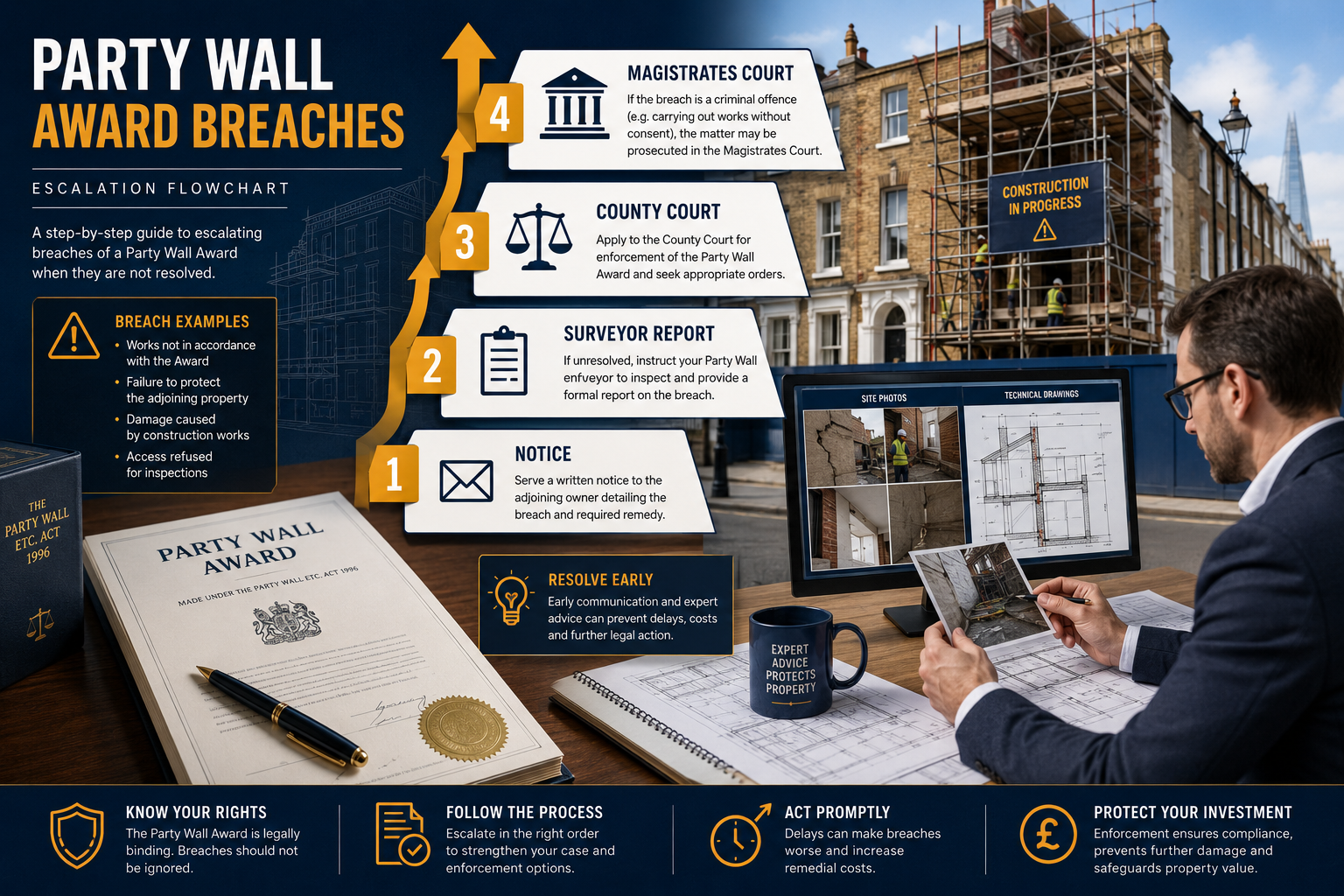
When a building owner fails to comply with an award — whether by ignoring access requirements, failing to make good damage, or continuing prohibited works — the adjoining owner must act methodically.
Step 1 — Document the Breach Immediately
The moment non-compliance is suspected, evidence gathering begins. A professional schedule of condition prepared before works started becomes the critical baseline document. Compare it against:
- Dated, timestamped photographs of current damage or non-compliance
- Written records of all communications with the building owner
- Site visit notes from the appointed surveyor
- Any written acknowledgements of the award by the defaulting party
Do not delay this step. Courts look favourably on parties who acted promptly and kept thorough records.
Step 2 — Formal Written Notice of Breach
Before issuing court proceedings, send a formal letter before action to the building owner. This should:
- Reference the specific award clauses being breached
- State the remedial action required
- Set a reasonable deadline (typically 14–21 days)
- Warn that court proceedings will follow if compliance is not achieved
This step is not just good practice — courts expect it, and failure to attempt resolution first can affect cost awards.
Step 3 — Engage the Appointed Surveyor for an Expert Report
The appointed surveyor's role does not end when the award is issued. In enforcement scenarios, surveyors become expert witnesses whose reports carry significant evidential weight. A well-prepared enforcement report should include:
| Report Element | Purpose in Court |
|---|---|
| Schedule of condition (pre-works) | Establishes baseline state of property |
| Post-breach photographic survey | Documents damage or non-compliance |
| Technical analysis of breach | Explains why conduct violates the award |
| Cost of remedial works estimate | Supports financial recovery claims |
| Surveyor's professional opinion | Expert testimony on causation and extent |
Surveyors' appointments are personal and statutory under the 2026 RICS guidance [3], meaning their duty runs to the process and both parties — a factor that actually strengthens their credibility as independent expert witnesses in court proceedings.
Step 4 — Choose the Correct Court Pathway
Two enforcement routes exist under the Act:
🏛️ County Court
Suitable for:
- Injunctions to stop ongoing works
- Claims for damages (property damage, loss of enjoyment)
- Recovery of sums awarded but unpaid
- Complex disputes requiring judicial case management
⚖️ Magistrates' Court (Section 17)
Section 17 of the Party Wall etc. Act 1996 provides a specific, streamlined route for recovering sums recoverable under an award [2]. This is particularly useful for:
- Straightforward debt recovery (e.g., unpaid surveyor fees, compensation awards)
- Cases where speed matters and the sum is clearly defined
- Situations where the building owner is a private individual rather than a company
🔑 Key distinction: The Magistrates' Court route under Section 17 is faster and cheaper for monetary recovery. The County Court is more appropriate for injunctive relief or complex damages claims.
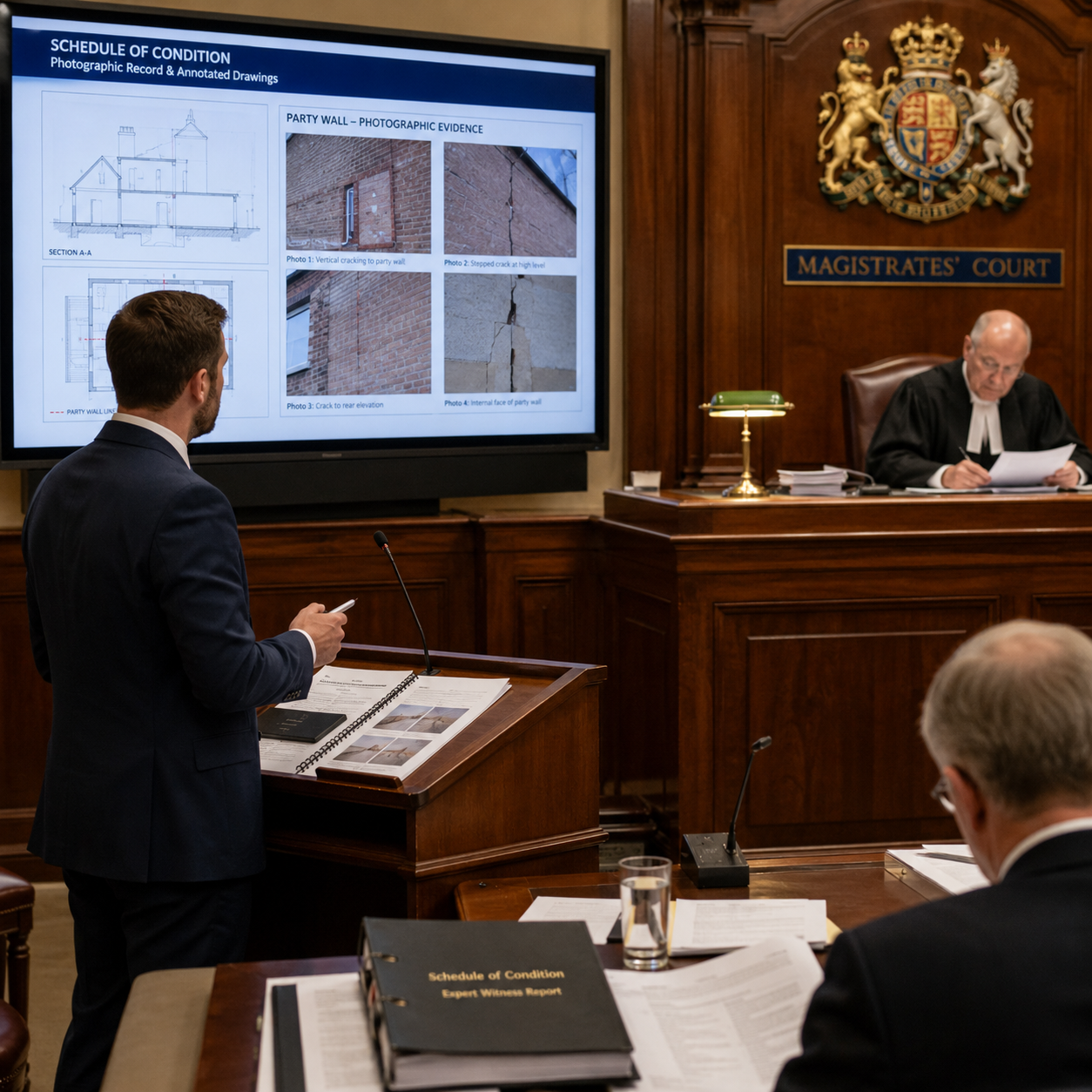
Step 5 — Preparing for the Magistrates' Court Hearing
Magistrates' Court proceedings for party wall enforcement are relatively straightforward but require proper preparation. The claimant (usually the adjoining owner) must:
- File the claim — Submit the award document, evidence of breach, and particulars of the sum claimed
- Serve the defendant — The building owner must be formally served with court papers
- Attend with evidence — Bring the surveyor's report, photographic evidence, and correspondence bundle
- Present the surveyor as witness — Where the sum or breach is disputed, the surveyor may need to give oral evidence
Magistrates have the power to issue judgment for the sum claimed plus costs, enforceable through standard court enforcement mechanisms (attachment of earnings, charging orders, bailiff action).
Surveyor Evidence: What Courts Expect in 2026
The quality of surveyor evidence is frequently the deciding factor in party wall enforcement cases. Under the RICS 8th Edition Guidance [1], surveyors face heightened accountability — and courts are increasingly sophisticated about what constitutes credible expert evidence.
The Expert Witness Standard
Surveyors presenting evidence in enforcement proceedings must comply with Civil Procedure Rules Part 35 (for County Court matters) or provide clear, factual testimony in Magistrates' proceedings. Key requirements:
- Objectivity — The report must reflect the surveyor's independent professional opinion, not the client's preferred outcome
- Clarity — Technical findings must be explained in plain language accessible to lay magistrates or judges
- Completeness — All relevant facts, including those that may not favour the instructing party, must be disclosed
- Qualification — The surveyor's credentials and experience must be clearly stated
Ex Parte Awards and Their Enforcement Implications
The 2026 RICS guidance specifically cautions that ex parte awards (issued when one surveyor refuses to engage or cannot be contacted) should address only the specific subject matter of the request or refusal [2]. An overly broad ex parte award is more vulnerable to challenge on appeal — and an appealed award cannot be enforced until the appeal is resolved.
Parties have 14 days from receipt of an award to file an appellant's notice at the County Court [4]. After this window closes, the award is final and enforcement can proceed without risk of the appeal complication.
The Third Surveyor's Role in Disputed Evidence
Where the two appointed surveyors disagree on the extent of a breach or the appropriate remedy, the Third Surveyor may be called upon. The 2026 RICS guidance provides clearer rules on Third Surveyor engagement [1], aiming to reduce the tactical use of Third Surveyor referrals to delay enforcement. The Third Surveyor's determination on a disputed point can itself become the basis for a further enforceable award.
For adjoining owners in London, having access to an experienced adjoining owner's surveyor who understands these escalation dynamics is invaluable.
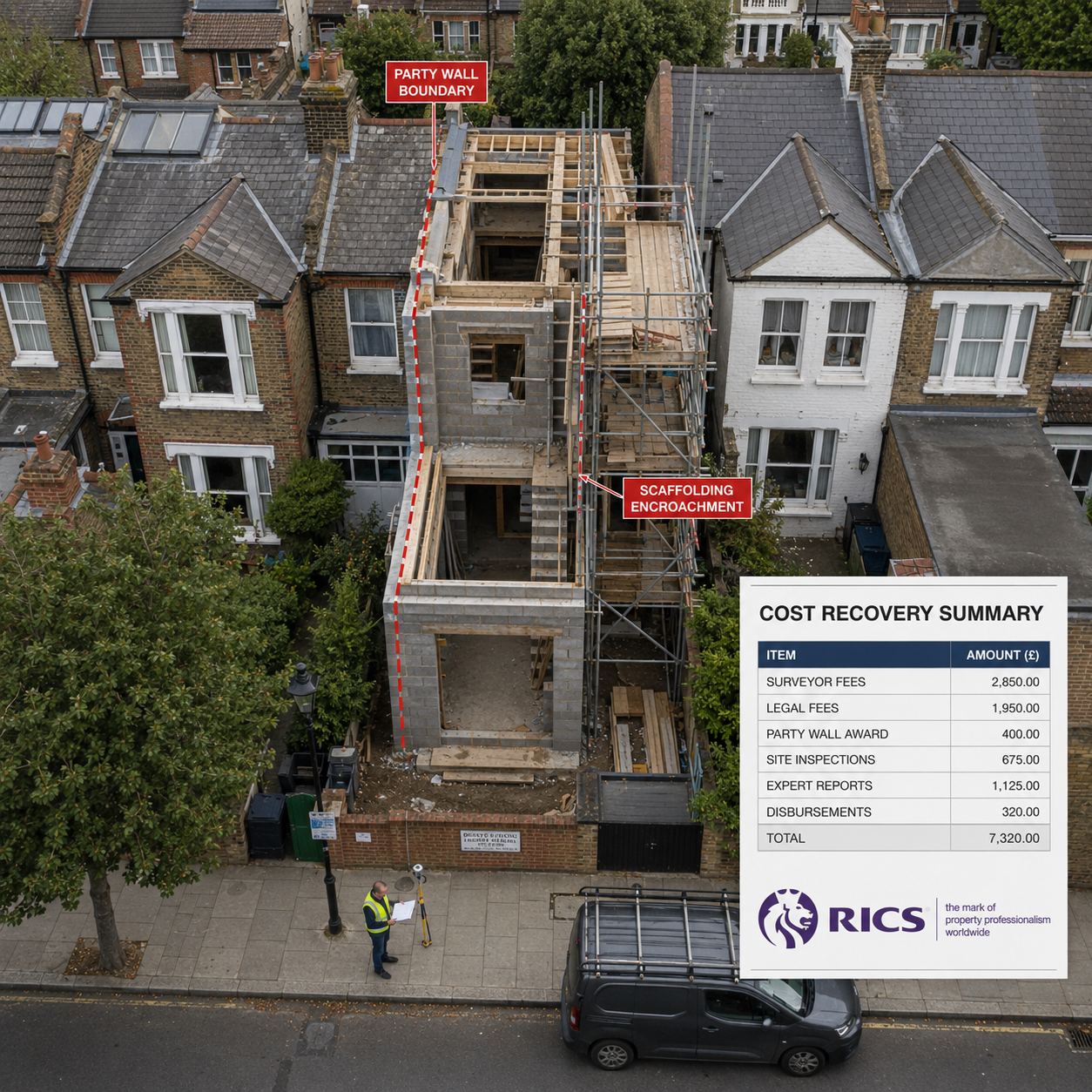
Cost Recovery in Party Wall Enforcement Cases
One of the most practically important aspects of enforcement is who pays for it. The short answer: the defaulting party should, if the case is properly prepared.
What Costs Are Recoverable?
| Cost Type | Recovery Route |
|---|---|
| Surveyor fees (enforcement report) | Award or court order |
| Legal costs (court proceedings) | Court discretion (usually follows the event) |
| Remedial works costs | Damages claim or award |
| Consequential losses | County Court damages claim |
| Original award sums unpaid | Section 17 Magistrates' Court |
The Fee Practices Dimension
The RICS 8th Edition Guidance strengthens rules on surveyor fees to reduce disputes and overcharging [1]. This matters for enforcement because inflated or poorly documented fee claims weaken the credibility of the overall case. Surveyors preparing enforcement evidence should ensure their fee records are transparent, proportionate, and clearly linked to the work undertaken.
For those concerned about managing costs throughout the party wall process, guidance on keeping party wall costs down provides practical strategies — but in enforcement scenarios, the cost of not acting promptly almost always exceeds the cost of professional enforcement.
Common Enforcement Pitfalls and How to Avoid Them
Even well-intentioned enforcement actions can fail due to procedural missteps. The most frequent problems seen in 2026 include:
❌ Pitfall 1: Defective Original Notices
If the original party wall notice was improperly served, the entire award may be vulnerable. Approximately 40% of party wall disputes originate from notice-stage errors [5]. Courts have struck out enforcement actions where the foundational notice was defective.
Fix: Always verify notice validity before relying on the award in enforcement proceedings.
❌ Pitfall 2: Missing the Appeal Window
Attempting to enforce an award that is still within the 14-day appeal period — or worse, one that is under active appeal — wastes time and costs. Track service dates carefully [4].
Fix: Confirm the award service date and calculate the appeal deadline before filing any enforcement action.
❌ Pitfall 3: Inadequate Pre-Works Documentation
Without a robust schedule of condition prepared before works began, proving that damage was caused by the notifiable works (rather than pre-existing) becomes extremely difficult.
Fix: Insist on a thorough pre-works schedule of condition as a non-negotiable element of every award.
❌ Pitfall 4: Surveyor Acting Outside Jurisdiction
An award made by a surveyor who lacked proper jurisdiction — for example, where no genuine dispute existed — is void and unenforceable [2].
Fix: Ensure jurisdiction is confirmed at appointment stage, in line with 2026 RICS guidance.
❌ Pitfall 5: Choosing the Wrong Court
Seeking an injunction in the Magistrates' Court (which cannot grant one) or pursuing a simple debt in the County Court (slower and more expensive) wastes resources.
Fix: Take legal advice on the appropriate forum before filing.
The 2026 RICS Guidance: What Changes for Enforcement?
The RICS 8th Edition Guidance, finalised in May 2026, introduces several changes with direct enforcement implications [1][3]:
| Change | Enforcement Impact |
|---|---|
| Strengthened jurisdiction confirmation | Awards more robust against challenge |
| Updated notice service best practice | Reduces defective notice arguments |
| Clearer ex parte award scope | Limits overreach that invites appeal |
| Stronger fee practice rules | Cleaner cost recovery claims |
| New public engagement standards | Better-informed parties, fewer procedural disputes |
| Clearer Third Surveyor rules | Reduces tactical delay in enforcement |
For building owners carrying out works, understanding these changes through a qualified building owner's surveyor is equally important — compliance from the outset avoids enforcement exposure entirely.
Conclusion: Act Early, Document Everything, Enforce Confidently
Enforcing party wall awards in 2026 is a structured, achievable process — but only when the groundwork is solid. The key principles are clear:
Actionable Next Steps:
- 🔍 Identify the breach precisely — reference specific award clauses and gather dated evidence immediately
- 📄 Commission a surveyor's enforcement report — this is the evidential backbone of any court action
- ✉️ Send a formal letter before action — courts expect pre-litigation attempts at resolution
- ⚖️ Choose the right enforcement route — Section 17 Magistrates' Court for monetary recovery; County Court for injunctions and complex damages
- 📅 Monitor the 14-day appeal window — do not file enforcement while an appeal is live
- 💷 Claim all recoverable costs — surveyor fees, legal costs, and remedial works are all potentially recoverable from the defaulting party
- 🏗️ Use 2026 RICS guidance as your standard — awards prepared and enforced in line with the 8th Edition are more resilient to challenge
The rise in urban extension projects across London makes party wall enforcement an increasingly common necessity. Whether dealing with a recalcitrant neighbour ignoring access requirements or a building owner who has caused structural damage and refuses to remedy it, the legal tools exist — and when used correctly, they work.
For expert guidance specific to your area, experienced surveyors are available across North London, South London, East London, West London, and Central London to support both pre-enforcement documentation and court proceedings.
References
[1] RICS 8th Edition Party Wall Guidance 2026 Implementation Challenges And Surveyor Compliance Strategies – https://wimbledonsurveyors.com/rics-8th-edition-party-wall-guidance-2026-implementation-challenges-and-surveyor-compliance-strategies/
[2] RICS Party Wall 8th Edition Guidance Consultation Document – https://consultations.rics.org/party_walls_8th_edition_guidance/viewCompoundDoc?docid=16799988&partid=16802324&pfv=y
[3] RICS 8th Edition Party Wall Guidance 2026 Whats Changed And How Surveyors Must Adapt – https://wimbledonsurveyors.com/rics-8th-edition-party-wall-guidance-2026-whats-changed-and-how-surveyors-must-adapt/
[4] If You Can't Agree — GOV.UK Party Walls and Building Works – https://www.gov.uk/party-walls-building-works/if-you-cant-agree
[5] Common Mistakes In Party Wall Notices How Surveyors Fix Dissent And Delays – https://partywallsurveyorlondon.uk/blogs/common-mistakes-in-party-wall-notices-how-surveyors-fix-dissent-and-delays/
[6] What Happens If A Neighbor Refuses A Party Wall Notice – https://legalclarity.org/what-happens-if-a-neighbor-refuses-a-party-wall-notice/
[7] Party Wall Awards Explained Surveyor Roles Notice Periods And Dispute Resolution Under 2026 RICS Guidance – https://wimbledonsurveyors.com/party-wall-awards-explained-surveyor-roles-notice-periods-and-dispute-resolution-under-2026-rics-guidance/
