


Fewer than 15% of party wall disputes ever reach a Third Surveyor — yet when they do, the outcome can determine tens of thousands of pounds in costs, months of construction delay, and the long-term relationship between neighbours. Understanding Third Surveyor roles in party wall disputes: RICS guidance updates and dispute resolution timelines has never been more critical, especially as the draft 8th edition RICS guidance note reshapes how these appointments are triggered, how decisions are made, and how fees are allocated in 2026.
This article breaks down everything property owners, building professionals, and appointed surveyors need to know — from the precise statutory triggers that bring a Third Surveyor into play, to practical strategies for avoiding escalation before it begins.
Key Takeaways 📌
- A Third Surveyor is not a mediator — they act as a statutory decision-maker with binding authority under the Party Wall etc. Act 1996.
- The draft 8th edition RICS guidance (2026) clarifies appointment triggers, strengthens impartiality requirements, and introduces clearer fee allocation principles.
- Third Surveyor referrals typically add 4–12 weeks to dispute resolution timelines, making early de-escalation strategies essential.
- Either the building owner's surveyor or the adjoining owner's surveyor can refer a matter — the adjoining owner themselves can also refer directly in specific circumstances.
- Proactive communication, well-drafted notices, and experienced surveyor selection remain the most effective tools for avoiding Third Surveyor involvement altogether.
What Is a Third Surveyor and Why Does the Role Exist?
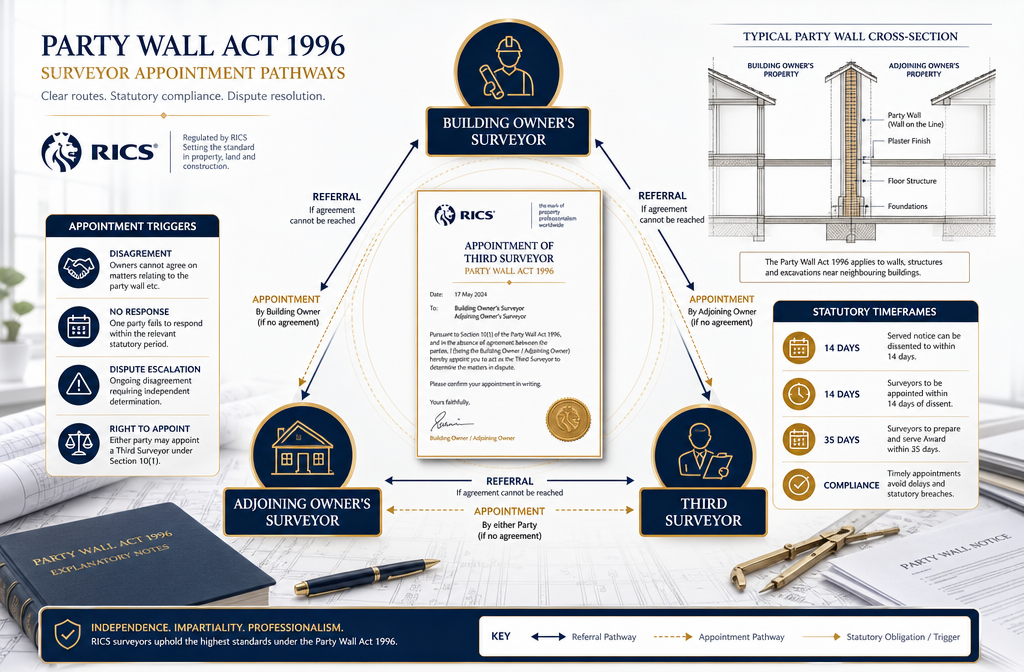
The Party Wall etc. Act 1996 creates a statutory framework for resolving disputes between building owners and their neighbours before, during, and after construction works. When both parties appoint their own surveyors — or when a single "agreed surveyor" is not acceptable — those two surveyors must jointly select a Third Surveyor at the outset of the process.
💡 Pull Quote: "The Third Surveyor is not appointed to take sides. They are a statutory referee, called upon only when the two appointed surveyors cannot reach agreement."
This pre-selection is a legal requirement under Section 10 of the Party Wall etc. Act 1996. The Third Surveyor's name is recorded at the start of proceedings — long before any dispute arises — so that if referral becomes necessary, there is no delay caused by negotiating who should fill the role.
To understand the full legislative framework underpinning this process, the Party Wall etc. Act 1996 overview provides essential background on how the Act structures rights and responsibilities for all parties.
The Third Surveyor Is Not an Arbitrator
A common misconception is that the Third Surveyor acts like an arbitrator or mediator who hears both sides and negotiates a compromise. This is incorrect. The Third Surveyor:
- Makes a binding determination on the specific matter referred
- Acts independently, not as an advocate for either party
- Has the power to issue a party wall award that supersedes the positions of both appointed surveyors
- Can be called upon by either appointed surveyor — or in limited circumstances, directly by an owner
Appointment Triggers Under the Draft 8th Edition RICS Guidance
The draft 8th edition RICS guidance note — anticipated for full publication in 2026 — introduces refined language around the conditions that legitimately trigger a Third Surveyor referral. This is one of the most practically significant updates for dispute resolution timelines.
When Can a Referral Be Made?
Under Section 10(11) of the Act, either appointed surveyor may refer any matter in dispute to the Third Surveyor. The draft guidance clarifies that "matter in dispute" should be interpreted broadly, including:
| Trigger Category | Examples |
|---|---|
| Disagreement on award terms | Scope of works, working hours, protective measures |
| Failure to agree on methodology | Structural calculations, material specifications |
| Surveyor inaction or delay | One surveyor failing to respond within a reasonable period |
| Fee disputes between surveyors | Disagreements on reasonable fees to be included in the award |
| Scope of the Act itself | Whether specific works fall within the Act's remit |
The draft 8th edition guidance is notable for addressing surveyor inaction more explicitly than previous editions. If one appointed surveyor is unresponsive or obstructive, the other surveyor now has clearer grounds — and a clearer process — for escalating to the Third Surveyor without being seen as acting improperly.
Direct Owner Referral: A Clarified Right
Section 10(11) also permits an owner (not just their surveyor) to refer a matter to the Third Surveyor if their appointed surveyor refuses to act or is not available. The draft guidance reinforces this right and recommends that surveyors inform their clients of it at the point of appointment — a transparency requirement that was less explicitly stated in earlier editions.
For adjoining owners who are unfamiliar with this process, understanding the role of an adjoining owner's surveyor is a useful starting point before any dispute escalates.
Decision-Making Powers: What the Third Surveyor Can and Cannot Do

Once a matter is referred, the Third Surveyor has significant — but not unlimited — authority. The 2026 RICS guidance updates place particular emphasis on the scope of the referral, meaning the Third Surveyor should only determine the specific matter referred, not reopen the entire award from scratch.
Powers the Third Surveyor Holds ✅
- Issue a party wall award on the referred matter, which is legally binding on all parties
- Determine costs associated with the referral, including which party bears the Third Surveyor's fees
- Inspect the property if necessary to make an informed determination
- Request written submissions from both appointed surveyors
- Set timelines for the resolution of the referred matter
Limitations on Third Surveyor Authority ❌
- Cannot act on matters not referred to them
- Cannot override an already agreed and executed award unless there is a specific challenge
- Cannot act if they have a conflict of interest — the draft guidance tightens the definition of what constitutes a disqualifying conflict
- Cannot compel either party to carry out works beyond what the Act permits
🔑 Key Point: The Third Surveyor's award on the referred matter has the same legal standing as any other party wall award. It can be appealed to the County Court within 14 days of service, but this is rarely pursued in practice.
For those unfamiliar with how awards function in the broader process, the guide to party wall awards explains their legal weight and practical implications.
Fee Allocation: How the Draft 8th Edition RICS Guidance Changes the Landscape
Fee allocation in Third Surveyor referrals has historically been a source of confusion and, occasionally, abuse. The draft 8th edition guidance introduces a more structured approach that aligns with principles of proportionality and reasonableness.
The General Rule
The building owner typically bears the costs of the party wall process, including reasonable surveyor fees on both sides. However, when a Third Surveyor referral is triggered, the guidance introduces nuance:
- If the referral was necessary due to unreasonable conduct by one party's surveyor, the Third Surveyor can direct that the costs be borne by the party whose surveyor caused the escalation.
- If the referral was frivolous or vexatious, the Third Surveyor can award costs against the referring party.
- If the dispute was genuine and reasonable, costs typically remain with the building owner.
Third Surveyor Fee Rates in 2026
The draft guidance does not set fixed rates, but it reinforces that Third Surveyor fees must be:
- Reasonable relative to the complexity of the matter
- Proportionate to the value of the works involved
- Transparent — surveyors should disclose their hourly rates at the point of selection
Typical Third Surveyor fees in London in 2026 range from £150–£350 per hour, with straightforward referrals often resolved within 3–6 hours of professional time. More complex disputes involving structural methodology or multi-property scenarios can involve significantly more time.
For practical guidance on managing overall party wall costs, the article on how to keep party wall costs down offers actionable strategies that apply both before and during the dispute resolution process.
Dispute Resolution Timelines: What to Expect in 2026
One of the most pressing concerns for building owners and adjoining owners alike is how long a Third Surveyor referral will take. The answer depends on several variables, but the draft RICS guidance encourages a more time-bound approach than has been standard practice.
Typical Timeline Breakdown
Week 1–2:   Matter referred in writing to the Third Surveyor
Week 2–3:   Third Surveyor acknowledges referral, requests submissions
Week 3–5:   Written submissions received from both appointed surveyors
Week 5–7:   Third Surveyor reviews, may request site inspection
Week 7–10:  Draft determination issued for comment
Week 10–12: Final award issued and served on all parties
⏱️ Timeline Reality Check: In straightforward cases, resolution in 4–6 weeks is achievable. In complex or contentious cases involving multiple referred matters, 10–14 weeks is more realistic.
The draft 8th edition guidance encourages Third Surveyors to set explicit response deadlines in their initial acknowledgement letter — a practice that was recommended but not strongly emphasised in earlier editions. This change is designed to prevent the "waiting game" that has historically extended timelines unnecessarily.
Strategies to Avoid Escalation and Speed Up Awards in Contentious Cases
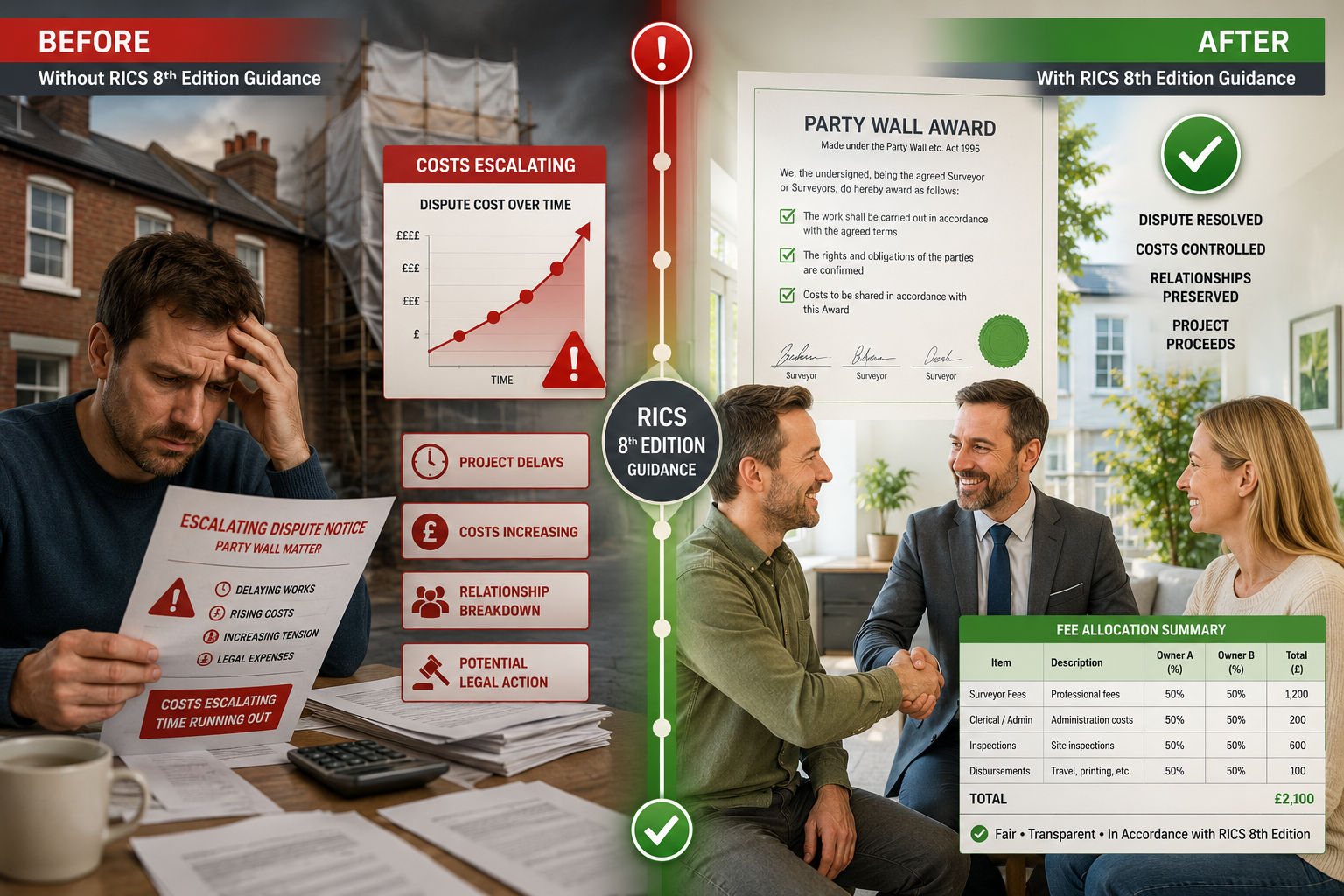
The most cost-effective outcome is always one that never reaches the Third Surveyor at all. The following strategies are particularly relevant for contentious 2026 cases where tensions between neighbours are already elevated.
Before Works Begin 🏗️
1. Serve notices correctly and on time
Poorly drafted or late notices are one of the most common triggers for dispute escalation. Understanding party wall notices and how to respond is essential groundwork for any building owner.
2. Select experienced surveyors
The quality of the appointed surveyors on both sides is the single greatest predictor of whether a Third Surveyor will ever need to act. Surveyors with strong working relationships and deep knowledge of the Act resolve the vast majority of disputes without escalation.
3. Prepare a thorough Schedule of Condition
A well-prepared schedule of condition eliminates ambiguity about pre-existing damage, removing one of the most common flashpoints for post-works disputes.
During the Award Process 📋
4. Communicate proactively between surveyors
The draft guidance encourages appointed surveyors to document all communications and to make genuine efforts to resolve disagreements before referral. A written record of good-faith negotiation can also influence fee allocation decisions if a referral does become necessary.
5. Use without-prejudice discussions
While the Act does not formally provide for mediation, appointed surveyors can engage in informal without-prejudice discussions to narrow the issues in dispute before any formal referral.
6. Narrow the scope of any referral
If escalation is unavoidable, referring only the specific point of disagreement — rather than the entire award — keeps the Third Surveyor's involvement focused and the timeline shorter.
After a Third Surveyor Award Is Issued ✅
7. Comply promptly
Failure to comply with a Third Surveyor's award can result in County Court enforcement proceedings, adding further cost and delay. Prompt compliance — even where a party disagrees with the outcome — is almost always the more pragmatic choice.
For building owners navigating works for the first time, the dedicated guidance for those carrying out works provides a clear process overview that can help prevent missteps from the outset.
Regional Considerations: Third Surveyor Disputes Across London
London's density of terraced and semi-detached housing means party wall disputes — and Third Surveyor referrals — are proportionally more common here than in most other parts of England and Wales. The availability of experienced Third Surveyors varies by area.
Property owners and surveyors in different parts of the capital can access location-specific guidance and surveyor services:
- North London — party wall surveyor services in North London
- South London — party wall surveyor services in South London
- East London — party wall surveyor services in East London
The concentration of high-value works — basement excavations, rear extensions, loft conversions — in central and inner London areas means that Third Surveyor referrals in these locations often involve more complex structural matters and correspondingly longer resolution timelines.
Conclusion: Navigating Third Surveyor Referrals with Confidence in 2026
The evolving landscape of Third Surveyor roles in party wall disputes: RICS guidance updates and dispute resolution timelines reflects a broader push toward greater transparency, proportionality, and efficiency in the party wall process. The draft 8th edition RICS guidance note tightens the rules around appointment triggers, strengthens impartiality standards, and introduces a more structured approach to fee allocation — all changes that benefit property owners and surveyors who engage with the process in good faith.
Actionable Next Steps
- ✅ Review your surveyor's appointment letter to confirm a Third Surveyor has been pre-selected at the outset of any dispute process.
- ✅ Ask your surveyor to explain the referral process before any disagreement arises — forewarned is forearmed.
- ✅ Prioritise experienced surveyor selection on both sides; this is the most effective single step to avoid Third Surveyor involvement.
- ✅ Document all communications between surveyors in writing to support any future fee allocation arguments.
- ✅ Act promptly on any Third Surveyor award — compliance is almost always more cost-effective than County Court enforcement.
The party wall process exists to protect all parties. When Third Surveyor involvement becomes necessary, understanding the rules — and the 2026 updates to RICS guidance — ensures that the outcome is reached as quickly, fairly, and cost-effectively as possible.