


The construction industry stands at a pivotal moment where traditional party wall surveying practices meet cutting-edge digital technology. As London's skyline continues to evolve with ambitious extensions, basement excavations, and complex redevelopments, party wall surveyors face mounting pressure to deliver faster, more accurate assessments while maintaining strict compliance with the Party Wall etc. Act 1996. Enter Building Information Modeling (BIM) and 3D clash detection—technologies that are revolutionizing how surveyors identify conflicts, prepare schedules of condition, and draft comprehensive party wall awards in 2026.
This comprehensive guide explores how BIM Integration for Party Wall Surveys: Enhancing Awards with 3D Model Clash Detection in 2026 is transforming the profession, offering surveyors RICS-aligned workflows that detect shared wall conflicts before they escalate into costly disputes.
Key Takeaways
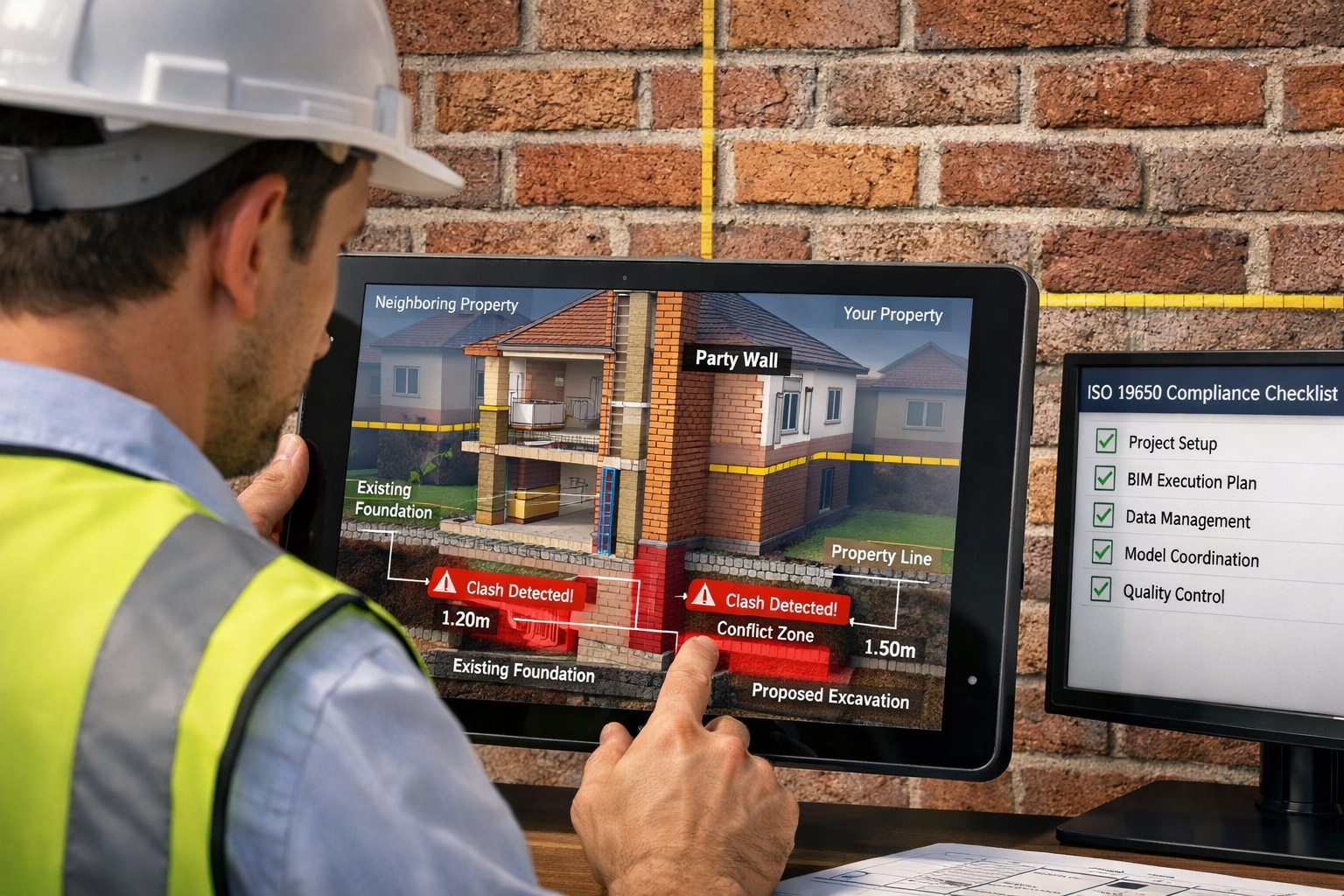
- BIM adoption has reached 60% across construction firms, enabling party wall surveyors to detect design conflicts before work begins, reducing disputes by up to 85%
- 3D clash detection technology identifies foundation conflicts, structural interference, and boundary encroachments automatically, streamlining the award preparation process
- ISO 19650 standards are undergoing major revisions for 2026, requiring surveyors to adopt standardized information management protocols
- Net zero compliance requirements are now integrated with party wall procedures, demanding strategic BIM workflows for retrofit and extension projects
- RICS-aligned digital workflows combine traditional surveying expertise with AI-powered modeling to produce more comprehensive, defensible awards
Understanding BIM Integration for Party Wall Surveys: Enhancing Awards with 3D Model Clash Detection in 2026
What is Building Information Modeling (BIM)?
Building Information Modeling represents far more than simple 3D visualization. BIM creates intelligent digital representations of physical and functional characteristics of buildings, containing rich data about materials, dimensions, structural properties, and spatial relationships. For party wall surveyors, this means accessing a comprehensive digital twin of both the building owner's proposed works and the adjoining owner's existing structure.
In 2026, BIM has evolved from an optional tool to an industry standard. Research shows that 60% of construction firms have integrated BIM into their processes, improving collaboration, minimizing errors, and streamlining project timelines [3]. This widespread adoption means party wall surveyors increasingly receive BIM models from architects and structural engineers, creating opportunities to enhance traditional surveying methods.
The Evolution of Party Wall Surveying
Traditional party wall surveys rely on:
- Physical site inspections
- Manual measurements
- 2D architectural drawings
- Photographic schedules of condition
- Hand-drafted awards and notices
While these methods remain valid under the Party Wall etc. Act 1996, they present limitations:
❌ Limited spatial visualization of complex structural interactions
❌ Time-intensive manual calculations for foundation depths and load transfers
❌ Difficulty identifying hidden conflicts until construction begins
❌ Challenges coordinating multiple surveyors across separate properties
❌ Potential for measurement errors in complex geometries
BIM integration addresses these limitations while maintaining compliance with established party wall procedures and party wall notices requirements.
How 3D Clash Detection Works
Clash detection uses BIM software to automatically identify where different building elements intersect or conflict. For party wall surveys, this technology detects:
🔍 Hard clashes: Physical intersections where proposed foundations encroach into adjoining property
🔍 Soft clashes: Clearance violations where minimum safe distances aren't maintained
🔍 Workflow clashes: Sequencing issues where construction activities impact shared structures
🔍 Time-based clashes: Temporal conflicts in phased construction affecting party walls
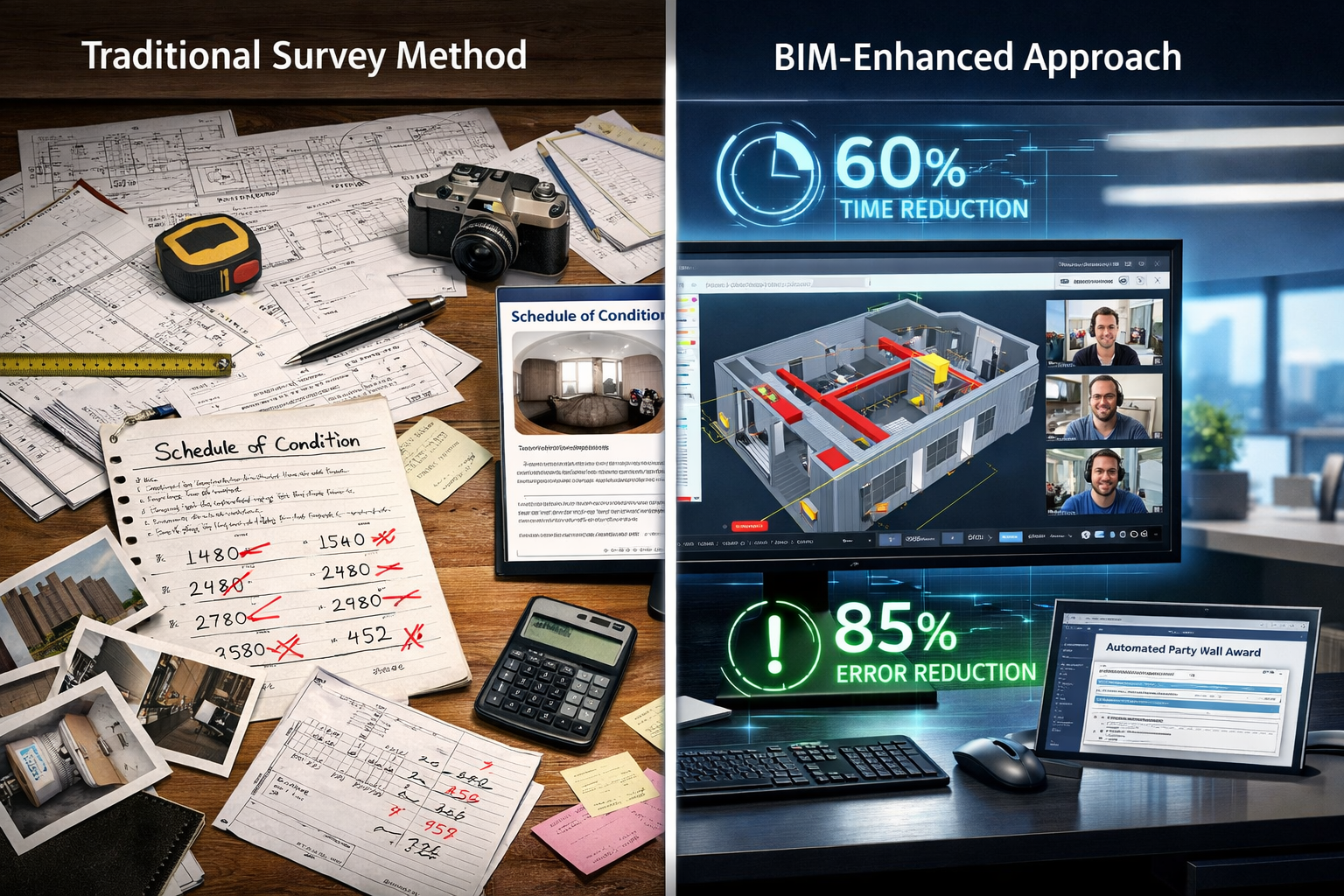
Advanced tools now use AI-powered analysis to convert 2D plans into BIM models, with platforms like WiseBIM reducing manual modeling time while improving accuracy [3]. This automation allows surveyors to focus on professional judgment rather than technical drafting.
The Benefits of BIM Integration for Party Wall Surveys in 2026
Early Conflict Identification
The most significant advantage of BIM Integration for Party Wall Surveys: Enhancing Awards with 3D Model Clash Detection in 2026 is proactive conflict identification. Rather than discovering foundation conflicts during excavation—when remediation costs skyrocket—surveyors can identify issues during the design phase.
Case Example: A basement extension in Kensington revealed through BIM analysis that proposed underpinning would extend 300mm beyond the property boundary. Traditional 2D plans hadn't clearly shown this encroachment. Early detection allowed the structural engineer to redesign the foundation system, avoiding a potential dispute and saving approximately £45,000 in legal fees and construction delays.
Enhanced Schedule of Condition Accuracy
BIM models integrate seamlessly with modern schedule of condition documentation methods:
- 360-degree photogrammetry linked to 3D spatial coordinates
- Laser scanning data providing millimeter-accurate baseline measurements
- Thermal imaging overlays identifying existing defects in party walls
- Digital annotation systems allowing precise defect location marking
- Automated comparison tools for post-construction verification
This comprehensive documentation provides stronger evidence should disputes arise regarding damage causation, protecting both building owners and adjoining owners.
Streamlined Award Preparation
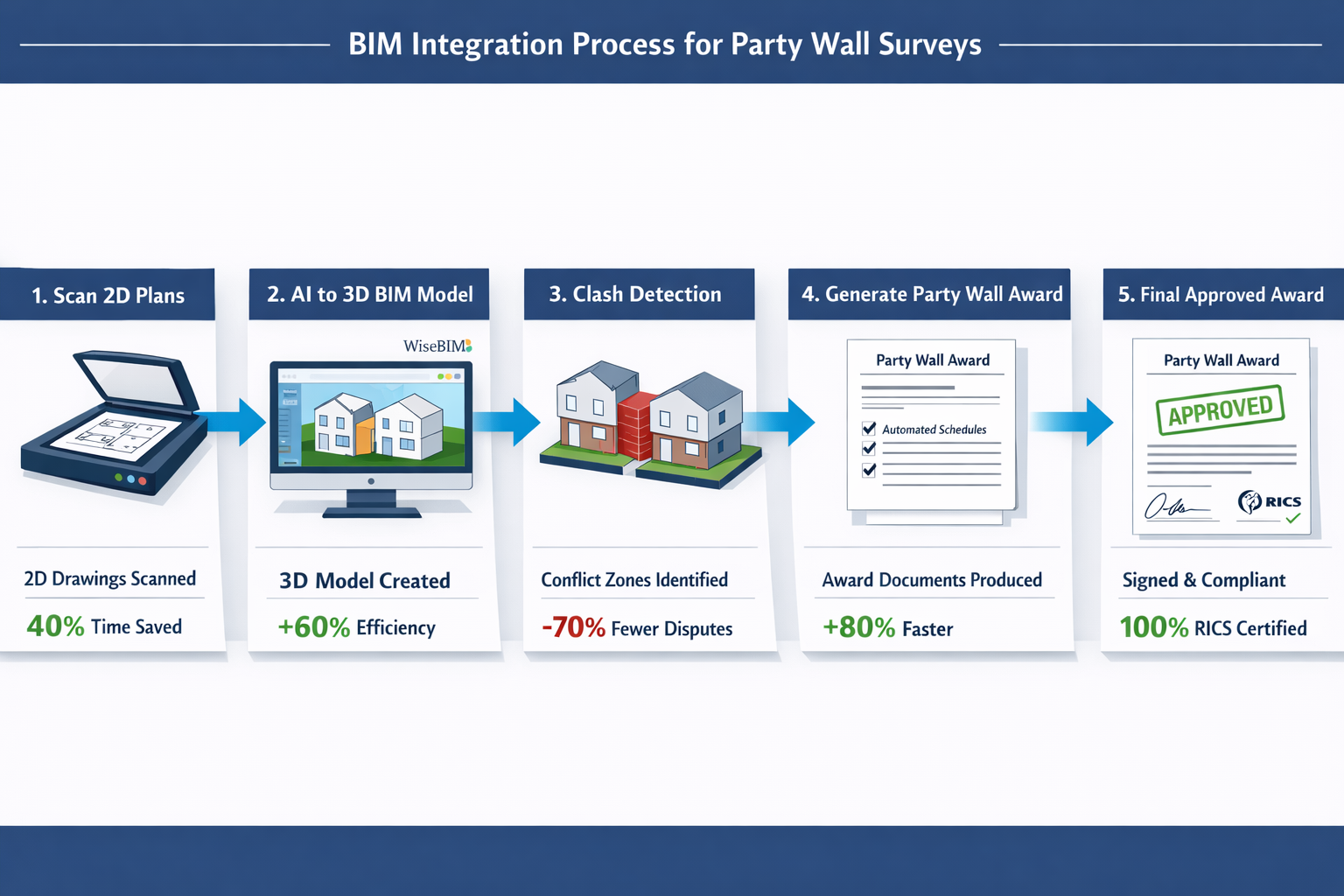
BIM integration significantly reduces the time required to prepare comprehensive party wall awards. Automated processes include:
| Traditional Method | BIM-Enhanced Method | Time Saving |
|---|---|---|
| Manual measurement extraction from drawings | Automated dimension queries from BIM model | 65% |
| Hand-drafted cross-sections | Auto-generated sections at any angle | 80% |
| Separate foundation calculations | Integrated structural analysis | 70% |
| Manual schedule compilation | Template auto-population from model data | 75% |
| Physical document distribution | Digital award delivery with 3D visualizations | 90% |
These efficiencies don't compromise quality—they allow surveyors to dedicate more time to professional analysis and dispute prevention strategies.
Improved Communication with All Parties
Complex structural relationships often confuse property owners unfamiliar with construction terminology. BIM models provide intuitive 3D visualizations that clearly demonstrate:
- Exactly where proposed works interact with party walls
- The extent of temporary support requirements
- Predicted movement and settlement zones
- Construction sequencing and access requirements
- Protective measures and monitoring locations
This visual clarity reduces misunderstandings and helps adjoining owners make informed decisions when responding to party wall notices.
Compliance with Evolving Standards
The ISO 19650 BIM standard is undergoing major revision for 2026, affecting how BIM teams manage information across projects [2]. Party wall surveyors adopting BIM integration position themselves ahead of these regulatory changes, ensuring their workflows remain compliant as standards evolve.
Additionally, 2026 brings integration of net zero compliance objectives with traditional party wall procedures [4]. BIM models can simultaneously assess thermal performance, embodied carbon, and party wall compliance, addressing multiple regulatory requirements through a single digital workflow.
Implementing BIM Integration for Party Wall Surveys: RICS-Aligned Workflows
Step 1: Initial Assessment and Model Acquisition
When appointed as a building owner's surveyor or adjoining owner's surveyor, request BIM models in industry-standard formats:
- IFC (Industry Foundation Classes): Open format ensuring cross-platform compatibility
- Revit files: Native format for Autodesk's leading BIM platform
- SketchUp models: Common for smaller residential projects
- Point cloud data: Laser scan files for existing conditions
If no BIM model exists, consider commissioning laser scanning of the existing structure, particularly for complex types of party wall works involving structural alterations or significant excavation.
Step 2: Model Validation and Coordination
Never assume received BIM models are accurate. Validation protocols include:
✅ Site verification: Compare key dimensions against physical measurements
✅ Boundary alignment: Confirm model positioning matches Land Registry plans
✅ Level verification: Check datum points and finished floor levels
✅ Structural review: Validate existing party wall construction details
✅ Coordination check: Ensure architectural and structural models align
This validation process protects surveyors from liability arising from errors in architect-supplied information.
Step 3: Clash Detection Analysis
Run comprehensive clash detection focusing on party wall-specific conflicts:
Foundation Analysis:
- Proposed excavation depth vs. existing foundations
- Underpinning extent vs. property boundaries
- Temporary works vs. adjoining structure
- Drainage runs vs. existing services
Structural Interface:
- New beams penetrating party walls
- Load transfer to shared structures
- Movement joints at party wall junctions
- Fire protection continuity
Access and Protection:
- Scaffold locations vs. adjoining property
- Material storage zones
- Protective hoarding positions
- Temporary support requirements
Document all detected clashes with screenshots, coordinates, and severity ratings for inclusion in the party wall award.
Step 4: Enhanced Schedule of Condition
Integrate BIM data with traditional condition documentation:
- Pre-construction scan: Laser scan adjoining property, creating point cloud
- Model registration: Align point cloud with BIM coordinate system
- Defect mapping: Annotate existing cracks, movement, and defects in 3D space
- Photographic integration: Link photographs to specific model locations
- Baseline establishment: Create digital baseline for post-construction comparison
This comprehensive approach provides irrefutable evidence of pre-existing conditions, significantly reducing spurious damage claims.
Step 5: Award Preparation and Documentation
Prepare awards incorporating BIM-derived information while maintaining compliance with statutory requirements:
Essential Award Components:
- Traditional written descriptions (statutory requirement)
- BIM-generated cross-sections showing work extent
- 3D visualizations of party wall interfaces
- Clash detection reports with resolution strategies
- Digital schedule of condition with model links
- Monitoring protocols with sensor locations mapped in BIM
- Access and working hours specifications
Ensure awards remain legally robust by maintaining clear written descriptions—BIM visualizations should supplement, not replace, traditional documentation.
Step 6: Construction Monitoring
Use BIM models during construction for:
- Progress verification: Compare as-built conditions against approved model
- Variation assessment: Quickly evaluate proposed design changes
- Damage investigation: Reference baseline model when assessing alleged damage
- Dispute resolution: Provide clear visual evidence during disagreements
Many surveyors now use tablet devices on-site, accessing BIM models in real-time for instant reference during inspections.
Overcoming Challenges in BIM Integration for Party Wall Surveys
Technical Skills Gap
Not all party wall surveyors possess advanced BIM skills. Addressing this challenge requires:
- Targeted training: RICS-accredited BIM courses for surveyors
- Software partnerships: Collaborating with BIM specialists for complex projects
- Graduated adoption: Starting with simple visualization before advanced clash detection
- Peer learning: Joining professional networks sharing BIM best practices
Remember that surveyors bring irreplaceable professional judgment—technical staff can handle software operation while surveyors focus on interpretation and compliance.
Cost Considerations
BIM software and training represent significant investments. However, costs of party wall processes can be managed through:
- Cloud-based subscriptions: Avoiding large capital expenditure
- Project-specific licensing: Paying only when BIM capabilities are needed
- Efficiency gains: Reduced award preparation time offsetting software costs
- Competitive advantage: Attracting higher-value instructions through advanced capabilities
For guidance on managing expenses, review strategies for keeping party wall costs down while maintaining service quality.
Legal and Liability Issues
Questions arise regarding liability for BIM model accuracy. Protect your practice through:
- Clear engagement terms: Specify responsibility for model accuracy
- Independent verification: Always validate received models against site conditions
- Professional indemnity insurance: Ensure coverage extends to BIM-related activities
- Documentation protocols: Maintain audit trails of model versions and validation checks
When disputes arise, the combination of traditional surveying methods and BIM analysis provides stronger defensibility than either approach alone.
Data Security and Privacy
BIM models contain sensitive information about property layouts and security systems. Implement robust protocols:
- Encrypted file transfer systems
- Access-controlled cloud storage
- GDPR-compliant data handling
- Clear data retention and deletion policies
- Client consent for model sharing with third parties
These measures protect both your practice and your clients' interests.
Real-World Applications: BIM Integration for Complex Extensions
Basement Excavations in Urban Settings
London's basement boom presents particularly challenging party wall scenarios. BIM integration proves invaluable for:
- Underpinning sequencing: Visualizing phased underpinning to maintain structural stability
- Groundwater modeling: Assessing dewatering impacts on adjoining foundations
- Temporary works coordination: Planning propping and support systems
- Service protection: Identifying and safeguarding shared drainage and utilities
For projects in densely built areas, consult experienced party wall surveyors in Central London who regularly handle such complex scenarios.
Terraced Property Extensions
Victorian and Georgian terraces present unique challenges with their interconnected structures. BIM helps surveyors:
- Model load paths through shared party walls
- Assess cumulative impact when multiple properties extend simultaneously
- Coordinate with conservation requirements in listed buildings
- Plan steel beam insertions without compromising structural integrity
Data Centre Developments
The AI-driven surge in data centre construction creates novel party wall challenges [1]. These projects involve:
- Massive foundation loads affecting adjoining properties
- 24/7 construction schedules requiring careful neighbor coordination
- Complex service installations crossing property boundaries
- Vibration-sensitive equipment requiring stringent movement controls
BIM Integration for Party Wall Surveys: Enhancing Awards with 3D Model Clash Detection in 2026 provides the analytical tools necessary for these sophisticated projects, ensuring compliance amid rapid development timelines.
Net Zero Retrofit Projects
As 2026 brings heightened focus on net zero compliance integrated with party wall procedures [4], surveyors face new challenges:
- External wall insulation affecting party wall lines
- Heat pump installations requiring party wall consent
- Solar panel structural loads on shared roofs
- Ventilation systems penetrating party walls
BIM models can simultaneously assess thermal performance, structural adequacy, and party wall compliance, providing holistic project evaluation.
The Future of Party Wall Surveying: Emerging Technologies
Artificial Intelligence and Machine Learning
AI is revolutionizing BIM workflows through:
- Automated clash detection: Machine learning algorithms identifying conflicts with 99% accuracy
- Predictive analytics: Forecasting settlement and movement based on soil conditions
- Natural language processing: Auto-generating award text from BIM model data
- Pattern recognition: Identifying design features likely to cause disputes based on historical data
These capabilities augment—not replace—professional surveyor judgment, handling routine analysis while freeing surveyors for complex decision-making.
Augmented Reality (AR) Site Inspections
AR technology overlays BIM models onto physical structures through smartphone or tablet cameras, allowing surveyors to:
- Visualize proposed works in real-world context during site visits
- Compare as-built conditions against approved designs instantly
- Demonstrate work extent to property owners on-site
- Document variations with geo-tagged annotations
Blockchain for Award Authentication
Blockchain technology offers tamper-proof documentation of:
- Award issuance and acknowledgment timestamps
- Model version control and change tracking
- Multi-party digital signatures
- Immutable condition records
This technology may revolutionize dispute resolution by providing indisputable documentation chains.
Digital Twins for Long-Term Monitoring
Creating persistent digital twins of party wall structures enables:
- Continuous structural health monitoring through IoT sensors
- Long-term settlement tracking against baseline models
- Predictive maintenance identifying issues before failures
- Historical performance data informing future projects
Best Practices for Surveyors Adopting BIM Integration
Start Small and Scale Gradually
Don't attempt comprehensive BIM integration on your most complex project. Instead:
- Phase 1: Use BIM viewers to visualize architect-supplied models
- Phase 2: Incorporate BIM screenshots and sections in awards
- Phase 3: Conduct basic clash detection analysis
- Phase 4: Commission laser scanning for schedules of condition
- Phase 5: Develop fully integrated digital workflows
This graduated approach builds competence while managing risk.
Maintain Traditional Skills
BIM enhances but doesn't replace fundamental surveying competencies:
- Physical site inspection remains essential
- Professional judgment interprets BIM outputs
- Statutory compliance requires traditional documentation
- Dispute resolution depends on communication skills, not software
The most effective surveyors combine traditional expertise with digital tools, leveraging strengths of both approaches.
Collaborate with BIM Specialists
Consider partnering with:
- BIM coordinators: Managing model integration and clash detection
- Laser scanning providers: Capturing existing conditions accurately
- Structural engineers: Validating load analysis and foundation design
- Legal advisors: Ensuring digital workflows maintain statutory compliance
These partnerships expand your capabilities without requiring mastery of every technical discipline.
Invest in Continuous Professional Development
BIM technology evolves rapidly. Maintain currency through:
- RICS-accredited BIM training courses
- Industry conferences and webinars
- Professional journal subscriptions
- Peer networking groups
- Software vendor training programs
The Royal Institution of Chartered Surveyors (RICS) now offers specialized BIM competency pathways for party wall surveyors, recognizing this skill set's growing importance.
Document Your Methodology
Create standard operating procedures documenting:
- BIM model validation protocols
- Clash detection analysis procedures
- Quality assurance checkpoints
- File naming and version control systems
- Client communication protocols
Standardized workflows ensure consistency, facilitate staff training, and demonstrate professional rigor should disputes arise.
Conclusion: Embracing the Digital Future of Party Wall Surveying
BIM Integration for Party Wall Surveys: Enhancing Awards with 3D Model Clash Detection in 2026 represents more than technological advancement—it embodies the evolution of professional surveying practice. As construction projects grow more complex, regulatory requirements more stringent, and client expectations more demanding, surveyors must adapt or risk obsolescence.
The evidence is compelling: 60% of construction firms have already integrated BIM [3], and this percentage continues rising. Party wall surveyors who embrace these tools position themselves at the profession's forefront, offering enhanced services that detect conflicts earlier, document conditions more comprehensively, and produce awards more efficiently.
Yet technology alone doesn't guarantee success. The most effective approach combines BIM's analytical power with surveyors' irreplaceable professional judgment, statutory knowledge, and dispute resolution skills. Digital tools amplify human expertise—they don't replace it.
Actionable Next Steps
For surveyors new to BIM:
- Enroll in an introductory BIM visualization course
- Request BIM models from architects on your next project
- Experiment with free BIM viewer software
- Join professional networks discussing BIM integration
- Consider partnering with BIM specialists for complex projects
For surveyors with basic BIM experience:
- Invest in clash detection software or cloud subscriptions
- Develop standardized workflows for BIM-enhanced awards
- Commission laser scanning for your next schedule of condition
- Market your enhanced capabilities to architects and building owners
- Pursue RICS BIM competency accreditation
For all surveyors:
- Stay informed about ISO 19650 revisions affecting 2026 practice
- Understand net zero compliance integration with party wall procedures
- Review professional indemnity insurance coverage for BIM activities
- Maintain traditional surveying skills alongside digital capabilities
- Prioritize client communication—technology should clarify, not confuse
The future of party wall surveying is digital, collaborative, and data-driven. By embracing BIM Integration for Party Wall Surveys: Enhancing Awards with 3D Model Clash Detection in 2026, surveyors not only enhance their professional capabilities but also deliver superior outcomes for building owners and adjoining owners alike.
Whether you're handling straightforward extensions or complex developments requiring coordination across multiple London locations, BIM integration provides the tools necessary for excellence in modern party wall practice. The question isn't whether to adopt these technologies, but how quickly you can integrate them into your professional toolkit.
Start your BIM integration journey today, and position your practice for success in the digital age of party wall surveying.
References
[1] Party Wall Agreements In Data Centre Developments 2026 Compliance Amid Ai Driven Uk Demand – https://nottinghillsurveyors.com/blog/party-wall-agreements-in-data-centre-developments-2026-compliance-amid-ai-driven-uk-demand
[2] Iso 19650 Bim Changes – https://excelize.com/blog/iso-19650-bim-changes/
[3] Pre Construction Trends For Architects Engineers Homebuilders – https://www.awaydigital.com/pre-construction-trends-for-architects-engineers-homebuilders/
[4] Party Wall Essentials For 2026 Net Zero Compliance Projects Surveyor Checklists For Epc Retrofit Disputes – https://nottinghillsurveyors.com/blog/party-wall-essentials-for-2026-net-zero-compliance-projects-surveyor-checklists-for-epc-retrofit-disputes