

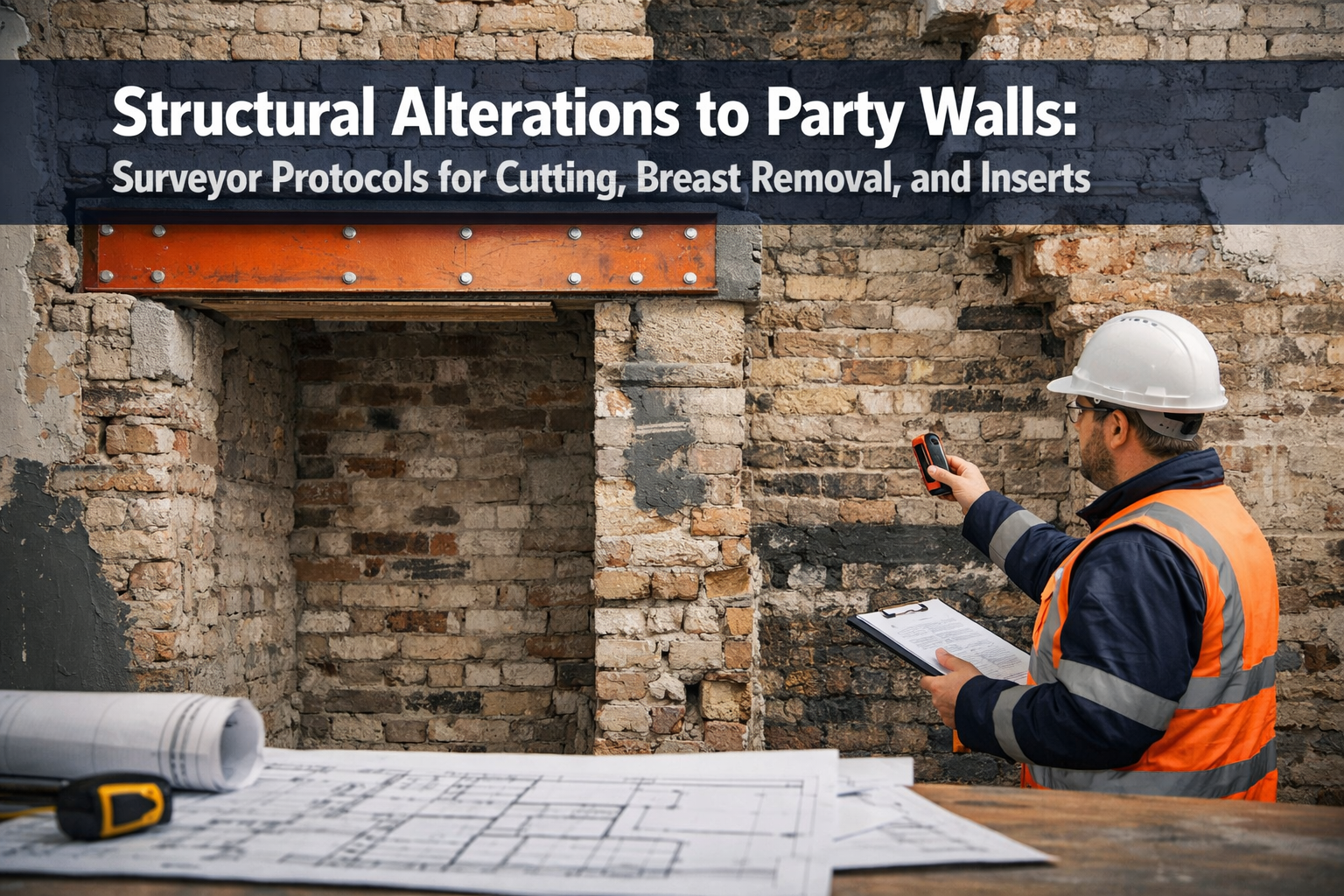
Over 60% of party wall disputes in London's construction boom arise from inadequate documentation during structural alterations—a statistic that underscores the critical importance of proper surveyor protocols when cutting into shared walls, removing chimney breasts, or installing steel beams. As urban renovation projects intensify across England and Wales in 2026, understanding the technical and legal frameworks governing Structural Alterations to Party Walls: Surveyor Protocols for Cutting, Breast Removal, and Inserts has become essential for property owners, contractors, and construction professionals alike.
The Party Wall etc. Act 1996 provides the legislative backbone for these complex procedures, but the practical application requires specialized knowledge that extends far beyond simple notification requirements. When structural work involves creating new openings, removing load-bearing elements, or inserting steel reinforcements within party walls, the margin for error shrinks dramatically—and the potential for costly disputes escalates.
Key Takeaways
- Formal notification under the Party Wall etc. Act 1996 requires 2 months' notice for structural alterations affecting party walls, with mandatory surveyor involvement when neighbors dissent
- Schedule of condition documentation must be completed before any cutting, breast removal, or beam insertion work begins to protect all parties from unfounded damage claims
- Structural calculations and temporary support systems are non-negotiable requirements for maintaining wall stability during alterations, with specific protocols for load transfer
- Party Wall Awards must include detailed specifications, working methods, and dispute resolution mechanisms for complex structural interventions
- Professional surveyor oversight throughout the construction phase ensures compliance with agreed protocols and protects both building and adjoining owners
Understanding the Legal Framework for Structural Alterations to Party Walls
The Party Wall etc. Act 1996 establishes the statutory requirements for notifying neighbors and managing structural work that affects shared walls between properties. This legislation applies specifically to England and Wales, creating a balanced framework that protects the rights of both building owners who wish to undertake improvements and adjoining owners whose properties may be affected.[1]
Notice Requirements and Timeframes
When planning structural alterations that involve cutting into party walls, removing chimney breasts, or installing steel beams, property owners must serve appropriate notices well in advance of commencing work. The Act mandates 2 months' notice for works affecting party walls and 1 month for excavation work near neighboring foundations.[1]
The notice must contain specific details about the proposed work, including:
- Precise location of the structural alteration
- Nature and extent of the cutting, removal, or insertion work
- Proposed start date for construction activities
- Technical drawings showing the scope of intervention
- Structural calculations where load-bearing elements are affected
When Surveyor Appointment Becomes Mandatory
If adjoining owners don't provide written consent within 14 days of receiving notice, the matter automatically becomes a party wall dispute requiring formal resolution. At this point, qualified party wall surveyors must be appointed to prepare a Party Wall Award—a legally binding document that governs how the work will proceed.[1]
The surveyor appointment process follows one of three paths:
- Agreed Surveyor: Both parties consent to a single surveyor acting impartially
- Two Surveyors: Each party appoints their own surveyor, who then select a third surveyor
- Three Surveyors: Used for complex projects with multiple adjoining properties
For structural alterations involving cutting, breast removal, and inserts, the two-surveyor approach is most common, as it provides independent representation while maintaining professional collaboration. Professional building owners' surveyors and adjoining owners' surveyors work together to protect their respective clients' interests.
Types of Structural Work Covered Under Surveyor Protocols
Understanding the specific types of party wall works that require rigorous surveyor oversight helps property owners plan appropriately and avoid costly delays. The protocols for Structural Alterations to Party Walls: Surveyor Protocols for Cutting, Breast Removal, and Inserts address three primary categories of intervention, each with distinct technical and legal considerations.
Cutting into Party Walls for New Openings
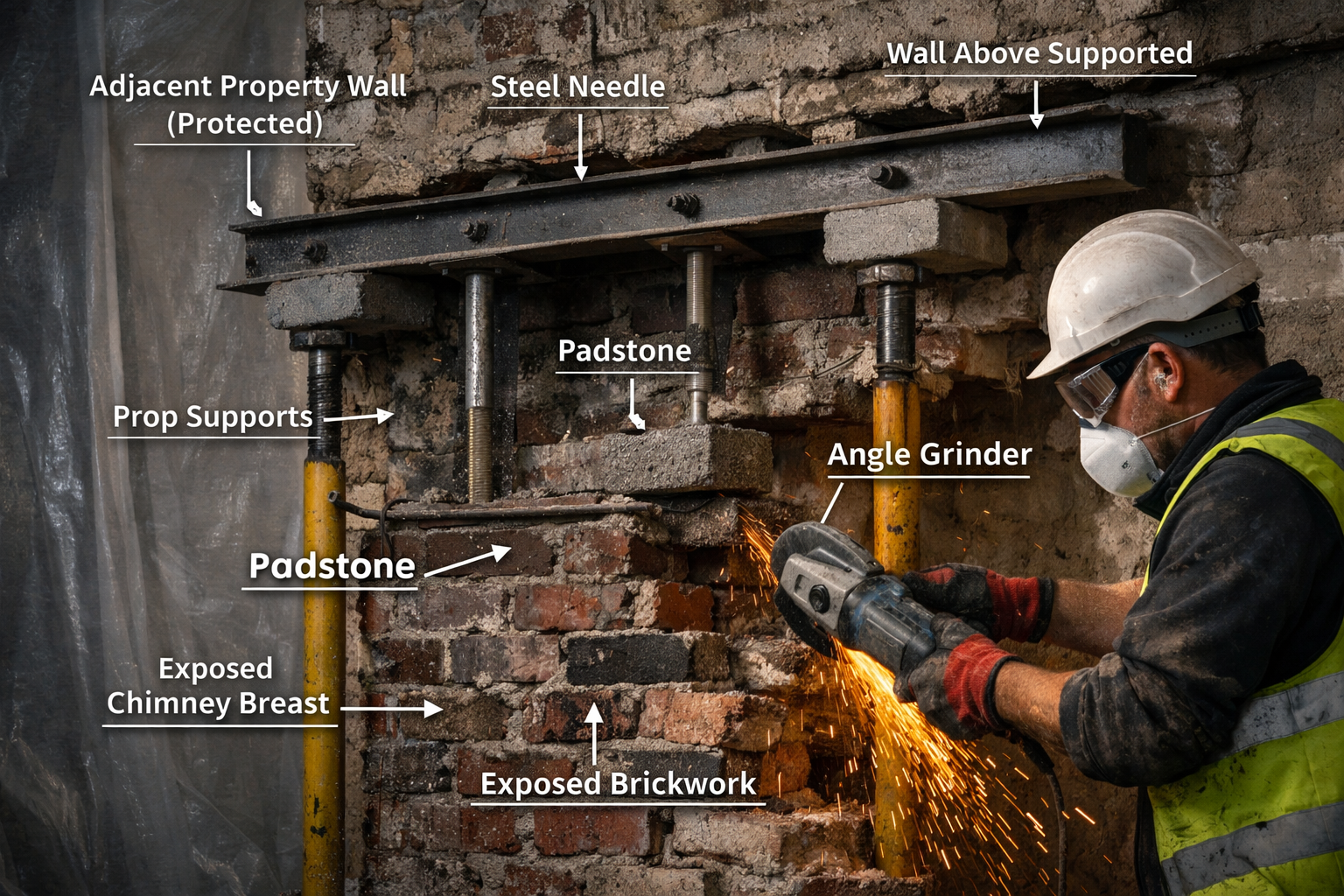
Creating doorways, windows, or service penetrations through party walls represents one of the most common—and potentially problematic—structural alterations. The surveyor protocol for cutting operations includes:
Pre-Work Assessment 🔍
- Structural engineer's calculations confirming wall capacity
- Identification of existing load paths and stress points
- Assessment of wall construction (solid brick, cavity, timber frame)
- Evaluation of floors and roof loads bearing on the wall section
Temporary Support Requirements
- Installation of needling systems (horizontal steel beams) to support loads above the proposed opening
- Acrow props or adjustable steel columns positioned on both sides of the wall
- Load transfer calculations ensuring adequate support during cutting
- Protection measures for adjoining owner's finishes and fixtures
Cutting Methodology
- Phased removal of masonry in controlled sections
- Diamond cutting or hand-cutting techniques depending on wall composition
- Dust suppression and vibration monitoring
- Daily progress documentation with photographic evidence
Chimney Breast Removal Protocols
Removing chimney breasts from party walls requires particularly careful surveyor oversight, as these structures often provide lateral restraint to the wall and may carry loads from breasts on upper floors. The protocol addresses both ground-floor and upper-floor removals differently.
Ground Floor Breast Removal 🏗️
When removing a chimney breast at ground level while the structure above remains in the adjoining property, the surveyor protocol mandates:
- Gallows bracket installation: Steel framework supporting the retained breast above
- Load calculation verification: Ensuring supports can handle the suspended weight
- Wall tie inspection: Checking connections between the party wall and the retained breast
- Lateral restraint provision: Installing wall straps or ties to prevent instability
Upper Floor Breast Removal
Removing breasts from upper floors while leaving lower sections intact creates a different structural challenge:
- Corbelling assessment: Evaluating whether existing corbels adequately support the breast below
- Additional support installation: Steel beams or reinforced concrete lintels where needed
- Flue capping: Proper sealing and ventilation of abandoned flue sections
- Party wall integrity: Ensuring removal doesn't compromise the shared wall structure
Steel Beam Inserts and Reinforcement
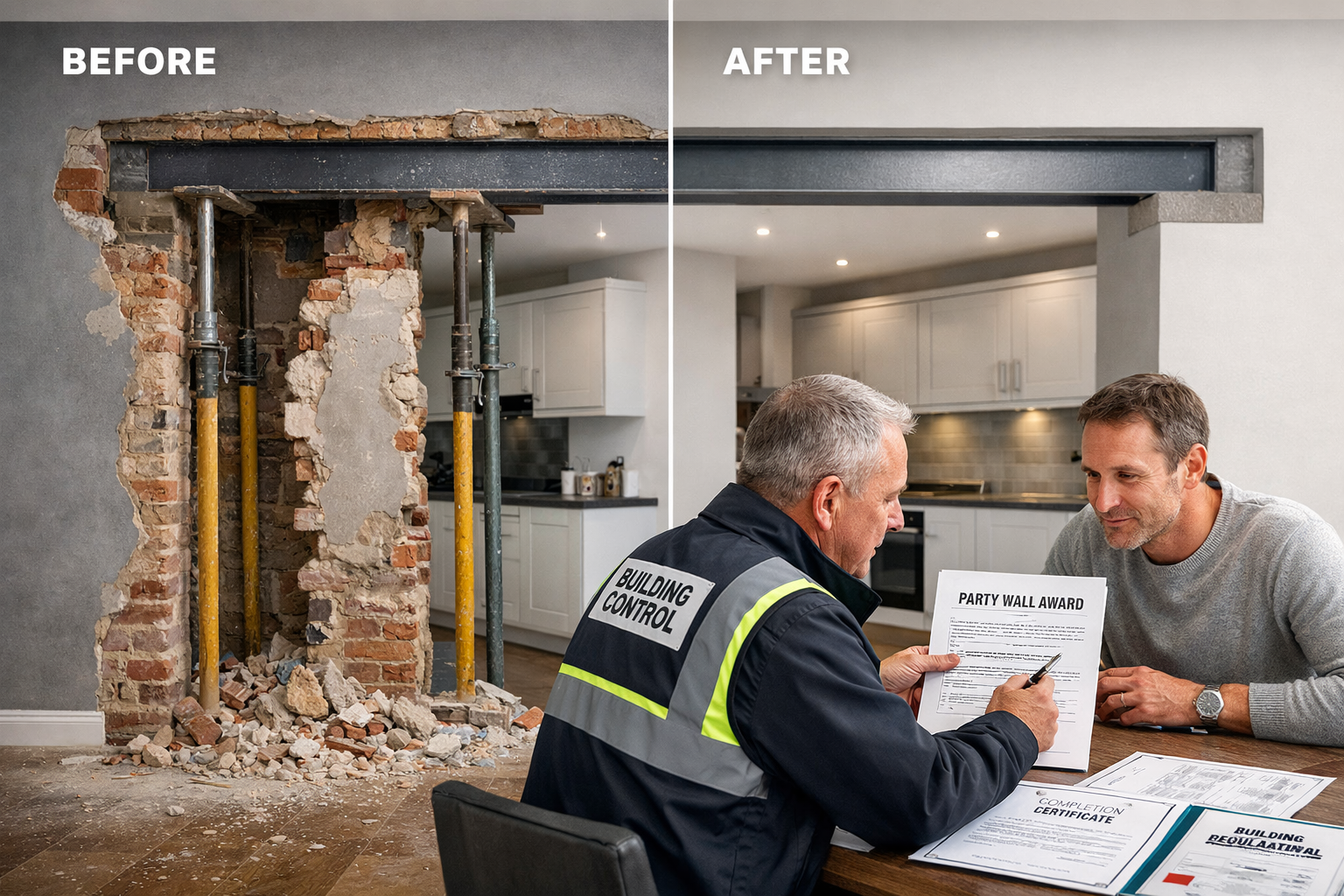
Installing rolled steel joists (RSJs) or universal beams within or adjacent to party walls requires the most comprehensive surveyor protocols, as these interventions fundamentally alter load distribution.
Beam Pocket Creation ⚙️
- Precise cutting of recesses (pockets) into the party wall
- Minimum bearing lengths (typically 100mm for domestic installations)
- Padstone installation: Concrete or engineering brick supports distributing beam loads
- Damp-proof course integration preventing moisture transmission
Load Transfer Considerations
- Structural calculations showing load paths from beam through wall to foundations
- Assessment of wall capacity to accept new concentrated loads
- Evaluation of foundation adequacy for increased loading
- Temporary propping during beam installation to maintain wall stability
Party Wall Award Specifications
The surveyor-prepared award for beam inserts must detail:
| Specification Element | Required Detail |
|---|---|
| Beam dimensions | Size, length, grade (e.g., 203×133 UB25) |
| Bearing details | Pocket depth, padstone dimensions, DPC provision |
| Connection method | Bolted, welded, or restraint strap specifications |
| Fire protection | Intumescent coating or boarding requirements |
| Acoustic separation | Sound insulation measures at beam penetrations |
| Making good | Restoration of finishes to match existing |
Schedule of Condition: The Foundation of Dispute Prevention
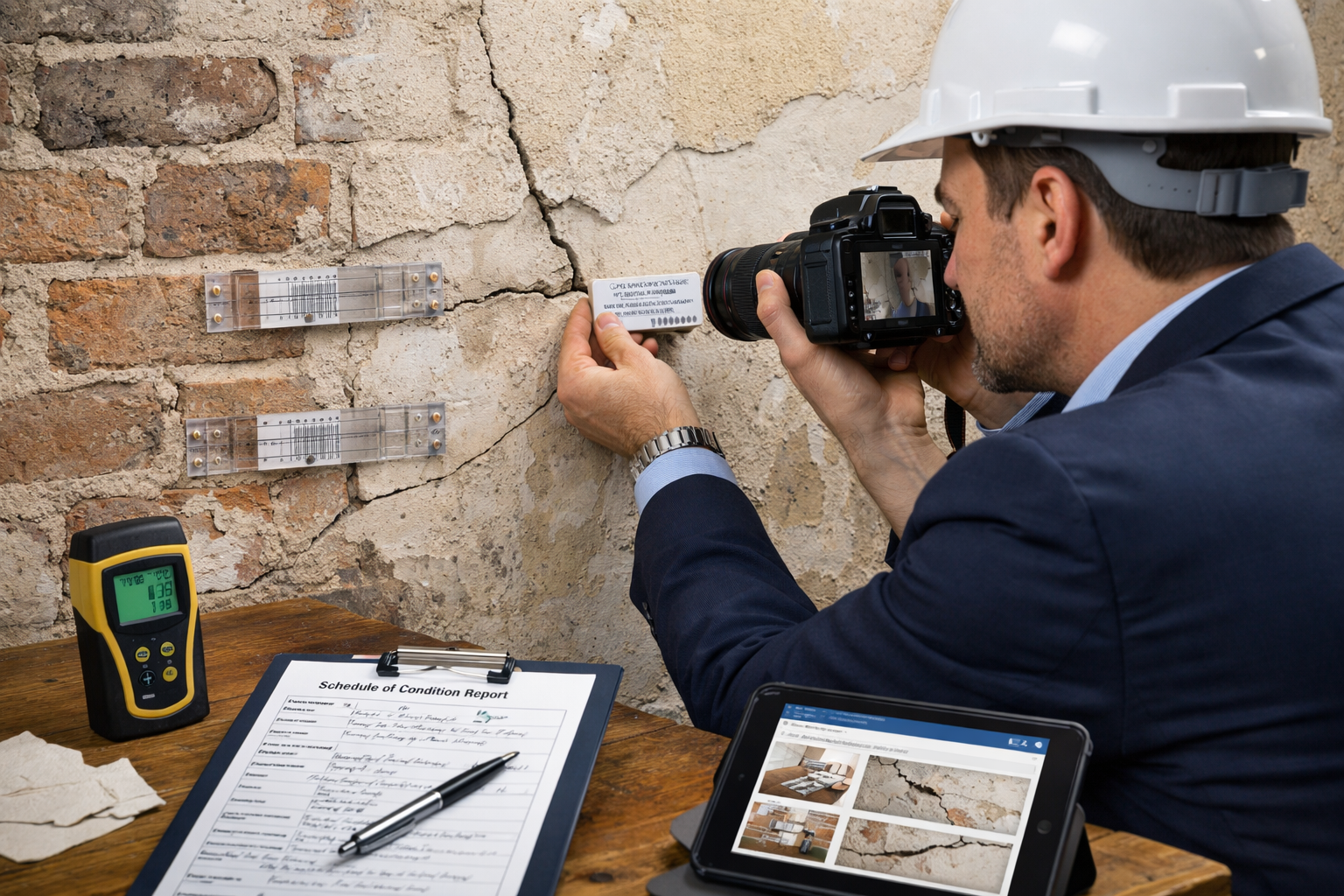
Perhaps the most critical element in surveyor protocols for structural alterations is the schedule of condition—a comprehensive pre-work documentation that serves as the baseline for assessing any damage claims. This document protects both parties by establishing the factual condition of properties before cutting, breast removal, or beam installation begins.
Comprehensive Documentation Requirements
A professional schedule of condition for structural party wall alterations extends beyond simple photography. The surveyor must systematically document:
Internal Condition Assessment 📋
- Crack mapping: Precise measurements and photographs of all existing cracks, with width gauges showing dimensions
- Plaster condition: Areas of blown plaster, historic repairs, damp staining
- Ceiling integrity: Sagging, cracking, or previous water damage
- Floor levels: Spirit level readings identifying existing settlement
- Decorative condition: Paint, wallpaper, and finish quality
External Condition Assessment
- Brickwork pointing: Condition of mortar joints and any previous repointing
- Structural cracks: Stepped cracking, vertical splits, or displacement
- Damp penetration: Evidence of water ingress or efflorescence
- Roof interface: Condition where party wall meets roof structure
- Chimney stack: Stability, pointing, and any existing movement
Technology-Enhanced Documentation
Modern surveyor protocols increasingly incorporate advanced documentation technologies:
- 3D laser scanning: Creating precise digital models of the existing structure
- Crack width monitoring: Installing tell-tales or electronic sensors to track movement
- Photogrammetry: Generating measurable images for future comparison
- Moisture mapping: Thermal imaging identifying hidden damp issues
- Vibration monitoring: Baseline readings for comparison during construction
This comprehensive approach proves invaluable when disputes arise. In urban renovation projects across Central London, North London, and other high-density areas, detailed schedules of condition have prevented countless unfounded damage claims by clearly distinguishing pre-existing conditions from construction-related impacts.
Party Wall Award Provisions for Structural Alterations
The Party Wall Award serves as the contractual document governing how structural alterations will proceed. For complex work involving cutting, breast removal, and beam inserts, the award must contain specific provisions that protect all parties while enabling the building owner to complete necessary improvements.
Essential Award Clauses for Structural Work
A comprehensive Party Wall Award for structural alterations typically includes:
Working Hours and Access ⏰
- Permitted construction hours (typically 8am-6pm weekdays, 8am-1pm Saturdays)
- Access provisions for surveyors to inspect work in progress
- Notice requirements for particularly noisy or disruptive operations
- Emergency contact information for out-of-hours issues
Structural Protection Measures
- Temporary support specifications: Detailed requirements for propping and needling
- Vibration limits: Maximum acceptable vibration levels during cutting operations
- Dust control: Sheeting, extraction, and cleaning protocols
- Security provisions: Maintaining weather-tightness and security during work
Technical Specifications
The award must reference or incorporate:
- Structural engineer's calculations and drawings
- Beam specifications and installation methodology
- Temporary works designs for complex support systems
- Building Control approval references
- Materials specifications (concrete grades, steel specifications, etc.)
Damage Resolution Mechanisms
Despite careful planning, structural alterations occasionally cause unforeseen damage. The Party Wall Award must establish clear protocols for addressing such issues:
Damage Assessment Process 🔧
- Immediate notification: Building owner or contractor informs surveyors within 24 hours
- Joint inspection: Both surveyors examine the damage together
- Causation determination: Establishing whether damage results from the notifiable works
- Repair specification: Agreeing appropriate remediation methods
- Cost allocation: Determining responsibility for repair costs
Dispute Resolution
When surveyors cannot agree on damage causation or appropriate remedies, the award should specify:
- Third surveyor referral: Automatic escalation to the appointed third surveyor
- Expert determination: Timelines for third surveyor decisions (typically 10 working days)
- Binding nature: Confirmation that third surveyor decisions are final
- Cost allocation: How dispute resolution costs will be shared
Case Studies: Preventing Damage Claims Through Proper Protocols
Real-world examples demonstrate the value of rigorous surveyor protocols for Structural Alterations to Party Walls: Surveyor Protocols for Cutting, Breast Removal, and Inserts. These case studies from 2026 urban renovation projects illustrate both successful outcomes and cautionary tales.
Case Study 1: Victorian Terrace Beam Installation in East London
Project: Installing steel beam through party wall to create open-plan ground floor
Challenge: The Victorian terrace in East London had existing settlement cracks in the adjoining property, raising concerns about construction-related damage claims.
Surveyor Protocol Application:
- Comprehensive schedule of condition with crack width measurements and photogrammetry
- Installation of five crack monitoring tell-tales before work commenced
- Daily vibration monitoring during cutting operations
- Phased needling approach minimizing load redistribution at any single point
Outcome: ✅ Minor hairline crack extension occurred during beam pocket cutting, but tell-tale monitoring proved the movement was within the 0.5mm tolerance specified in the award. The detailed schedule of condition prevented a potential £15,000 damage claim, as pre-existing cracks were clearly documented. Work completed without dispute.
Case Study 2: Chimney Breast Removal Dispute in South London
Project: Ground floor chimney breast removal in semi-detached property
Challenge: Adjoining owner claimed significant ceiling cracking resulted from breast removal in South London property.
Protocol Failure:
- Inadequate schedule of condition (only basic photographs, no crack measurements)
- No vibration monitoring during removal
- Temporary support calculations not independently verified
- Building owner proceeded without proper Party Wall Award
Outcome: ⚠️ Extended dispute requiring third surveyor determination. Lack of detailed pre-work documentation made causation assessment difficult. Settlement required building owner to pay £8,500 in repairs plus £4,200 in surveyor fees—costs that could have been avoided with proper protocols.
Case Study 3: Complex Multi-Opening Project in West London
Project: Creating three new openings in party wall with steel beam inserts for West London townhouse conversion
Challenge: Multiple simultaneous interventions in party wall with adjoining property occupied by elderly residents concerned about disruption and damage.
Surveyor Protocol Excellence:
- Detailed Party Wall Award with phased working schedule
- Structural engineer's temporary works design for sequential support system
- Weekly progress meetings with both surveyors and building owner
- Real-time vibration and noise monitoring with automated alerts
- Daily photographic documentation of work progress
Outcome: 🌟 Exemplary project completion with zero damage claims. Adjoining owners expressed satisfaction with communication and care taken. Building owner completed complex renovation 10% under budget due to absence of dispute-related delays. The comprehensive surveyor protocols added £3,500 to initial costs but saved an estimated £20,000+ in potential dispute resolution and delay expenses.
Working with Professional Surveyors: Best Practices
Engaging qualified party wall surveyors early in the planning process dramatically improves outcomes for structural alteration projects. Whether carrying out works yourself or responding as a neighbor to construction activity, understanding best practices ensures smooth project progression.
Selecting Qualified Surveyors
Not all surveyors possess the specialized knowledge required for complex structural party wall work. Look for professionals with:
Essential Qualifications 🎓
- Membership in the Royal Institution of Chartered Surveyors (RICS) or Faculty of Party Wall Surveyors (FPWS)
- Specific experience with structural alterations (not just boundary or excavation work)
- Professional indemnity insurance covering party wall work
- Knowledge of structural engineering principles and temporary works design
- Familiarity with local building control requirements
Red Flags to Avoid
- Surveyors offering to act for both parties without proper agreed surveyor appointment
- Unrealistically low fee quotations suggesting inadequate service scope
- Lack of references from recent structural alteration projects
- Unwillingness to conduct comprehensive schedules of condition
- Poor communication or delayed responses during initial consultations
Cost Considerations and Fee Management
Understanding party wall costs helps property owners budget appropriately. For structural alterations involving cutting, breast removal, and beam inserts, typical surveyor fees range from £800-£2,500 per surveyor depending on project complexity.
Strategies for keeping party wall costs down include:
- Early engagement: Consulting surveyors during design phase prevents costly redesigns
- Clear documentation: Providing complete structural drawings and calculations upfront
- Realistic scheduling: Avoiding rushed timelines that require premium fees
- Professional contractors: Using experienced builders reduces surveyor site visit frequency
- Agreed surveyor approach: When relationships with neighbors permit, single surveyor reduces overall costs
Communication and Transparency
Successful structural alteration projects depend on clear communication among all parties. Best practices include:
For Building Owners 💬
- Serve formal party wall notices well ahead of required timelines
- Provide neighbors with clear explanations of proposed work in plain language
- Share structural drawings and calculations proactively
- Maintain regular communication through the surveyor throughout construction
- Address concerns promptly and professionally
For Adjoining Owners
- Respond to notices within the 14-day timeframe
- Appoint qualified surveyors to protect your interests
- Cooperate with schedule of condition inspections
- Raise concerns through proper channels (your surveyor) rather than directly with contractors
- Understand that reasonable structural work is permitted under the Act
Compliance, Building Control, and Safety Protocols
Structural alterations to party walls exist within a broader regulatory framework extending beyond the Party Wall etc. Act 1996. Successful projects require coordination between party wall surveyors, structural engineers, and building control authorities.
Building Regulations Approval
All structural work involving cutting, breast removal, and beam inserts requires Building Regulations approval. The application must demonstrate compliance with:
Structural Stability (Approved Document A)
- Adequate support for loads during and after construction
- Proper load paths from new beams to foundations
- Lateral restraint provisions maintaining wall stability
- Structural calculations by qualified engineer
Fire Safety (Approved Document B)
- Maintaining fire resistance of party walls (typically 60 minutes for residential)
- Fire-stopping around beam penetrations
- Compartmentation integrity preservation
Sound Insulation (Approved Document E)
- Acoustic performance standards for party walls
- Sound insulation testing where wall construction is altered
- Resilient bar installation or acoustic boarding where required
Construction Phase Safety
The Construction (Design and Management) Regulations 2015 impose safety duties on all parties involved in structural alterations. Key requirements include:
Temporary Works Safety ⚠️
- Competent person design of propping and needling systems
- Regular inspection of temporary supports (typically weekly minimum)
- Load testing of critical support elements
- Emergency procedures for support failure scenarios
Contractor Competence
- Evidence of appropriate skills and experience for structural work
- Public liability insurance (minimum £5 million for domestic projects)
- Health and safety policy and risk assessments
- Method statements for high-risk activities (cutting, lifting, working at height)
Emerging Trends in Surveyor Protocols for 2026
The construction industry continues to evolve, and surveyor protocols for structural party wall alterations adapt accordingly. Several trends are shaping practice in 2026:
Digital Documentation and BIM Integration
Building Information Modeling (BIM) increasingly influences party wall surveying:
- 3D models replacing traditional 2D drawings in Party Wall Awards
- Digital schedules of condition with embedded measurements and annotations
- Cloud-based collaboration enabling real-time document sharing among surveyors
- Augmented reality site inspections comparing as-built conditions to approved designs
Enhanced Monitoring Technologies
Advanced monitoring systems provide objective evidence of construction impacts:
- IoT vibration sensors with automated alerts when thresholds are exceeded
- Continuous crack monitoring using electronic displacement sensors
- Tilt monitoring detecting wall movement in real-time
- Environmental monitoring tracking dust, noise, and temperature fluctuations
These technologies strengthen the evidentiary basis for resolving disputes and provide early warning of potential problems.[2]
Sustainability Considerations
Party wall protocols increasingly address environmental performance:
- Thermal bridging assessment at beam inserts and openings
- Airtightness testing after party wall alterations
- Embodied carbon calculations for structural materials
- Circular economy principles encouraging reuse of removed materials
Conclusion
Structural Alterations to Party Walls: Surveyor Protocols for Cutting, Breast Removal, and Inserts represent some of the most technically demanding and legally complex construction activities in urban environments. The convergence of structural engineering requirements, Party Wall Act compliance, and neighbor relations demands rigorous professional oversight at every stage.
The evidence from 2026 construction projects demonstrates that comprehensive surveyor protocols deliver measurable value: detailed schedules of condition prevent unfounded damage claims, properly specified Party Wall Awards minimize disputes, and professional oversight ensures structural safety throughout the construction process. The modest investment in qualified surveyors—typically representing just 2-3% of total project costs—provides disproportionate protection against delays, disputes, and damage claims that can derail renovation projects.
Actionable Next Steps
For property owners planning structural party wall alterations:
- Consult qualified party wall surveyors during the design phase, before finalizing structural plans
- Engage structural engineers to provide calculations and temporary works designs
- Serve formal notices with complete technical documentation at least 2 months before planned start dates
- Insist on comprehensive schedules of condition documenting pre-existing conditions in detail
- Select experienced contractors with proven track records in party wall structural work
- Maintain open communication through professional channels throughout the project
- Document everything with photographs, daily logs, and progress reports
For adjoining owners receiving party wall notices:
- Respond promptly within the 14-day timeframe to protect your rights
- Appoint your own surveyor to represent your interests independently
- Cooperate with schedule of condition inspections to establish baseline evidence
- Raise concerns formally through your surveyor rather than directly with builders
- Understand your rights under the Party Wall etc. Act 1996 while recognizing neighbors' legitimate improvement rights
The construction boom continues across England and Wales in 2026, with urban densification driving demand for structural alterations that maximize space within existing building footprints. As this trend accelerates, the role of professional party wall surveyors in protecting property rights, ensuring structural safety, and preventing disputes becomes ever more critical. By following established protocols for cutting, breast removal, and beam inserts, the construction industry can deliver the housing improvements communities need while maintaining the trust and cooperation that make dense urban living possible.
References
[1] Party Wall Agreement – https://hoa.org.uk/advice/guides-for-homeowners/i-am-improving/party-wall-agreement/
[2] Party Wall Surveys Amid 2026 Construction Boom Handling Disputes In High Demand Uk Housing Markets – https://nottinghillsurveyors.com/blog/party-wall-surveys-amid-2026-construction-boom-handling-disputes-in-high-demand-uk-housing-markets