


Nine out of ten self-filed party wall notices contain errors that can cost homeowners thousands in legal fees and project delays.[5] As renovation activity surges across England and Wales in 2026, understanding the Top 10 Most Common Party Wall Questions Answered: Notices, Awards, and Act Essentials for 2026 Homeowners has never been more critical for anyone planning building work near or on a shared boundary.
Whether you're planning a loft conversion, basement excavation, or simple wall repairs, the Party Wall etc. Act 1996 establishes a legal framework that protects both building owners and their neighbours. Yet confusion persists around notice requirements, surveyor appointments, and what happens when neighbours object. This comprehensive guide addresses the most frequently asked questions with updated 2026 flowcharts and practical guidance to help homeowners navigate the party wall process confidently.

Key Takeaways
- Party wall notices are legally required for specific works including building on boundaries, altering shared walls, and excavating within 3-6 meters of neighbouring structures—failure to serve proper notice can result in fines and legal action
- Neighbours have 14 days to respond to party wall notices, and no response typically triggers a deemed dispute requiring surveyor appointment, not automatic consent
- Building owners pay all reasonable surveyor fees including their neighbour's surveyor costs, as they are initiating the work under the Act
- Party Wall Awards are legally binding documents that outline work conditions, protect both parties' rights, and include schedules of condition to prevent disputes
- Professional surveyors prevent costly mistakes—self-filed notices are incorrect 90% of the time, leading to delays and additional expenses
Understanding Party Walls: Definition and Legal Framework
A party wall is a wall shared by two adjoining properties, forming part of both buildings' structures or standing on the boundary line dividing two parcels of land.[1] This definition extends beyond simple dividing walls between terraced houses to include:
- Party structures: Shared floors or ceilings in flats and maisonettes
- Party fence walls: Walls built astride a boundary line, typically in gardens
- Boundary walls: Walls built entirely on one owner's land but used by both properties
The Party Wall etc. Act 1996 provides the legal framework for preventing and resolving disputes related to party walls, boundary walls, and excavations near neighbouring buildings throughout England and Wales.[5] This legislation balances the rights of building owners to carry out necessary work with the protection of adjoining owners' properties.
Why the Party Wall Act Matters in 2026
With property prices remaining high and renovation costs becoming more economical than moving, homeowners increasingly choose to extend and improve existing properties. Understanding party wall notices and how to respond ensures projects proceed smoothly without legal complications or neighbour disputes.
Question 1: What Types of Work Require a Party Wall Notice?
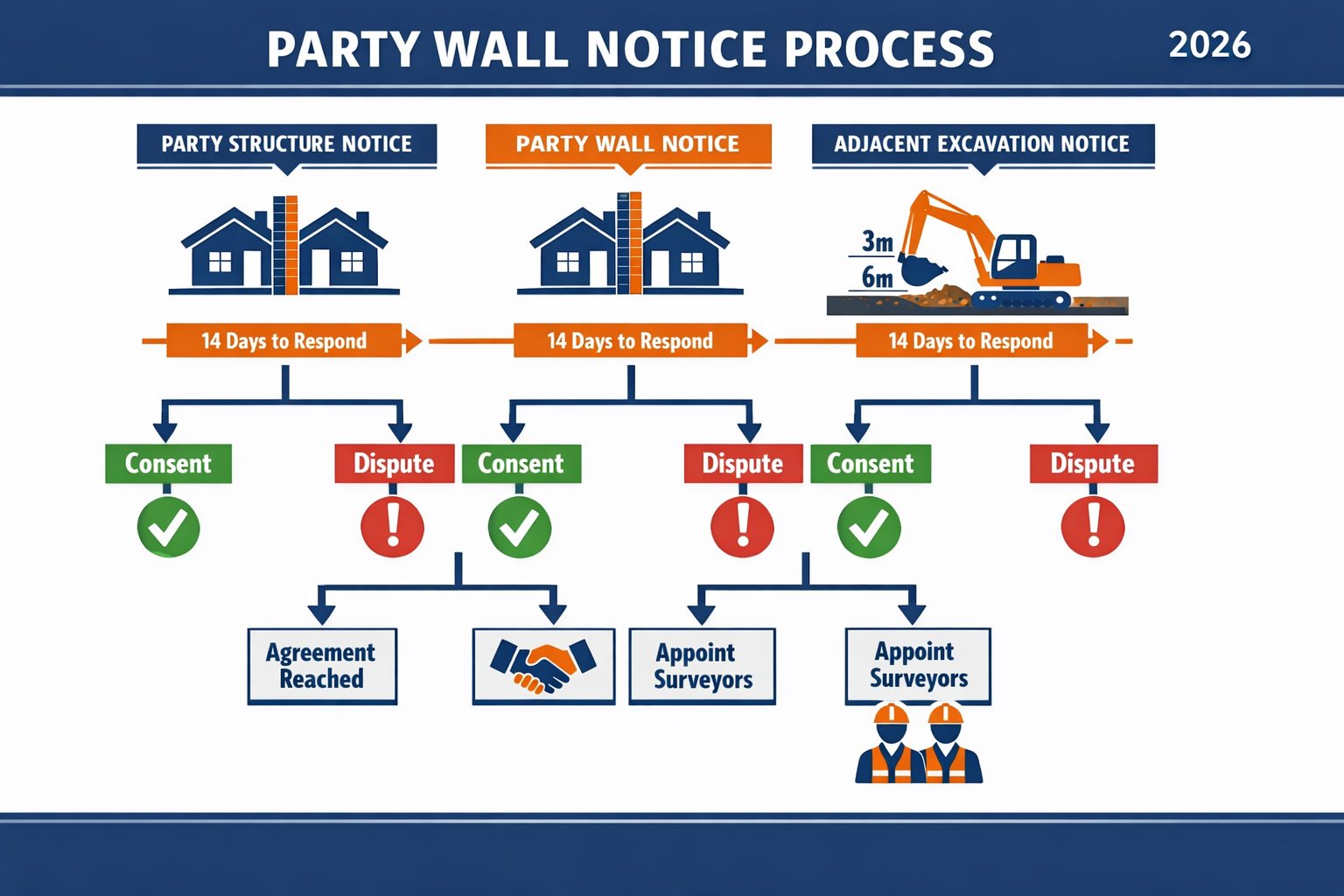
The Party Wall Act covers three main categories of work, each requiring different notice types:
Work Covered Under the Act
Building or altering a party wall (Party Wall Notice):
- Cutting into a party wall to insert beams or damp-proof courses
- Raising the height of a party wall
- Demolishing and rebuilding a party wall
- Underpinning a party wall
Building on or astride a boundary line (Party Structure Notice):
- Constructing a new wall on the boundary between properties
- Building a structure that straddles the property line
Excavating near neighbouring buildings (Adjacent Excavation Notice):
- Digging within 3 meters of a neighbour's structure if your excavation goes deeper than their foundations
- Digging within 6 meters if your excavation goes deeper than a line drawn at 45 degrees from the bottom of their foundations[2]
Common Works That Require Notice
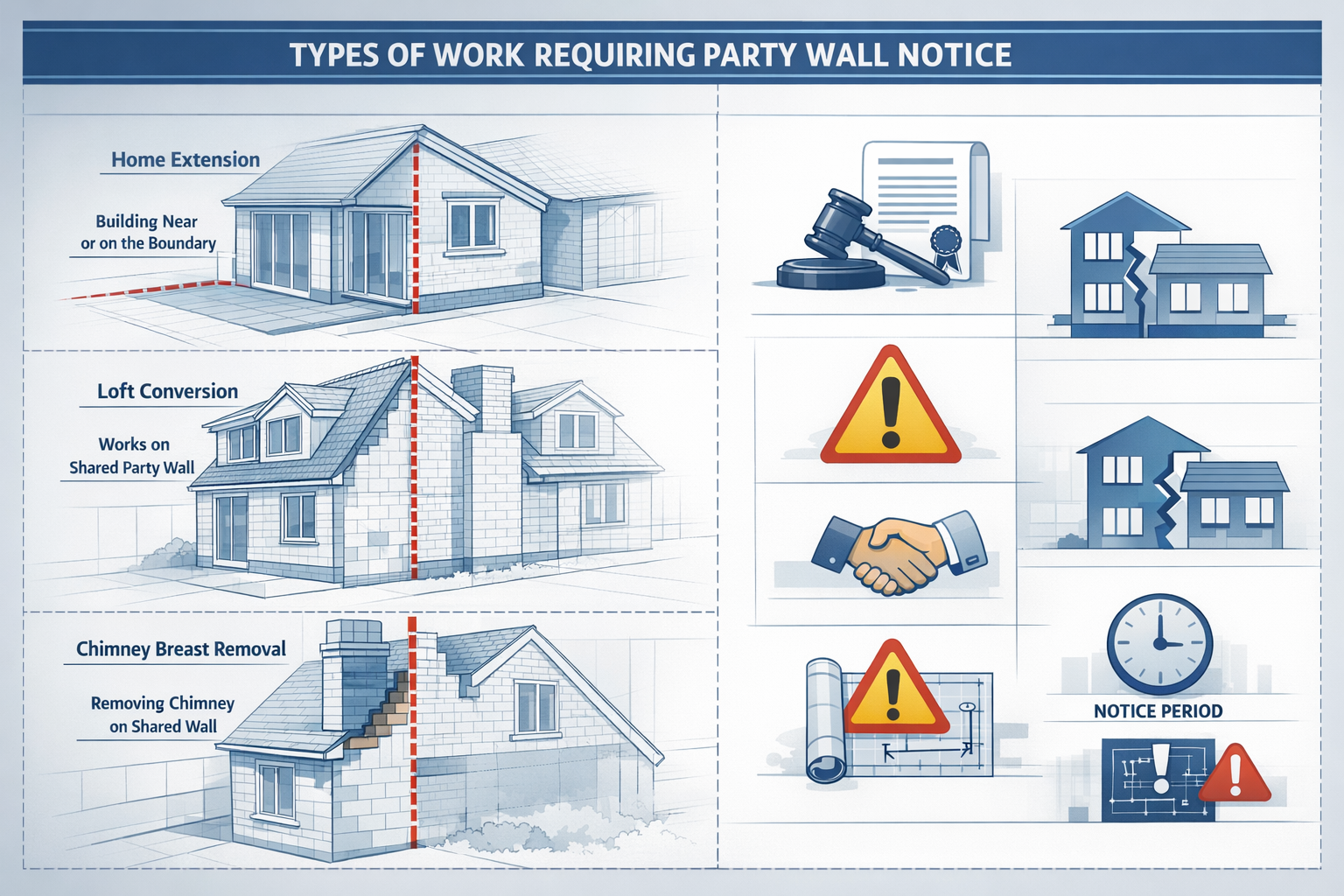
Many homeowners mistakenly believe certain projects don't require party wall procedures. Loft conversions frequently need party wall notice, especially when steel beams are inserted into party walls or chimney breasts are affected.[4] Similarly, basement excavations almost always trigger the adjacent excavation provisions due to foundation depth requirements.
For guidance on specific types of party wall works, professional surveyors can assess your project plans and determine notice requirements.
Question 2: How Much Notice Must I Give My Neighbour?
Notice periods under the Party Wall Act vary depending on the work type:
| Notice Type | Minimum Notice Period | When Work Can Start |
|---|---|---|
| Party Wall Notice | 2 months | After consent or award issued |
| Party Structure Notice | 1 month | After consent or award issued |
| Adjacent Excavation Notice | 1 month | After consent or award issued |
Critical timing consideration: These notice periods represent the minimum time before work can legally commence. Once served, your neighbour has 14 days to respond.[3] If they consent in writing, work can proceed after the notice period expires. If they object or don't respond, the dispute resolution process begins, which can add several weeks to your timeline.
2026 Best Practice Timeline
For projects starting in 2026, experienced surveyors recommend:
- 8-12 weeks before planned start date: Consult a party wall surveyor to review plans
- 6-8 weeks before: Serve formal notices
- 4-6 weeks before: Allow time for neighbour response and potential surveyor appointment
- 2-4 weeks before: Finalize Party Wall Award and schedule of condition
- Start date: Commence work with all documentation in place
Question 3: What Happens If My Neighbour Doesn't Respond?
A widespread misconception suggests that no response means automatic consent—this is false for most notice types.[4] Under the Party Wall Act, if your neighbour fails to respond within 14 days, a dispute is deemed to have arisen.[6]
The Deemed Dispute Process
When a deemed dispute occurs:
- Surveyor appointment becomes mandatory: You cannot proceed without following the statutory dispute resolution process
- Three surveyor options exist:
- Each party appoints their own surveyor (most common)
- Both parties agree to use a single "Agreed Surveyor"
- If the neighbour refuses to appoint, the building owner's surveyor can make the appointment on their behalf after serving further notice
- Party Wall Award must be issued: The surveyor(s) will prepare a formal award document outlining work conditions
This process protects both parties—building owners gain legal permission to proceed, while adjoining owners receive documented protection for their property through schedules of condition and work specifications.
Question 4: Can My Neighbour Refuse Permission and Stop My Work?
Neighbours cannot simply veto lawful works that fall under the Party Wall Act.[4] However, they can influence how the work proceeds and what protective measures must be implemented.
What Neighbours Can and Cannot Do
✅ Neighbours CAN:
- Require proper notice procedures to be followed
- Appoint their own surveyor at your expense
- Request specific working hours or access arrangements
- Demand a comprehensive schedule of condition
- Require additional protective measures during construction
- Seek compensation for proven damage
❌ Neighbours CANNOT:
- Completely prevent work that complies with planning and building regulations
- Demand unreasonable conditions that make the work impossible
- Refuse to allow necessary access if the Award requires it
- Delay indefinitely by refusing to engage with the process
If disputes cannot be resolved through the surveyor process, either party can appeal to the County Court within 14 days of the Award being served. However, courts typically uphold properly prepared Awards unless significant procedural errors occurred.
Question 5: Who Pays for Party Wall Surveyors?
In the vast majority of cases, the building owner proposing the work pays for all reasonable surveyor fees.[1] This includes:
- Your own surveyor's fees
- Your neighbour's surveyor's fees (if they appoint one)
- The Agreed Surveyor's fees (if using a single surveyor)
- Costs for preparing the Party Wall Award
- Fees for schedules of condition
Why Building Owners Pay
The rationale is straightforward: the building owner initiates the work and therefore bears the responsibility for ensuring the statutory process is followed correctly. This payment obligation is established in the Act itself and cannot be avoided.
Typical costs in 2026:
- Simple projects (single party wall): £700-£1,200 per surveyor
- Complex projects (multiple walls, excavations): £1,500-£3,000+ per surveyor
- Agreed Surveyor (both parties consent): £800-£1,500 total
For strategies on how to keep party wall costs down, consider early engagement with surveyors and maintaining good neighbour relations to facilitate the Agreed Surveyor route.
Question 6: What Is a Party Wall Award and Why Do I Need One?
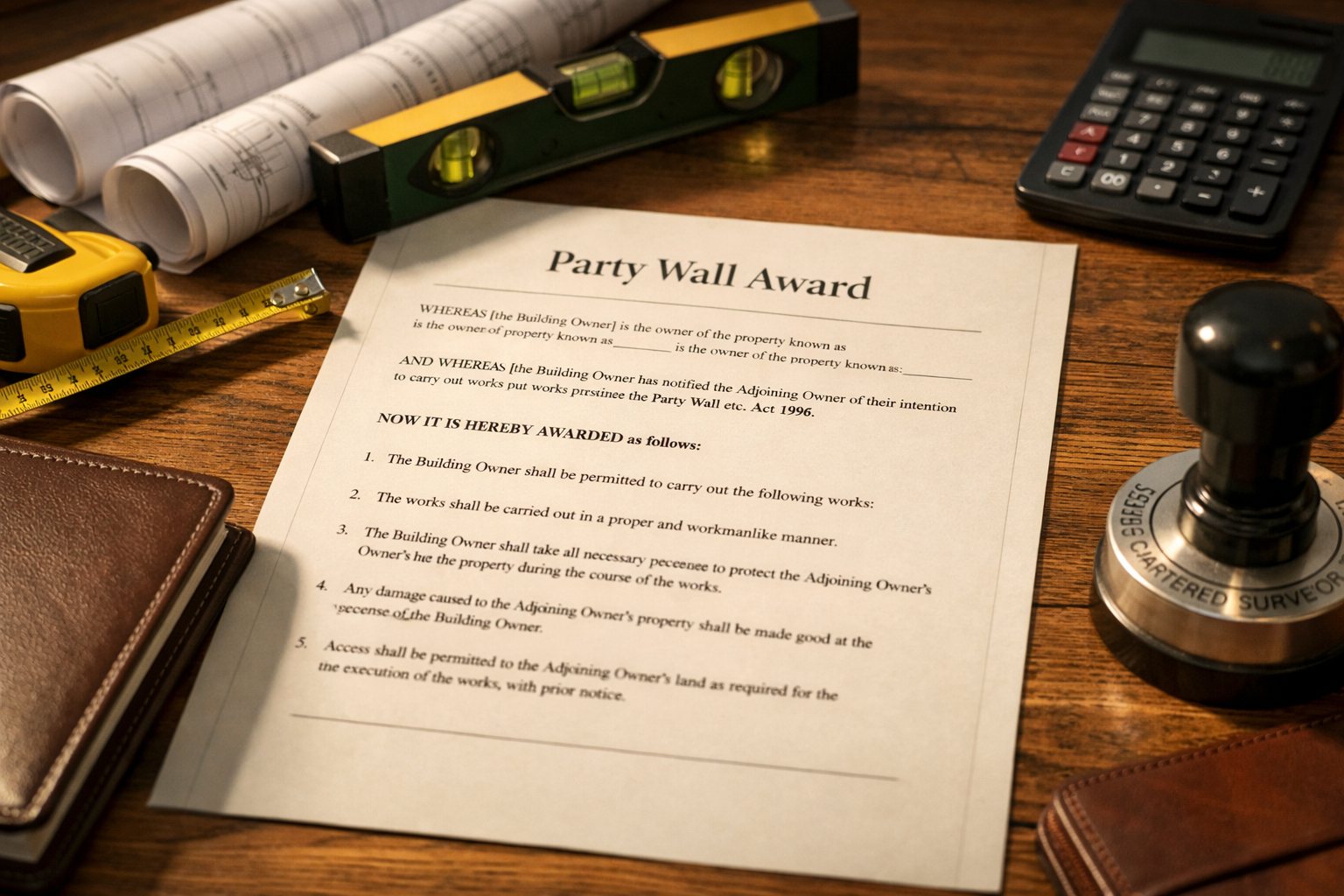
A Party Wall Award is a legally binding document prepared by the appointed surveyor(s) that sets out the rights and responsibilities of both parties regarding the proposed work.[2] Think of it as a detailed contract that protects everyone involved.
Essential Components of a Party Wall Award
📋 Standard Award Contents:
- Description of proposed works: Detailed specifications of what will be done
- Working hours and access rights: When work can occur and how contractors access the site
- Schedule of condition: Photographic and written record of the neighbour's property before work begins
- Protective measures: Requirements for scaffolding, weather protection, dust control
- Dispute resolution procedures: Process for handling issues during construction
- Compensation provisions: How damage will be assessed and remedied
- Surveyor fees: Breakdown of costs and payment terms
Why Awards Matter
The Award serves multiple critical functions:
- Legal protection: Provides building owners with statutory right to proceed
- Evidence baseline: Schedule of condition proves pre-existing conditions
- Dispute prevention: Clear terms reduce misunderstandings during construction
- Damage claims: Establishes process for legitimate compensation claims
- Insurance compliance: Many insurers require Awards before covering party wall work
For detailed information about party wall awards and their structure, professional surveyors can explain how Awards protect your specific project.
Question 7: Do I Really Need a Professional Surveyor or Can I Do It Myself?
While the Party Wall Act doesn't explicitly require professional surveyors, attempting to navigate the process without expert help is risky. Industry data shows that 9 out of 10 self-filed party wall notices contain errors.[5]
Common Self-Filing Mistakes
❌ Frequent errors include:
- Incorrect notice type for the work proposed
- Missing essential information required by the Act
- Wrong notice periods or calculation errors
- Inadequate description of works
- Failure to include required drawings or specifications
- Improper service methods that invalidate the notice
Consequences of Incorrect Notices
When notices are served incorrectly:
- Work must stop: Neighbours can obtain injunctions halting construction
- Re-serving required: The entire notice period starts over with corrected documents
- Additional costs: Legal fees and surveyor costs multiply
- Project delays: Timeline extends by months in worst cases
- Neighbour relations: Mistakes damage trust and cooperation
Professional party wall surveyors bring specialized knowledge of the Act's technical requirements, local building practices, and dispute resolution procedures. Their fees represent insurance against far more expensive mistakes.
For those considering whether to proceed without a surveyor, understand the significant risks involved.
Question 8: What If Damage Occurs During the Work?
Despite careful planning, construction work sometimes causes damage to neighbouring properties. The Party Wall Award establishes clear procedures for handling such situations.
The Schedule of Condition: Your Protection
A schedule of condition is a detailed photographic and written record of the adjoining owner's property taken before work begins.[7] This document:
- Records existing cracks, damage, and defects
- Provides baseline evidence for damage claims
- Protects building owners from false claims
- Helps surveyors assess whether damage is work-related
Best practices for 2026 include high-resolution photography, video walkthroughs, and detailed written descriptions of every room potentially affected by the work.
Damage Claims Process
If damage occurs:
- Immediate notification: Building owner must inform the adjoining owner and surveyors
- Surveyor inspection: The appointed surveyor(s) assess the damage
- Cause determination: Surveyors determine if damage resulted from the notified works
- Repair specification: Award outlines how damage must be remedied
- Compensation: Building owner pays for repairs to restore property to previous condition
The Party Wall Act provides a streamlined process that avoids lengthy court proceedings for most damage disputes. Surveyors act as neutral experts to ensure fair outcomes.
Question 9: Does the Party Wall Act Apply to My Loft Conversion?
This question generates considerable confusion among homeowners. Many loft conversions do require party wall procedures, contrary to popular belief.[4]
When Loft Conversions Trigger the Act
🏠 Notice required if:
- Steel beams are inserted into or bear on party walls
- Party wall chimney breasts are removed or altered
- New walls are built on or near the boundary
- Structural work affects the party wall's integrity
- Load-bearing changes impact the shared structure
🏠 Notice may not be required if:
- Work is entirely within your own roof space
- No structural alterations affect party walls
- No beams or supports penetrate shared structures
- Changes are purely cosmetic (insulation, boarding)
The distinction often depends on technical details in your architect's plans. Professional surveyors can review drawings to determine whether party wall procedures apply to your specific loft conversion design.
Question 10: How Do Party Wall Rules Differ for Excavations?
Excavation work near neighbouring properties triggers specific provisions under the Party Wall Act, with rules that differ from party wall alterations.
The 3-Meter and 6-Meter Rules Explained
3-meter rule: If you plan to excavate within 3 meters of a neighbouring building and your excavation will go deeper than the bottom of their foundations, you must serve an Adjacent Excavation Notice.[2]
6-meter rule: If excavating within 6 meters of a neighbouring building and your excavation will go deeper than a line drawn at 45 degrees downward from the bottom of their foundations, notice is required.[2]
Calculating Excavation Depth Requirements
These calculations require:
- Accurate survey of neighbouring foundation depths
- Precise measurement of distances from boundary
- Professional assessment of soil conditions
- Understanding of foundation types and construction methods
Most basement and deep foundation projects in urban areas trigger these provisions. Homeowners planning significant excavations should engage structural engineers and party wall surveyors early in the design phase.
For boundary wall rules and excavation guidance, professional advice prevents costly mistakes.
Regional Considerations: Party Wall Surveyors Across London
Party wall procedures remain consistent across England and Wales, but local expertise matters when navigating regional building practices and council requirements.
Finding Qualified Surveyors
Experienced party wall surveyors operate throughout London's diverse neighbourhoods:
- Party Wall Surveyor South London
- Party Wall Surveyor Central London
- Party Wall Surveyor East London
- Party Wall Surveyor North London
- Party Wall Surveyor West London
Local surveyors understand area-specific challenges such as Victorian terrace construction methods, soil conditions affecting excavations, and typical foundation depths in different neighbourhoods.
2026 Party Wall Process Flowchart: Step-by-Step Guide
Understanding the complete party wall process helps homeowners plan effectively:
For Building Owners Starting Work
Phase 1: Planning (8-12 weeks before start)
- Develop detailed construction plans
- Consult party wall surveyor to assess notice requirements
- Review project timeline and build in party wall procedures
Phase 2: Notice Service (6-8 weeks before start)
- Prepare and serve appropriate party wall notices
- Include all required information and drawings
- Use proper service methods (hand delivery, recorded post)
Phase 3: Response Period (14 days)
- Neighbour reviews notice
- Neighbour consents, objects, or doesn't respond
- If consent: proceed after notice period expires
- If objection/no response: move to surveyor appointment
Phase 4: Surveyor Appointment (2-4 weeks)
- Each party appoints surveyor or agree on single surveyor
- Surveyors exchange information and inspect properties
- Schedule of condition prepared
Phase 5: Award Preparation (2-3 weeks)
- Surveyors draft Party Wall Award
- Both parties receive copies
- 14-day appeal period begins
- If no appeals: Award becomes binding
Phase 6: Work Commencement
- Comply with Award conditions
- Maintain communication with neighbours
- Address any issues through surveyor procedures
For Adjoining Owners Receiving Notice
When you receive a party wall notice:
- Review carefully: Read all documents and understand proposed works
- Seek advice: Consult a party wall surveyor within 14 days
- Respond formally: Provide written consent or dissent
- Appoint surveyor: If dissenting, appoint your own surveyor (at building owner's expense)
- Participate: Engage with the surveyor process to protect your interests
- Document everything: Keep records of all communications and conditions
For comprehensive guidance, visit our general FAQs covering both building and adjoining owner perspectives.
Avoiding Common Party Wall Mistakes in 2026
Learning from others' errors saves time, money, and neighbour relationships:
Top Mistakes to Avoid
🚫 Starting work without serving notice: The most serious error, potentially resulting in injunctions and legal action
🚫 Assuming no response means consent: For most notice types, silence triggers a deemed dispute, not permission
🚫 Using generic online templates: Self-filed notices are wrong 90% of the time; professional preparation is essential
🚫 Ignoring excavation rules: Basement and foundation work almost always requires notice
🚫 Skipping the schedule of condition: Without baseline documentation, damage disputes become expensive
🚫 Poor communication with neighbours: Many disputes arise from lack of information rather than actual objections
🚫 Delaying surveyor appointments: Timeline pressure doesn't excuse cutting corners on statutory procedures
Success Strategies
✅ Engage professionals early: Surveyors integrated into planning save money long-term
✅ Communicate proactively: Inform neighbours before serving formal notices
✅ Build realistic timelines: Include 8-12 weeks for party wall procedures
✅ Document thoroughly: Photographs, emails, and records protect all parties
✅ Follow Award conditions: Compliance prevents disputes and maintains good relations
✅ Address issues immediately: Quick response to problems prevents escalation
Understanding Your Rights and Responsibilities
The Party Wall Act creates a balanced framework of rights and obligations for both building owners and adjoining owners.
Building Owner Rights
As someone proposing work, you have the right to:
- Carry out necessary work on party walls and boundaries
- Access neighbouring property if required for work (with reasonable notice)
- Expect timely responses to properly served notices
- Proceed with work once Award is issued
Building Owner Responsibilities
You must:
- Serve proper notice with adequate detail and timing
- Pay all reasonable surveyor fees
- Comply with Award conditions
- Repair any damage caused by your work
- Minimize disruption to neighbours
- Maintain insurance covering party wall work
Adjoining Owner Rights
If you receive a party wall notice, you can:
- Appoint your own surveyor at the building owner's expense
- Request detailed information about proposed works
- Require a comprehensive schedule of condition
- Seek specific protective measures in the Award
- Claim compensation for legitimate damage
Adjoining Owner Responsibilities
You should:
- Respond to notices within 14 days
- Engage constructively with the surveyor process
- Provide reasonable access for inspections
- Allow necessary access for work if specified in Award
- Report damage promptly through proper channels
Conclusion: Navigating Party Wall Procedures Successfully in 2026
Understanding the Top 10 Most Common Party Wall Questions Answered: Notices, Awards, and Act Essentials for 2026 Homeowners empowers property owners to approach building projects with confidence. The Party Wall etc. Act 1996 provides a clear framework that protects everyone's interests when properly followed.
Key principles for success include early engagement with professional surveyors, proper notice service with adequate timing, constructive communication with neighbours, and strict compliance with Party Wall Award conditions. While the process may seem complex initially, it prevents far more serious disputes and legal complications down the line.
Your Next Steps
If you're planning building work:
- Review your plans with a qualified party wall surveyor 8-12 weeks before your intended start date
- Identify which notices your project requires
- Serve proper notices with professional assistance
- Build party wall procedures into your project timeline
- Maintain open communication with neighbours throughout
If you've received a party wall notice:
- Seek professional advice within 14 days
- Appoint your own surveyor if you have concerns
- Engage constructively with the process
- Ensure a thorough schedule of condition is prepared
- Understand your rights to protection and compensation
The 2026 construction landscape continues to see high renovation activity as homeowners maximize their existing properties' potential. By understanding party wall essentials and following proper procedures, you can complete your project successfully while maintaining positive neighbour relationships and protecting your property investment.
For personalized guidance on your specific situation, consult experienced party wall professionals who understand both the legal requirements and practical realities of construction in your area. Professional advice represents a small investment that prevents exponentially larger problems and ensures your project proceeds smoothly from planning through completion.
References
[1] 10 Common Questions About Party Wall Issues Answered Clearly – https://www.adamjoseph.co.uk/10-common-questions-about-party-wall-issues-answered-clearly
[2] Most Popular Party Wall Questions – https://grahamkinnear.com/landing-pages/most-popular-party-wall-questions/
[3] Party Wall Agreement – https://hoa.org.uk/advice/guides-for-homeowners/i-am-improving/party-wall-agreement/
[4] Party Wall Myth Busting Common Misunderstandings London Homeowners Still Believe – https://www.houricanassociates.com/party-wall-news/party-wall-myth-busting-common-misunderstandings-london-homeowners-still-believe/
[5] Party Wall Faqs 18 Questions You May Be Asking – https://www.kemptoncarr.co.uk/news-and-knowledge/party-wall-faqs-18-questions-you-may-be-asking/
[6] The Party Wall Act Common Misunderstandings – https://www.peterbarry.co.uk/blog/the-party-wall-act-common-misunderstandings/
[7] Schedules Of Condition In Party Wall Works Best Practices To Prevent Post Construction Claims In 2026 – https://nottinghillsurveyors.com/blog/schedules-of-condition-in-party-wall-works-best-practices-to-prevent-post-construction-claims-in-2026