


Modern construction standards have pushed foundation depths to unprecedented levels, creating a compliance minefield for property developers. Since the adoption of BS 8004:2015, strip foundations now regularly exceed 1.2 metres—double the depth of many Victorian-era properties—triggering Party Wall Act Section 6 requirements on projects that would have sailed through unchallenged a decade ago. Understanding the Party Wall Act Essentials for Foundation Excavations Near Boundaries: 2026 Depth Rules and Notice Timing has become critical for surveyors drafting compliant awards in increasingly dense urban environments.
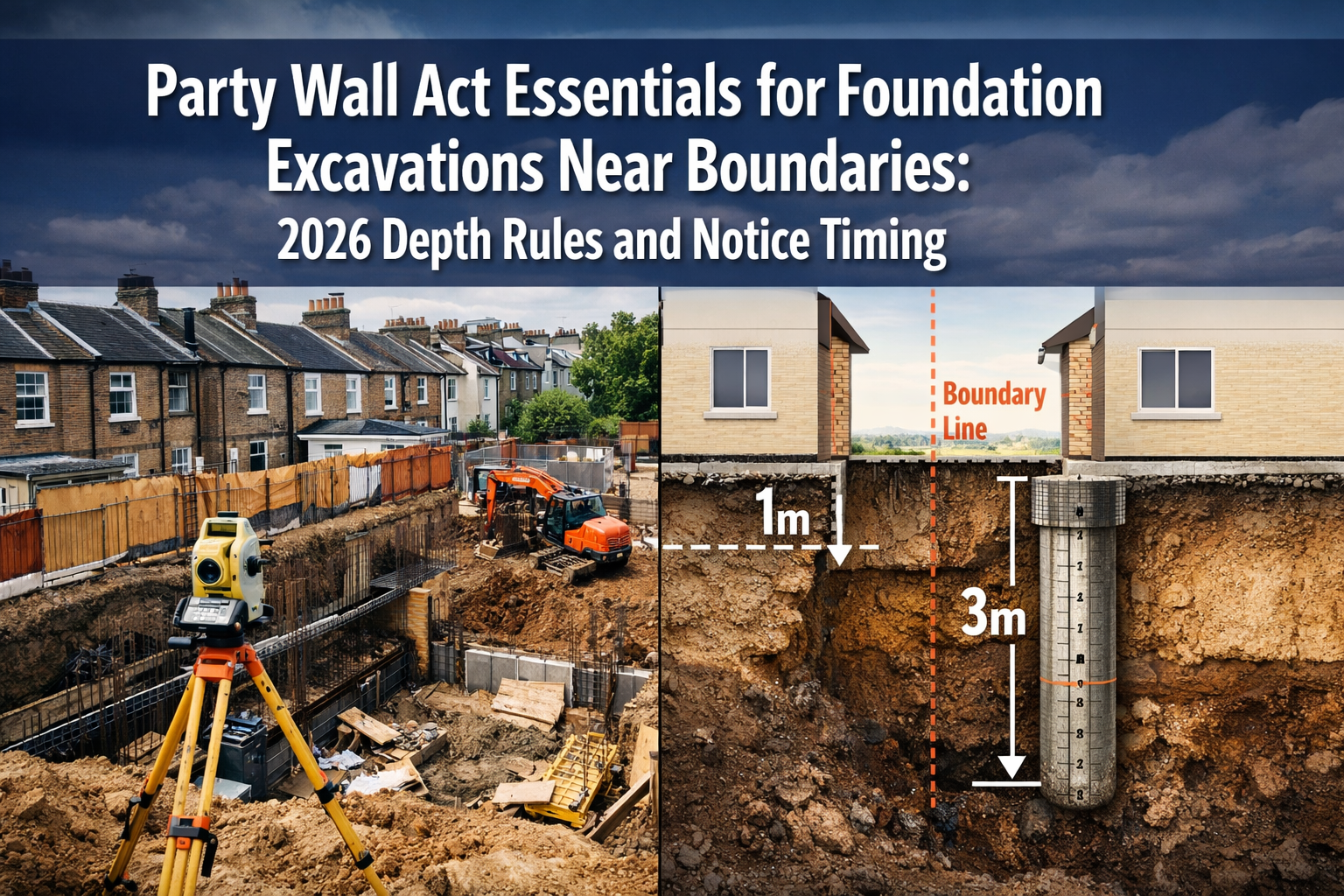
The complexity intensifies when working near older properties. A standard extension on a post-2015 home might sit comfortably outside Section 6 triggers, but the same excavation adjacent to a 1930s terrace will almost certainly breach the 3-metre or 6-metre rules. This article clarifies the precise triggers, notice timing requirements, and documentation standards that separate compliant projects from costly legal disputes.
Key Takeaways
- ✅ The 3-metre rule requires Section 6 notice when excavating within 3 metres of a neighbour's building AND going deeper than their existing foundations—distance alone doesn't trigger compliance
- ⏰ Minimum one-month notice is mandatory for excavation works, with two months required for construction elements; late notices invalidate the entire process
- 📏 Modern foundations (post-2015) now reach 1.5m+ depth, making Section 6 compliance almost inevitable when working near Victorian properties with 450mm shallow foundations
- 📋 Section 6 Notices must include detailed plans and cross-sections showing excavation depth and location—missing documentation is the most common cause of rejected notices
- 🔧 Special foundations using reinforced concrete, steel pins, or piles require written neighbour consent, not just standard notice procedures
Understanding Section 6 Triggers: The 3-Metre and 6-Metre Rules
The Party Wall etc. Act 1996 establishes two distinct distance-based triggers for foundation excavations near boundaries. These rules determine when property owners must serve formal Party Wall Act notices to adjoining owners before commencing work.
The 3-Metre Rule Explained
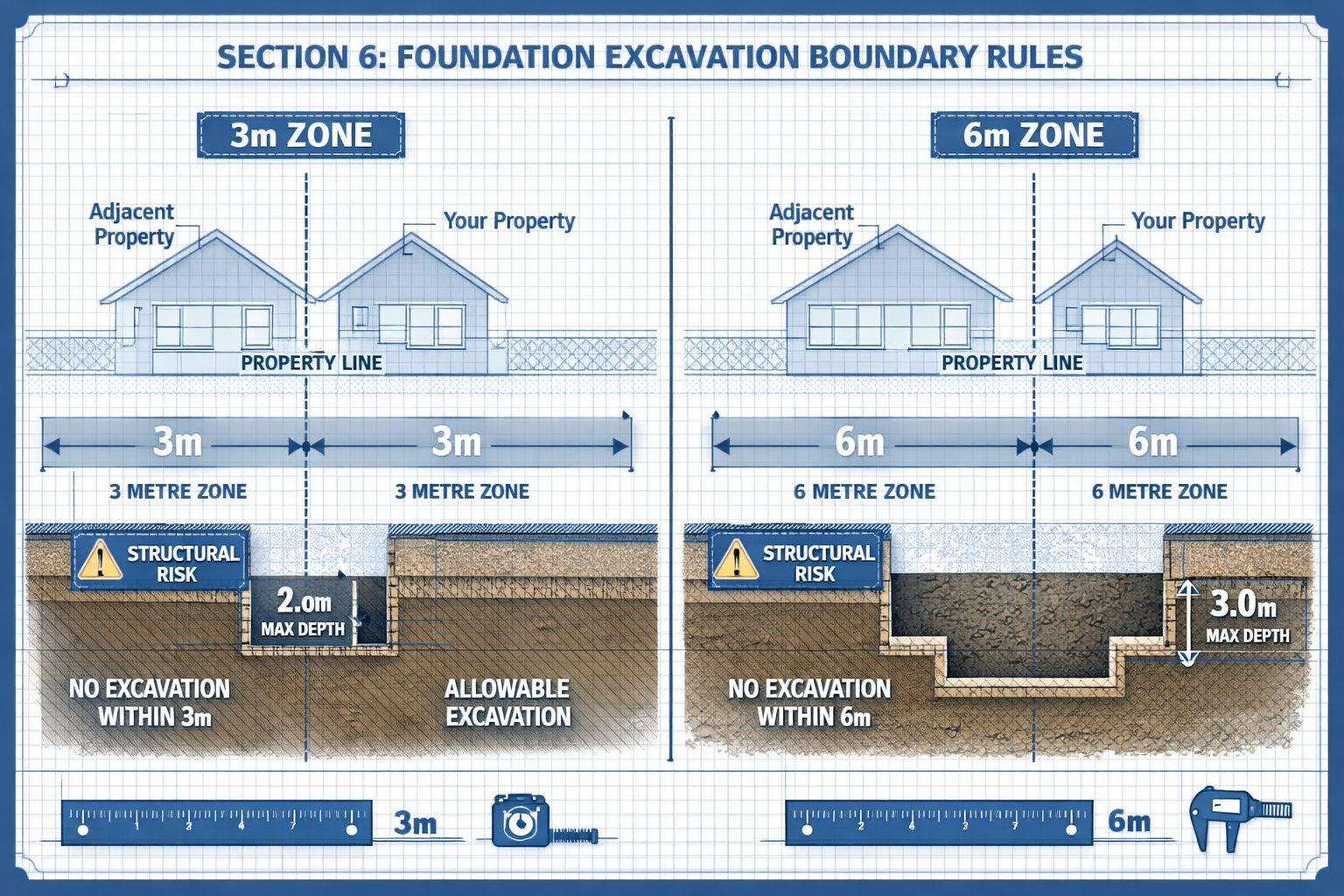
The 3-metre rule applies when excavation for new foundations occurs within 3 metres of a neighbouring building and the proposed foundation will extend to a greater depth than the neighbour's existing foundations.[1] This is a critical distinction that many property owners misunderstand.
Distance alone does not trigger Section 6 requirements. The depth comparison is the determining factor.[2] If excavation remains shallower than the neighbouring property's foundations, no Section 6 notice is generally required, regardless of proximity.[1]
Consider this practical example:
| Scenario | Your Excavation Depth | Neighbour's Foundation Depth | Distance from Boundary | Section 6 Required? |
|---|---|---|---|---|
| A | 1.2m | 1.5m | 2.5m | ❌ No |
| B | 1.5m | 1.2m | 2.5m | ✅ Yes |
| C | 1.5m | 1.2m | 3.5m | ❌ No (beyond 3m) |
| D | 0.9m | 0.6m | 1.0m | ✅ Yes |
The 6-Metre Rule and 45-Degree Angle Test
The 6-metre rule applies when excavation occurs within 6 metres of a neighbouring building where a 45-degree downward line drawn from the bottom of the neighbour's foundations intersects with the proposed excavation zone.[1] This geometric test becomes the primary concern for basement conversions and deep piling projects.[1]
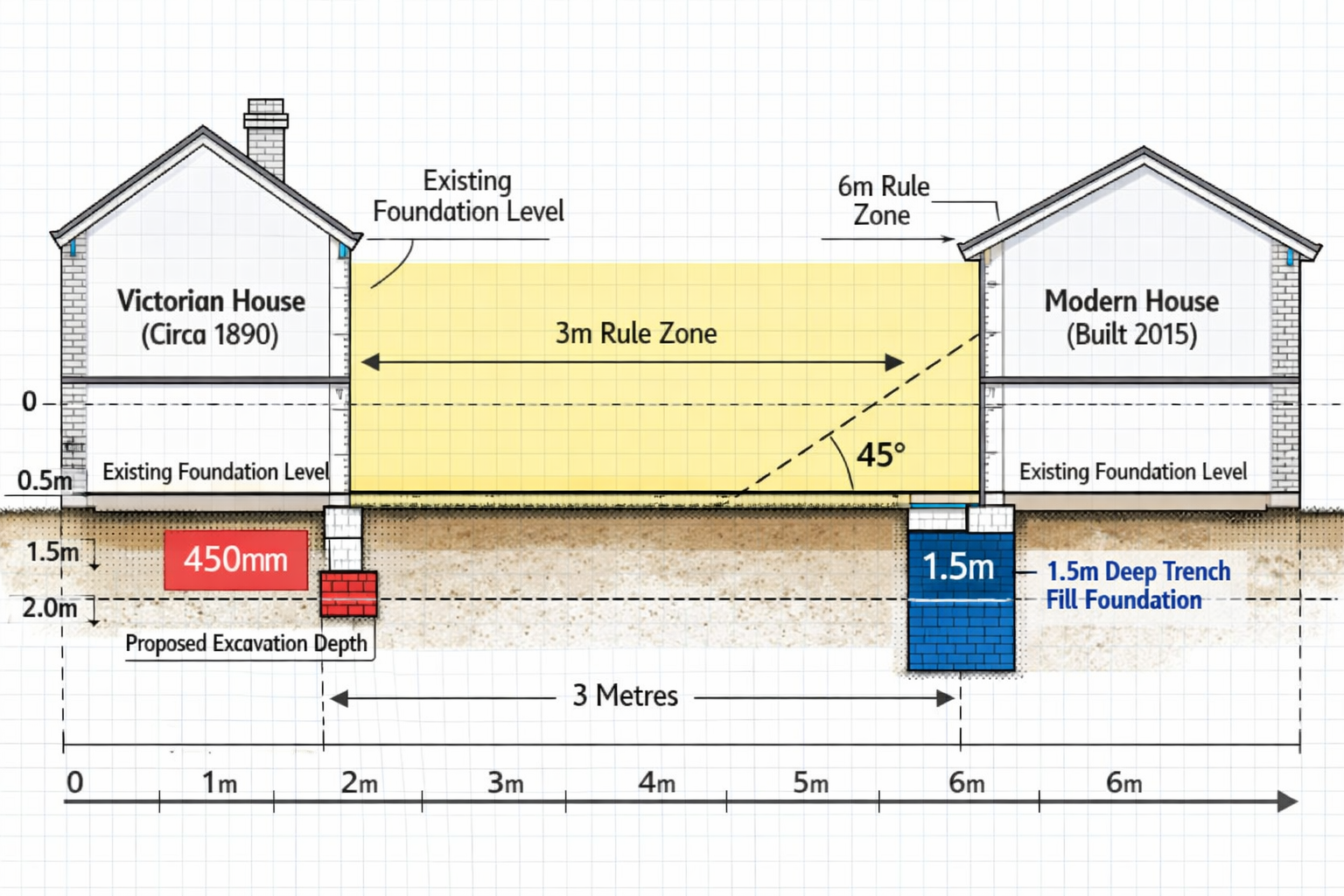
The 45-degree test works as follows:
- Identify the lowest point of your neighbour's existing foundations
- Draw an imaginary line at 45 degrees downward from that point toward your property
- If your proposed excavation crosses below this line, Section 6 applies[5]
This rule catches many developers off guard, particularly those undertaking basement conversions in terraced properties. Even if the excavation starts 5 metres from the boundary, digging down 3 metres may still intersect the 45-degree plane.[1]
Modern Foundation Depths and Section 6 Implications
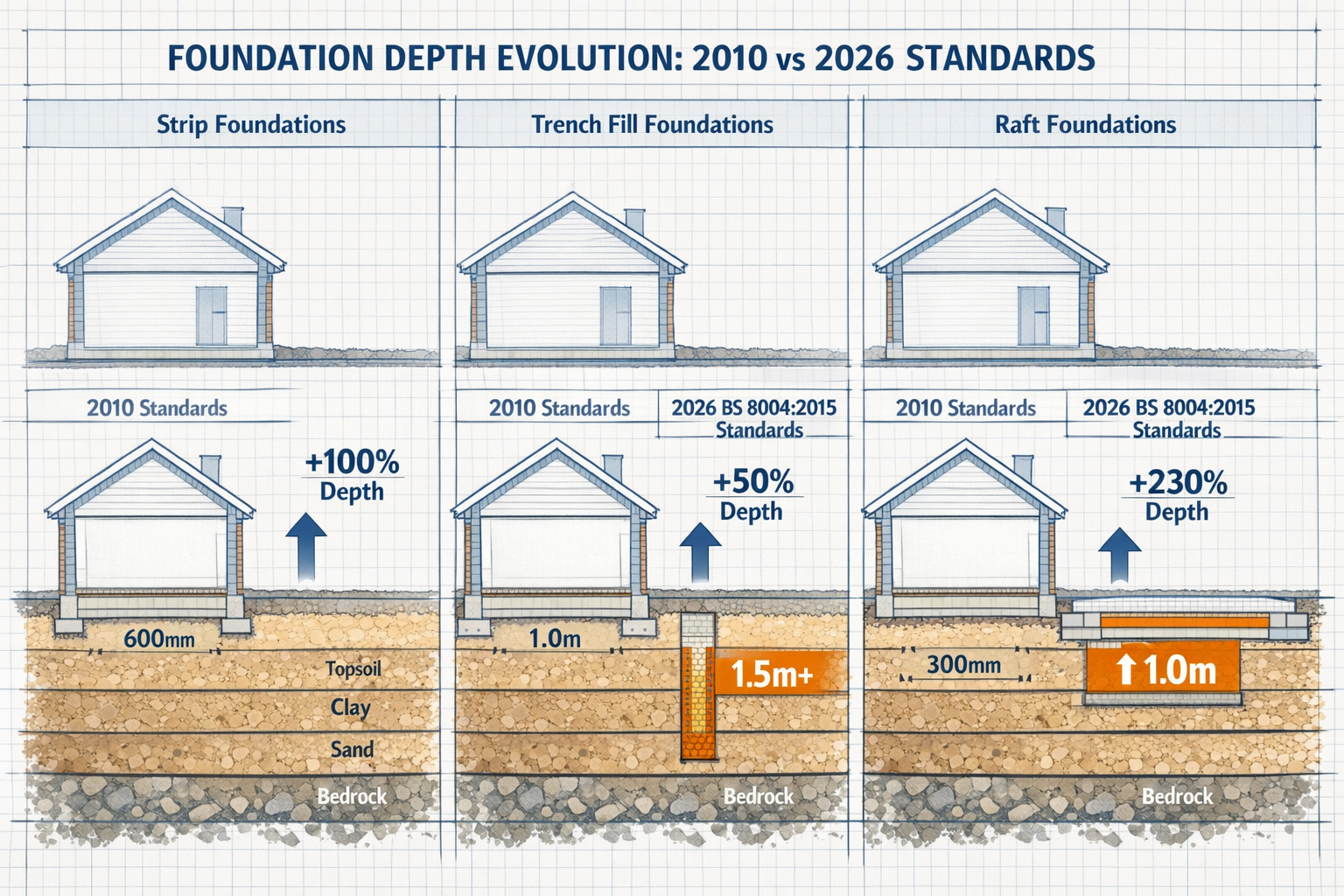
Current British Standard guidance under BS 8004:2015 has dramatically increased typical foundation depths compared to pre-2010 practice:[3]
Strip Foundations:
- 2010 standard: 600mm–1.0m
- 2026 standard: 900mm–1.2m
Trench Fill Foundations:
- 2010 standard: ~1.0m
- 2026 standard: 1.5m+ (regularly exceeding this depth)
Raft Foundations:
- 2010 standard: 300mm–600mm
- 2026 standard: 500mm–1.0m[3]
This evolution creates a generational gap in foundation depths. Victorian and 1930s properties typically sit on shallow strip foundations as little as 450mm deep, meaning almost any modern excavation will trigger Section 6 requirements when working nearby.[3]
Conversely, properties built after 2010 with trench fill foundations at 1.5m depth may not trigger Section 6 if proposed works involve similar excavation depths—unless the new excavation goes deeper or closer than specified thresholds.[3]
Party Wall Act Essentials for Foundation Excavations: Notice Timing and Content Requirements
Proper notice timing separates compliant projects from those facing injunctions and costly delays. The Party Wall Act Essentials for Foundation Excavations Near Boundaries: 2026 Depth Rules and Notice Timing require strict adherence to statutory periods that cannot be shortened, even with neighbour agreement.
Statutory Notice Periods for Section 6 Works
A Section 6 Notice must be served to neighbours a minimum of one month before work begins for excavation-only projects.[1] This is distinctly different from other types of party wall works, which may require different notice periods.
For works involving construction elements (non-excavation activities), a two-month notice period applies.[7] This distinction matters when projects combine foundation excavation with structural building work.
Critical timing considerations:
⏰ Notice period starts from the date the neighbour receives the notice, not when it's sent
⏰ The one-month minimum cannot be waived, even if neighbours verbally agree to earlier commencement
⏰ Serving notice too early (more than 12 months before work) invalidates the notice under the Act
⏰ Late notices require restarting the entire process, potentially delaying projects by months
Essential Content for Valid Section 6 Notices
Section 6 Notices must include plans and sections detailing the excavation depth and location for validity.[4] Omitting this information is the most common compliance mistake that causes delays and disputes.[4]
Mandatory notice contents include:
📋 Detailed site plans showing the boundary line, proposed excavation location, and distance measurements to neighbouring buildings
📋 Cross-sectional drawings illustrating the depth of proposed foundations relative to ground level and neighbouring foundations
📋 Specification of proposed foundation depth with precise measurements in metres
📋 Intended location of the new wall or structure being supported by the foundations[1]
📋 Building owner's name and address plus details of the property where works will occur
📋 Description of the proposed works in sufficient detail for the neighbour to understand the scope
Many property owners attempt to serve notices using vague descriptions or without technical drawings. This approach invariably leads to rejection and requires resubmission with proper documentation, resetting the statutory notice period.[4]
For guidance on properly drafting and serving notices, refer to our comprehensive guide on Party Wall Act notices and how to respond.
Special Foundations: Additional Consent Requirements
Projects involving reinforced concrete or steel elements (pins or piles)—common in basement conversions and heavy extensions—require specific written consent from the neighbour, not just standard notice.[1] This elevated requirement reflects the increased structural risk these foundation types pose.
Special foundations requiring explicit consent:
🔧 Steel piling or mini-piles
🔧 Reinforced concrete underpinning
🔧 Ground anchors or soil nails extending toward neighbouring property
🔧 Secant or contiguous piled walls
🔧 Diaphragm walls with reinforcement
The distinction matters significantly. Standard Section 6 notices allow work to proceed after the notice period expires, even without neighbour agreement (triggering the dispute resolution process). Special foundations cannot proceed without affirmative written consent—silence or dispute does not permit commencement.[1]
Determining Existing Foundation Depths: Investigation Standards for 2026
Accurate knowledge of neighbouring foundation depths is essential for determining whether Section 6 applies. Historical building records are often unavailable or unreliable, particularly for properties built before 1950.
Trial Pit Investigation Protocols
Party Wall Surveyors commonly use trial pits—exploratory holes dug 3–15 feet deep—prior to work commencement to accurately determine existing foundation depth and position.[2] This investigation ensures compliance and prevents future structural damage from weakened support.
Standard trial pit procedure:
- Obtain permission from the property owner where the trial pit will be dug (usually the building owner's land)
- Position pits strategically near the boundary to expose foundation edges without undermining structures
- Excavate carefully using hand tools or mini-excavators to avoid damaging existing foundations
- Document findings with photographs, measurements, and cross-sectional sketches
- Backfill properly with compacted material to prevent settlement
Trial pits typically cost £300–£800 per location, depending on depth and site access constraints. This investment prevents far costlier disputes arising from incorrect Section 6 determinations.[2]
Alternative Investigation Methods
When trial pits are impractical due to site constraints, surveyors may employ:
Ground Penetrating Radar (GPR): Non-invasive scanning that identifies foundation edges and depth through electromagnetic wave reflection. Accuracy varies with soil conditions; clay-heavy soils reduce effectiveness.
Structural Drawings Review: Examining approved building control drawings from the local authority, though these may not reflect as-built conditions if construction deviated from plans.
Visual Inspection of Basement/Cellar Walls: Internal examination can reveal foundation depth in properties with accessible below-ground spaces.
Neighbour Cooperation: Direct measurement from the neighbour's side with permission, though this requires goodwill that may not exist in contentious situations.
For complex urban projects, particularly those in Central London or West London where properties are densely packed, professional surveyor involvement from the outset prevents costly missteps.
Common Compliance Failures and How to Avoid Them
Understanding where projects typically fail helps surveyors draft bulletproof party wall awards and building owners avoid legal challenges.
Failure Point #1: Assuming Distance Alone Triggers Section 6
The mistake: Property owners believe any excavation within 3 metres of a neighbour automatically requires Section 6 notice.
The reality: Section 6 only applies when excavation is both within the distance threshold AND deeper than neighbouring foundations.[1][2]
The solution: Always determine neighbouring foundation depth before serving notices. Unnecessary notices create administrative burden and may trigger disputes where none would otherwise exist.
Failure Point #2: Incomplete Notice Documentation
The mistake: Serving Section 6 notices with vague descriptions like "foundation excavation for extension" without technical drawings or depth specifications.
The reality: Notices lacking plans and sections are invalid and must be resubmitted, resetting the statutory notice period.[4]
The solution: Engage a qualified surveyor to prepare comprehensive notice packages including:
- Scaled site plans (minimum 1:100 scale)
- Cross-sectional drawings showing both properties' foundation levels
- Detailed specifications with measurements in metres
- Clear identification of special foundation elements requiring consent
Failure Point #3: Incorrect Notice Timing
The mistake: Starting work 3 weeks after serving notice, or serving notice 18 months before anticipated work commencement.
The reality: The one-month minimum is absolute, and notices served more than 12 months before work are invalid.[1]
The solution: Coordinate notice timing with realistic construction schedules, allowing buffer time for potential neighbour disputes or surveyor appointments.
Failure Point #4: Proceeding Without Consent for Special Foundations
The mistake: Treating reinforced concrete piles or steel pins as standard foundations requiring only Section 6 notice.
The reality: These elements require explicit written neighbour consent before work can commence.[1]
The solution: Identify special foundation requirements during design phase and initiate consent discussions early. Consider alternative foundation designs if neighbour consent appears unlikely.
For properties in areas with high development density, such as North London or South London, these compliance failures occur with alarming frequency, often derailing projects for months.
Practical Application: Case Studies for 2026 Projects
Case Study 1: Victorian Terrace Extension
Scenario: Two-storey rear extension on 1890s Victorian terrace in East London. Proposed strip foundations at 1.1m depth, located 2.2m from boundary. Neighbouring property (also Victorian) has original foundations at estimated 500mm depth.
Section 6 Analysis:
- Distance: 2.2m (within 3-metre rule threshold) ✅
- Depth comparison: 1.1m proposed vs. 500mm existing (going deeper) ✅
- Result: Section 6 notice required
Action taken: Building owner served Section 6 notice with cross-sectional drawings showing 1.1m excavation depth. Neighbour consented after 2 weeks. Trial pit confirmed neighbouring foundations at 480mm. Work commenced 32 days after notice service.
Outcome: Compliant project with no disputes. Total surveyor costs: £850.
For similar projects in East London, this scenario represents the standard application of Party Wall Act Essentials for Foundation Excavations Near Boundaries: 2026 Depth Rules and Notice Timing.
Case Study 2: Modern Semi-Detached Basement Conversion
Scenario: Full basement excavation beneath 2012-built semi-detached house. Proposed excavation depth: 2.8m below ground level. Distance to neighbouring property: 4.5m. Neighbouring property built simultaneously with same foundation specification (1.5m trench fill).
Section 6 Analysis:
- Distance: 4.5m (within 6-metre rule threshold) ✅
- 45-degree test: Line drawn from neighbour's foundation base (1.5m) at 45° extends 1.5m horizontally, reaching 3.0m from boundary
- Proposed excavation at 4.5m distance and 2.8m depth intersects the 45° plane ✅
- Result: Section 6 notice required despite modern foundations
Action taken: Building owner commissioned structural engineer drawings showing excavation profile and 45° plane intersection. Section 6 notice served with detailed underpinning methodology. Neighbour initially disputed, triggering surveyor appointments. Party wall award drafted specifying temporary support measures and schedule of condition.
Outcome: Work proceeded after 8-week surveyor process. Total costs: £3,200 (including both surveyors' fees). No structural damage to neighbouring property.
Case Study 3: Shallow Garden Wall Foundation
Scenario: New 1.8m high garden boundary wall requiring 600mm deep strip foundation. Location: 1.5m from neighbouring 1930s property with foundations at 700mm depth.
Section 6 Analysis:
- Distance: 1.5m (within 3-metre rule threshold) ✅
- Depth comparison: 600mm proposed vs. 700mm existing (staying shallower) ❌
- Result: No Section 6 notice required
Action taken: Building owner obtained confirmation of neighbouring foundation depth through friendly discussion with neighbour and visual inspection of visible foundation edge. Proceeded without formal notice.
Outcome: Work completed without Party Wall Act involvement. Zero surveyor costs. Good neighbour relations maintained.
This case demonstrates the importance of understanding that the Party Wall Act Essentials for Foundation Excavations Near Boundaries: 2026 Depth Rules and Notice Timing do not apply universally—depth comparison is critical.
Drafting Compliant Awards for Deep Excavations
For surveyors preparing party wall awards for foundation excavations, 2026 best practices demand comprehensive documentation that addresses both immediate construction risks and long-term structural implications.
Essential Award Clauses for Foundation Works
Excavation methodology: Specify permitted excavation techniques, maximum daily dig depths, and requirements for temporary support (sheet piling, trench boxes, etc.).
Underpinning protocols: Where excavation undermines neighbouring foundations, detail the underpinning sequence, materials specifications (concrete grade, reinforcement), and inspection requirements.
Monitoring provisions: Require installation of crack monitoring stations, level monitoring points, and regular surveyor inspections during excavation phases.
Working hours: Define permitted construction hours to minimize neighbour disruption, typically 8am–6pm Monday–Friday, 8am–1pm Saturday in residential areas.
Schedule of condition: Mandate comprehensive photographic and descriptive records of neighbouring property condition before work commences.[7] This protects both parties in subsequent damage claims.
Insurance requirements: Specify minimum public liability coverage (typically £5–10 million for residential projects) and require proof before work commences.
Dispute resolution mechanisms: Outline procedures for addressing concerns arising during construction, including surveyor inspection protocols and temporary work cessation triggers.
For detailed guidance on schedules of condition, see our article on preventing post-construction claims in party wall works.
Special Considerations for Basement Conversions
Basement excavations present heightened risks requiring additional award provisions:
🏗️ Temporary works design: Require structural engineer certification for temporary support systems, particularly where excavation depth exceeds 2 metres.
🏗️ Dewatering protocols: Address groundwater management to prevent undermining neighbouring foundations through water table changes.
🏗️ Vibration limits: Specify maximum vibration levels (typically 10mm/s peak particle velocity for residential structures) with continuous monitoring.
🏗️ Access arrangements: Define routes for machinery and material delivery to minimize impact on neighbouring properties.
🏗️ Duration limitations: Set realistic completion timeframes with penalties for excessive delays that prolong neighbour disruption.
Understanding boundary wall rules and the difference between party fence walls and boundary walls helps surveyors determine whether additional notices beyond Section 6 may be required for projects affecting existing boundary structures.
Cost Implications and Fee Structures for 2026
Understanding the financial implications of Section 6 compliance helps building owners budget appropriately and avoid surprises.
Typical Cost Breakdown
Building owner's surveyor fees: £800–£1,500 for straightforward excavation projects; £1,500–£3,000 for complex basement conversions[13]
Adjoining owner's surveyor fees: Similar range, paid by the building owner under the Act
Trial pit investigations: £300–£800 per location
Schedule of condition preparation: £400–£800 for comprehensive photographic and descriptive records
Monitoring during construction: £200–£500 per inspection visit (typically 3–6 visits for excavation projects)
Total typical range: £2,500–£7,000 for projects triggering Section 6 requirements
For strategies to minimize these expenses, see our guide on how to keep party wall costs down.
When Costs Escalate
Disputes dramatically increase expenses. If neighbours dissent to the notice, the surveyor appointment process begins, adding:
- Extended timelines (typically 6–12 weeks additional delay)
- Increased surveyor fees for dispute resolution
- Potential for third surveyor appointment if the two appointed surveyors cannot agree
- Legal fees if disputes escalate beyond the surveyor process
Prevention strategies:
💰 Engage neighbours early with informal discussions before serving formal notices
💰 Provide clear, professional documentation that demonstrates competence and care
💰 Offer to fund schedule of condition at your expense to demonstrate good faith
💰 Consider appointing an agreed surveyor if neighbour relations are positive, reducing total fees
Conclusion: Ensuring Compliance in 2026's Regulatory Environment
The Party Wall Act Essentials for Foundation Excavations Near Boundaries: 2026 Depth Rules and Notice Timing represent a critical compliance framework that protects both building owners and their neighbours during construction projects. As modern foundation depths continue to increase under current British Standards, Section 6 triggers have become nearly inevitable when working near pre-2010 properties.
Key action steps for building owners:
✅ Determine neighbouring foundation depths early through trial pits or alternative investigation methods before finalizing foundation designs
✅ Serve Section 6 notices with comprehensive documentation including scaled plans, cross-sections, and precise depth specifications at least one month before work commencement
✅ Identify special foundation requirements (reinforced concrete, steel elements) and obtain explicit written consent where required
✅ Engage qualified party wall surveyors at project inception to ensure compliant notice timing and award drafting
✅ Budget appropriately for surveyor fees, investigations, and monitoring—typically £2,500–£7,000 for projects triggering Section 6
For surveyors drafting awards:
✅ Apply the 3-metre and 6-metre rules precisely using actual foundation depth comparisons and geometric 45-degree tests, not assumptions
✅ Draft comprehensive awards addressing excavation methodology, underpinning protocols, monitoring provisions, and dispute resolution mechanisms
✅ Mandate schedules of condition before work commences to establish baseline property conditions
✅ Specify special provisions for high-risk works like basement conversions, including vibration limits and temporary works certification
The regulatory environment in 2026 demands professional competence and meticulous documentation. Projects that cut corners on Section 6 compliance face injunctions, costly delays, and potential liability for structural damage. Those that follow the Party Wall Act Essentials for Foundation Excavations Near Boundaries: 2026 Depth Rules and Notice Timing proceed smoothly, maintain neighbour relations, and avoid legal entanglements.
For property owners embarking on foundation excavations near boundaries, early engagement with qualified professionals is not optional—it's essential. Whether you're a building owner planning works or an adjoining owner receiving notice, understanding these rules protects your interests and ensures compliant, successful project delivery.
References
[1] Excavation And The Party Wall Act Navigating The 3 And 6 Metre Rules For Foundations – https://www.partywallslimited.com/blog/excavation-and-the-party-wall-act-navigating-the-3–and-6-metre-rules-for-foundations
[2] Party Wall Act 3 Metre Rule – https://iconsurveyors.co.uk/blog/party-wall-act-3-metre-rule/
[3] Are Foundations Getting Deeper A Look At Modern Building Practice And Party Wall Implications – https://www.peterbarry.co.uk/blog/are-foundations-getting-deeper-a-look-at-modern-building-practice-and-party-wall-implications/
[4] Party Wall Excavation Questions – https://collier-stevens.co.uk/faqs/party-wall-excavation-questions/
[5] The Party Wall Act 3 Metre Rule Explained – https://westvilleassociates.com/blog/the-party-wall-act-3-metre-rule-explained
[6] Drafting Party Wall Awards For Basement Conversions 2026 Protocols For Deep Excavations Near Boundaries – https://nottinghillsurveyors.com/blog/drafting-party-wall-awards-for-basement-conversions-2026-protocols-for-deep-excavations-near-boundaries
[7] Schedules Of Condition In Party Wall Works Best Practices To Prevent Post Construction Claims In 2026 – https://nottinghillsurveyors.com/blog/schedules-of-condition-in-party-wall-works-best-practices-to-prevent-post-construction-claims-in-2026