

Nearly one in three party wall notices served in England and Wales contains at least one error significant enough to render it invalid — a statistic that costs building owners thousands in delays, legal fees, and damaged neighbour relationships. Whether it's a missing floor plan, an incorrect notice period, or a notice served on the wrong person, these mistakes are almost entirely preventable. This guide to Drafting Flawless Party Wall Notices: Common Errors, Legal Fixes, and RICS 8th Edition Templates breaks down exactly where notices go wrong, how to fix them, and what the updated RICS 8th Edition guidance means for compliance in 2026.
Key Takeaways 📋
- Invalid notices are common — errors in description, service method, or timing can void a notice entirely.
- RICS launched an 8th Edition consultation in April 2026, updating templates, fee guidance, and jurisdiction rules. [1]
- Three notice types exist under the Party Wall etc. Act 1996 — each has distinct requirements that must be met precisely.
- Corrected templates aligned with RICS 8th Edition drafts provide a reliable starting point for 2026 compliance.
- Professional surveyors remain the safest route to a valid, dispute-free notice process, but understanding the rules helps every building owner.
The Three Types of Party Wall Notices and Why Each One Matters
Before exploring errors, it helps to understand the legal framework. The Party Wall etc. Act 1996 creates three distinct notice types, each triggered by different works:
| Notice Type | Trigger Works | Minimum Notice Period |
|---|---|---|
| Party Structure Notice | Works to a shared wall, floor, or structure | 2 months |
| Line of Junction Notice | Building a new wall on or near the boundary | 1 month |
| Three Metre / Six Metre Notice | Excavations near a neighbour's foundations | 1 month |
Each notice type carries its own mandatory content requirements. Confusing them — or serving the wrong notice for the planned works — is one of the most common and costly mistakes.
💡 Pull Quote: "Serving the wrong notice type is not a minor technicality. It can void the entire process and expose a building owner to an injunction."
For a detailed breakdown of what each notice covers, the party wall notices overview explains the distinctions clearly.
Drafting Flawless Party Wall Notices: Common Errors, Legal Fixes, and RICS 8th Edition Templates — The Error Catalogue
This section covers the most frequent invalidation pitfalls, with corrected examples and practical fixes.
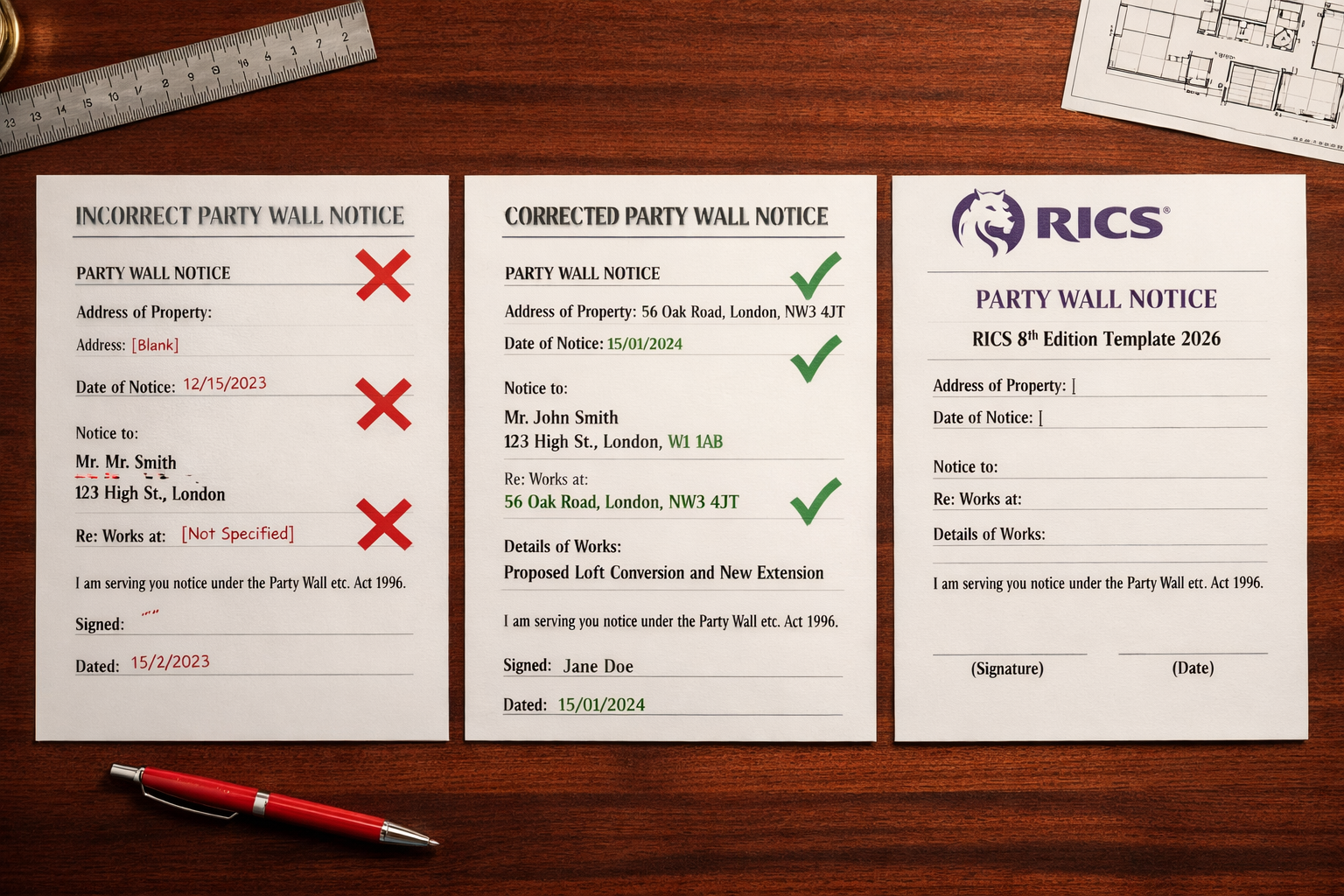
❌ Error 1: Vague or Incorrect Property Description
The problem: A notice that describes the property as "the house next door" or omits the full postal address is legally deficient. Courts and surveyors have challenged notices where the property affected was not precisely identified.
The fix: Include the full postal address, Land Registry title number where available, and a brief description of the structure affected (e.g., "the party wall forming the shared boundary between No. 14 and No. 16 Elm Street").
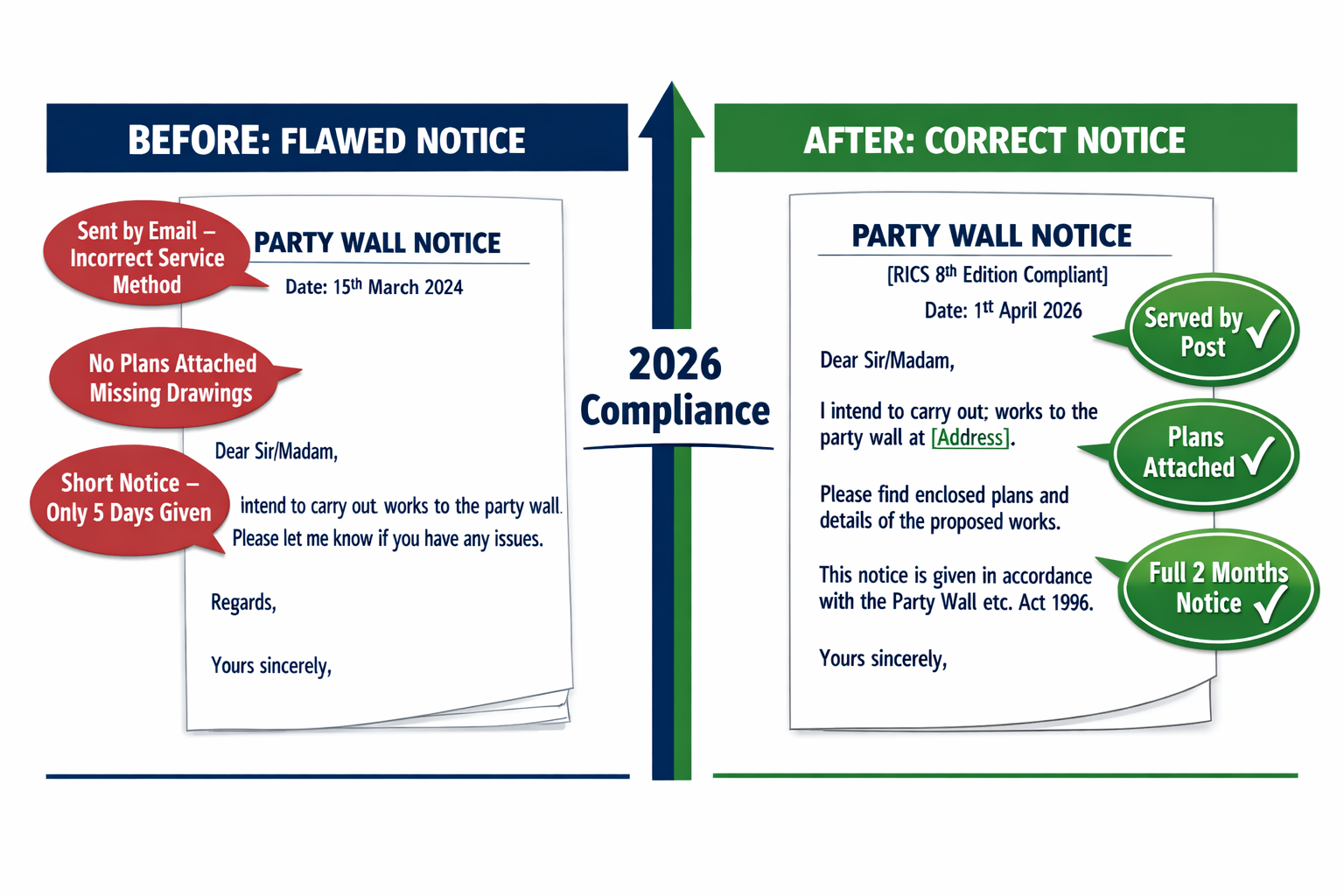
❌ Error 2: Missing or Inadequate Plans
The problem: The Party Wall etc. Act 1996 requires that notices include plans and sections showing the proposed works. Many building owners serve notices with no drawings at all, or attach sketches that lack sufficient detail — no dimensions, no indication of depth, no relationship to the party wall shown.
The fix: Attach scaled drawings that show:
- The location of the works relative to the party wall or boundary
- Depth of any excavations
- Any structural elements being altered or removed
- The footprint of any new structure
The RICS 8th Edition draft reinforces that supporting documentation must be adequate for the adjoining owner to understand the scope of works. [2]
❌ Error 3: Incorrect Notice Period
The problem: A building owner eager to start works may serve a Party Structure Notice and begin works after only three weeks, not realising the statutory two-month minimum applies. This is a jurisdictional error — works begun before the notice period expires are technically unlawful.
The fix: Calculate the notice period from the date of service, not the date of drafting. If serving by post, add two business days. Mark the earliest lawful start date clearly on the notice itself.
❌ Error 4: Serving Notice on the Wrong Person
The problem: The Act requires notice to be served on the adjoining owner — the person with a freehold or leasehold interest of more than one year. Serving notice only on a tenant when the freeholder is a different person, or vice versa, creates a gap in the legal process.
The fix: Conduct a Land Registry search before serving. If the property is tenanted, serve notice on both the freeholder and any qualifying leaseholder. For adjoining owners, understanding their rights from the outset reduces disputes.
❌ Error 5: Invalid Service Method
The problem: Hand-delivering a notice by pushing it through the letterbox without any record of delivery, or emailing a notice without prior written consent to accept electronic service, are both problematic. If the adjoining owner later claims they never received the notice, there is no evidence trail.
The fix: Serve by:
- Recorded delivery post (Royal Mail Signed For or Special Delivery)
- Personal service with a witness
- Electronic means only if the adjoining owner has explicitly agreed in writing
Keep a dated record of every service attempt.
❌ Error 6: Omitting the Response Options
The problem: A valid notice must inform the adjoining owner of their right to consent, dissent, or appoint a surveyor. Notices that simply state "we intend to carry out works" without explaining the response mechanism are incomplete.
The fix: Include a clear statement of the adjoining owner's options:
- Consent in writing within the response period
- Dissent and appoint their own surveyor
- Agree to appoint a single agreed surveyor
For more on how the response process works, see party wall act notices — what they are and how to respond.
❌ Error 7: Acting Without Proper Jurisdiction
The problem: The RICS 8th Edition draft specifically addresses cases where surveyors have proceeded to issue awards when no genuine dispute existed — or where the notice itself was invalid, stripping the surveyors of jurisdiction entirely. [2][4] Awards issued without valid jurisdiction have been successfully challenged in court.
The fix: Surveyors must confirm that a valid notice has been properly served and that a genuine dispute or deemed dispute exists before proceeding to award. Building owners should not pressure surveyors to skip steps.
What the RICS 8th Edition Draft Changes — and Why It Matters in 2026
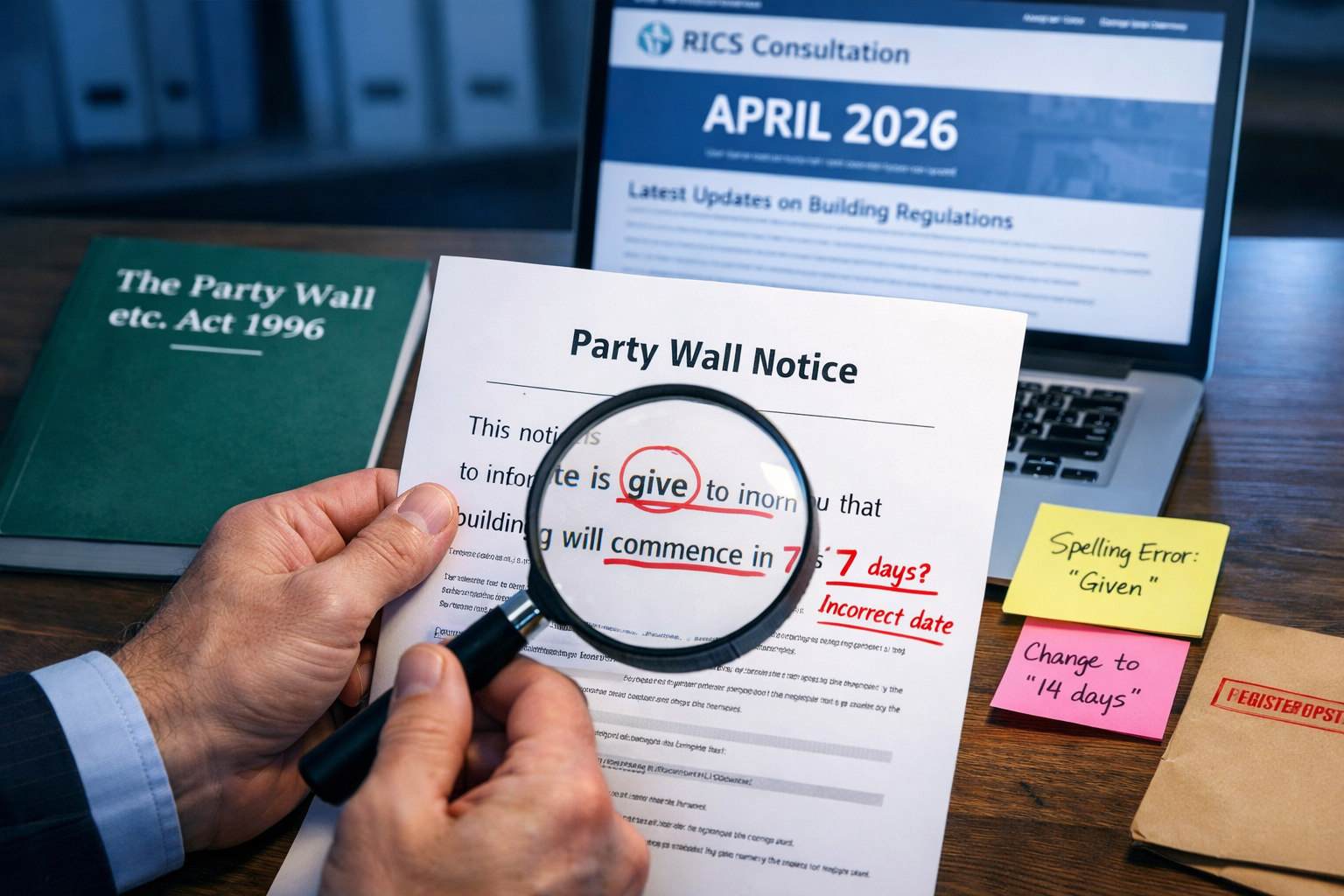
In April 2026, RICS launched an eight-week consultation on the draft 8th Edition of Party Wall Legislation and Procedure, replacing the existing 7th Edition. [1][3] The consultation targets surveyors, legal professionals, dispute resolution practitioners, and other stakeholders across England and Wales. [1]
Key Updates in the Draft 8th Edition
🔹 Enhanced Templates and Appendices
The draft includes revised letters of appointment, updated terms of engagement, and a refreshed draft award template. [1] These templates reflect current best practice and are designed to reduce the jurisdictional and procedural errors that have led to award challenges in recent years. [2]
🔹 Strengthened Fee Guidance
One recurring source of dispute has been disproportionate or opaque fee structures. The 8th Edition strengthens guidance on fee practices to promote transparency and fairness. [1] For building owners concerned about costs, understanding how to keep party wall costs down is increasingly important.
🔹 Clearer Guidance on the Third Surveyor
The updated edition provides clearer direction on when and how the Third Surveyor should be engaged, reducing ambiguity in contested situations. [1]
🔹 Surveyor Independence Reinforced
A key principle in the draft is that a party wall surveyor's appointment is personal and statutory — independent of client instruction. [2] This means a building owner cannot instruct their surveyor to act in a way that compromises the surveyor's statutory duty. This is a significant conduct reminder for all practitioners.
🔹 Jurisdiction Concerns Addressed
The draft directly tackles the problem of surveyors acting without proper jurisdiction — particularly in cases where awards have been challenged because no genuine dispute existed. [2][4] This has real implications for how notices are drafted and served, since an invalid notice means no valid jurisdiction.
💡 Pull Quote: "A surveyor's appointment is personal and statutory. No client instruction can override the duty to act impartially within the law." — RICS 8th Edition Draft Principle [2]
RICS 8th Edition Template Preview: What a Compliant Party Structure Notice Looks Like
While the full templates are subject to the ongoing consultation, the following structure reflects the requirements of a compliant Party Structure Notice under the Act and the anticipated 8th Edition standards.
✅ Compliant Party Structure Notice — Key Elements Checklist
| Element | Required Detail |
|---|---|
| Building Owner's Name & Address | Full legal name and correspondence address |
| Adjoining Owner's Name & Address | Full legal name, confirmed via Land Registry |
| Description of Works | Specific, referenced to attached plans |
| Supporting Plans | Scaled, dimensioned, showing party wall relationship |
| Proposed Start Date | At least 2 months from date of service |
| Response Options | Consent / Dissent / Agreed Surveyor clearly stated |
| Surveyor Details | Name and address of building owner's surveyor (if appointed) |
| Service Method Record | Date, method, and evidence of service |
For those wanting a ready-to-use starting point, a free sample party wall agreement template provides a practical foundation before engaging a professional.
Drafting Flawless Party Wall Notices: Common Errors, Legal Fixes, and RICS 8th Edition Templates — Practical Workflow
Following a structured workflow dramatically reduces the risk of notice invalidation. Here is a step-by-step process aligned with 2026 best practice:
Step-by-Step Notice Workflow 🗂️
-
Confirm the works trigger the Act — Not all construction work requires a party wall notice. Review the types of party wall works that fall under the Act.
-
Identify the correct notice type — Match the planned works to the appropriate notice (Party Structure, Line of Junction, or Excavation).
-
Identify all adjoining owners — Run a Land Registry search. Serve notice on every qualifying owner, including freeholders and long leaseholders.
-
Prepare scaled drawings — Commission an architect or structural engineer to produce compliant plans if needed.
-
Draft the notice — Use an RICS-aligned template. Include all mandatory elements from the checklist above.
-
Calculate the notice period — Count forward from the date of service, not drafting. Mark the earliest lawful start date.
-
Serve the notice — Use a recorded method. Retain proof of service.
-
Record the response — If the adjoining owner consents in writing, works can proceed after the notice period. If they dissent or fail to respond within 14 days, a dispute is deemed to have arisen and the surveyor process begins.
For building owners navigating this process alone, the guide on having a party wall agreement without a surveyor outlines the risks and limitations clearly.
When Professional Help Is Non-Negotiable
Some situations carry too much legal and financial risk to manage without a qualified surveyor:
- Complex structural works — loft conversions, basement excavations, underpinning
- Disputed boundaries — where the exact line of the party wall is unclear
- Multiple adjoining owners — terraced properties with several neighbours affected
- Prior relationship damage — where the neighbour relationship is already strained
- High-value properties — where the cost of an injunction or damages claim is significant
A party wall award issued by qualified surveyors provides legal protection for both sides. It is not just a formality — it is a binding document that defines the rights and obligations of each party throughout the works.
For London-based projects, specialist surveyors are available across all areas, including South London, North London, and beyond.
Conclusion: Actionable Next Steps for 2026 Compliance
Drafting flawless party wall notices is not about legal complexity for its own sake — it is about protecting a project, a property, and a neighbourly relationship. The most common errors (vague descriptions, missing plans, wrong service methods, incorrect notice periods) are all avoidable with the right knowledge and templates.
The RICS 8th Edition consultation launched in April 2026 signals a tightening of standards across the board — from template quality to surveyor conduct and jurisdiction rules. [1][3] Building owners and surveyors who align with these updated standards now will be better positioned to avoid the disputes and court challenges that have plagued poorly served notices.
✅ Take These Steps Today:
- Audit any draft notice against the checklist in this article before serving.
- Download a compliant template and cross-reference it with the RICS 8th Edition guidance once published.
- Confirm service method — use recorded delivery and keep proof.
- Consult a qualified party wall surveyor for any works involving structural changes, excavations, or disputed boundaries.
- Stay updated on the RICS 8th Edition final publication, expected following the April–May 2026 consultation period.
A small investment in getting the notice right at the start saves significant time, money, and stress throughout the entire project.
References
[1] RICS Launches Consultation On Updated Party Wall Practice Guidance – https://www.rics.org/news-insights/rics-launches-consultation-on-updated-party-wall-practice-guidance
[2] RICS Opens Consultation On Party Wall Guidance Update – https://www.propertywire.com/news/uk/rics-opens-consultation-on-party-wall-guidance-update/
[3] RICS Launches Consultation Updated Party Wall Practice Guidance – https://todaysconveyancer.co.uk/rics-launches-consultation-updated-party-wall-practice-guidance/
[4] RICS Consults On Updated Party Wall Practice Guidance – https://www.lexisnexis.co.uk/legal/news/rics-consults-on-updated-party-wall-practice-guidance