Nearly one in three party wall disputes that reach the County Court in England and Wales now results in an award being challenged on procedural grounds — a striking shift that signals a new era of legal scrutiny for the profession. The Evolving Duties of Party Wall Surveyors: Case Law Trends Favoring Adjoining Owners in 2026 Awards is not simply a legal curiosity; it is a live and urgent reality reshaping how surveyors must approach every instruction they accept. As RICS launches its draft 8th edition consultation in 2026 and courts apply increasingly demanding standards to awards, both surveyors and property owners need to understand where the law is heading — and fast.

Key Takeaways 📋
- Courts are applying tighter scrutiny to party wall awards in 2026, with surveyors increasingly exposed to adverse costs orders for procedural errors.
- The RICS draft 8th edition guidance, currently in consultation, sets higher competence and consistency standards that will directly affect how awards are drafted.
- Adjoining owners hold stronger legal tools than many realise — including the right to appeal within 14 days and the ability to seek injunctions against non-compliant building owners.
- The quasi-judicial nature of the surveyor’s role means impartiality is not optional; it is a legal duty enforced by the courts.
- Best practice in 2026 demands robust schedules of condition, transparent award drafting, and proactive communication — all of which protect surveyors and adjoining owners alike.
The Legal Foundation: What the Party Wall etc. Act 1996 Actually Requires
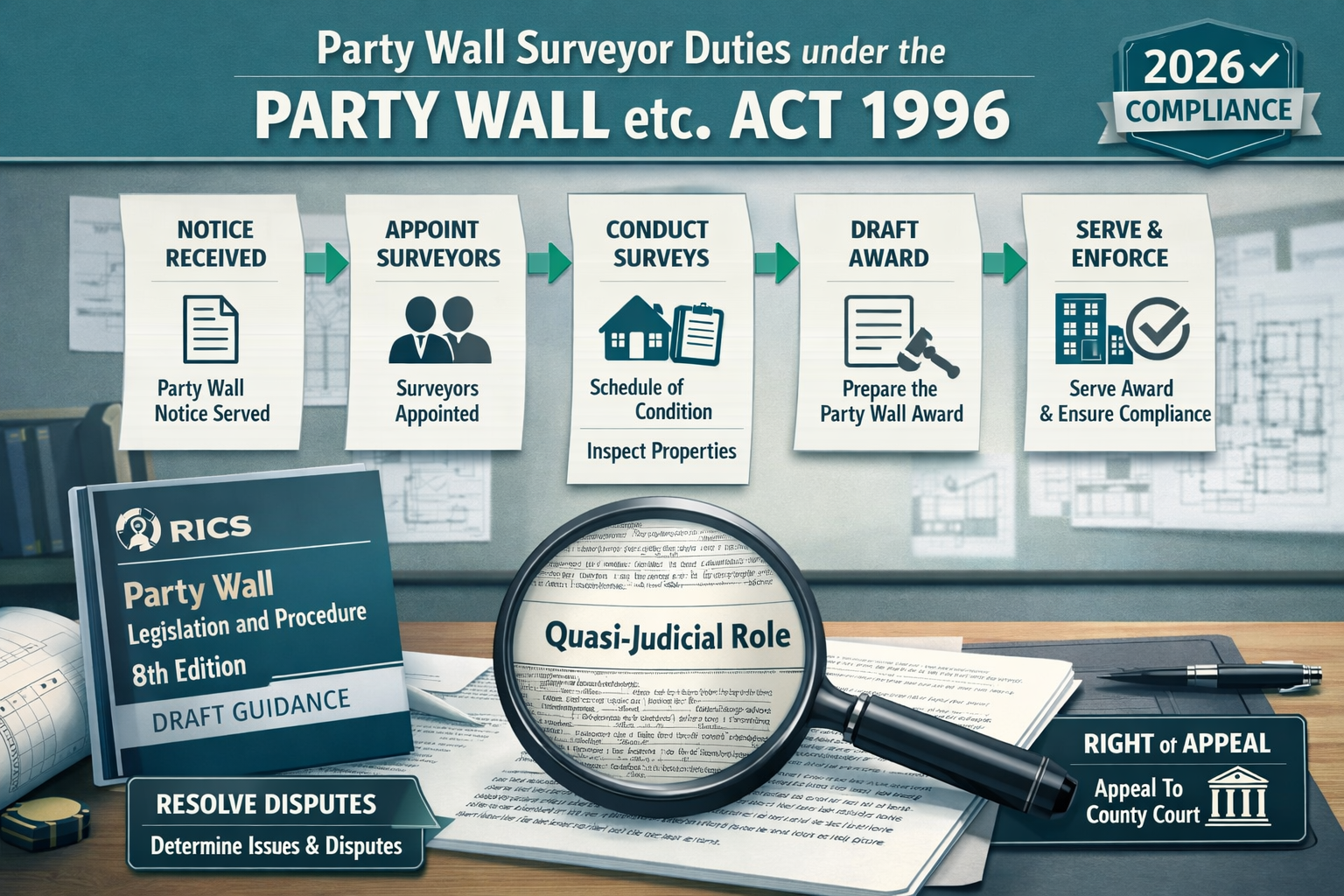
Before examining case law trends, it is worth grounding the discussion in the statutory framework. The Party Wall etc. Act 1996 creates a structured dispute resolution system that sits between civil litigation and informal negotiation. When a building owner proposes notifiable works — such as excavations near a boundary, alterations to a shared wall, or new structures on the line of junction — the Act requires formal party wall notices to be served on all adjoining owners.
If an adjoining owner dissents or fails to respond within the statutory period, a surveyor framework is triggered. The parties may each appoint their own surveyor, or they may agree on a single agreed surveyor. Crucially, an agreed surveyor must be independent — they cannot be the building owner’s own surveyor [3]. This independence requirement is not a formality; it is a cornerstone of the Act’s protective intent.
The surveyors then produce a party wall award: a legally binding document that governs how, when, and under what conditions the works may proceed. Understanding what a party wall award must contain is essential for both parties.
💬 Pull Quote: “The party wall award is not a courtesy document — it is a quasi-judicial determination that carries the weight of a court order and must be drafted with equivalent rigour.”
Evolving Duties of Party Wall Surveyors: Case Law Trends Favoring Adjoining Owners in 2026 Awards
The Quasi-Judicial Role Under the Microscope
The most significant legal development shaping the Evolving Duties of Party Wall Surveyors: Case Law Trends Favoring Adjoining Owners in 2026 Awards is the judicial confirmation — and expansion — of the surveyor’s quasi-judicial status. The Court of Appeal has established that party wall surveyors occupy a unique position: they are not advocates for the party who appointed them, but rather neutral decision-makers whose awards must withstand judicial review [1].
This has profound practical consequences:
| Surveyor Behaviour | Old Expectation | 2026 Legal Standard |
|---|---|---|
| Drafting award terms | Reflect appointing party’s wishes | Independently assess and balance both parties’ interests |
| Handling procedural errors | Often overlooked | Now grounds for adverse costs orders |
| Responding to court challenges | Rare involvement | Surveyors increasingly named as parties |
| Documenting decisions | Informal notes sufficient | Full reasoning expected in award text |
The shift is clear: surveyors who act as de facto advocates for the building owner are now legally exposed. Courts have shown willingness to make surveyors parties to county court actions when their awards contain procedural errors, and adverse costs orders against surveyors personally are no longer exceptional [1].
Why Adjoining Owners Are Winning More Challenges
Several converging factors explain why case law trends are increasingly favouring adjoining owners in 2026:
1. Stricter procedural standards
Courts are examining whether surveyors followed correct procedures before issuing awards. Errors in notice service, failure to allow adequate response time, or awards that exceed the surveyor’s jurisdiction are being treated as fatal flaws.
2. The schedule of condition requirement
Party wall agreements must include a schedule of condition that documents the state of adjoining properties before work begins [3]. When surveyors fail to prepare thorough schedules — or prepare them superficially — adjoining owners lose critical evidence. Courts are now treating inadequate schedules as a breach of the surveyor’s duty, strengthening damage claims after works complete. For adjoining owners, engaging a dedicated adjoining owner’s surveyor who prioritises this documentation is increasingly important.
3. The 14-day appeal window — and how courts are using it
Adjoining owners have 14 days from service of an award to appeal to the County Court [3]. While this window has always existed, courts in 2026 are applying it with greater flexibility in cases where surveyors failed to properly notify adjoining owners of their rights. This procedural generosity reflects judicial sympathy for adjoining owners who were not adequately informed.
4. Injunction powers
Adjoining owners can apply for an injunction to halt building works where proper notice has not been served [3]. The availability of this remedy — and courts’ willingness to grant it — creates a powerful deterrent against building owners who attempt to bypass the Act.
The RICS 8th Edition Consultation: What Changes Are Coming in 2026?
In April and May 2026, RICS launched a formal eight-week consultation on the draft 8th edition of its Party Wall Legislation and Procedure guidance [2]. This is the first major update to official guidance in this edition cycle, and its implications are significant.
The draft 8th edition explicitly aims to support competence and consistency in party wall professional work, establishing updated standards that RICS members must follow when the Party Wall etc. Act 1996 applies [2]. Key themes emerging from the consultation include:
- 🔍 Enhanced documentation requirements — surveyors must demonstrate their reasoning, not just their conclusions
- ⚖️ Clearer impartiality obligations — particularly for agreed surveyors navigating dual-party expectations
- 📋 Strengthened schedule of condition protocols — minimum content standards are expected to be formalised
- 🏗️ Updated guidance on new construction types — including telecom infrastructure, where new RICS compliance obligations took effect on 9 March 2026 [5]
Separately, new RICS compliance obligations for certain party wall work took effect on 9 March 2026, establishing updated protocols that professionals must follow for specific installation types [5]. This signals a broader regulatory direction: the profession is being asked to raise its standards across the board, not just in traditional residential contexts.
For surveyors practising across London — whether in East London, South London, North London, or West London — the 8th edition will set the benchmark against which their conduct is measured in any future court challenge.
Evolving Duties of Party Wall Surveyors: Case Law Trends Favoring Adjoining Owners in 2026 Awards — Best Practice for Surveyors
Balancing Impartiality With Client Duties
The central tension in party wall surveying has always been this: a surveyor is appointed by one party but must act in the interests of both. The Evolving Duties of Party Wall Surveyors: Case Law Trends Favoring Adjoining Owners in 2026 Awards makes this tension more acute — and more consequential — than at any previous point.
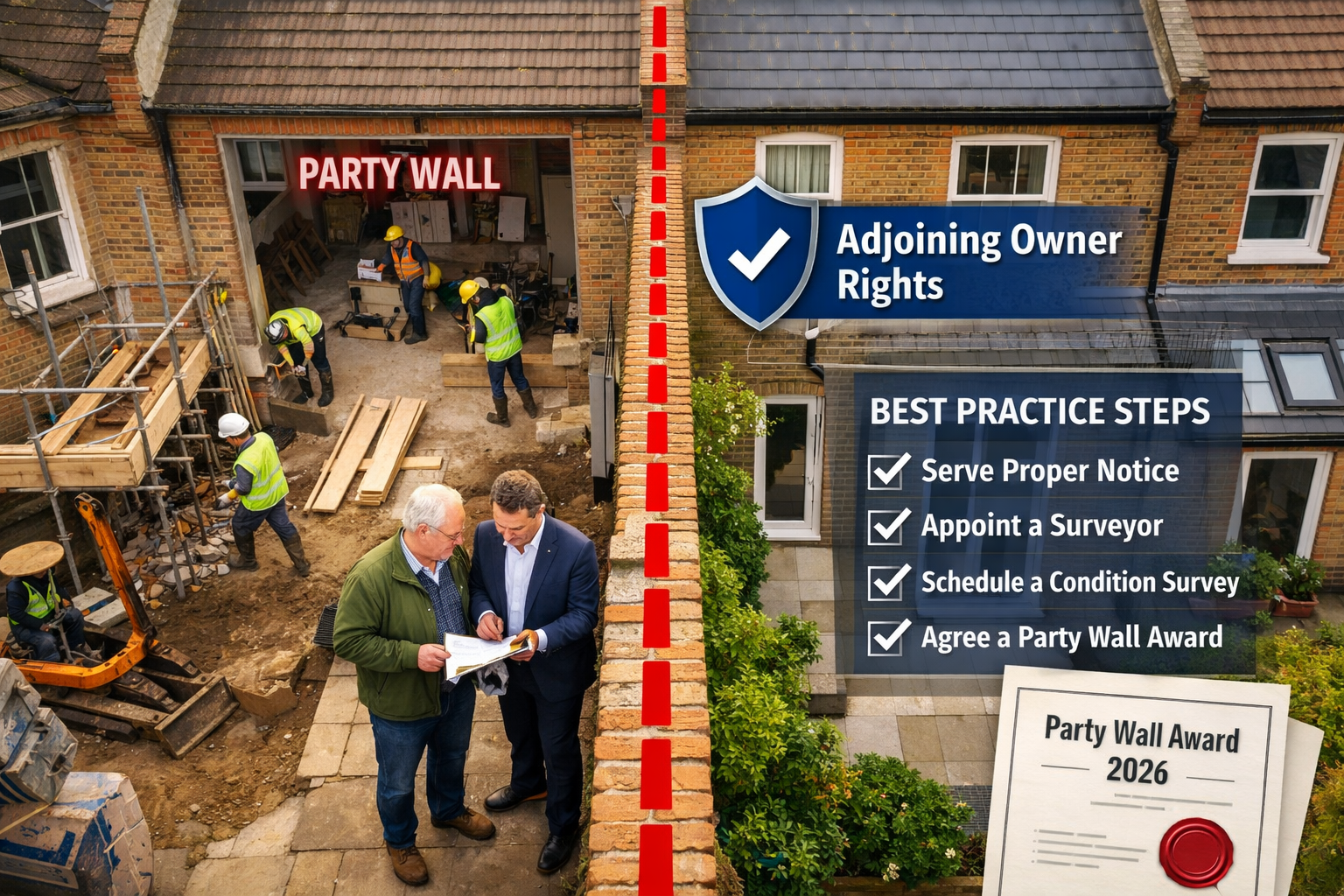
Here are the best practice principles that surveyors must embed into their practice in 2026:
✅ Draft Awards That Show Your Reasoning
Courts are no longer satisfied with awards that simply state outcomes. The quasi-judicial nature of the role [1] means that surveyors should document why each term was included, what evidence was considered, and how competing interests were balanced. This protects the surveyor if the award is challenged and demonstrates genuine impartiality.
✅ Prepare Comprehensive Schedules of Condition
A superficial schedule of condition is worse than useless — it creates a false sense of security. Surveyors should photograph every relevant surface, record existing cracks with reference markers, and note structural features that could be affected by the proposed works. This protects adjoining owners and insulates surveyors from later allegations of negligence. Learn more about schedule of condition requirements and best practice.
✅ Verify Notice Validity Before Proceeding
Awards issued following defective notices are increasingly being set aside by courts. Surveyors must independently verify that notices were correctly served, contained all required information, and were issued within the correct timeframe. Reviewing the party wall act notices guidance is a useful starting point for understanding what valid service requires.
✅ Communicate Proactively With All Parties
Adjoining owners who feel ignored or excluded are more likely to challenge awards. Regular, clear communication — explaining what the award contains, what rights the adjoining owner retains, and what the appeal process involves — reduces disputes and demonstrates the surveyor’s impartiality.
✅ Know When to Decline an Instruction
If a building owner is pressuring a surveyor to produce an award that does not fairly reflect the adjoining owner’s interests, the correct response is to decline the instruction — not to comply and hope the award is not challenged. The personal costs exposure identified in recent case law [1] makes this not just an ethical imperative but a commercial one.
What Adjoining Owners Should Know in 2026
The legal landscape in 2026 offers adjoining owners more protection than many realise. Here is a practical summary of key rights:
| Right | Detail |
|---|---|
| Appoint own surveyor | At the building owner’s expense in most cases |
| Receive schedule of condition | Before works begin — not after |
| Appeal any award | Within 14 days to the County Court [3] |
| Seek injunction | If proper notice was not served [3] |
| Claim compensation | For damage caused by notifiable works |
Adjoining owners who are unsure of their position should explore the dedicated adjoining owners guidance resource, which sets out the process in plain terms. It is also worth noting that the Act applies only in England and Wales — Scotland and Northern Ireland operate under different legal frameworks [3], so protections vary by jurisdiction.
One common misconception is that a party wall agreement can be reached without professional involvement. While this is technically possible in limited circumstances, the risks are significant — particularly when works are complex or relations between neighbours are strained. The guide on having a party wall agreement without a surveyor explains where this approach is viable and where it is not.
💬 Pull Quote: “An adjoining owner who understands their rights under the 1996 Act is an adjoining owner who is far less likely to suffer uncompensated damage — or to be steamrolled by an inadequate award.”
Jurisdiction, Costs, and the Practical Reality of 2026 Awards
Who Pays for Party Wall Surveyors?
In the vast majority of cases, the building owner bears the cost of the party wall process — including the fees of the adjoining owner’s surveyor. This is a significant protection that many adjoining owners do not know they have. Understanding the costs of party wall process helps adjoining owners engage confidently rather than avoiding the process for fear of expense.
However, costs can escalate when disputes are prolonged or when awards are challenged in court. Surveyors who draft clear, well-reasoned awards reduce the likelihood of costly litigation — which benefits all parties.
The Limits of Surveyor Jurisdiction
Party wall surveyors can only determine matters that fall within the scope of the Act. They cannot resolve boundary disputes, enforce planning conditions, or address matters unrelated to the notifiable works. Awards that stray beyond this jurisdiction are vulnerable to challenge — and this is another area where case law is tightening the boundaries of what surveyors may legitimately decide.
Conclusion: Actionable Next Steps for Surveyors and Adjoining Owners
The Evolving Duties of Party Wall Surveyors: Case Law Trends Favoring Adjoining Owners in 2026 Awards represents a genuine and accelerating shift in the legal landscape. Courts are applying higher standards to awards, RICS is raising the bar through its 8th edition consultation, and adjoining owners are increasingly aware of — and willing to exercise — their statutory rights.
For surveyors, the message is clear: the quasi-judicial nature of the role is not a metaphor. It carries real legal consequences. Surveyors who draft reasoned, procedurally sound awards; prepare thorough schedules of condition; and maintain genuine impartiality will be well-positioned to withstand scrutiny. Those who do not face personal costs exposure and reputational damage.
For adjoining owners, 2026 is a good year to know your rights. You are entitled to your own surveyor (usually at the building owner’s expense), a comprehensive schedule of condition, and the right to appeal any award within 14 days. Do not sign anything or agree to anything before understanding what the Act provides.
Actionable Next Steps ✅
- Surveyors: Review the RICS draft 8th edition consultation documents and submit feedback before the May 2026 deadline.
- Adjoining owners: Before any notifiable works begin next door, engage a qualified adjoining owner’s surveyor to protect your interests.
- Both parties: Ensure a thorough schedule of condition is prepared and agreed before works commence.
- Building owners: Engage a qualified building owner’s surveyor early to avoid procedural errors that could invalidate your award.
- All parties: If in doubt about the process, seek specialist advice — the cost of getting it right is always lower than the cost of getting it wrong.
References
[1] The Unique Role Of A Party Wall Surveyor – dwfgroup.com
[2] Rics Launches Consultation On Updated Party Wall Practice Guidance – rics.org
[3] Party Wall Agreement – hoa.org.uk
[4] Party Wall Surveys And Neighbour Disputes During 2026s Construction Uptick Rics Compliance Framework – https://nottinghillsurveyors.com/blog/party-wall-surveys-and-neighbour-disputes-during-2026s-construction-uptick-rics-compliance-framework
[5] Party Wall Surveys For 5g Mast Installations Rics Protocols Amid 2026 Telecom Infrastructure Expansion – https://nottinghillsurveyors.com/blog/party-wall-surveys-for-5g-mast-installations-rics-protocols-amid-2026-telecom-infrastructure-expansion
Speak to a RICS chartered party wall surveyor
Free initial consultation. Notices, awards and schedules of condition across London and nationwide.