Fewer than 1% of party wall surveyor appointments ever reach the stage where a Third Surveyor must step in — yet when they do, the costs, delays, and legal complexity can catch property owners completely off guard. Understanding Third Surveyor Awards in Party Wall Disputes: When, Why, and What Owners Should Expect in 2026 is no longer optional knowledge for homeowners planning extensions, loft conversions, or basement digs in London and beyond. [4]
With construction activity continuing to rise across the capital in 2026, neighbour disputes under the Party Wall etc. Act 1996 are becoming more common — and more contentious. [5] This guide breaks down exactly how the Third Surveyor mechanism works, what triggers it, how much it costs, and what both building owners and adjoining owners should realistically expect when the process reaches deadlock.
Key Takeaways 📌
- A Third Surveyor is only called upon when the two appointed surveyors cannot agree on a disputed matter — it is a last resort, not a routine step.
- Both surveyors must jointly nominate the Third Surveyor “forthwith” after their own appointments are confirmed — ideally before any dispute arises.
- The most common referrals involve surveyor fees or damage claims caused by construction works.
- The Third Surveyor’s determination is legally binding on all parties, with appeal rights limited to 14 days via County Court.
- Who initiates the referral often bears the cost, even if the Third Surveyor rules in their favour — making early resolution strategies critical.
What Is a Third Surveyor and When Are They Needed?
The Party Wall etc. Act 1996 creates a structured framework for resolving disputes between neighbouring property owners. When a building owner serves a valid party wall notice and the adjoining owner dissents, both parties appoint their own surveyor. These two surveyors are then expected to work together to produce a Party Wall Award — a legally binding document that governs how the works will be carried out.
But what happens when those two surveyors simply cannot agree?
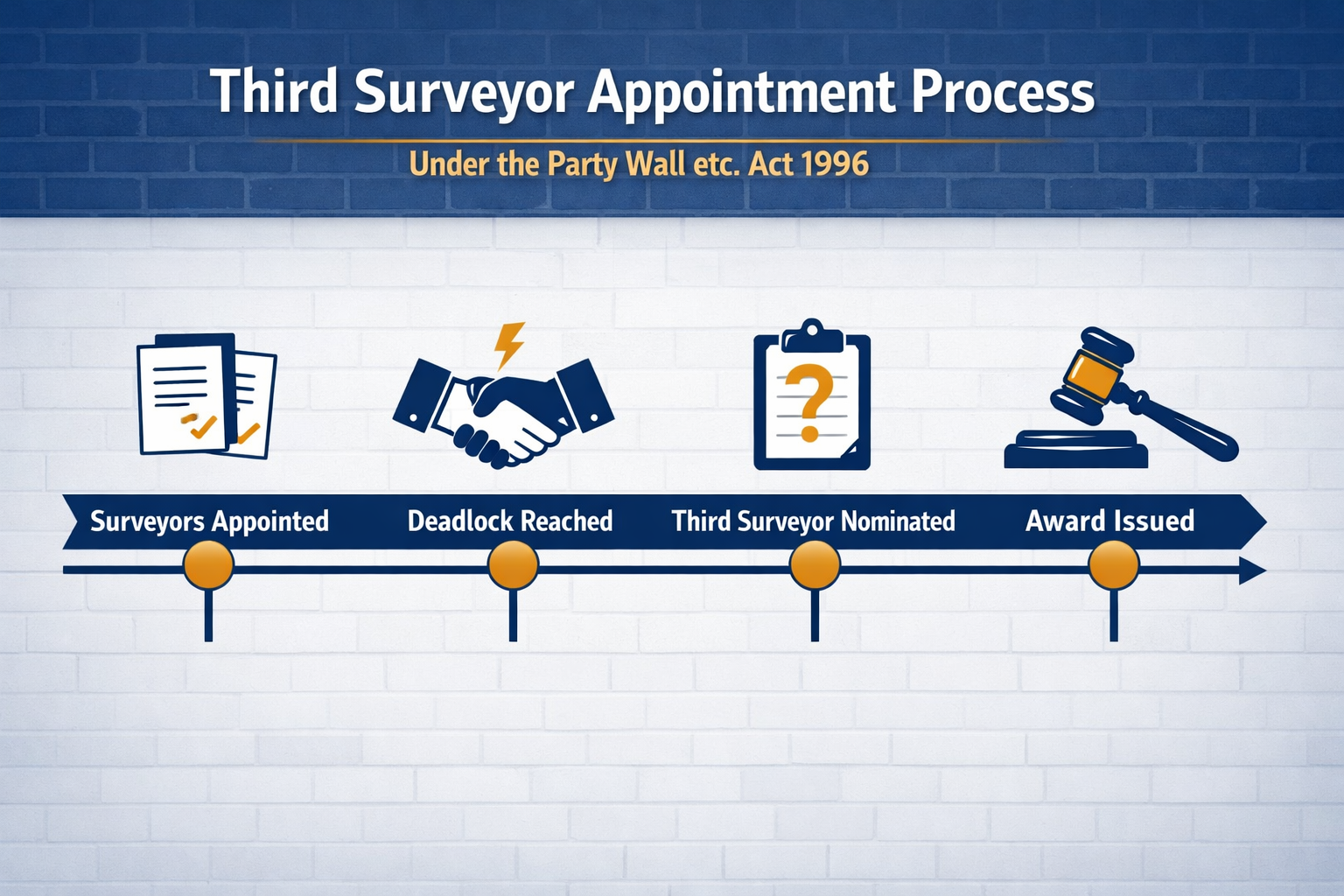
That is precisely the scenario the Third Surveyor mechanism was designed to address. Under Section 10(1)(b) of the Act, the two appointed surveyors are required to select a Third Surveyor “forthwith” — meaning immediately after their own appointments are confirmed. [2] This is not a reactive measure; it is a proactive safeguard built into the process from the very beginning.
💬 “The Third Surveyor is not an arbitrator chosen by the parties — they are a neutral expert selected jointly by the two appointed surveyors, specifically to resolve points of professional disagreement.”
The Selection Process: How Is a Third Surveyor Chosen?
The selection procedure follows a well-established competitive nomination process. [2] Typically:
- The building owner’s surveyor proposes three potential Third Surveyors.
- The adjoining owner’s surveyor either selects one from the list, requests additional names, or makes counter-suggestions.
- This back-and-forth continues until both surveyors agree on a single candidate.
This process succeeds in approximately 99% of cases without escalating further. [2] The chosen Third Surveyor must be a neutral, experienced party wall specialist — someone with no prior involvement in the dispute and no financial or professional ties to either party. [1]
Crucially, neither the building owner nor the adjoining owner has the right to choose the Third Surveyor themselves. The appointment rests entirely with the two appointed surveyors. [1]
When and Why Third Surveyor Awards Are Made: Key Triggers in 2026
Understanding Third Surveyor Awards in Party Wall Disputes: When, Why, and What Owners Should Expect in 2026 requires knowing exactly what types of disagreements trigger a referral. The Third Surveyor does not review the entire party wall matter from scratch — they rule only on the specific disputed points referred to them. [1]
Most Common Reasons for Third Surveyor Referrals
| Dispute Type | Description |
|---|---|
| Surveyor Fees | The adjoining owner’s surveyor proposes fees the building owner considers excessive |
| Damage Claims | Disagreement over whether damage was caused by the works and its extent |
| Award Terms | Specific conditions or restrictions within the draft Award that surveyors cannot agree on |
| Schedule of Condition | Disputes over the pre-works record of the adjoining property’s condition |
| Access Rights | Disagreement over the scope or timing of access to the adjoining property |
According to available data, the largest proportion of Third Surveyor referrals relate to either the fee proposed by the adjoining owner’s surveyor or damage caused by the works. [2] Fee disputes are particularly common in 2026 as construction costs — and professional fees — have risen significantly across London. [5]
The Review Process: What Does the Third Surveyor Actually Do?
Once referred, the Third Surveyor takes a structured approach:
- 📋 Reviews all written evidence submitted by both appointed surveyors
- 🏠 Conducts a site visit to assess the property and works firsthand
- 🗣️ Evaluates the arguments put forward by each surveyor
- ⚖️ Issues a binding determination on the specific disputed point(s)
This determination then enables the two appointed surveyors to finalise and issue the complete Party Wall Award. [1] The Third Surveyor does not replace the two surveyors — they resolve the blockage so the process can move forward.
Costs and Fee Allocation: What Owners Should Expect 💷
This is where many property owners are caught off guard. The cost implications of a Third Surveyor referral are significant and often misunderstood.
Key cost facts for 2026:
- The Third Surveyor can demand payment before issuing their award — unlike the two appointed surveyors. [2]
- They typically ask both owners to pay half upfront, with final allocation determined in the Award. [2]
- Who initiates the referral generally bears the cost — even if the Third Surveyor ultimately rules in their favour. [3]
- If the Third Surveyor does not fully agree with one party’s position, fees can be apportioned accordingly in the final Award. [2]
⚠️ Important: Initiating a Third Surveyor referral purely as a tactical move — to delay works or pressure the other party — can backfire significantly. The costs can be substantial, and the outcome is never guaranteed.
For a broader understanding of how party wall costs are structured, the costs of the party wall process page provides a useful overview of what owners typically pay at each stage.
What Owners Should Expect: Process, Timelines, and Appeal Rights
Understanding Third Surveyor Awards in Party Wall Disputes: When, Why, and What Owners Should Expect in 2026 means being realistic about timelines and legal rights once the process is triggered.
The Step-by-Step Process at a Glance
1. Two surveyors appointed → Third Surveyor nominated "forthwith"
2. Deadlock reached on specific point(s)
3. One or both surveyors refer the disputed matter to the Third Surveyor
4. Third Surveyor reviews evidence, visits site, evaluates arguments
5. Third Surveyor issues binding determination
6. Two surveyors finalise and serve the Party Wall Award
7. 14-day appeal window opens for County Court challenge
Timelines: How Long Does This Take?
There is no fixed statutory timeline for the Third Surveyor to issue their determination. However, in practice:
- Nomination of the Third Surveyor: Should happen immediately after the two surveyors are appointed — often within days. [2]
- Referral to the Third Surveyor: Can happen at any point during the Award preparation process when deadlock occurs.
- Determination timeline: Varies depending on the complexity of the dispute, the Third Surveyor’s availability, and whether a site visit is required. In straightforward fee disputes, a determination may be issued within a few weeks. Complex damage claims can take considerably longer.
Delays at this stage can hold up construction works entirely — a significant concern for building owners with contractors already engaged. This is one reason why understanding the party wall act process thoroughly before works begin is so important.
Appeal Rights: The 14-Day Window ⏱️
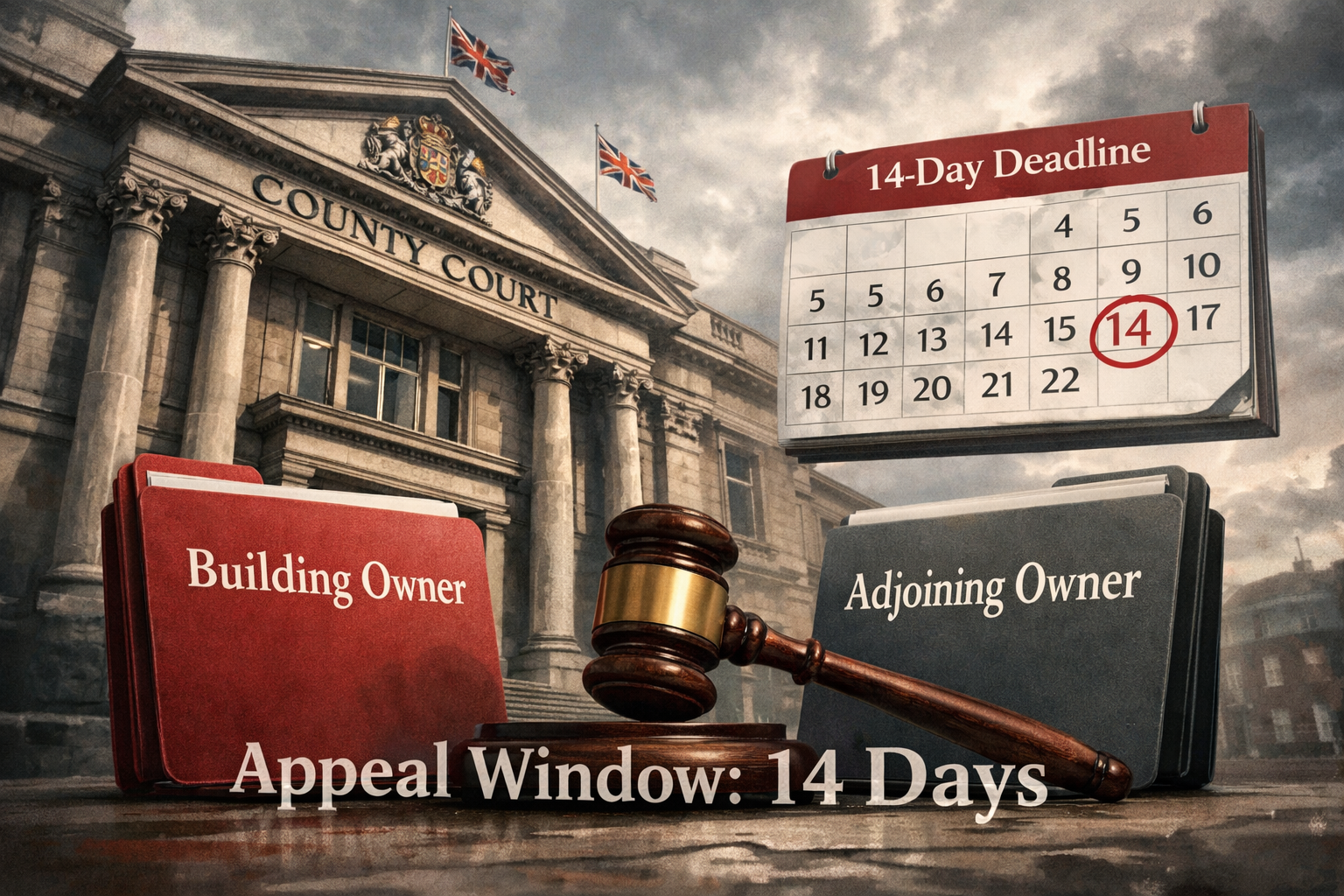
Once the Third Surveyor’s determination is served, all parties have a 14-day window to file an appeal with the County Court under Section 10(17) of the Act. [1] After this window closes, the determination becomes final and cannot be challenged.
However, appeals face a very high bar:
- Courts will generally only consider an appeal if the Third Surveyor acted beyond their powers or outside the scope of the Act. [1] [3]
- Appeals are rare, highly technical, and expensive. [1]
- Simply disagreeing with the outcome is not sufficient grounds for a successful appeal.
💬 “The Third Surveyor’s ruling on disputed matters is binding on all parties and the two appointed surveyors — it is not a starting point for further negotiation.” [1]
This is why choosing experienced, qualified surveyors from the outset matters so much. Both building owners and adjoining owners benefit from representation by surveyors who understand the Act deeply and can navigate disputes without escalating to Third Surveyor level unnecessarily.
How to Avoid Reaching Third Surveyor Stage: Prevention Strategies for 2026
The best outcome for all parties is one where the Third Surveyor is nominated but never actually called upon. Here are practical strategies to reduce the risk of escalation:
✅ For Building Owners
- Serve notices correctly and on time — errors in party wall notices are a leading cause of disputes. Review the guidance on party wall act notices before serving.
- Appoint an experienced surveyor who has a track record of reaching agreed Awards without escalation.
- Be realistic about surveyor fees — challenging reasonable adjoining owner surveyor fees is one of the most common triggers for Third Surveyor referrals. [2]
- Commission a thorough schedule of condition before works begin to reduce the risk of damage disputes later.
✅ For Adjoining Owners
- Engage promptly when a party wall notice is received — delays increase tension and reduce options.
- Appoint a qualified surveyor who will advocate effectively without being unnecessarily obstructive.
- Understand what the Act does and does not cover — unreasonable demands fall outside the Act’s scope and can lead to costly referrals.
- Consider whether agreement is possible — in some cases, a party wall agreement without a surveyor may be achievable for lower-risk works, though professional advice is always recommended.
The Role of Communication in Dispute Prevention 🤝
Many Third Surveyor referrals stem not from genuinely irreconcilable technical disagreements, but from a breakdown in professional communication between the two appointed surveyors. In 2026, experienced practitioners increasingly emphasise early dialogue, clear documentation of positions, and a willingness to compromise on non-essential points as the most effective tools for keeping disputes out of Third Surveyor territory. [4]
Frequently Asked Questions About Third Surveyor Awards
Q: Can the building owner or adjoining owner choose the Third Surveyor?
No. The Third Surveyor must be jointly selected by the two appointed surveyors. Neither property owner has a direct say in the selection. [1]
Q: Does the Third Surveyor review the entire Party Wall Award?
No. The Third Surveyor rules only on the specific disputed point(s) referred to them — not the entire Award. [1]
Q: What if one surveyor refuses to cooperate in nominating a Third Surveyor?
Section 10 of the Act provides mechanisms to address this, including the ability for the appointing party to make the appointment themselves in certain circumstances. This is an area where specialist legal advice may be needed.
Q: Can both surveyors refer a matter to the Third Surveyor, or only one?
Either surveyor can make the referral — it does not require both to agree to do so. [3]
Q: Is the Third Surveyor’s fee always paid by the losing party?
Not necessarily. The Award determines fee allocation, and if the Third Surveyor does not fully agree with either party, fees may be apportioned. The party who initiates the referral often bears the cost regardless of outcome. [2] [3]
Conclusion: Navigating Third Surveyor Awards Confidently in 2026
Third Surveyor Awards represent the Act’s built-in safety valve — a mechanism that ensures party wall disputes can always be resolved, even when professional agreement proves impossible. But reaching that stage carries real costs, delays, and uncertainty for both building owners and adjoining owners.
The most important takeaway for 2026 is this: prevention is always cheaper than resolution. Investing in experienced, qualified surveyors from the start — professionals who understand both the technical and interpersonal dimensions of party wall work — dramatically reduces the likelihood of ever needing a Third Surveyor to intervene.
Actionable Next Steps 🚀
- Before serving notice: Familiarise yourself with the types of party wall works covered by the Act to ensure your project is properly within scope.
- When appointing a surveyor: Ask specifically about their experience with contested Awards and Third Surveyor referrals.
- If a dispute arises: Seek advice early — do not wait until positions have hardened.
- If a Third Surveyor is called: Understand the cost implications upfront and ensure your surveyor has submitted clear, well-evidenced arguments.
- After a determination: Note the 14-day appeal window and take legal advice immediately if there are genuine grounds to challenge.
Whether you are a building owner planning works or an adjoining owner seeking to protect your property, understanding the full party wall process — including the Third Surveyor mechanism — puts you in a far stronger position. For tailored guidance, contact a specialist party wall surveyor who can advise on your specific situation in 2026.
References
[1] Appointing The Third Surveyor When Disagreements Arise And Why This Costly Step Is Necessary – partywallslimited.com
[2] Role Of The Third Surveyor In Party Wall Matters – taylor-mitchell.co.uk
[3] Disputing Party Wall Third Surveyor – stokemont.com
[4] Party Wall Surveys And Neighbour Disputes During 2026s Construction Uptick Rics Compliance Framework – https://nottinghillsurveyors.com/blog/party-wall-surveys-and-neighbour-disputes-during-2026s-construction-uptick-rics-compliance-framework
[5] Party Wall Agreement London 2026 – mayfairstudio.co.uk
Speak to a RICS chartered party wall surveyor
Free initial consultation. Notices, awards and schedules of condition across London and nationwide.