
Only 38% of homeowners planning a basement conversion in 2026 correctly identify which party wall notices apply to their project before breaking ground — a gap that leads to costly disputes, injunctions, and structural damage claims that could have been avoided entirely. Understanding Basement Extensions and Party Wall Notices: Surveyor Protocols for Excavation Safeguards Near Shared Boundaries is not just a legal formality; it is the single most important step in protecting both the building owner and their neighbours during one of the highest-risk construction activities in urban settings.
Basement excavation near shared boundaries triggers multiple overlapping obligations under the Party Wall etc. Act 1996. Each obligation carries its own notice type, timeline, and surveyor protocol. Getting any one of them wrong can halt a project mid-dig.
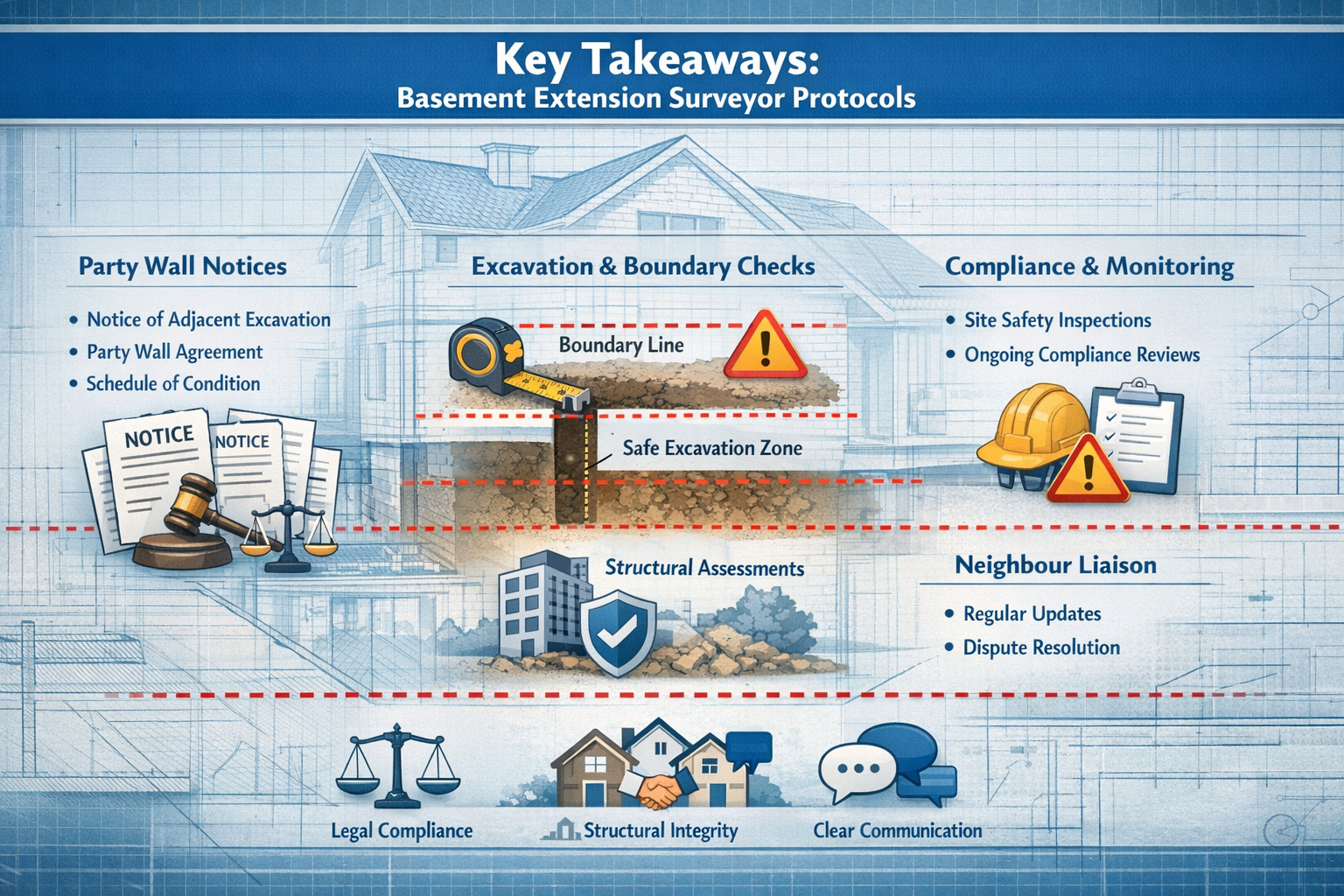
Key Takeaways 📋
- Three separate notice types may apply to a basement project: Section 1 (Line of Junction), Section 2 (Party Structure), and Section 6 (Adjacent Excavation) — each with different trigger conditions and notice periods.
- Section 6 notices are the most commonly misunderstood: they apply when excavation reaches within 3.0m of a neighbour’s foundations (or 6.0m for deep pile foundations).
- A schedule of condition for basement and underpinning works must cover all floors of the adjoining property — a significantly wider scope than for standard extensions.
- Vibration monitoring and temporary works provisions must be explicitly written into the party wall award for excavation projects.
- In London in 2026, surveyor fees typically range from £750–£1,800 per neighbour, and the full process takes 2–4 months [4].
Understanding the Three Notice Types for Basement Projects
Not all basement extensions trigger the same notice. The type of notice — and the statutory timeline attached to it — depends on the precise relationship between the proposed works and the shared boundary or party structure.
Section 1: Line of Junction Notice
A Line of Junction Notice under Section 1 of the Act is required when a basement extension pushes beyond the original footprint of the building to a shared boundary line. Common examples include:
- Light wells cut into the rear garden adjacent to the boundary
- Rear garden basement extensions extending toward a shared fence or wall
The statutory notice period is one month [1]. This notice is often overlooked because homeowners focus on the party wall itself and forget that any new build up to or astride the boundary line also triggers obligations. For a clear breakdown of how boundary walls interact with party wall law, see this guide on boundary wall rules and the difference between party fence walls and boundary walls.
Section 2: Party Structure Notice
A Party Structure Notice under Section 2 is mandatory for semi-detached and terraced properties where basement works involve:
- Underpinning the party wall
- Cutting into the party wall to insert beams or needle supports
- Exposing the party wall foundations
The statutory notice period is two months [1][2]. Critically, if the property is divided into flats, the notice must be served on the specific leaseholder whose demise includes the section of party wall being affected — not simply the freeholder [1]. For example, if a beam pocket is being cut into the ground-floor section of a party wall, the ground-floor flat owner must receive the notice directly.
💡 Pull Quote: “Serving a Section 2 notice on the wrong party — such as the freeholder when a ground-floor leaseholder’s wall is affected — can invalidate the entire notice process and delay a project by months.”
For a detailed explanation of how to serve this notice correctly, the Party Structure Notice guide is an essential reference.
Section 6: Adjacent Excavation Notice — The Most Complex Trigger
Section 6 is the notice type most frequently misunderstood and misapplied in basement projects. It is triggered when:
| Condition | Distance Threshold |
|---|---|
| Excavation near standard strip/pad foundations | Within 3.0 metres of a neighbouring structure |
| Excavation near deep foundations (e.g., augured piles) | Within 6.0 metres of a neighbouring structure |
| Excavation depth | Must exceed the base of the neighbour’s foundations |
The notice period is one month [1]. For stacked flats sharing common foundations, the Section 6 notice must be served on all leaseholders whose flats sit above the foundations being undermined — not just the ground-floor occupier [1].
Section 6 in Practice: Vibration Monitoring, Temporary Works, and Award Provisions
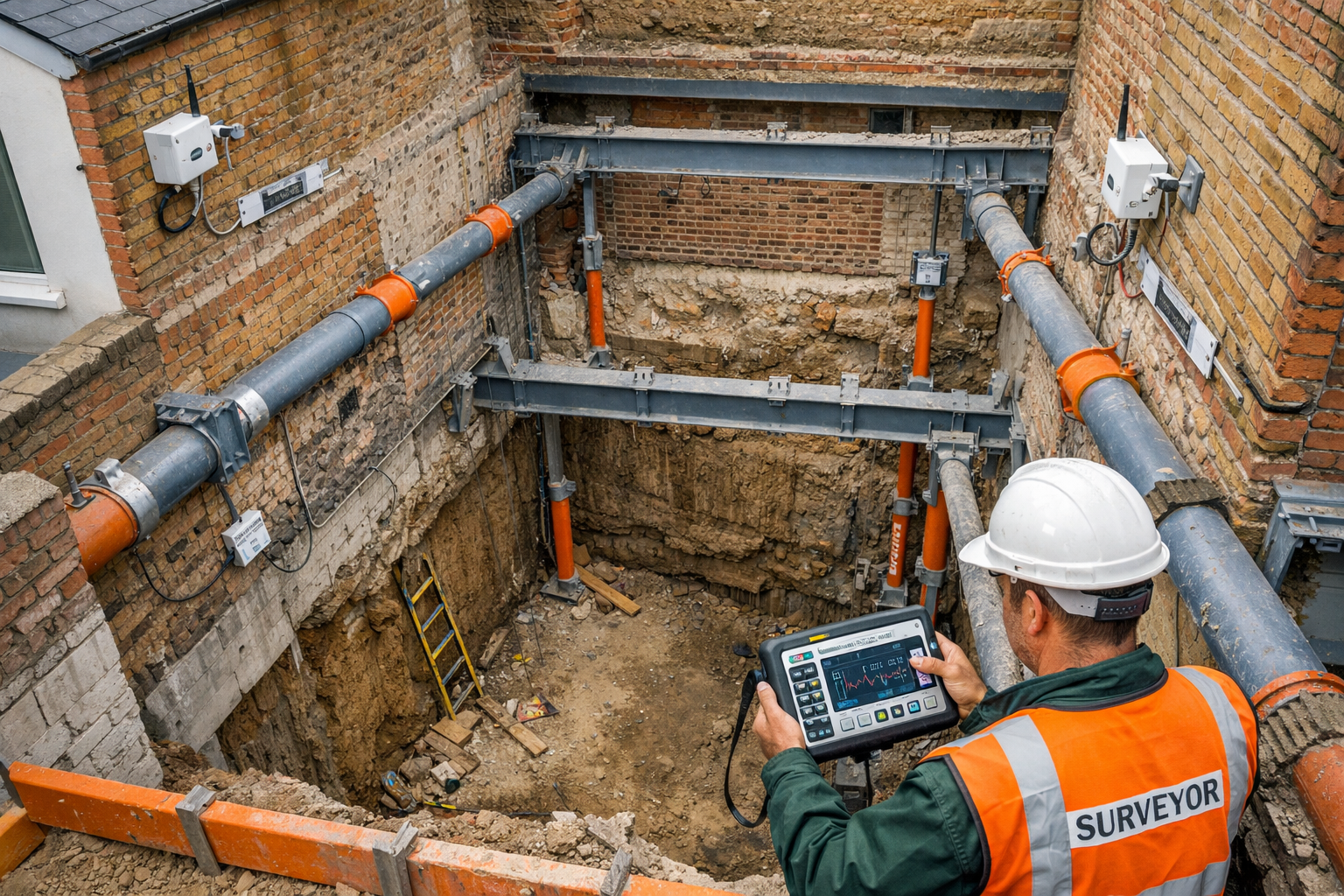
This is where Basement Extensions and Party Wall Notices: Surveyor Protocols for Excavation Safeguards Near Shared Boundaries becomes most technically demanding. A Section 6 notice alone is not sufficient protection. The party wall award — the legally binding document produced by the appointed surveyor(s) — must include specific provisions tailored to the risks of deep excavation.
What Must Be Written Into the Award
A well-drafted party wall award for a basement or underpinning project should include all of the following:
🔧 Temporary Works Specifications
- Details of any temporary propping, needling, or shoring to be installed before and during excavation
- Approval of the method statement from the structural engineer
- Requirements for underpinning sequences (e.g., bay-by-bay underpinning with maximum bay widths specified)
📡 Vibration Monitoring
- Installation of vibration monitoring sensors on the adjoining structure before works begin
- Defined peak particle velocity (PPV) thresholds — typically following BS 7385 or BS 5228 guidelines — at which works must pause
- Frequency of data logging (often continuous during active excavation phases)
- Obligation to share monitoring data with the adjoining owner’s surveyor on request
🏗️ Working Hours and Access
- Restricted working hours (commonly 8:00am–6:00pm Monday to Friday; 8:00am–1:00pm Saturday; no Sunday working)
- Defined access arrangements for surveyors to inspect works in progress [2]
- Dust and noise mitigation measures
⚠️ Damage Notification Protocol
- A clear procedure for reporting any cracking or movement observed in the adjoining property during works
- Obligation to halt works if structural movement exceeds agreed thresholds
The Building Owner’s Statutory Duty
Under Section 11(8) of the Party Wall etc. Act 1996, building owners carry a statutory duty to make good any damage caused by underpinning or adjacent excavation [1]. Adjoining owners can request payment in lieu of physical repairs — meaning the building owner pays the cost of rectification rather than carrying out the work themselves.
It is worth noting that for basement and underpinning projects, minor damage (BRE Damage Category 0–1) — hairline cracking — is often considered an inevitable consequence of the works [1]. The award should acknowledge this and set a clear threshold above which formal compensation becomes payable.
For building owners who want to understand their full obligations before serving notice, the building owner’s surveyor guide provides a practical overview of the process.
Schedule of Condition: Why Basement Projects Require Extended Scope
A schedule of condition is a photographic and written record of the state of an adjoining property before works begin. It serves as the baseline evidence in any future dispute about whether the building owner’s works caused a particular crack or defect [2].
For standard loft conversions or rear extensions, a schedule of condition typically covers a 3–4 metre radius from the works. For basement excavation and underpinning projects, the scope is fundamentally different:
💡 Pull Quote: “For basement and underpinning works, the schedule of condition must be doubled in measurement scope and extended to cover all floors of the adjoining property — not just the ground floor or the area immediately adjacent to the works.” [1]
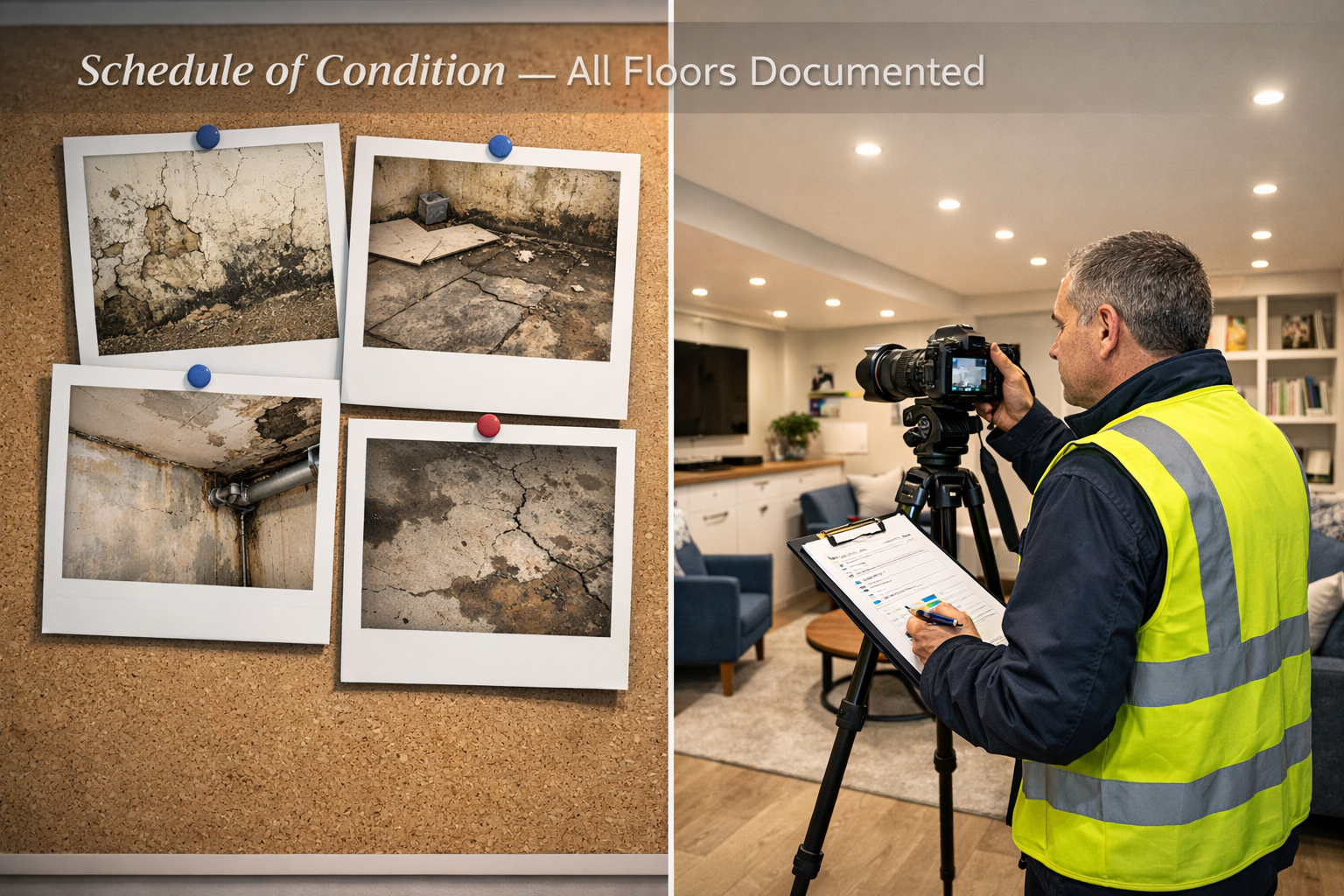
What a Comprehensive Basement Schedule of Condition Covers
| Area | What Is Documented |
|---|---|
| All floors (basement to roof) | Cracks, settlement, plasterwork condition |
| External walls | Existing cracking, pointing condition, render |
| Internal walls and ceilings | Hairline cracks, staining, movement joints |
| Floors | Levelness, existing damage, screed condition |
| Drainage | CCTV survey of shared or adjacent drains recommended |
| Garden and boundary structures | Condition of fences, walls, paving |
This extended scope matters enormously. Subsidence and vibration effects from deep excavation can manifest several floors above the excavation level and at distances greater than those seen with above-ground construction. A schedule that only covers the ground floor will leave both parties exposed in a dispute.
For adjoining owners who want to understand their rights and what a proper schedule should include, the schedule of condition page is a valuable resource. Adjoining owners also have the right to appoint their own surveyor — details of which are covered in the adjoining owner’s surveyor guide.
Practical Tips for 2026 Urban Basement Projects: Minimising Neighbour Disruption
London’s construction activity in 2026 continues to intensify, with basement conversions remaining one of the most sought-after ways to add space in high-density areas. The following practical steps help building owners manage the process efficiently while keeping neighbour relationships intact.
Before Serving Notice
✅ Commission a structural engineer’s report first. Understand the proposed foundation depth, soil conditions, and proximity to neighbouring foundations before determining which notices apply. This prevents serving the wrong notice type.
✅ Identify all parties who need to receive notice. In leasehold buildings, this may include multiple flat owners, freeholders, and mortgagees. Missing a single party can invalidate the process.
✅ Allow realistic timelines. With a two-month notice period for Section 2 works and a one-month period for Section 6, plus time for surveyor appointment and award drafting, the full process realistically takes 2–4 months before a spade enters the ground [4].
✅ Engage a specialist party wall surveyor early. For basement projects specifically, experience with underpinning and excavation awards is essential. A surveyor unfamiliar with vibration monitoring thresholds or temporary works specifications will produce an inadequate award.
During the Notice Period
✅ Open a dialogue with neighbours. A neighbour who understands what is happening and feels informed is far less likely to dissent or appoint an aggressive surveyor. Early communication reduces costs for everyone.
✅ Prepare a detailed method statement. Surveyors on both sides will want to review the structural engineer’s proposed excavation sequence. Having this ready accelerates the award drafting process.
✅ Consider the costs. In London in 2026, surveyor fees range from £750–£1,800 per neighbour [4]. For projects with multiple adjoining owners, costs can accumulate quickly. For guidance on managing these costs, see how to keep party wall costs down.
During Works
✅ Do not deviate from the agreed method statement without consulting the party wall surveyor. Changes to excavation sequences or propping arrangements mid-project can void the protections offered by the award.
✅ Keep vibration monitoring logs up to date and share them proactively with the adjoining owner’s surveyor. Transparency builds trust and reduces the risk of emergency injunctions.
✅ Photograph any new cracking in the adjoining property immediately and notify all parties. Prompt reporting demonstrates good faith and prevents minor issues from escalating.
Serving Notices Correctly: A Checklist for Building Owners
Getting the notice right from the start is critical. Use this checklist before serving any notice for a basement project:
- Confirm the type(s) of notice required (Section 1, 2, and/or 6)
- Identify all adjoining owners, including leaseholders and freeholders
- Confirm notice periods: 1 month (Sections 1 & 6) or 2 months (Section 2)
- Include all required information: description of works, start date, structural drawings
- Serve notice in writing (hand delivery, recorded post, or agreed electronic means)
- Record the date of service and keep proof of delivery
- Await response within 14 days; if no response or dissent, appoint surveyors
For a full overview of the notice process, the party wall notices guide covers all notice types and how to respond to them. Building owners can also review the Party Wall etc. Act 1996 overview for the statutory framework underpinning all of these obligations.
Conclusion: Actionable Next Steps for a Safe, Compliant Basement Project
Basement Extensions and Party Wall Notices: Surveyor Protocols for Excavation Safeguards Near Shared Boundaries is a topic that rewards careful preparation. The consequences of getting it wrong — injunctions, structural damage claims, neighbour disputes, and project delays — are far more costly than the investment in proper professional guidance from the outset.
Actionable Next Steps
- Engage a structural engineer to confirm excavation depth and proximity to neighbouring foundations before determining notice requirements.
- Identify all notice types that apply to the specific project — do not assume a single notice covers all obligations.
- Appoint an experienced party wall surveyor with a proven track record in basement and underpinning awards, not just standard extensions.
- Serve notices with the correct statutory periods and to all relevant parties, including leaseholders in divided buildings.
- Insist on a comprehensive schedule of condition covering all floors of every adjoining property at risk.
- Ensure the party wall award explicitly addresses vibration monitoring thresholds, temporary works specifications, and the damage notification protocol.
- Maintain open communication with neighbours throughout the project — it is the single most effective way to prevent disputes from escalating.
For building owners ready to begin the process, the building owners section provides a clear starting point, and the team at Party Wall Surveyor London can be reached directly through the contact page.
References
[1] Basements And The Party Wall Act – peterbarry.co.uk
[2] Party Wall Agreement – hoa.org.uk
[3] Party Wall Surveys And Neighbour Disputes During 2026s Construction Uptick Rics Compliance Framework – https://nottinghillsurveyors.com/blog/party-wall-surveys-and-neighbour-disputes-during-2026s-construction-uptick-rics-compliance-framework
[4] Party Wall Agreement London 2026 – mayfairstudio.co.uk
Speak to a RICS chartered party wall surveyor
Free initial consultation. Notices, awards and schedules of condition across London and nationwide.